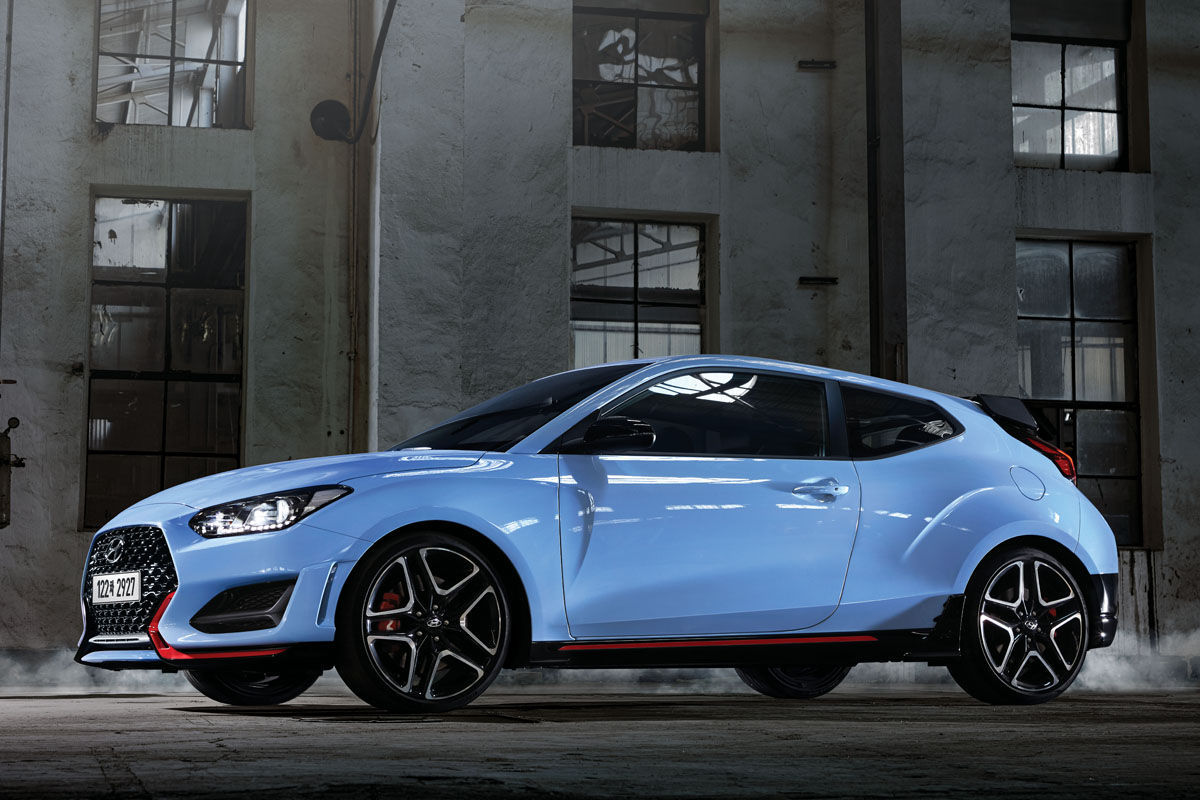
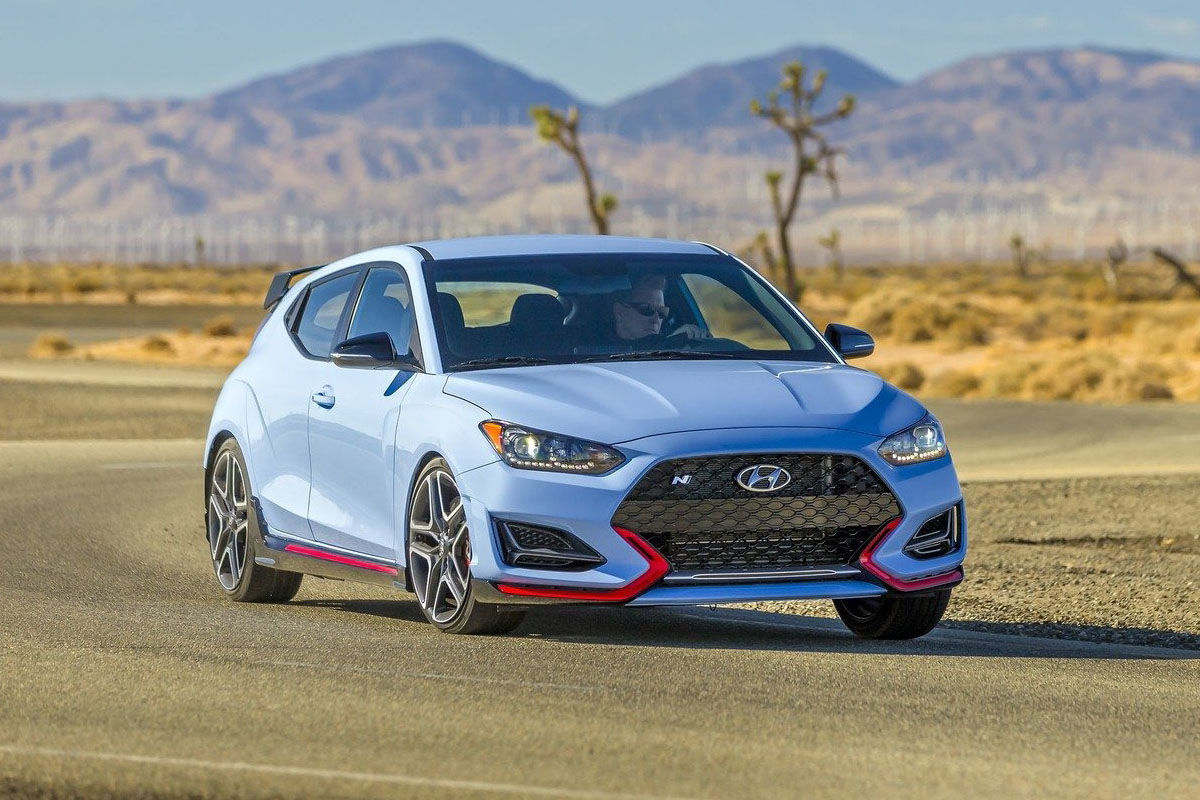
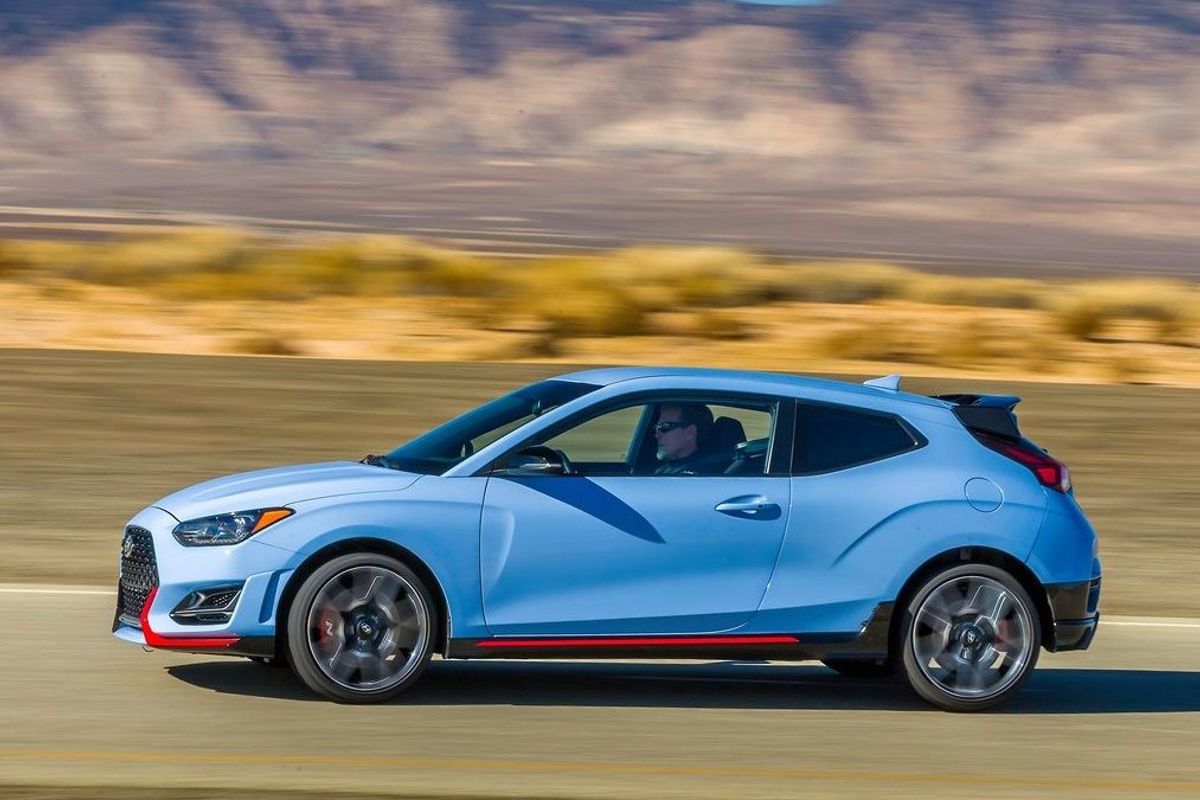
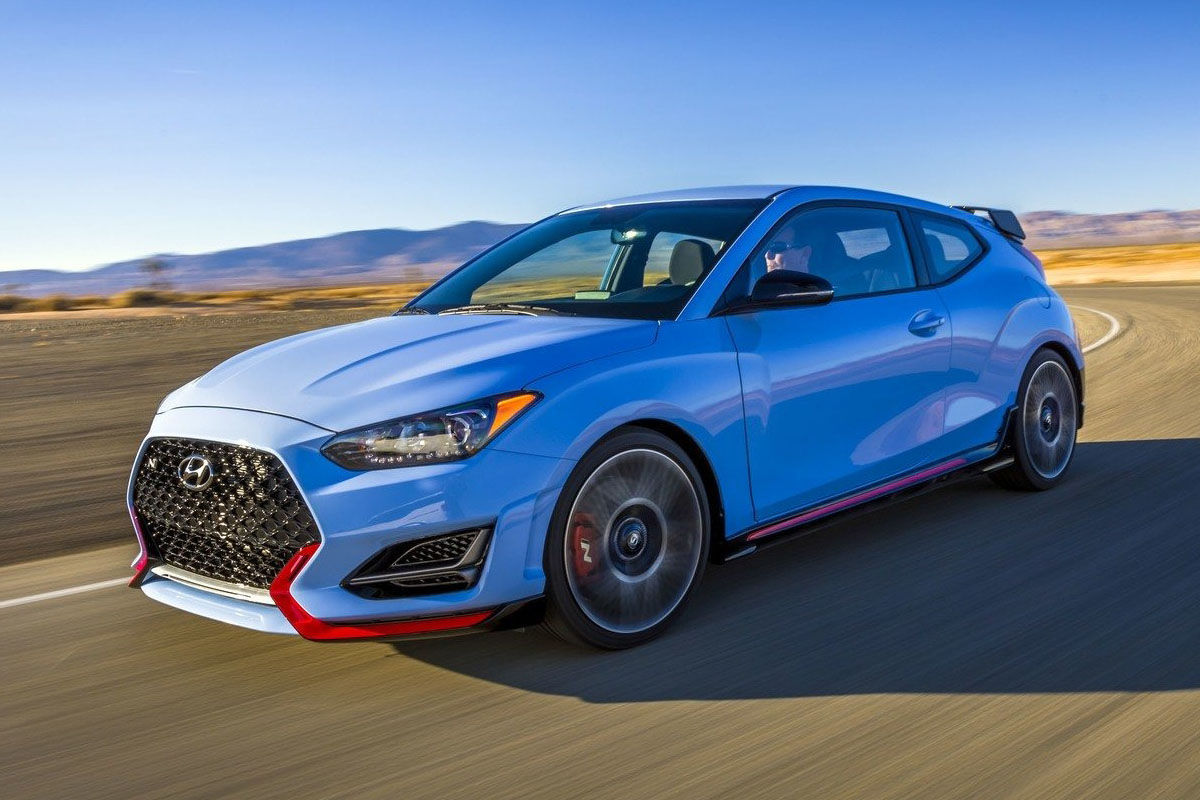
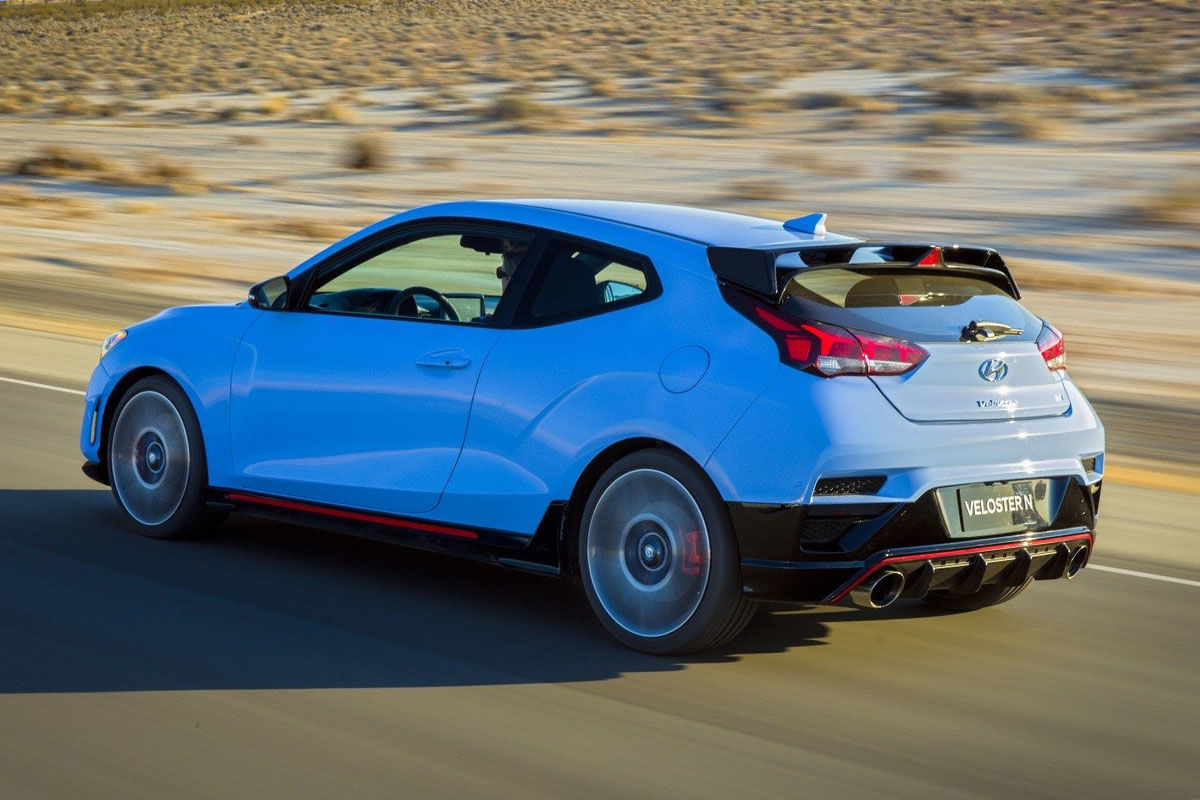
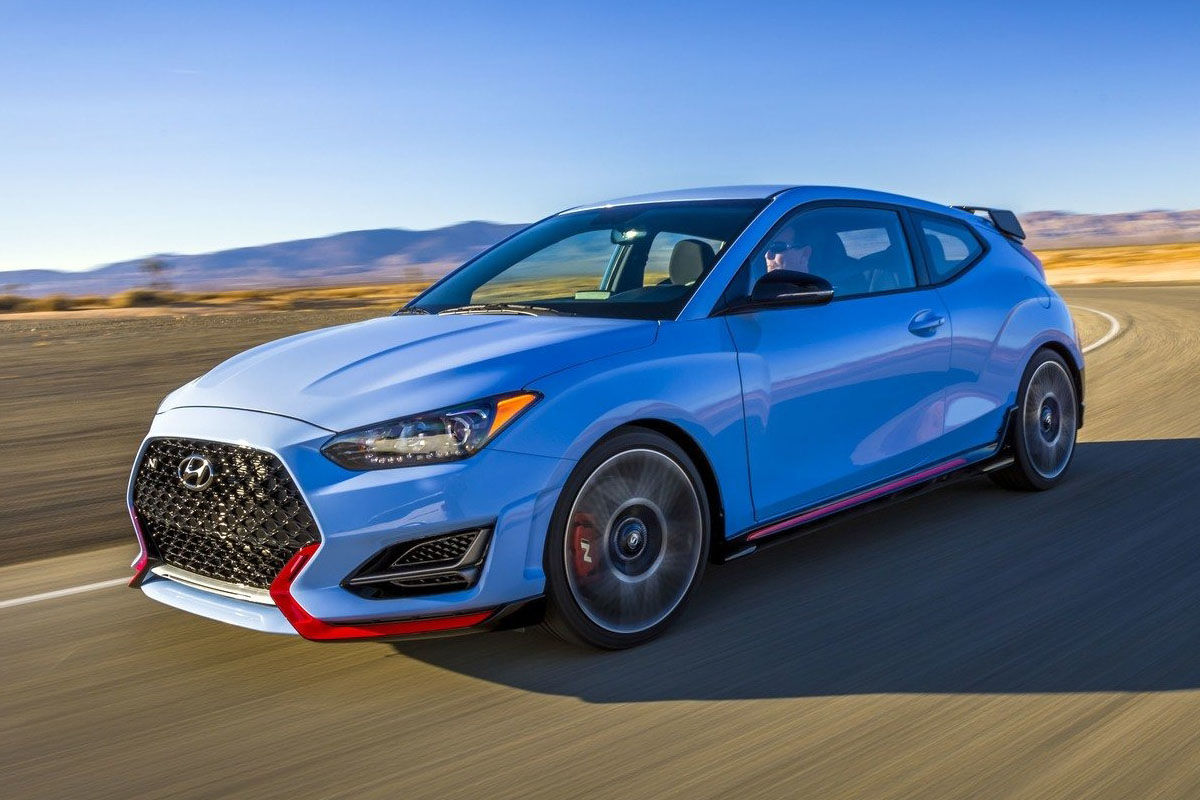
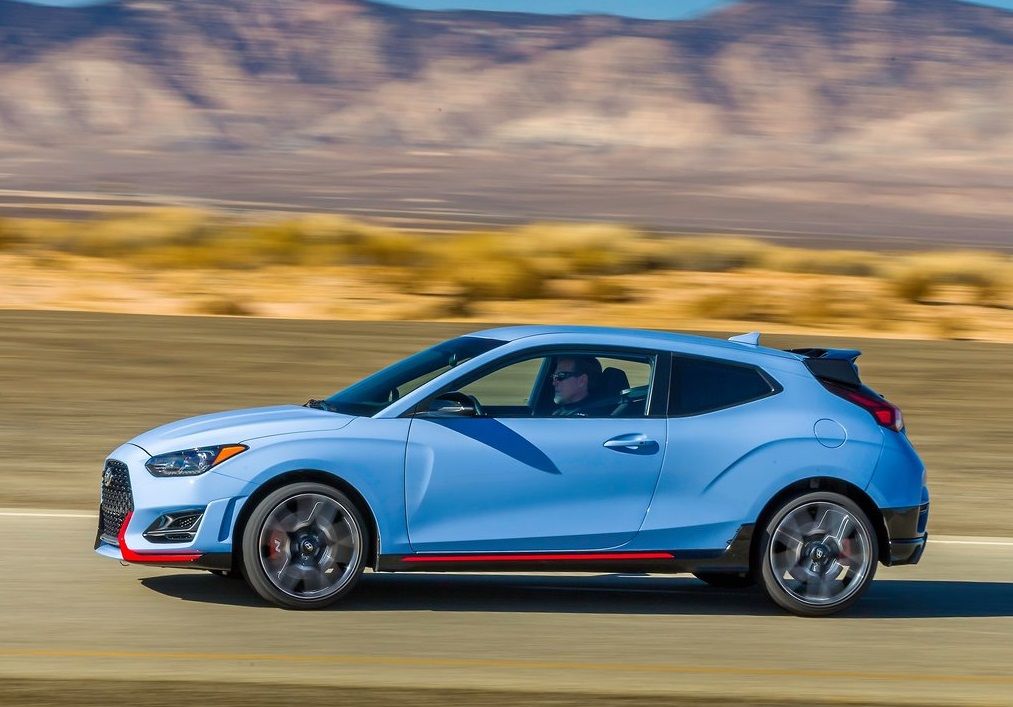
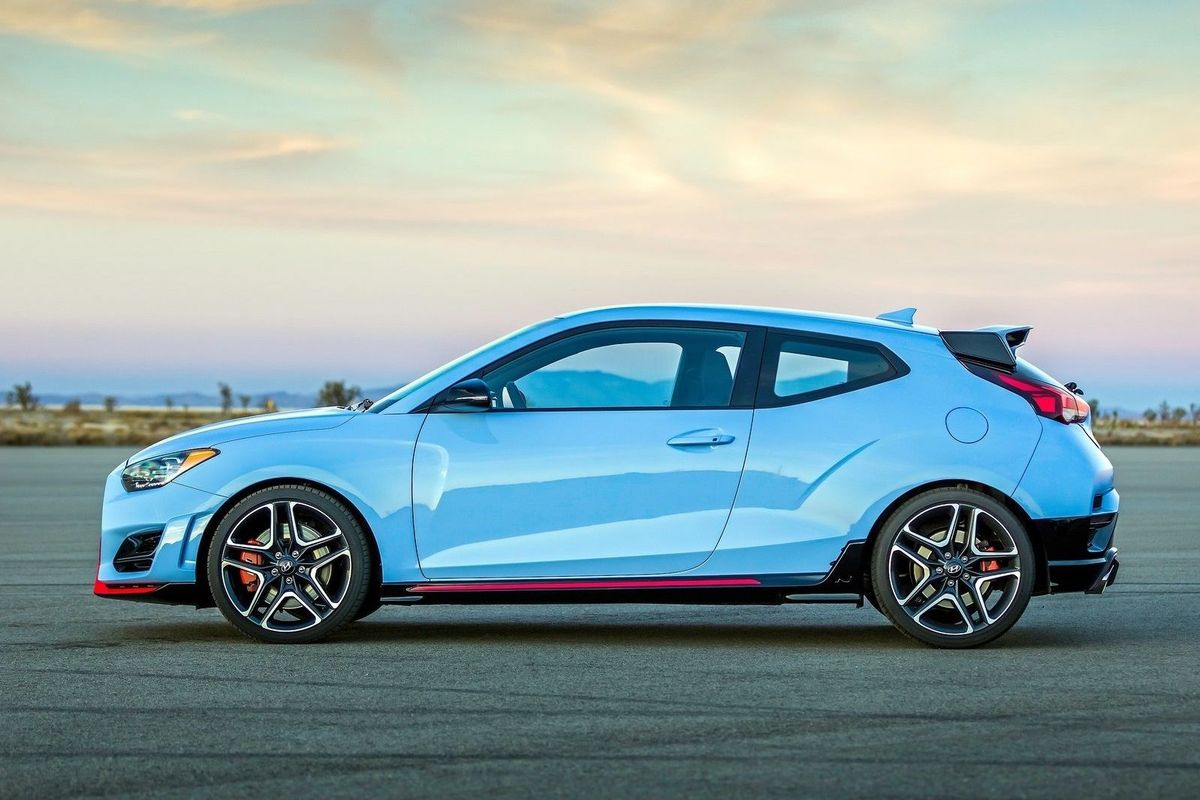
The hot-hatch market is dominated by models with dual-clutch transmissions; by launching its Veloster N with an 8-speed dual-clutch automatic and an i30 N manual-beating 377 Nm of torque, Hyundai is widening the appeal of its N derivatives.
It seemed everyone but Honda (Civic Type R) and Hyundai (i30 N) got the memo… A dual-clutch (or direct-shift) automatic is the transmission of choice in the hot-hatch market; in fact, Volkswagen no longer offers its iconic Golf GTI model with a 6-speed manual in South Africa; the 8th generation (scheduled to arrive here before the end of 2020) probably won't be available with a "stick-shift" either.
As opposed to its i30 sibling, the Veloster N was introduced at the same as the rest of the derivatives in the 2nd-generation range.
Hyundai offered the previous generation of the Veloster in South Africa (in naturally aspirated and turbocharged 1.6-litre guises) and the current (2nd-generation) Veloster remains under consideration for the local market. However, the N derivative is not produced for right-hand-drive markets, but even if it was, it’s not as strong a proposition as its i30 N sibling due to its quirky 4-door packaging.
What is significant about the self-shifting Veloster N, however, is the fact that it comes equipped with Hyundai’s new N DCT – an 8-speed dual-clutch automatic transmission with a wet (oil-lubricated) configuration – as opposed to the 7-speed dual-clutch setup of the now discontinued Elantra 1.6 Turbo Elite Sport. And, of course, the i30 N will ultimately be available with that transmission as well.
The i30 N has only been available as a 6-speed manual thus far, which has pleased traditionalists, but arguably limited its appeal.
Like its (thus far manual-equipped) i30 N sibling, the Veloster N produces peak power of 205 kW (okay, the local model is rated at 202 kW, but that's close enough), but its peak torque figure is 377 Nm, which is notably higher than the former’s 353 Nm (claimed).
The cars have the same 2.0-litre 4-cylinder turbopetrol motor, so where does the newcomer’s extra 24 Nm come from? Well, as a demonstration that super-serious Hyundai’s burgeoning N Division is now trying its hand at hot-hatch marketing ballyhoo (to be fair, as so many other manufacturers have – and still do) the answer is: N Grin Shift (NGS).
The Veloster N is said to charge from 0 to 100 kph in 5.5 seconds in manual guise, so the N DCT version should be slightly faster.
That’s right, apart from being additionally equipped with N Power Shift (NPS) and N Track Sense Shift (NTS) modes, the new transmission’s NGS technology allows the Veloster N’s engine to deliver an extra 24 Nm on overboost in 20-second bursts.
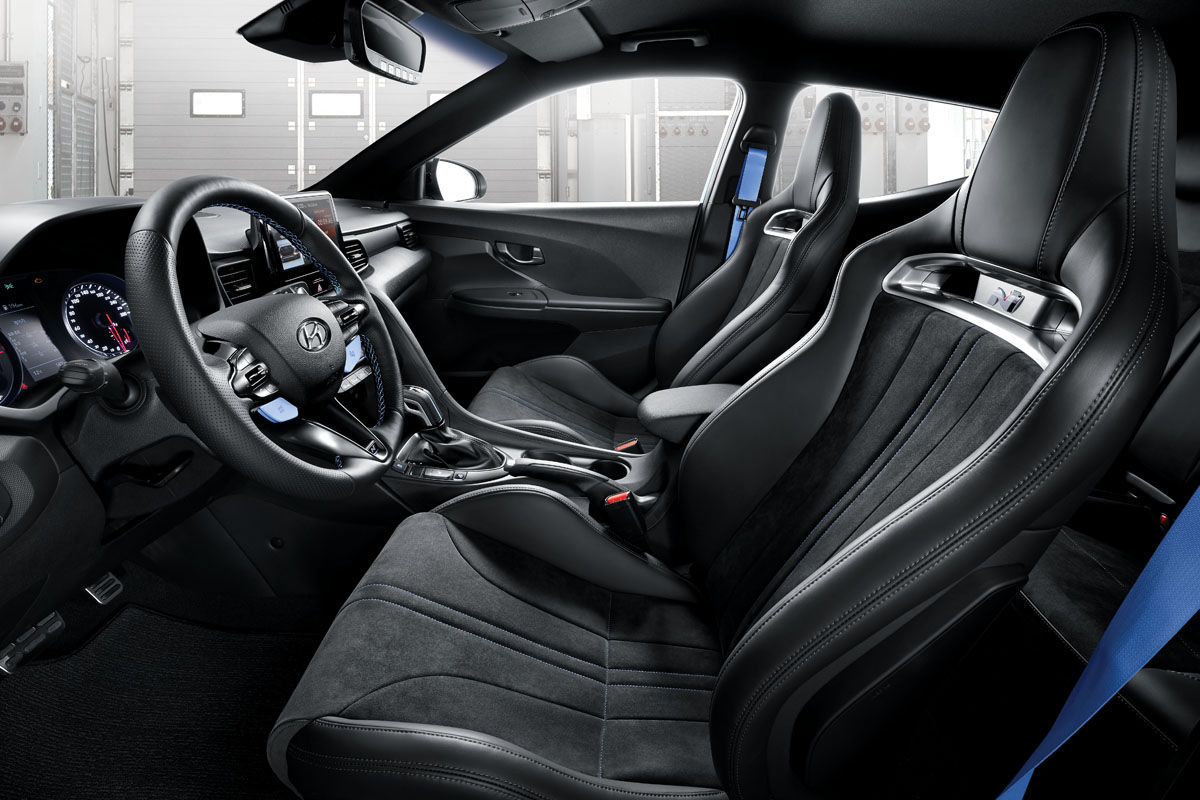
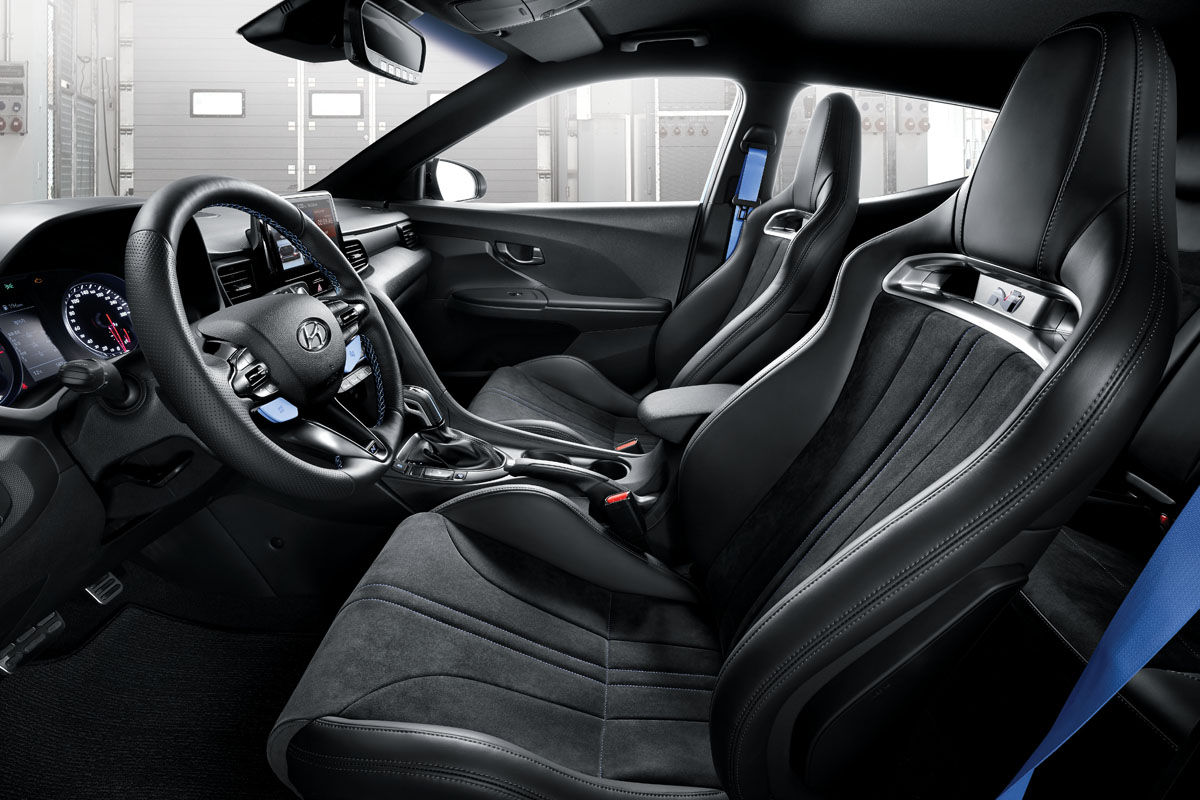
The newcomer further features an 8-inch infotainment system, a premium JBL audio setup and optional N Light Sports Bucket Seats. Apart from being 2 kilograms lighter, each N seat features an illuminated logo built into the aluminium-trimmed backrest.
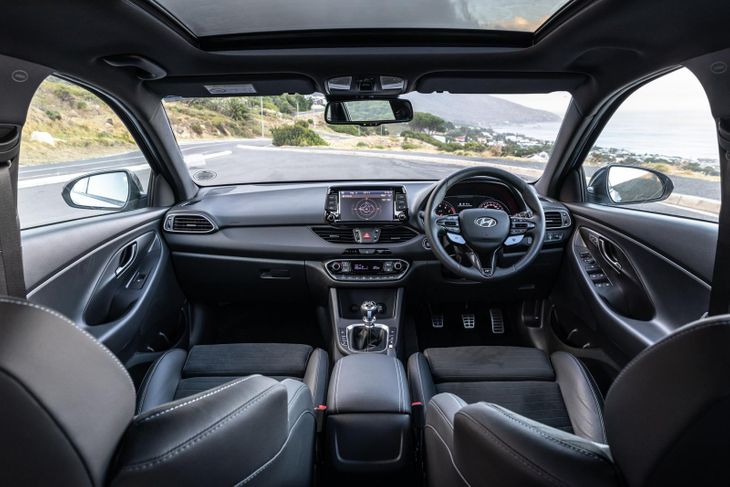
Although it is difficult to tell from this image, the Veloster N comes equipped with steering-wheel-mounted shift paddles.
We don’t believe there is much chance of the Veloster N coming to South Africa (even if Hyundai changes its mind about LHD-only production, it's a very niche offering and in a very price-sensitive segment). What’s more, Hyundai SA has not officially committed to the (now pre-facelift) i30 N’s sustained availability beyond the first consignment of cars that arrived here a couple of months ago.
However, should circumstances change regarding the i30 N on the local market, given the market’s preference for dual-clutch-equipped hot hatchbacks, an 8-speed DCT-equipped i30 N derivative would certainly be well received by local hot-hatch aficionados. Watch this space.
In conclusion, also bear in mind that a wet-clutch setup allows for much higher torque delivery and resistance to punishment (such as sustained hard driving or track excursions, for example). Hyundai has been testing a 2.5-litre motor in its Veloster, so if the N Division plans to introduce a higher output motor in one or several of Hyundai’s models, this ‘box would be well suited to that application.
Ford will be keen to keep the iconic Mustang alive in an increasingly green-focused world. The next-gen Ford Mustang will feature a hybrid V8 as well as all-wheel drive.
*Pictured is the Ford Mustang Mach-E, the brand's Mustang-inspired all-electric SUV
Ford recently celebrated the 56th birthday of its iconic Mustang sports car and unfortunately, for it to survive the future, it will need to go green. According to Autocar, the next-generation Ford Mustang will gain a hybrid engine as well as all-wheel drive. Back in 2017, Ford filed a patent for a V8 motor driving the rear wheels with electric motors driving the front wheels and its this tech which is expected to land up in the next-generation Ford Mustang. There's also talk of the next-generation Mustang using a modular platform shared with one of the many SUVs Ford makes.
While many petrolheads will understandably vent and express disappointment that the V8 tyre-shredding icon is going soft, Ford, unfortunately, has no choice but to go down the green route to meet increasingly tough emissions and efficiency targets. Ford has already laid out plans to reveal at least 18 mild-hybrid and full-hybrid in the next 2 years. There were already question marks over the Ford Mustang Mach-E, which is everything a Mustang isn't: an all-electric and all-wheel-drive SUV, and yet, bookings and orders for it have been impressive.
The last 2 iterations of Ford Mustang have been a runaway success for the Blue Oval as it finally introduced right-hand drive, meaning countries like the UK and South Africa could sell them.
Korean car brand Hyundai is rapidly expanding its N performance arm and there are many products in the pipeline. There's also a new engine.
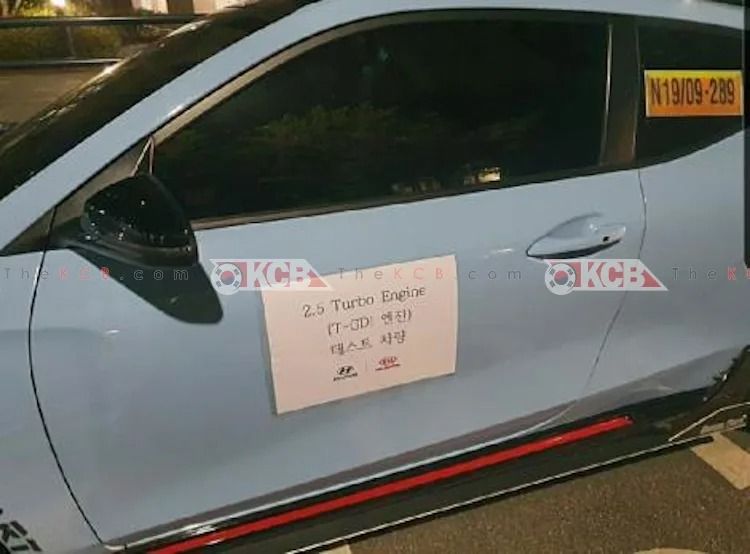
First spotted by KoreanCarBlog, a Veloster N mule was seen cruising the streets with a sticker on the door, detailing its engine capacity. Rumours are strong that the Koreans are shifting from the 2.0-litre turbo Theta II motor to the Theta III 2.5-litre turbo. There are already rumours Hyundai will adopt the new Smartstream technology which means more power and we're expecting to see a jump to 223 kW and 421 Nm.
Photo from KoreanCarBlog
As it stands, we already have the Hyundai i30 N in two states of tune (although the SA market only gets the high-spec model), i30 N Fastback, Veloster N and we know Hyundai is working on N versions of its Kona, Elantra sedan and compact i20. There are also strong signs of Hyundai working on a mid-engined hybrid high-performance vehicle based on the Veloster. There's also an 8-speed dual-clutch transmission for the i30 N and Veloster N due in the next few months.
Given its rapid growth, we're expecting a lot from the performance arm of Hyundai and we already think its fair to ask if N is the new M, given how many German engineers now work for Hyundai.
Halving the flagship C-Class' cylinder count might alienate Mercedes-AMG's loyal customer base, but it involves issues beyond Benz's control.
The man who built the terrifically successful performance-car business that is Mercedes-AMG (AMG) is also aware of its weaknesses. Since taking control of Mercedes-Benz's Affalterbach-based performance division in 2013, Tobias Moers has used his engineering background to deliver cars that customers want – and generate the kind of profits that the Daimler's shareholders expect.
For the world’s oldest car company, it has been a brilliant business. Since being fully absorbed by Mercedes-Benz in 1999, AMG has become a centre of global technical excellence. Although AMG was once seen as nothing more than wayward tuning firm (prone to creating warranty issues among Mercedes-Benz’s most well-heeled and daring customers), it has inarguably proven its worth.
The downside to growth
AMG has evolved into more than Mercedes-Benz could ever have hoped: It is now recognised as a standalone brand and its models are in high demand. Having said that, there has always been an external risk to the linear progression of AMG’s success – Moers recently alluded to this when he speculated that the division's product line-up had grown too diverse, possibly at the cost of confusing customers and creating the potential for model cannibalisation.
Political interference is the other significant peril for AMG. As EU and global emission laws grow ever stricter, AMG has realised that its celebrated V8 engines are at risk. The original M156 V8 established the brand’s dominance, but when AMG shrunk its V8 engines from 6.2 to 4.0 litres and added turbochargers, it triggered a trend that was never going to reverse.
Hybridisation is now a reality for AMG and the latest information from Germany suggests that one of the brand’s most iconic cars is likely to be radically downsized in the W206 C-Class.
Skipping the sixes
Despite introducing a 6-cylinder AMG in 2018, AMG looks to be pursuing 4-cylinders instead.
After an absence of nearly 20 years, Mercedes-Benz revived its inline 6-cylinder configuration in 2018. It was not a question of respecting tradition, but a decision driven by pure economics and engineering requirements…
Packing the latest mild-hybrid technology, with integrated starter motors and generators proved far easier with an inline engine, as opposed to the more popular V-configuration.
Mercedes-Benz also gained notable build efficiency by replacing its V6s with inline sixes. A production line that makes inline 4-cylinder engines can easily be adapted to produce 6-cylinder powerplants too. By contrast, building a mix of inline 4-cylinder engines and V6s on a single machining and assembly line is nearly impossible.
AMG has implemented the new 3.0-litre inline 6-cylinder engine in the 53-series models, but the V8-engined 63s have historically driven a great deal of profit for Affalterbach.
However, the pressure on AMG's future performance-car business is now so severe that the Affalterbach division is engineering a radical new powertrain structure destined to halve its powerplants' cylinder counts. The next iteration of the C63 is virtually guaranteed to become AMG’s first 63-series car that is not a V8. As a matter of fact, it won’t even be an inline 6…
Numbers or noise?
Mercedes-AMG has built much of its reputation on producing powerful, but also particularly sonorous, V8 powerplants.
There are benefits and risks to making AMG’s forthcoming C63 a 4-cylinder petrol-electric hybrid. Removing the emotional argument for the C63 to remain a V8, there is no question that AMG’s next C63 will be incredibly potent. It is a simple equation of physics that smaller 4-cylinder engines can spin their cranks with less inertia than a similarly turbocharged V8. By that logic, the 4-cylinder C63 could have an impressive engine-speed ceiling.
The next C63’s engine should be an evolved version of AMG 45-series M139 2.0-litre motor, which redlines at 7 000 rpm, the same as AMG’s current 4.0-litre twin-turbo V8s. Enthusiasts will be hoping for more, with AMG engineers capable of increasing the hybridised M139 powertrain to shriek well beyond 7 000 rpm.
By downsizing the engine so dramatically (from 8 to only 4 cylinders), AMG will reduce the weight of the ICE component of the C-Class flagship. That said, the hybrid system’s motor/s and batteries will add weight, but that mass will be positioned in optimised locations to benefit the car’s overall balance.
Without a large V8 mounted above the front axle, the 4-cylinder C63 should have more agile handling then AMG’s current version. But will that really matter?
It's hard to forget the sound of the old 6.2-litre V8. Will new engines measure up in the sound department?
For all their lofty peak power and torque outputs, the C63s are most adored for their throaty V8 soundtracks. AMG’s spent a great deal of research in exhaust materials, tube diameters and contours to ensure its cars are loud and dramatic. Customers expect it.
All the mechanical engineering and metallurgy in the world cannot undo the discrepancy in the quality of sound produced by a V8 and a 4-cylinder engine with half its capacity. Even with the best ignition and fuel system control technology, AMG will be unable to make its 4-cylinder C63s sound even remotely as sonorous as their V8 predecessors. And that could be a significant issue.
People who buy C63s don’t really care about tenths of a second when discussing 0-100 kph times. They care about the way their cars sound when delivering full-throttle performance between sets of traffic lights, and perhaps even more so, on the overrun.
AMG is in an unenviable position. Compared with its V8 predecessor, the 4-cylinder C63 will better in every measure of performance, yet customers may be deterred by its less evocative soundtrack.
Big money for only 4-cylinders
Will C-Class AMG owners mind sharing powertrains with A-Class drivers?
Sound (or lack thereof) may not the only inhibitor to the 4-cylinder 63-series' chances of success. With each iteration of its products, AMG has added enhanced technical expertise.
When I drove the original C63 AMG back in 2008 (the 6.2-litre naturally aspirated version, at a sweltering Phakisa circuit test session), it was an awe-inspiring model, but looking back, it had a mechanically geared limited-slip rear differential and 7-speed automatic transmission. AMG’s 2020 version of the C63 has a 9-speed transmission and torque vectoring between the rear wheels.
As the C63 grows in complexity and incorporates increasingly exotic materials, AMG will expect customers to keep paying more for the model, but in return for ostensibly less engine and drama. To price the future C63 halfway between R1- and R2 million and expect customers to happily pay for an acoustically muted driving experience powered by only 4-cylinders might be a bridge too far.
In the realm of pure status cars, assumption matters. AMG’s engineers will deliver a 4-cylinder hybridised C63 AMG that is superior to its V8 predecessor in all metrics, but that won’t matter – with cars of this calibre, it never does. What has made the C63 so desirable is the profound noise it emits and the way that the V8 engine gently burbles at idle.
The collector's performance car market has taught us that cylinders equal value, over time. That is the reason why many genuinely awful-to-drive Italian supercars still command premium prices: because they have temperamental 12-cylinder engines. To give you another example: Porsches are among the best investment cars you can buy. However, the flat-6 Porsche models appreciate in value over time (especially the air-cooled ones), but 4-cylinder cars from the same era trade like South African government bonds.
The original compact performance Benz had a 4-cylinder powerplant…
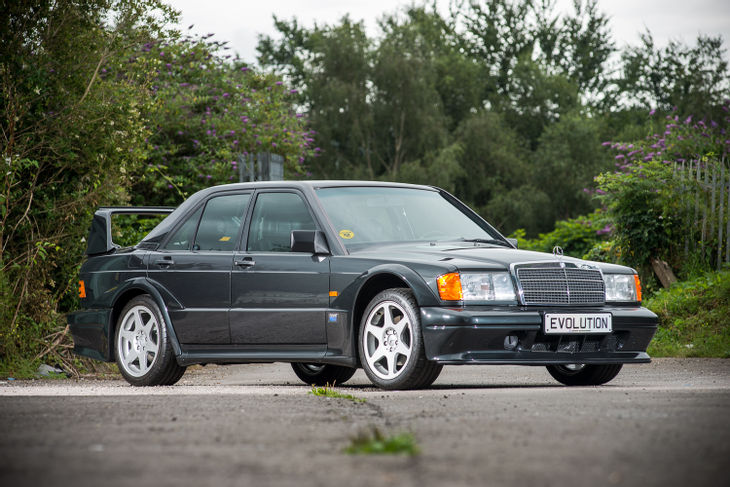
Perhaps history is also evidence that things could be different for our ominous 4-cylinder C63 predictions. Mercedes-Benz’s original performance sedan was a 4-cylinder; the car in question being Stuttgart’s 190E Cosworth Evo 2. It was an extraordinarily bold venture for Mercedes-Benz, completely out of character for the company’s deeply conservative manner in the early 1990s.
With a dogleg gearbox and engine technology from a British specialist, the 190E Cosworth Evo was everything Mercedes-Benz wasn't (at the time). The original list price was radical, yet demand easily outstripped supply. Even more telling is that despite all the 6- and 8-cylinder AMGs that followed, the 4-cylinder 190E Cosworth remains Mercedes-Benz’s most coveted 4-door car.
The 190E Cosworth cars set a precedent for Mercedes-Benz, the motorsport-bred 4-cylinder sports sedan was a precursor to much-beloved performance models from the Three-pointed Star. Perhaps the next C63 AMG will channel some of that legacy and be more universally accepted than we assume. Either that or M156-engined C63s are about to become an excellent investment opportunity…
Imagine if Audi had to go down this dusty road and actually produce a bakkie… The Ingolstadt-based firm would at least be in a position to learn from the spectacular failings of the Mercedes-Benz X-Class.
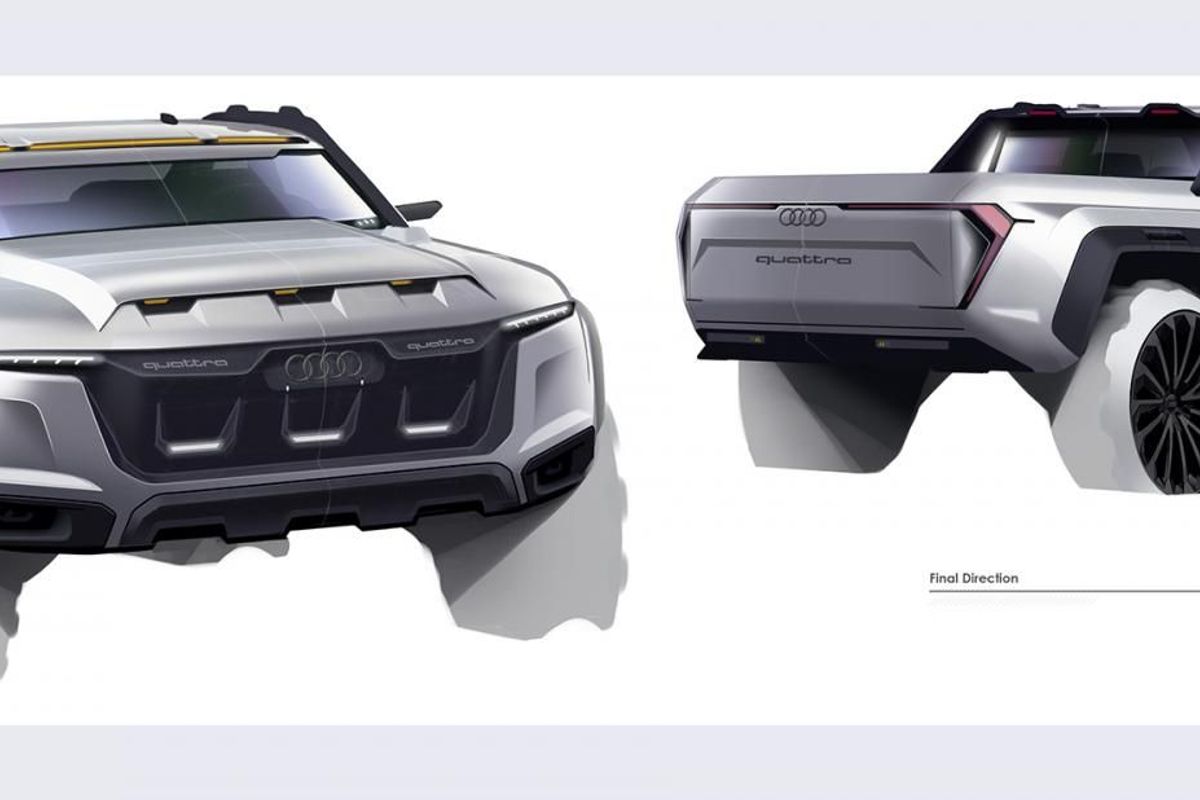
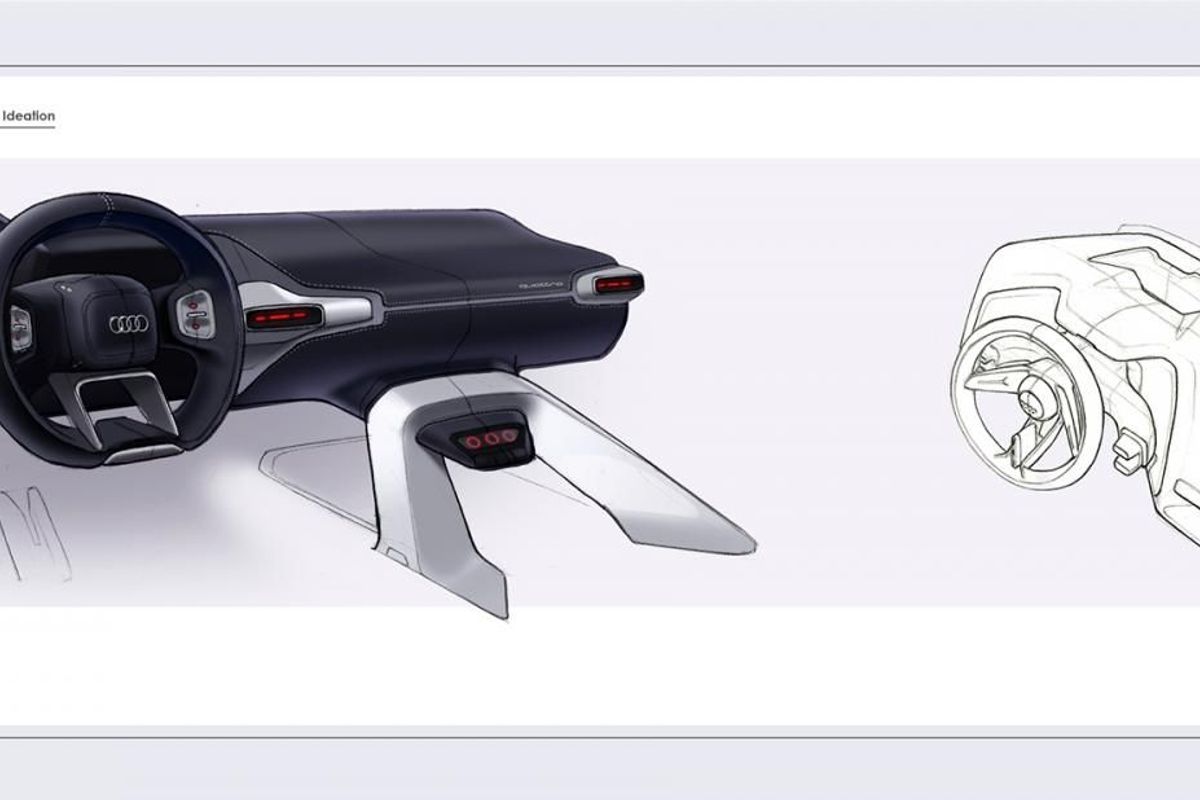
Nonetheless, the sketch you see here by Raleigh Haire shows the potential for an Audi Quattro Truck that would take aim at the American market where vehicles such as the Ford F-150 and Chevrolet Silverado dominate.
The Audi Quattro Truck is said to blend Audi’s offroad rally heritage with advanced electric hybrid technology and Raleigh reckons “Audi has all the necessities for a tough high tech truck”.
Unlike the typical body-on-frame design seen on today’s bakkies, the Audi Quattro Truck features a unibody frame which is lighter and more rigid and with the hybrid system’s batteries integrated into the frame which aids in lowering the centre of gravity while also improving overall packaging. A nifty feature is a detachable utility battery from the side of the vehicle that can be used to charge equipment or provide power in your campsite.
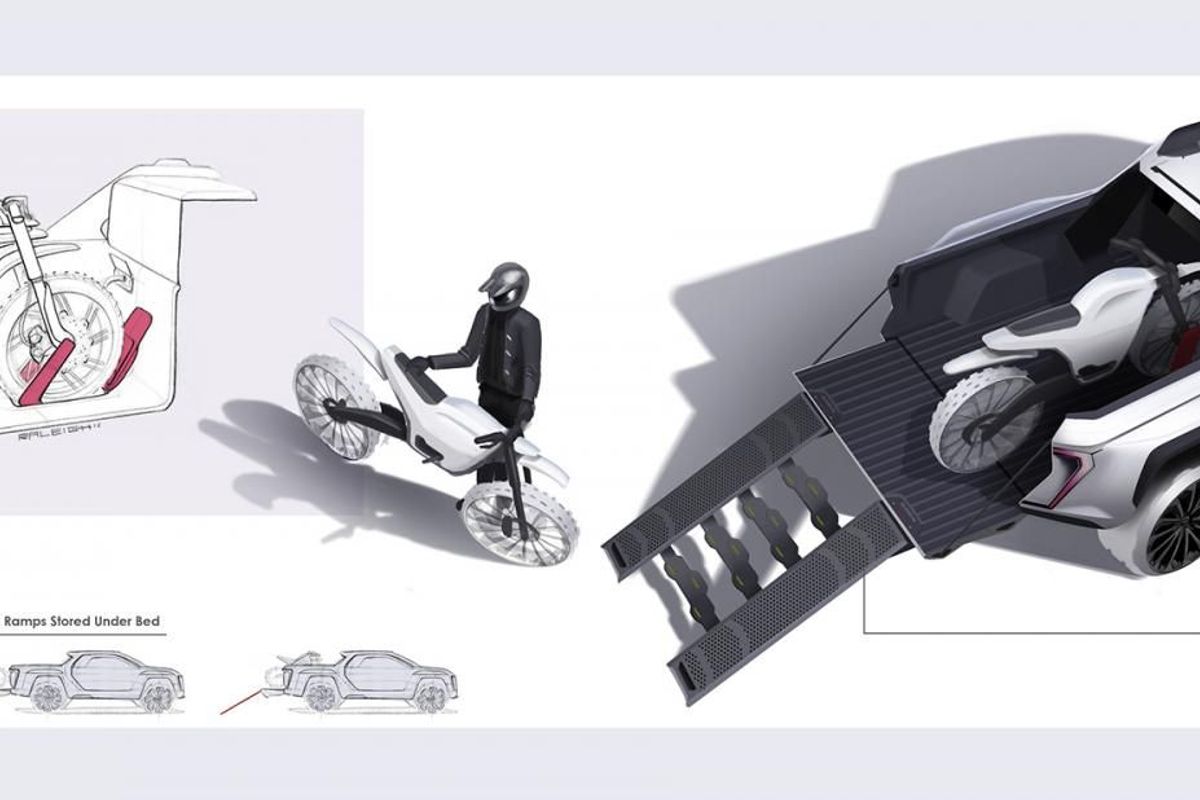
In terms of design, the exposed unibody frame adds visual strength to the design while the front end features a single light bar graphic with a glowing Audi logo at its centre. The grille itself is integrated into the body panelling and external LED lighting provides illumination while also adding to the rugged look of the truck. Aimed at the power-sport enthusiast, the Audi Quattro Truck is also fitted with integrated loading ramps should you wish to easily load up your dirt bike into the load bin.
While this is only a design study, it’s interesting to imagine what an Audi bakkie could look like. Do you think this is something Audi should pursue or do you think Audi should rather focus refining its current passenger car offerings?
The onset of the COVID-19 pandemic and the consequent national lockdown has changed the car market in South Africa significantly. But, if you are in the market for a new car, it may be a good idea to "pull the trigger" quite soon after the lockdown ends.
*updated with Level 4 data*
The next few months will be very telling for the South African motor industry – and especially for the brands that import models into Mzansi. The coronavirus has changed the country’s economic landscape, not just because of economic stagnation and a widescale loss of income and employment, but because it coincided with the country's national credit rating being downgraded to sub-investment (or trash) grade by rating agencies, which sent the value of the Rand into freefall. As a result, an economic turnaround will be extremely tough to achieve in the short to medium term.
If we focus solely on the car market, dealers have been able to make provisional sales and secure finance for prospective buyers, but no vehicle deliveries have been possible since the lockdown was enforced. Consumers will undoubtedly have been window-shopping (to stave off boredom) in the meantime, but many buyers will also hope to save money to make provision for tougher times to come.
Vehicle prices are likely to increase in the coming months.
If we look beyond the lockdown, those who are fortunate enough to not have had their incomes negatively affected by the enforced economic lull may be able to take advantage of manufacturers looking to push sales the second the proverbial gates open. There are two things to take note of, however. The first is the exchange rate… We went into the lockdown at R17.20-ish to the Dollar (importers mostly purchase in Dollars) and at today’s spot price, we have declined to R18.20. That’s a large difference and not something that can be absorbed by local manufacturers or their dealers.
Further to that, a month earlier, at the end of February, South Africa was spotted at R15.00 to the Dollar. Much of the current stock sitting on dealer floors today (or that recently arrived in the country and are stored in depots) would have been purchased at around R15 to the Dollar so once that stock clears, there is likely to be hefty price increases on the cards for new vehicles listed on our national price list. Some manufacturers admittedly have foreign exchange insurance, but who knows whether they will stand by that considering how extensively the developments during the pandemic/national lockdown have devalued the Rand. Most currency insurance only lasts for 3 months – or at most a quarter, so it’s unlikely to help importers in the long run.
The second factor in favour of buyers is the 200-point basis drop in the repo rate. Those with unaffected incomes will have better buying potential and those who were on the fringe before may be in a position to buy the vehicles they could not previously afford. The repo rate is a double-edged sword however: it could easily rise in a year’s time, so be careful when stretching your spending power.
Local manufacturers will benefit both from exporting and less foreign exchange exposure.
What will be interesting to see is how these developments affect our local manufacturers. Brands such as Toyota, Ford, Volkswagen, Nissan, BMW, Mercedes and Isuzu all produce for the domestic- as well as export markets. The exchange rate will support the major exporters, making our vehicles affordable for overseas markets – if local supply chains make it through the lockdown unscathed.
What this could lead to is a major pricing disparity between locally-produced vehicles and purely imported vehicles. Brands such as Hyundai, Kia, Mazda, Renault, Suzuki, Volvo and JLR (the brands which don’t get export credits from local production) will have to box clever to maintain competitiveness in the market, especially in the small-car segment where margins are already tight.
There is another kick in the teeth on the way for buyers, so it might be even more prudent to make haste on that upcoming car purchase: the increased emissions tax. As of April 1, the new CO2 tax comes into play; vehicles that produce more than 95g/km (the threshold is no longer 120g/km) of CO2 will be more expensive to buy. The new rate is R120 per gram of CO2 above 95g/km. A dealer may be able to absorb that cost with current stock (if you find a nice dealer), but as soon as the price increase kicks in, expect the impact of CO2 taxation to further increase new vehicle prices.
While we are not financial advisors by any stretch of the imagination, but the evidence is pretty clear on what the future holds for vehicle prices in South Africa. As always, be prudent, do your own research and weigh up exactly what you can afford before you sign on the dotted line.
Level 4 updates
Some details about Level 4 restriction were announced on the 30 April, which have eased some of the strain on the motoring industry. You will be able to buy spare parts from open outlets to repair your vehicle, hopefully the supply chain of this industry is able to also return to work. Local manufacturers are allowed to operate at up to 50% capacity, meaning that they will again be able to produce cars for the local and export markets. Vehicle sales are also going to be phased in during level 4, the official statement quotes 'permission has been granted for car sales under specific directions.' As pleasing as this sounds, additional information on the specific directions have not been forthcoming. Naamsa has also put in a request to confirm if heavy commercial vehicles and motorcycles are also included under this classification. Dealers have also been asked by Naamsa to make use of e-commerce as much as possible and to attempt online bookings for test drives to minimise the foot traffic on dealership floors.
SentiMETAL launches digital magazine for petrolheads
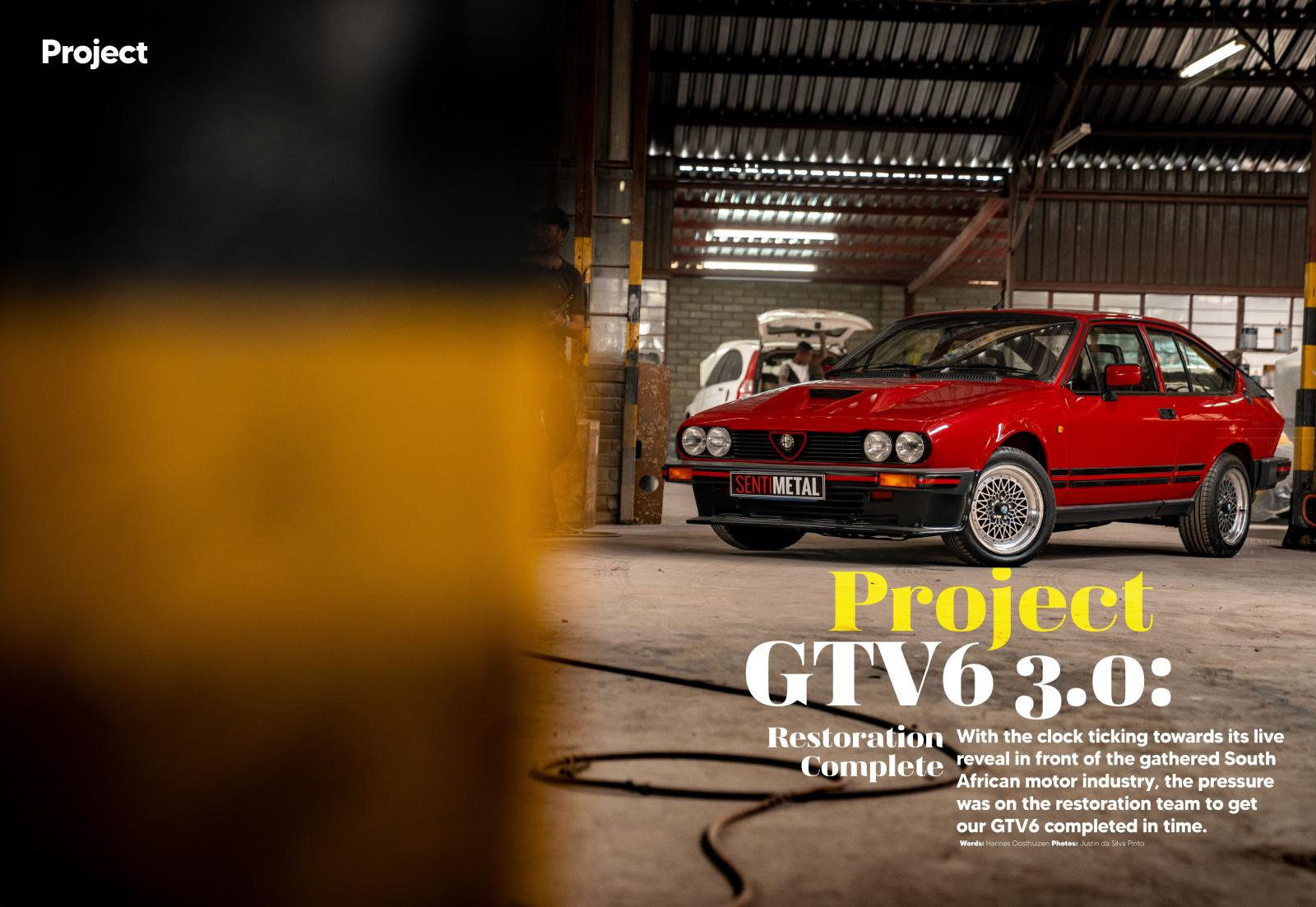
Cars.co.za's car-culture sub-brand, SentiMETAL, has launched a new digital magazine aimed at petrolheads. The first edition is available for purchase and download now.
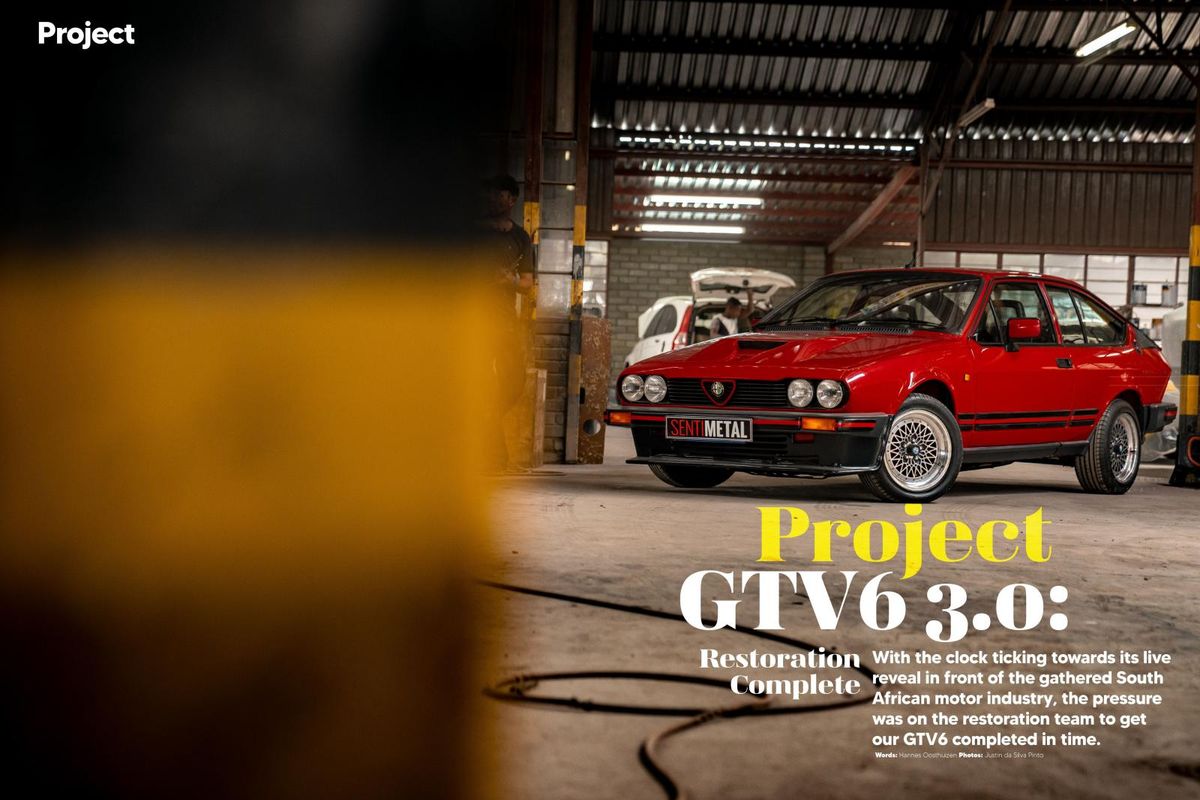
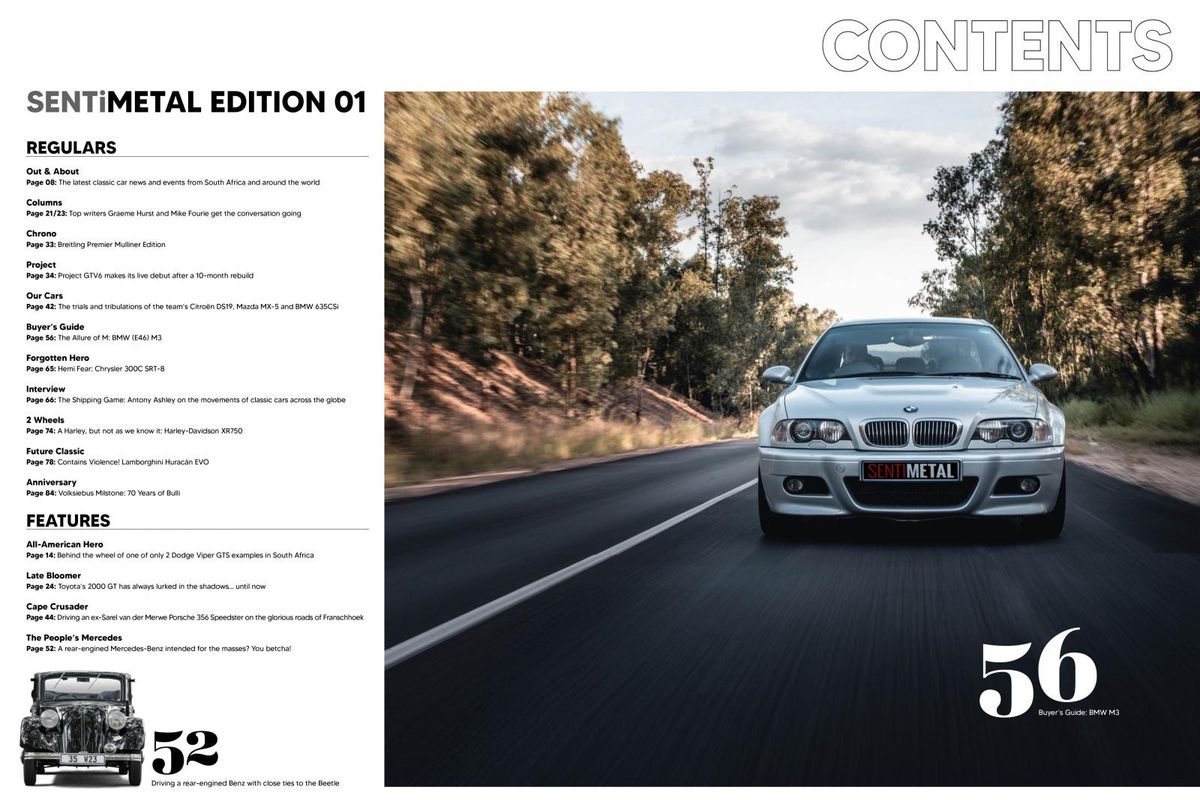
The new title, simply called SentiMETAL, Live To Drive #1 features the uniquely South African Alfa Romeo GTV6 3.0 on the cover, and consists of nearly 90 pages filled with petrolheaded content.
"We've noticed a tremendous increase in interest in motoring content, particularly entertaining content, in the past few weeks as people are spending a lot more time on their digital devices," says Hannes Oosthuizen, SentiMETAL project head. "So, about two weeks ago we decided to launch a SentiMETAL digital magazine aimed at those petrolheads, and I'm really proud of the team for putting it together so swiftly and beautifully," he says.
The magazine is for sale on www.sentimetal.shop. Following payment, the buyer is sent a link and a password to download the magazine and open it in PDF magazine format.
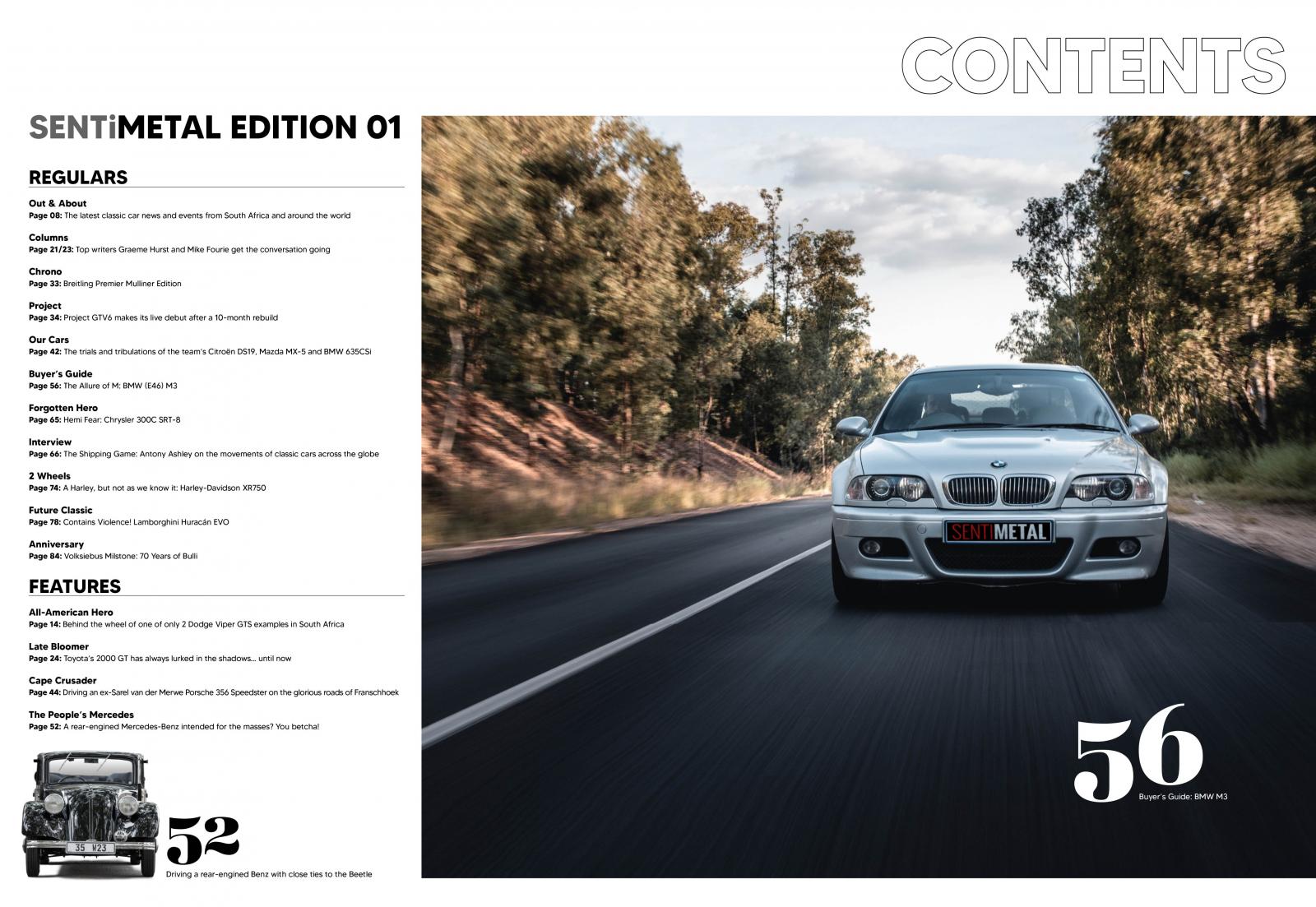
In the first issue
Our Alfa Romeo GTV6 3.0 restoration project in detail
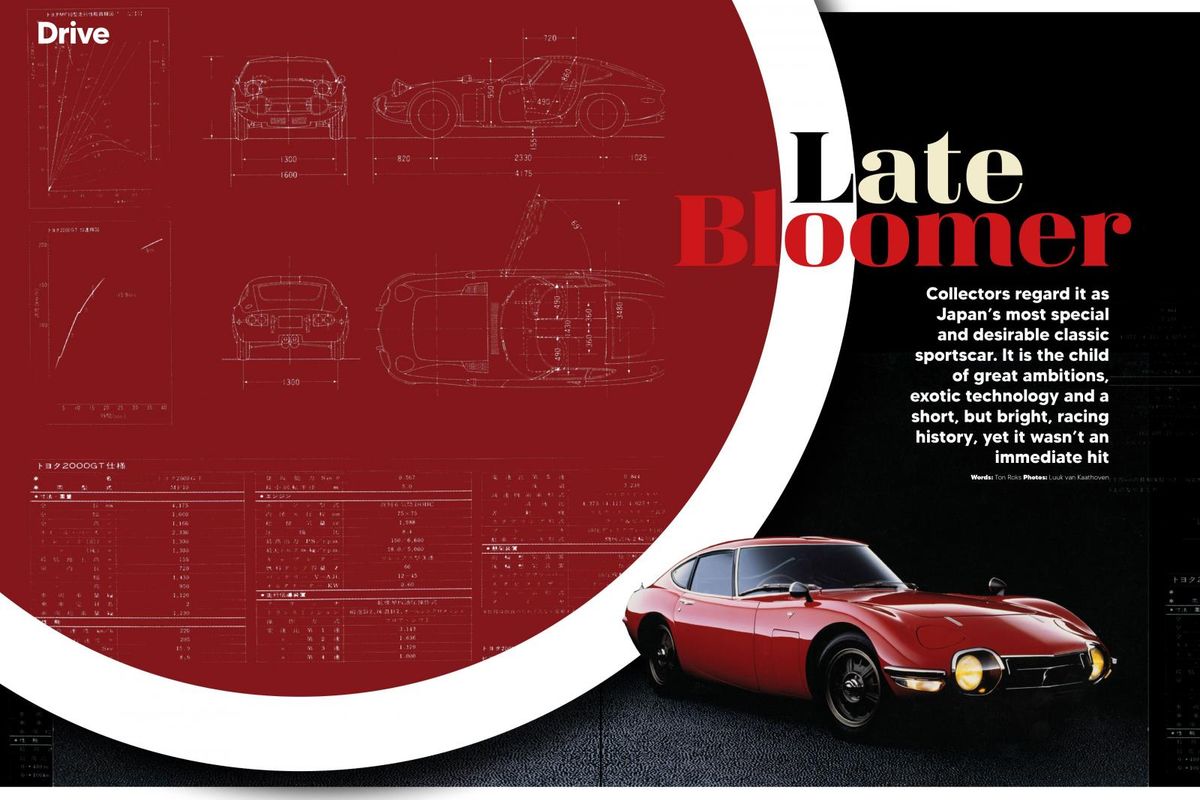
Driving Toyota's late bloomer, the beautiful 2000 GT
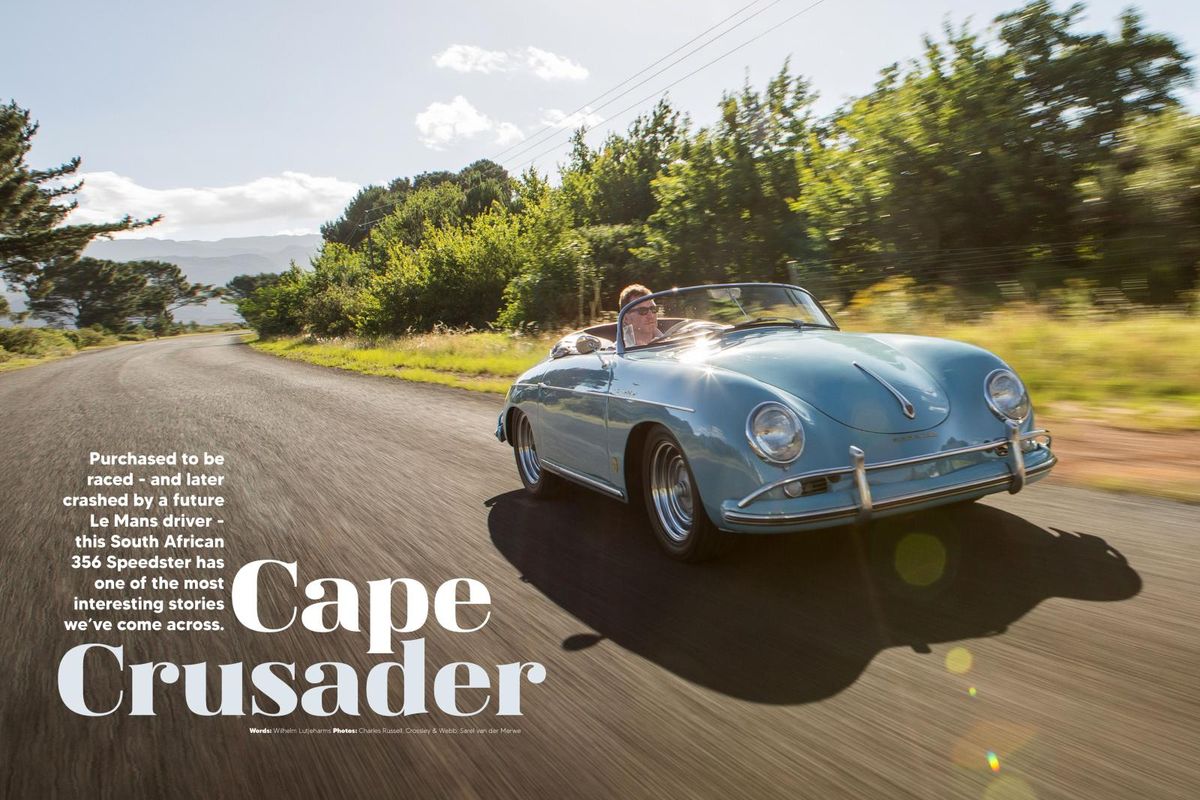
Cruising the fabulous Western Cape roads in an ex-Sarel van der Merwe Porsche Speedster
In-depth Buyer's Guide on the BMW (E46) M3
Behind the wheel of one of only two Dodge Viper GTS examples in SA
A closer look at the fascinating history of the Harley-Davidson XR750
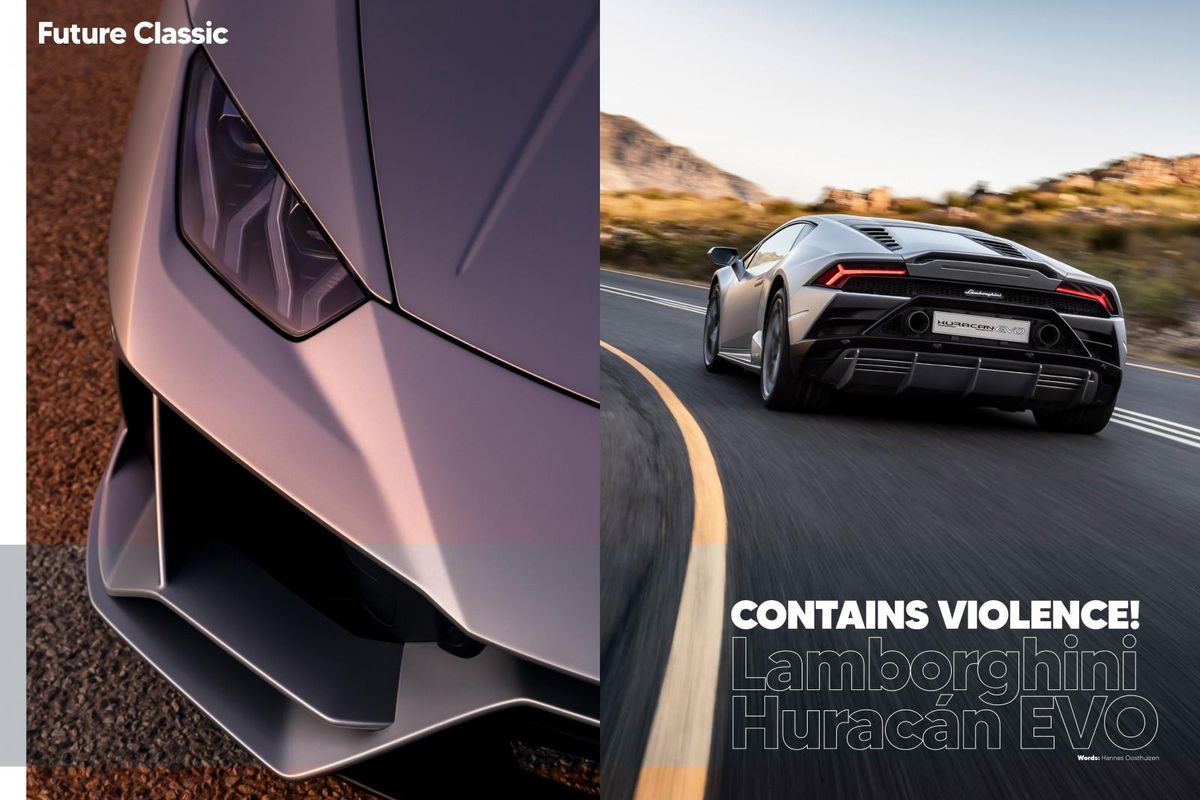
Future classic: we take Lamborghini's new Huracan EVO for a spin
An odd-ball rear-engined Mercedes-Benz from the '30s, the 130
Furthermore, the issue features an overview of local and international classic-car related news and events (including our two SentiMETAL Gatherings earlier this year), updates on our contributors' experiences with their own classics, columns by Mike Fourie and Graeme Hurst, an interview with Antony Ashley from Freight Factory about global car shipping and more.
Hyundai’s N division is preparing a high-performance version of the Kona compact SUV.
Picture credit: S. Baldauf/SB-Medien. We have paid for these photos and at the photographer's request, have watermarked them.
Hyundai isn’t a brand typically associated with producing high-performance vehicles but that perception is changing fast as the brand’s N division rolls out exciting performance models.
Last year, we saw spy images of a hotter version of Hyundai’s Kona compact SUV and now Korean Car Blog reports that the Kona N will be revealed in July 2020.
The Kona N is also expected to be the first N model to feature all-wheel-drive and will be fitted with the same 2.0-litre turbopetrol engine found in the i30 N and Veloster N and will be tuned to offer up to 205 kW (202 kW is likely). An 8-speed DCT was recently confirmed for the Veloster N and it too is expected to be offered in the Kona N while a 6-speed manual transmission is also on the cards.
In terms of styling, the Kona N will likely feature a more purposeful face with a mesh grille, skid plates and a dual exhaust system. The Kona N will ride on N-branded 19-inch wheels with red brake callipers adding a sporty touch.
The Ford Everest has been given the Mustang's 2.3-litre EcoBoost engine.
Straight away we can tell you that it's not for the SA market as we're adopting a diesel-only approach for the 7-seater bakkie-based SUV. This engine change is earmarked for the Chinese market and will give the Everest some muscle.
The engine is the 2.3-litre EcoBoost, a motor we've sampled in the Ford Mustang as well as the 3rd-gen Ford Focus RS. It produces 202 kW and 455 Nm, easily surpassing its oil-burning siblings. Like the diesel Everests we've experienced on numerous occasions, it too features the 10-speed automatic gearbox.
Do you think there's place for petrol-powered Ford Everests in our market?
New drawings show Mazda is pushing ahead with rotary development.
Mazda fans will be overjoyed with confirmation that the Japanese brand is keeping its most famous engine configuration alive.
Although there are no current Mazda vehicles powered by the Wankel rotary design, the company’s in-house research department tasked with evolving this engine technology, has never seen a funding cut.
The result of that is a new patent application drawing which clearly shows that rotaries are very much part of Mazda’s future product planning.
Drawings filed at the Japanese patent office show a new hybrid vehicle architecture from Mazda. It features all-wheel drive by virtue of a rotary engine, in combination with a smallish lithium-ion battery pack and capacitors.
Weight has been one of the most significant engineering challenges for electric vehicles. Batteries are heavy and unlike fuel, they don’t become lighter as you journey.
Mazda’s solution to this has been a lower energy density 3.5 kWh lithium-ion battery pack, which is very light. To ensure decent performance, the company’s engineers have integrated capacitors.
So where does the rotary engine revival come into all of this? Well, hybrid petrol-electric engines are a technical nightmare to package and integrate. Mazda’s rotary is wonderfully compact, which makes its packaging a lot easier within the hybrid system.
The use of in-wheel electric motors is a way for Mazda to profit from the charging and discharging ability of capacitors, which have thus far been a peripheral technology in vehicle electrification.
Where this new rotary-hybrid drivetrain will be of use, remains unclear for now. Mazda’s patent application indicates serious intent and a likely candidate could be the brand’s unconfirmed RX9 or possibly a large luxury crossover.