Mercedes-Benz GLB (2020) International Launch Review
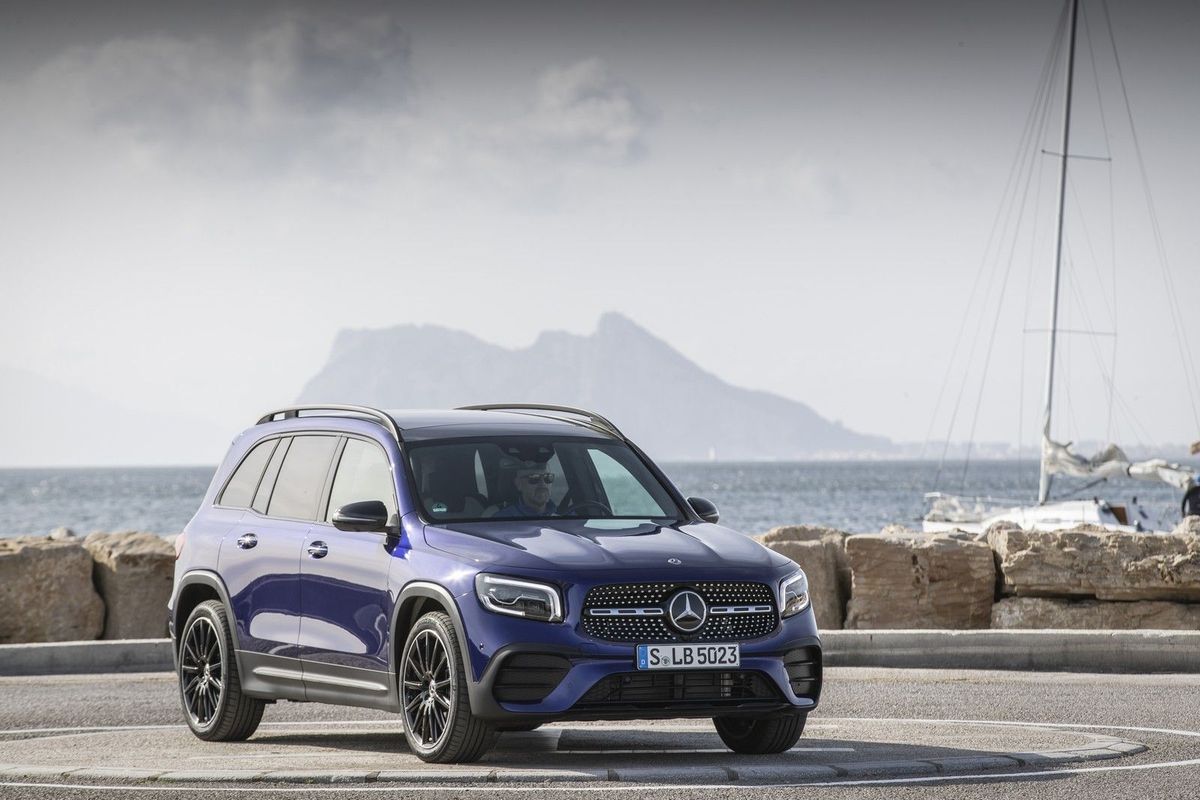
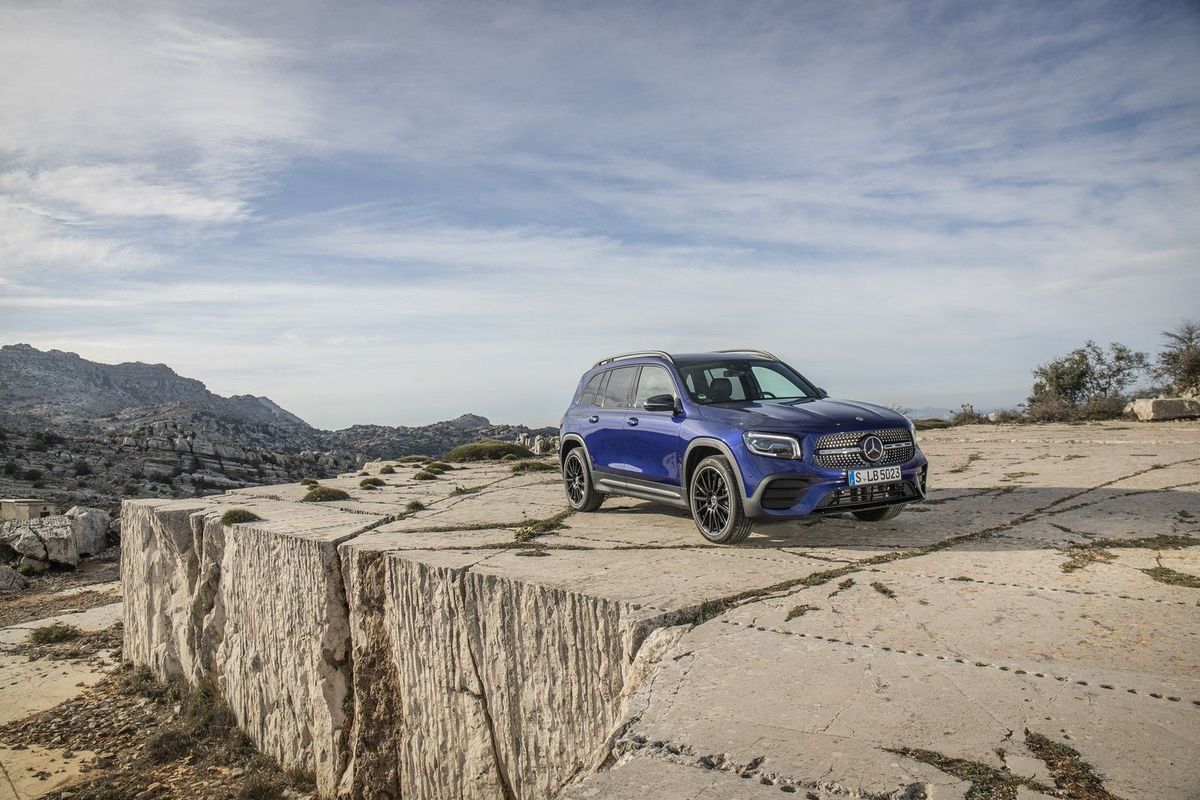
The family-car market is increasingly crowded – even at its premium end – but that hasn’t stopped Mercedes-Benz from adding yet another high-riding, off-road-flavoured model to its line-up (its 8th, to be precise). Our UK correspondent James Disdale recently got to grips with the new GLB, which will arrive in South Africa in the 2nd quarter of 2020, in Spain. 

As the "B" part of its name suggests, the new GLB can be considered a rough-and-tumble version of the B-Class, which means there’s more than a touch of MPV to this SUV. But just how much?

Well, like the recently refreshed Land Rover Discovery Sport, the GLB seats 7 occupants. And, unlike its GLC and GLE big brothers, but like the smaller GLA, this latest addition is available in both 2- and 4-wheel-drive guises.
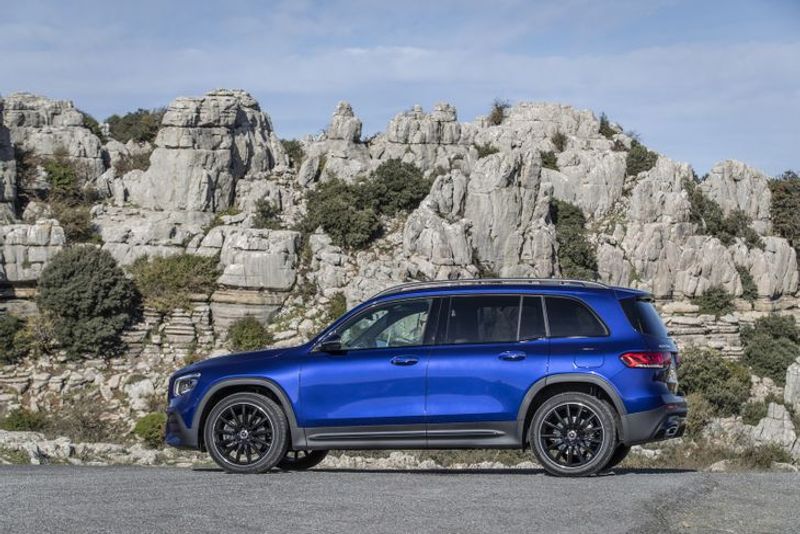

While the upcoming GLA will cater to boutique crossover buyers, the unashamedly squared-off GLB has practical pretensions.

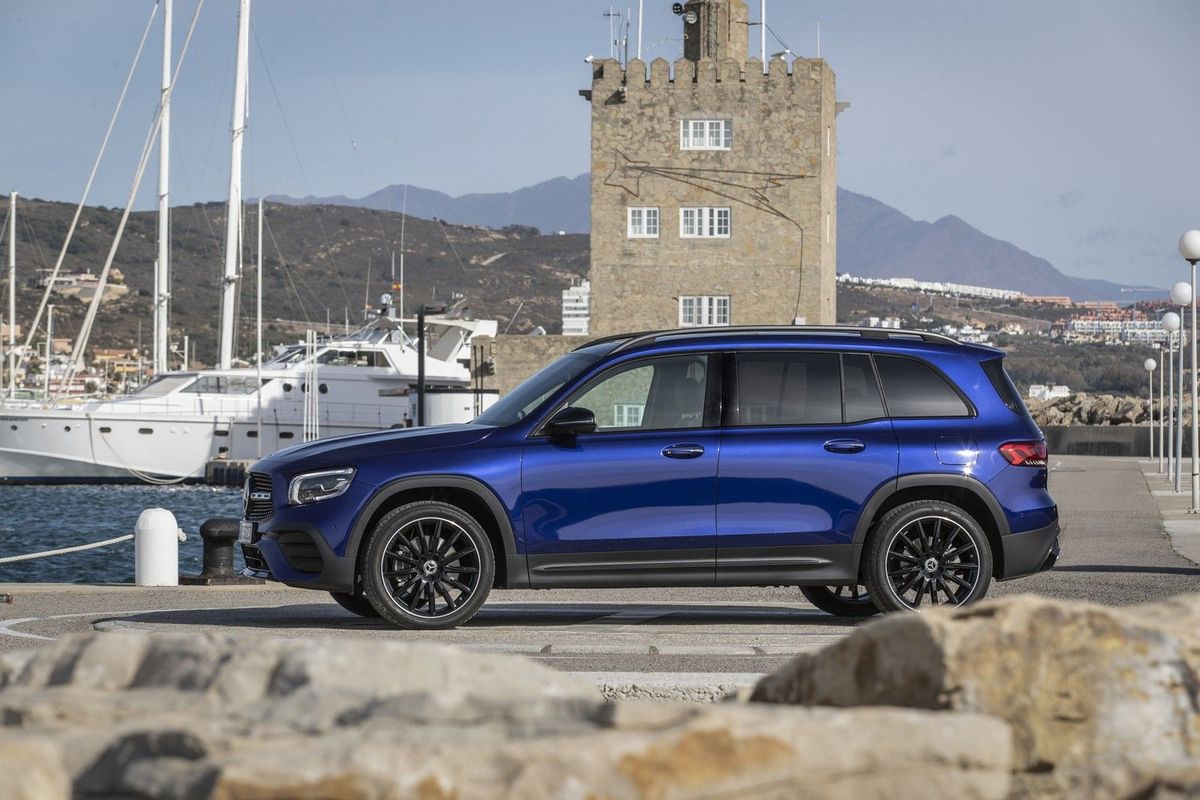
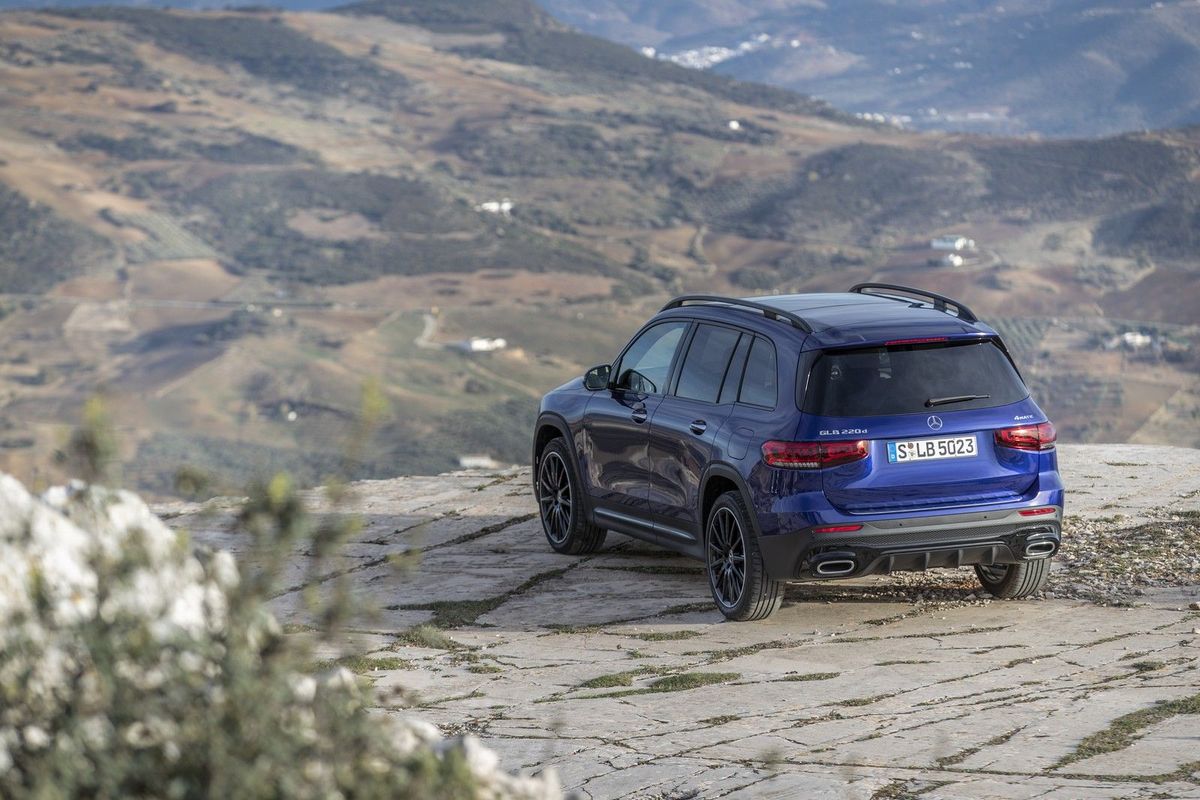
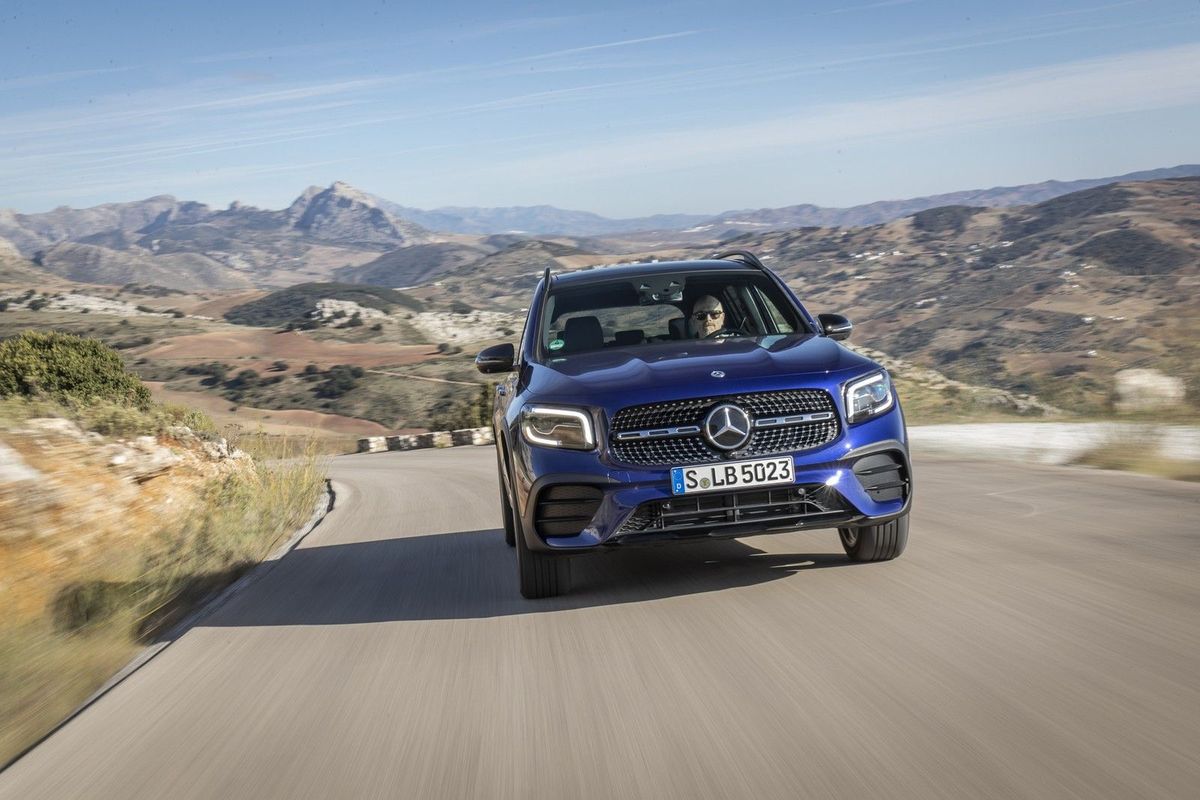
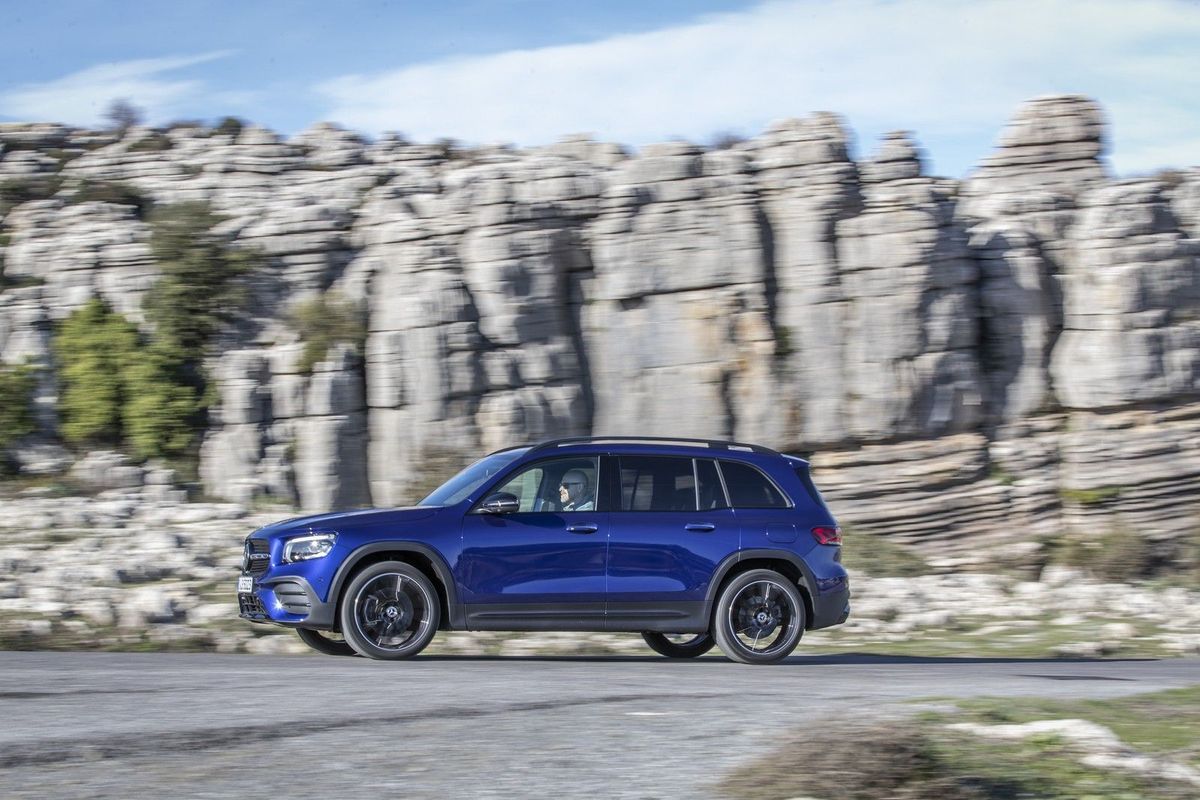
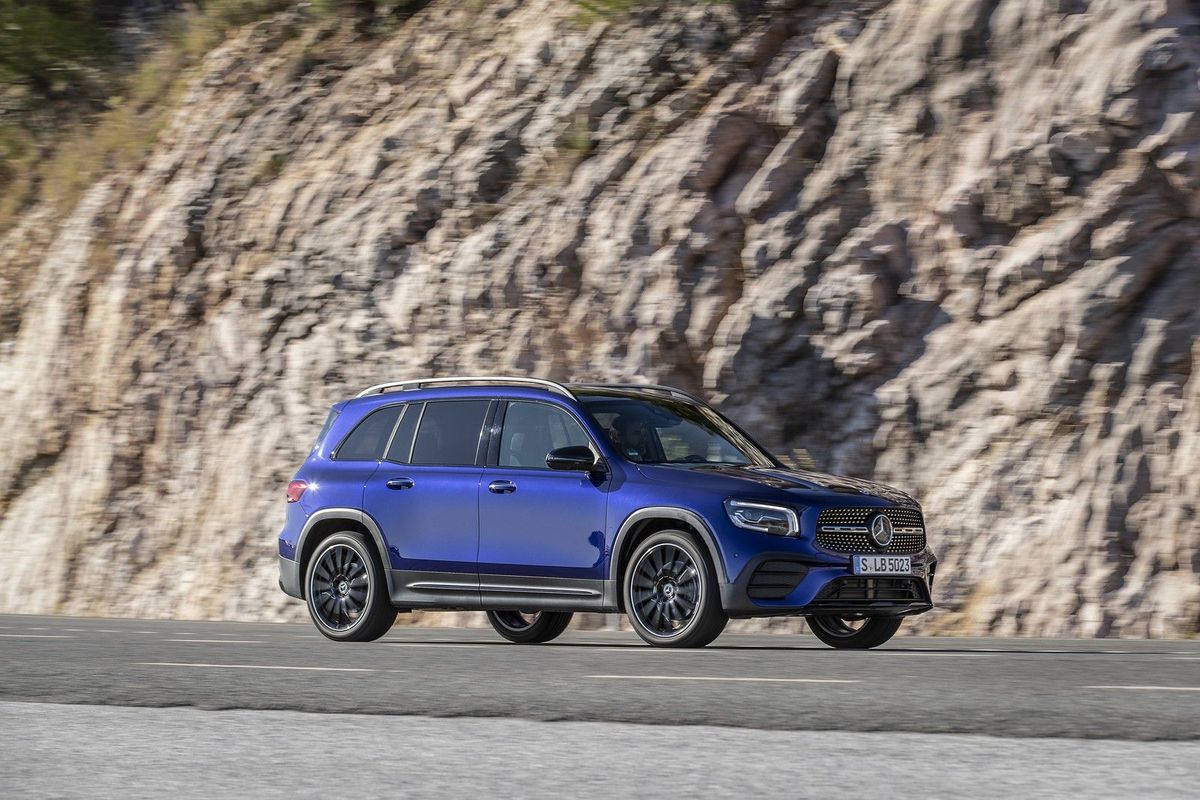
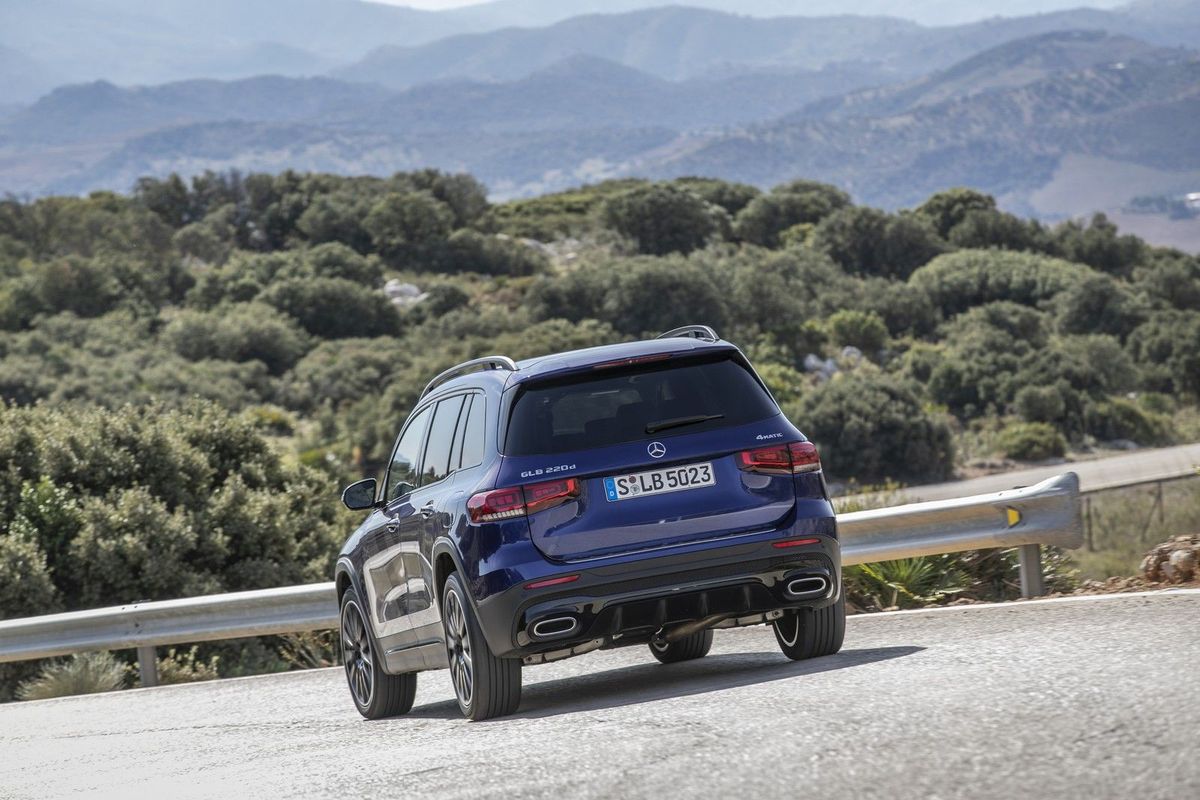
Okay, so what have we got here? Externally, the GLB looks a little like a shrunken GLS, which means it has an upright and boxy presence on the road. You’ll have to make your own mind up about the looks, but from some angles, it’s slightly ungainly, while from others there’s more than a hint of the Citroe?n C5 Aircross (which itself recently made its debut in South Africa upon Citroen's reintroduction to the local market).

Suitably smart inside

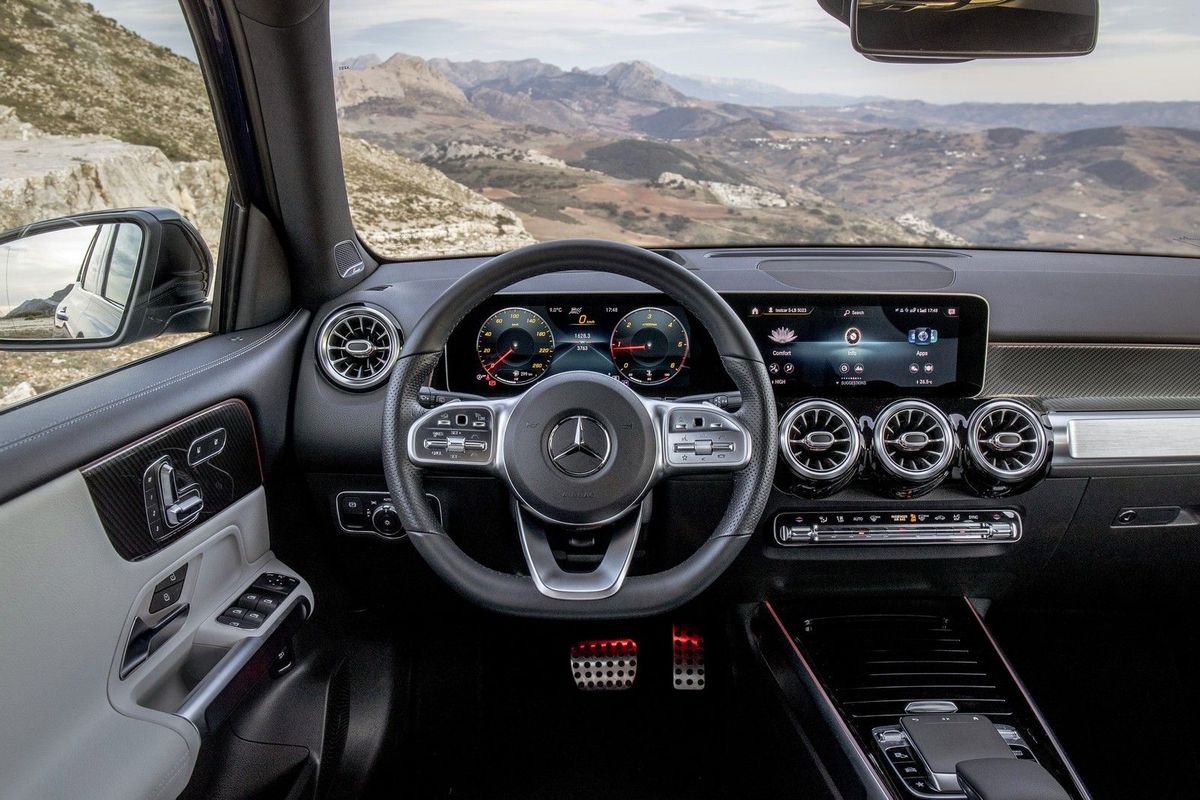
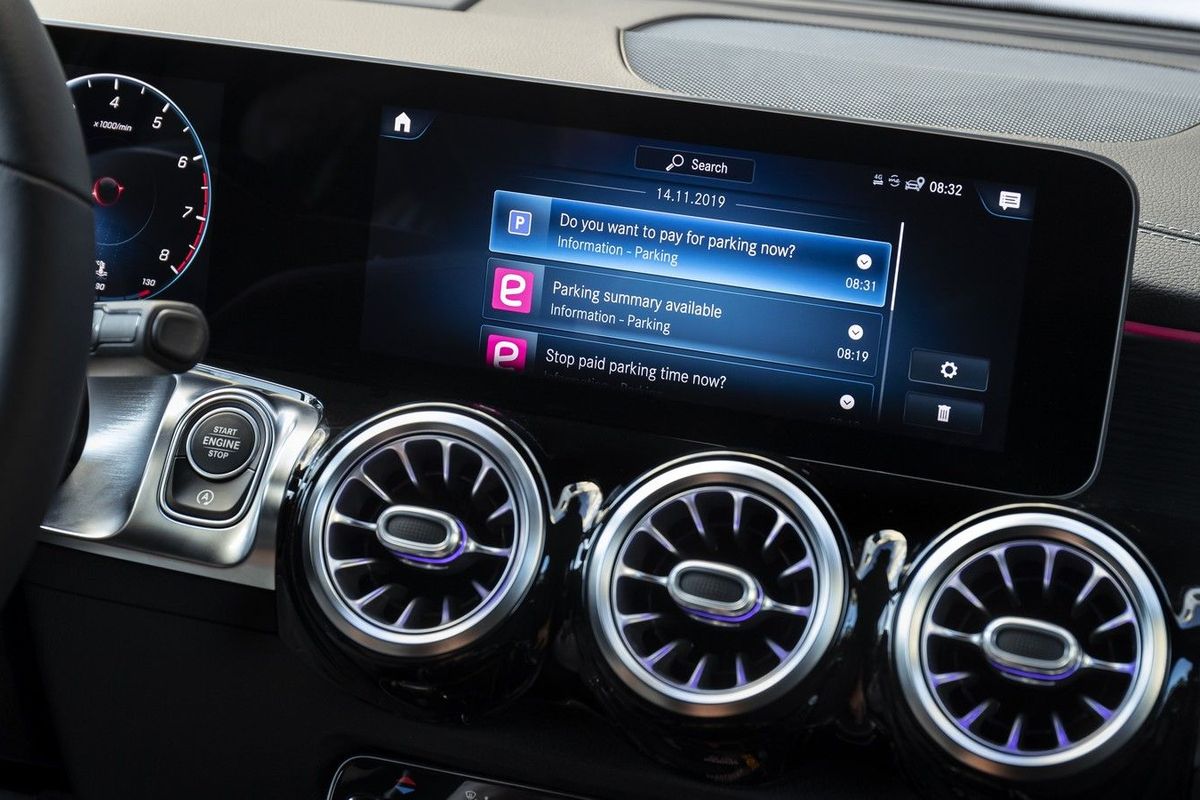
Matters improve markedly inside, where the GLB benefits from the slick wall-to-wall TFT infotainment and all-digital instrument cluster that made its debut in the A-Class last year. Some of the plastics used lower down in the cabin look and feel a little scratchy, but otherwise, it’s a high-quality affair that rivals anything on offer from BMW and Audi. In fact, with its neat trio of turbine air vents, a pair of metallic climate control toggles and 3-spoke multi-function steering wheel, you could be forgiven for thinking you're seated inside an A-Class – the raised driving position aside, of course.
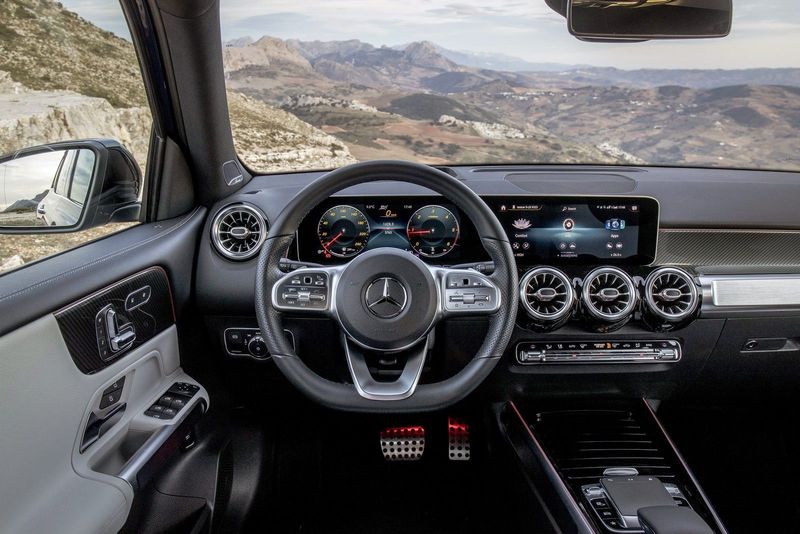

The tasteful implementation of the MBUX user interface and strategic brightwork lifts the newcomer's cabin ambience appreciably.

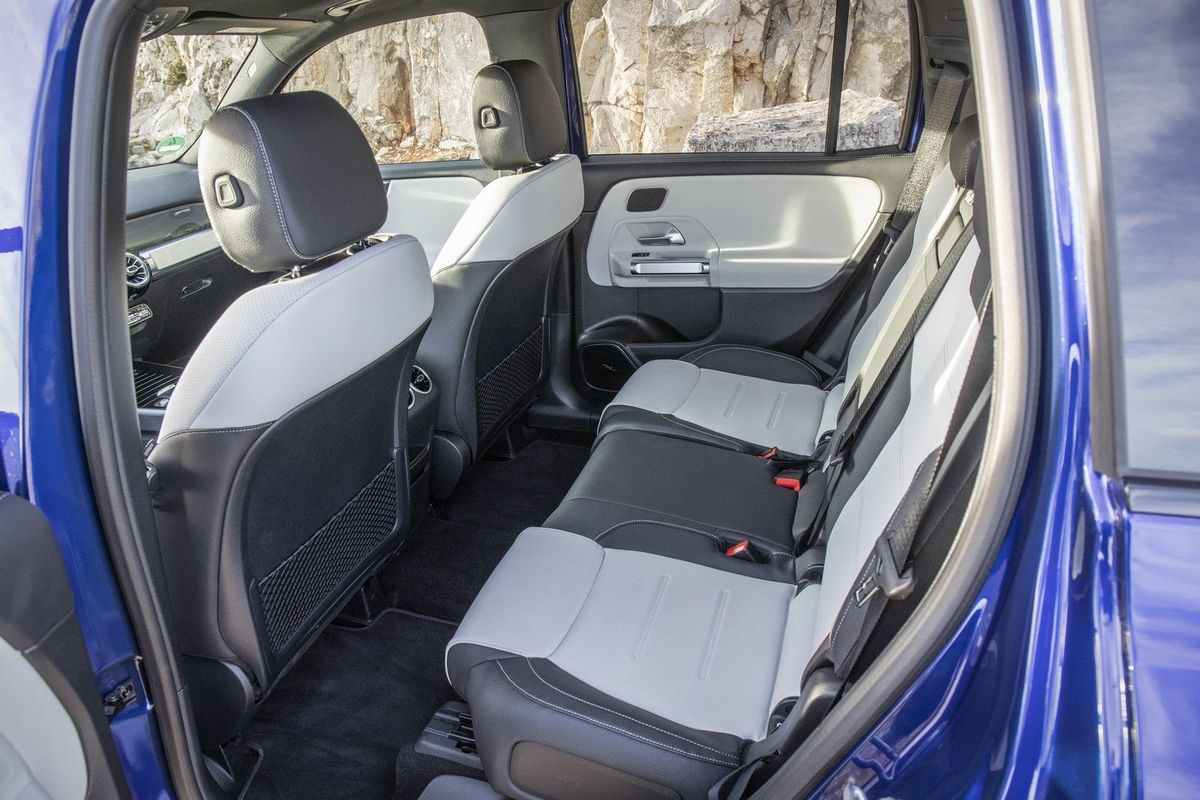
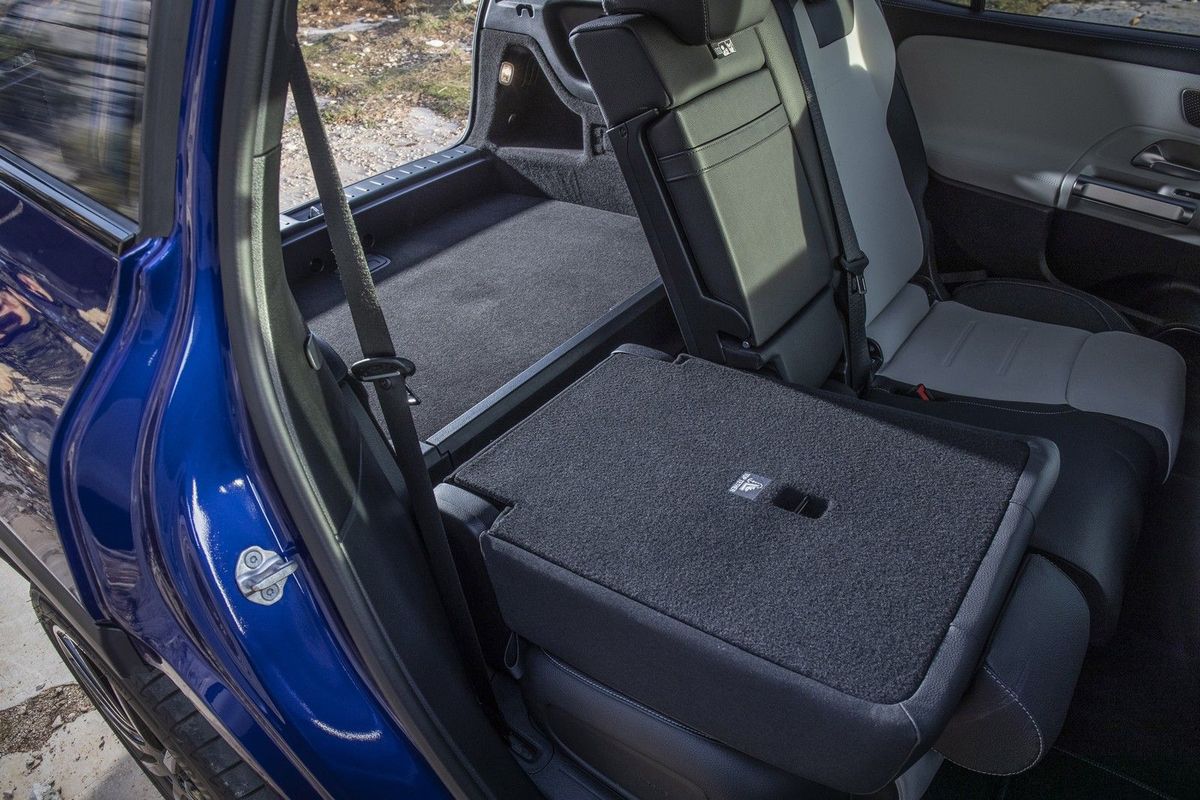
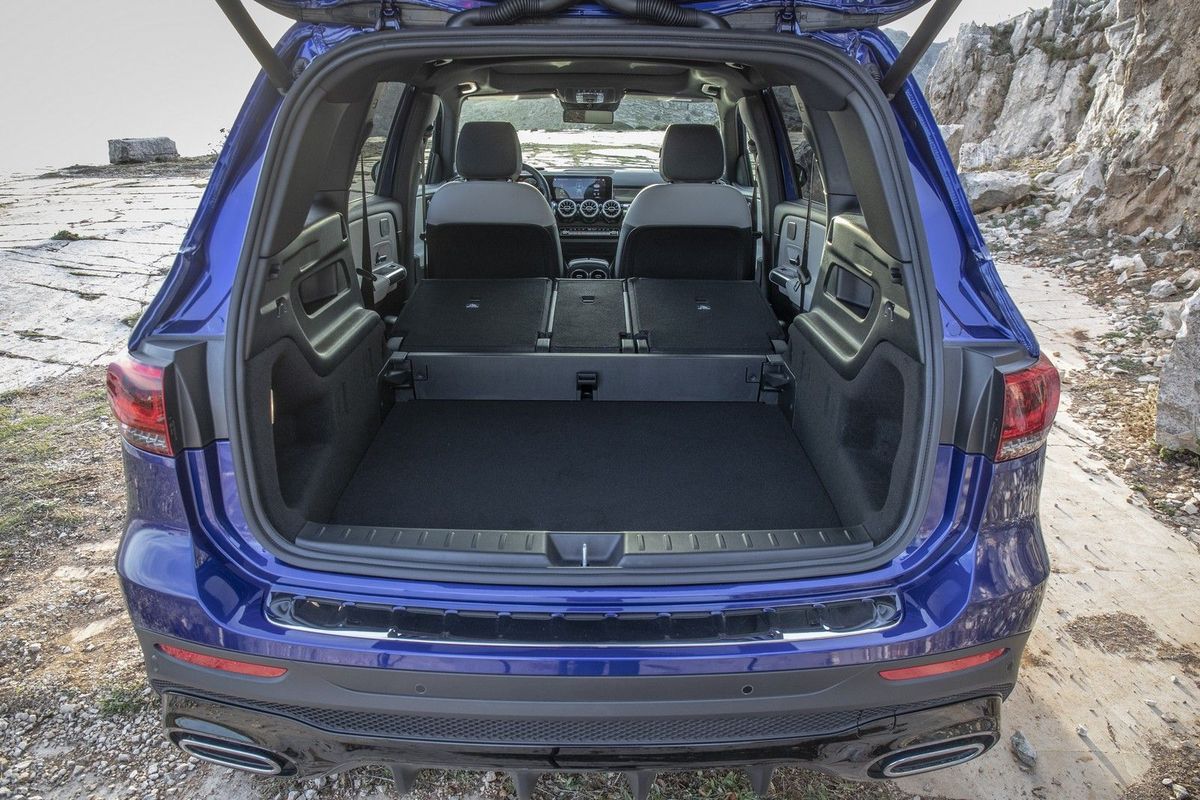
It’s fairly spacious, too, although the optional 3rd row of seats is designed for young children or occasional adult use only because, with the sliding 2nd row in its rearmost setting, there’s virtually no legroom behind it. Speaking of space, load bay capacity shrinks from a handy 570 litres with the 3rd row stowed (it folds into the floor in an easy movement) to virtually nothing with the chairs raised – a Land Rover Discovery Sport offers more space with seats up or down.

More of a Q5/X3 rival than a foil to the Q3/X1 

The GLB is essentially based on the same MFA2 platform as the A-Class, although it’s been stretched by 100 mm (to accommodate those extra seats, for those who wish to upgrade from 5- to 7-seater configuration). It can sometimes be tricky to judge a vehicle's size from pictures… One'd think the SUV variant of the A- and B-Class would be directly comparable with the Audi Q3 and BMW X1, but if you get the tape measure out, you'll notice the GLB is closer to those cars' respective executive-class siblings: the Q5 and X3. The Benz is only about 30 mm and 70 mm shorter than those cars, nearly as wide and within a whisker in height of its Ingolstadt-based rival (and 22 mm shorter than the Bimmer). 
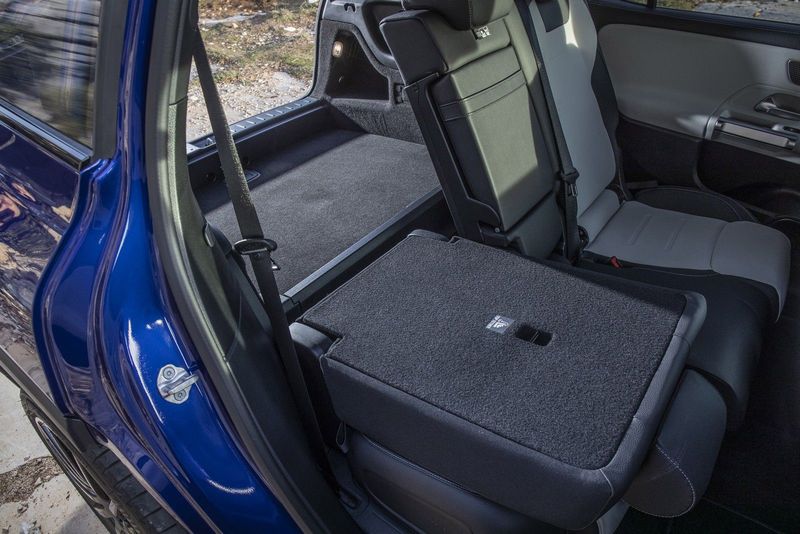

The 2nd-row bench can slide fore/aft in a 140-mm range. In 5-seater configuration, loading practicality increases substantially. 

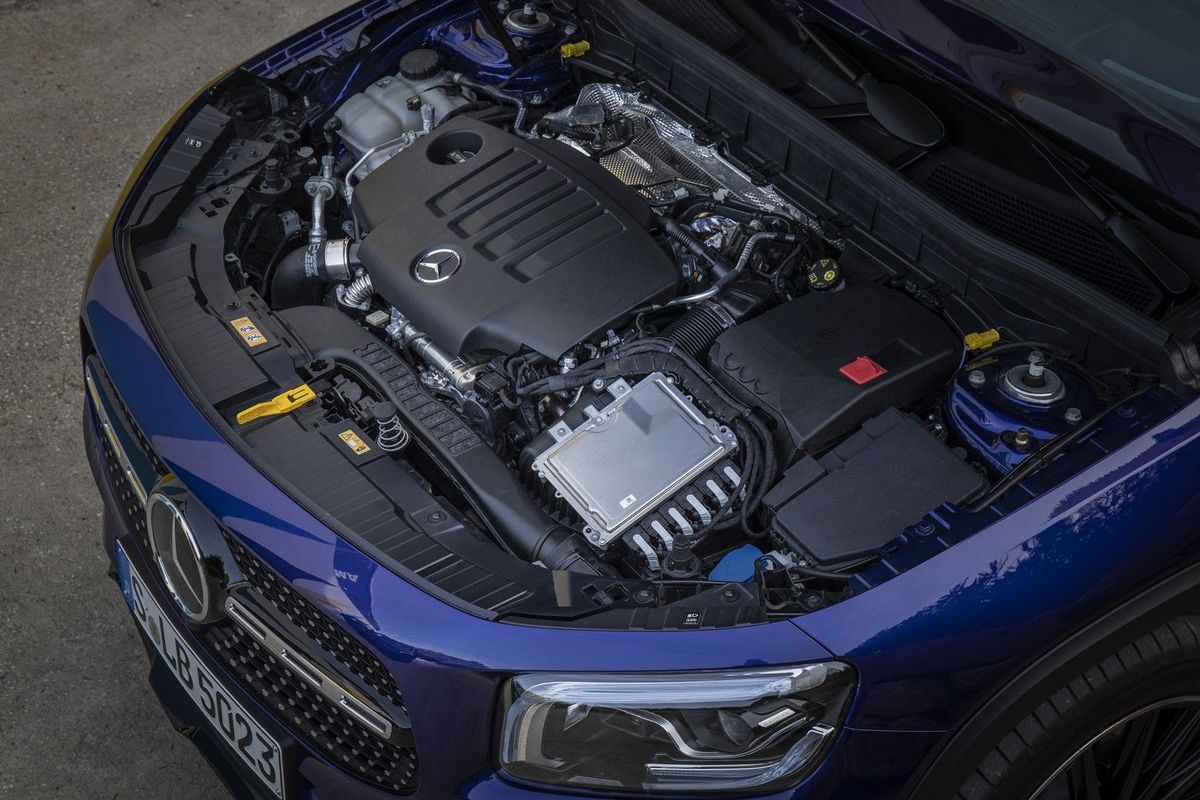
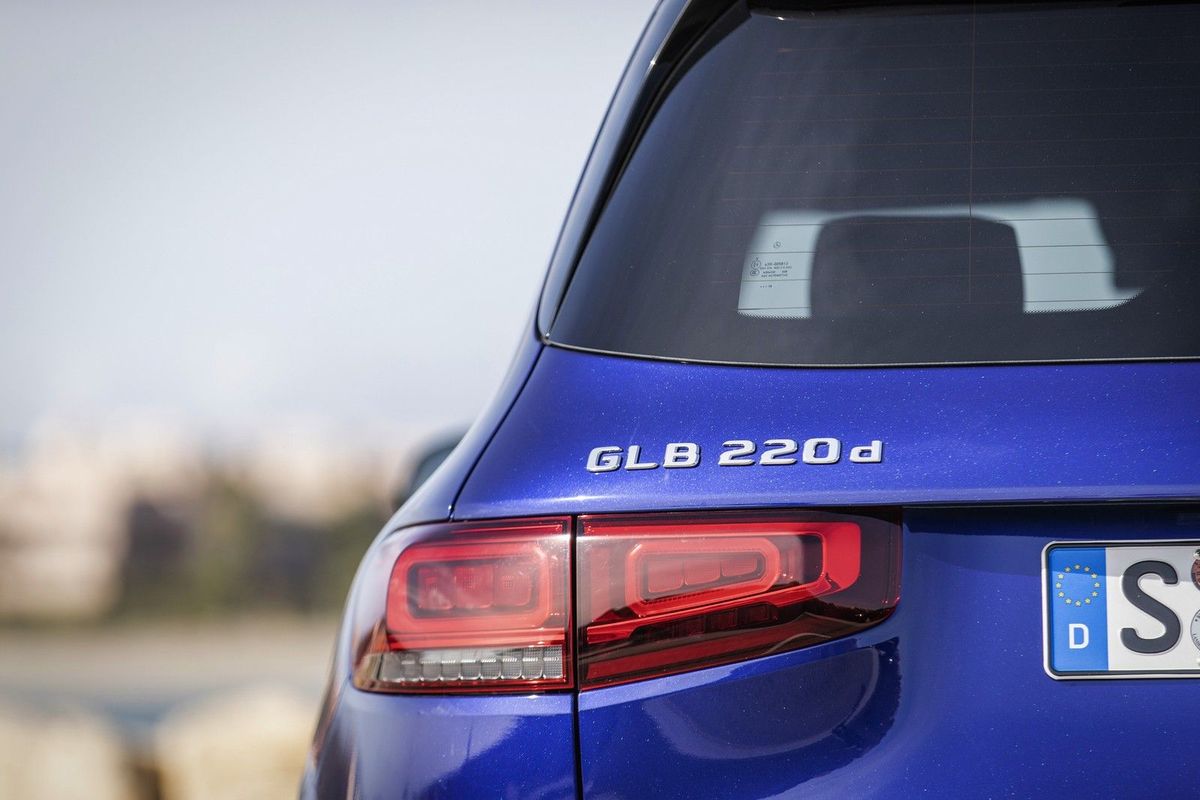
The familiar Mercedes-Benz architecture means a similar line-up of 4-cylinder turbopetrol and -diesel engines, up to and including the 225 kW/400 Nm AMG-fettled A35, which isn't coming to South Africa… not in the immediate future, anyway. The South African launch line-up will comprise the GLB 250 (165 kW/350 Nm) in front-wheel-drive guise and the GLB 220d 4Matic, both of which will feature the newly-developed 8-speed dual-clutch (automatic transmission).

During the launch, we sampled the GLB 200 (also FWD), powered by a 1.3-litre turbopetrol 4-pot developed jointly with Nissan/Renault. Given the motor’s small size and the GLB’s 1 555 kg kerb weight, its performance was fairly brisk. Peak torque (250 Nm) is available at just 1 620 rpm, plus the nicely insulated engine will happily rev to 6 000 rpm. Drivetrain responses are boosted by the dual-clutch transmission, which slots home its ratios quickly and smoothly.
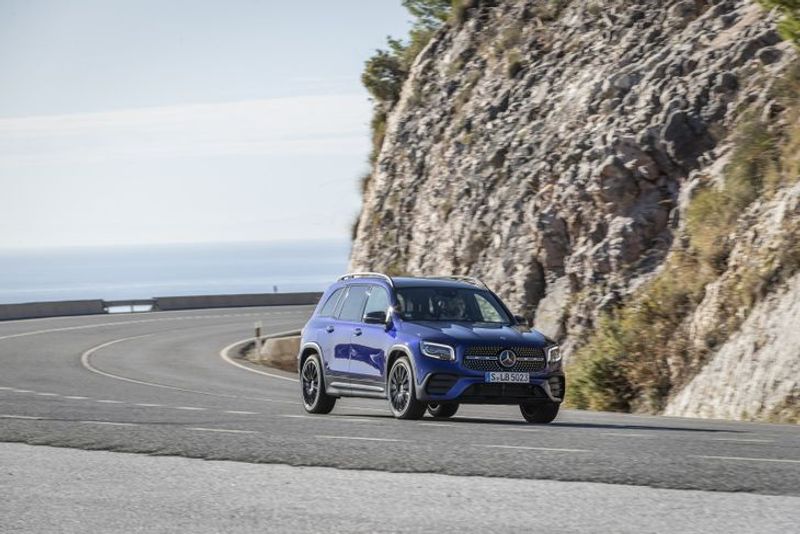

As opposed to the A200 hatchback, the GLB 200 features a (notably pliant) multi-link rear suspension setup.

The car’s dynamism is best described as easy-going – the package is geared towards delivering everyday comfort, as opposed to crisp cornering ability. All GLB derivatives feature a McPherson-strut front- and a multi-link rear axle suspension setup (in contrast to the torsion-beam aft setup on cooking variety A-Class derivatives), while our test unit further benefited from optional adaptive dampers that, on our smoothly surfaced test route, served up welcome plushness over bumps. Benz's newcomer represents a quiet and comfortable way to get about. And while it’s not exactly a thrill-a-minute in the twisty bits, there’s enough composure and grip to allow you to maintain a decent pace.

The steering setup feels inert, but despite the tiller's lack of heft, it's precise enough to make the Benz's manoeuvrable in tight city confines. What's more, the GLB's body control is rather good, despite being prone to lean when pushing on. With some load going through the suspension, you can feel both axles sharing the cornering forces, which helps to minimise a natural tendency to understeer…
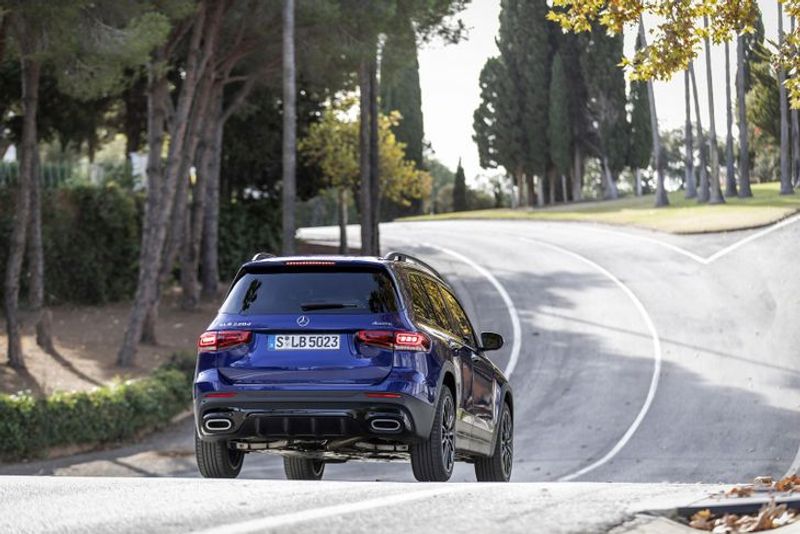

The ride quality of the GLB is impressive, especially when the Benz is equipped with adaptive dampers.

And for those who seek off-road ability, the GLB 220d derivative (140 kW/400 Nm) comes equipped with a 4Matic system that uses torque-vectoring technology (the transmission can be locked in a 50:50 split), hill descent control (which utilises the vehicle's dynamic stability sensors) and even an optional off-road lighting pack. With ground clearance of 200 mm, however, the Benz would be best suited to traversing dirt roads, sandy tracks and the odd grassy knoll.

Summary

If you consider the GLB a compact 7-seater, which is how Benz initially trumpeted its MPV-flavoured (but SUV-styled) crossover, then its first, best rival is the Land Rover Discovery Sport, which is a former #CarsAwards champion. It's a package that doesn't appear to need the beefier powerplants in the range to put its best foot forward, because it's likely to be used as a laid-back and versatile family runaround, besides, it works fine in its standard 5-seater configuration. Given its size and loading practicality (when it's not occupied by a full complement of passengers, mind you), the GLB is as big a threat to executive SUV models as the family-car offerings most people are likely to compare it with… 

Own a Mercedes-Benz? Tell us about your experience here

Related content:

Audi Q3 35 TFSI S tronic (2019) Review

Land Rover Discovery Sport Significantly Updated for 2019
Facelifted BMW X1 Revealed (SA Pricing Update)

Best Executive SUVs in SA – #CarsAwards Finalists

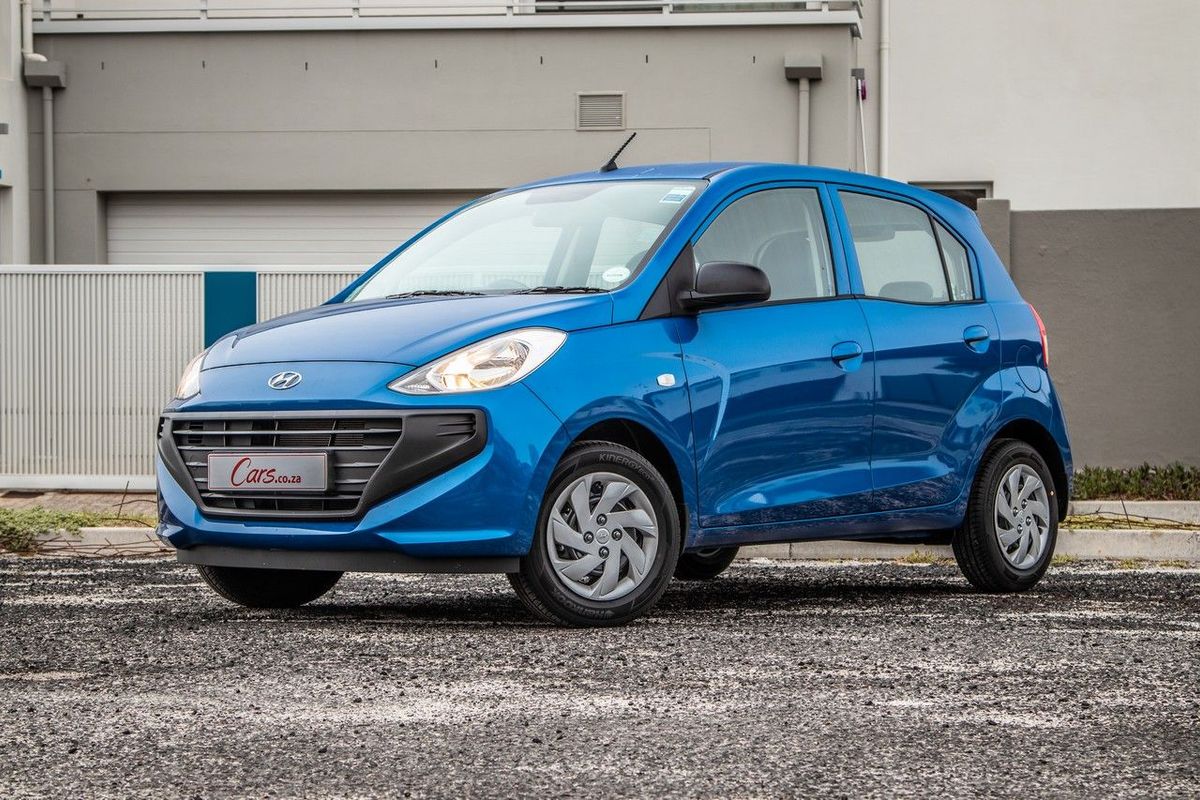
Hyundai Atos 1.1 Motion (2019) Review

The Atos nameplate has made a welcome return to the South African market. Should you add it to your list if you're shopping in the (very price-sensitive) entry-level hatchback segment?

We Like: Build quality, exceptional specification, good driving traits, brand cachet, warranty and after-sales support.

We Don’t Like: Small load bay, no steering column/driver's seat adjustment and lack of rear wiper/demist function.

Fast Facts

  • Price: R159 900
  • Engine: 1.1 naturally-aspirated 4-cylinder petrol
  • Power/Torque: 50 kW / 99 Nm
  • Transmission:  5-speed manual gearbox
  • Fuel economy: 5.9 L/100 km
  • Load capacity: 235 litres

Own a Hyundai? Tell us about your experience here

SERIOUS ABOUT BUYING?


Built in India as the Santro, the Hyundai Atos has made a welcome return to the SA motoring landscape…

What is it?

The plucky Atos is back. Like its predecessor, this new model is assembled in India and, judging by details on Hyundai India's website, the SA version is similarly-specced to the model in its home market. From launch, there's just the one derivative: the 1.1 Motion. Hyundai SA already has a budget-car offering in the shape of the Grand i10, but the Atos sits below that and is targeted at first-time buyers, the rental market and consumers who are obligated to "buy down". This segment is hotly-contested by a number of brands vying to find the best balance of features, performance, safety tech and price. Some of them are even offering complementary insurance deals to sweeten their propositions.

On paper at least, the new Atos looks primed to take on the budget segment. A long spec-sheet is only half the battle won, so without further ado, let's get stuck into the 2019 Hyundai Atos to see if it's worthy of your consideration.

How does it perform in terms of…

Performance and efficiency


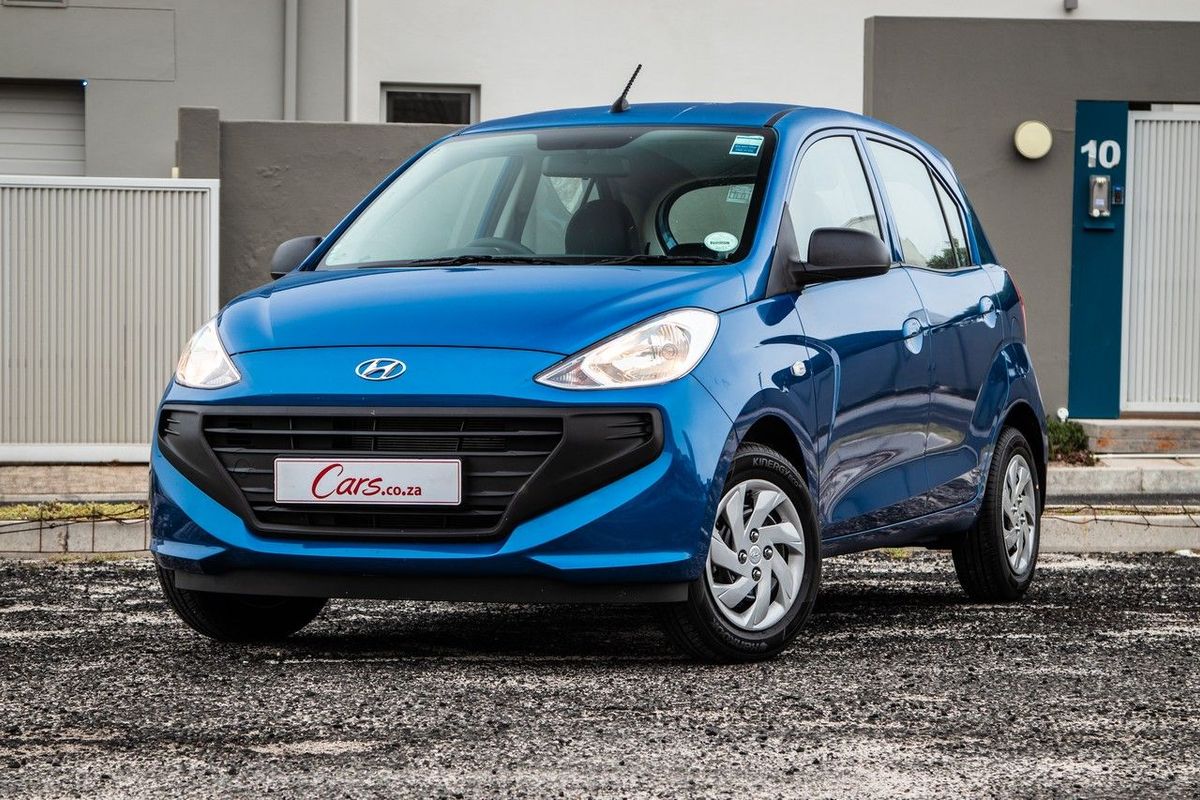
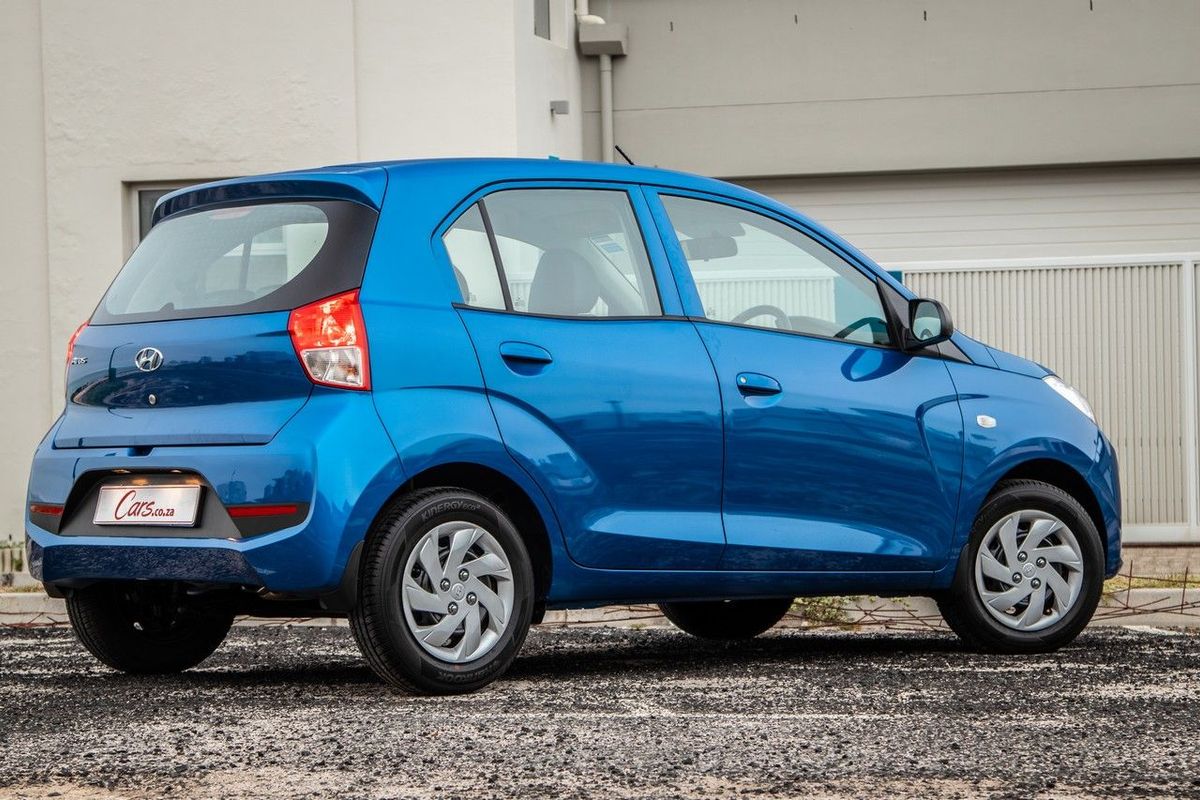
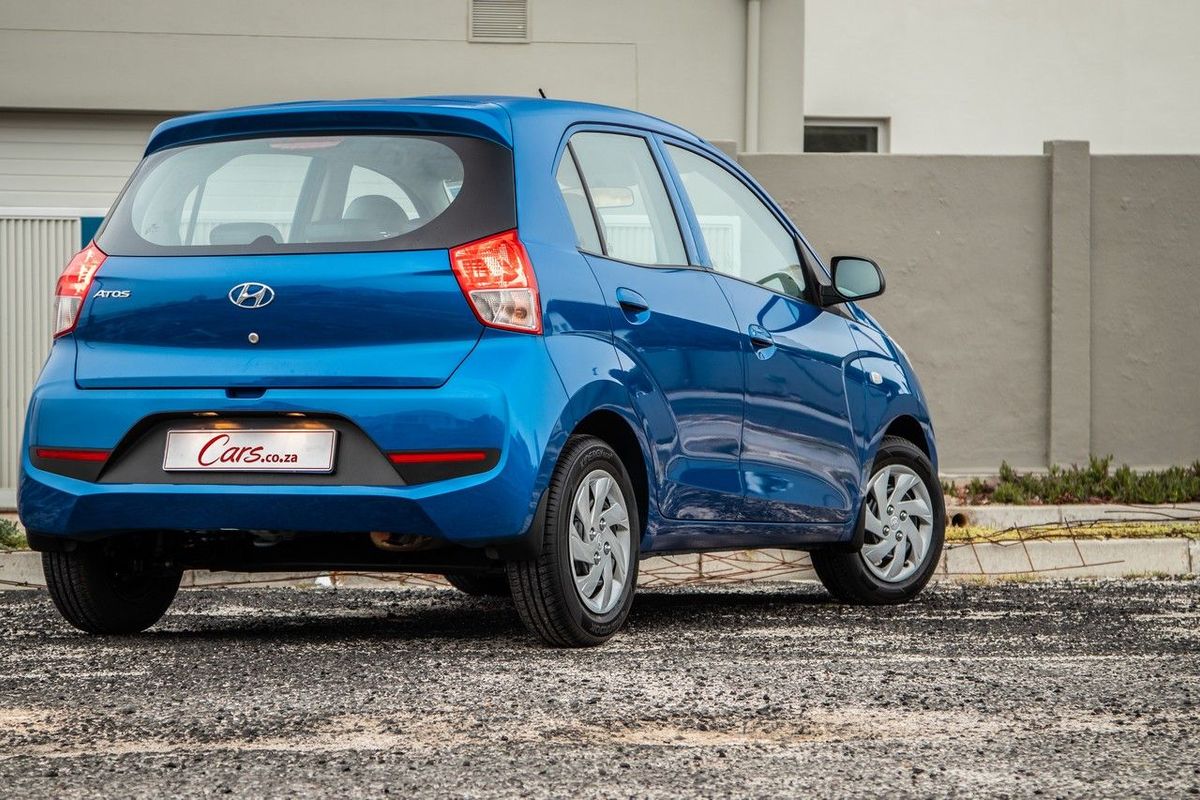
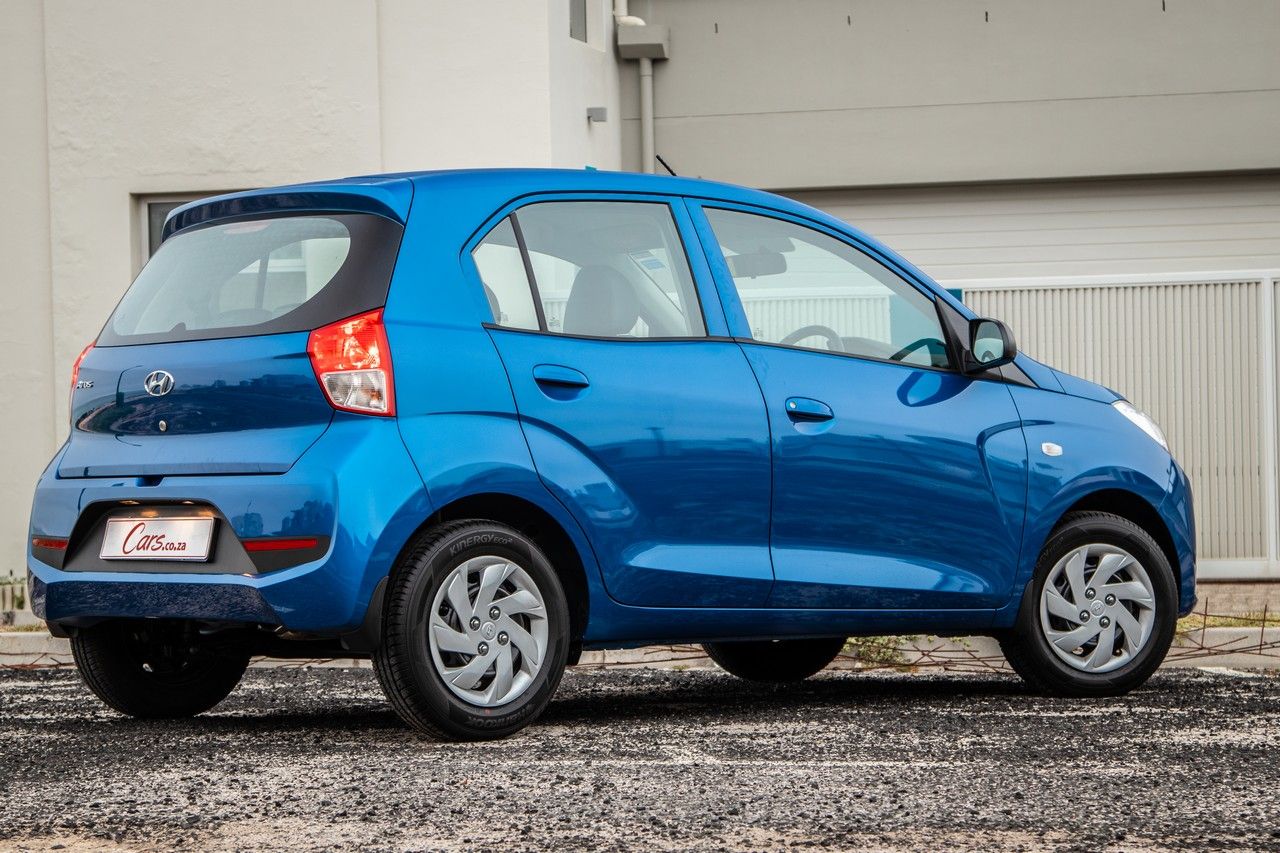
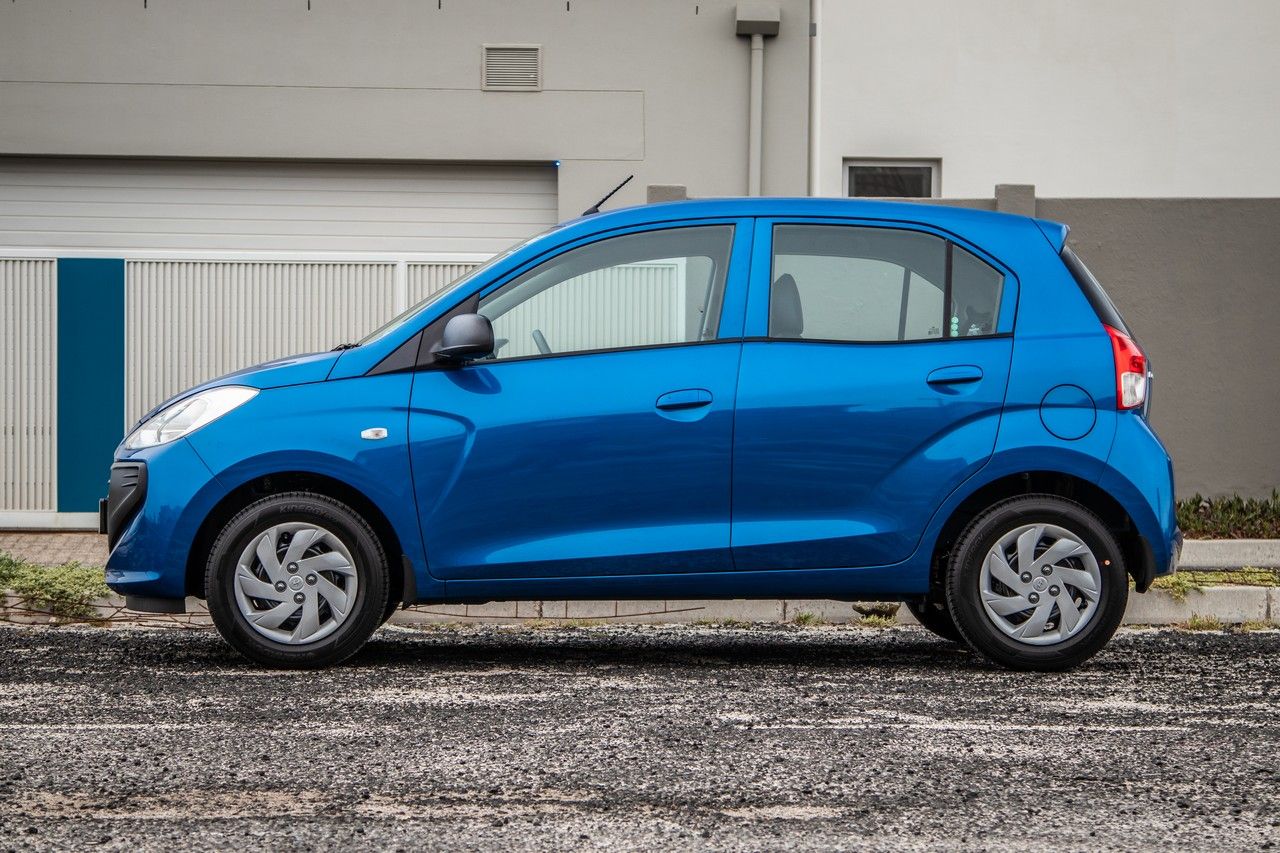
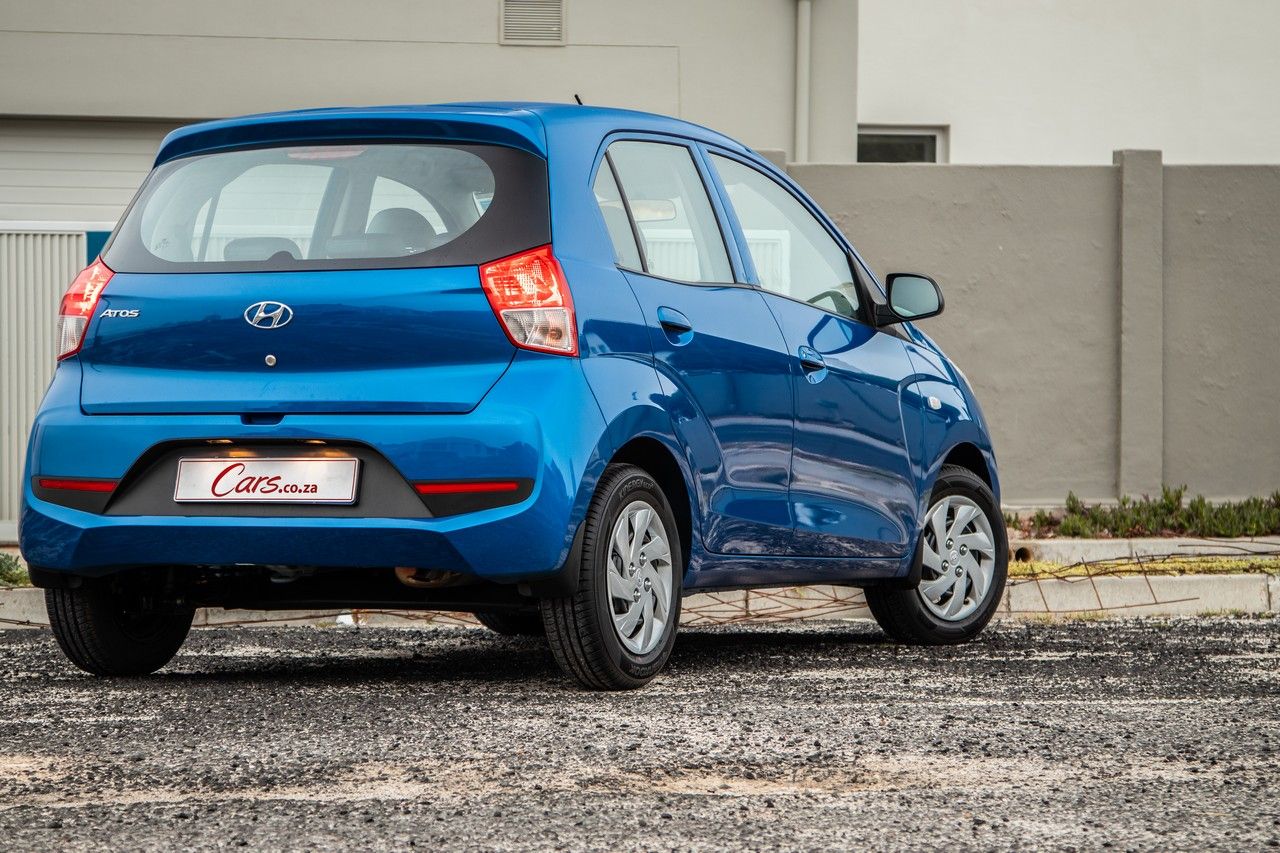
The Atos' design is inoffensive enough and features just enough "fluidic sculpture" cues to be instantly recognisable as a Hyundai.

The Atos' naturally-aspirated engine boasts an extra cylinder over the Datsun Go and Renault Kwid (4) and its displacement (1.1 litres) sits bang in between those of its Japanese and French rivals. Workmanlike outputs of 50 kW and 99 Nm of torque drive the front wheels via a 5-speed manual 'box. An advantage of the additional cylinder is that the motor runs smoother. In this segment, refinement measures such as precision engine-balancing and vibration damping are not particularly important, therefore although 3-cylinder-engined models emit rorty off-beat engine notes, their vibrations can become intrusive/bothersome at higher revs. This 4-cylinder unit feels and sounds quieter and more refined.

Hyundai claims an average fuel economy figure of 5.9 L/100 km, but we found ourselves hovering in the low 6s, which is still more than fair if you combine urban and open-road driving. The fuel tank has a capacity of 35 litres.

Ride and handling 


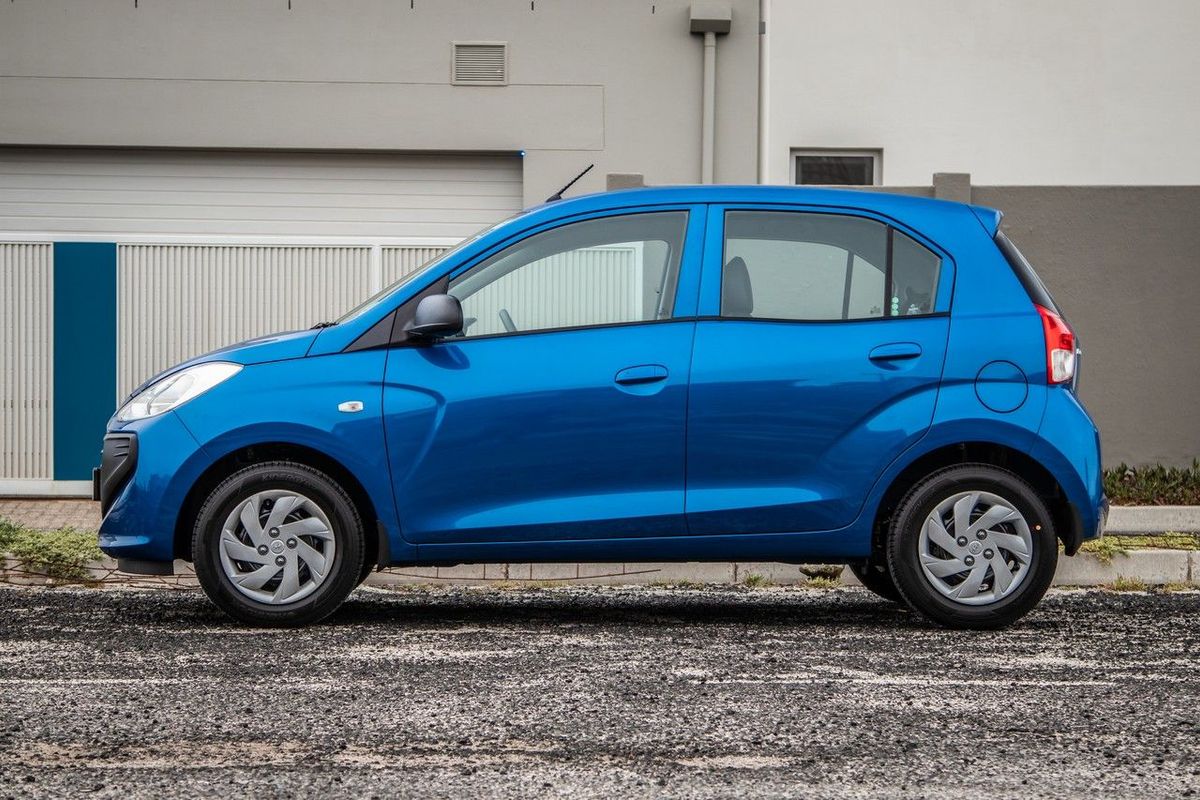
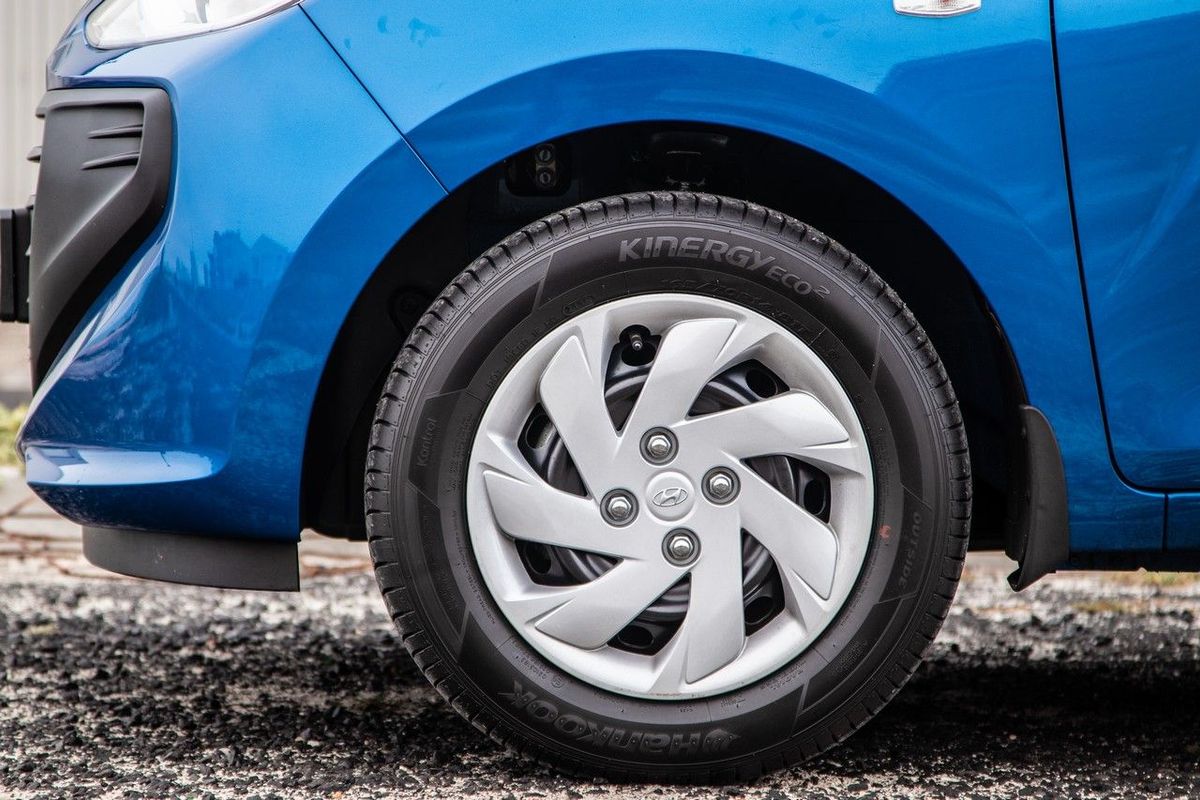
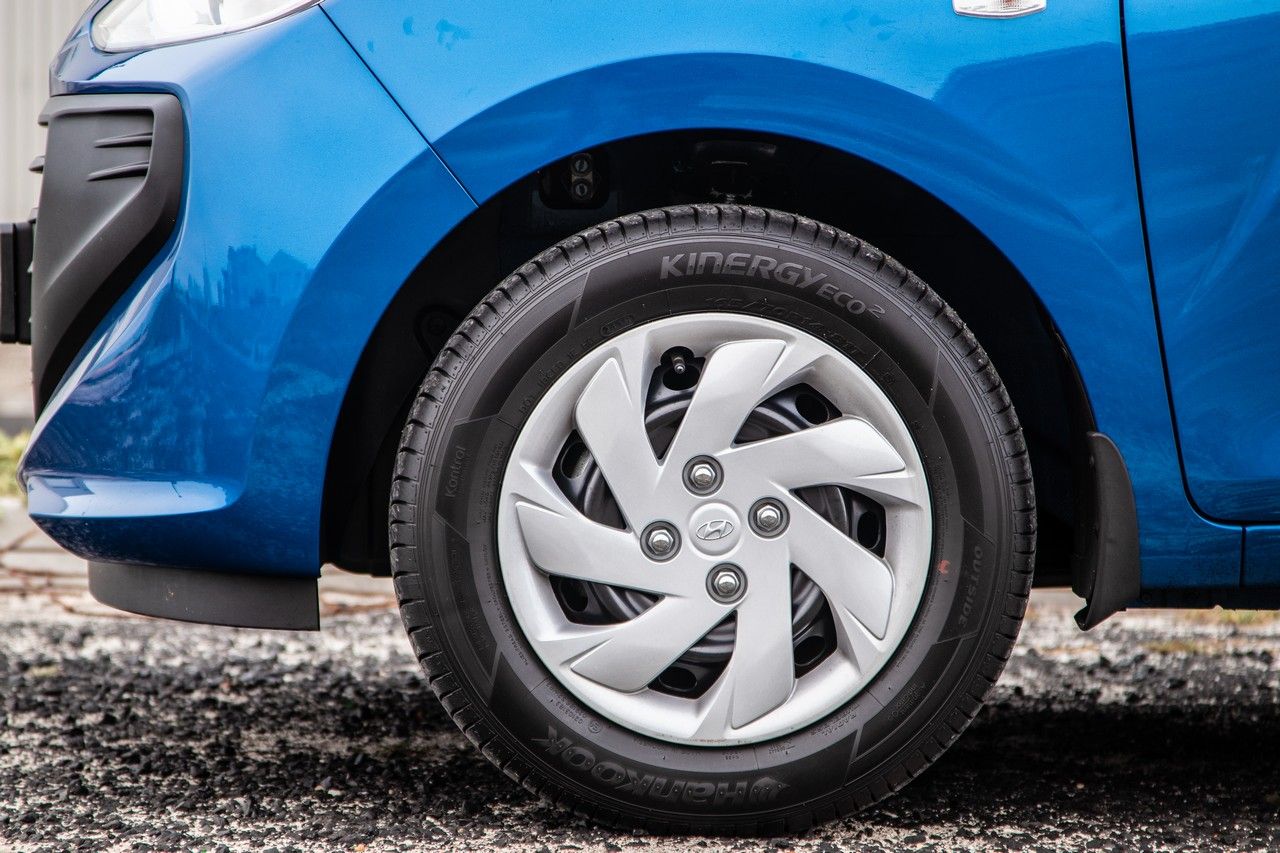
These 14-inch wheels (with covers) aren't fancy alloy items, but the higher-profile rubber facilitates a more absorbent the ride quality.

Around town, the Atos' motor is tractable enough to move the 870 kg Atos about with intent, but bear in mind that we tested the 1.1 Motion at sea level… in Gauteng, where non-turbo motors (such as this 1.1 litre unit) lose about 20% of their performance due to the thinner atmosphere, the Hyundai might struggle when loaded up with a couple of adult passengers and their cargo, especially on inclines or when overtaking acceleration is required. As mentioned before, the 4-cylinder mill accelerates smoothly, but the engine note increases dramatically as it approaches its rev limit. The 5-speed 'box gets a thumbs-up because it's slick, direct and easy to use, which is just as well because you'll be working it often to keep the engine on the boil. The short gearing makes the newcomer feel spritely, but a 6th ratio would have been handy to reduce mechanical noise/keep the revs down at the national speed limit; they sit quite high at 120 kph.

The short wheelbase and torsion beam rear suspension setup don't provide cossetting occupant comfort, but at this price point, the general ride quality is more than acceptable. The new Atos rides on 14-inch steel wheels wrapped in generously-sidewalled (Hankook) tyres. The steering is light and fairly direct, which is what you'll want in a compact city car. We noticed that the turning circle of the Atos was small, making it a cinch to manoeuvre in parking lots.

Interior quality and features


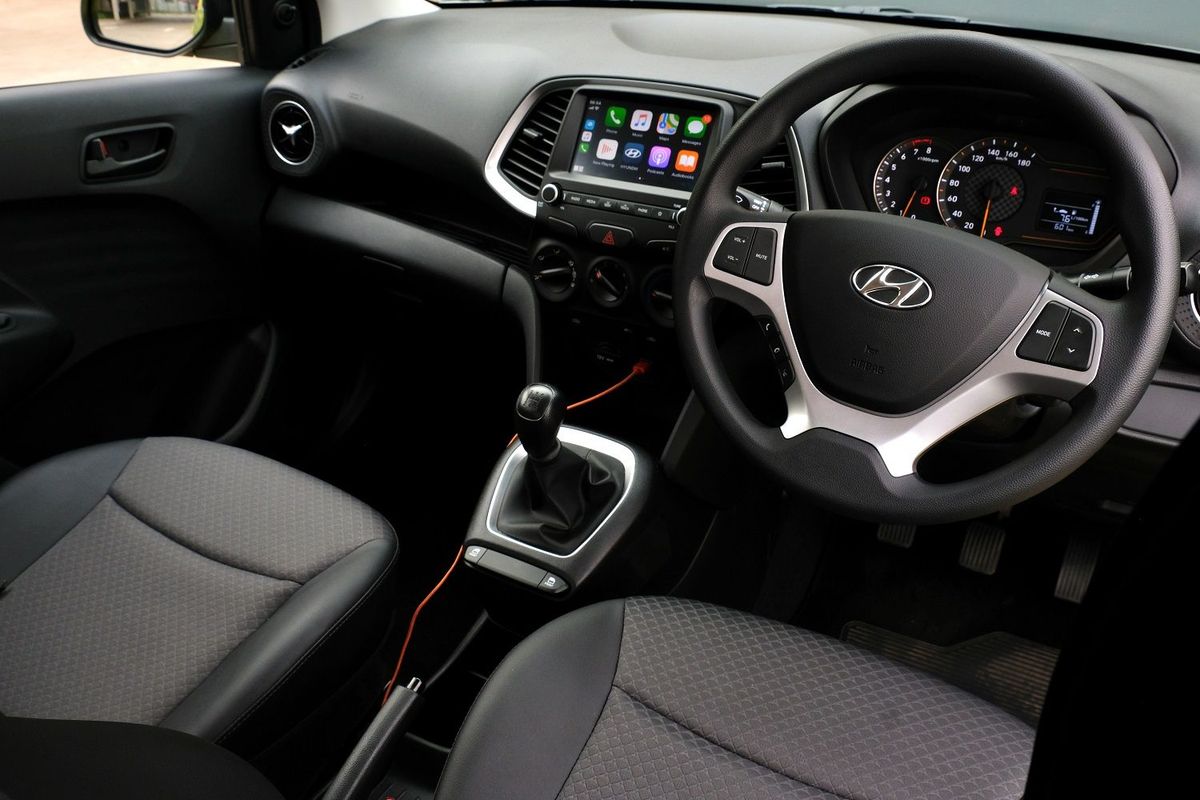
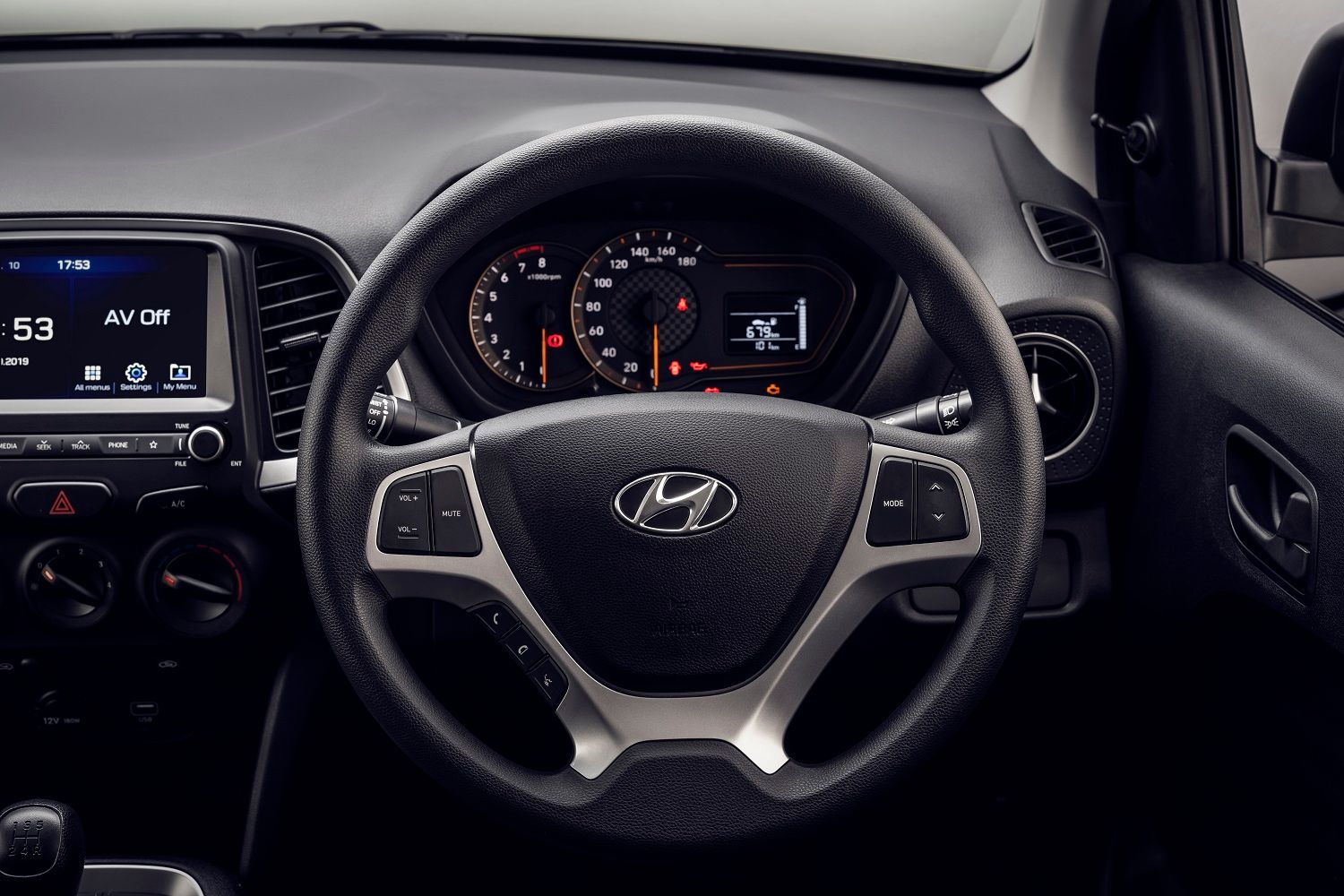
The cabin of the Hyundai Atos may be simple, but it doesn't feel cheap.

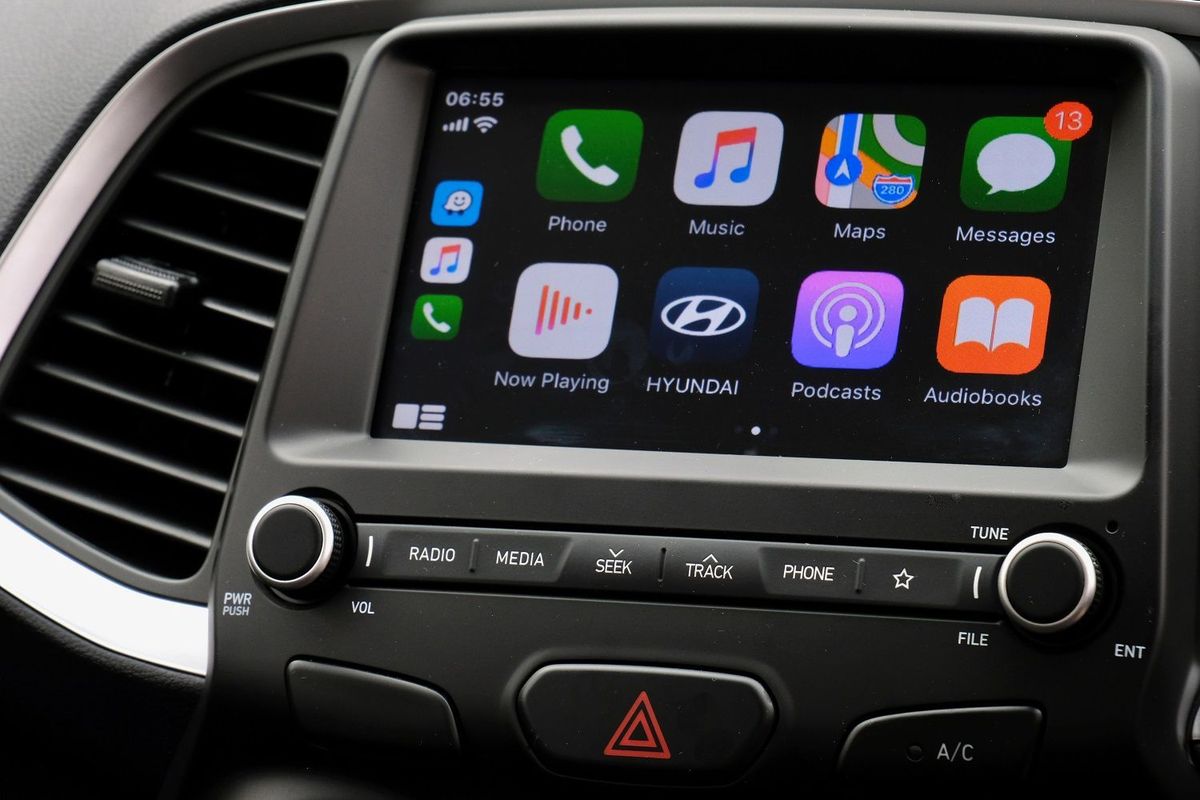
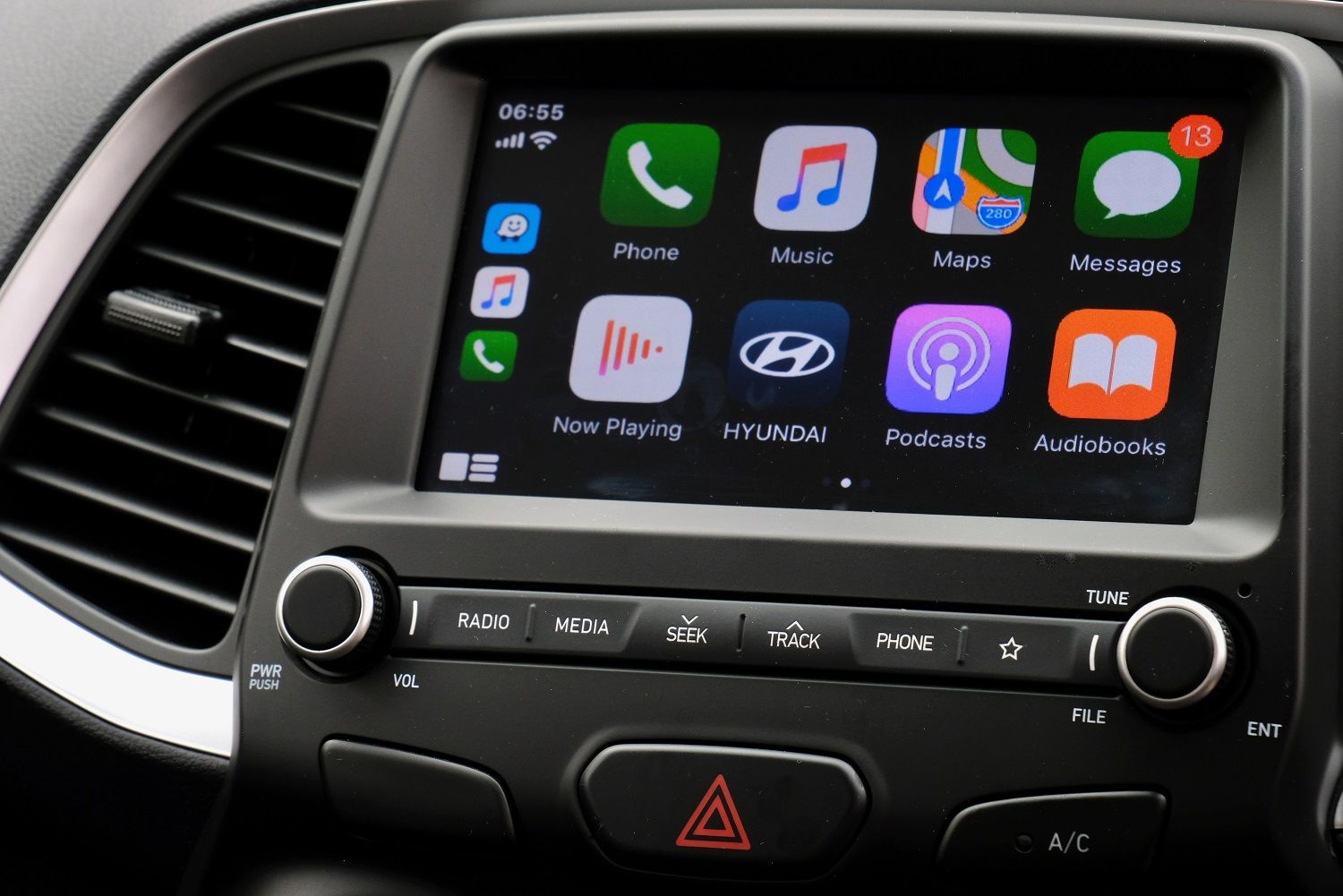
Hyundai knows a thing or 2 about making good-quality interiors and even in this budget-oriented Atos, the Grand i10's solid and durable-feeling cabin materials have been successfully carried over. Compared with its Japanese and French rivals, the Atos' plastic components and surfaces feel more upmarket and although it's an affordable car, it doesn't feel like a cheap car, which is a commendable trait. The 7-inch touchscreen infotainment unit from the Grand i10 is retained as well, which is great because it offers an intuitive, unfussy user experience. It comes with Android Auto/Apple Carplay and if you want even more connectivity, there's USB/Bluetooth, as well as a 12V charger.

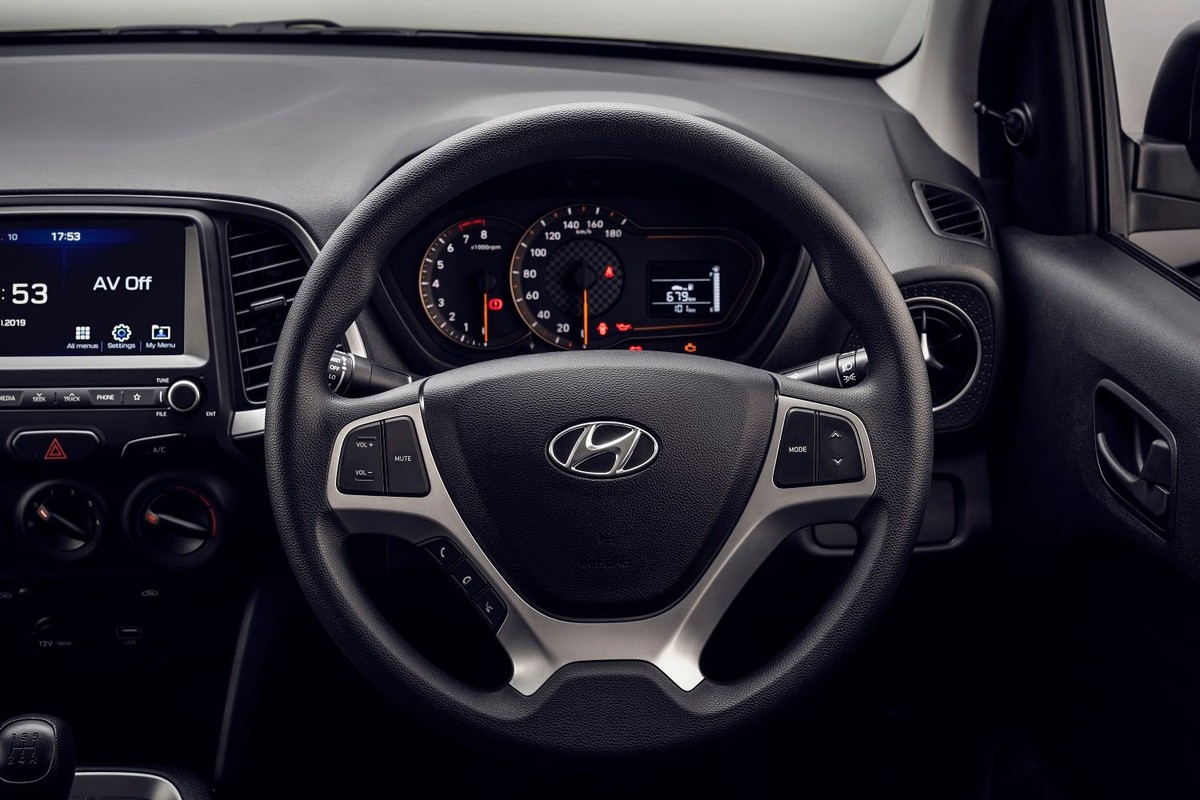
The Bluetooth hands-free functionality, which can read out WhatsApp messages out to you (to which you can, in turn, reply) is a boon to safety, Google Maps adds navigation functionality to the car and you access streaming services like Spotify directly. Another big advantage of the new Atos is the provision of steering-wheel controls, including audio volume and change-track/station toggles, as well as the ability to activate your smartphone and answer/decline calls.

Safety is a prickly subject as far as entry-level hatchbacks and budget cars are concerned. Stability control is rare at this end of the market, but we're glad to see anti-lock braking (ABS) is becoming commonplace. The Go and Kwid lacked ABS upon their initial release and were slammed by many commentators; that's been rectified, but the damage has been done. Worse still, Global NCAP tested those cars in India and found their structures unable to withstand severe impacts. This Atos, for its part, didn't fare too well in the Global NCAP test either and scored just 2 stars. It does, however, feature ABS with EBD and 2 airbags as standard – it'd qualify as a #CarsAwards budget car contender.

While we think the new-generation Atos boasts impressive levels of standard specification, such as the aforementioned Apple CarPlay/Android Auto-compatible infotainment system, front electric windows and (surprisingly potent) aircon, we did note that the Hyundai's missing a rear demister/rear wiper combination. 


It's keen entry-level hatchback price point notwithstanding, the Atos joins the ranks of the budget-car segment by offering Android Auto / Apple Carplay.

Practicality 

One of the few gripes about the Atos concerns its hardly-adjustable driving position. The steering column is in a fixed position (which feels a tad too low), and the driver's seat merely slides and reclines (in other words, it lacks height adjustment). This gives you a feeling of you're sitting on the car, as opposed to in it, and if you're a tall person like this author (and a number of the Cars.co.za testers), you're most likely to battle to find that perfect position.

However, this criticism is countered to an extent by the vehicle's overall height, which, at 1560 mm, is more than those of its rivals, and while it may not sound like much, it makes it easier to get in and out of the Indian-made hatchback. The load bay is notably one of the smallest in the segment, however, and is only really suitable for carrying small suitcases and a laptop bag or 2. 

Price and warranty 

The Hyundai Atos 1.1 Motion costs R159 900 and it comes with a 1-year service plan with intervals every 15 000 km. A 7-year/200 000 km warranty and roadside assistance for 7 years/150 000 km are included too.

Buy a Hyundai Atos in Cars.co.za

Verdict

In a country where affordability is a significant barrier to new-car ownership (not just in terms of asking prices, but also constrained household incomes), the humble Atos might be one of the most significant new-vehicle introductions of 2019, because it brings excellent value for money, strong brand reputation, reasonable refinement (oh, and an acceptable suite of safety features) to a sometimes maligned segment. Yes, its 2 rivals may boast a bit more power and less weight, but they lack the Hyundai's substance. You know you're getting into something near the bottom of the ladder, but hundreds of new-vehicle buyers do exactly that every month and now they another (and strong) option to consider. 

Should you buy one? Well, if you find yourself craving an all-new car at this price point, this is arguably one of the nicer and more pleasant offerings in the contemporary market. With the backing of a strong brand such as Hyundai and its comprehensive 7-year mechanical warranty, the new Atos 1.1 Motion holds a clear edge over its rivals. Is there a better vehicle, available from brand new, that offers a stronger proposition at R160k? We seriously doubt that. 

Related Content:

Hyundai Atos (2019) Launch Review

Hyundai Atos (2019) Specs & Price

Datsun Go CVT (2019) Launch Review

6 Cheapest New Cars in South Africa (2019)

Spy Shots: 2020 Volkswagen Golf 8 GTI

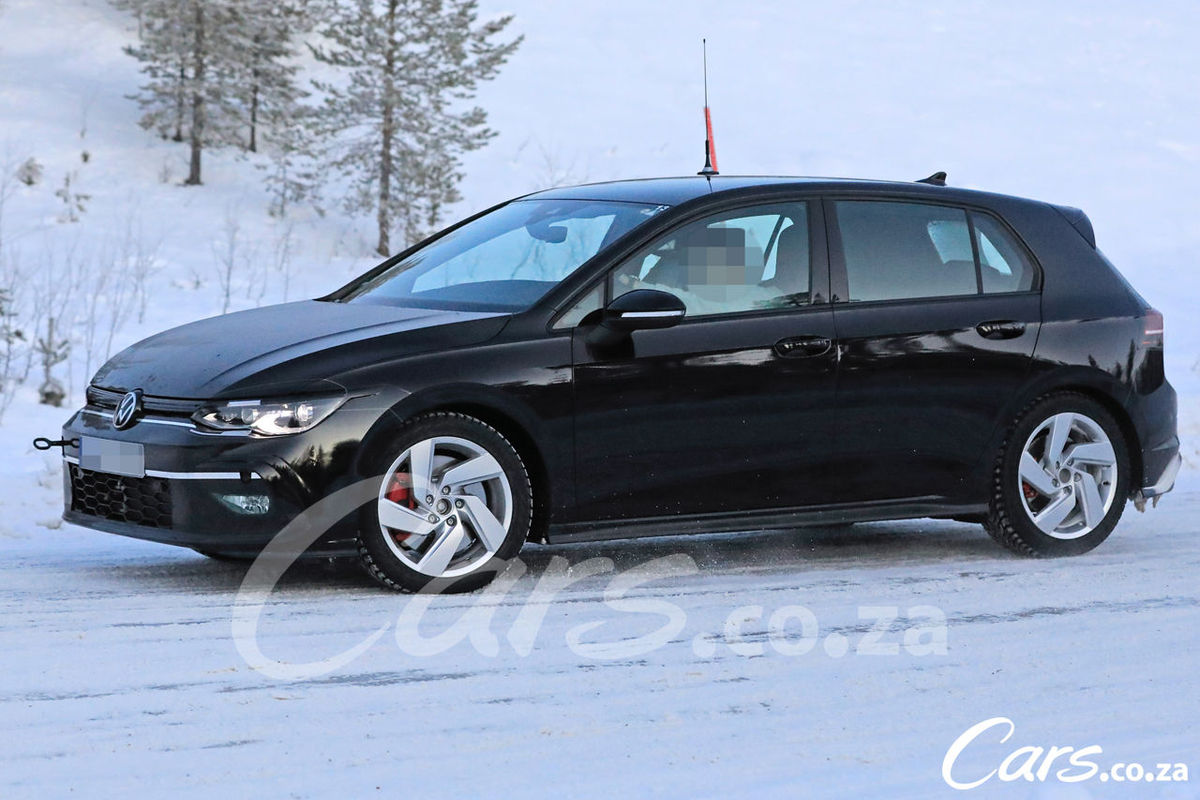
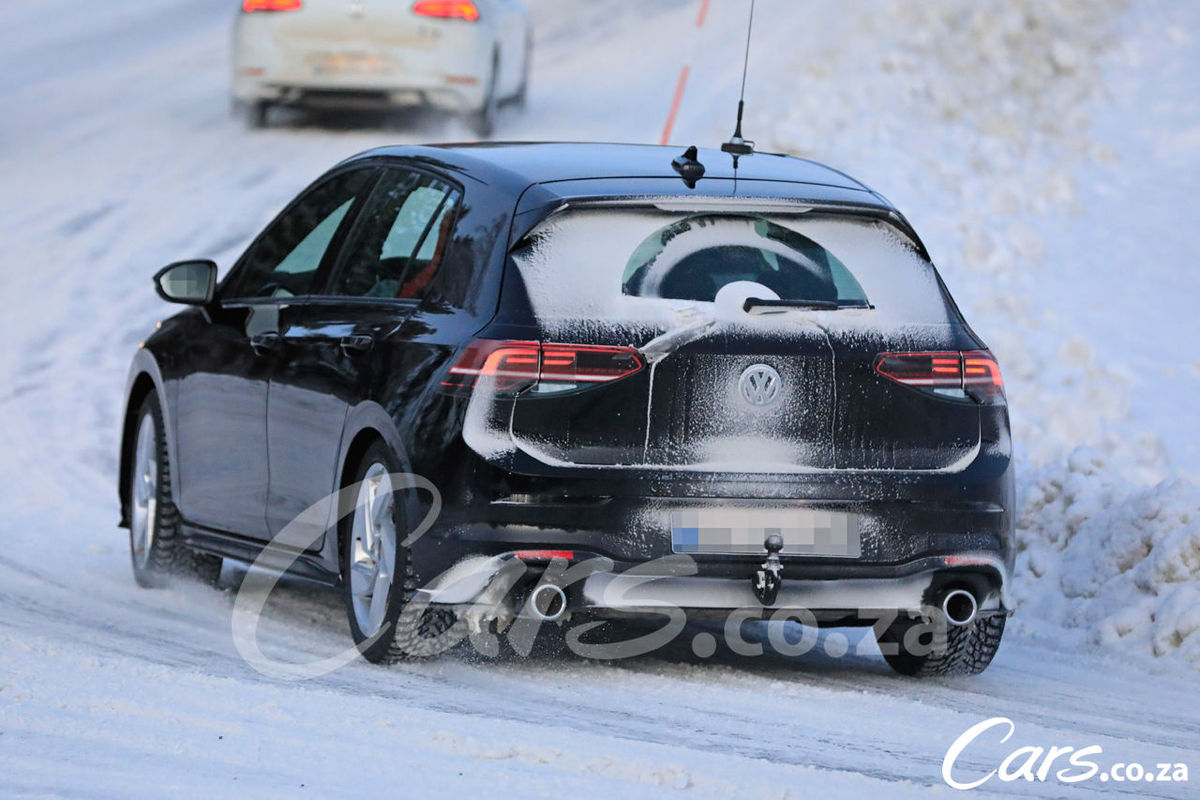
With the testing of the all-new Volkswagen Golf 8 all but complete, focus now turns to the performance versions. This is the 2020 Volkswagen Golf 8 GTI undergoing testing!

Picture credit: S. Baldauf/SB-Medien

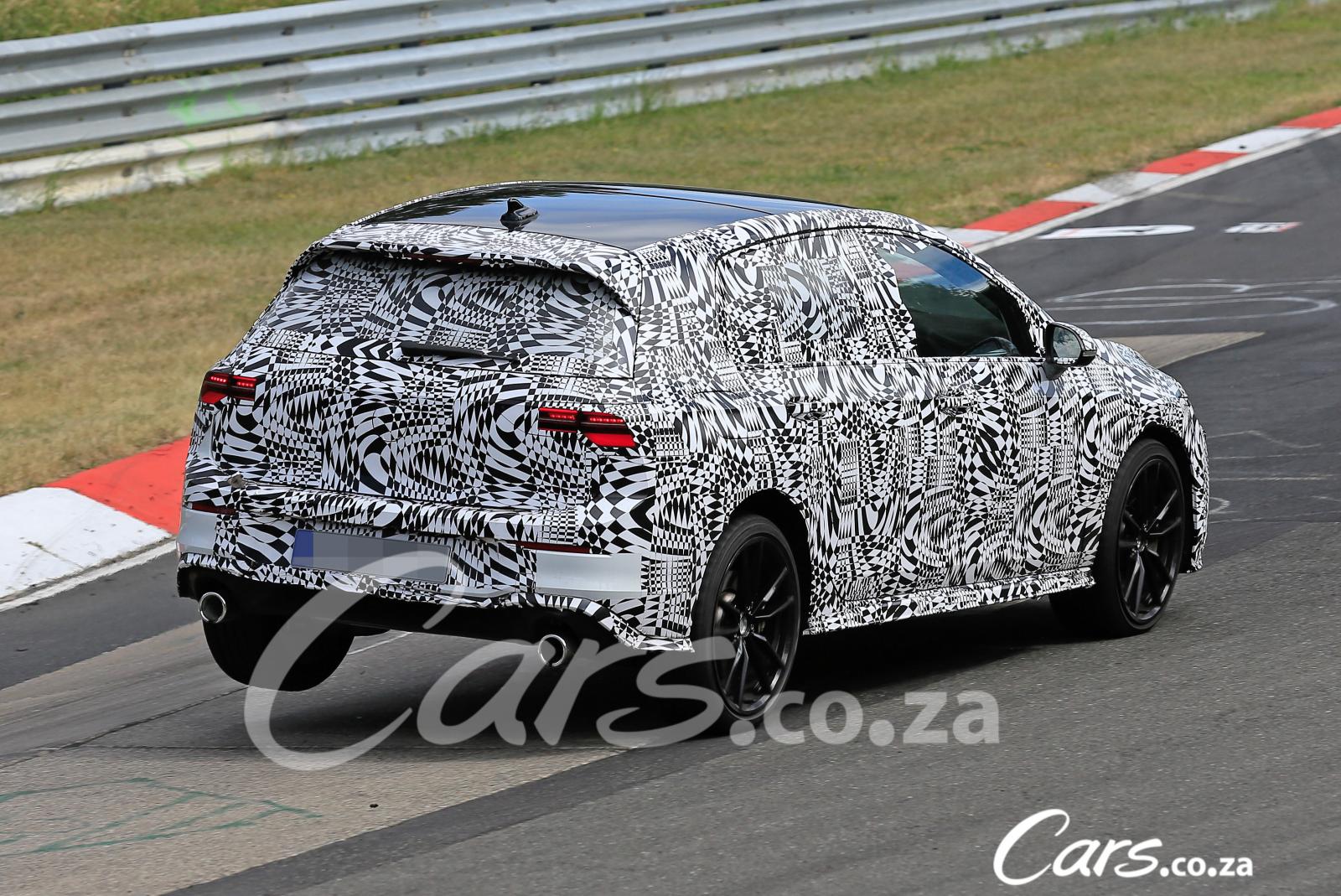
What you see here is the all-new Volkswagen Golf 8 GTI undergoing aggressive dynamic testing at the Nurburgring. The second photo shows the new car lifting its rear wheel – a phenomenon that only occurs when you're really pushing hard. So what do we know of the newcomer so far? 

Our photographer sources said it'll continue using the EA888 2.0-litre 4-cylinder turbocharged engine, however in this new version outputs will be increased. A figure of 300 hp (223 kW) is being thrown around, which is on par with the outgoing Golf R. If 223 kW will be the Golf GTI, how much power will the next-generation Golf R have? For the new Golf R to be competitive, it'll likely have at least 240 kW. 

The market has changed significantly since the last Volkswagen Golf 8 GTI made an appearance. The Ford Focus ST has just been launched and features a detuned 2.3-litre turbo motor from the Focus RS, while the Renault Megane RS has received a flagship Trophy-R derivative. It'll be fascinating to see how the newcomer fares against segment newcomer, the Hyundai i30 N too. Let's not forget the addition of the Mercedes-AMG A35 and the new BMW M135i xDrive to the segment either.

From the photos, we can see the all-new Volkswagen Golf 8 GTI has the stereotypical twin exhausts, bigger wheels and a bold new bumper. We expect the new Volkswagen Golf 8 to be revealed before the end of 2019, with an estimated arrival date in SA around the middle of 2020, with the GTI version following soon after.


Getting a hot hatch onto three wheels takes some doing, which means Volkswagen is testing its Golf GTI to extremes

Further Reading

Ranked: The 5 Best Volkswagen CitiGolfs

Official Volkswagen Golf 8 Sketches Released

New Volkswagen Golf 8 Boosted with Mild Hybrid Tech

New Volkswagen Golf 8 – What to Expect

Spy Shots: 2020 Volkswagen Golf 8

Best Fun Hatch in SA – #CarsAwards Finalists

Meet the finalists in the Fun Hatch category of the 2019/20 Cars.co.za Consumer Awards – powered by WesBank!

Now in its 5th year, the #CarsAwards was conceived to be South Africa's definitive automotive awards programme and is backed, for the 4th year running, by the country's leading supplier of vehicle finance, WesBank.

Read more about the finalists in the 2019/20 Cars.co.za Consumer Awards – powered by WesBank here!

Best Fun Hatch in SA

The Fun Hatch category is guided by both eligibility factors and Pillars of Success. 

Eligibility for this category includes a list price that falls between R300 000 and R500 000 at the time of semi-finalist voting (1 September 2019) to ensure that this doesn’t become a category dominated by extravagant and unattainable exotics.

Pillars of Success in this category include drivetrain engagement, handling, sensory appeal and standard features.

Visit www.carsawards.co.za for more information. The finalists are as follows:

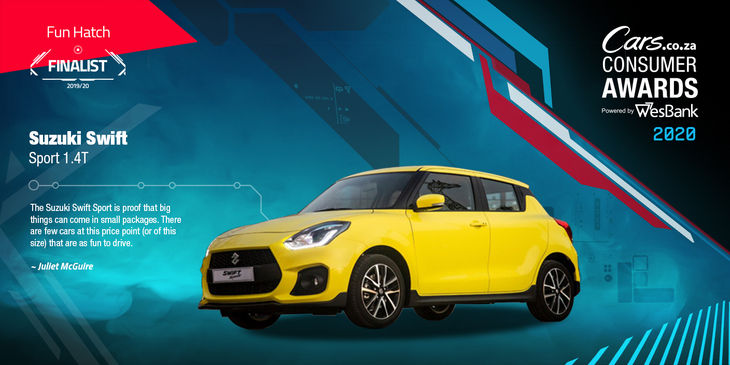
Suzuki Swift Sport 1.4T

The Suzuki Swift Sport delivers loads of fun-to-drive appeal and has gained a cult following over the years. Now, the Hamamatsu-based firm has introduced a new Swift Sport featuring a new turbocharged BoosterJet engine that seeks to up the fun-factor in Suzuki’s feisty compact hatch.

View specification details for the Suzuki Swift Sport 1.4T 

Do you own a Suzuki? Have your say and complete our Ownership Satisfaction Survey here!

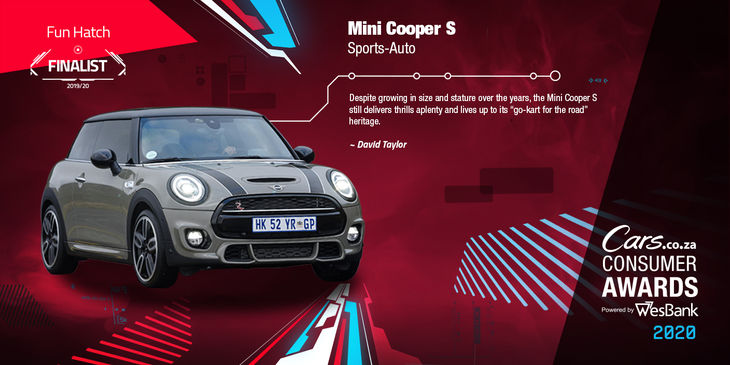
Mini Cooper S Sports-Auto

When you think of a “fun hatch”, the Mini Cooper S always springs to mind. No fast small hatchback shootout is complete without the original “go-kart for the road”. For 2019, the Cooper S sports a few styling changes and neat new tech, but it remains a blast to whip around corners.

View specification details for the Mini Cooper S Sports-Auto

Do you own a Mini? Have your say and complete our Ownership Satisfaction Survey here!

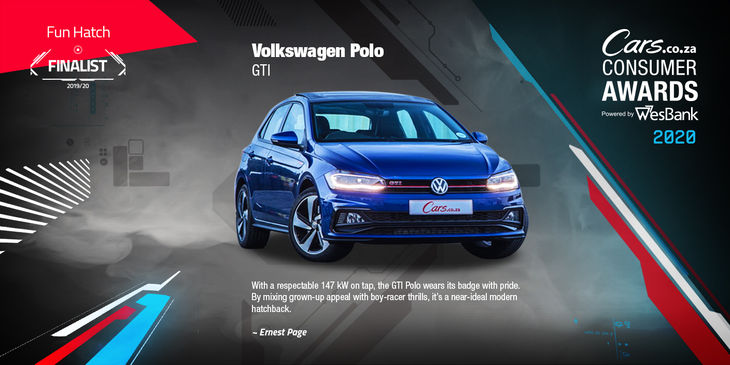
Volkswagen Polo GTI

Volkswagen substantially revised the Polo GTI in 2018. The boy racer image has (somewhat) diminished and in its place is a junior hot hatch – a playful executive, if you will. Some detractors have called the Polo GTI a "Golf GTI lite", which is a trifle unfair, the Polo GTI is, as a matter of fact, powered by a detuned version of the 2.0-litre turbocharged 4-cylinder motor from its "Golf 7.5 GTI" sibling. What's more, the Polo GTI also features its bigger brother's trick XDS electronic front differential, which should liven things up in the handling stakes.

View specification details for the Volkswagen Polo GTI

Do you own a Volkswagen? Have your say and complete our Ownership Satisfaction Survey here!

See last year's #CarsAwards winners here!

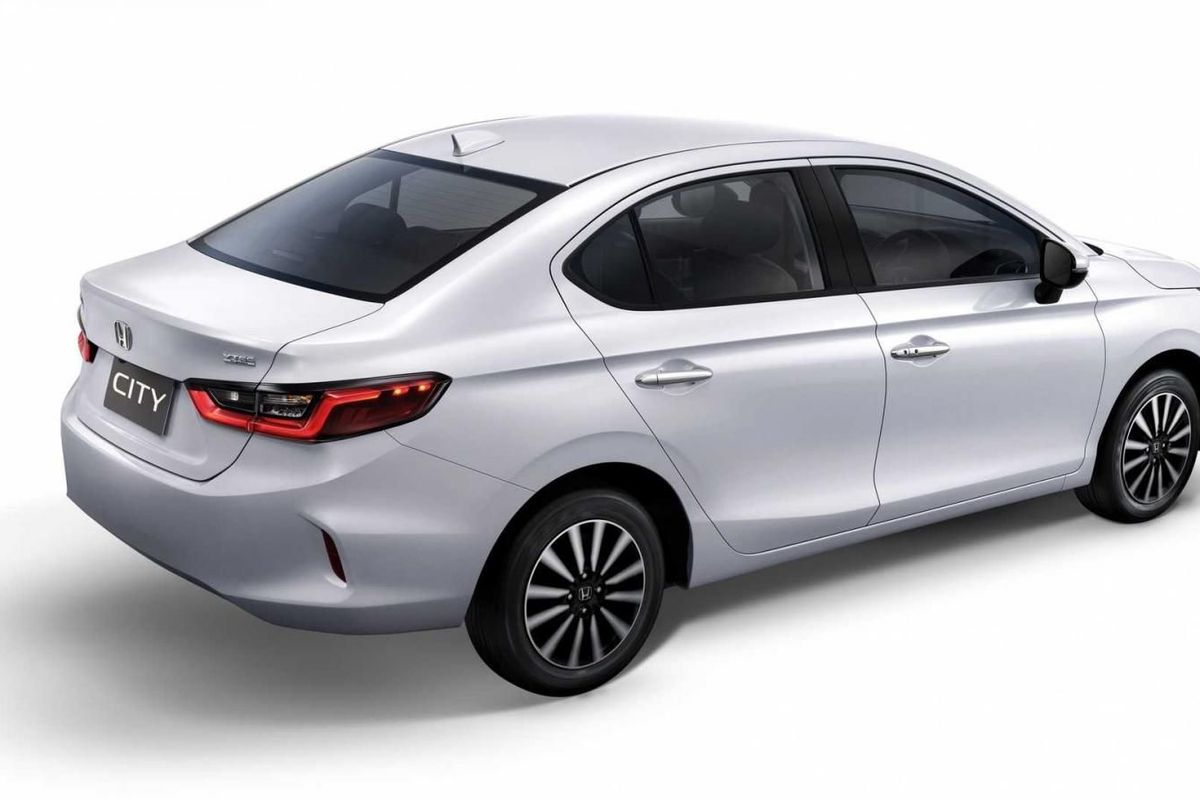
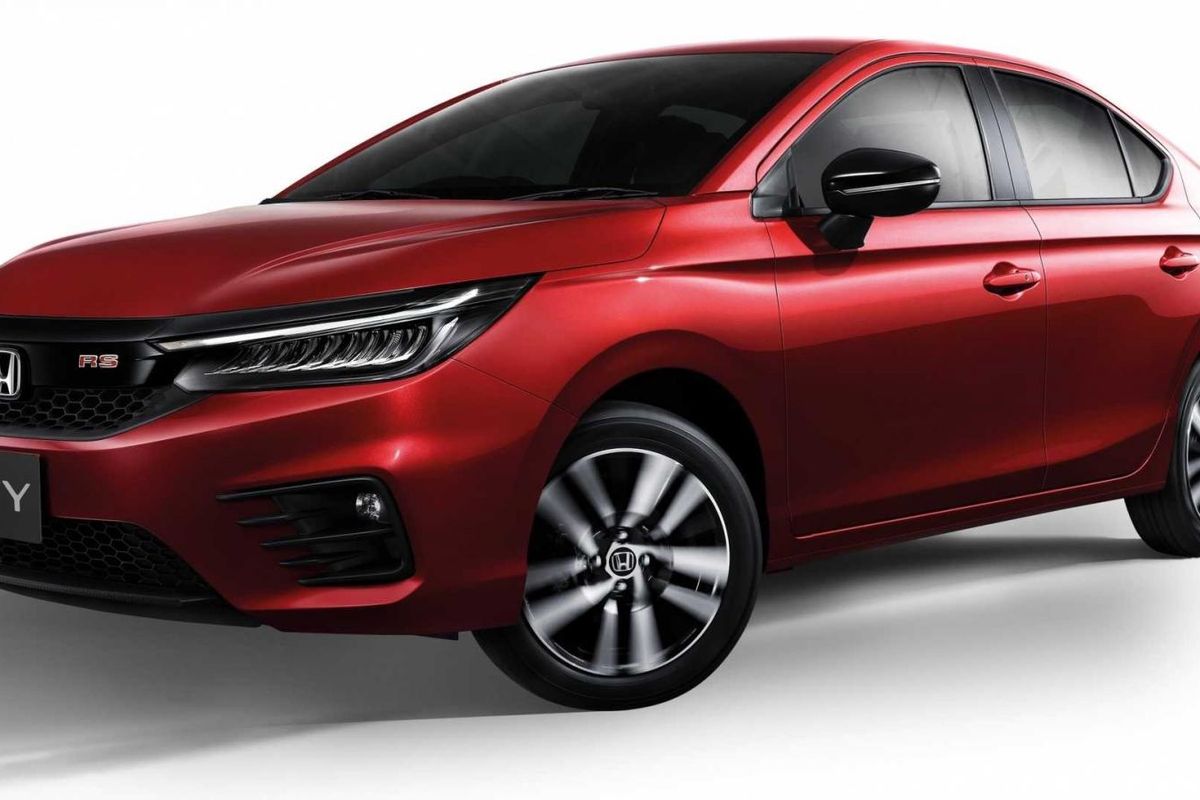
New Honda Ballade Revealed

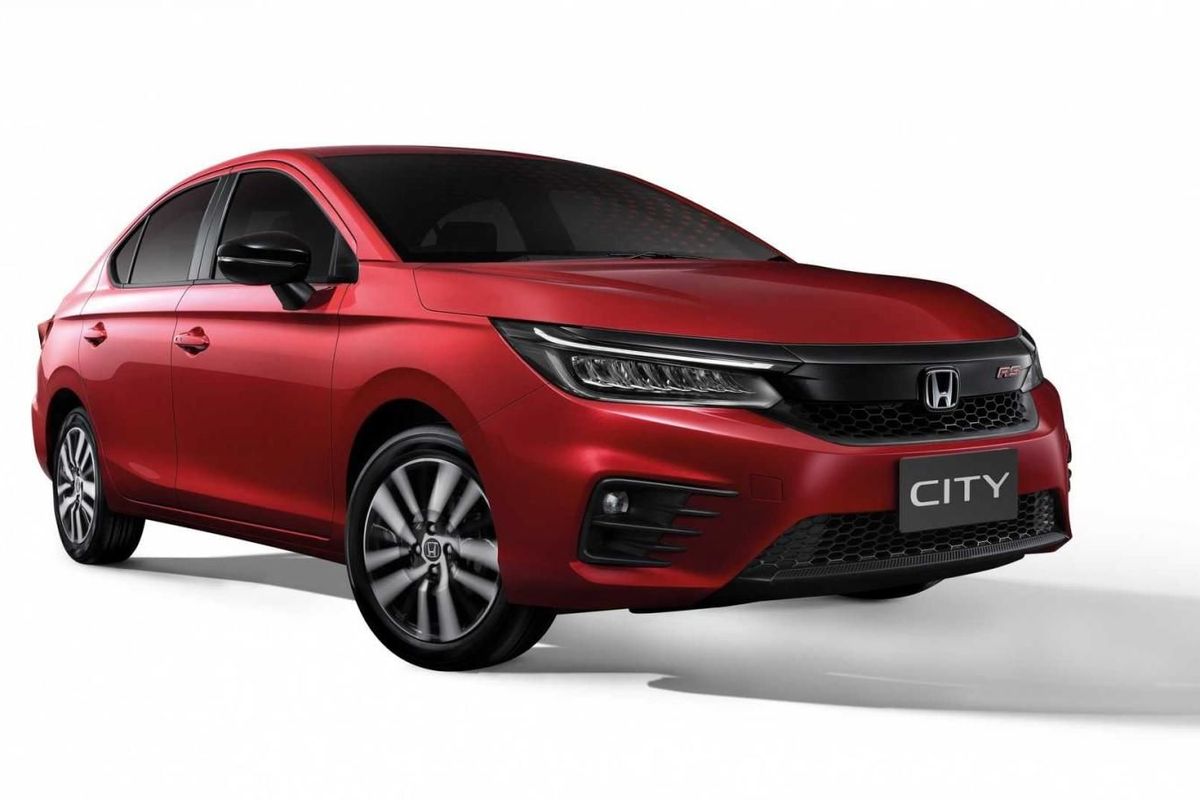
The next-generation Honda City/Ballade has been revealed in Thailand. Here's all you need to know about the compact sedan.

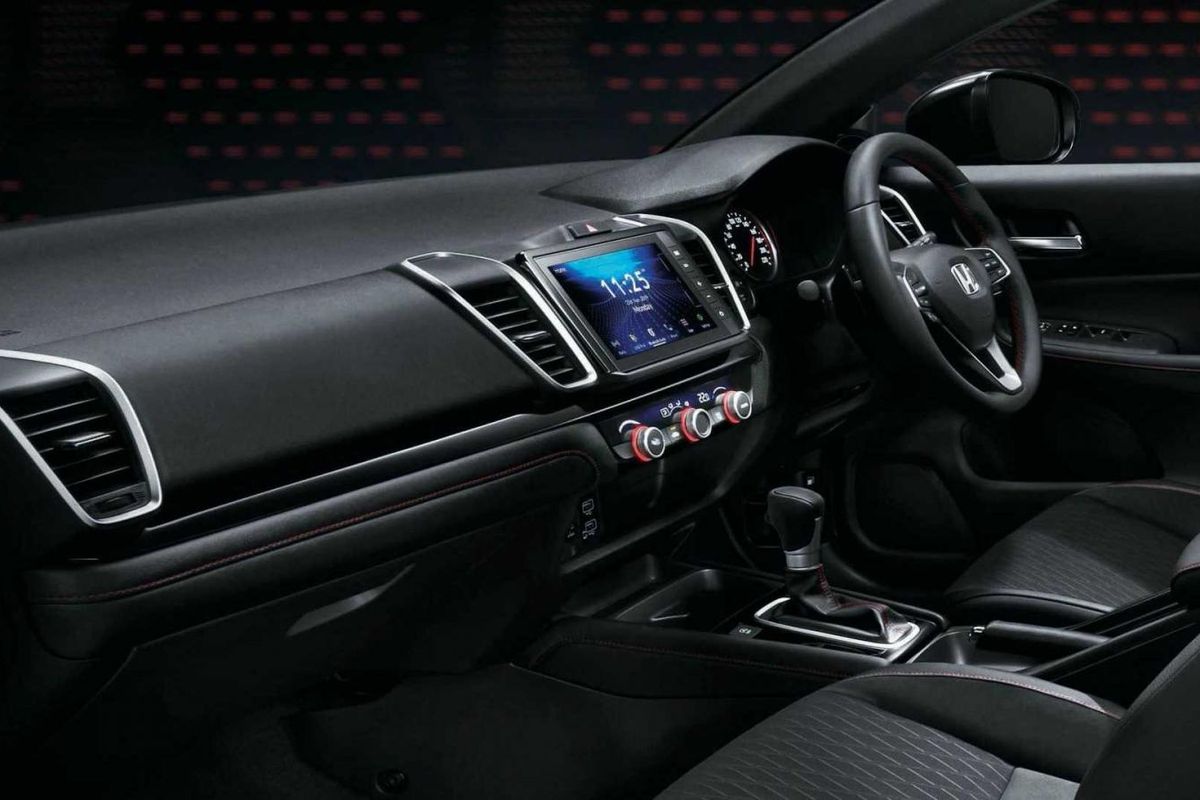
While it doesn't appear to have changed dramatically on the outside, the Honda Ballade is said to be inspired by the 10th-generation of Honda Accord. There are LED DRLs, 15-inch alloy wheels and it looks reasonably fresh and modern. The red car you see in these photos is what Honda is calling RS trim. It has been given some sporty touches like LED headlights, 16-inch alloy wheels, aggressive body kit and a few RS badges here and there. 

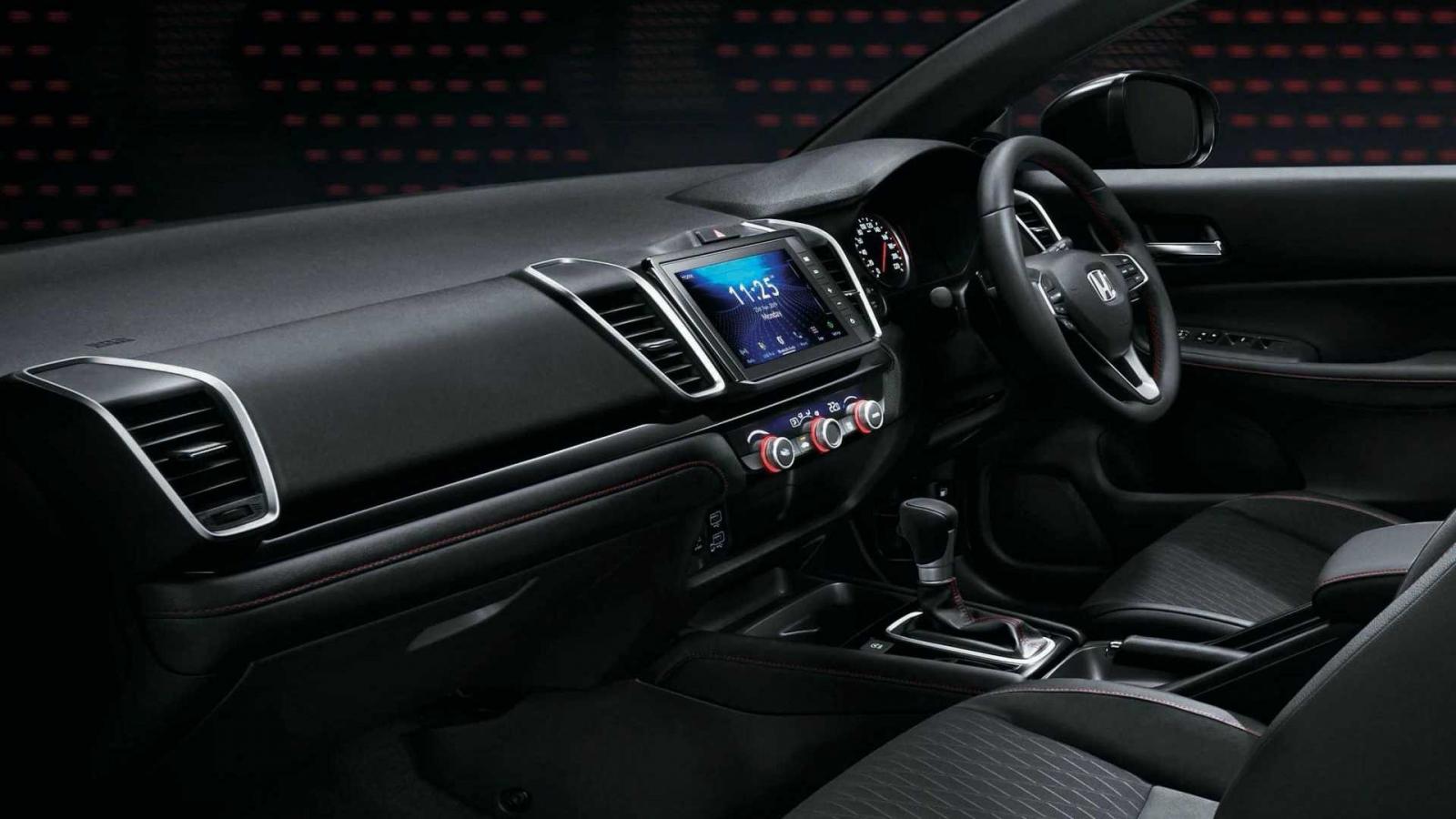
Powering this new Honda Ballade is a new 1.0-litre turbocharged 3-cylinder motor which develops 90 kW and 173 Nm. Power goes to the front wheels via a CVT and it is said to consume around 4.2 L/100 km. There are paddle shifters on the steering wheel as well as cruise control. There's also Android Auto/Apple CarPlay connectivity. In terms of safety specification, the Honda Ballade is comprehensively covered with 6 airbags, ABS, EBD, stability control, hill-start assist as well as a rearview camera.

At this stage, there's no confirmation from Honda South Africa regarding the availability of this new Honda Ballade.

Further Reading

Honda Ballade Updated in SA

Honda Ballade (2014) Launched in SA

New Honda Jazz Shown

Aston Martin DBS Superleggera Concorde Edition Announced

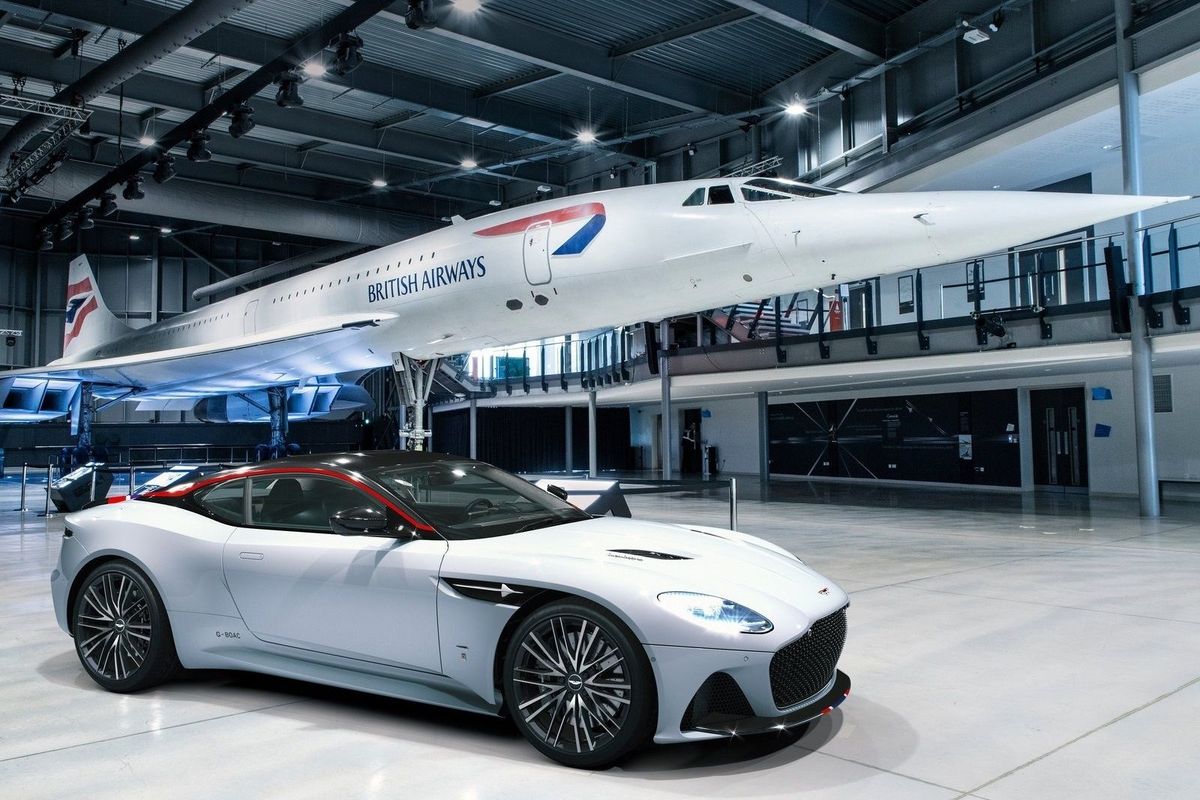
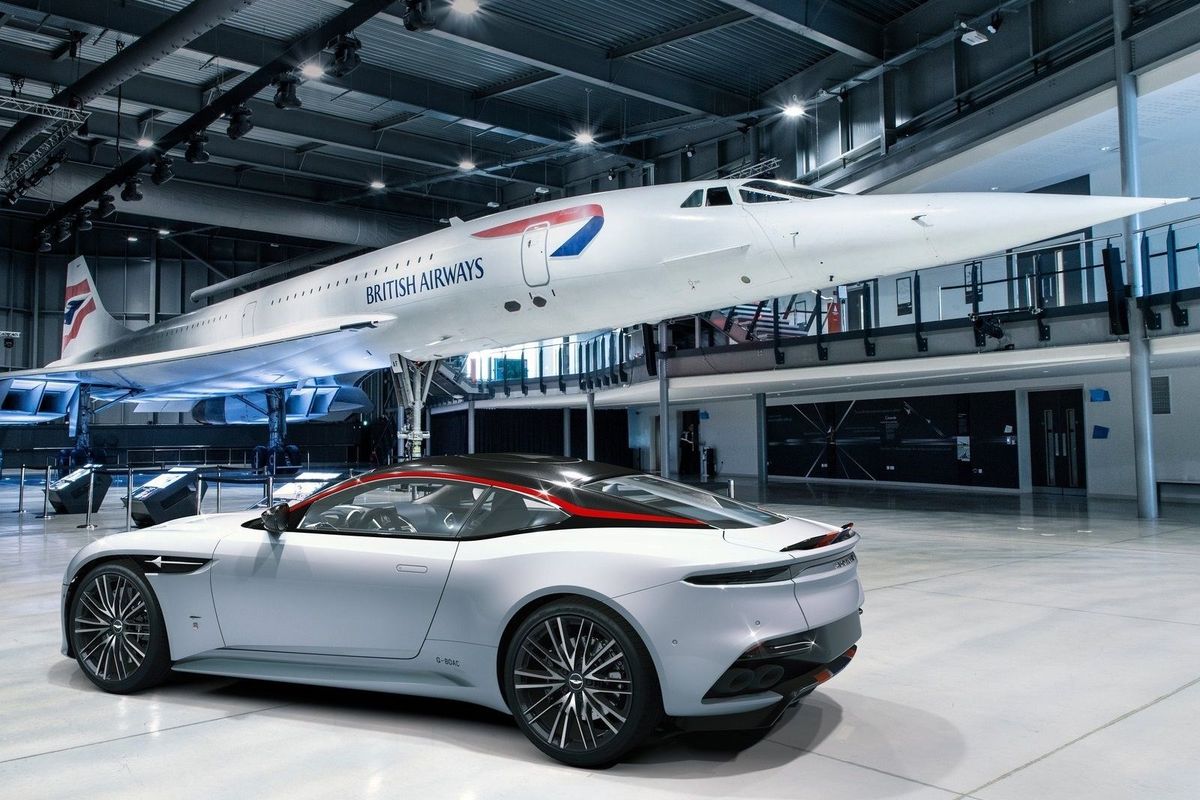
Aston Martin has released a limited edition DBS Superleggera to celebrate 50 years of the Concorde supersonic passenger jet's first flight.

There'll be just 10 units available and they feature some really interesting touches, both inside and out. With luxury trimmings from Q by Aston Martin, the DBS Superleggera Concorde features bespoke side strakes milled from solid aluminium; a bespoke paint scheme featuring British Airways colours on the roof strake, aero blade and rear diffuser; black tinted carbon fibre roof with Concorde silhouette graphic; the famous British Airways 'Speedmarque' logo in chrome on the front wings; a unique Q by Aston Martin wing badge with black enamel infill; unique and authentic jet black painted Civil Aviation Authority aircraft identifier numbers and bespoke inspection plaques signed by Aston Martin Lagonda President and Group CEO Andy Palmer and British Airways Chairman Álex Cruz.

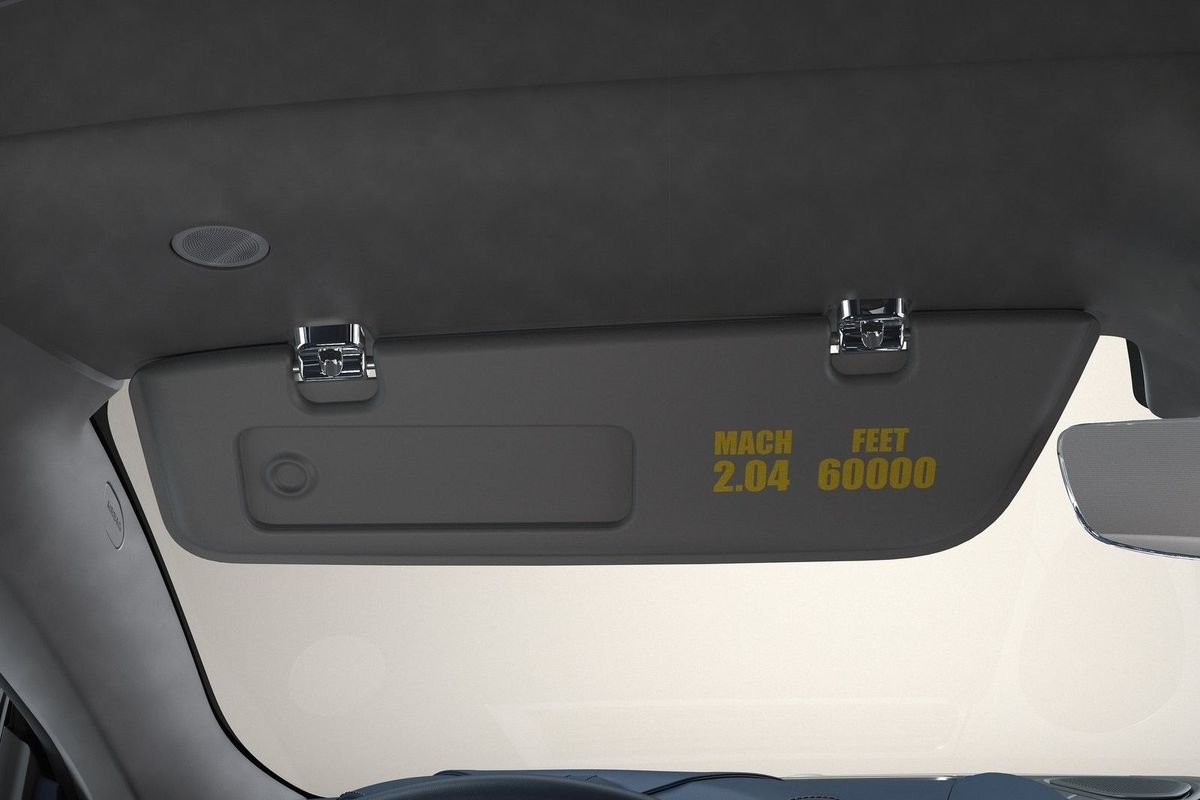
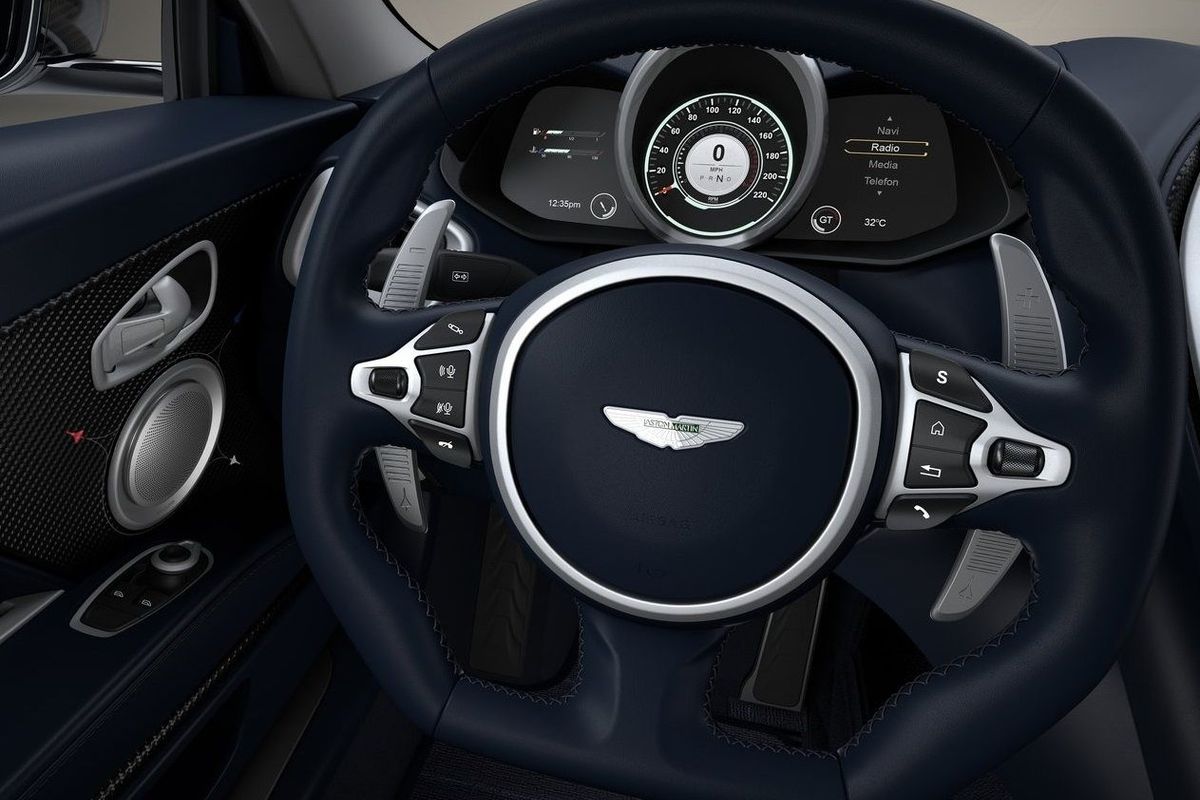
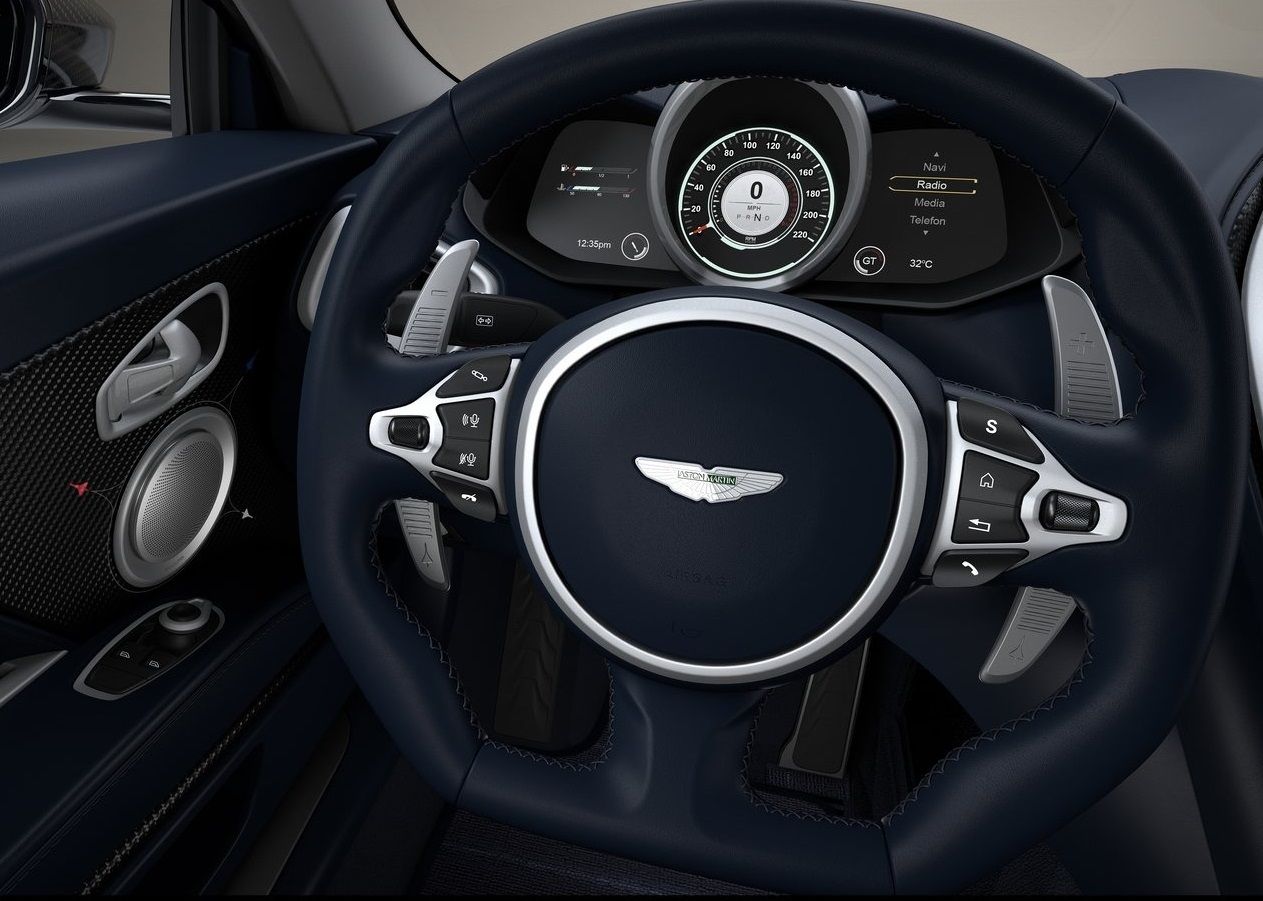
Inside the cabin, there are Concorde logos on the front seats, a Mach meter graphic on the sun visor, paddle shifters made from titanium from Concorde compressor blades; floor mats in Terence Conran design pattern; seatbelt buckle badges milled from solid aluminium and bespoke sill plaques.

The engine is untouched and for the record, it's the 5.2-litre twin-turbocharged V12 with 533 kW and 900 Nm. 0-100 kph and 0-160 kph are obliterated in a claimed 3.4 and 6.4 seconds respectively. A portion of the sales from each Aston Martin DBS Superleggera Concorde Edition will go to the Air League Trust. 


The paddle shifters are made from titanium from Concorde compressor blades, which has to be next-level cool!

Further Reading

Aston Martin DBX Revealed with 404 kW

Aston Martin Announces DBS Superleggera Volante

Aston Martin DBS Superleggera – First Drive

Updated Jaguar F-Type Sportscar Coming

Jaguar has released a teaser of its updated F-Type sportscar which is due for a reveal in early December 2019.

Picture credit: S. Baldauf/SB-Medien

The unveiling will take place on the 2nd December 2019 and from what we can see, the changes will be extensive. The vehicle gains a bit of a redesign, with tweaks to the headlights, bonnet, and body work. There are also updates to the vehicle's cabin, with the latest infotainment system making its way into Jaguar's sportscar. 

In terms of engine, there's a lot of talk of the JLR straight-6 engines making their way into the F-Type. Whether that's true or not is another story, but if it is the case, then we'll be bidding farewell to the fantastically-sounding supercharged V6 motors. The 2.0-litre 4-cylinder and 5.0-litre supercharged V8 engines are expected to live on. Jaguar Land Rover has been venturing into the world of mild-hybrid powertrains and it wouldn't surprise us to see at least one derivative with such an engine. 

The YouTube teaser you see below features Hot Wheels toys, so we're expecting a partnership of sorts.

Further Reading

Jaguar F-Type R Coupe Breaks SA Land Speed Record

Jaguar F-Type Coupe (2014) Driven

4-Cylinder Jaguar F-Type (2017) Price in SA

Jaguar F-Type SVR (2016) First Drive [with Video]

Suzuki Swift Sport (2019) Review

It’s a brand new era for the Suzuki Swift Sport: its rev-happy, naturally aspirated 1.6-litre engine has been replaced by a new 1.4-litre, turbocharged Boosterjet mill. While we are fairly certain fans will appreciate the latest iteration of Suzuki’s feisty hatchback, we wanted to live with the range-topper for a while to find out just how much fun it really has to offer…

This Suzuki Swift Sport review will provide you with all the information you need to help you make an informed car buying decision.

We Like: Performance, ride and handling, fun factor 

We Don’t Like: Interior not ‘special’ enough, iffy plastic trim, not very spacious

Fast Facts

  • Price: R315 900 (November 2019) 
  • Engine: 1.4-litre turbopetrol
  • Power/Torque: 103 kW / 230 Nm
  • Transmission: 6-speed manual 
  • Fuel economy: 6.1 L/100km
  • Load capacity: 242-918 litres

Own a Suzuki? Tell us about your experience here

SERIOUS ABOUT BUYING?

What is the Suzuki Swift Sport?


The Swift Sport now uses turbo power for the first time and is lighter and more agile than ever…

The Suzuki Swift Sport has garnered a considerable fan base over the years and while we will miss the characterful 1.6-litre engine of the previous model, we are excited and intrigued by the brand’s new turbopetrol engine, which has found its way under the bonnet of this playful hatchback. 

Built on Suzuki’s Heartect platform, the Swift Sport now combines perky turbo power, reduced weight, a revised chassis and tweaked suspension and brakes, all of which culminate in a potent and fun-filled driving experience that’s hard to beat at this price point. 

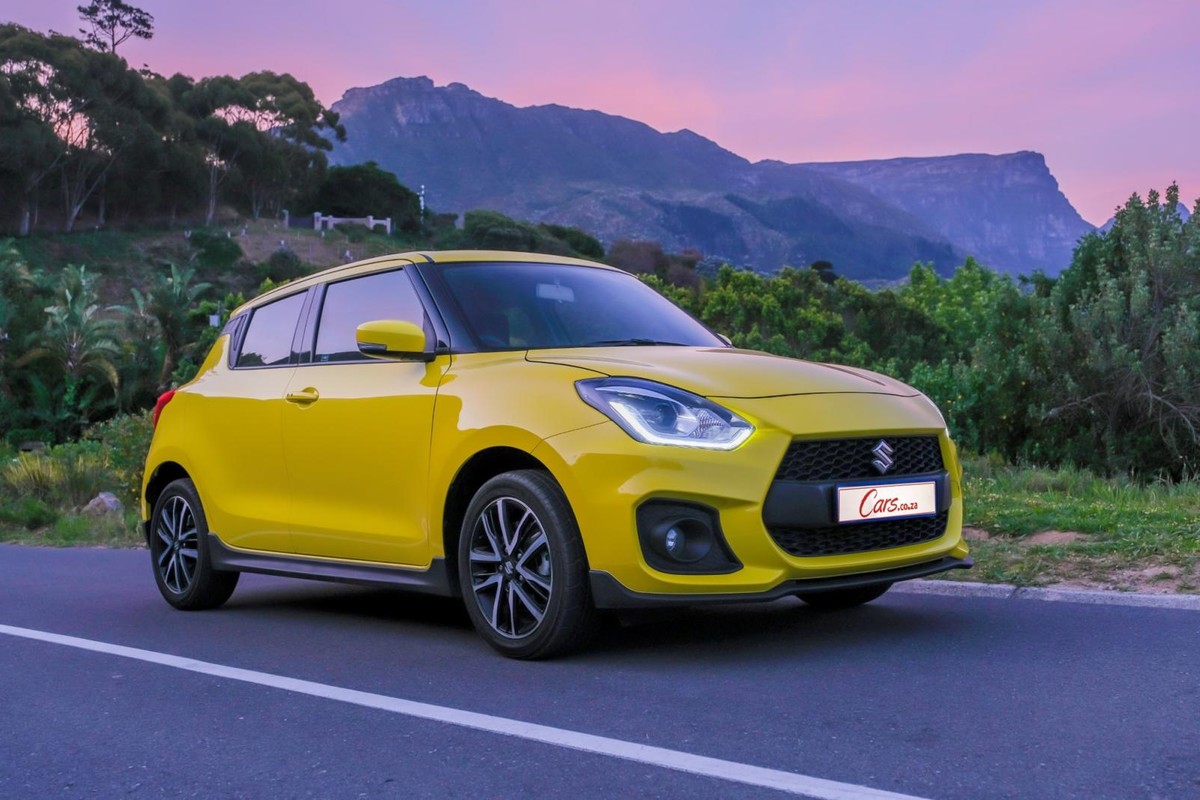
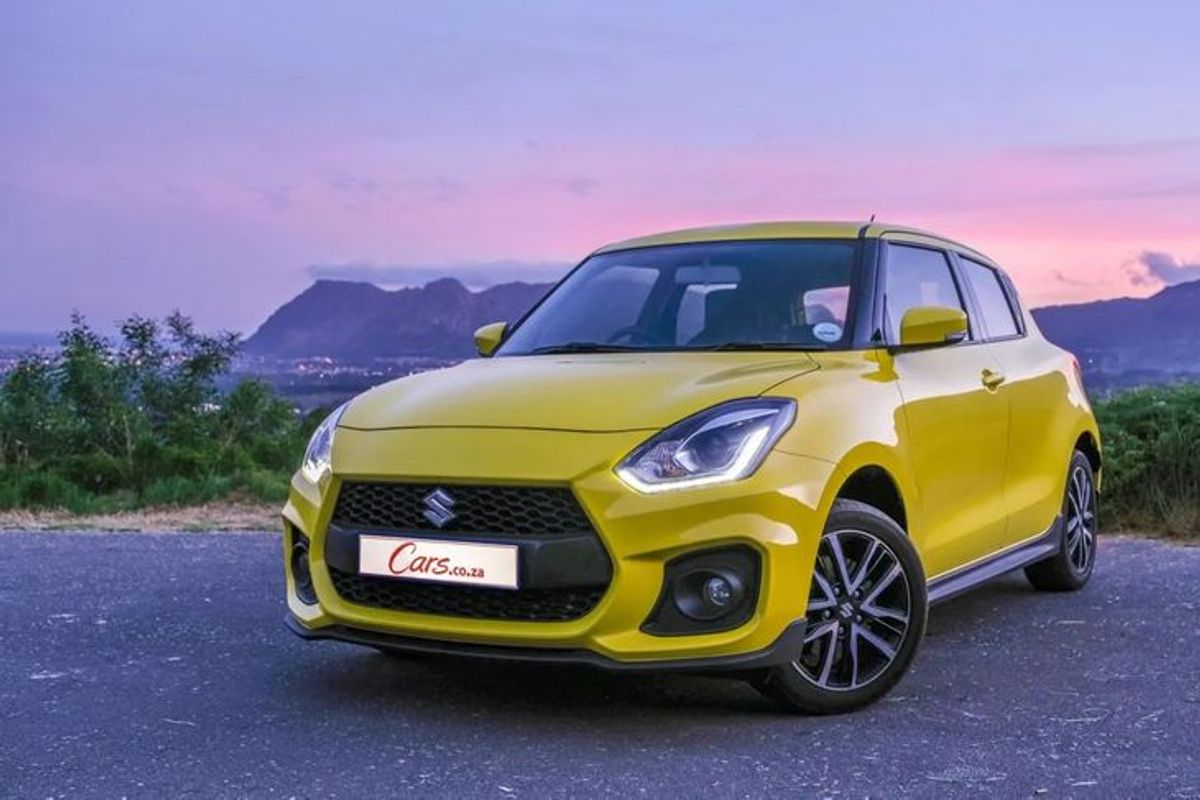
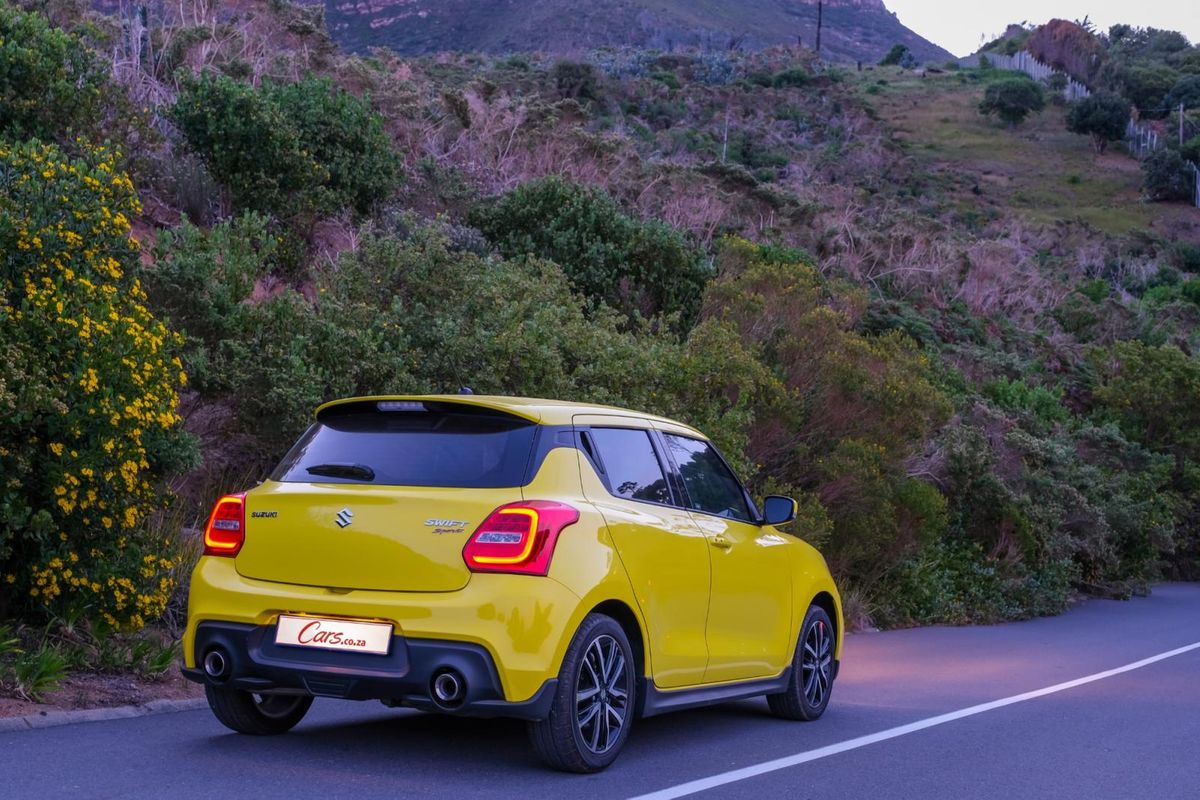
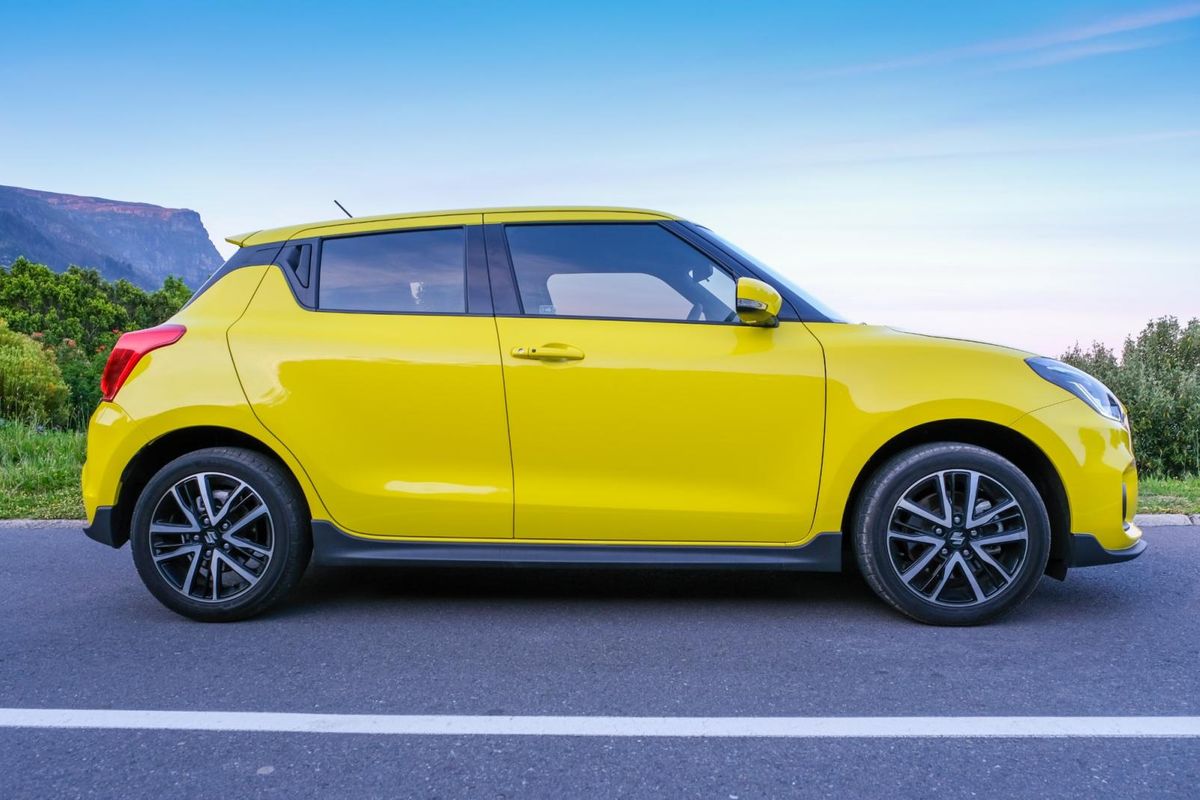
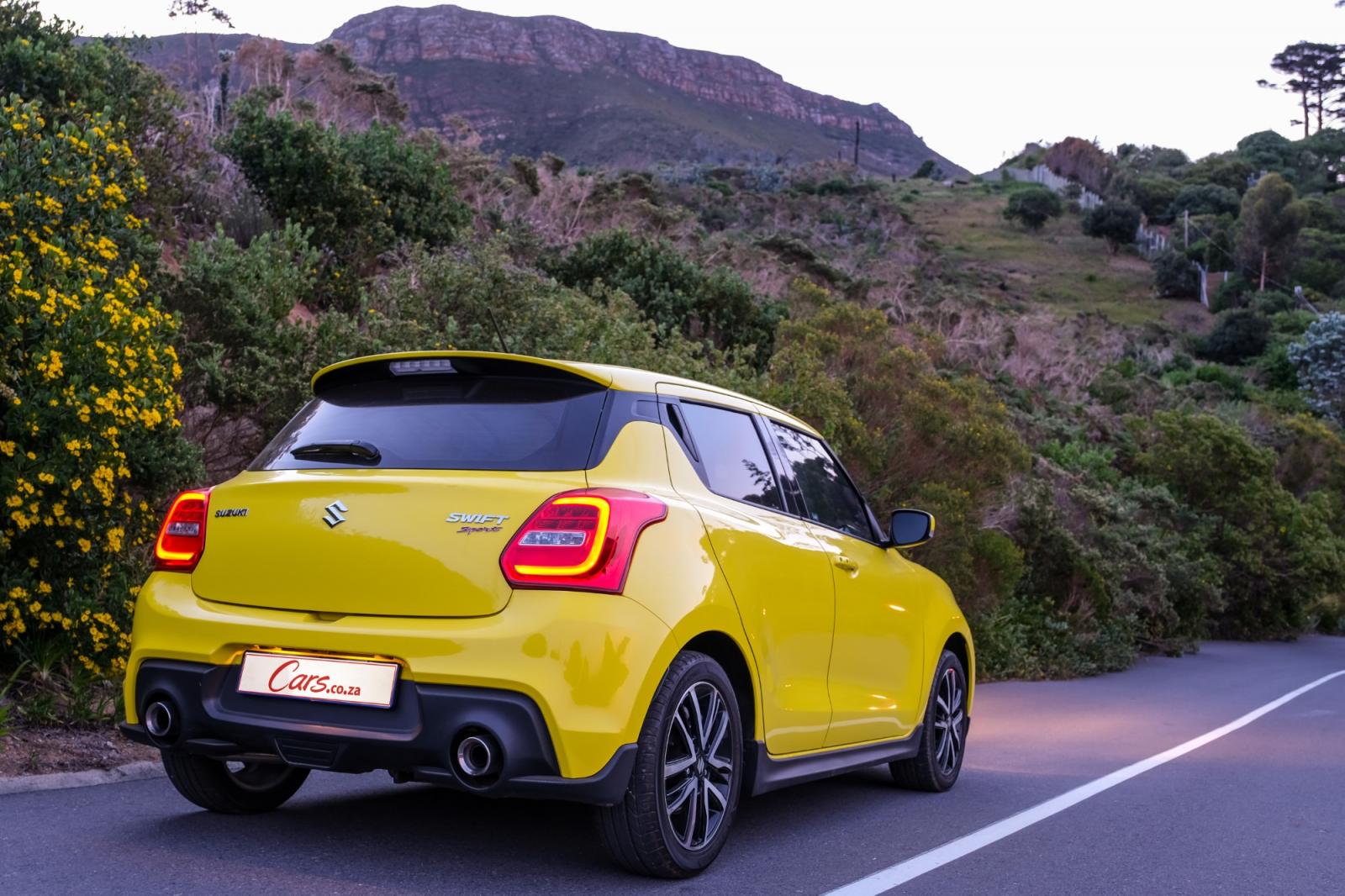
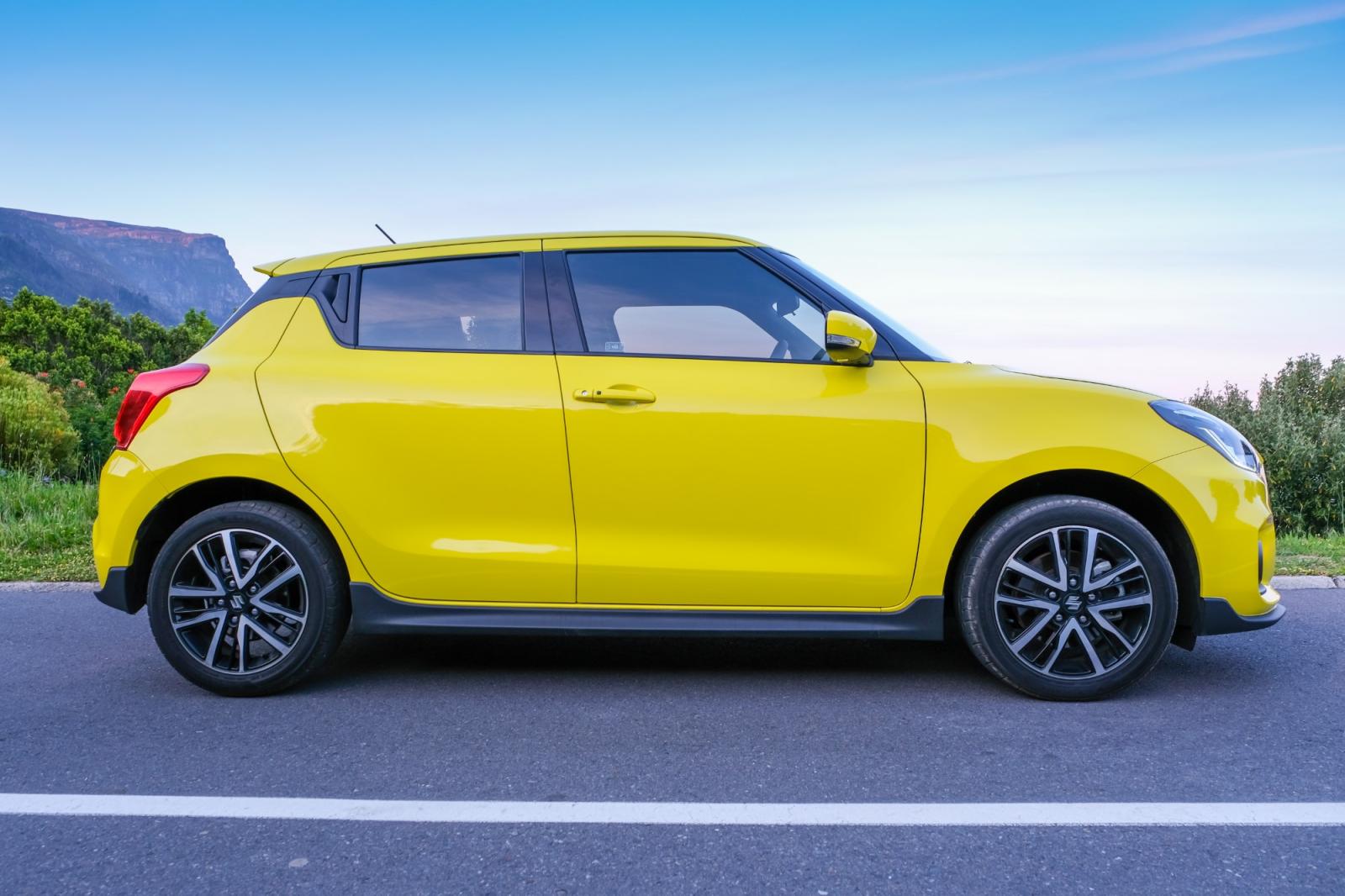
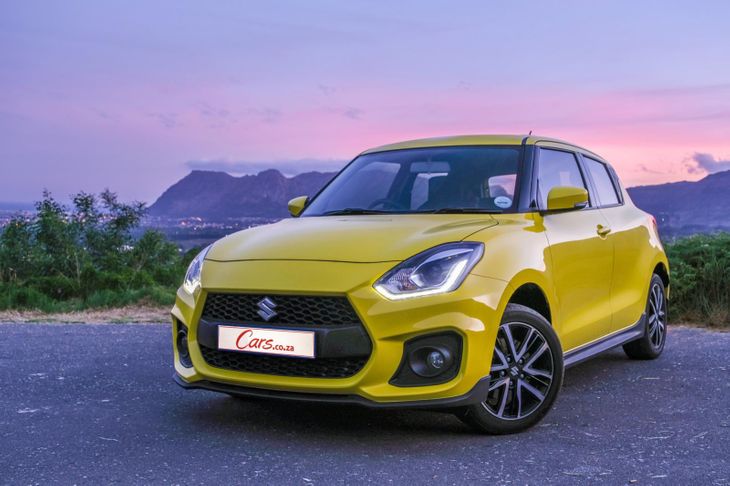
It’s no surprise that the latest iteration of the Swift Sport has been nominated as a finalist in the Fun Hatch category of the #CarsAwards powered by WesBank. We had a Swift Sport finished in (an almost luminescent) Champion Yellow on test to experience just how much fun it has to offer! 

How does the Suzuki Swift Sport perform in terms of…

Performance and efficiency


The Swift Sport punches above its weight and offers nimble performance between robots. 

Given its outputs of 103 kW and 230 Nm of torque, you could be forgiven for thinking that the Swift Sport’s new 1.4-litre turbopetrol doesn’t have much to offer in the way of extra performance, at least not compared with its predecessor. That would be an incorrect assumption, however. Yes, the previous Swift Sport offered only 3 kW less, but also had a 70 Nm deficit to its successor. As a result, it had to be revved mercilessly to extract peak performance.

You see, the new Swift Sport weighs in at only 970 kg, which makes it, significantly, 90 kg lighter than its predecessor. The reduced weight translates into a meaningful power-to-weight ratio of 106.2 kW per tonne, all of which renders the Swift Sport a potent little performer that won’t hesitate to take swipes at cars with larger, more powerful engines. 

By virtue of its 6-speed manual gearbox, it’s laughably easy to have fun behind the ‘wheel of the Swift Sport. With all that torque coming on song from 2 500 rpm, surging acceleration is never very far away from a driver’s right foot. Suzuki claims a 0-to-100 kph sprint time of 8 seconds, but the newcomer feels even more energetic than that… 

The transmission has a direct, positive shift action and while we have yet to test the automatic derivative of the Swift Sport (the first to be offered in the South African market), we suspect that the manual transmission version will offer superior driver engagement. 

The Swift Sport’s performance comes to the fore right off the line, from where it pulls strongly and responsively. It zips through traffic easily and, when presented with a freeway, it obliges by getting up to speed quickly. It is, of course, more than happy to venture beyond the national speed limit and hardly ever runs out of puff when overtaking vehicles.

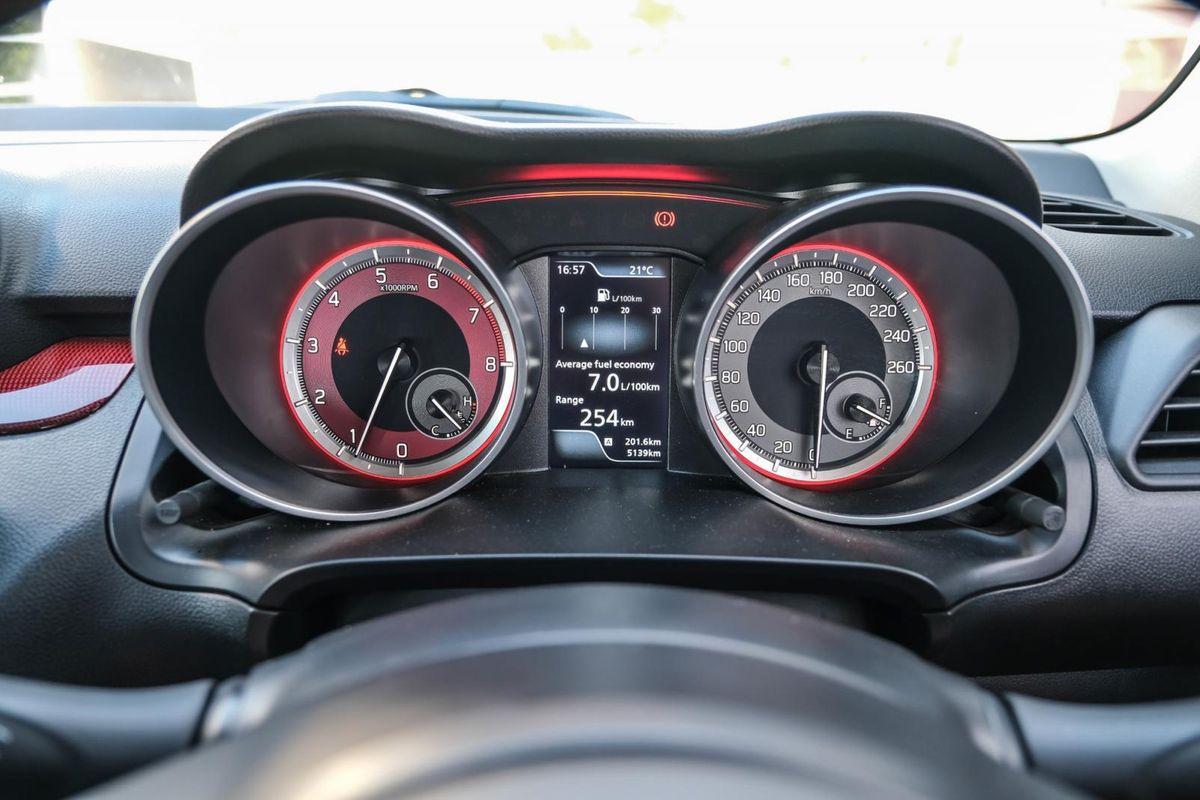
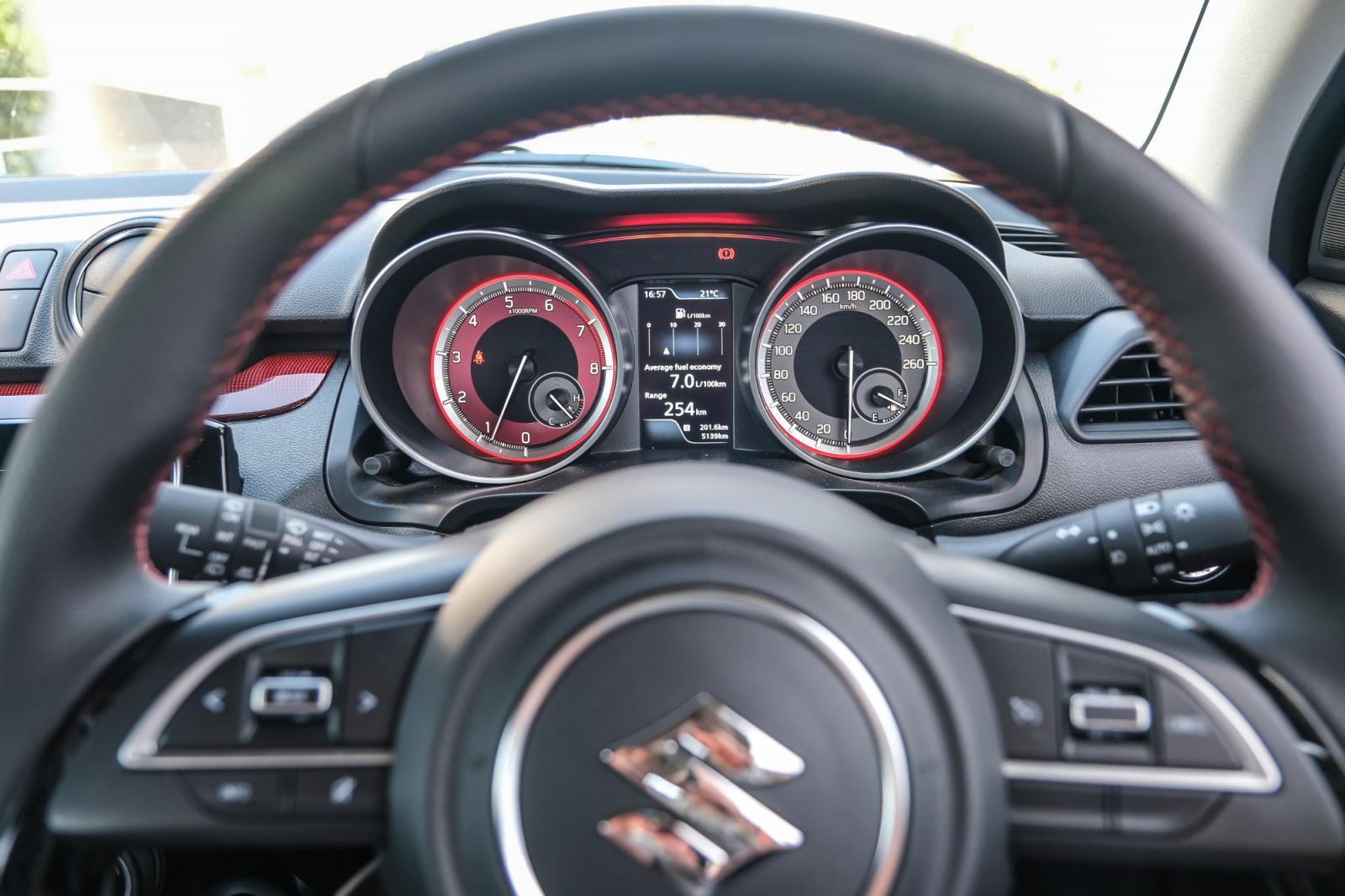
When driven with intent, the Swift Sport accelerates with zeal and tractability is excellent in just about all of the gears, which means that you don’t always have to gear down to “hunt for grunt”. Overtaking manoeuvres are, therefore, easily executed. On top of that, the extra (6th) gear helps to conserve fuel when you are cruising at freeway speeds. Suzuki claims 6.1 L/100 km, but we saw returns of around 7.0 L/100 km, which is good, considering we were driving the Swift Sport rather enthusiastically during the test… 

We mentioned the 1.4T’s revvy predecessor and maximum engine speed is perhaps an area in which this new engine could be more fun to play with… The limiter cuts in a mite prematurely (we feel) at a whisper over 6 000 rpm. It seems the Swift Sport’s just hitting its straps when the fun gets zapped by the electronic limiter.

Ride and handling 


Agile and surefooted handling is what you can expect from this latest Swift Sport…

Over and above its punchy engine, the Swift Sport handles with dextrous aplomb. We were duly impressed by the high level of composure that the Swift Sport displayed under enthusiastic cornering. The steering is responsive with good feedback and the swiftest Swift will dive into corners with confidence but not at the cost of straight-line stability. Put simply, it’s a hoot to drive every day! Having said that, the 1.4T does seem to have lost a little bit of its predecessor’s tenacious Japanese street-fighter character. The new model doesn’t feel as quite as chuckable or as edgy when driven roughly. This is a more composed and comfortably-handling car, which is both a boon… and to its detriment.

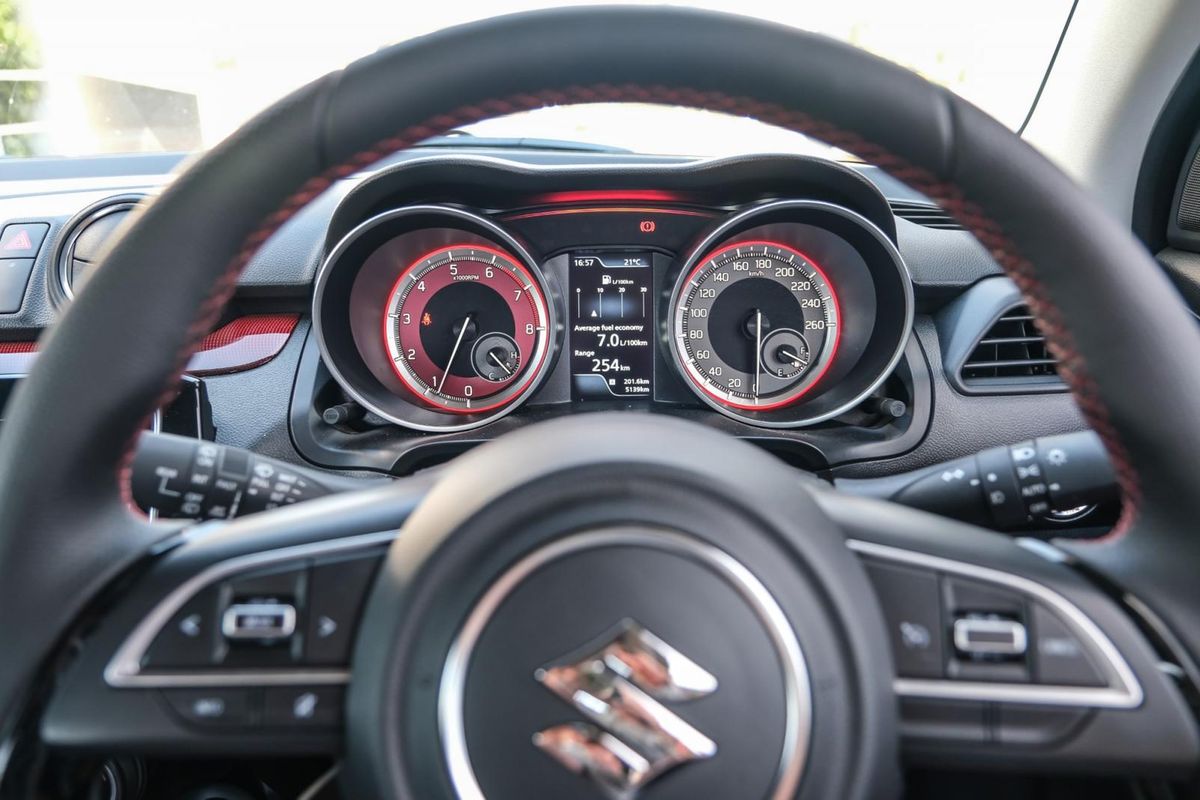
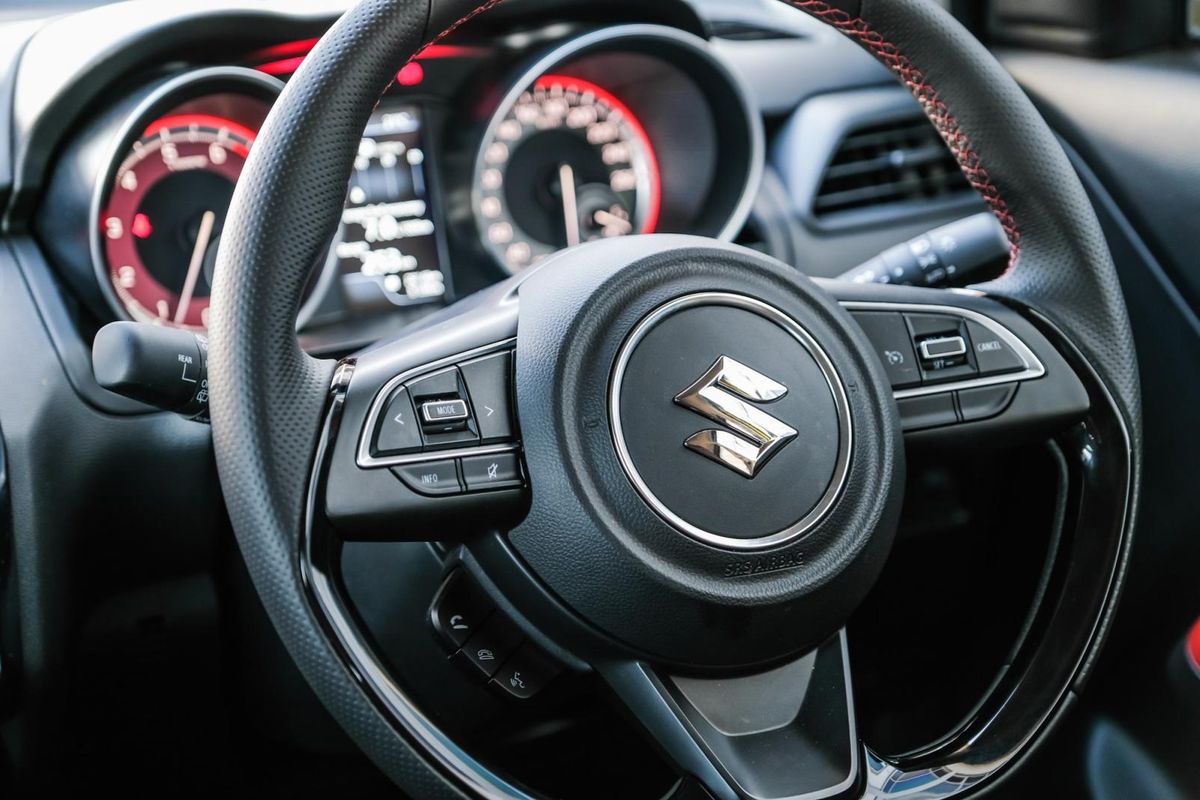
It’s also worth noting that Suzuki could have fitted a sportier steering wheel that’s better suited to a car of this nature. The steering wheel rim feels a bit too thin in hand and the plastic trim inlay detracts from the feel. We think a chunkier wheel with better grip would improve the overall feel of the steering and therefore enhance the driving experience.   

Interior quality and features


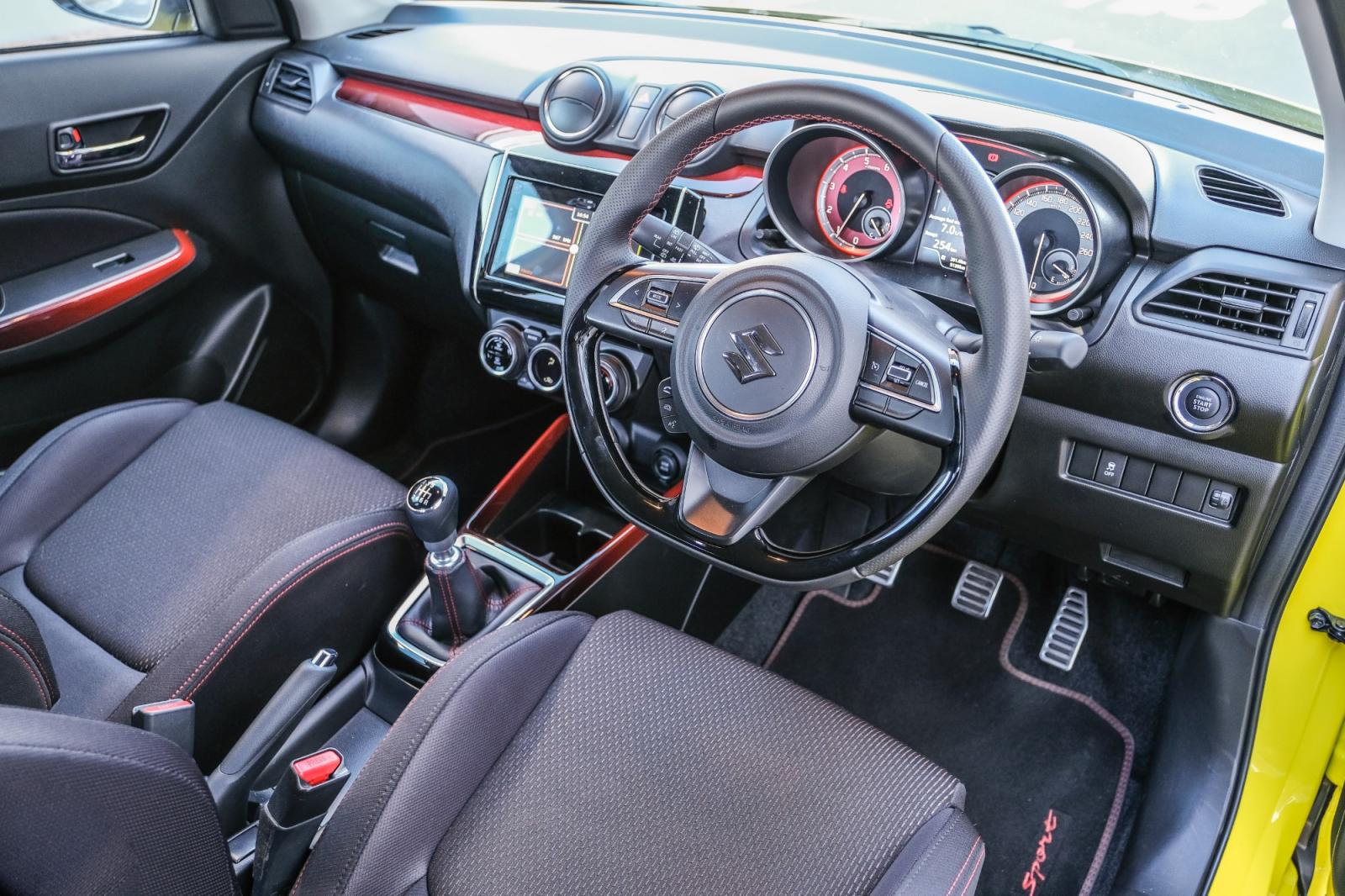
The Swift Sport’s interior comes well equipped, but we think some of the finishes could be of better quality.

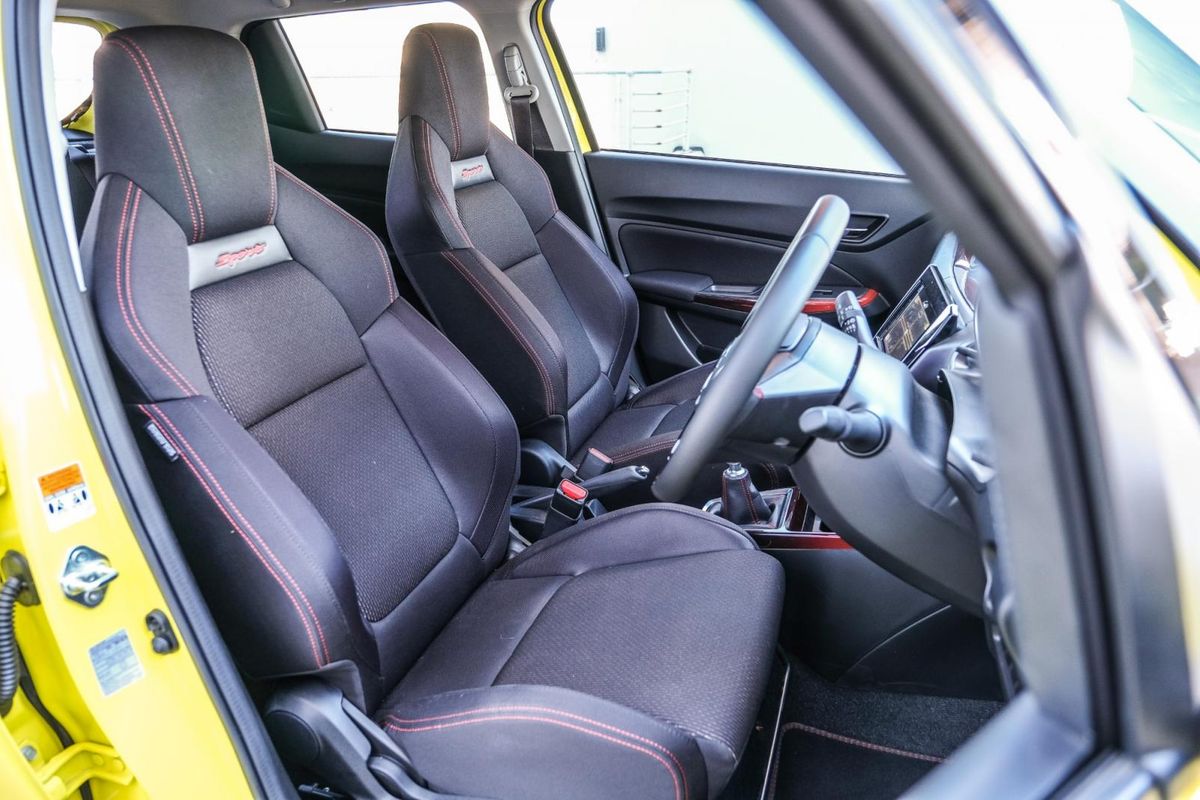
Perhaps the first thing you will notice when sliding into Swift Sport’s cockpit is that the seats are indeed very comfortable with sufficient support and bolstering. The driver’s seat is height-adjustable and the steering column can be adjusted for rake and reach, which means that finding your ideal driving position should be easily achievable. 

Perceived interior build quality is good, but we must mention that some of the material finishes could be of better quality. For example, the aforementioned plastic inlay on the steering wheel looks and feels cheap, as does the orange inlay on the dashboard, door trim and centre tunnel, for example. 

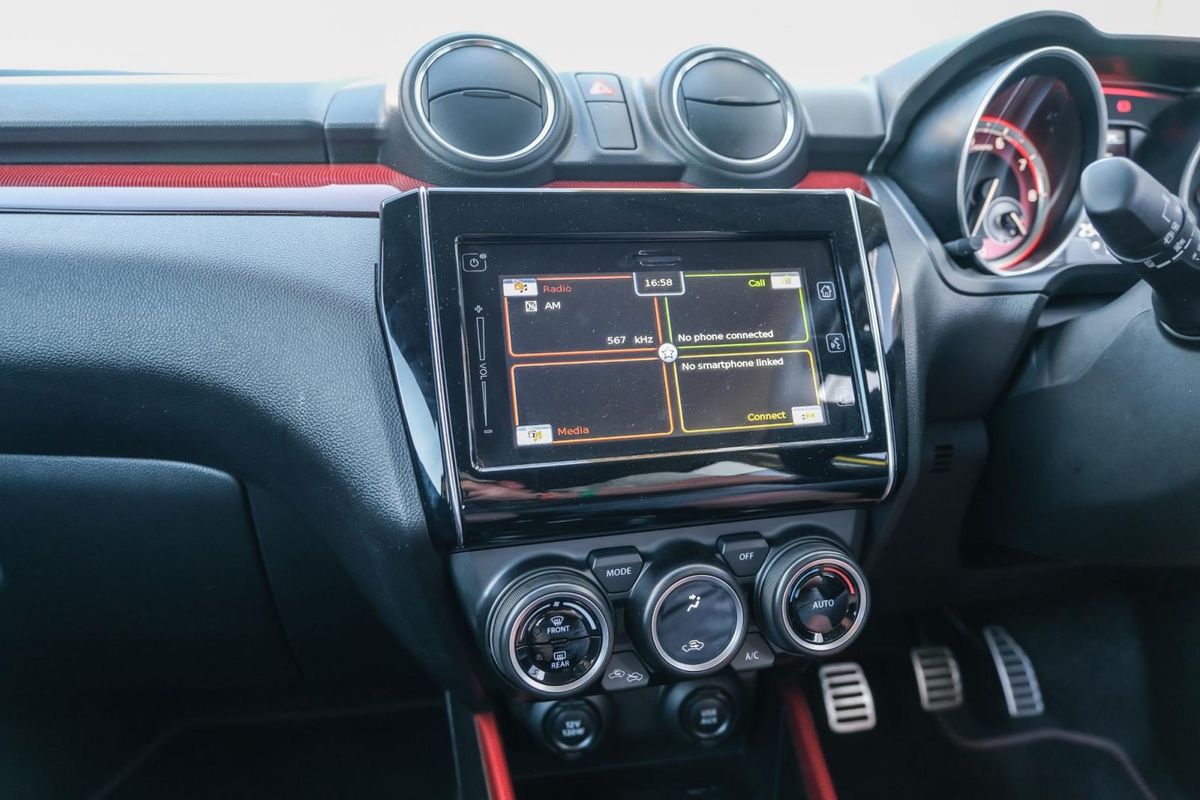
Also, the 7.0-inch infotainment system looks like an afterthought, but we were pleased to find that it is both Android Auto and Apple CarPlay compatible, replete with an intuitive user interface (easy-to-use menu system). The screen also displays the feed from the reverse-view camera. USB and auxiliary ports are included, as well as nice-to-have features such as cruise control, automatic climate control, electric folding rearview mirrors and front/rear electric windows. 

Safety features include a total of 6 airbags, ABS with EBD, brake assist and electronic stability control (ESC). 

Practicality 


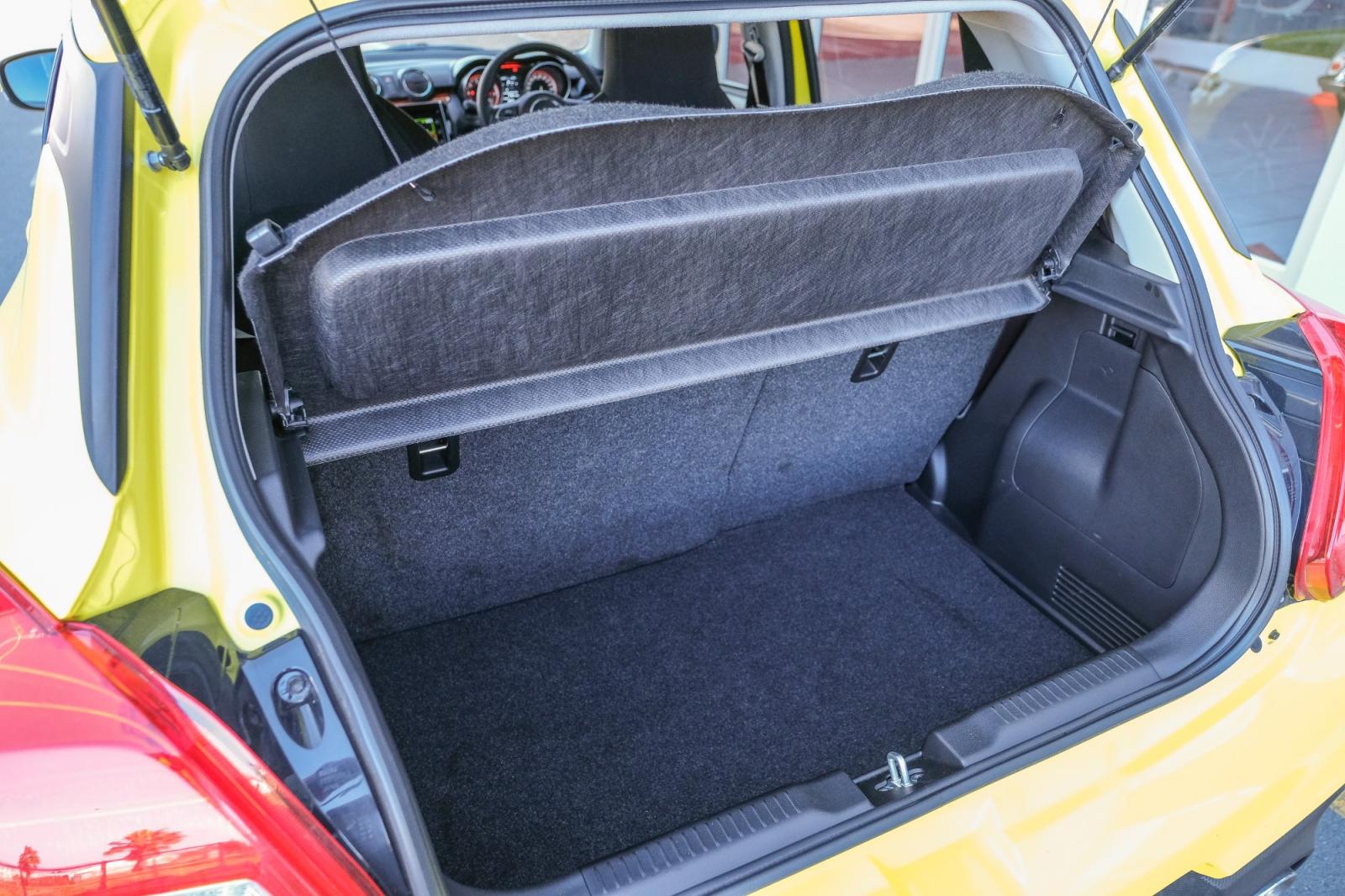
There are more spacious cars on offer in this segment, but few are as fun to drive as the Swift Sport. 

Space utilisation has never really been a strong point of the Swift platform. Granted, the load bay in the new Swift has grown through the years, but at 242 litres of space, it’s still not generous. As a comparison, the Volkswagen Polo offers 350 litres. Utility space expands to 918 litres when the 60:40 split-folding rear seats are folded down. 

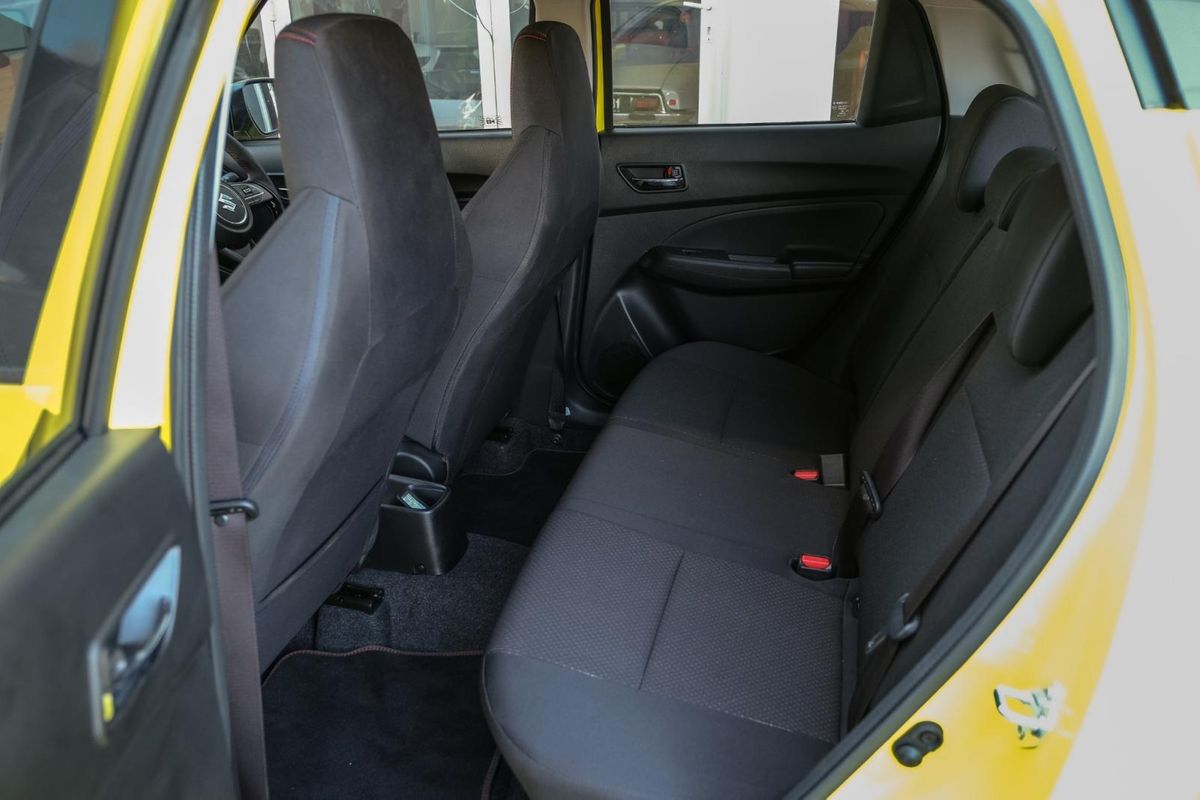
As far as rear passengers are concerned, legroom is adequate for average-sized adults, while taller passengers will find the rear bench accommodation cramped and the rear seat cushions less than cossetting…  

Storage for bottles and oddments can be found in the door mouldings. The driver and front passenger have access to 2 cupholders, while there’s a central cupholder in the rear.     

How much does the Suzuki Swift Sport cost in South Africa?

The Swift (1.4T) Sport costs R315 900, while its automatic counterpart is priced from R335 900. A 3-year/100 000 km warranty and 4-year/60 000 km service plan are standard.

Buy a Suzuki Swift Sport on Cars.co.za

Verdict 


Overall, the Swift Sport doesn’t disappoint and it remains an attractive option if you want some performance at a reasonable price. 

Is the new, turbocharged Swift Sport better than the outgoing version? We love how remarkably responsive the newcomer remains despite its switch to forced-induction and we like the fact it is so palpably easy to extract peak performance from its plucky turbopetrol engine. The Suzuki’s admirably engaging to drive while exhibiting impressive road-holding and handling ability through corners. This is a fun car to drive! It’s more refined and faster than the old one, but has lost some of its feistiness in the process.

We also feel that Suzuki could have done a bit more to heighten the sense of occasion inside the Swift Sport’s cabin but at the asking price, you get what you pay for. 

Nonetheless, at this price point, the Swift Sport rules the roost. Its closest rival in terms of outputs is the soon-to-be-replaced Opel Corsa GSi with 110 kW and 220 Nm, but it’s significantly more expensive at R365 900. Other options to consider include the Mini One and Abarth 595, but their peak outputs are no match for the Swift Sport’s. So, in terms of smile-per-mile value, the Swift Sport makes a very compelling case for itself; if you are looking for performance bang-for-buck, you can’t really go wrong with this car…

Frequently Asked Questions

What are the different Suzuki Swift models available in South Africa?

The 2025 Suzuki Swift in South Africa is available in three main derivatives: the GL, a new mid-tier GL+, and the top-end GLX.

What is the engine and performance of the new Swift?

The new Swift is powered by a Z-Series (Z12E) 1.2-litre, 3-cylinder petrol engine. This engine produces 60 kW of power and 112 Nm of torque, and is paired with either a 5-speed manual or a Continuously Variable Transmission (CVT).

What is the price of the new Suzuki Swift in South Africa?

The starting price for the 2025 Suzuki Swift is approximately R219,900, with the top-end GLX model priced around R284,900.

What safety features are standard on the 2025 Suzuki Swift?

Standard safety features across all models include six airbags, hill-hold control, ABS, electronic stability control (ESC), and ISOfix child-seat anchors.

What warranty and service plan are included with the Swift?

The vehicle comes with a 5-year/200,000 km warranty and a 2-year/30,000 km service plan.

Related Content

Suzuki Swift: Specs & Price (2025)

Review Articles 

Suzuki Swift (2014) Review

Suzuki Swift (2021) Review

Suzuki Swift 1.2 GL Review (2018) 

Suzuki Swift Sport Review (2019) 

Suzuki Swift Sport Review (2016) 

Suzuki Swift Sport (2013)

Comparison Articles

Suzuki Swift vs Hyundai Grand i10 (2023) What To Buy 

Suzuki Swift vs Kia Picanto (2014) What To Buy

Suzuki Swift Sport (1st-, 2nd- & 3rd-gen): Classic Comparison

Buyer’s Guide

Suzuki Swift Buyer’s Guide (2011-2018)  

Suzuki Swift Buyer’s Guide (2018-2024)


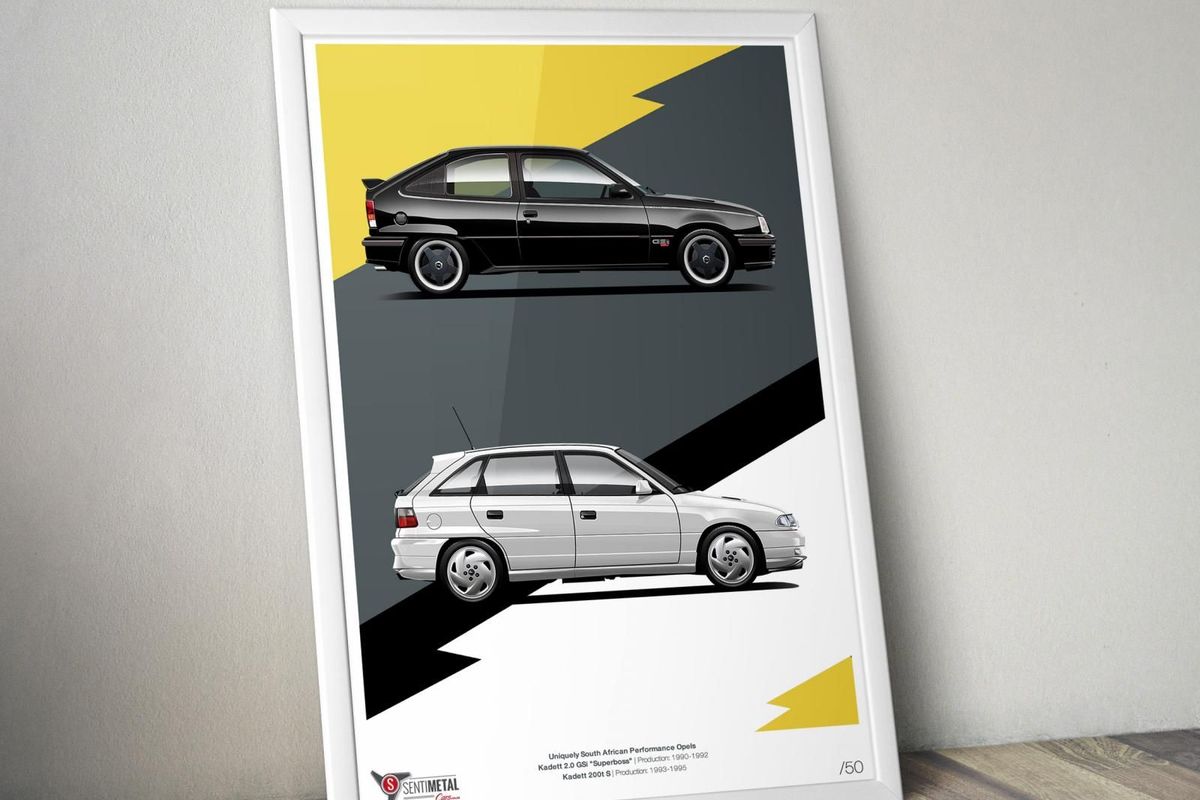
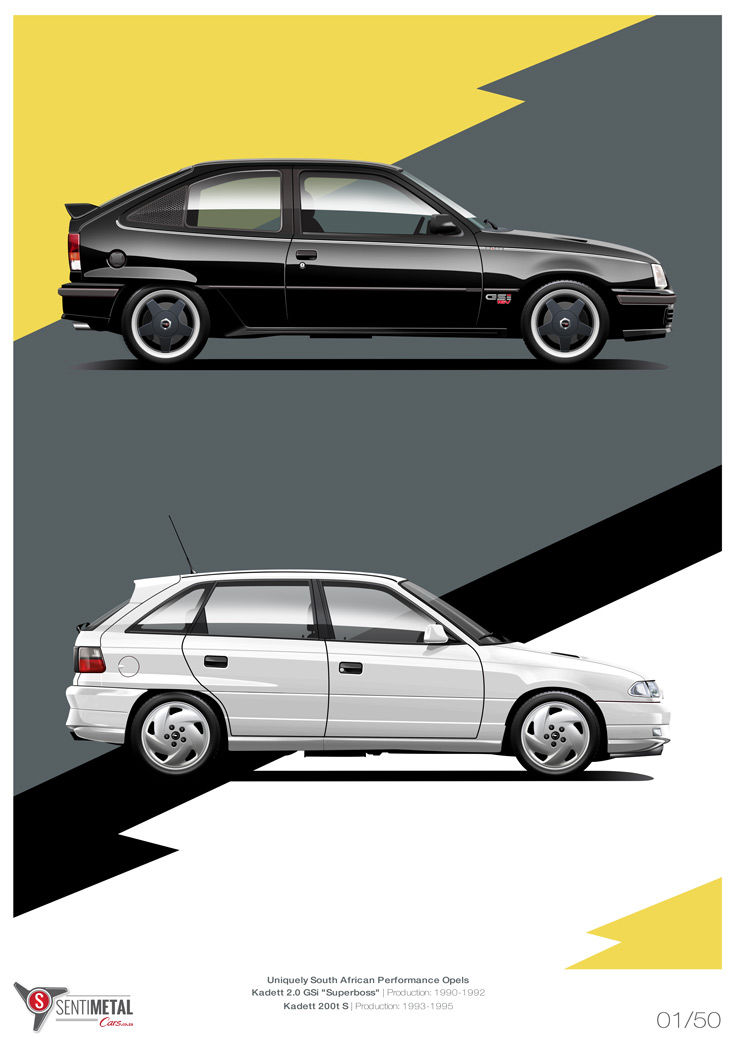
Opel SA’s super hatches remembered in new SentiMETAL print


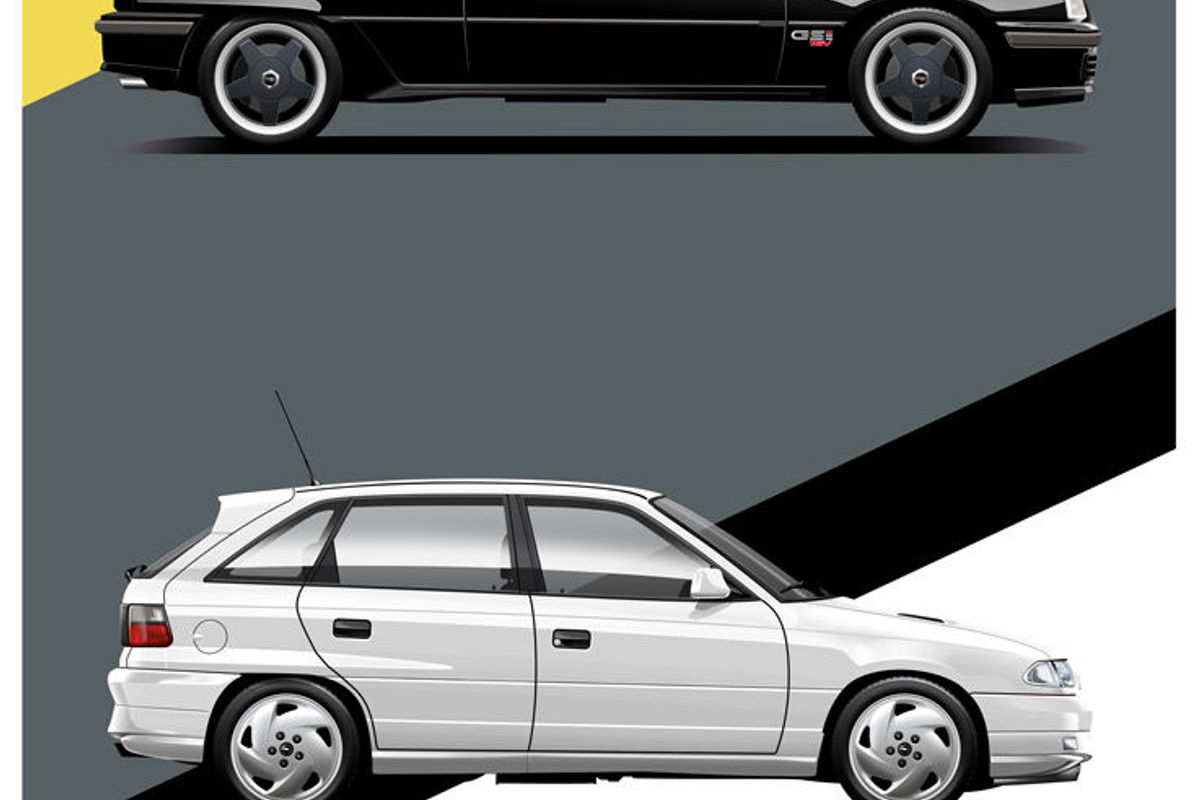
The creative team at SentiMETAL has released a stunning new limited-edition print featuring 2 of South Africa's most memorable locally-developed Opels.

Only 50 of these A2 prints will be produced, each individually numbered, and featuring the German marque's iconic motorsport colours (black, grey, yellow and white). The 2 cars featured need little introduction, though the more modern Kadett… the legendary 200t S's story is more complex and less often told. 

  • To find out more about the Superboss, a 125kW firecracker that was developed to beat BMW on the track, watch our video here.


The 200t S (built in Astra sedan and Kadett hatch shapes from 1993 to 1995) followed closely on the Superboss's legend (built from 1990 to 1992) and though motorsport was very much in mind when it was developed, it never actually raced because attention in local motorsport shifted away from Group N and to Super Touring Cars (where an Opel Astra Sedan raced very successfully). 


Stunning artwork by Wayne Batty (cars) and Andrew Crawford (layout and design) make this an awesome print.

But to develop the 200t S, Delta Motor Corporation (the then local manufacturer/distributor for Opel) had to dig quite deep. Using the new Kadett/Astra platform, it then borrowed the turbocharged version of the famous red-top 2.0L 16-valve from the European market's Calibra all-wheel drive. But in South Africa, the Kadett (and the Astra) channelled all that 160kW of fury through the front wheels only, resulting in a dangerous cocktail of understeer, torque steer and lift-off oversteer if legend is to be believed (we have a video coming soon…).

Loads of Calibra hardware

The Kadett 200t S also received the stunning 5-stud 16-inch wheels from the Calibra (to cope with the extra torque of 280Nm), and it also got heavy-duty front wheel hubs, steering knuckles and wheelbearings (also from the Calibra). Opel claimed a top speed of 240kph and a 0-100kph time of 7 seconds. Later in the car's lifecycle, power was turned down slightly to 150kW, possibly as a result of heating issues.

Both cars come from a fascinating time in South Africa's motoring history, as well as what was probably Opel at the height of its powers in this country. Will we ever see the likes of the Superboss and 200t S again? Very unlikely…

You can secure your print by going here.

You may also be interested in

SentiMETAL releases print series celebrating the Citi Golf

Record number of cars show up at latest SentiMETAL Gathering

New print featuring 4 uniquely South African BMWs launched

European Car of the Year 2020 Finalists Announced


The finalists for the 2020 European Car of the Year have been announced. Check them out.

Our very own Hannes Oosthuizen forms part of the 60-strong judging panel and the 2020 winner will be announced at the Geneva Motor Show which takes place in March 2020. 

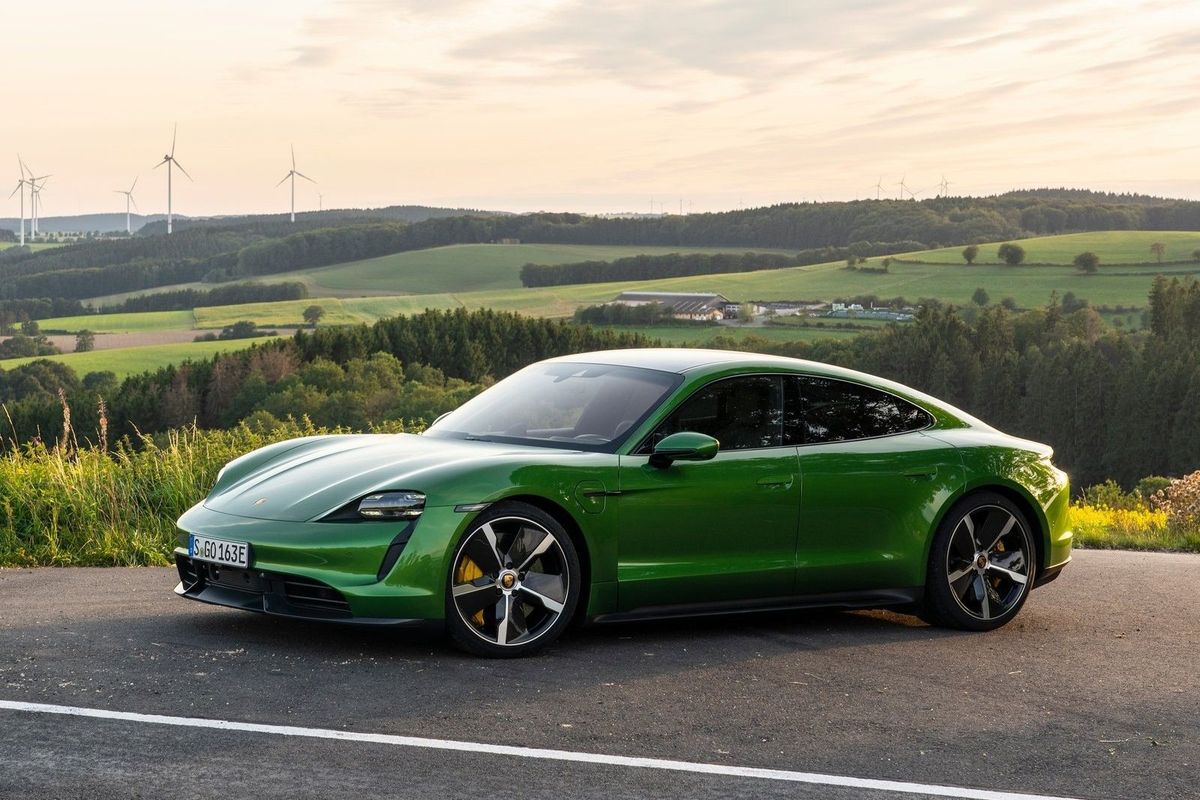
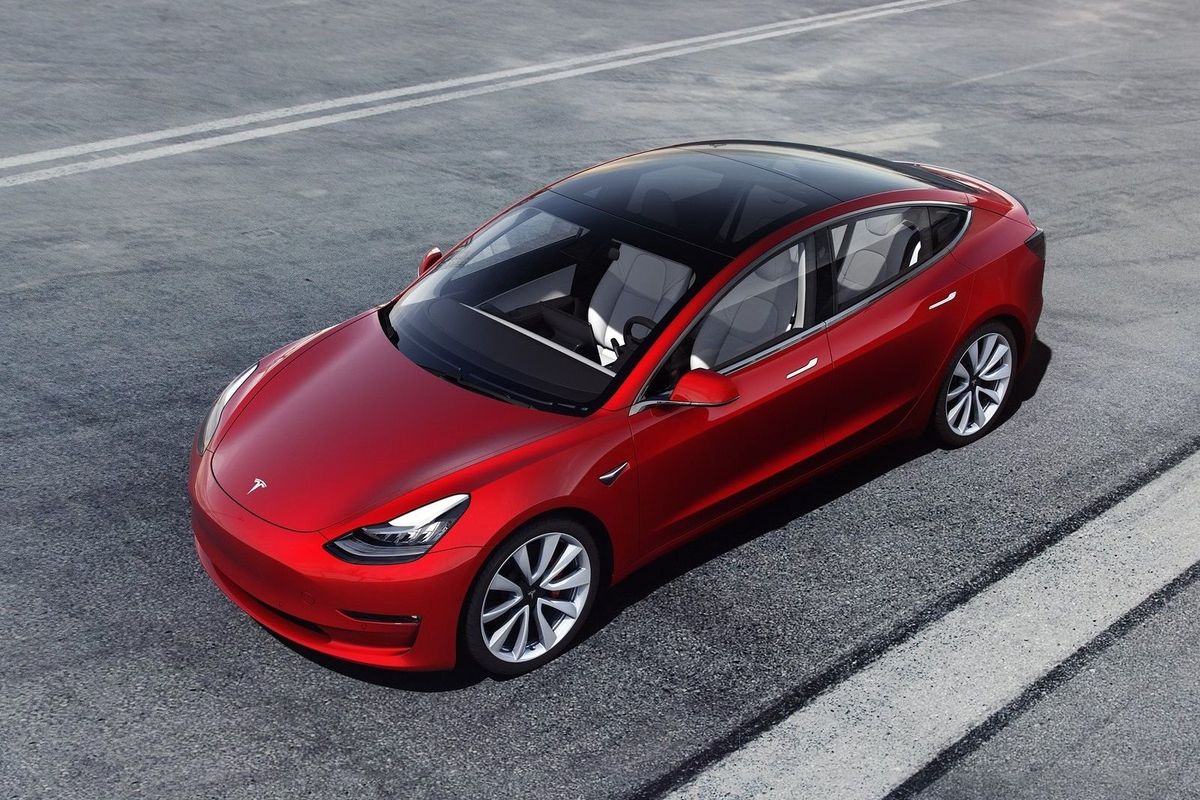
The 7 finalists come from a shortlist of 30 vehicles and it'll be fascinating to see if an electric vehicle can pull off a repeat win. In last year's competition, the Jaguar I-Pace walked away with the overall win and a few category wins too. There are 2 electric entrants this year, with the Porsche Taycan and Tesla Model 3. 

2020 Car of the Year Finalists

Click on the headlines to learn more about the specific vehicle.

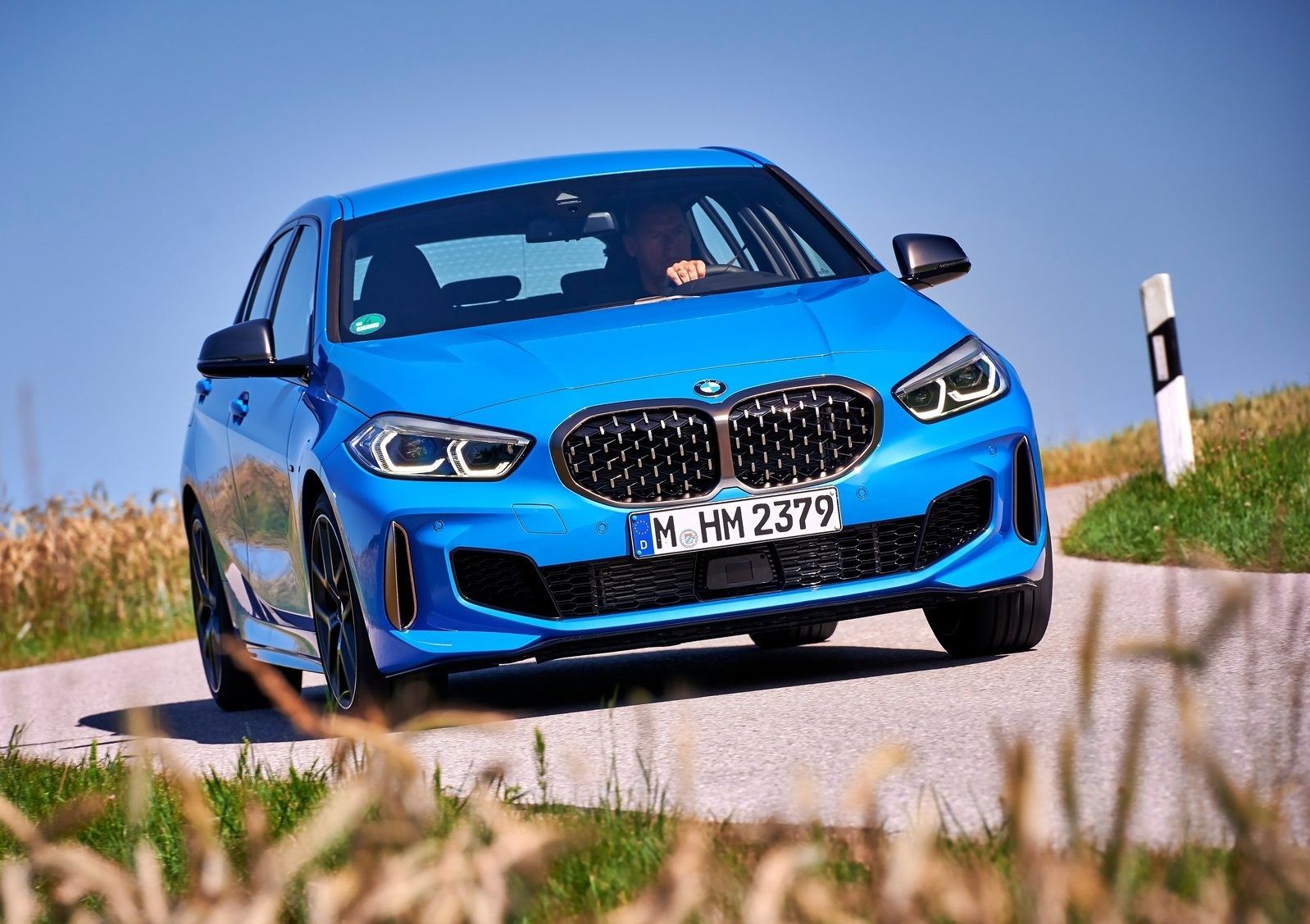
BMW 1 Series


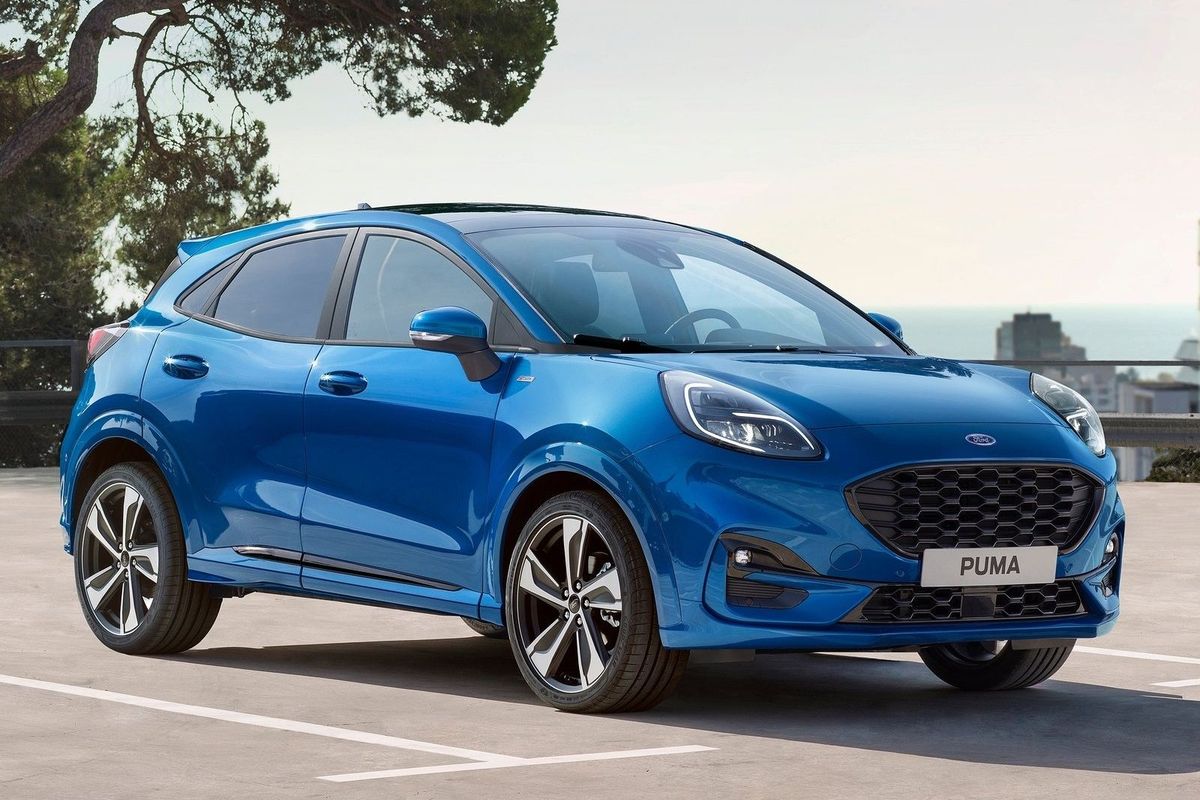
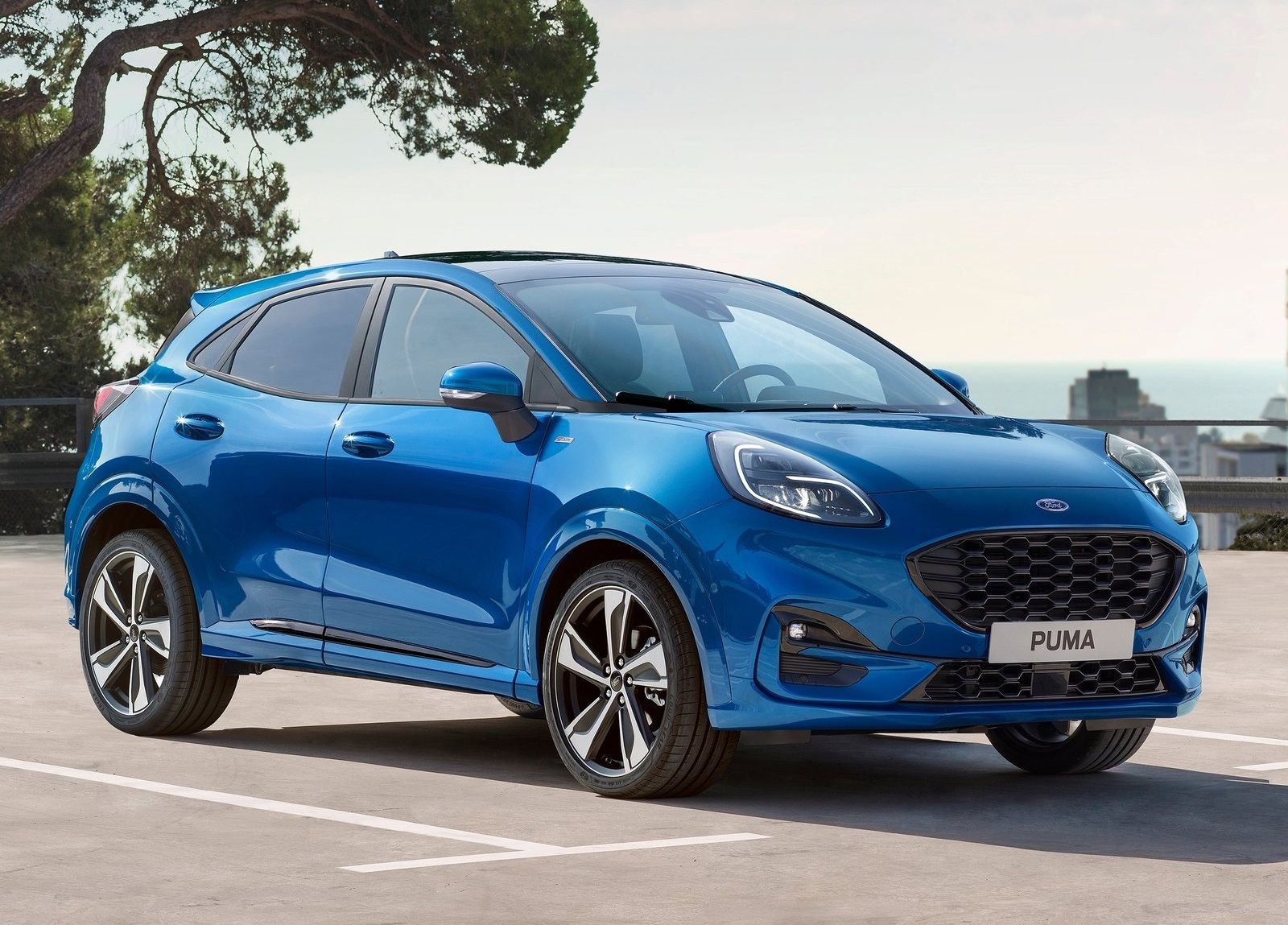
Ford Puma


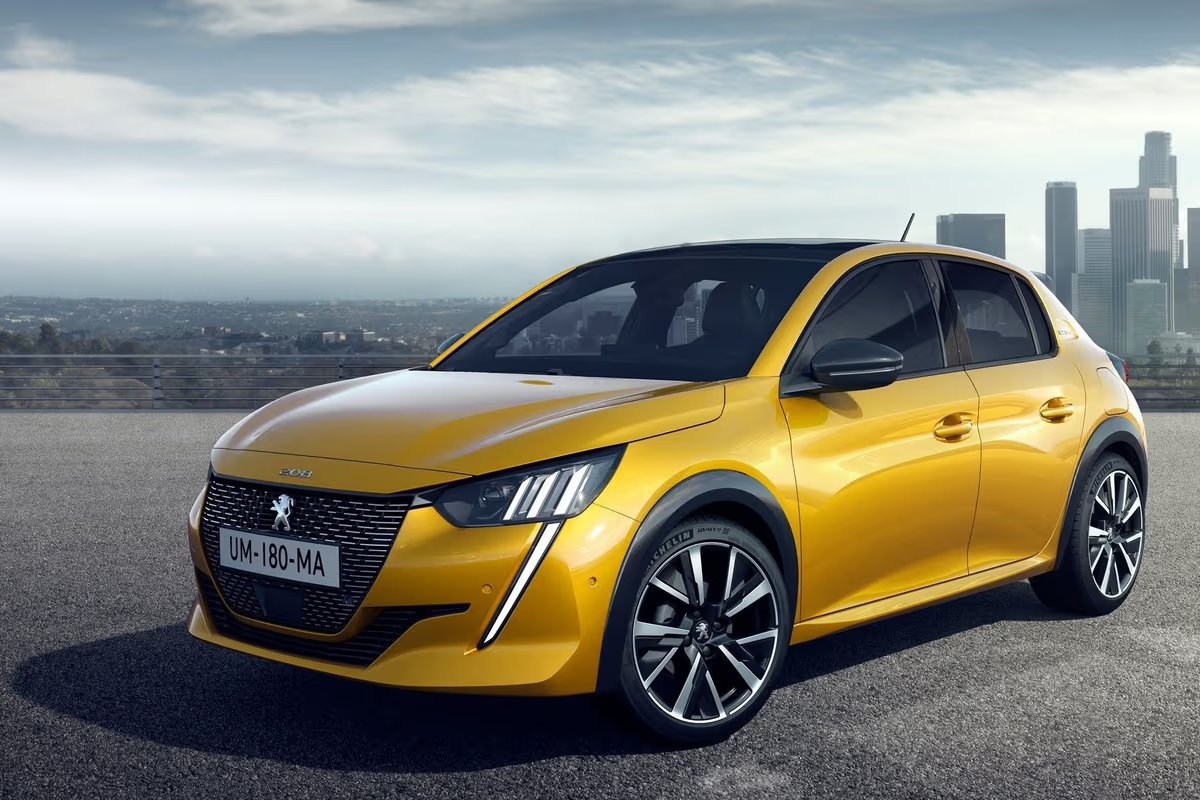
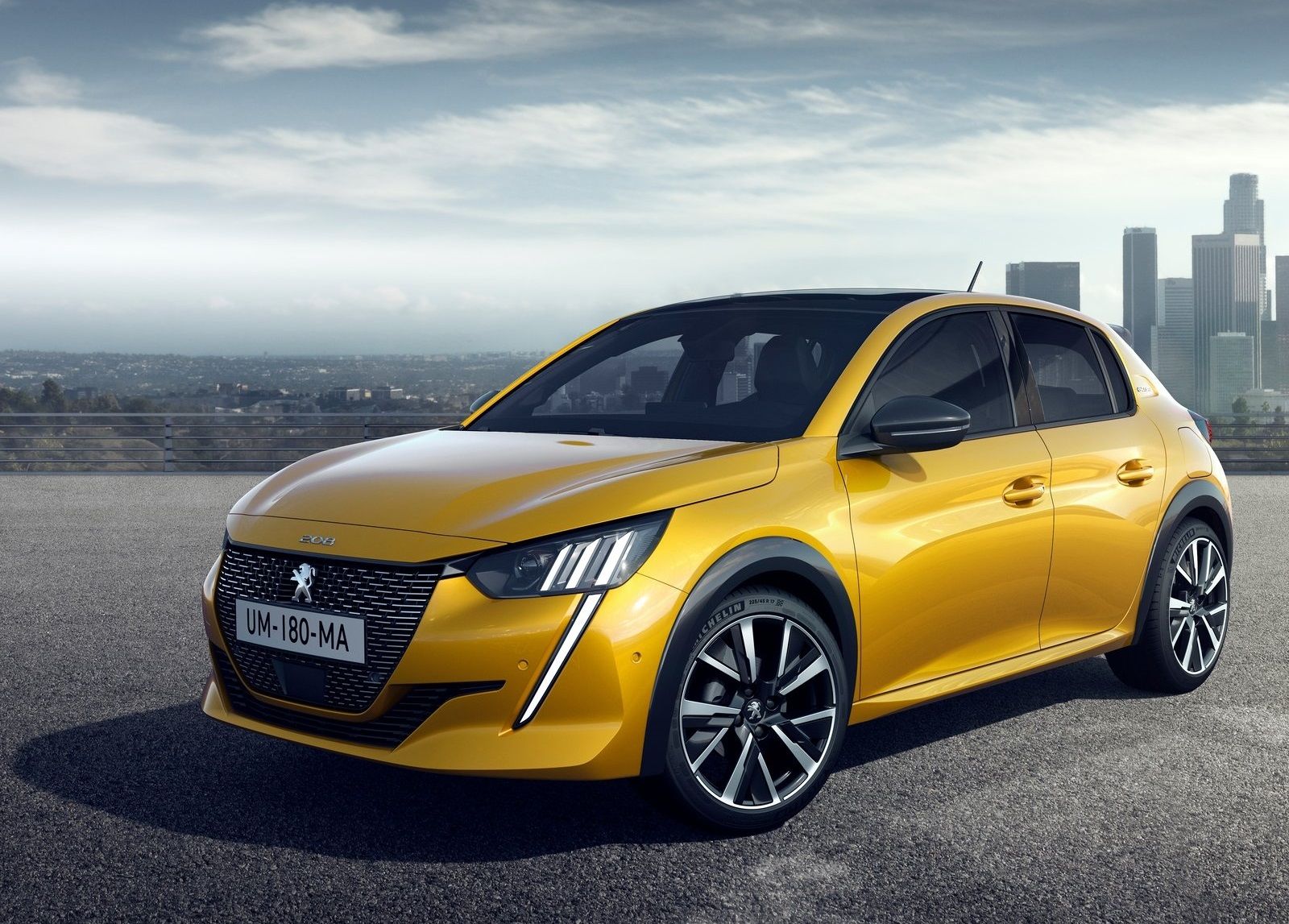
Peugeot 208


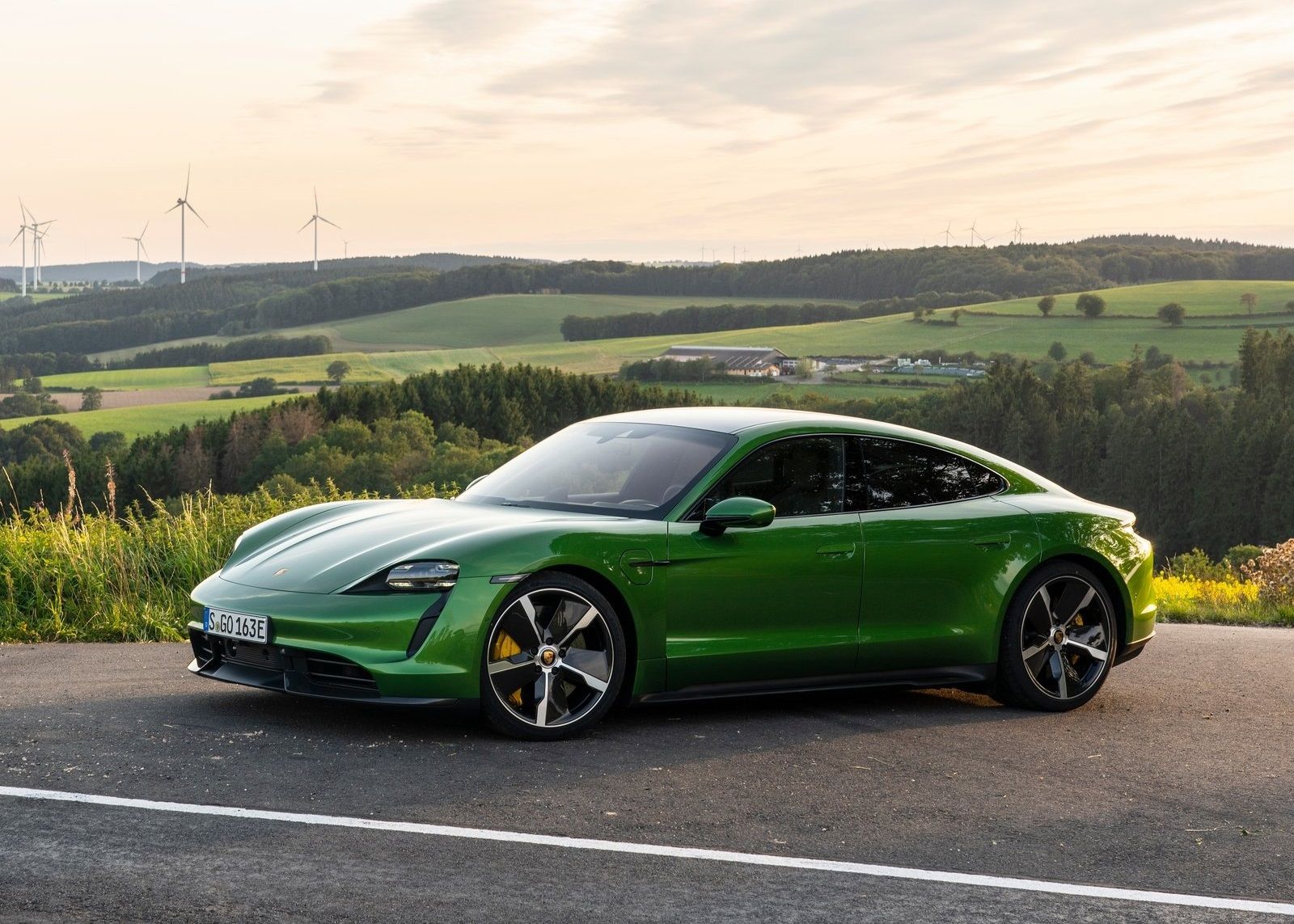
Porsche Taycan


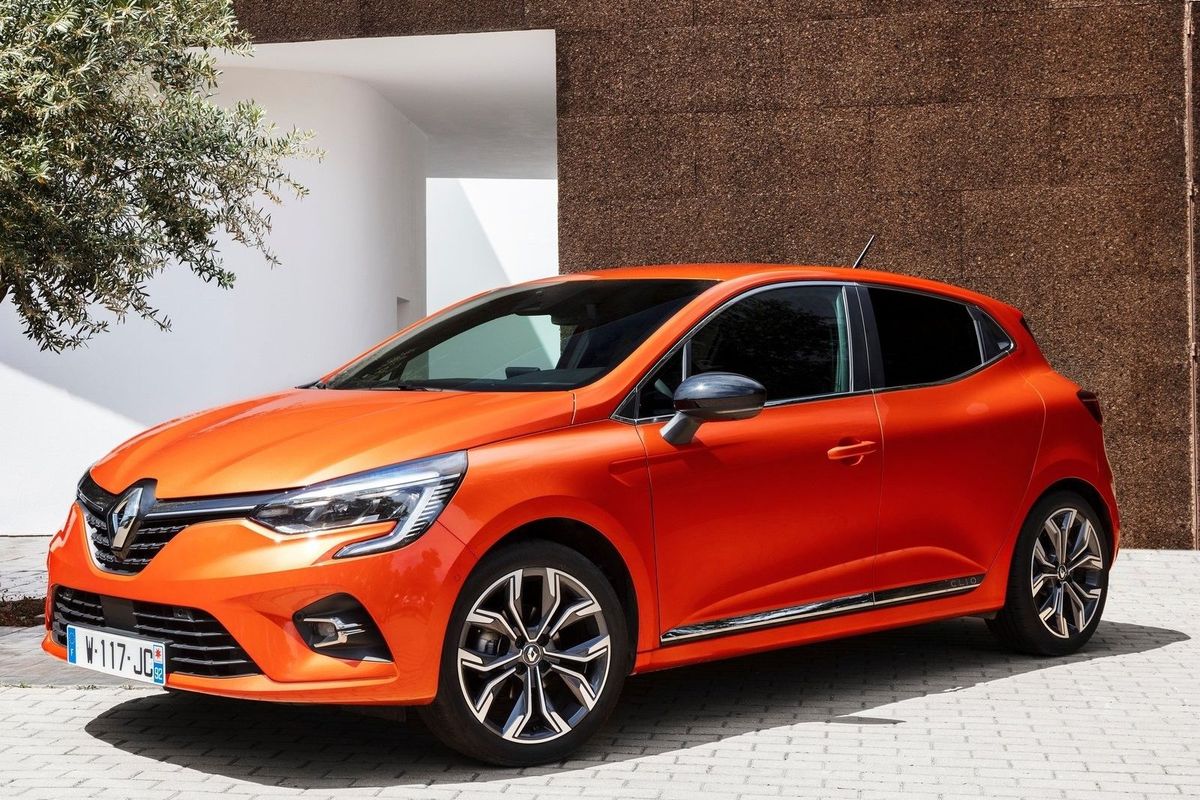
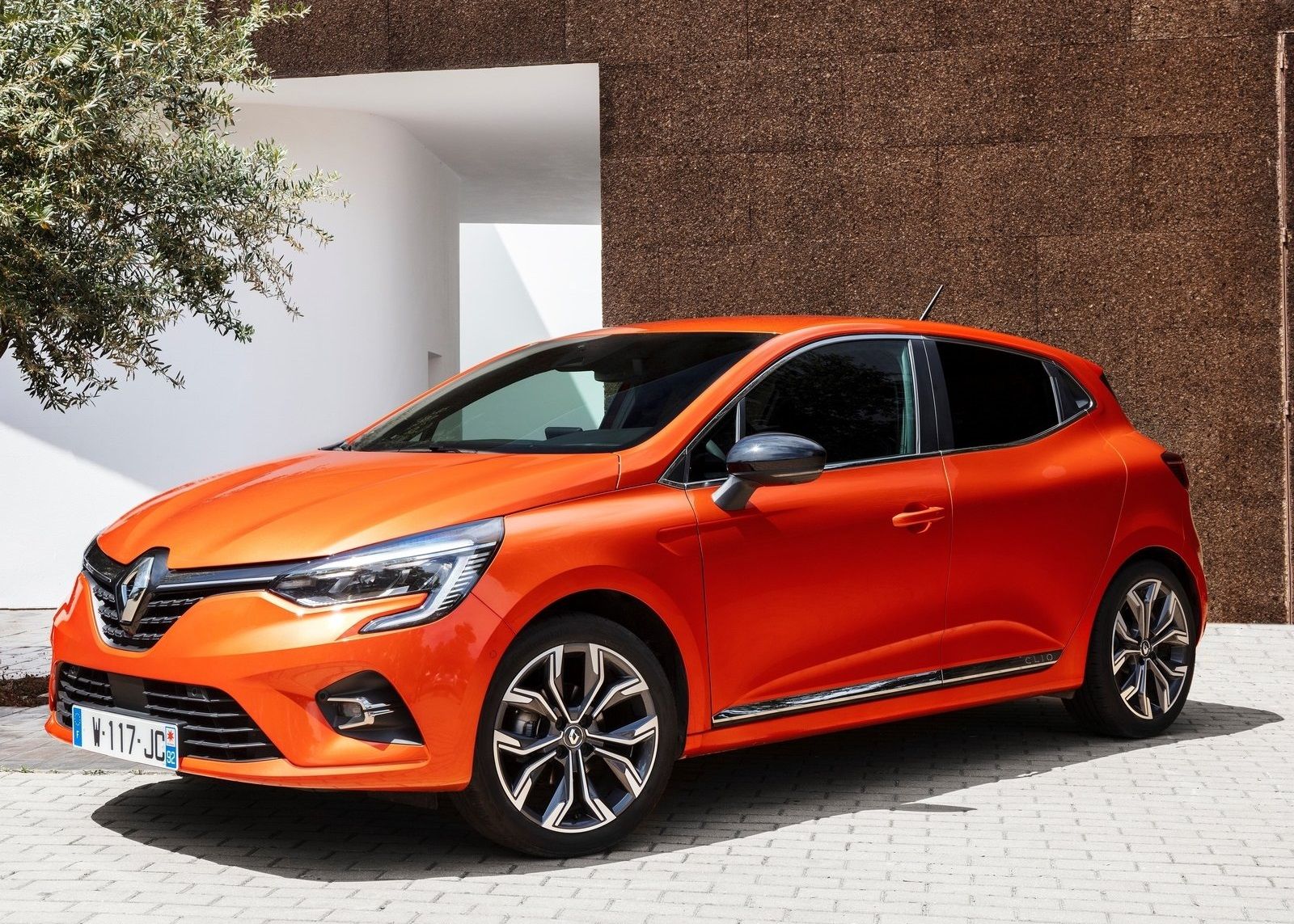
Renault Clio


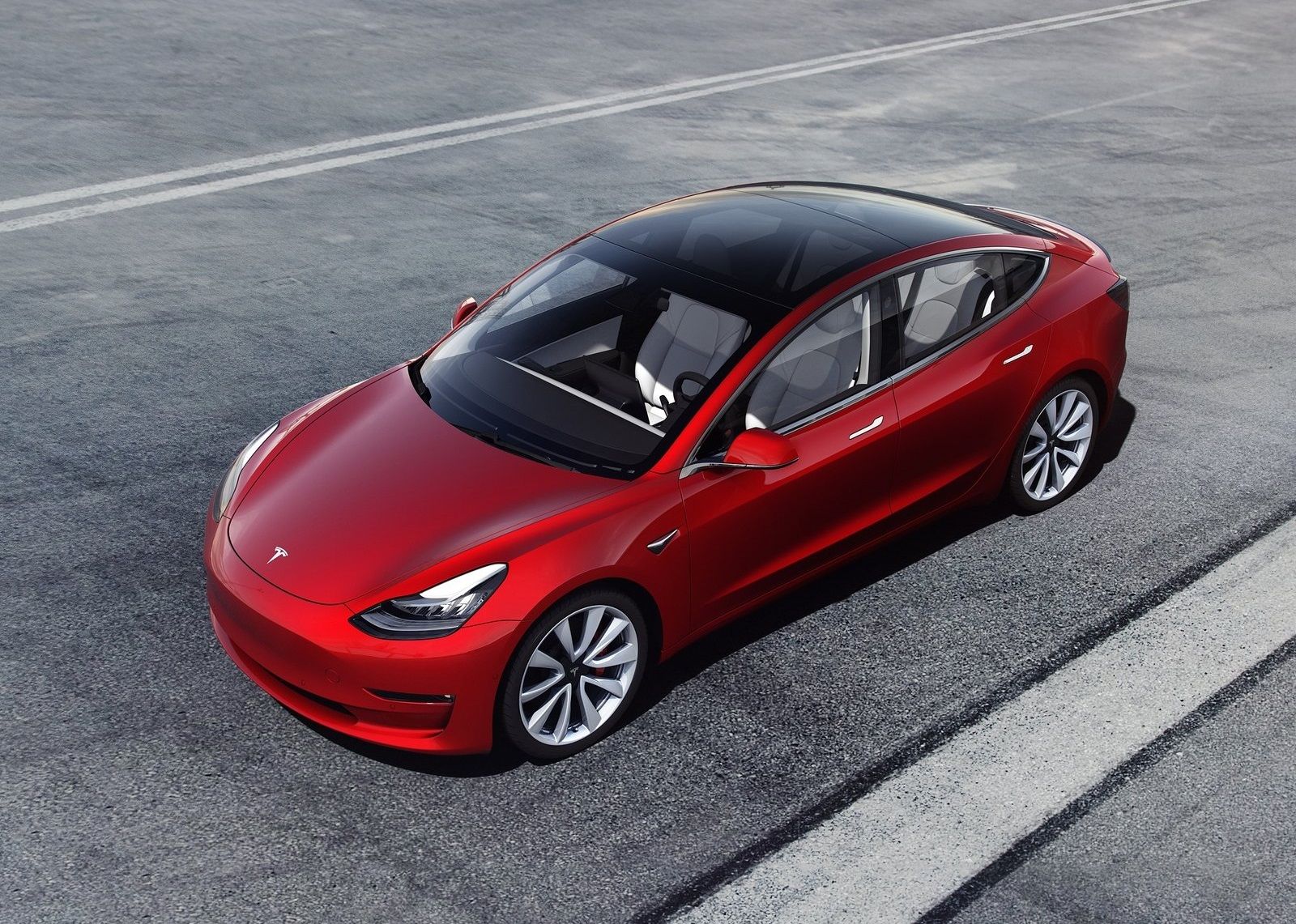
Tesla Model 3


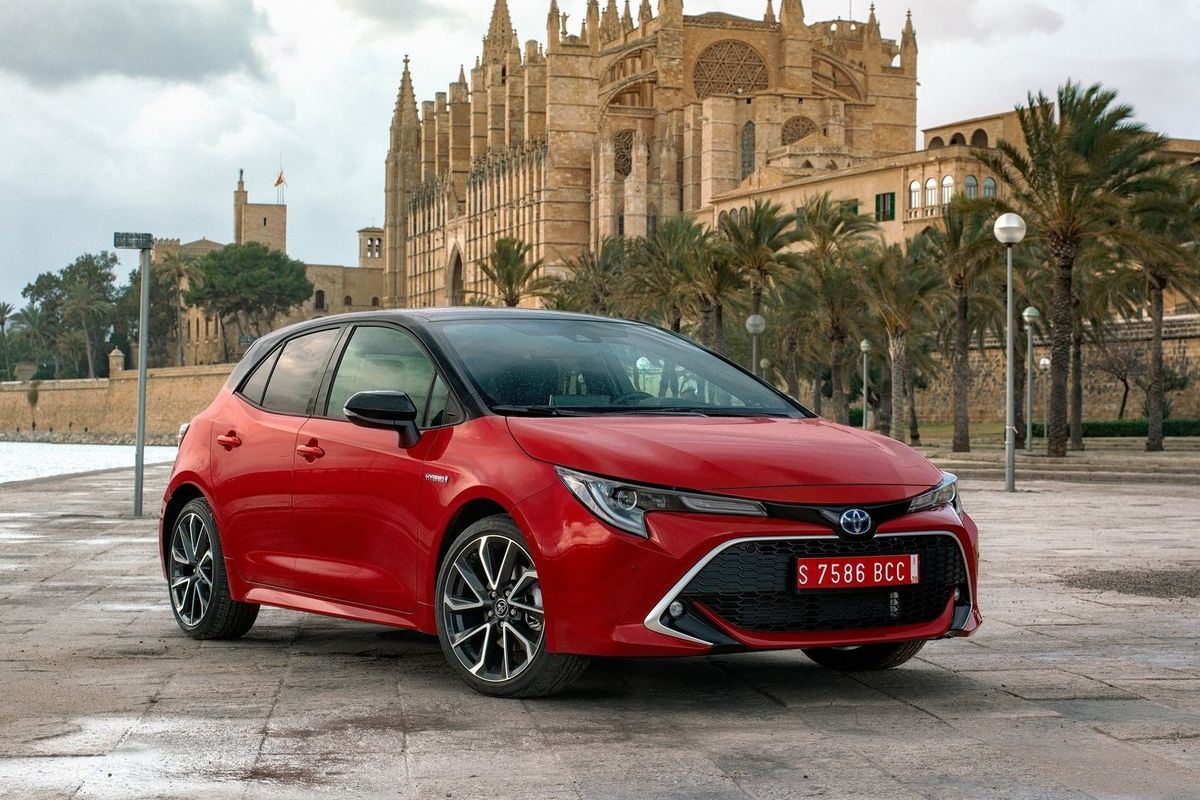
Toyota Corolla