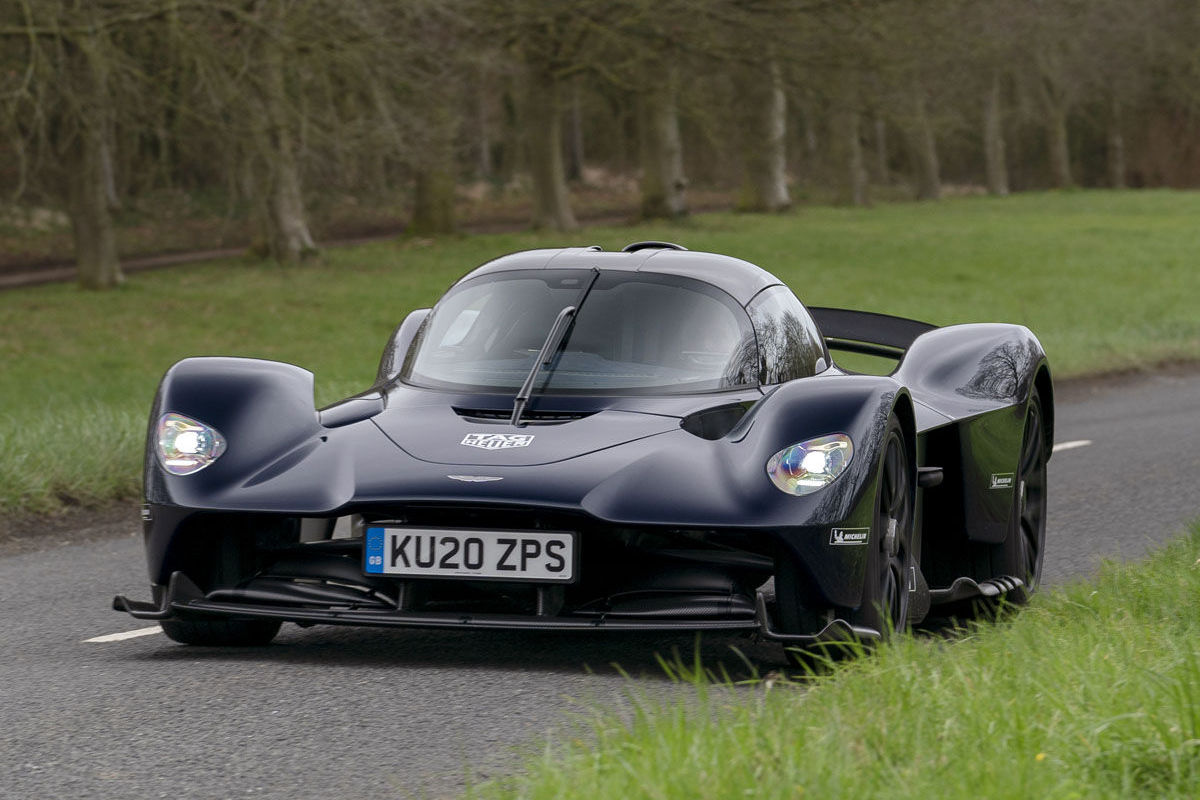
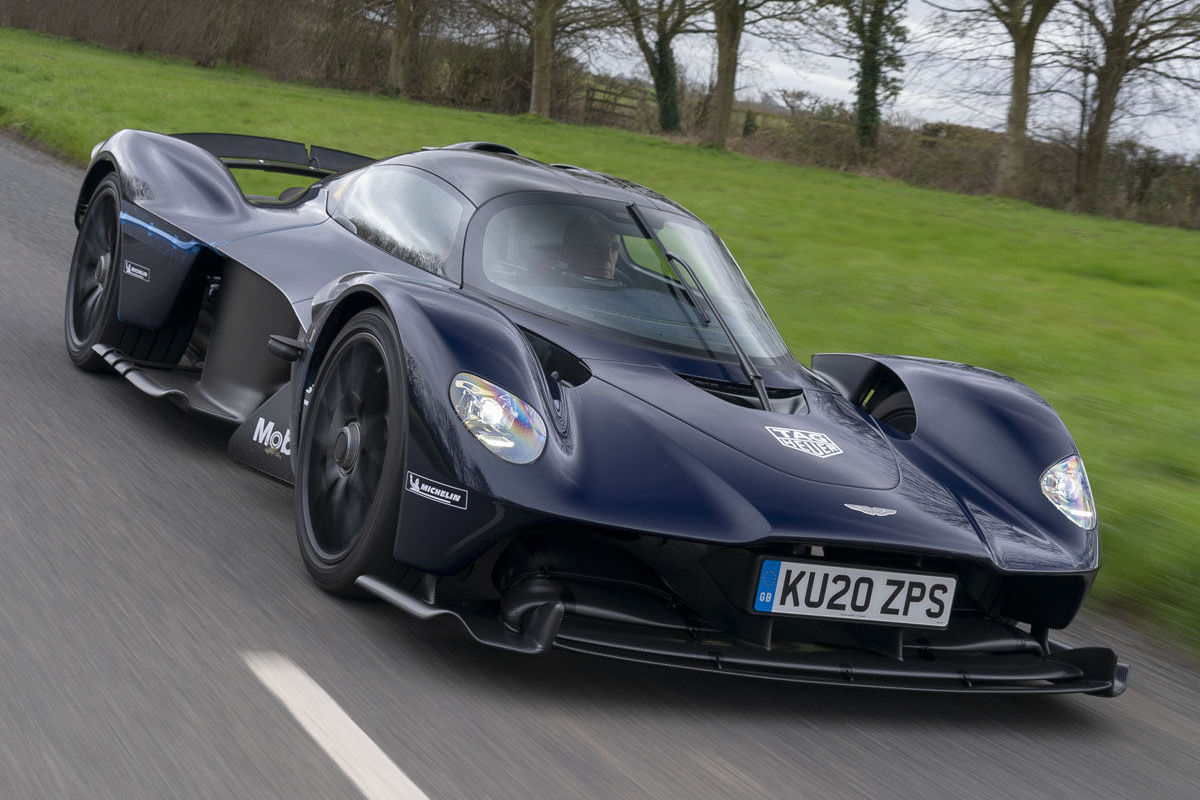
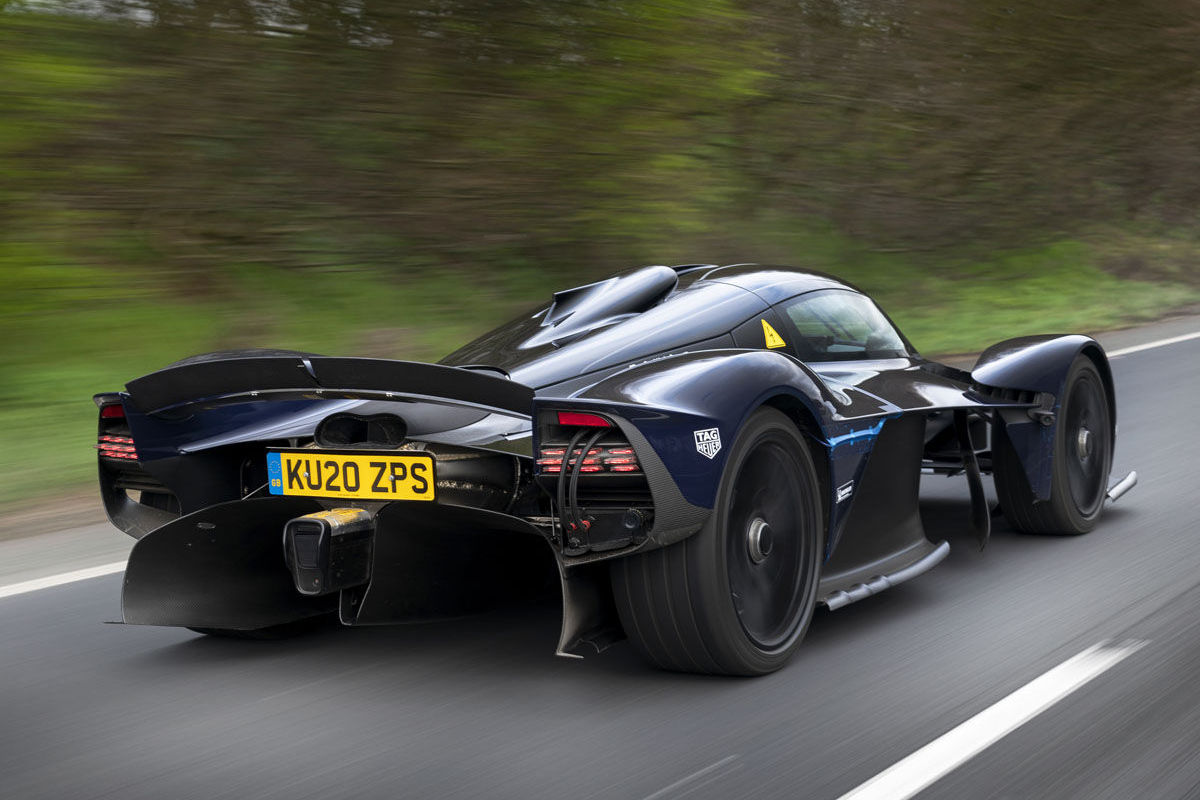
Finally, we get a good look at the production-ready Nissan GT-R50 by Italdesign.
The Nissan GT-R50 by Italidesign is a unique take on the GTR concept and after we were wowed by the initial images, it appears that customers were too. There have apparently been a significant number of deposits and customers are already choosing their spec.
Just 50 will be built, making it quite the collectable. The first customer car will be on display at the 2020 Geneva Motor Show, with the first customer deliveries towards the end of 2020.
"Our customers have relished the personalized experience provided by Italdesign, who have a long tradition in the exclusive field of ultra-rare, bespoke high-performance vehicles," said Bob Laishley, global sports car program director at Nissan. "Their experience with the GT-R50 has been incredible and I can say first-hand that each car will certainly be a standalone masterpiece."
The GT-R50 is a collaboration between Nissan and Italian styling house Italdesign and it is based on the latest iteration of the Nissan GT-R NISMO. Under the bonnet is the NISMO-tuned 3.8-litre twin-turbocharged V6, which produces a thundering 530 kW.
Europe’s most important automotive group has a new designer for its core brand.
VW has announced that a Slovakian will become the company’s new chief designer, an appointment which will be hugely important as the German business attempts perhaps the most ambitious vehicle electrification strategy in history.
The man who will oversee and direct all future design work for VW, starting in January 2020, is Jozef Kaba?. And for the 46-year old Slovakian, it completes an interesting career orbit.
Kaba? trained in his native Slovakia before moving to London for advanced study at London’s Royal College of Art. He started his car designing career at VW, back in the 1990s. Kaba?’s first notable promotion was a move to Audi, in 2003.
By 2007, Kaba? was entrusted with all exterior design at Audi – at a time when the German premium brand was producing some of its most revered work.
As one would expect of somebody with strong Slovak roots, Kaba? spent a long time at VW’s Skoda sub-brand, working as design chief from 2008-2017.
In 2018 Kaba? defected to BMW to become head of design. He was soon moved to BMW’s British luxury division, Rolls-Royce, but his tenure here was short. Kaba? only remained with Rolls-Royce for less than half a year.
VW has now managed to reemploy one of its most experienced and daring designs. For Kaba? the challenge will be to translate classic VW design simplicity and values to a range of new electric vehicles which will have radically different proportions and packaging.
There can be little doubt regarding Kaba?’s design credential or talent. He was responsible for the exterior design of the Bugatti Veyron.
Owners of Electric Vehicles (EVs) and Plug-in Hybrid Vehicles (PHEVs) can now use a live map to check the status of charging stations in South Africa.
Jaguar has launched a live map showing the status of charging stations all over South Africa which will make it easier for EV and PHEV owners to plan their journeys.
Jaguar's new live map will make planning your EV charging much easier.
The map shows the entire network Jaguar Powerway and GridCars charging stations and indicates whether these stations are online, offline or currently in use. More than this, the map will also indicate the time and date of the last successful charge while also showing how many times the station has been used.
In 2018, Jaguar partnered with electric vehicle charging authority, GridCars, to install 82 new charging stations across South Africa with an investment of R30-million. The charging stations were installed at all Jaguar Land Rover retailers as well as at various points of convenience such as shopping centres, major hubs including Johannesburg, Pretoria, Durban, Cape Town, Port Elizabeth, East London and Bloemfontein and along major holiday routes in an effort to alleviate range anxiety for owners of electric and plug-in hybrid vehicles.
Brian Hastie, Network Development Director, Jaguar Land Rover South Africa said “While the primary charging habit for the majority of EV drivers will be at home where it’s most convenient and cost-effective, we know that the future of electric mobility ultimately relies on a public charging network. As the rollout of public charging stations intensifies and the dots between existing locations are connected, it’s vital that EV drivers are able to view the status of chargers remotely. This live map makes that possible.”
Most charging stations on the network are 60 kWh fast chargers which also accommodate PHEVs with a 22 kWh AC fast-charge ports. The AC standard Type 2 socket will allow charging of all EVs currently available in South Africa, while the DC charger is fitted with the CCS DC type socket used by the vast majority of EVs in SA.
The BMW i3 received a mild facelift in 2019 and we recently evaluated an updated eDrive REx derivative (over a 10-day period) to evaluate whether the all-electric lifestyle had become more viable by virtue of an improvement in the EV's projected range. Can the high purchase cost be justified and, more importantly, can you avoid range-anxiety?
We Like: Futuristic looks both inside and out, highly entertaining acceleration, enhanced range.
We Don’t Like: High price, cramped rear space, no government subsidies, charging network still being rolled out.
The BMW i3. Note the 2 panels, the one towards the rear is where you plug in, while the front is to top up the range-extender petrol engine.
What is it?
This is not our first experience with the BMW i3 Range Extender (REx). We first had a go back in 2015 and came away impressed with the endearing eccentricity of BMW's first foray into the electric-vehicle space. Now for 2019, BMW has enhanced its i3 range with improved battery range and some design tweaks, as well as the addition of a sportier i3 S, which affords a sportier driving experience. The critical change is a higher-capacity battery. When this range first came to market, the pure electric i3 had an optimal range of just 130 km. Now, thanks to the advancement of technology, the ultimate range has increased to 260 km, but the battery has remained the same size. Now that's progress!
How it performs in terms of…
Performance and efficiency
With its unique style, there's nothing quite like it on the roads.
With peak outputs of 125 kW and 250 Nm being directed to the i3 eDrive REx's rear wheels via a single-speed automatic transmission, the diminutive BMW's accelerative ability was always going to be brisk, especially when you consider how light the EV's body is (thanks to liberal applications of carbon-fibre in its construction). According to our test equipment, the BMW i3 zipped from 0 to 100 kph in 8.14 seconds (on a cool morning), which kind of elevates it into "warm hatchback" territory. The key here is that the electric motor delivers lag-free performance and since there are no gears to change, acceleration is seamless and elastic. You'll find that while there's considerable enjoyment to be had in flattening the accelerator pedal to experience that "eerily quiet" acceleration, the BMW's range diminishes at quite an alarming pace. The key here is to drive conservatively and cruise along at the same pace as the traffic around you.
The eDrive REx has a supplementary 2-cylinder petrol engine, but it doesn't propel the car. Instead, when you run out of charge, you'll hear a humming noise as the 2-pot engine fires up to generate more electricity so that you won't grind to a halt. Once fully charged, you should get just over 400 km using both the battery and the petrol-powered "top-up". BMW states its battery capacity has increased from 60 Ah to 120 Ah, which explains the commendable jump in range.
By utilising a trio of driving modes (Comfort, Eco Pro and Eco Pro+), you can extend the i3's efficiency, but do note that the last mode should be used in extreme circumstances to eke out as much range as possible, because in Eco Pro+ the top speed is limited to an awkward 90 kph and you have to make do without climate control, which is a sweat at the height of summer. We found that when it comes to charging, your best bet is to park the eDrive REx in your garage and plug in overnight, much like your cellphone, but this all depends on how much driving you do. For those short city drives, you're most likely be able to do 2 or 3 days' worth of commuting before you need to plug in and charge it fully.
If you live in a major city and find yourself in need of a charge, your local BMW dealer will probably have a high-powered charger with which you charge up to 80% capacity in 30 minutes AND it's free. We discovered the Plugshare app, which overlays Google Maps with available charging stations, and you'll be surprised by just how many have been rolled out in the larger metropolitan areas. Shopping malls, airports and even petrol stations are installing charging points.
For a fast and free charge, head to your nearest charging point-equipped BMW dealership.
Ride and handling
The first thing you'll notice about the BMW i3's driving experience is just how quiet and refined the EV is. As it is unencumbered by an internal combustion engine (ICE), which, as we know, produces mechanical noise even when at idle, travel in the i3 is whisper-quiet as the eDrive REx seemingly glides around effortlessly. Imbued with a pleasingly direct steering feel, the BMW i3 is entertaining to drive in short and energetic bursts, which is helped by the maximum torque being instantly available. Given the BMW's tall and narrow shape, coupled with the skinny tyres, the i3 eDrive REx does feel somewhat top-heavy when you're pressing on, but remember: this is an electric city car and not a hot hatch.
The secret behind the test unit's pleasant ride quality is the inherent rigidity of the carbon-fibre-strengthened shell and low centre of gravity (by virtue of the battery being located at the bottom of the car). The i3's biggest forte is urban commuting; that's when its instant responses and linear performance work wonders. It tends to lose a bit of oomph on freeways – we noted the range dropped quickly as the car fought to punch through the air at 120 kph. When you come off the throttle, the regenerative braking kicks in, which replenishes some charge and slows the car down. The deceleration is strong enough to trigger the brake lights, so you can adopt a 1-pedal driving style and coast to intersections.
Despite the low profile and narrow width of the tyres, the BMW i3 happens to ride surprisingly smoothly. These 20-inch units are a R20k option though!
Interior quality and features
Like it did back in 2015, the i3's interior design really tickles our fancy – it's one of the coolest cabins we've experienced. The first aspect you notice is the modern and minimalistic ergonomic layout, which we really like, but legacy car owners may find it too polarising. For the BMW traditionalists, they'll be happy to see the BMW iDrive controller and familiar layout of the infotainment system.
Call the i3 "novel" or "eccentric" all you like, but BMW is a luxury brand and its models' arrays of features and interior quality still need to be of a certain standard. Thankfully, the i3 eDrive REx is no exception. In terms of specification, it covers the basics well with climate control, cruise control, auto lights and -wipers, USB/Bluetooth connectivity, steering wheel controls and satellite navigation. In terms of options, we'd advise speccing the upgraded audio system, Apple CarPlay connectivity and tyre pressure sensors additionally, if your budget stretches far enough. For those concerned about safety, the i3 boasts ABS with EBD and brake assist, electronic stability control and 6 airbags.
The clean and minimalistic interior of the BMW i3. Note the lack of a central transmission tunnel.
Practicality
The BMW i3 may be a compact city car, but its interior space is cleverly utilised. The load bay lacks depth, but there's sufficient space for a few shopping bags. Drop the rear bench, slide the front passenger seat forward and you can fit in a mountain bike with relative ease. With no transmission tunnel, there's a support strap to hold bottles or documents and the door pockets are practically-sized. The armrest doubles as a storage pocket; it's ideal for storing house keys.
Those contoured leather seats form part of the Interior Design Suite package.
The compact dimensions of the i3 mean that while it does have the capacity to carry 4 occupants, rear legroom is tight. For quick jaunts around town, it can just about accommodate 4 adults. Dubbed the "Life Module", the BMW's passenger compartment eschews B-pillars and the rear doors open outward like those of a cabinet, which makes ingress and exits simpler. The front passengers each get their own sunroof, which is a simple yet thoughtful touch.
With both doors open, you can see how easy it is to gain entry into the BMW i3. While there are seats at the back, there's not much legroom.
Price and warranty
The BMW i3 eDrive REx costs R740 700 before options. The vehicle comes with a 2-year vehicle/unlimited distance and 8-year/100 000 km hybrid battery warranty. There's also a 5-year/100 000 km maintenance plan.
With its quirky and futuristic looks, combined with its ultra-responsive powertrain, the updated BMW i3 still offers a fascinating glimpse into the not-too-distant future. The facelift adds some design upgrades, both in the cabin and the exterior, but the biggest (and the most important) improvement is the increase in battery capacity. The additional (projected) range will assist with the reduction in range anxiety, but despite the rapid expansion of the Gridcars and ChargeNow networks, there will still be some buyers who'll be wary of not using fuel stations for anything but buying snacks or checking tyre pressures. The spectre of load-shedding won't help the image of electric cars either.
Then, finally, some will find the i3's looks too outlandish. All in all, it's a love it – or hate it – kind of car. As far as the Cars.co.za test team is concerned, we love the BMW i3 for making electric cars exciting; it suits our lifestyles very well.
As we mentioned in our road test of the first BMW i3 eDrive REx, the big issues are not with BMW or the i3, but rather the underdeveloped charging infrastructure in South Africa. While there has been notable progress made with the rollout of an EV-charging network and trips across SA have been accomplished by electric cars, there are still not enough chargers outside of the metropolitan areas. It's a catch-22: Manufacturers are hesitant to bring in more electric cars unless there's an adequate charging network, and the companies who build the chargers don't want them to sit idle. Pricing is also a bugbear and while the BMW i3 is the most affordable electric car in SA, it's still beyond the reach of the vast majority of the driving population. The government needs to change its tune and introduce some incentives to encourage electric car ownership or risk being left far behind. Happily, we are seeing progress, albeit at a glacial pace.
Right now, the electric car market is tiny (even if you add up the hybrid and plug-in hybrid models, it's a small percentage of the passenger car market. The compact EV space is by far the smallest of the lot). Nissan SA can't confirm when its new-generation Leaf will make it to market, but we do know there are some units floating around in South Africa. Mercedes-Benz and Audi will be launching the electrically-powered EQC and e-tron SUVs respectively next year, but they'll be priced significantly higher than the BMW i3 as they provide competition for the Jaguar I-Pace. Volkswagen SA is quite hushed on its plans for electrification locally, but we expect to hear some big news towards the end of 2020.
So, basically, the plucky little BMW has the segment all to itself, but, should you buy one? If you can afford the initial outlay and don't do mileages of more than 200 km a day, then the i3 makes for a compelling (and let's face it, conversation-starting) city car. Better yet, if you're in a 2-car household then you can easily slot the i3 in as a charming urban runabout with the internal-combustion engined vehicle being used to transport the family on longer journeys.
VW has teased a new compact crossover. Think of it as a coupe variant of the wildly popular T-Cross; something that could ultimately work quite well in the South African market.
Although the Wolfsburg-based firm is being coy about the technical details, it has released the strategy around its Nivus cross-coupe. Due to debut in the Brazilian market next year, the Nivus is a cross-coupe built on VW’s current small car platform and, judging by the teaser images, the Nivus clearly has a coupe shape with a sloping roofline, with a crossover-esque ride height.
A generously proportioned rear end should ensure competitive luggage capacity despite the tapered roofline, plus the Nivus' tailgate features a slightly broader taillamp design than the T-Cross.
Developed on the very accomplished VW MQB A0 platform, the Nivus should have all the ride, handling and refinement attributes of a Polo, but with additional ground clearance.
It is expected to feature the same drivetrains as the derivatives in the T-Cross range, which means the 1.0-litre 3-cylinder TSI turbopetrol engine should be the default powerplant.
Power is graded at 85 kW and the only traction configuration is front-wheel drive – like most other hatchback-based crossovers. The Nivus will be available with either a 6-speed manual- or 6-speed dual-clutch (dual-clutch) transmission.
Volkswagen has not confirmed its global product strategy for the Nivus, besides confirming that its launch market will be Brazil. Countries which already receive T-Cross will naturally be candidates for this new VW compact cross-coupe. That means that it's not out of the question that the Nivus could be introduced into the local market at some point in the future.
There are some potent SUVs destined for South Africa and these 5 Power SUVs are coming to rock your world in the new year.
For many people, big, powerful SUVs represent ultimate success and while these brutes are designed to offer near-supercar-like performance, they also serve as luxurious family vehicles that can deliver the kids to school in a flash or transport wealthy politicians and business people to the office, which means that they also serve a practical function.
Here are 5 Power SUVs worth taking note of in the coming year…
Aston Martin’s first-ever SUV, the DBX is due to be revealed in Cape Town this weekend and the event officially marks its arrival on South African soil. Built from the ground up on Aston Martin’s new SUV platform and produced in St Athan, Wales, the DBX is built to perform.
Powered by an uprated Mercedes-AMG-sourced twin-turbocharged 4.0-litre V8 that produces outputs of 404 kW and 700 Nm of torque, the DBX offers some serious grunt. A 9-speed automatic transmission directs those numbers to all 4 wheels effectively with both an active central differential and an electronic limited-slip differential at the rear. An active exhaust system delivers aural pleasure and Aston Martin claims that the DBX will sprint from zero to 100 kph in 4.5 seconds before reaching a top speed of 291 kph. Pricing is expected to be revealed soon.
Audi’s range-topping SUV, the RS Q8 will make landfall in the third quarter of 2020 and it’s one of the most anticipated new arrivals for the year. The RS Q8 will bring massive firepower to the road with outputs of 441 kW and 800 Nm developed by its 4.0-litre bi-turbocharged engine.
As you would expect, those outputs will ensure scintillating performance and the RS Q8 will dash from zero to 100 kph in 3.8 seconds before smashing a top speed of 305 kph. Pricing will be confirmed closer to launch.
BMW’s dashing duo are due rock the SA market in the second quarter of 2020 and both will be powered by a twin-turbocharged 4.4-litre V8 engine tuned to deliver a whopping 460 kW and 750 Nm. Coupled with an advanced all-wheel-drive system and an 8-speed automatic transmission, the sprint from zero to 100 kph will take only 3.8 seconds before reaching a limited top speed of 250 kph (290 kph is optional). A dual branch exhaust system with active valves will provide the necessary soundtrack to let people know you have arrived…
The recently-revealed Mercedes-Maybach GLS has been confirmed for South Africa in 2020 and while it’s sure to impress with high levels of luxury it will also bring notable performance to the road. Under the bonnet is a 4.0-litre turbocharged V8 engine with an electric EQ Boost. Total output is rated at 410 kW and 730 Nm and the performance for such a hefty vehicle is impressive with a claimed zero to 100 kph time of 4.9 seconds. If you wish to make a statement then this might be the SUV for you, but it won’t come cheap. Pricing will be confirmed in 2020.
All the SUVs on this list boast incredible engine outputs which make them worthy of being on this Power SUV list. However, what the forthcoming Land Rover Defender might lack in terms of engine output, it makes up for it with outright offroad prowess! This is a power SUV in the world of offroading and we can’t wait for the new Defender to hit South Africa!
With a ground clearance of 291 mm, wading depth of 900mm and Terrain Response 2 which incorporates Clear Sight camera technology, the Defender is expected to be a formidable vehicle that’s geared to tackle any terrain in its path.
The long-wheelbase Defender 110 will be launched first in Q2 of 2020 with the short-wheelbase Defender 90 coming later. Two engines will be initially offered including a 2.0-litre 4-cylinder turbodiesel engine with 177 kW and 430 Nm of torque as well as a 3.0-litre straight-six turbopetrol good for 294 kW and 550 Nm of torque.
5 ways carmakers are making money by ‘taking the Mickey’
On the one hand, car firms are either happy to ride roughshod over tradition in their mad rush to downsize engines – or hand out their motors like they're flyers at an intersection. On the other, cynical marketing departments are maniacally launching special editions… of special editions. Either way, manufacturers are making more money by "taking the Mickey".
While the world economy faces ever-present threats of another recession, no doubt fuelled by the ongoing Brexit saga and Donald Trump's tariff war with China. Somewhere in between the chaos, the car industry is trying to keep afloat by, on the one hand, schizophrenically reinventing itself as the Greta Thunberg-approved patron saint for carbon-neutral citizenry, while on the other, trying to not alienate the supremely profitable (but ozone-eviscerating) performance component of mobility marketing. We've arrived at an uncomfortable and unsettling junction in motoring. CO2 emissions keep tumbling, but kilowatt outputs continue to rocket. A win-win for everyone, surely? Oh no, and here’s why:
Just a decade ago, BMW's 3.0-litre twin-scroll turbopetrol (35i) engine produced 225 kW, but it was a straight-6. The M135i xDrive produces the same, but it's a 4-pot with an electronically augmented exhaust note.
1. Efficiency is trumping tradition
Power outputs and engine efficiency are improving simultaneously, but the victim of this uneasy truce between petrolheads and environmentalists is tradition. Consider that the newest iteration of BMW’s 2.0-litre B48 engine develops 225 kW and 450 Nm – figures that are similar to its 3.0-litre outputs from not so many years ago, but with reduced consumption and associated emissions: almost certainly a mortal blow to the company cornerstone – the straight-6 engine.
All of which means your car is nowhere as special as you think it is, because its engine is being downsized and democratised in the finest socialist tradition – by über-capitalist car companies, who charge you a premium for the privilege.
2. My hot hatch; your SUV: what’s the difference?
So it’s all good to blow next year’s school fees on an “early model Ford Focus ST, styled to look like an RS, low mileage (well, 300 000 km), no accident damage (but a minor respray), one careful lady driver, Ricardo seats, capable of an 11-sec quarter-mile (but never been raced)” knowing full well what you’re letting yourself in for. But that special sensation of swopping your second mortgage for the almost new hot hatch of your dreams will disappear as quickly as you can Instagram it – only to discover its engine is appropriated across the range with other – more ordinary – models, including the nemesis of all things performance, Lifestyle SUVs. Which means a sweaty fist bump from the Range Rover Evoque driver when he spots your recently discontinued (but still sick) Focus ST in the gym parking lot. When it comes to the pursuit of exclusivity and bespokeness and being charged for it, sharing has never meant caring.
Take that, Taycan! Tesla and Porsche have been vying for bragging rights around the legendary Nordschleife Nürburgring.
3. ’Ring sting: Leveraging SUV lap times
Yes, but what about so-called performance SUVs? Enough has been said about the motoring world's nonsensical obsession with kerb-climbers with ludicrous Nürburgring lap times. Green Hell, indeed: Jaguar has even turned its Ring taxi into an electrically-powered SUV, so the apocalypse has already arrived (if you ask me). Because the first thing you always inquire about when shopping for an SUV at the dealership is never about the folding rear seats, the ground clearance or the torque-vectoring all-wheel-drive system, but whether its record ’Ring time was achieved with all-purpose road tyres or Michelin Pilot Sport Cup 2 or the Pirelli Trofeo R or the Dunlop Direzza DZ03s, not so?
Car manufacturers are now also inventing their own categories for ’Ring time entries, followed by bold but baseless claims such as “best in class”, notably when there are no other competitors in that class, or any to have ever made such attempts. In August, Porsche claimed its electric Taycan, uhm, Turbo S, was “the fastest 4-door EV” around the Nürburgring. The “4-door” bit is important, because as an EV, the Taycan is almost a minute slower than the 2-door Nio EP9 around the 20.8 km-long lap. But that hasn’t stopped them from claiming a record – in a category Porsche created for themselves – before Tesla arrived in October with their “GT3-spec” Model S that beat the Taycan’s time by 19 sec.
Soon you'll see ’Ring records for “fastest blue cars with one white stripe, hey, remember to view that in private mode. Sorry, what was that?” or “the fastest blue cars with one white stripe with times set on a Monday” – all “best in class.”
This R35-generation Nissan GT-R has been in sale in South Africa since 2009… there have been several versions, here and abroad.
4. Special editions of special editions
This has to be the ultimate in shameless cash-mining manoeuvring by manufacturers: sell an already limited-run product, only to inform customers 6 months to a year later that there is now an über-er version of their once über-est version, which will necessarily devalue exponentially at the very moment of such announcement. With its uncountable track packs and lightweight editions, there have been more versions of Nissan’s geriatric R35-generation GT-R than there are Fast & Furious and Marvel Universe movies combined.
Another example is the Porsche 911 GT3 RS – the ultimate version of the already piping hot GT3, which in turn stands above the regular 911 Carrera – with the price, rarity and desirability factors to match Kim Kardashian’s phone number. Only for you to be later told “that’s not all”, because there now also happens to be a Weissach Pack edition intended to strip your once-hot GT3 RS of its specialness; even if in any GT3 derivative’s instance it’ll retain its value. Porsche did the same when launching the GT3 RS 4.0. And then the 911R. Because you’re totally worth it – but never quite special enough, for long enough.
The Mercedes-Benz X-Class has not been nearly as popular as its maker (and many others) thought that it would be…
5. Brand-busting buddy-ups
The thought of 2 respected manufacturers pooling their best efforts to make the most superlative car ever is a scintillating prospect. Audi’s limited-edition RS2 Avant stands tall as one of the coolest and credible collaborative efforts in history. Between March 1994 and July 1995, the Ingolstadt-based brand joined forces with Porsche to create the most iconic performance estate ever built. In a 1995 test for Autocar magazine, the RS2 delivered a 0-48 kph time of 1.5 seconds – which was faster than the McLaren F1 supercar – and indeed the Williams-Renault F1 car of that year.
Sadly, not all joint efforts capture the buying public’s imagination and run the very real risk of brand dilution or loss of product identity. Recent examples are Toyota’s flirtations with Subaru and BMW for the respective co-parenting of the 86/BRZ and more recently, the Supra/Z4. And after disappointing sales worldwide, Mercedes-Benz now regrets the creation of its X-Class and has already announced its intention to cull it at an undisclosed date: a perception of marginal build quality and a too-similar countenance to its Nissan Navara double cab organ donor, along with an excessive asking price, seem to signal the death knell of the Stuttgart-based firm’s He-Man meets Hugo Boss utility vehicle.
It has been said that the motor industry will see more disruption in the next 5 years than it has seen over the past 3 decades. The increasingly prevalent (and nauseating) acronym – C(onnected) A(assisted) S(hared) E(lectric) stands at the centre of this apocalyptic prospect. Our cars are becoming Tupperware appliances before our very eyes and through our subjection to advertising and all layers and avenues of influence, we’re being coaxed to feel good about it.
This is wrong.
In the 20th century, the automobile became the ultimate signifier of individual freedom. In future, it seems, it will come to symbolise enslavement and the death of individual expression. It’s the rise of the machines – and unless you’ve got something special from yesteryear hidden away under a cover in your garage, you won’t be immune to its advances.
Citroen has returned to the South African market with a renewed lineup that consists of 2 crossovers and a budget-car offering. We get to grips with the C3 Aircross, a compact SUV competing in a segment which has seen a slew of new entries in 2019. Can it compete with the entrenched competition?
We like: Styling, practicality, full-house safety equipment.
We don’t like: Uninspiring drive, Android/Apple Carplay only available on top-spec Shine.
Some Citroen dealers regularly offer specials: Have look here.
Where does it fit in?
Citroen's design is unmistakably French and quirky. Are those orange Shrek ears?
Automotive manufacturers appear to have found a new segment that’s gaining traction among young, trendy buyers and small families. The Citroen C3 Aircross is ostensibly aimed at buyers that would usually purchase traditional family cars such as the Mazda CX-5, Peugeot 3008, Toyota RAV4 and Volkswagen Tiguan… but they don't necessarily need all the space those cars offer.
What's more, the target market appreciates the appeal of a stylish lifestyle vehicle that can still fit children in the back and sports equipment in the load bay. A hint of extra ground clearance goes a long way, especially when the cars are unencumbered with the fuel penalty that comes part and parcel with an all-wheel-drive configuration… after all these are city-based cars that may only need to conquer gravel roads a handful of times (or even less) a year.
And so, the C3 Aircross plays its hand as a fun and funky alternative to the more traditional players in the segment. It comes in a playful range of colours and sports a design that stands out in a way only a French brand's product can.
How it fares in terms of…
Kerb appeal
You’re either going to love or hate the looks of the Citroen C3 Aircross. That’s probably the exact effect the French marque was going for anyway; it wants to be something different and an extension of an individual's personality. In that regard, the C3 Aircross delivers. As tested, finished in an orange-accented cream colour or dirty beige, it stands out from other offerings in the crowded compact crossover/SUV segment like very few cars can.
Kanye West may have inspired the shutter shades on the rear pillar. Doesn't make it easier to see out the rear.
For added quirkiness, it’s also wearing a set of Kanye West-inspired shutter shades on its rear side panels (C-pillars). While these may seem a cool, modern design element, they do make it rather difficult to see out of the rear. The 1.2T Feel has 16-inch wheels, while 17-inch items are optional on the Shine 1.2T. Ground clearance is 178 mm, which adds to the "SUV look" that’s on-trend but in reality, it’s only about 4 cm higher off the ground than a common hatchback.
Drivetrain performance
The 1.2-litre 3-cylinder turbopetrol engine at the heart of the C3 Aircross has been around for some time and we’ve sampled it in just about every contemporary Peugeot and Citroen in the last 3 years. With peak outputs of 81 kW and 205 Nm on tap, it’s on par with other small turbos from the likes of VW, Renault, Ford and Hyundai (to name just a few). It’s a bit noisy at low revs, but calms down markedly in the mid-range.
The engine and drivetrain are adequate and comparable to other offerings in the segment.
The acceleration isn’t going to get your blood pumping but that’s not what buyers in this segment are after. If performance figures have no bearing on your buying decision, the gentle, uncluttered acceleration experience will come off as pleasant. Drivetrain refinement is again, decent but not inspiring. The 6-speed auto ‘box does a good enough job of keeping the engine in the torque band but with a very short first and second gear, it has a tendency to lunge a bit in traffic. It is, however an improvement over the Cactus we last experienced this combination in.
Fuel economy for all the 3-cylinder turbo engines never meets expectations as they end up having to work quite hard to keep pace with traffic and highway speeds. Citroen claims you should average 6.5L/100 km but after 2 weeks with the C3 Aircross, we were at 8.4L/100 km.
Ride and handling?
The orange theme is carried over to the inside as well. Note the wide front seats.
For all it’s excitingly quirky exterior and interior bits, the "ride and drive" of the 1.2T Feel left our testers underwhelmed. There is a fair amount of body roll in the corners and the steering is lifeless and uninspiring when the Citroen's asked to display its (limited) dynamic ability. And, like almost all its competitors, it struggles to deal with abrupt bumps and a lot of those abrasions are transferred to the cabin which is unpleasant (but not out of the ordinary for a compact SUV).
The C3 Aircross deals with bigger undulations, such as speedbumps and pavement hops, markedly better and absorbs those with more of a cushioning effect.
Interior features
Part of the appeal of the C3 Aircross is the extensive list of standard interior equipment. The seats have a funky square design to them and are quite wide. Slimmer occupants may find them a bit loose-fitting, but they are comfortable on long journeys and adjustable in virtually all directions. Having a rake- and reach-adjustable steering column makes life more comfortable as well…
As for infotainment, there is a major difference between the Feel and Shine derivatives in that Apple Carplay and Android Auto compatibility is standard on the latter, whereas the former is equipped with Bluetooth and a USB port at the front. That feels like an oversight considering how tech-focused the modern buyer is; screen-mirroring technology is even available on the humble Datsun Go budget car. That said, BMW doesn’t have Android Auto available yet either.
The Feel model does not get Android Auto/Apple Carplay, only the top-spec Shine.
The touchscreen itself has a matte texture to it, a bit like a smartphone screen protector that removes that nice crisp colour and display that makes a modern screen a desirable item. The basic functions are easy to access with the shortcut buttons below the screen, but delving into the menus can be confusing if you’re not well acquainted with it.
Interior practicality
The long wheelbase of the C3 Aircross endows it with more passenger space than its rivals. The load bay is claimed to have a 410-litre capacity, which is on the bigger side for the segment. If you want even more practicality, the high-spec Shine derivative’s rear seats are set on rails, which allow you to slide the 2nd row forward to produce an extra 110 litres of loading space.
Safety features
Analogue dials are becoming a rare sight in new cars.
Both the Feel and the Shine get a full allocation of modern safety features including stability control, ABS and EBD, hill-start, ISOfix anchors for the rear seats and 6 airbags. Added safety features come in the form of a tyre pressure sensor, auto-locking doors and seatbelt warning chimes.
Price and warranty
The C3 Aircross 1.2T Feel costs R339 900 with its Feel sibling R359 900 (December 2019). For the extra R20k, the Shine offers better value-for-money with its extra features and added practicality. Citroen offers an inclusive 5-year/100 000 km warranty and a 5-year/100 000 km service plan on the C3 Aircross range. The service plan, in particular, is longer than what any of its competitors currently offer.
Verdict
The C3 Aircross is probably not the killer blow that Citroen SA is looking for.
Citroen has made its return to the local market with a suitably boutique line-up and the C3 Aircross fits perfectly into a segment that’s currently taking off in South Africa. The newcomer's exterior styling is a study in quirkiness and head-turning French design that makes it stand out from other offerings in the segment. The engine and gearbox combo is adequate compared with those of its rivals, but unlikely to satisfy those who enjoy a bit more perk to their performance.
With its longer wheelbase, the C3 Aircross offers more room for passengers and capacious loading space. Definitely consider spending extra for the Shine spec, which offers sliding rear seats and an upgraded infotainment system. The Citroen's driving experience is perhaps a trifle humdrum… It was always going to battle to match the aesthetic quirkiness and style of the overall package but nonetheless, we were left a little underwhelmed by the way it felt to drive.
What's more, the 1.2T Feel's asking price is not quite keen enough to really make buyers take notice or forget about the mainstream models that may represent "safer" buys in terms of anticipated resale value a few years down the line. The specification levels are high, however, and the safety kit comprehensive, plus the 5-year warranty and 5-year service plan go some way to elevate the Citroen as a reasonable long-term ownership proposition. Voila!
One of South Africa’s most important people movers lives on, in 14-seater configuration.
The introduction of Toyota’s 6th-generation Quantum earlier this year has made it inarguably more comfortable for many South Africans to get to work and visit family whilst on vacation. However, an unexpected consequence of the new Quantum’s success has been the revival of the previous one! It might sound a touch confusing, but you can now buy both Quantums in South Africa, with the revived version being marketed under the HiAce nameplate.
Those loyal taxi industry followers will know that HiAce was the name which established Toyota’s dominance of the South Africa mass transit transport market in the 1990s.
In terms of specification, the rebranded MPV (to reiterate, essentially an old Quantum), is configured with 14-seats and positioned aside Toyota’s Ses’fikile 16-seater in the HiAce range, albeit with more convenience kit such as air-conditioning, an audio system and USB ports.
Technical details are very much as they were. Power comes from the proven 2.5-litre turbodiesel with 75 kW and 260 Nm. Drive is to the rear wheels via a 5-speed manual transmission and its mechanically durability is unquestionable.
Colour options are limited to, predictably, simple white and silver.
An interesting ownership aspect of the 14-seater HiAce is that it is classified as a light commercial vehicle and does not require a code 10 licence to operate. Priced at R571 000, this latest HiAce is cheaper than a new-generation Quantum 14-seater, which retails for R635 000. The HiAce Ses’fikile 2.5 16-seater remains your value choice at R453 900.
The Jaguar brand is generally associated with sporty sedans and sensual sportscars, but for the past few years, the F-Pace premium SUV has been the Coventry-based firm's top-seller. Without it, the iconic British marque would be in far greater trouble than it is. Has Jaguar managed to crack the performance-SUV recipe with the storming SVR derivative, however?
We like: Attractive design, rorty exhaust, driving enjoyment, price positioning
We don't like: Not quite as "premium" inside as its Germans rivals
Fast Facts
Price: R1 530 728 (November 2019, without options)
Some Jaguar dealers regularly offer specials: Have look here.
Where does it fit in?
The F-Pace SVR's big exhaust tips emit a b-i-g sound… so much so that it borders on cacophonous.
As our Ciro de Siena recently mused in a video review of the Audi Q8, high-performance SUVs may have displaced traditional sportscars and first-class cars as the "dream cars" of today. That's why it's particularly important for Jaguar to get the F-Pace SVR spot on. After all, this is a brand that was built on performance and dynamism, so even though it succumbed to market forces and built an SUV, the product of that endeavour – the F-Pace – had to remain true to the marque's DNA. We already know, from our experience of lesser models, that the F-Pace is a fun-to-drive SUV, but this SVR will be up against the big boys from Germany, you know… those that brandish M, AMG and RS badges.
At present, and at the price, the F-Pace SVR is one of the most powerful and fastest SUVs you can buy. And also the loudest…
The F-Pace isn't the biggest SUV in its segment, but in SVR guise, it gains a muscular presence.
Finished in silver and riding on striking (and optional) 22-inch wheels, the F-Pace SVR is a mean-looking machine, but arguably not as aggressively styled as the likes of the Alfa Romeo Stelvio Quadrifoglio and BMW X5 M. But the F-Pace is one of the more handsome Premium SUVs anyway, and Jaguar's Special Vehicles Operation (SVO) has been clever in giving it a more muscular appearance, but without going OTT. Still, if you were ever in any doubt about the SVR's positioning, its quartet of large-bore exhaust tips (and the sound they emit) will be more than enough to put any doubts to bed. This is the top-dog F-Pace – it looks it and sounds it.
Step inside and the favourable first impressions continue, mostly because of the standard (and aggressively bolstered) sports seats trimmed in lavish quilted leather. Otherwise, the SVR is relatively similar to lesser F-Pace derivatives inside, save for the odd smattering of carbon-fibre trim, which is not a bad thing. The F-Pace's cabin is by no means cramped, but at the same time, it's not as spacious as, for example, the latest BMW X5 and Mercedes-Benz GLE, which are admittedly newer models. The transmission tunnel is high and the glasshouse shallow – design features that contribute to a more "enclosed" sportscar-like feeling behind the steering wheel, which itself offers plenty of adjustment.
Certainly an attractive place to spend time in, and also solidly put together.
Second-row legroom is decent enough for most families' needs, and the load-bay capacity is rated at a spacious 650 litres, which is the same as the new X5 and considerably bigger than the Stelvio's. You can drop the rear seats down to free up additional space for cargo, but the Jaguar doesn't offer quite as much utility volume as its German rivals. Where it also lags the Germans (very) slightly is in the perceived quality stakes. Build quality is solid, and most of the materials feel durable and luxurious, but there are some minor trim details that could be improved, or more "detailed".
The F-Pace SVR features a digital instrument panel as standard, as well as the InControl Touch Pro (SSD) navigation system that allows for smartphone integration via Apple CarPlay. In general, the standard features list looks impressive. The front seats feature both heating and cooling functions, while the rear bench can be heated. Dual-zone climate control is standard, but you pay extra for a 4-zone system (R15 400). The steering wheel features a heating function as standard. Cruise control, lane-keep assist and a reverse-view camera are standard too, but you pay extra for a powered tailgate (R6 400), surround camera system (R4 600) and a sliding panoramic sunroof (R19 900).
Performance & Efficiency
Want to make the throttle response explosive? Just toggle towards the chequered flag…
The F-Pace SVR is powered by the marque's charismatic supercharged 5.0-litre V8 petrol motor, which pumps out 405 kW (more than the similarly priced BMW X5 M50i and Alfa Romeo Stelvio Quadrifoglio), but less than the upcoming (and likely to be significantly pricier, BMW X5 M). Peak torque is a meaty 680 Nm (available from 2 500 to 5 500 rpm), which is sent to all 4 wheels via Jaguar's slick 8-speed automatic transmission.
Jaguar claims a 0-100 kph time of 4.3 seconds and a 283-kph top speed – that's sportscar-like performance in anyone's book – and the veritable barrage of thrust is produced in a pleasingly traditional, oh-so-Jaguar kind of way. The SVR always feels ready to catapult itself towards the horizon; its throttle response is electrifying (even before you switch to the sportier driving modes). And, my word, that quartet of exhausts ends emits a sonorous and cacophonous roar! It's so loud, in fact, that Jaguar in Australia has been told to reduce the SVR's sound levels if they want to keep selling it there. Hopefully, the up-tightness Down Under will never spread to South Africa and muzzle the spirited SVR here…
It is, however, a thirsty beast and you'll be required to top up that 82-litre tank quite regularly. Jaguar claims a combined cycle consumption figure of 11.9 L/100 km, but you're likely to average a figure closer to 14 L/100 km.
Ride & Handling
Massive 22-inch wheels provide lots of grip and, impressively, the ride remains relatively supple.
By virtue of being underpinned by the same platform as the sweet-handling XF executive sedan, the F-Pace has always been one of the more dynamic vehicles in its segment – SVO (Special Vehicle Operations), Jaguar's performance division, clearly had a good base to work from. Compared with its standard siblings, the SVR's adaptive suspension software is different, and the front and rear springs are 30% and 10% stiffer, respectively.
The F-Pace SVR is, however, one of the heavier vehicles in this segment, which is something to keep in mind when thundering into a corner – there's quite a bit of body lean and the natural tendency is towards slight understeer, but if you're mindful of these traits, this is a fun car to hustle through the twisties, because its so responsive to throttle pedal and steering inputs. The larger brakes, too, perform impressively, they deliver reassuring pedal feel and are seemingly resistant to regular hard use. Traction and grip are never in short supply: the electronically-controlled active differential and torque vectoring system undoubtedly play strong supporting roles in the SVR's overall on-road poise.
Considering those gorgeous 22-inch wheels and the low-profile tyres they're shod with (in fact, the rubber looks as if it was painted onto the rims), you'd expect the SVR's ride quality to be uncompromisingly stiff. But Jaguar knows how to make fun-handling cars that retain a measure of suppleness. Yes, over rougher roads and lower speeds, you feel the effect of the bigger wheels, but once up to speed, the F-Pace SVR is a smooth, relaxed and comfortable car to drive.
Price and warranty (November 2019)
The F-Pace SVR sells for R1 530 728, without options, but our test car came specced with several optional features, including a sliding panoramic roof for R19 900, Navigation Pro with a Meridian Sound system (R9 600) and Adaptive Surface Response (ASR) for R2 400. We regard Jaguar's extra-cost features reasonably well priced; even with all R61 000-worth of optional extras fitted to our test unit, its price compares favourably to rivals' (standard) pricing.
The price includes a 5-year/100 000 km warranty and 5-year/100 000 km maintenance plan.
Verdict
The Jaguar F-Pace SVR is a characterful, accomplished alternative to the German super-SUVs
We thoroughly enjoyed our time with the Jaguar F-Pace SVR. Unlike some of its rivals, it's neither overly aggressive nor shouty in appearance, yet it's undoubtedly a handsome car with plenty of kerb appeal. It makes its presence known, however, through an addictive soundtrack that we just could not get enough of (there's a button to make it even louder, hurrah!). It's positioned in an interesting space in the market, competing largely against less extreme variants of its German rivals, though you can get the smaller GLC 63 S at the same price. Undoubtedly the upcoming X5 M and Mercedes-AMG GLE 63 S, as well as the Audi RS Q8, will be more powerful… but also significantly more expensive.
But do you really need more performance and road presence than what the F-Pace SVR offers? We seriously doubt it.