Cars.co.za Consumer Awards, powered by WesBank Completes Testing at Gerotek
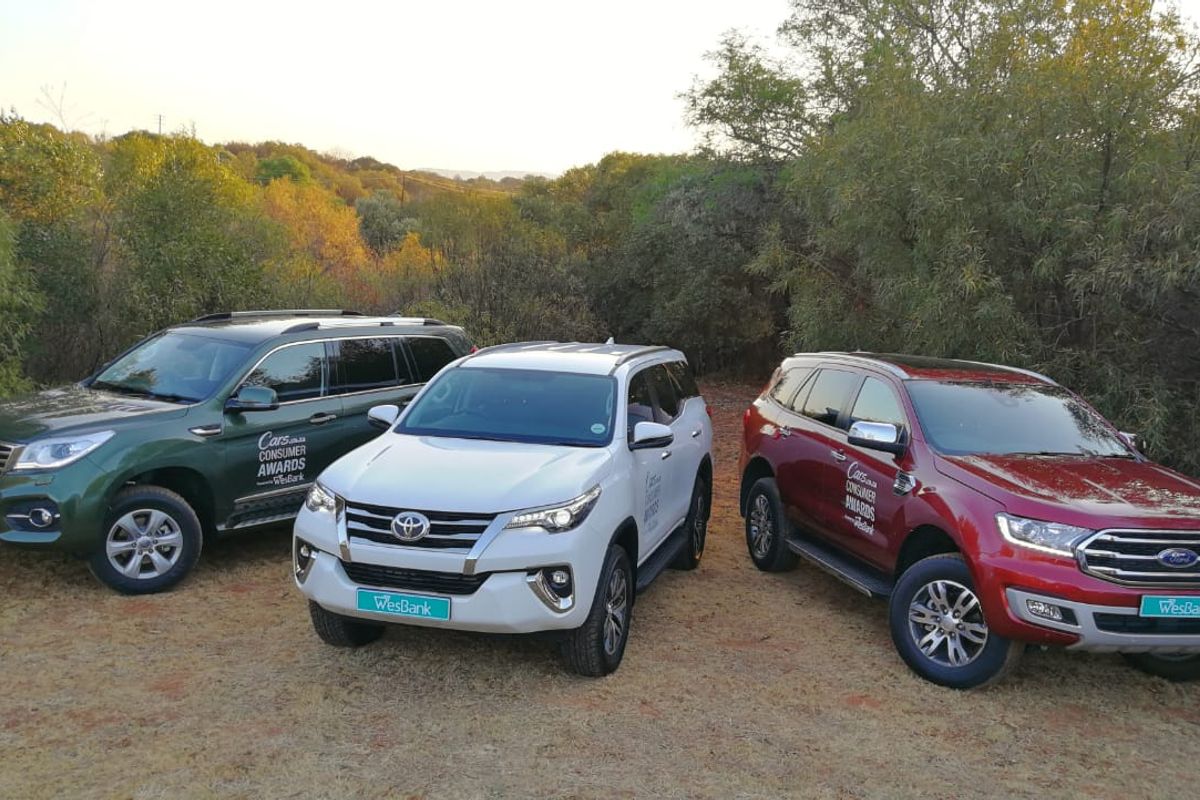
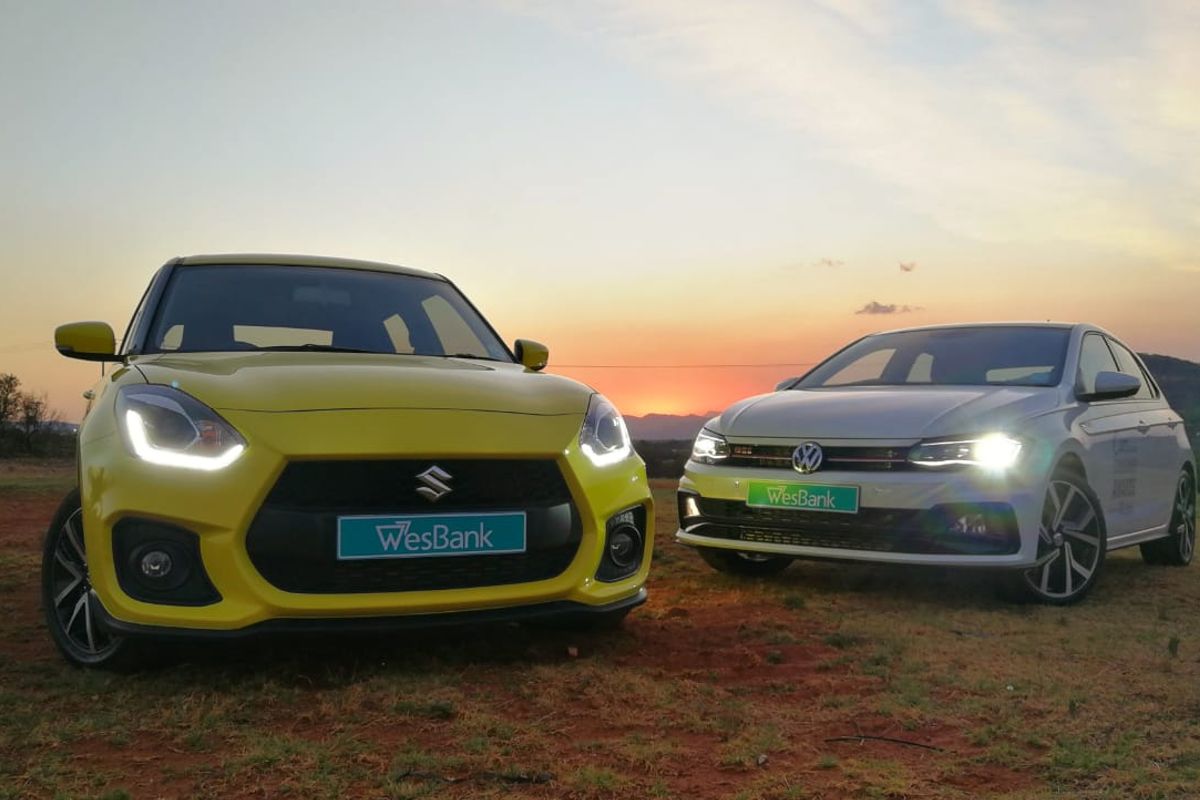
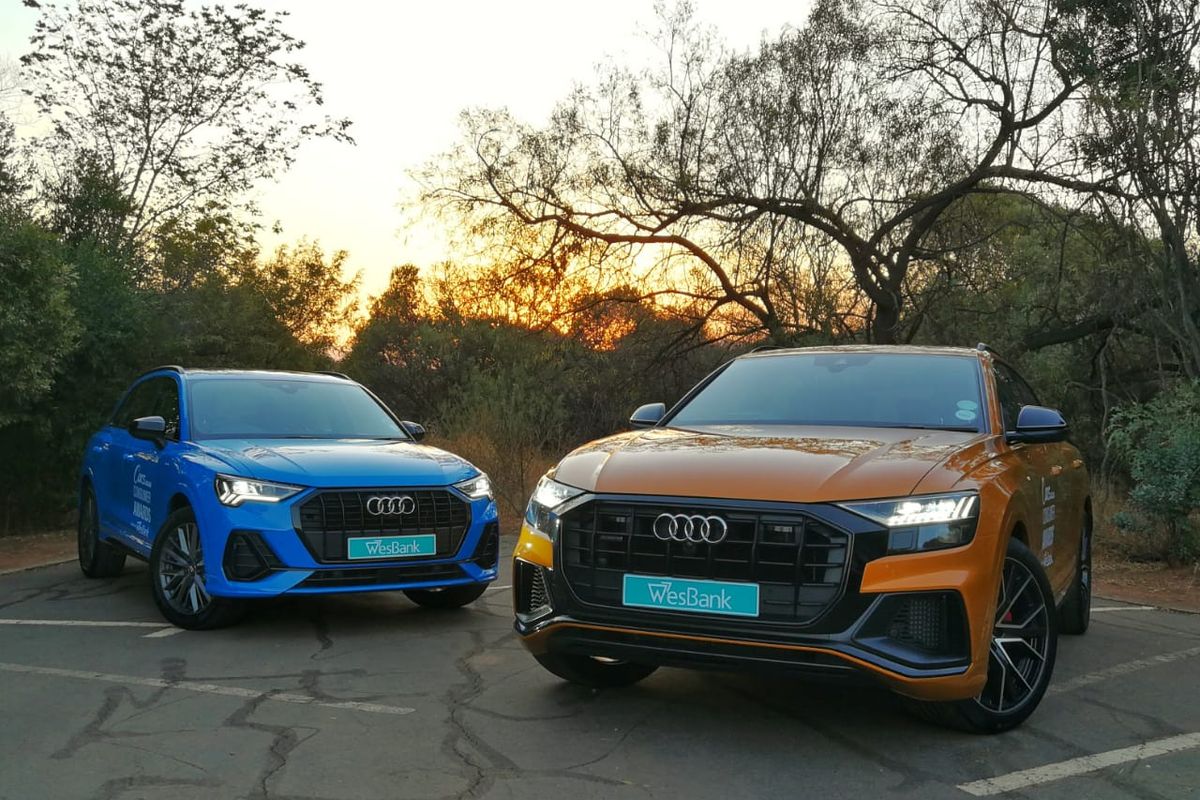
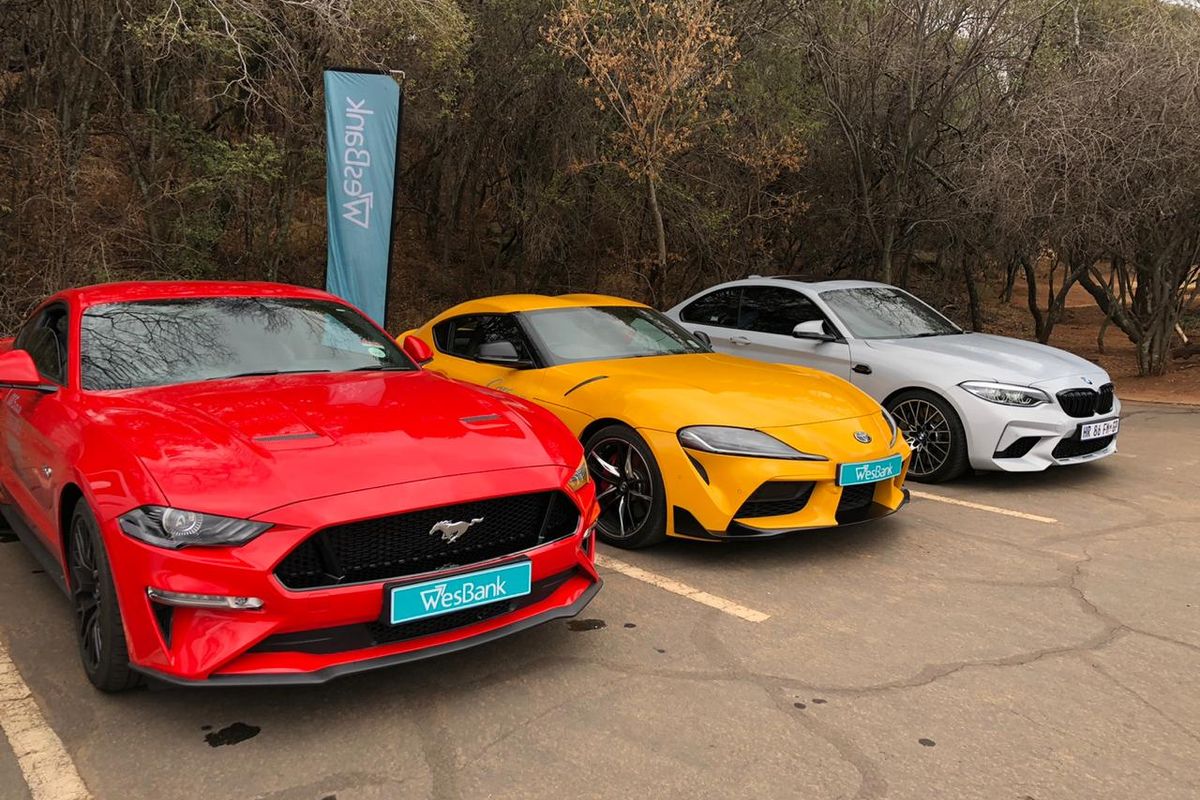
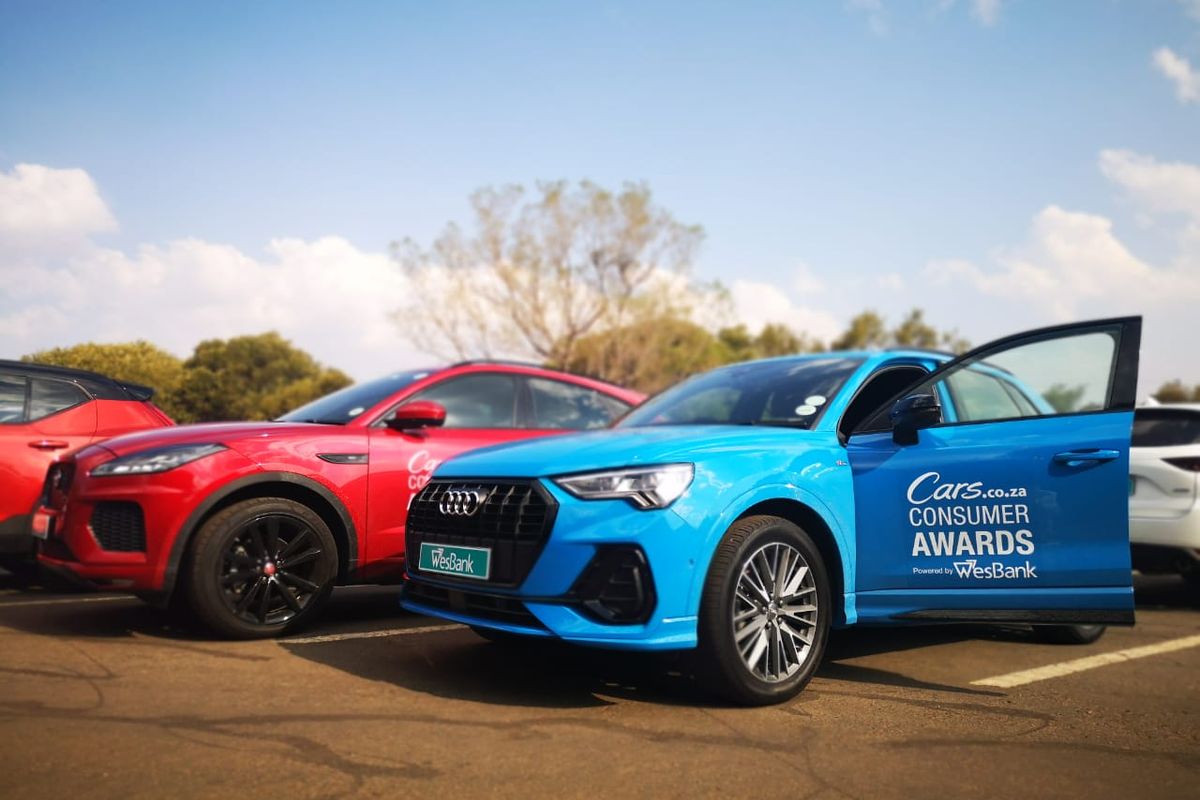
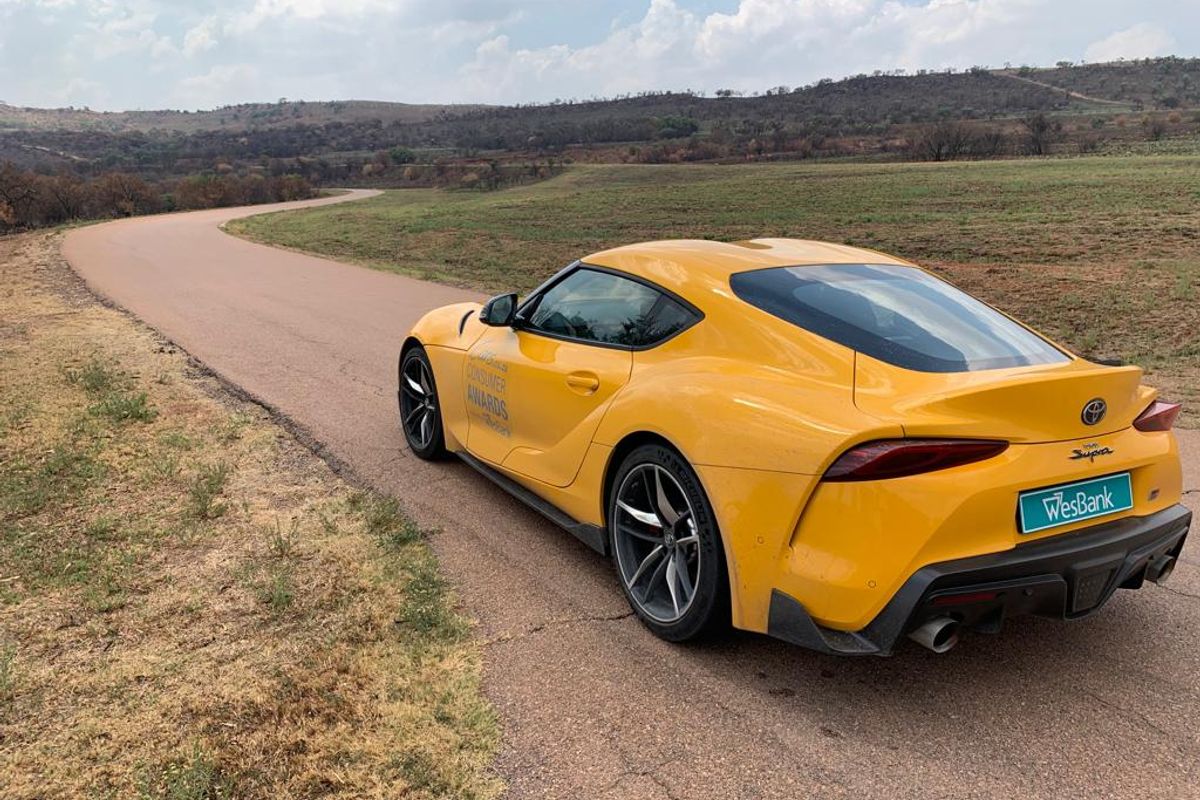
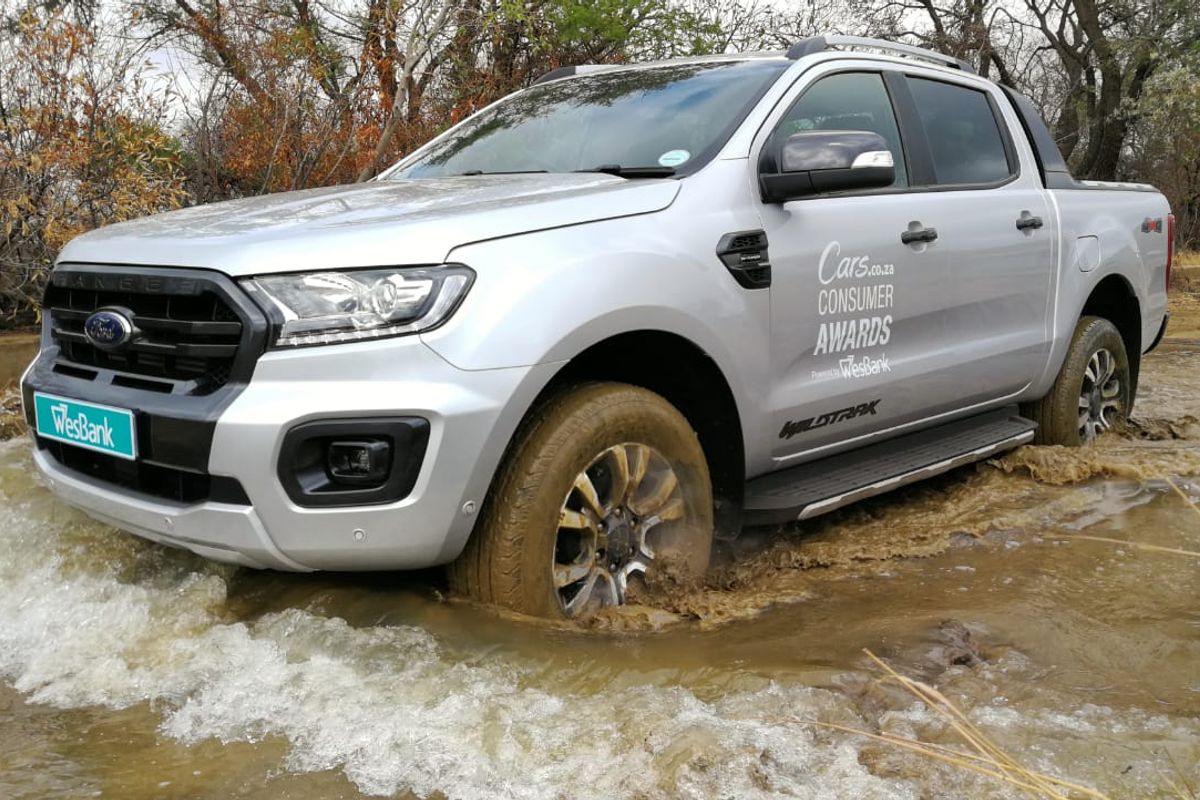
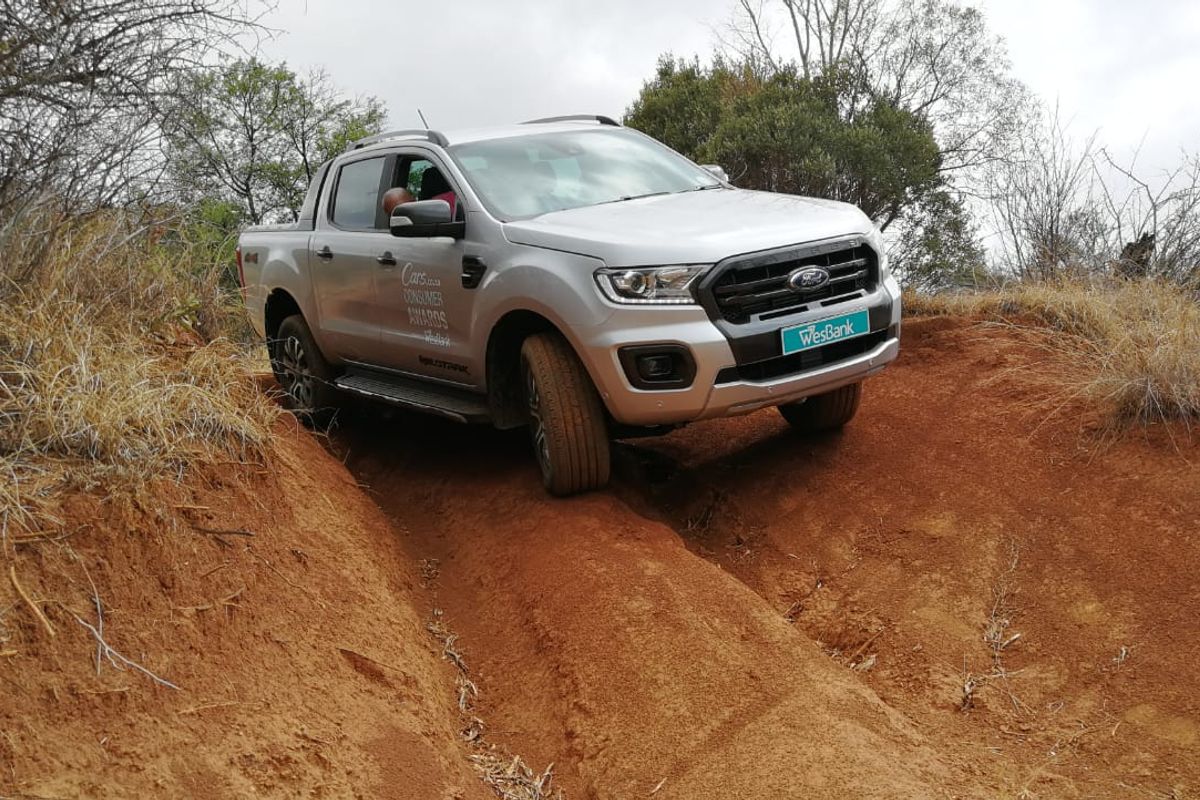
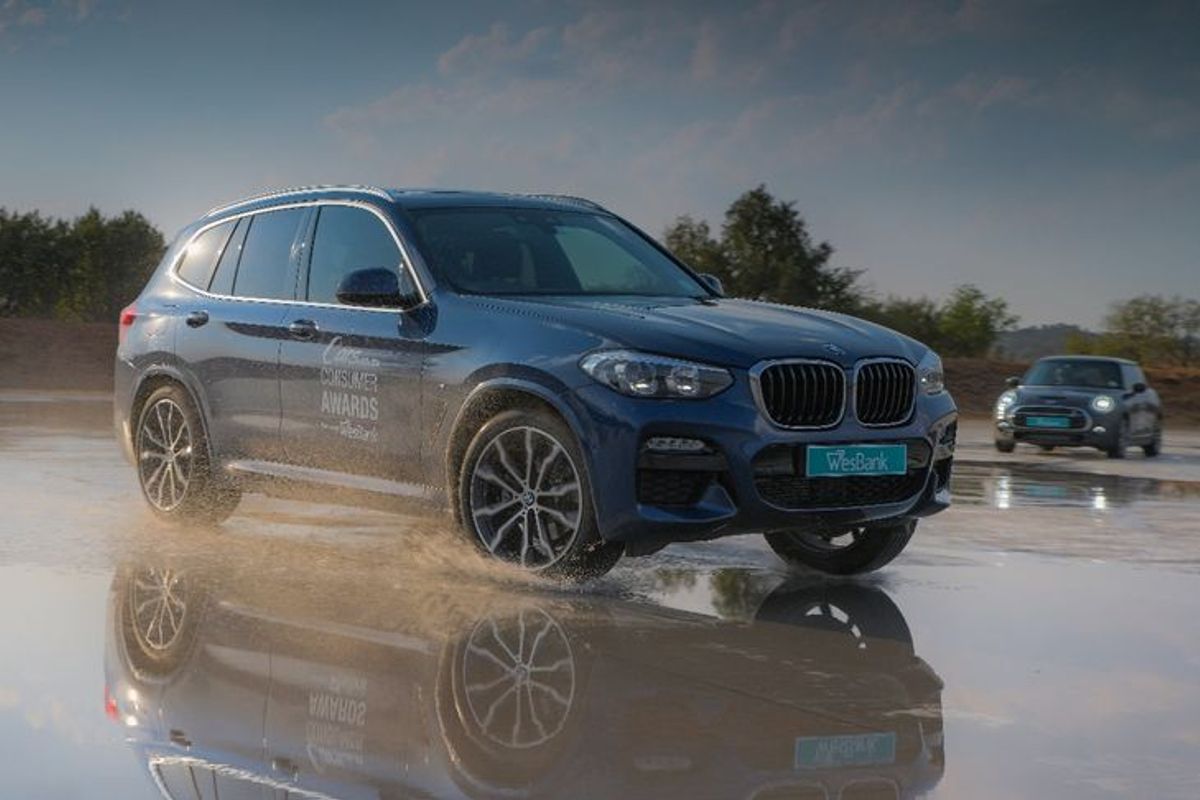
Gerotek was a hive of activity on Thursday, 30 October and Friday, 1 November as judges convened at this world-class testing facility to evaluate the finalists in the 2019/20 Cars.co.za Consumer Awards, powered by WesBank.
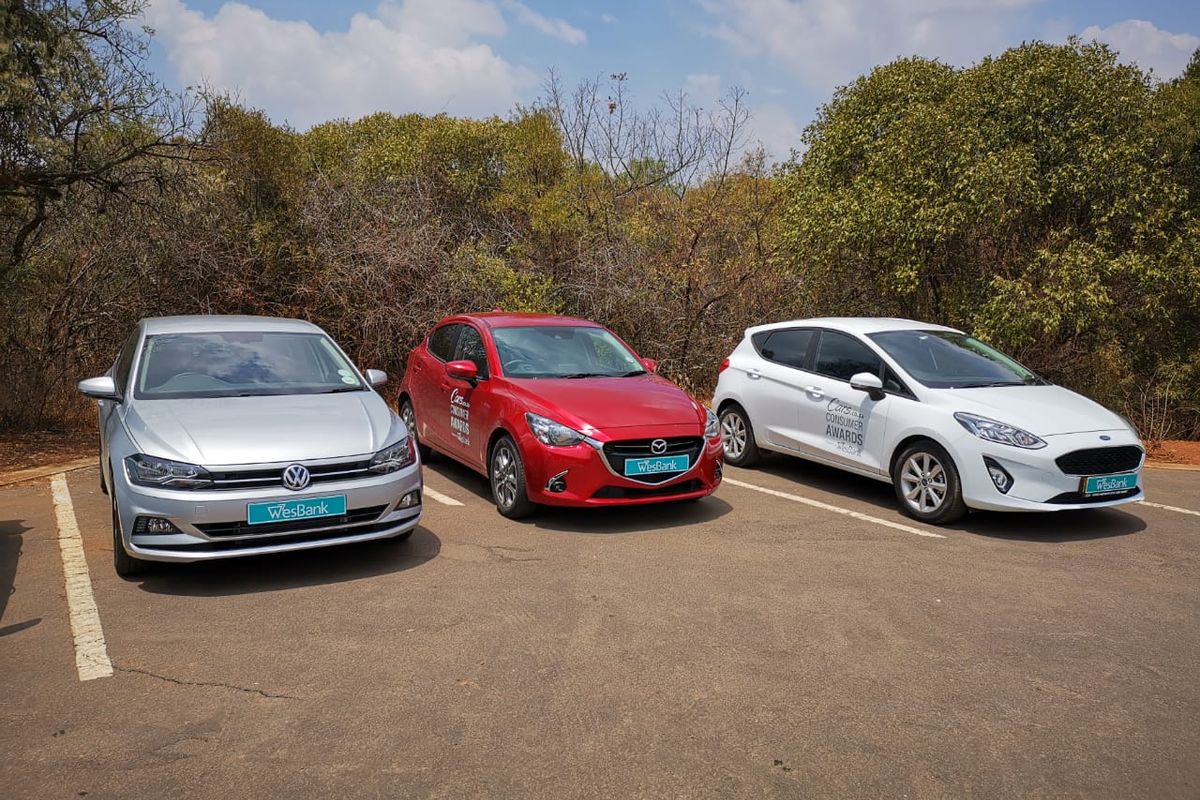
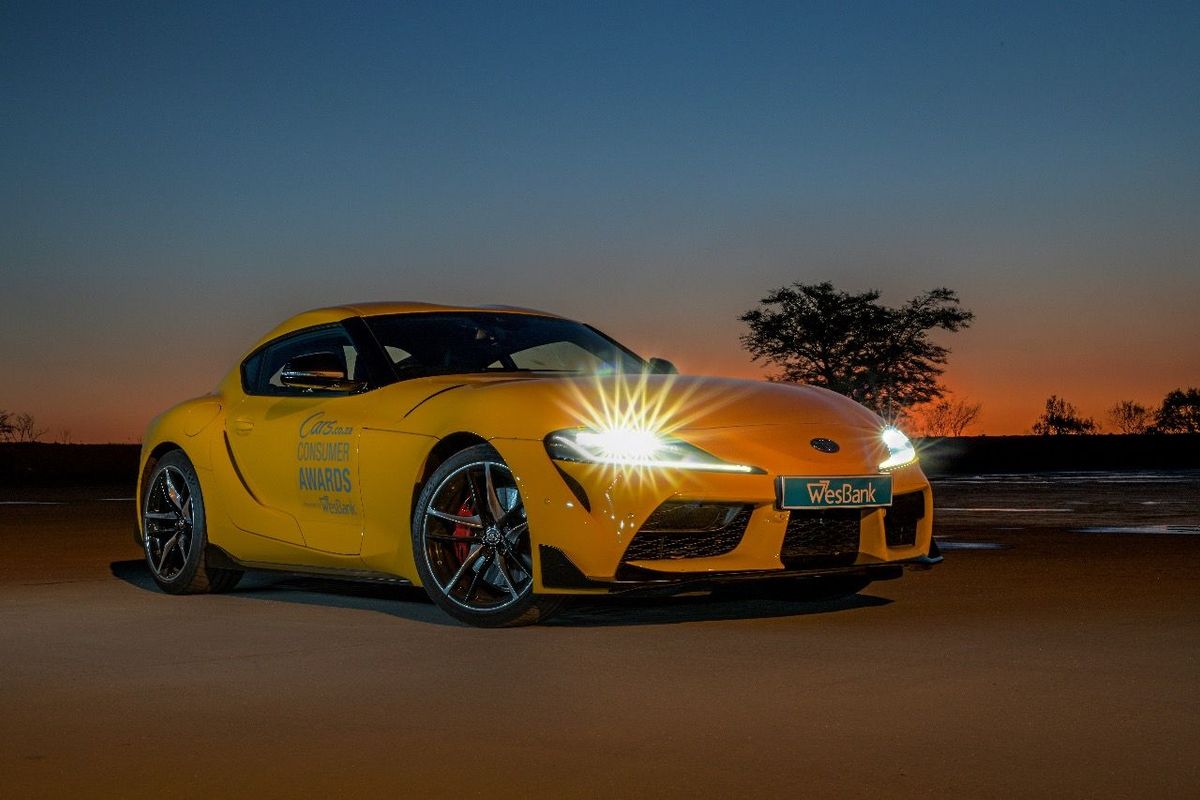
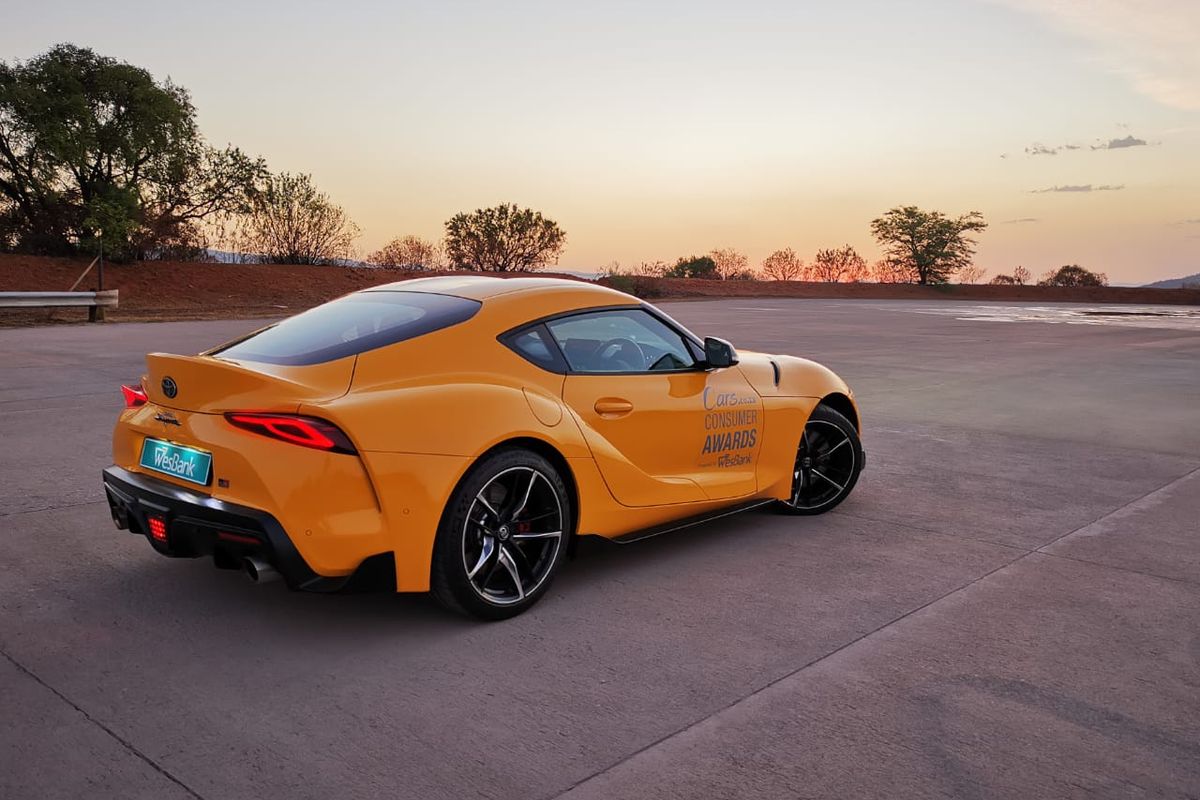
The judges, who included the full Cars.co.za editorial team and a host of celebrity judges, tested 39 vehicles across 13 different categories.
Their scores will now be tabulated by auditors PwC and combined in equal measure with the feedback of thousands of vehicle owners from the Cars.co.za Ownership Satisfaction Survey to decide each category winner. The customer feedback has been compiled in partnership with vehicle information specialists, Lightstone Auto.
The Cars.co.za Consumer Awards, powered by WesBank, made waves five years ago when they were launched as a comprehensive and statistically significant evaluation of the thousands of models available on the South African market.
Unlike other automotive competitions, the Cars.co.za Consumer Awards, powered by WesBank, considers all vehicles that are on sale on a given date (1 September 2019, in this case). From this pool, the judges pick semi-finalists and finalists using a very rigorous set of criteria, including the feedback from owners and market insight from Cars.co.za’s deep knowledge of the automotive market.
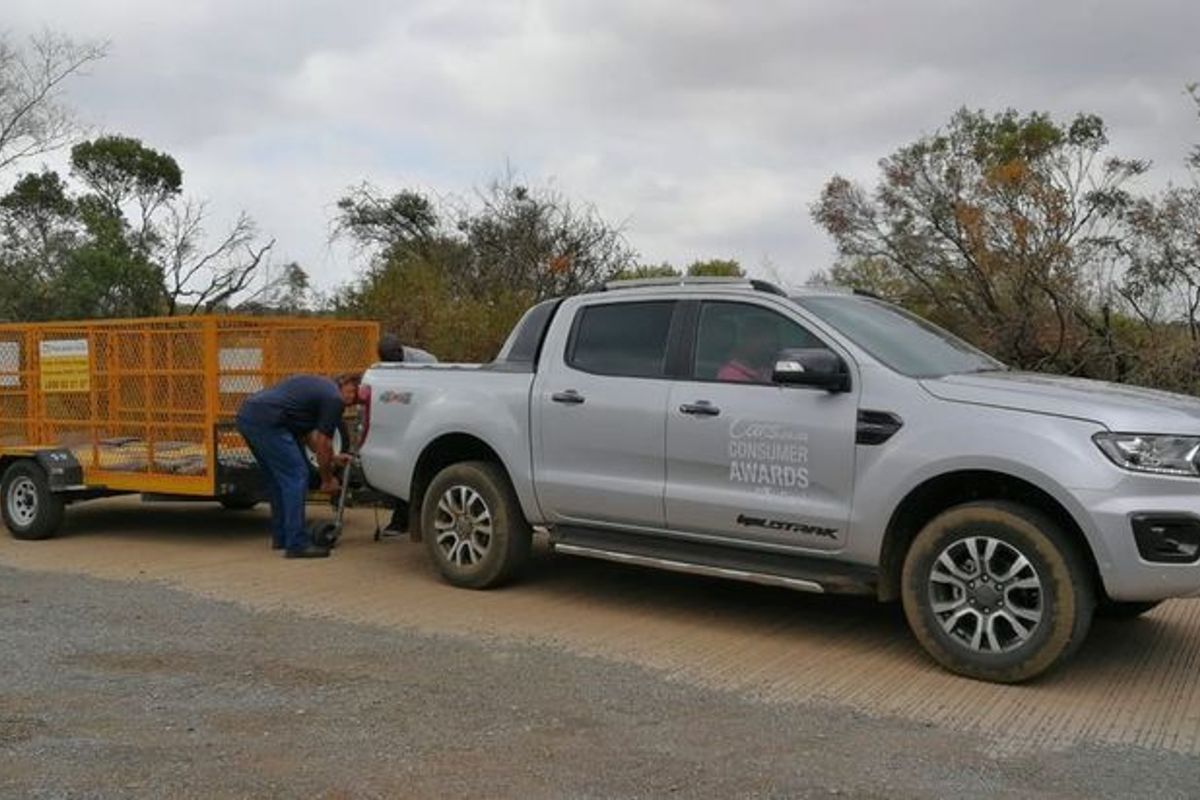
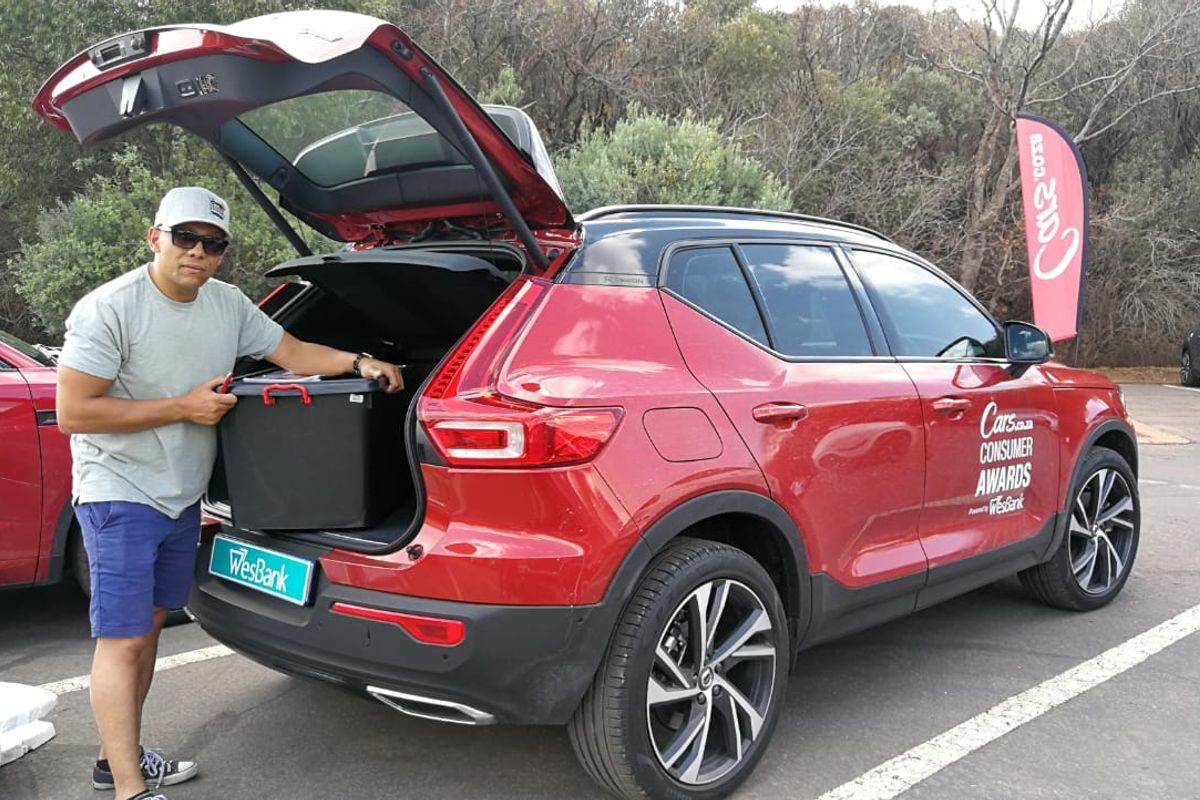
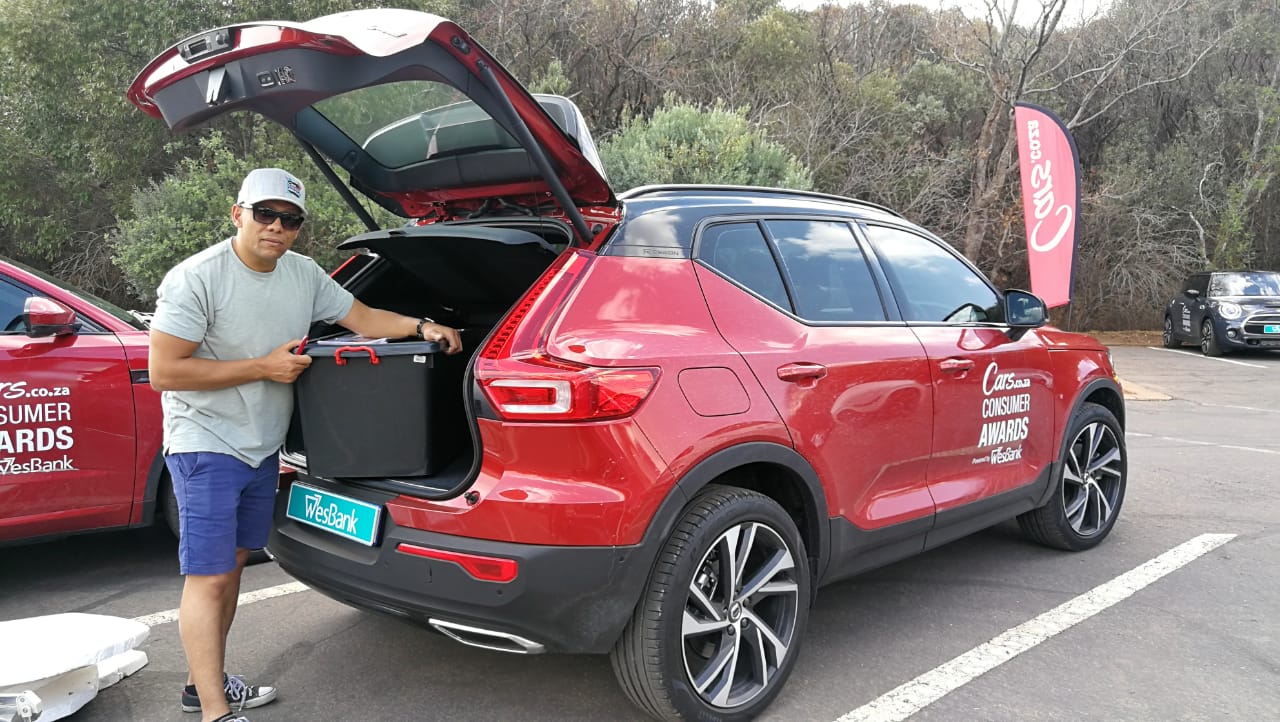
The #CarsAwards finalists undergo thorough testing at Gerotek. Judge, Ernest Page, testing practicality.
The finalists are then pitted against each other over two days at Gerotek, with specific judges assigned to each category. Their inputs are weighted, based on the category, and combined with the customer data from the Ownership Satisfaction Survey to truly find the best vehicle in each category.
This process means that poor service support or sub-par vehicle durability will show up in the Ownership Satisfaction Survey and act as a counterbalance to excellent on-track performance at Gerotek. Similarly, a vehicle may prove to offer exceptional service and durability, but not represent automotive excellence, causing it to fall short at the Gerotek testing. Both emotion and reason have to be present for a vehicle to win its category.
“In the past five years, we conducted over 1 800 test drives and considered hundreds of thousands of customer inputs. This, along with the insights from our partner, WesBank, has allowed us to perfect our judging process and build an unmatched database of vehicle data,” says Hannes Oosthuizen, Cars.co.za Consumer Experience Manager.
As part of its process of refinement, Cars.co.za has introduced a new Crossover segment, removed the Executive Sedan category due to its low sales and a lack of new models and redefined the Hot Hatch category to a Fun Hatch category.
The #CarsAwards gala event will take place in February 2019, where the winners across all 13 categories will be announced.
“Through our partnership with the Cars.co.za Consumer Awards, we have further broadened our understanding of the vehicle market and made it available to customers and manufacturers alike. This helps would-be buyers take the stress out of buying a vehicle, meaning they can make an informed choice, apply with our FastFinance app and drive away in their dream car in minutes,” says Lebogang Gaoaketse, Communications, Social & PR Manager at WesBank.
Aside from celebrating the fifth running of the Cars.co.za Consumer Awards – powered by WesBank, Cars.co.za also popped the champagne on its tenth anniversary and its status as South Africa’s largest vehicle portal.
Cars.co.za currently has over 75 000 vehicles listed on its site and it welcomes over 5 million monthly visitors. It also hosts South Africa’s top-ranked YouTube channel and, thanks to its vehicle restoration programme and editorial initiatives like SentiMETAL, has become a custodian of South Africa’s automotive heritage.
The 2019/20 #CarsAwards finalists in their respective categories are:
Porsche’s PDK dual-clutch transmissions are so good at changing gears that very few owners ever miss the more tactile interaction of a manual 'box. However, the German sportscar brand remains a purist car company at heart and, to that end, the Zuffenhausen-based brand remains committed to offering 'stick-shift' on selected models.
If you would like your new 8th-generation Porsche 911 with an H-gate and 3rd pedal, that choice is now available… Porsche will be offering its 7-speed manual transmission as a no-cost option on the latest Carrera S and 4S variants.
That means you get one less gear than a comparative PDK-equipped derivative, which has 8 forward ratios, but the reward of developing proper clutch-brake-and-throttle coordination is worth the sacrifice for some…
An interesting technical change that differentiates the 7- and 8-speed 911s is that they employ distinct rear differentials… A PDK-equipped 911 has an electronic slip-mitigating differential, while the manual version features a more traditional mechanically actuated limited-slip diff at the back.
Porsche is yet to release detailed acceleration statistics, but there is no way that even the most skilled driver will be faster from 0-100 kph with a manual-shifting 911 compared with its PDK equivalent. The discrepancy in 0-100 kph times should be about 20%, which sounds like a lot, but in reality, it averages to 5 or 6 tenths of a second. Porsche claims a 0-100kph time of "around 4 seconds" for the manual-box 911 Carrera S and 4S.
One aspect in which a manual 911 is superior to any PDK sibling, is mass. The absence of additional clutches and shift mechanisms mean that Porsche’s 7-speed 911s are 38 kg lighter than the dual-clutch transmission cars.
Although Porsche is willing to configure its Carrera S and 4S with the 7-speed manual, you won't be able to order the most basic 911 with a manual.
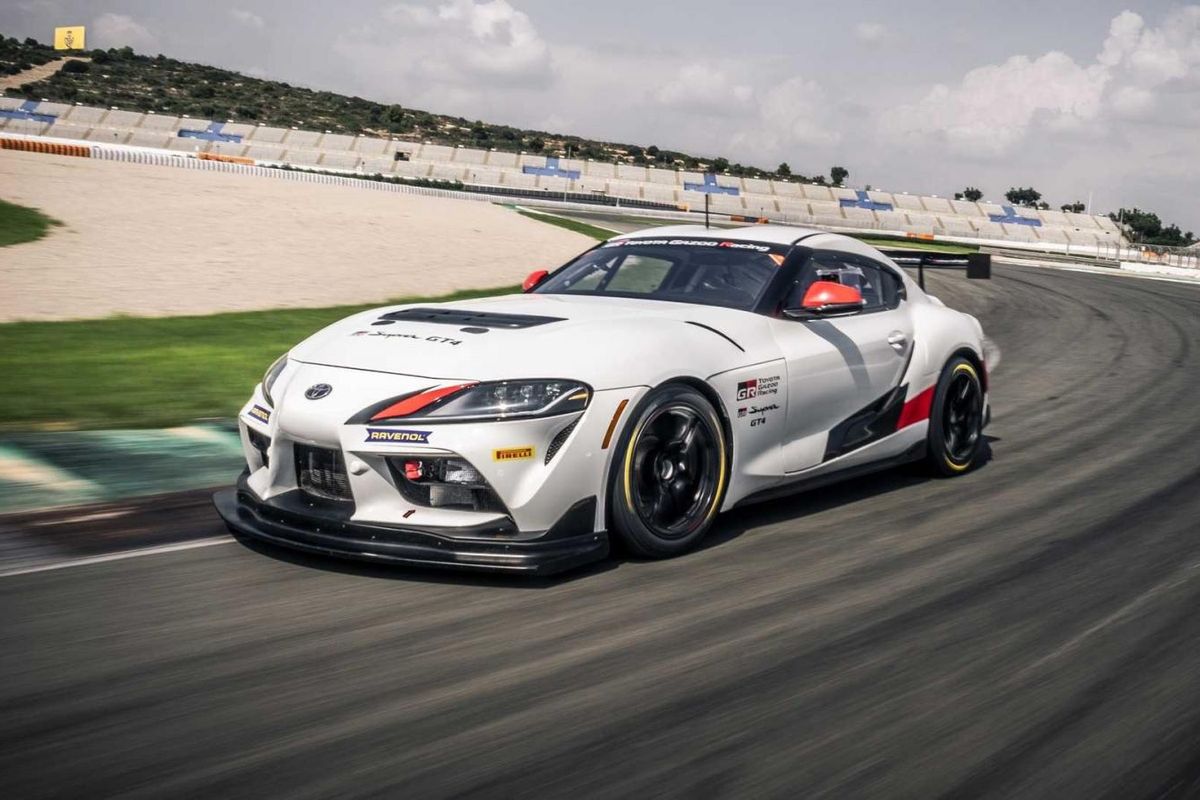
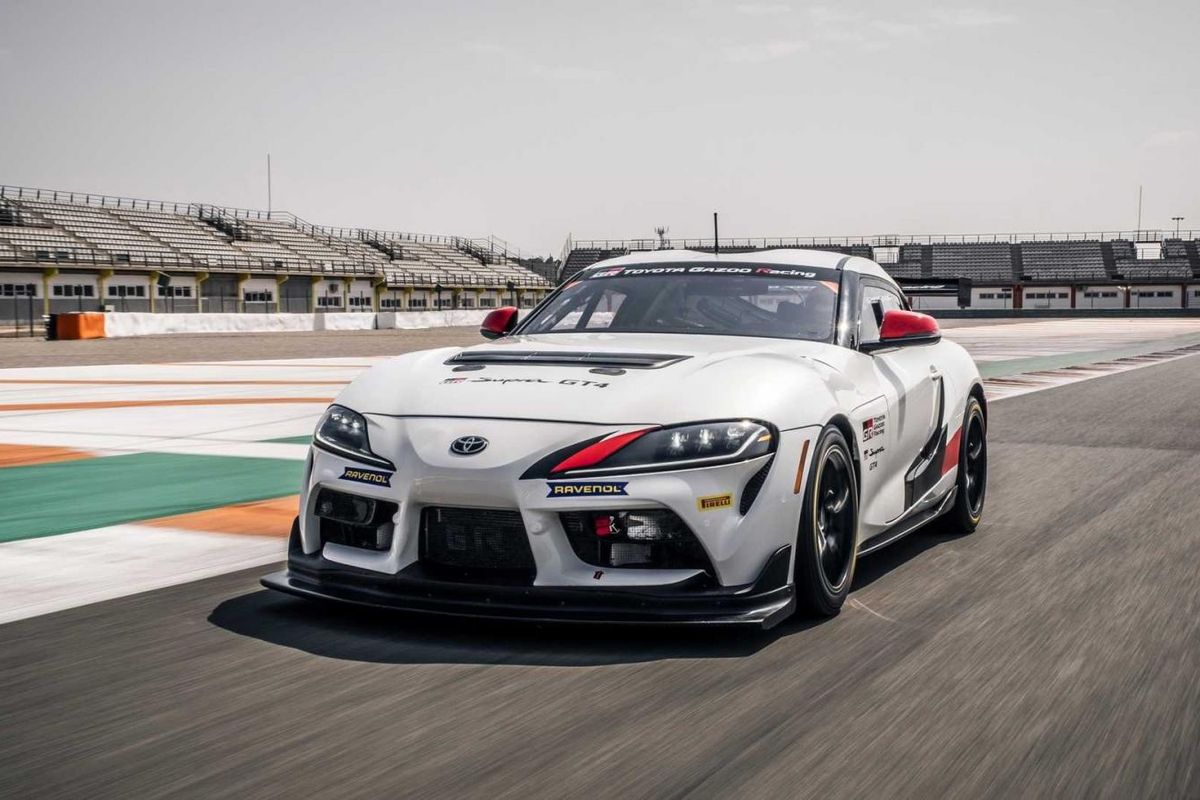
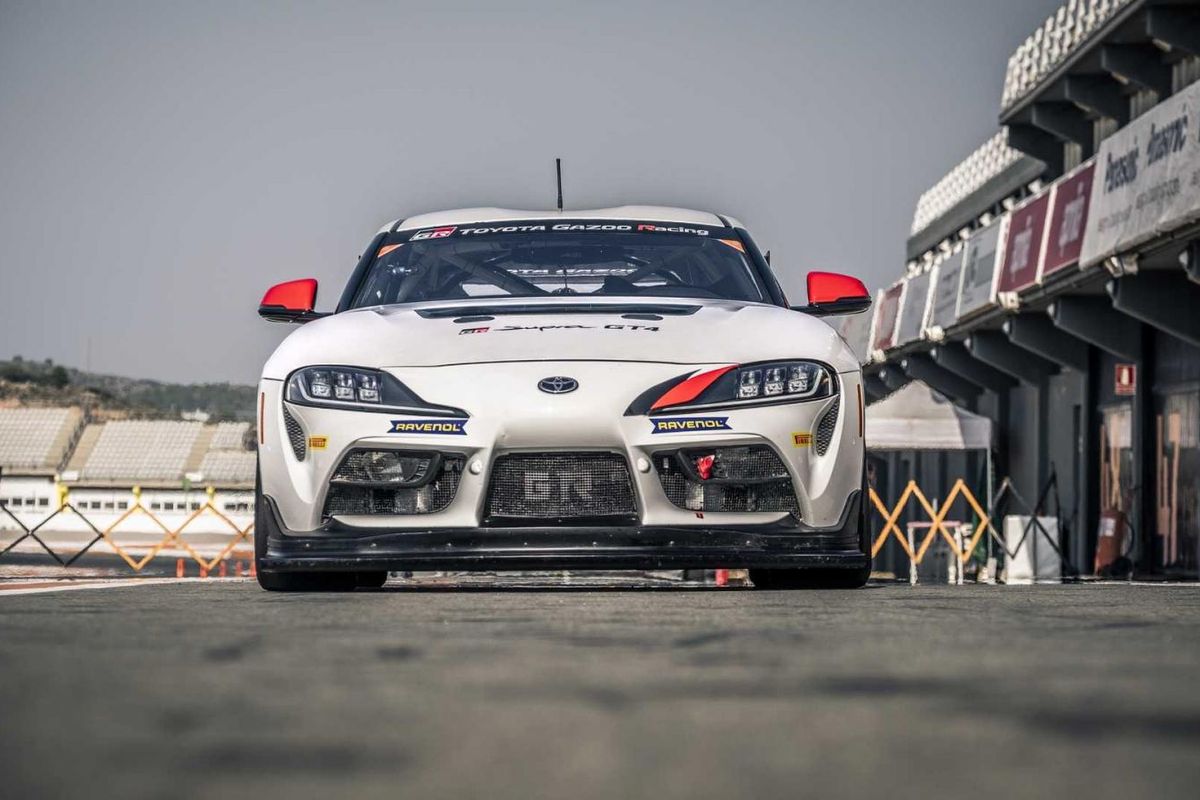
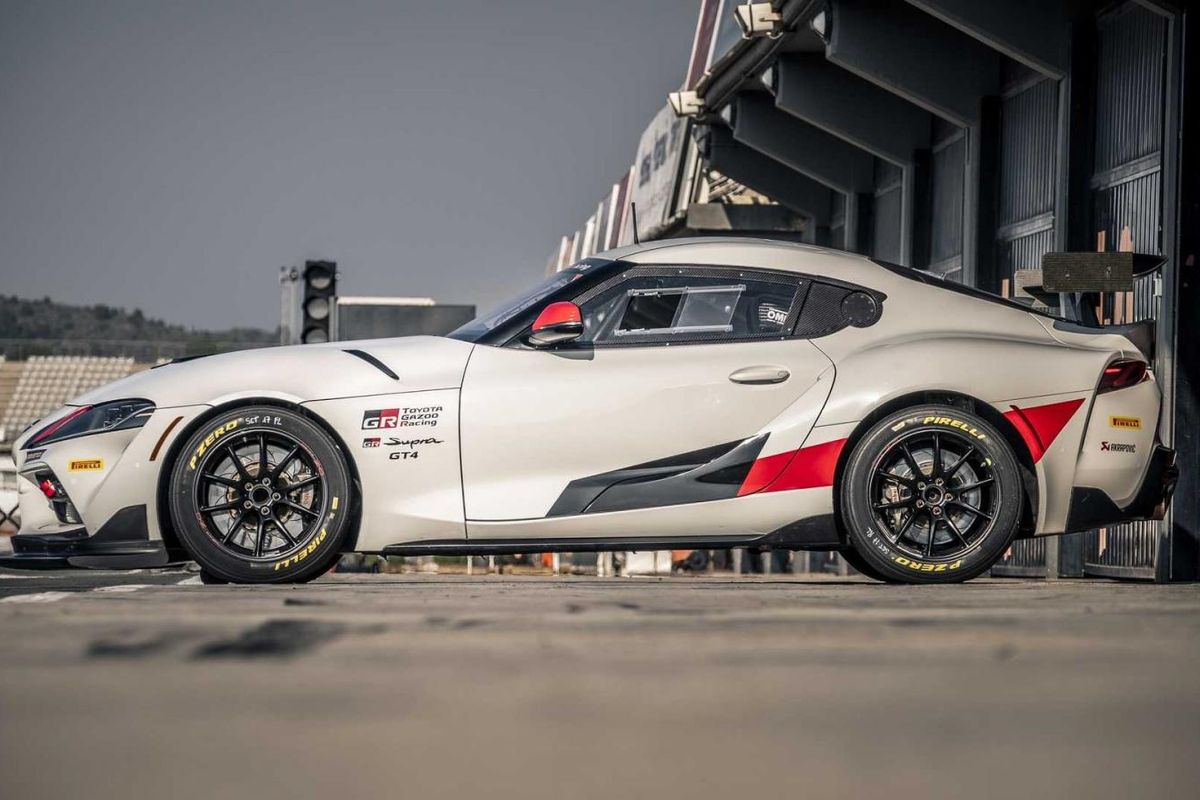
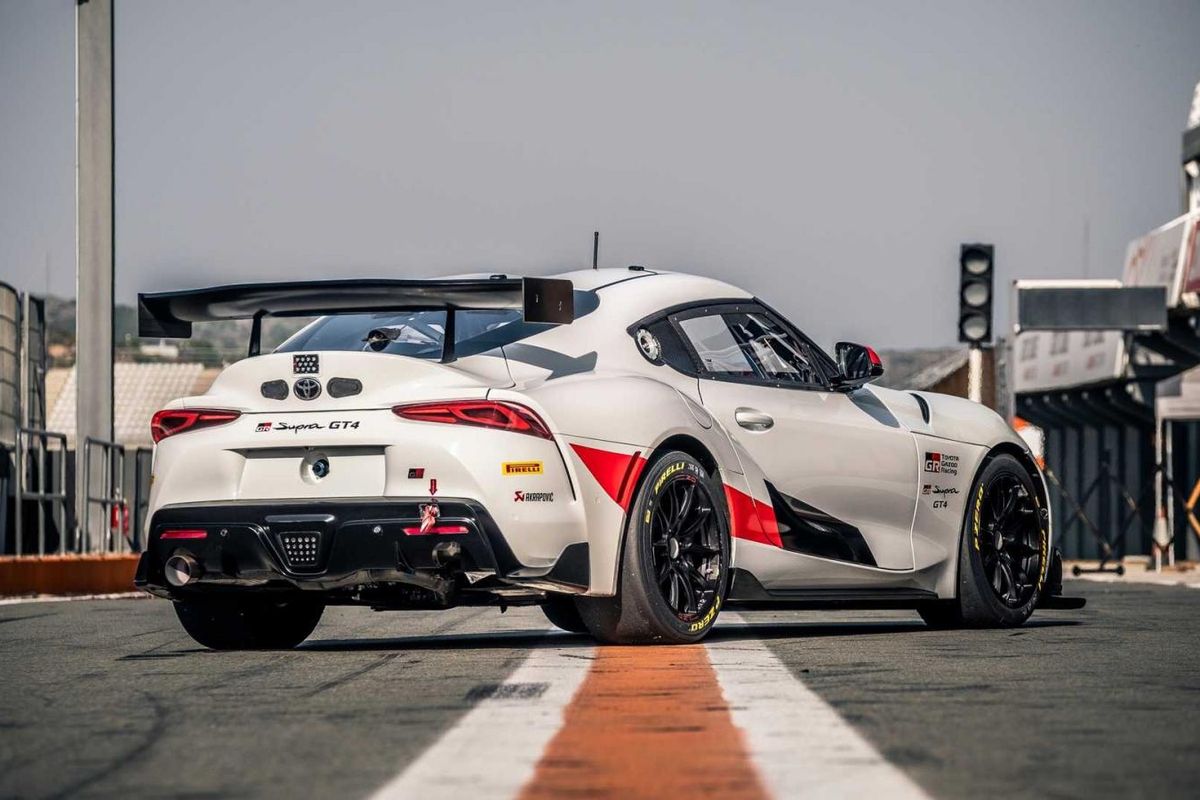
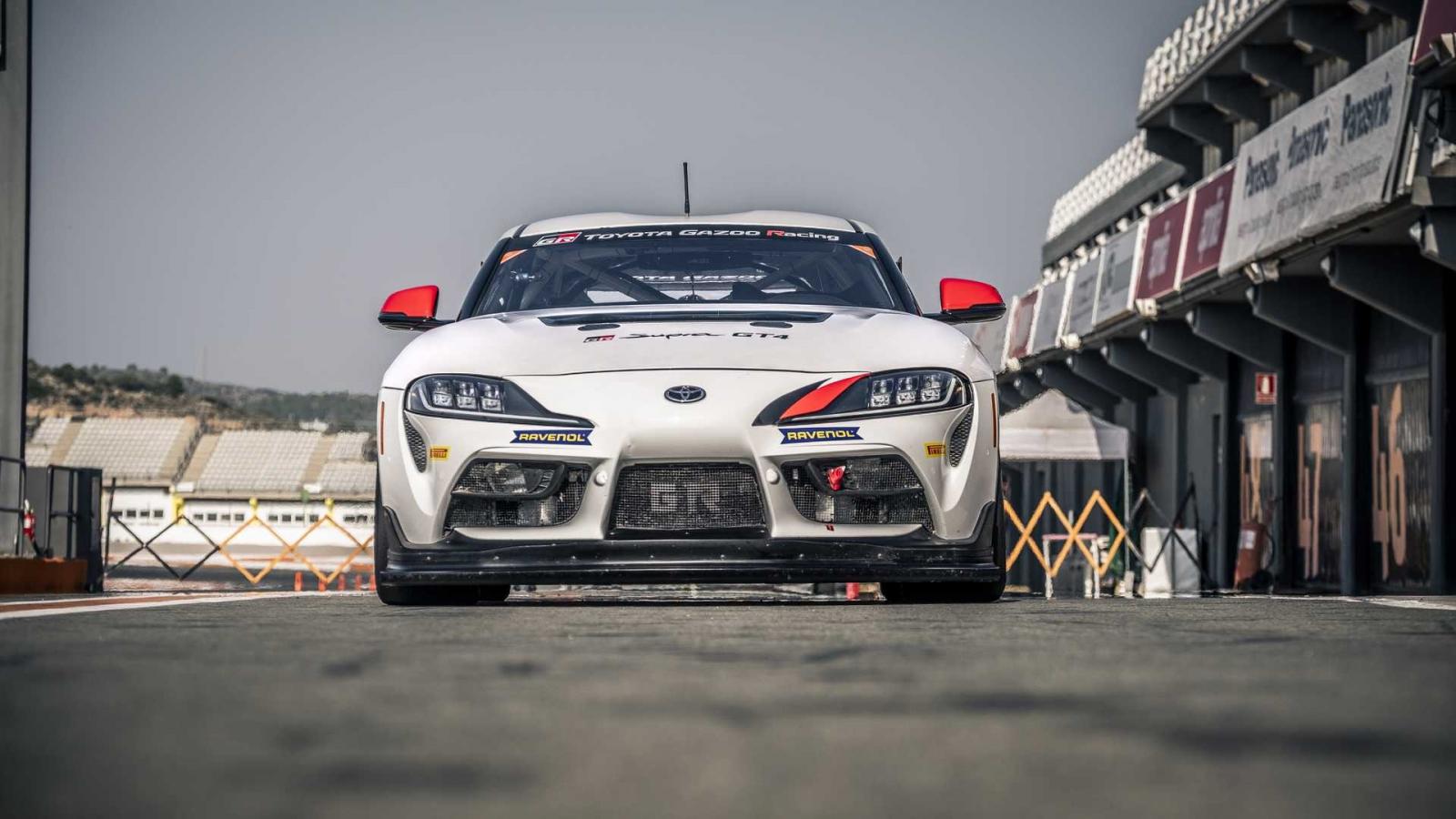
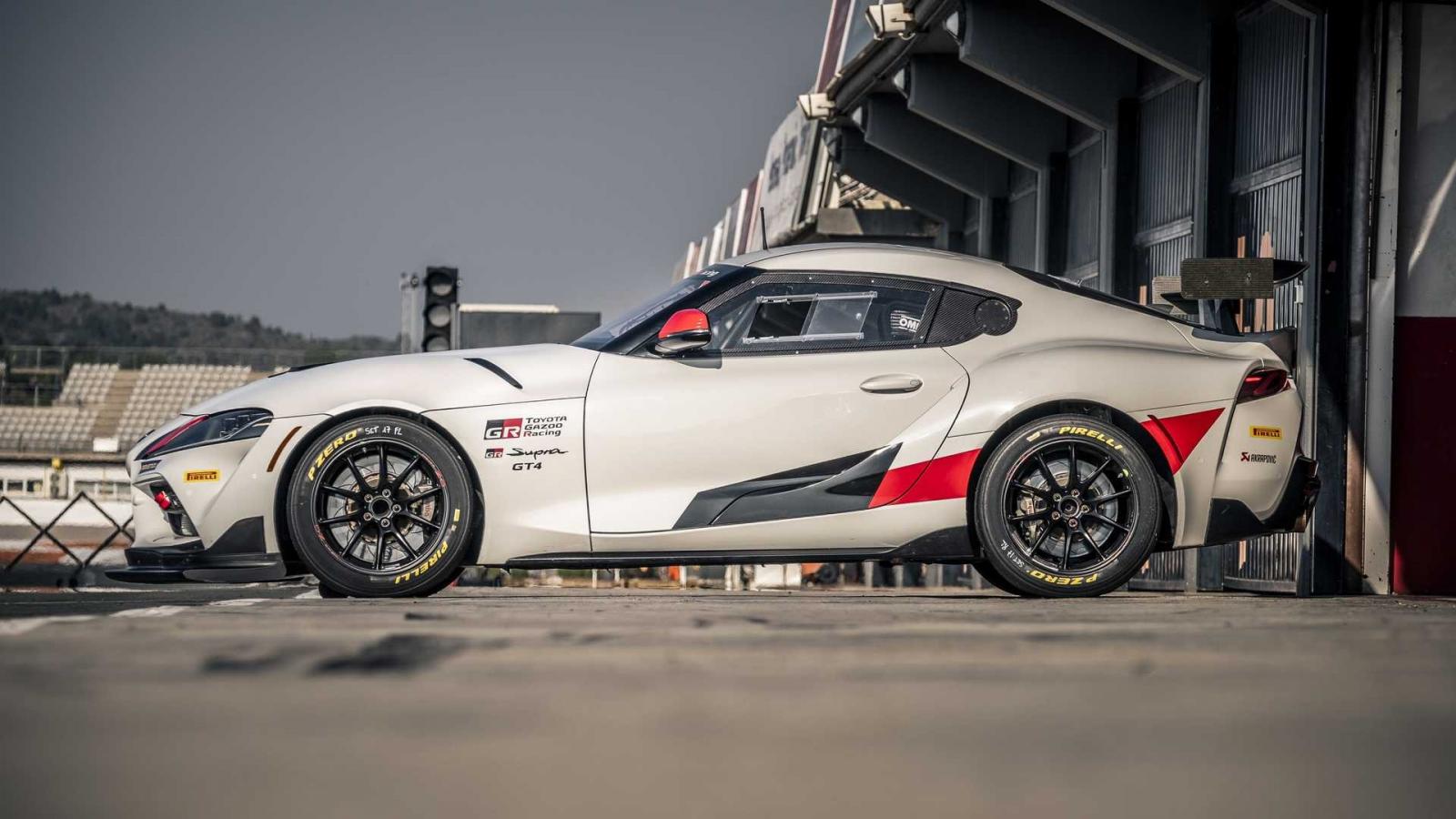
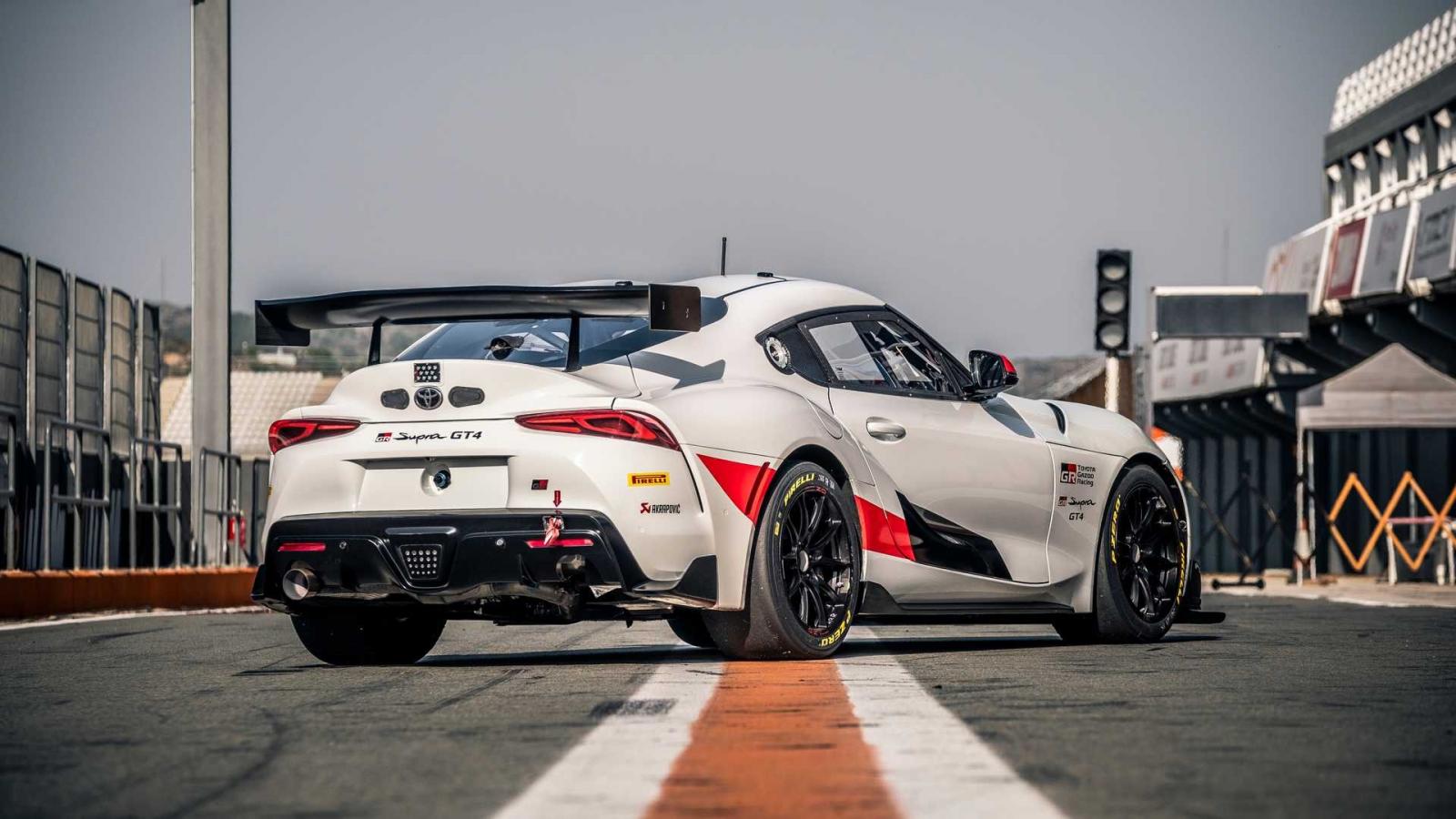
This GT4-specification race car demonstrates how much scope the GR Supra has for further development.
Since its launch, sportscar enthusiasts have been pondering how Toyota will evolve its new GR Supra with potentially more potent derivatives. The standard car produces a peak output of 250 kW and offers more than adequate performance, balanced by a harmonized dynamic driving experience. Yet the 3.0-litre straight-6 turbopetrol engine undoubtedly has vast potential for producing more power.
Although Toyota has not officially committed on the likelihood that a potent Supra road-car variant will be released in due course, it has now revealed a GT4-specification factory racer that illustrates the platform’s potential.
The Supra GT4 racer features an assortment of components which would not have applications to a road car, such as its roll cage, but there are mechanical bits which are of interest…
Toyota has managed to extract a lot more power from the in-line 6-cylinder motor, boosting peak outputs to 320 kW and 650 Nm. Those are tidy gains compared to the standard GR Supra’s 250 kW and 495 Nm. It would theoretically give Toyota quite a comfortable margin for boosting the road car’s performance for future special editions.
Beyond the increase in engine power, another aspect that could find its way into the GR Supra road-car options catalogue, is a sonorous exhaust configuration, courtesy of Slovenian specialist, Akrapovi?.
The Supra GT4 racer also has adjustable KW dampers at each corner, and upgraded Brembo brakes hide behind those 18-inch OZ alloy wheels.
Toyota might be marketing the Supra GT4 to privateer racers, ostensibly as a turnkey track car, but it certainly does give some insight to what can be extracted from the current GR Supra platform.
Rudimentary calculations would put a safe road-car power increase at half of what the GT4 racer has, which could mean a roadgoing GR Supra with a 285-kW peak output. All this augers well for a very special edition Gazoo Supra production car, one that fully exploits the chassis' potential…
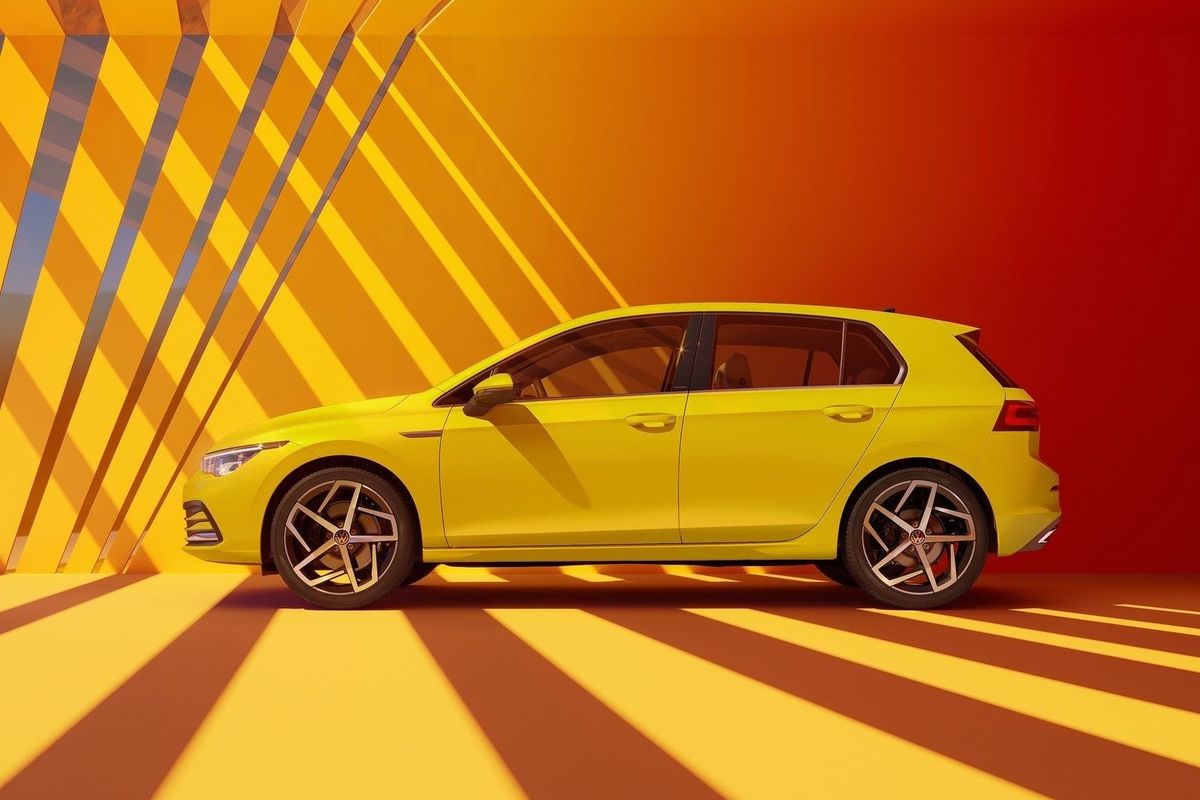
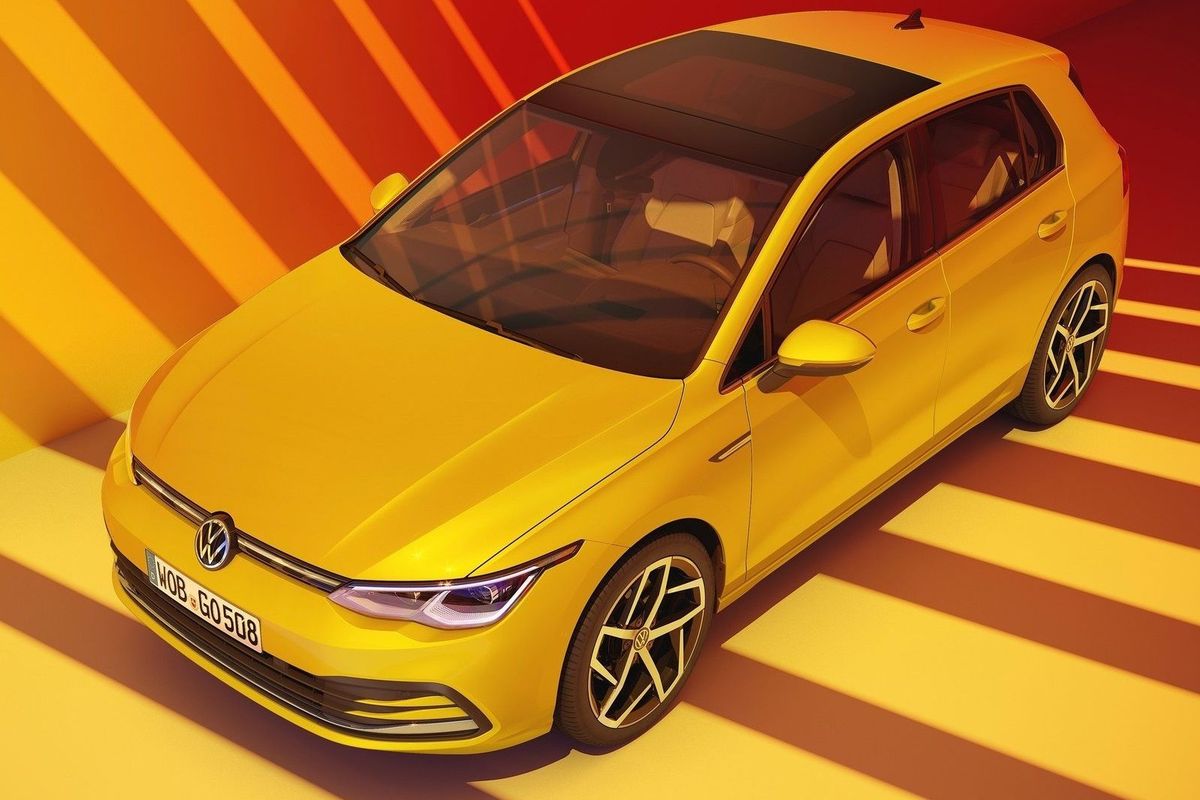
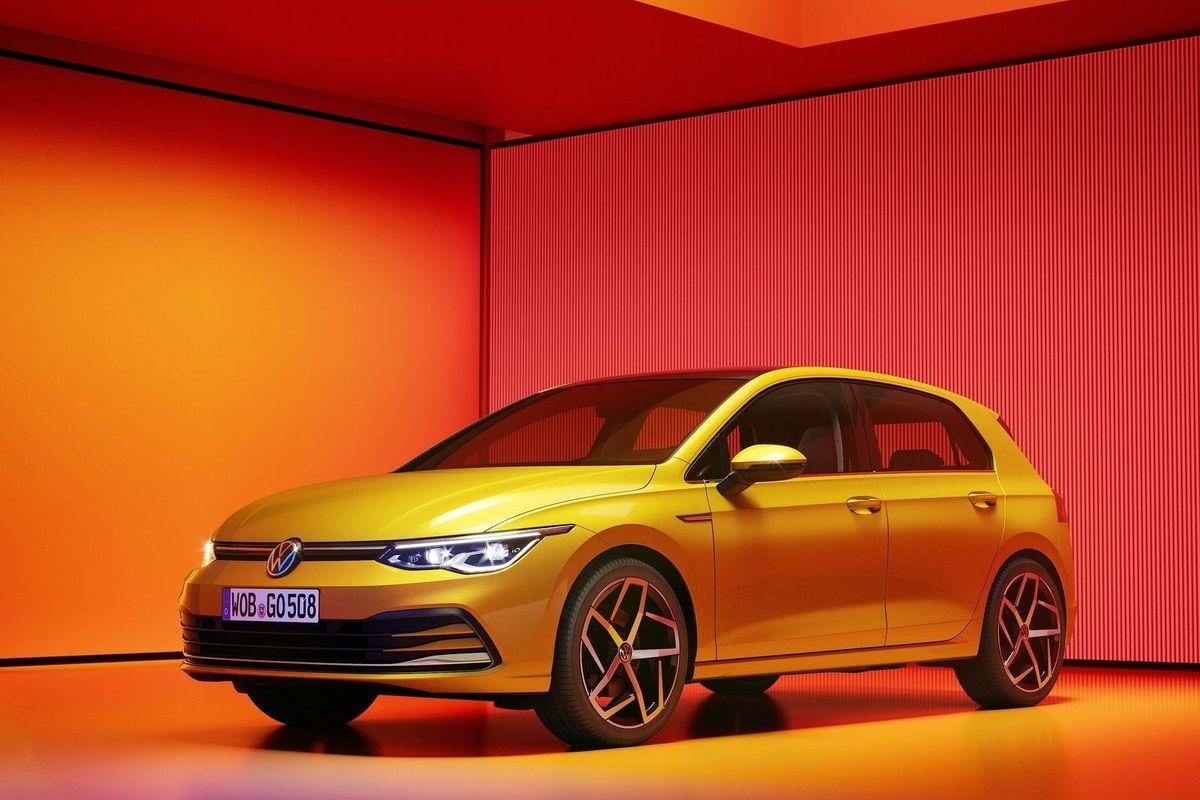
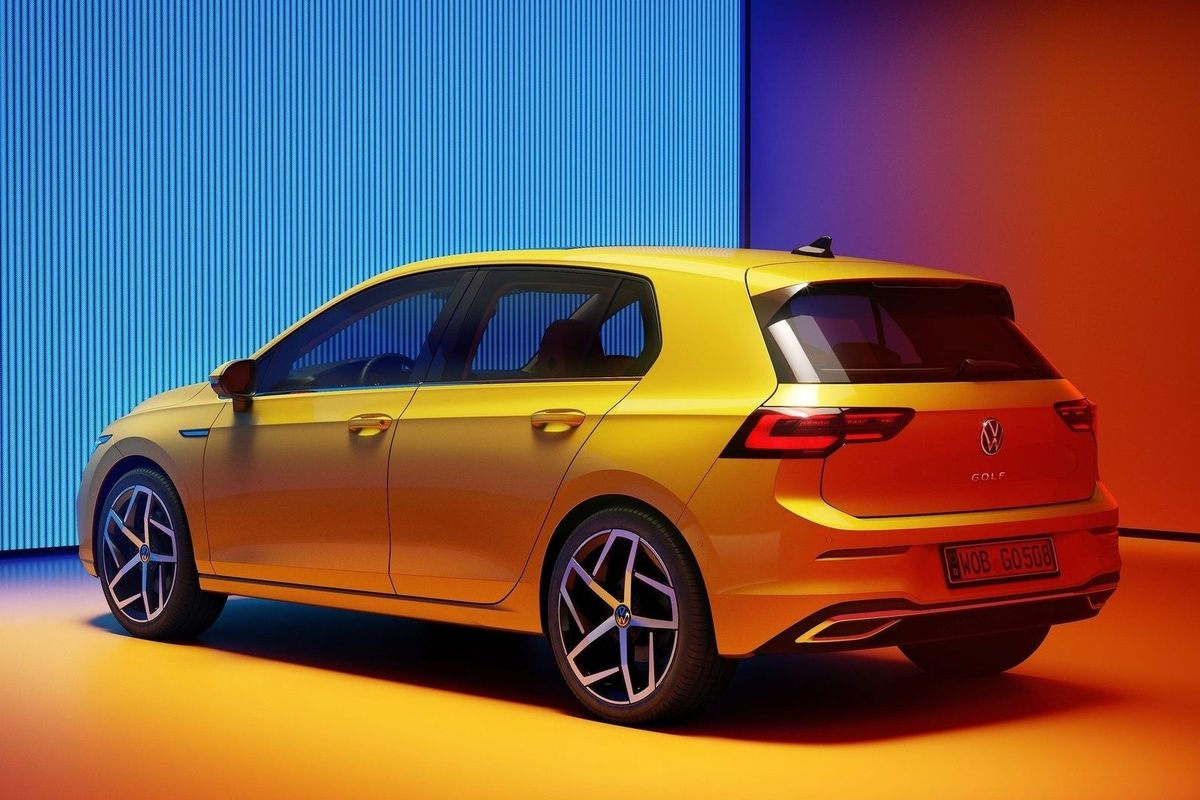
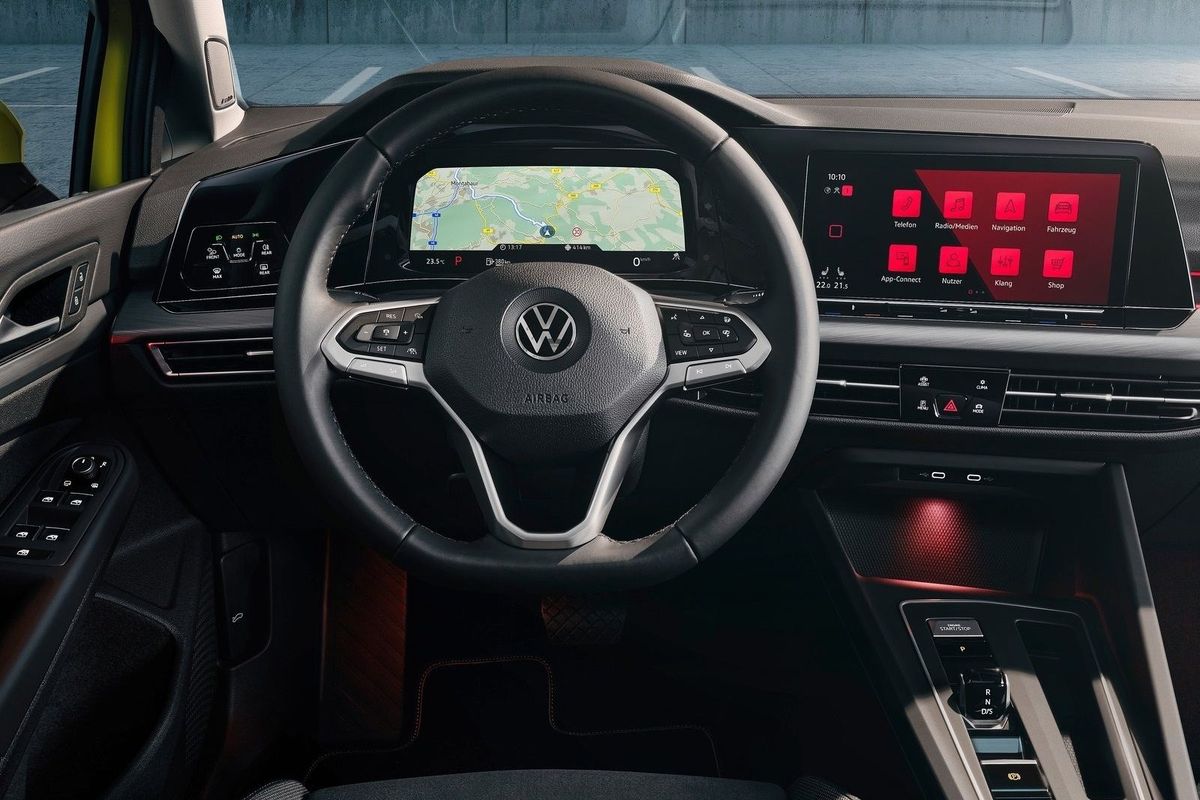
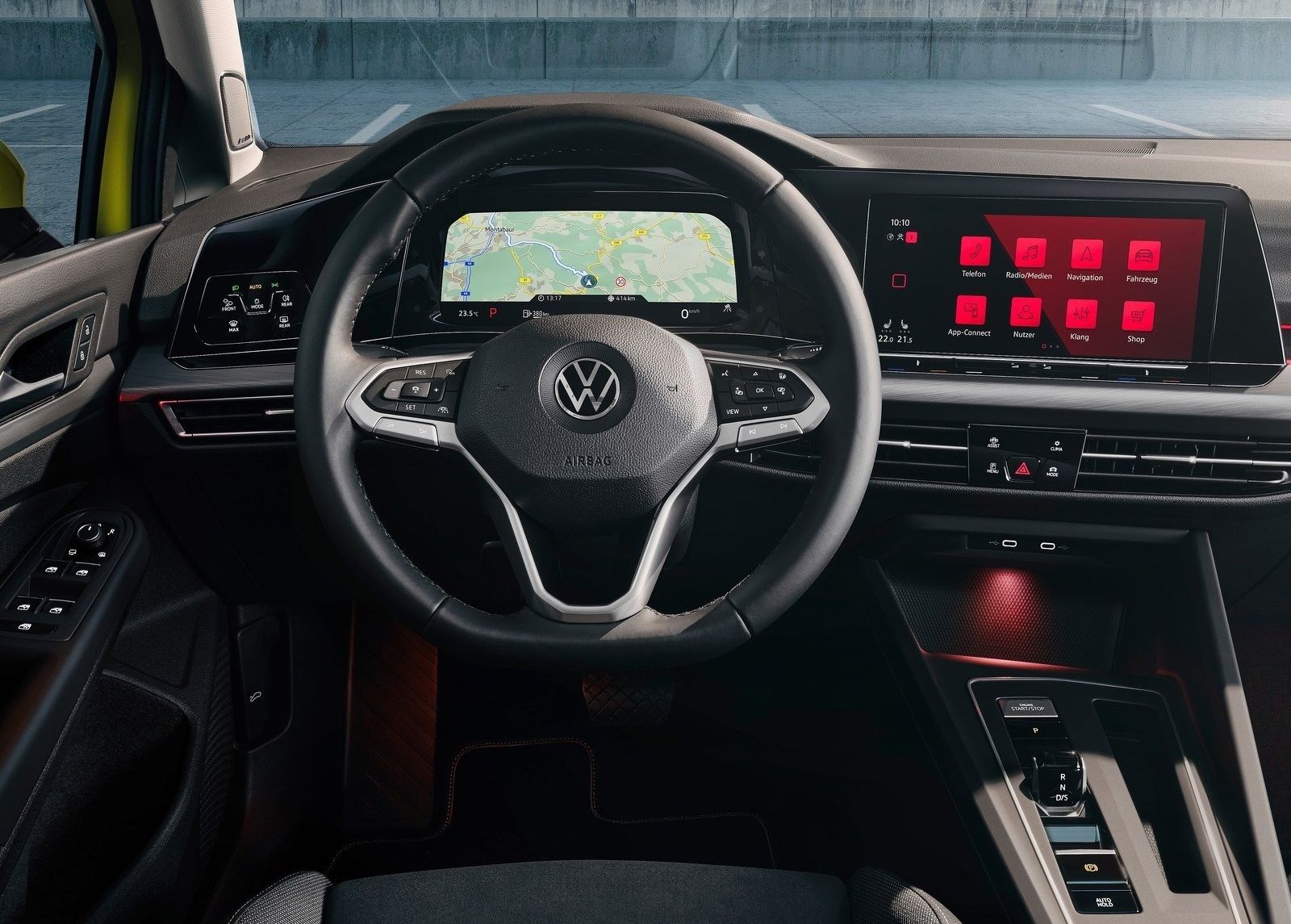
Volkswagen Golf 8 (2020) SA Launch Details [w/Video]
Volkswagen South Africa has confirmed which Golf 8 models we'll be getting.
After months of teasers, leaks and spy shots the Volkswagen Golf 8 has finally been revealed and we've covered it extensively. If you have missed it, all you need to know can be found at the bottom of the article.
However, despite the comprehensive press release and gallery, and subsequent communication with Volkswagen SA, we were left wondering where is the GTI and why is VWSA only introducing Golf 8 towards the end of 2020?
Now we have clarity, we can put 2 and 2 together and answer those questions. The first Golf 8 to come to South Africa will be the GTI model and it's expected to touch down late in 2020, followed by a 1.4-litre model and the top-of-the-range Golf R. We do know that the manual transmission will not be available, with Volkswagen SA instead offering the slick-shifting DSG only.
It appears that Volkswagen Group as a whole has been taking a conservative approach to engine selections, as Audi SA only offers the 1.4-litre turbocharged 4-cylinder petrol engine and now Volkswagen SA will be using the same motor. It produces 110 kW and 250 Nm, and is likely to be paired with the newer 7-speed DSG unit.
Volkswagen will be revealing the performance variants of the new Golf 8 in early 2020 and the range will comprise GTI, TCR and R, and all will likely feature uprated versions of the 2.0-litre turbocharged 4-cylinder motor.
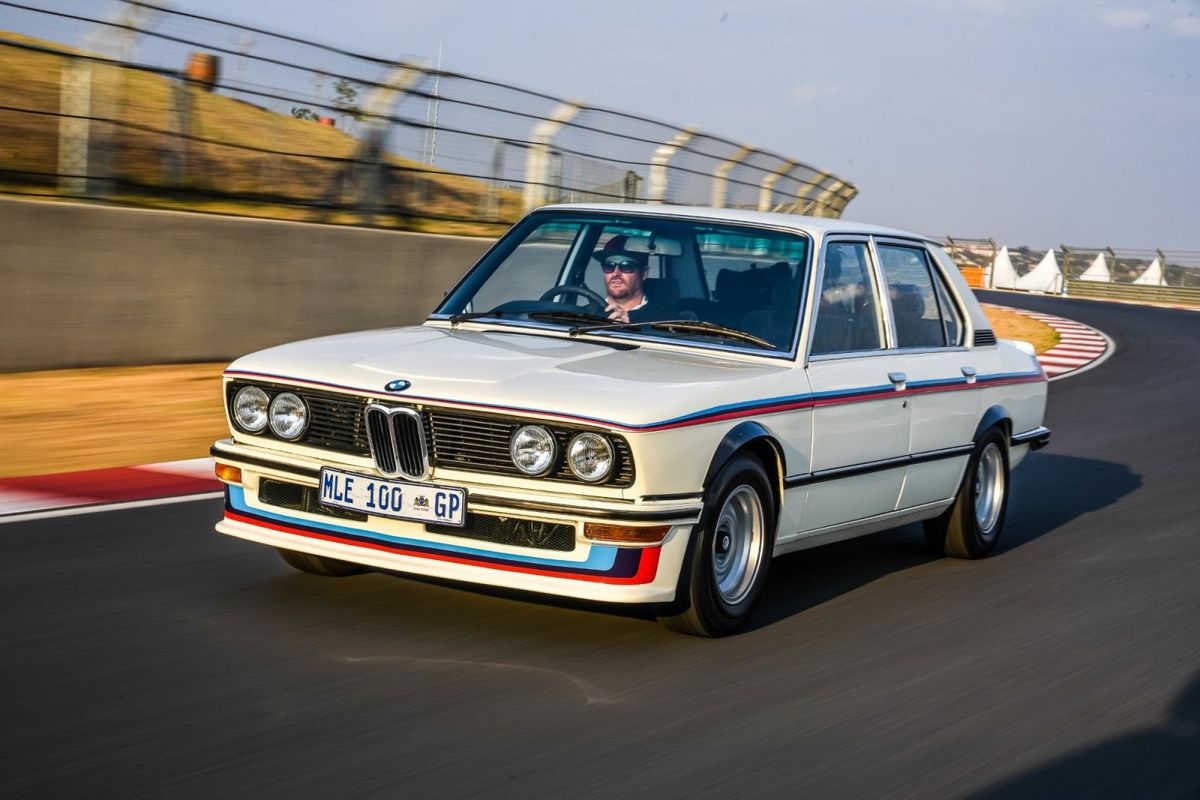
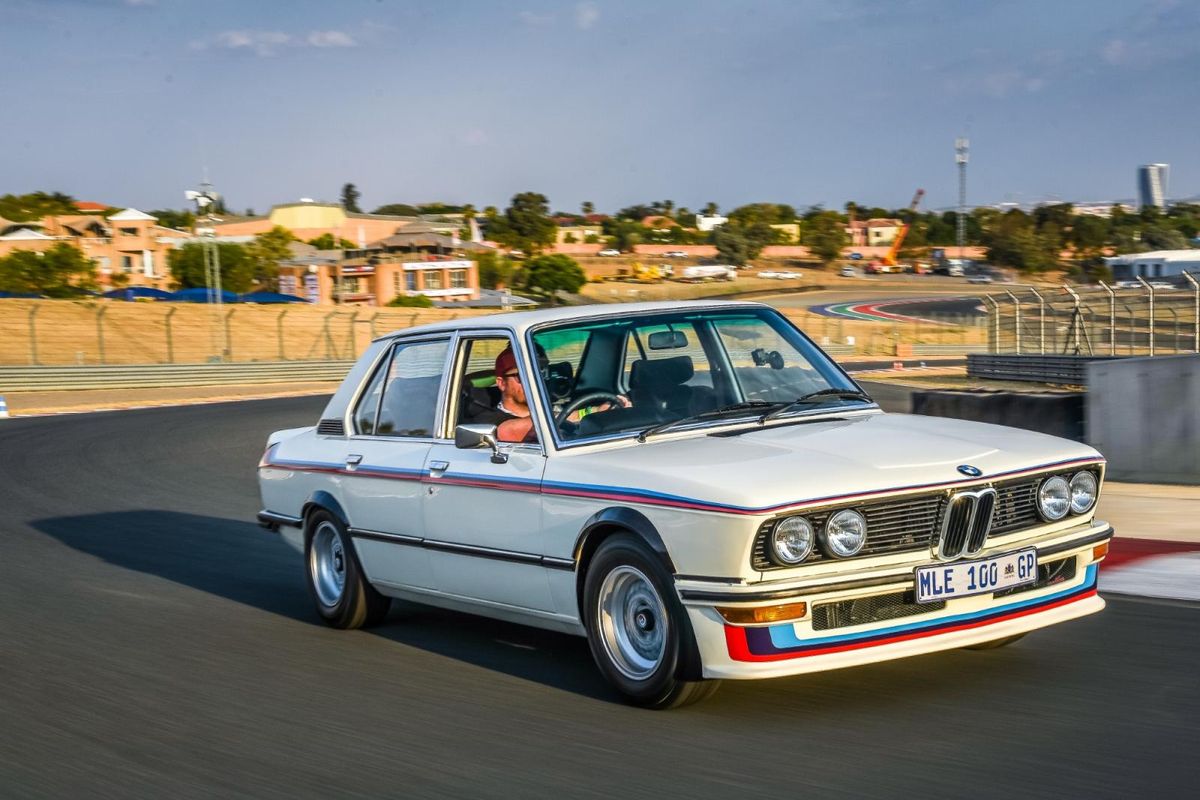
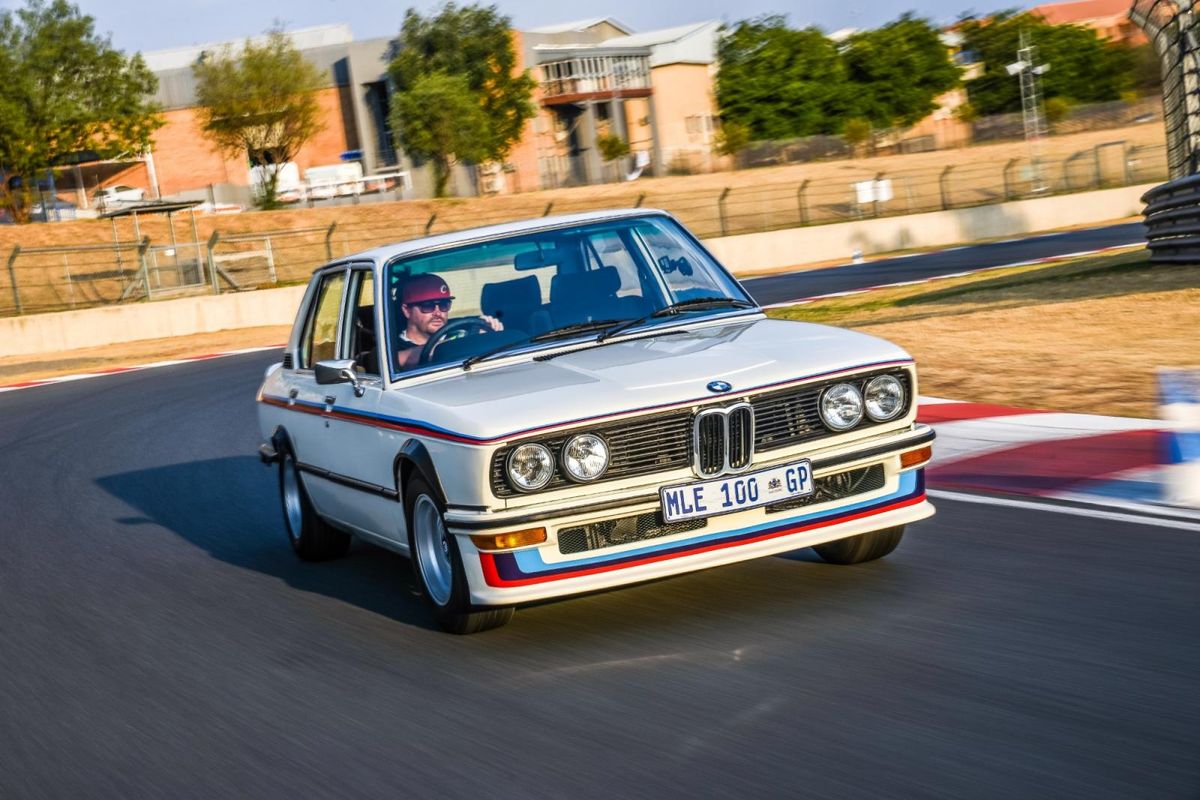
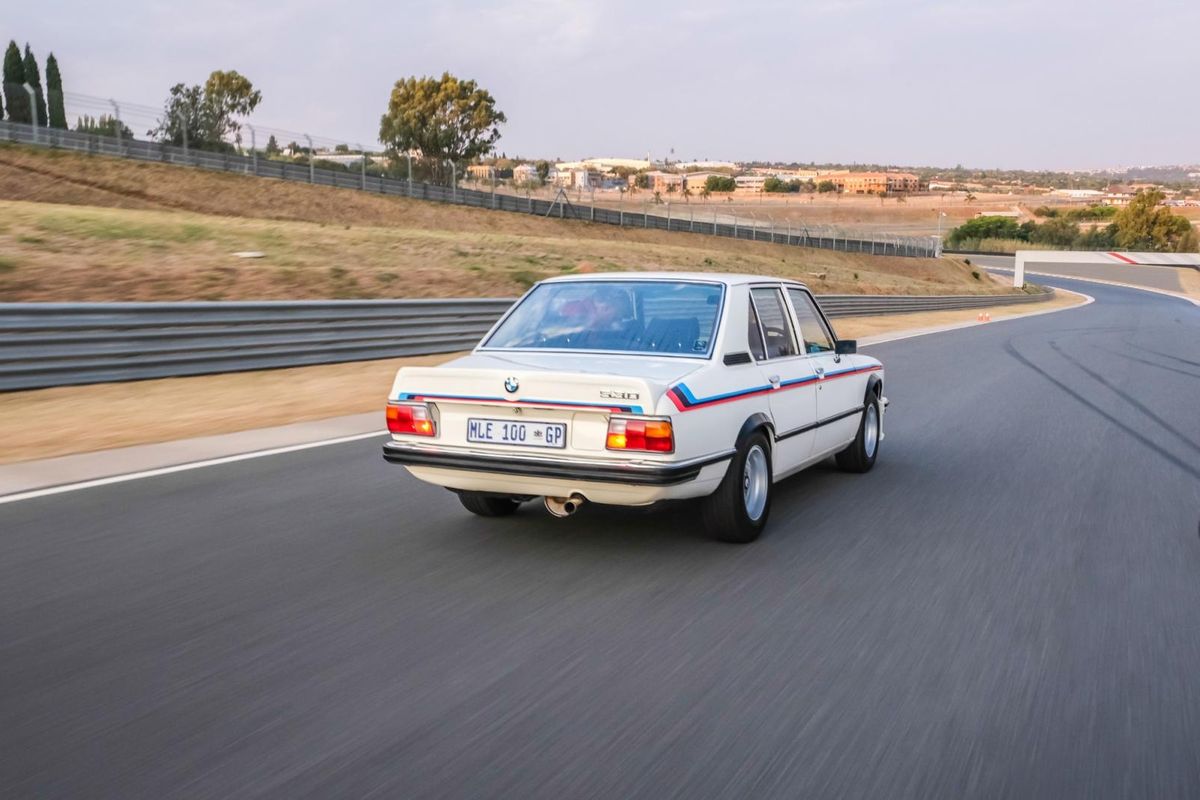
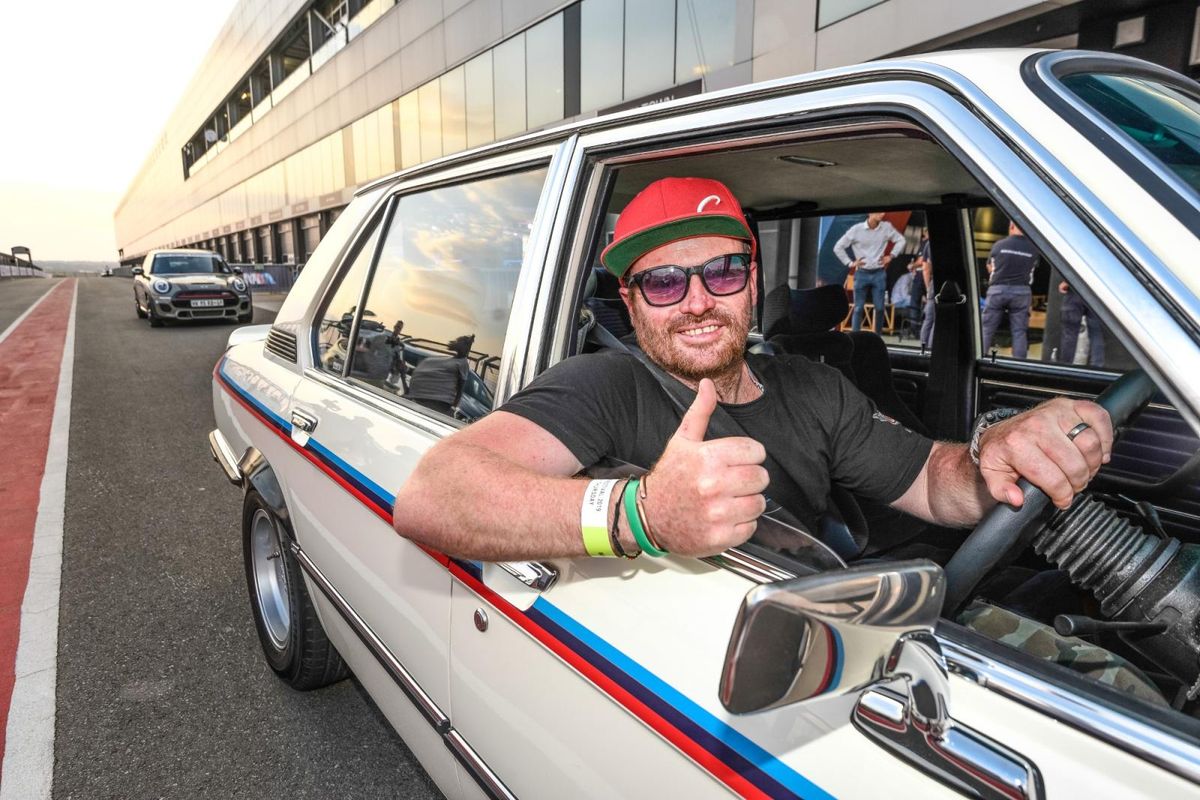
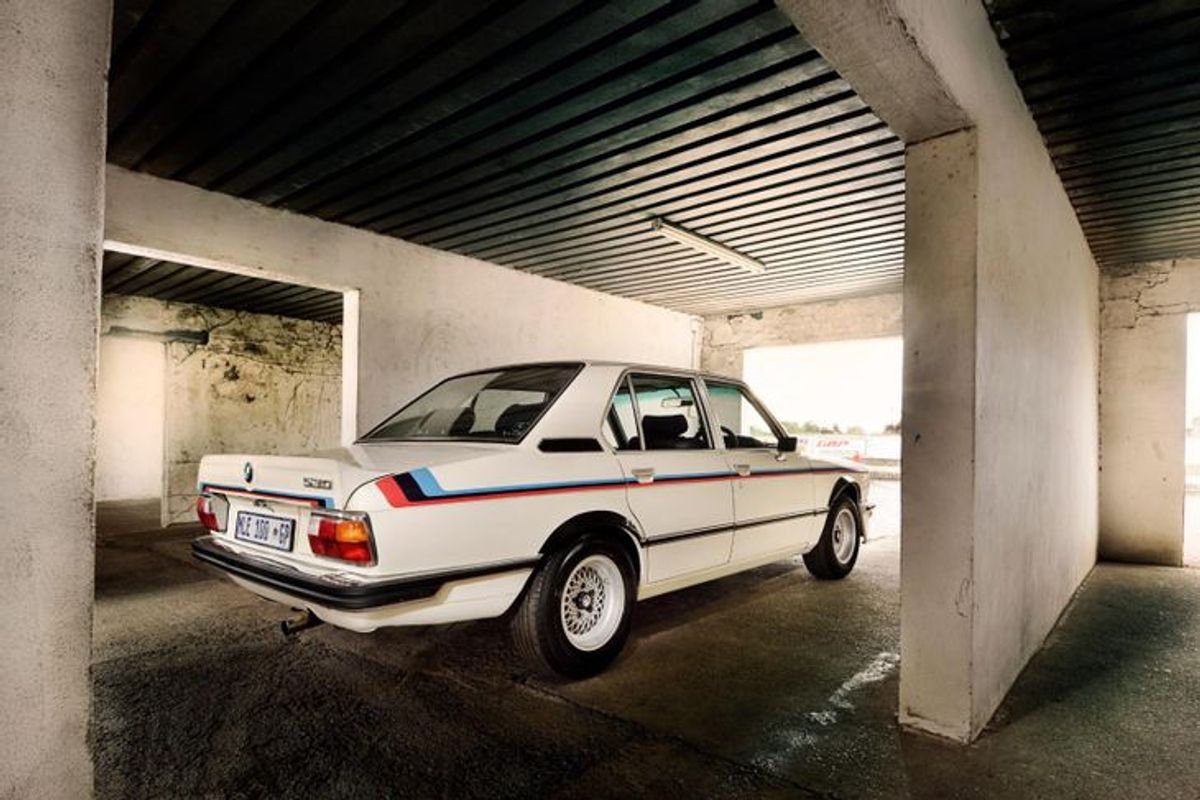
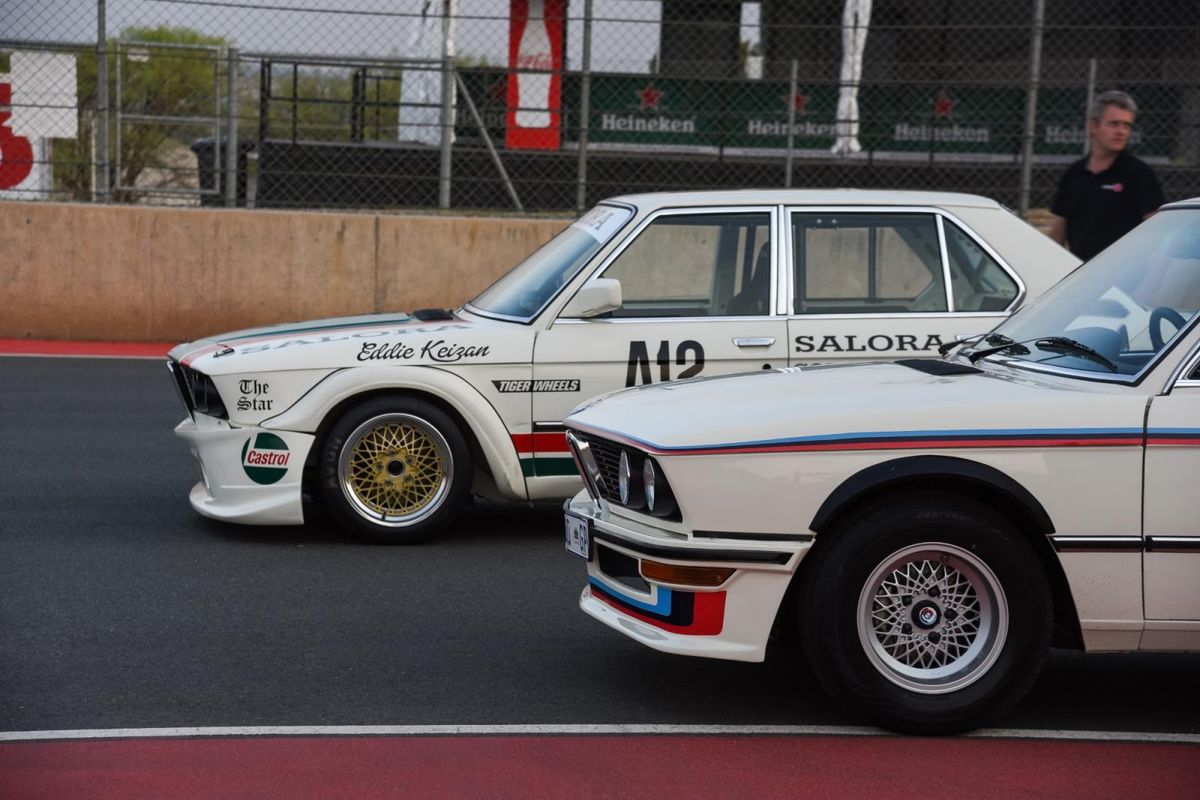
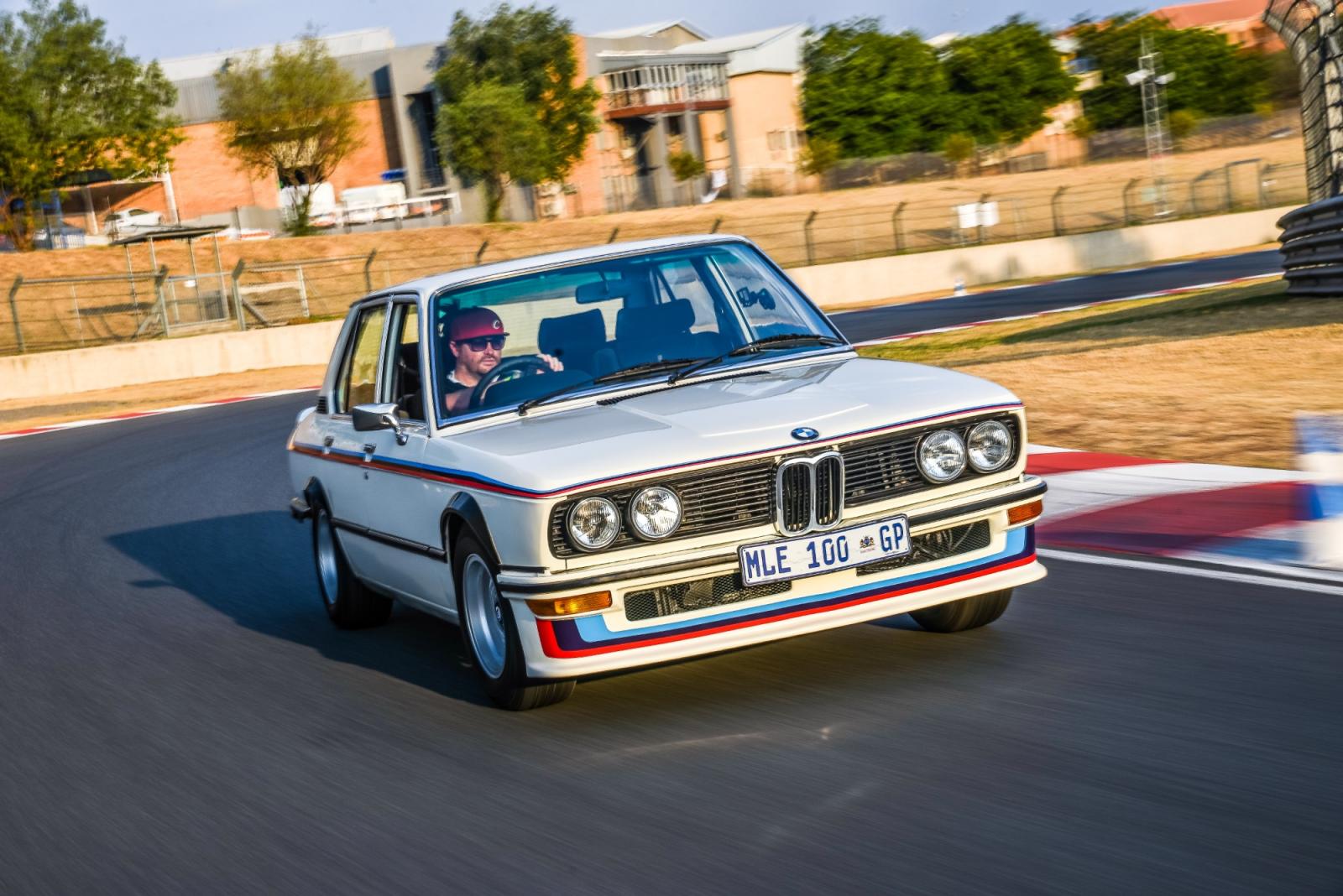
BMW South Africa showcased the latest addition to its Heritage Fleet – a fully restored 530 Motorsport Limited Edition – at the recent M Festival at Kyalami. Gero Lilleike had a rare opportunity to take BMW's "unofficial first M model" – and a cornerstone of the brand’s motorsport heritage in Mzansi – for a brief drive around the track.
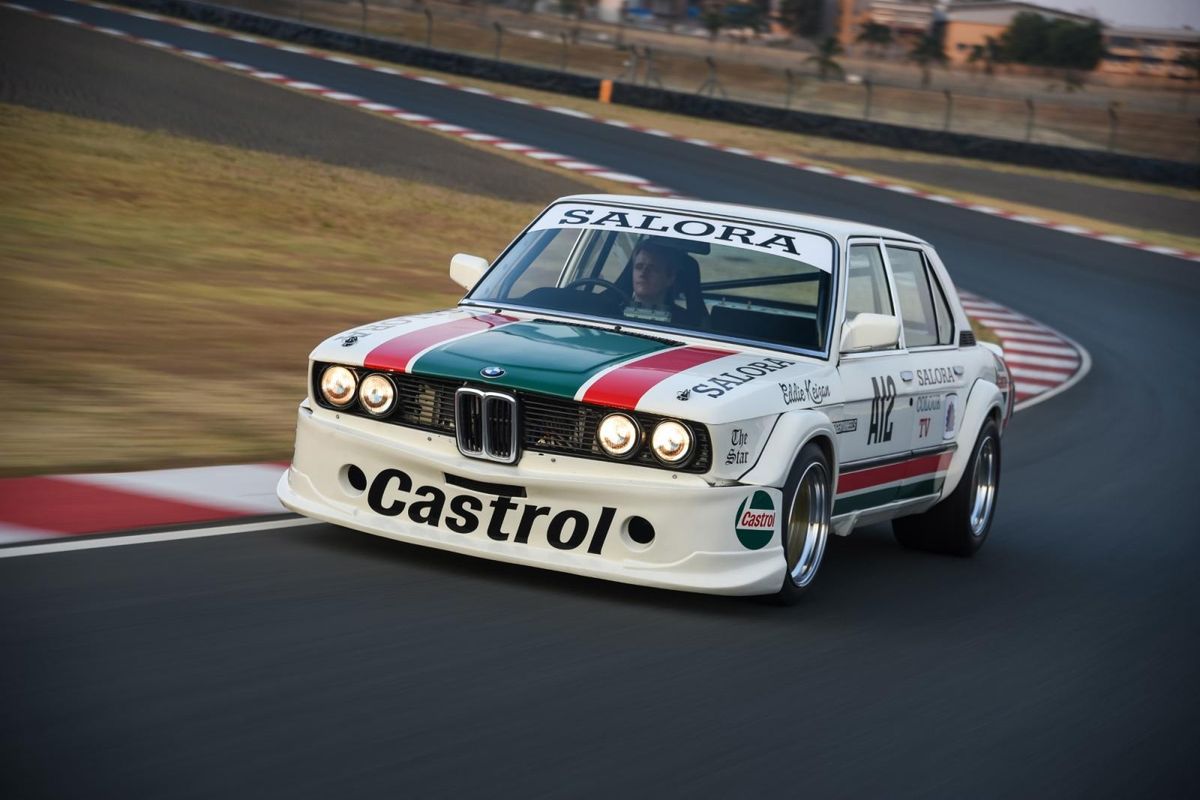
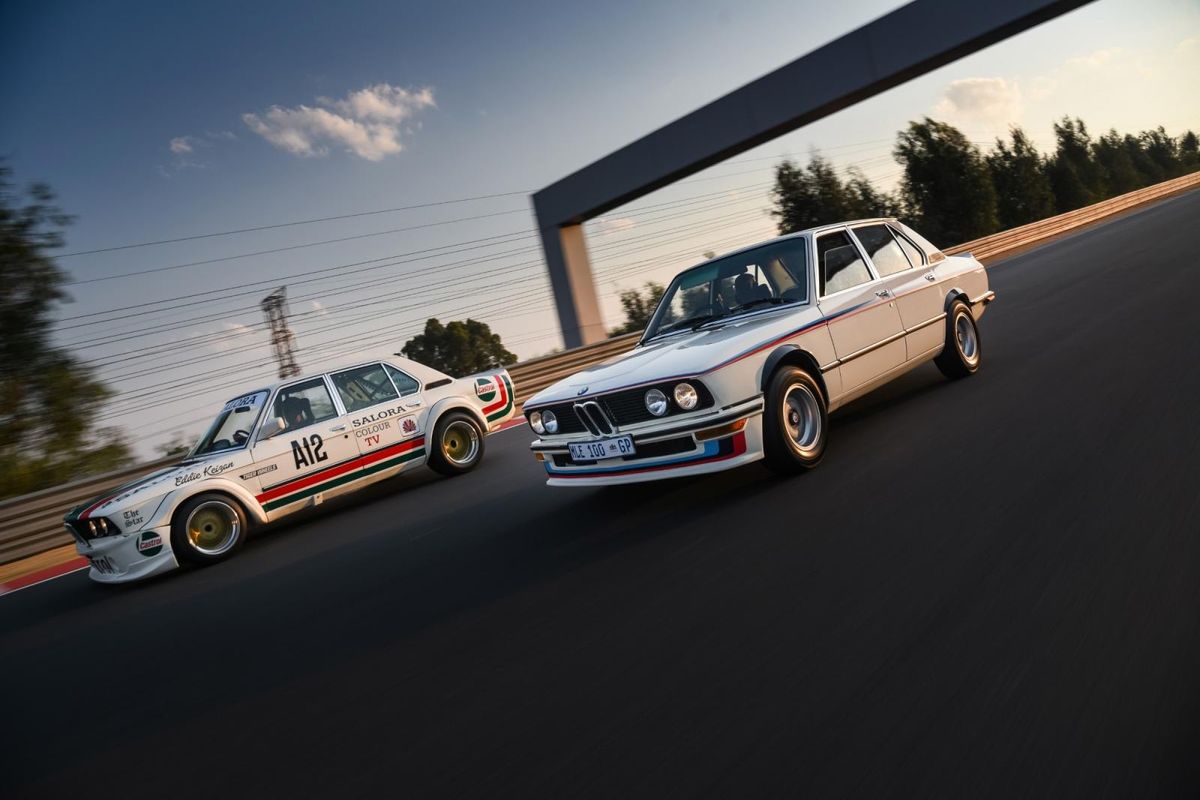
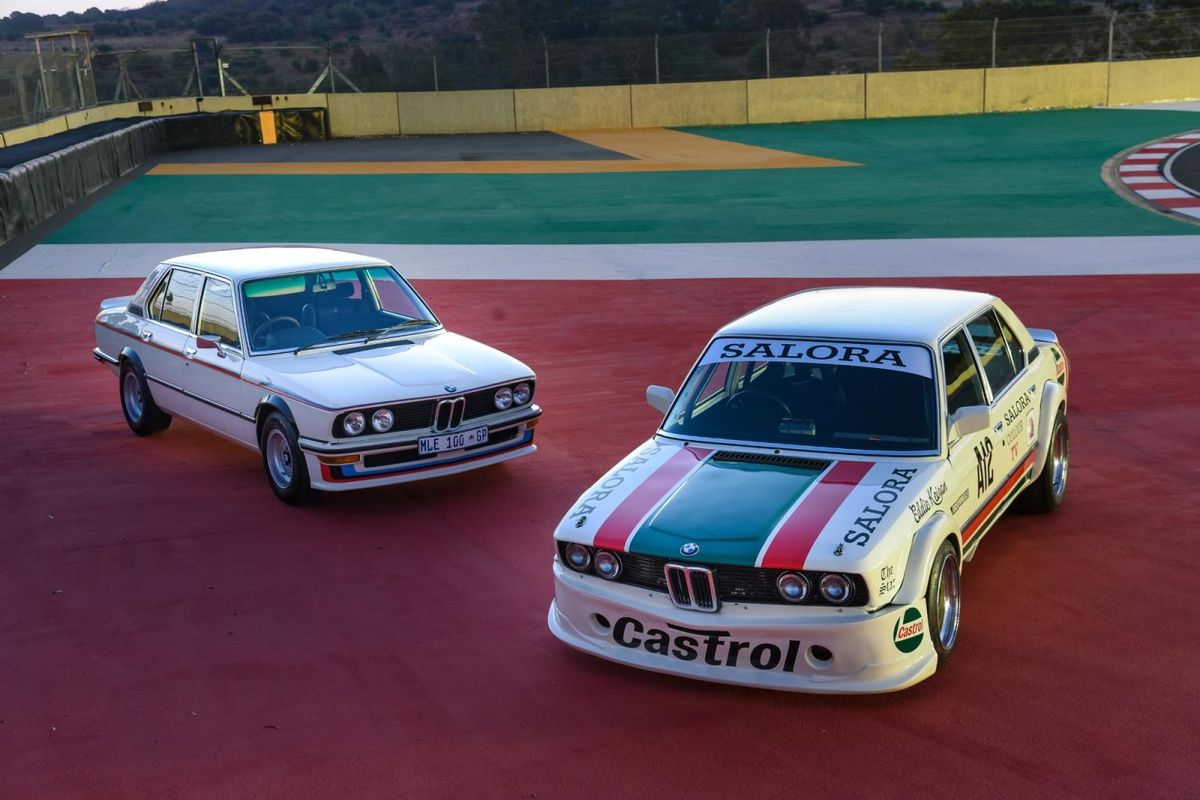
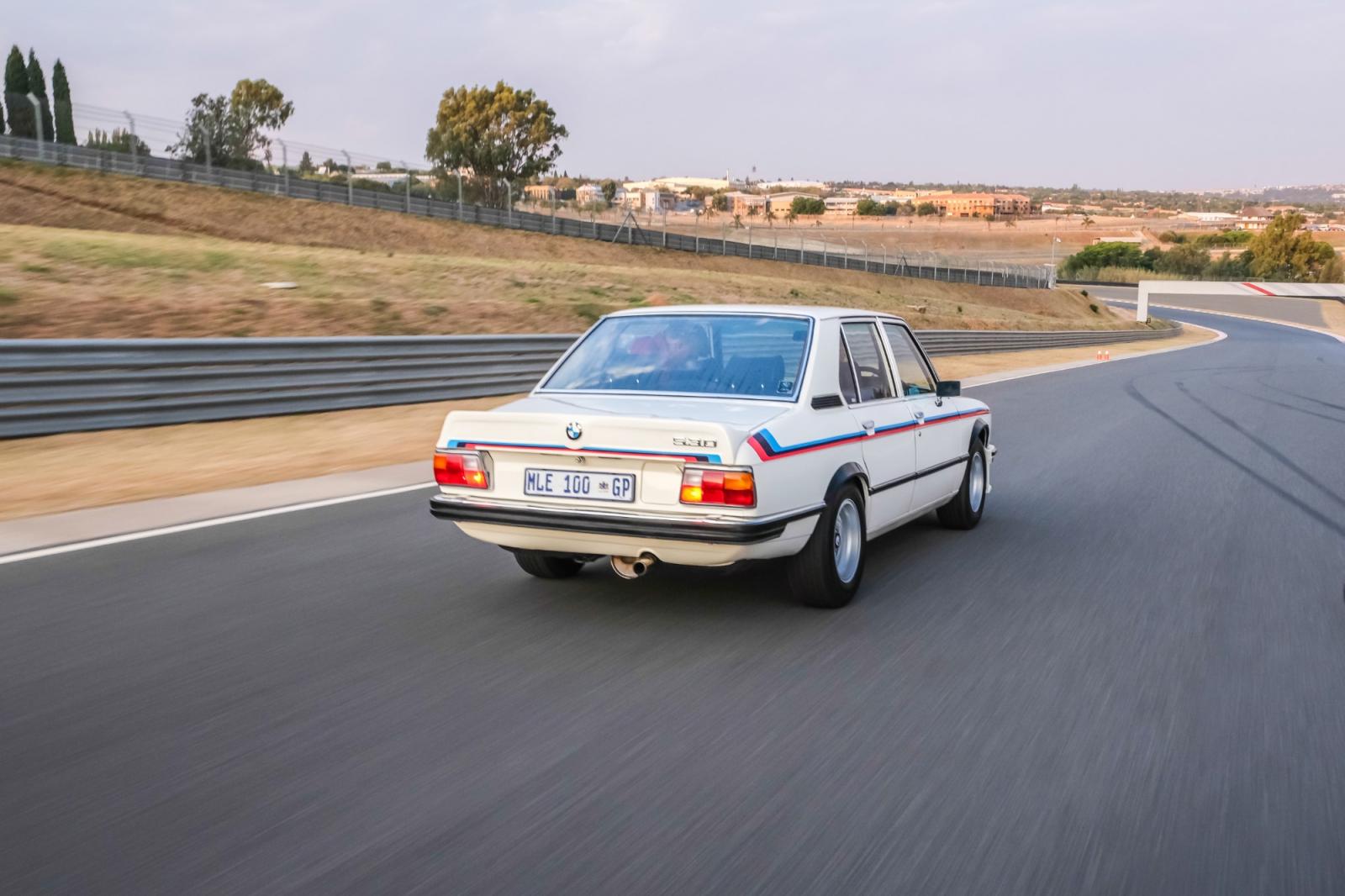
As far as unique-to-SA classic cars are concerned, the BMW 530 Motorsport Limited Edition (MLE) is among the most significant. What's more, it’s an utter rarity – only 7 roadgoing MLEs are believed to have survived! And what about the racing 530 MLE? There’s only 1! BMW South Africa produced a string of homologation models (cars produced in low volumes to conform with the entry requirements for sedan-based track racing) in the 'Eighties and early-'Nineties: the 333i, 745i and 325iS "Evo 1" and Evo 2. However, the 530 MLE pre-dates all of them… not only did it lay the foundation for BMW’s M Division to produce road cars; it enabled the Bavarian brand to market its cars through its involvement in SA motorsport.
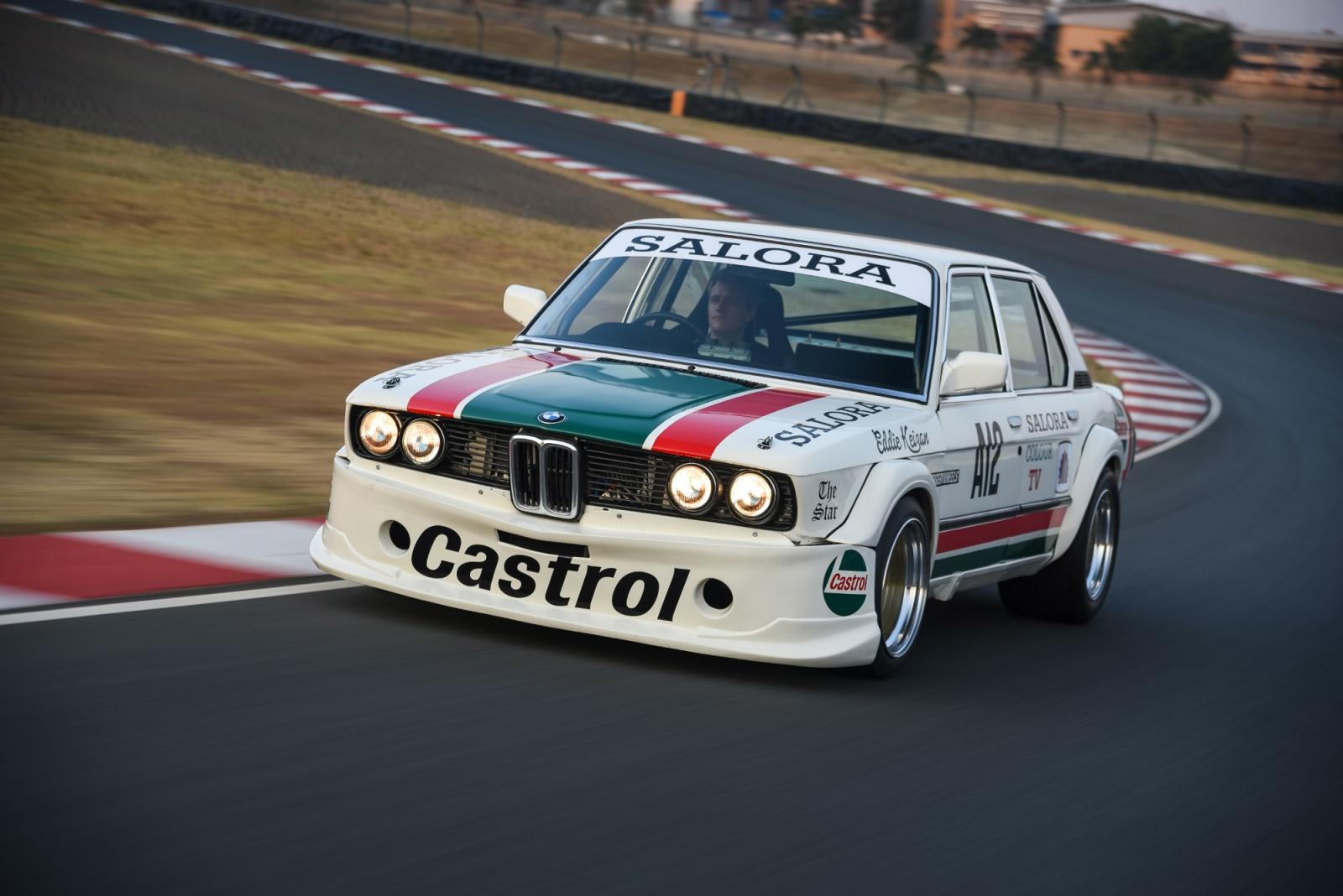
This is the only racing 530 MLE in the world. It dominated its series in local track racing in the '70s and early '80s!
Standing track-side with the recently-restored BMW 530 MLE, as the setting sun casts a colourful glow over Kyalami, my heart is pounding in my chest. I’m nervous, but also incredibly excited, because I’m about to drive BMW South Africa’s most recent restoration project, the 530 MLE and, most significantly, it's car #100, which was previously owned by Peter Kaye-Eddie, a former racing driver and 530 MLE racing team manager. More than this, I would be driving it around Kyalami, the very venue where the racing version of 530 MLE obliterated its competition more than 4 decades ago in the local Modified Production Series. Statistically speaking, it's the most successful racing version of the 5 Series to date… probably ever.
At the onset of the track demonstration, BMW Group Communications Manager, Diederik Reitsma, gave us a quick briefing and we were told that we would only have 1 hour to soak this car in. Nothing more, nothing less. And so, I patiently wait for my turn.
Then it happens. As I open the venerable Bimmer's driver’s door and slide into the driver’s seat, I've instantly transported to a time long ago. I had spent most of the day driving BMW’s latest products and now, as I step into the 530 MLE, it feels as if I'm stepping into another world…
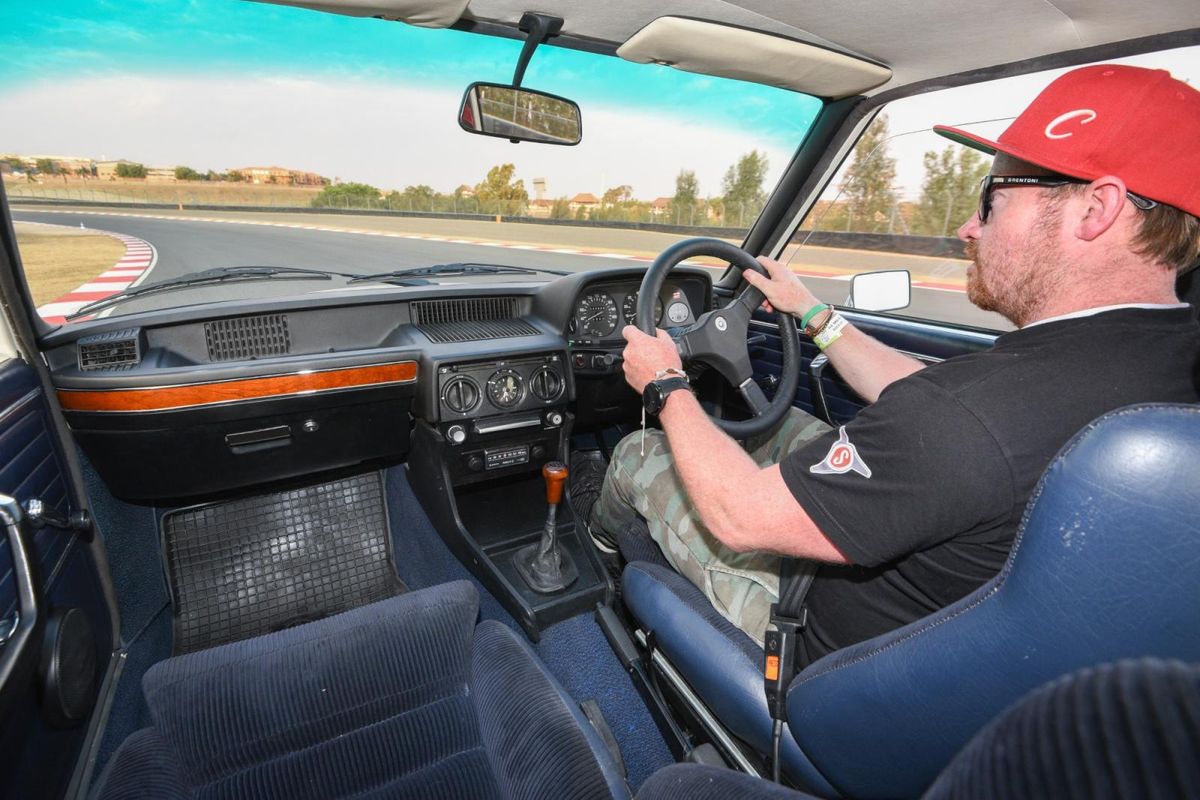
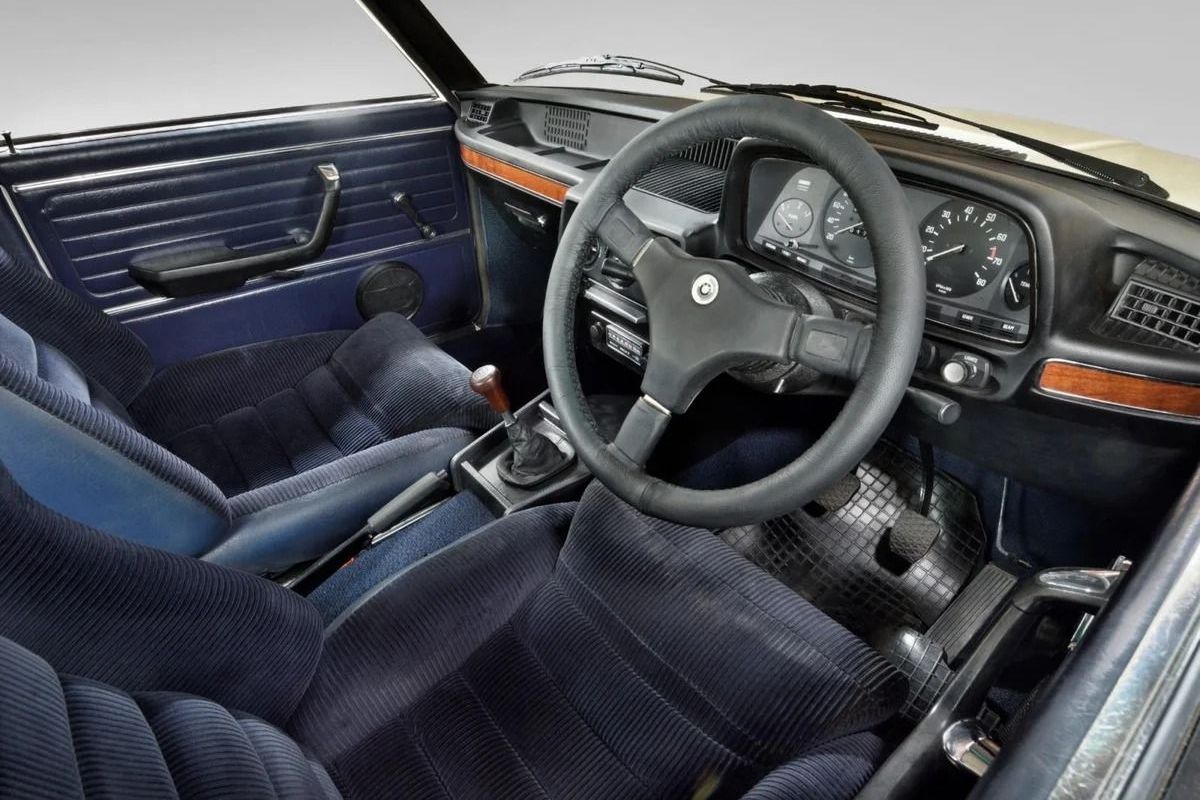
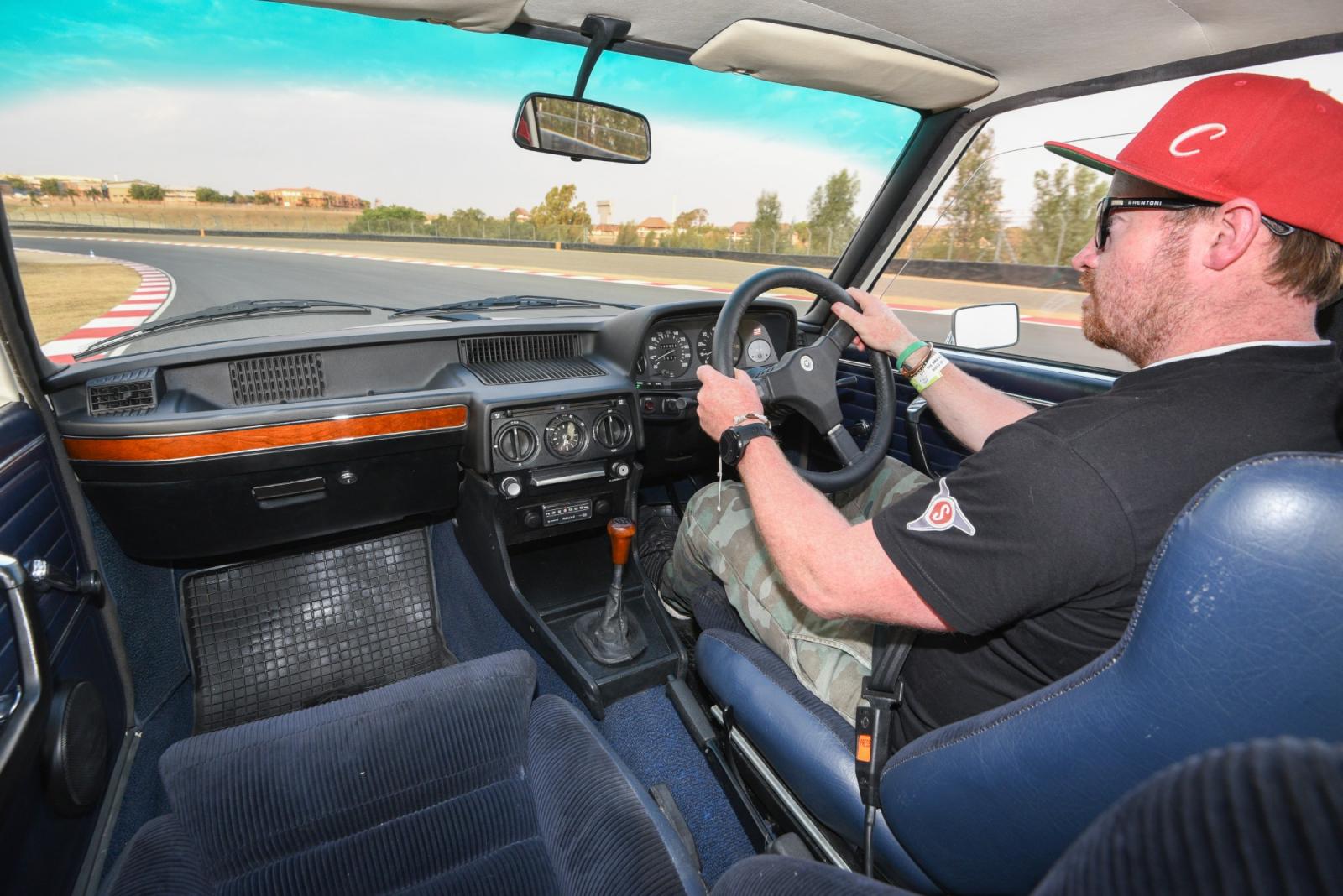
The 530 MLE's cabin is bereft of many conveniences found in modern cars, but it's such a charming place to be.
Upholstered in old-school corduroy cloth (it's like an old school velour…), the sculpted driver’s seat is generously bolstered but palpably comfortable, in a way that only an old car's seat can be. The U-shaped headrests catch my eye – they give the cabin a distinct 70’s touch. The old Sanyo Rally II tuner radio made me smile and the simplistic air conditioning dials, central analogue clock and mono dials are a reminder of much simpler times.
As I’m about to turn the key to start the 530 MLE, Luis Malhou of Custom Restorations, the man in charge of this restoration job, steps to the window. He kindly asks me to not rev the engine beyond 3 000 rpm and to go easy on the car around the track as both the engine and brakes are still being run/bedded in. I acknowledge his request with a smile, albeit a nervous one and reassure him that I will take good care of her.
I turn the key and the 3.0-litre, 6-cylinder motor springs to life. And, oh, what an urgent, unfiltered soundtrack it emits. I gently prod the throttle pedal, but it’s stiff. I prod it a bit harder and let the motor pipe up for a brief moment. My heart is racing, I’m overwhelmed…
Only 7 road-going BMW's 530 MLE's are thought to exist worldwide.
It’s time to go! The manual 5-speed Getrag transmission lever feels loose and mechanical in my hand but simultaneously direct with a longer-throw action, which is, of course, perfectly period correct and increasingly rare in these days of "user-friendliness". The gears catch sweetly. The lack of power steering is immediately noticeable and the tiller feels heavy as I steer the 530 MLE into Crowthorne, the first corner at this iconic track.
I wind down the window to afford my body much-needed fresh air amid the intensity of a track drive (of a priceless museum piece!) and, as the 530 MLE makes its way up through Jukskei Sweep to Barbecue corner, I can’t help but think how spoilt modern-day motorists are with convenience features. Driving this car makes this fact abundantly clear, especially considering that less than an hour prior I was driving the latest M340i.
The BMW 530 MLE tackles the famous Mineshaft at Kyalami.
As I work the wheel and the Bimmer rolls on towards Clubhouse Bend and the Esses, my thoughts drift to motorsport and I try to imagine what it must have been like racing the 530 MLE at full throttle on track. I imagine what those days, in which privateers worked on their cars in their back yards during all hours of the week, before risking life and limb racing these elemental tin tops at the weekend, must have been like.
It’s worth noting here that the racing version had notably higher outputs from its modified 3.0-litre engine with no less than 206 kW and 318 Nm on offer – it must’ve been a real tail-happy treat to drive at the old Kyalami. With the sun setting behind me and its rays bathing the cabin with warm light, I turn onto the famous Mineshaft and I savour the dream-like moment (still puttering along at 50 kph, I daren't drive the 530 MLE any faster).
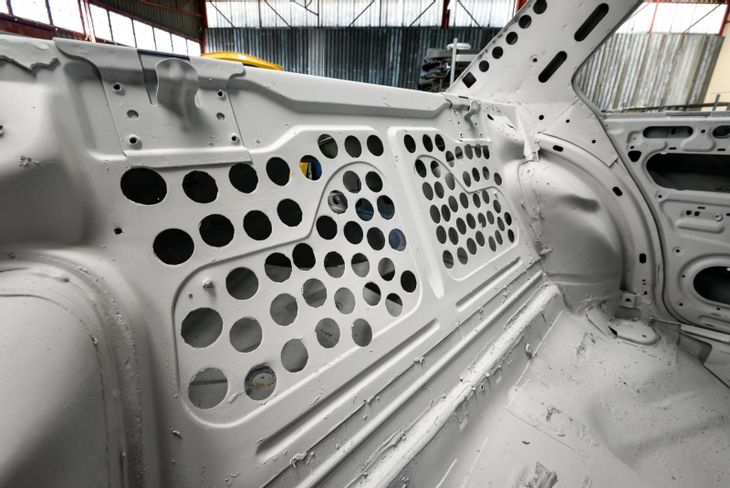
Less than a year ago, the 530 MLE was down to bare metal. Note the holes that were drilled into the bulkhead to save precious kilos.
It then dawns on me that I wasn’t even born when the 530 MLE left its indomitable mark on South African motorsport. The late Tony Viana, from Welkom, and other revered saloon-car racers achieved successes in local racing at the wheel of race-bred BMWs I mentioned before (Deon Joubert also won the South African driver's championship in a modified 535), but would any of those cars have existed had the MLE not paved the way?
I pull into the pits and switch off the Bimmer's engine. It's back to reality as I sit in silence. I take a few seconds to reflect on my brief encounter with this 530 MLE. I’m happy and grateful for this day, for this drive. This must surely be a highlight of my career… This car has something; something special; something that most modern cars claim to have but just don’t have and probably never will have. It’s got character! And lots and lots of it.
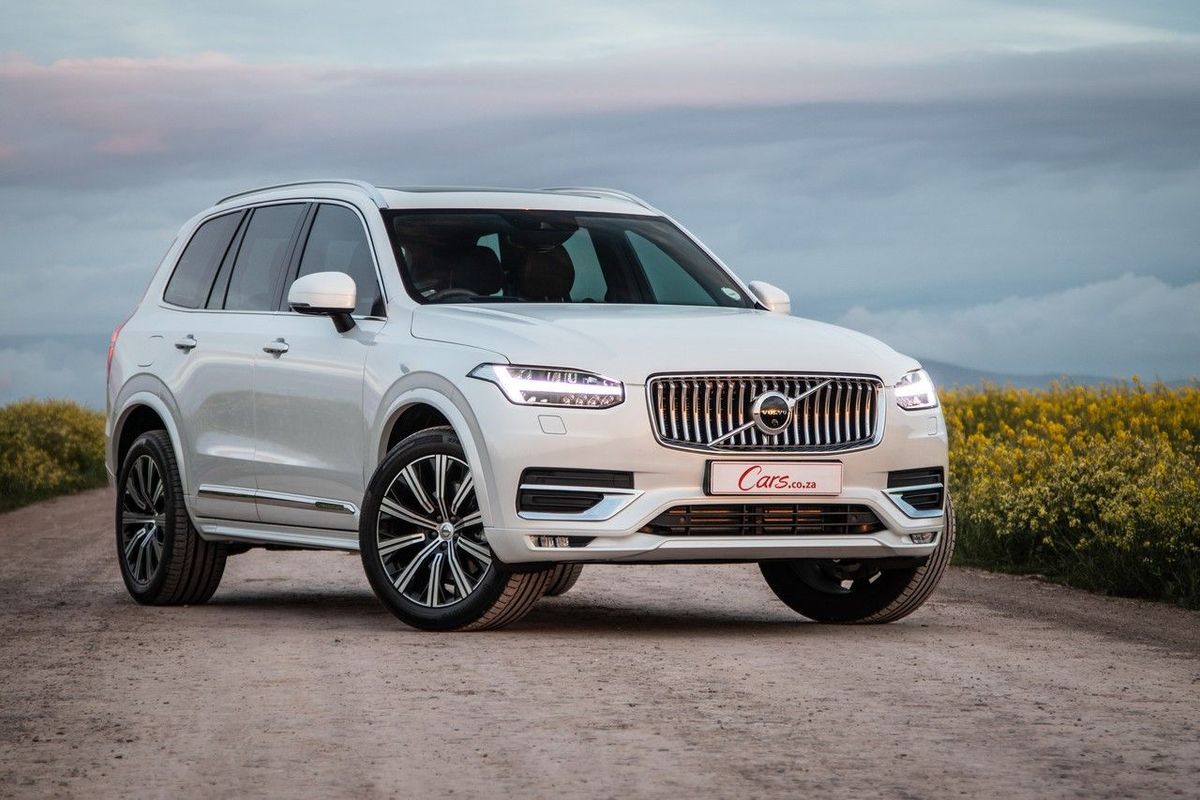
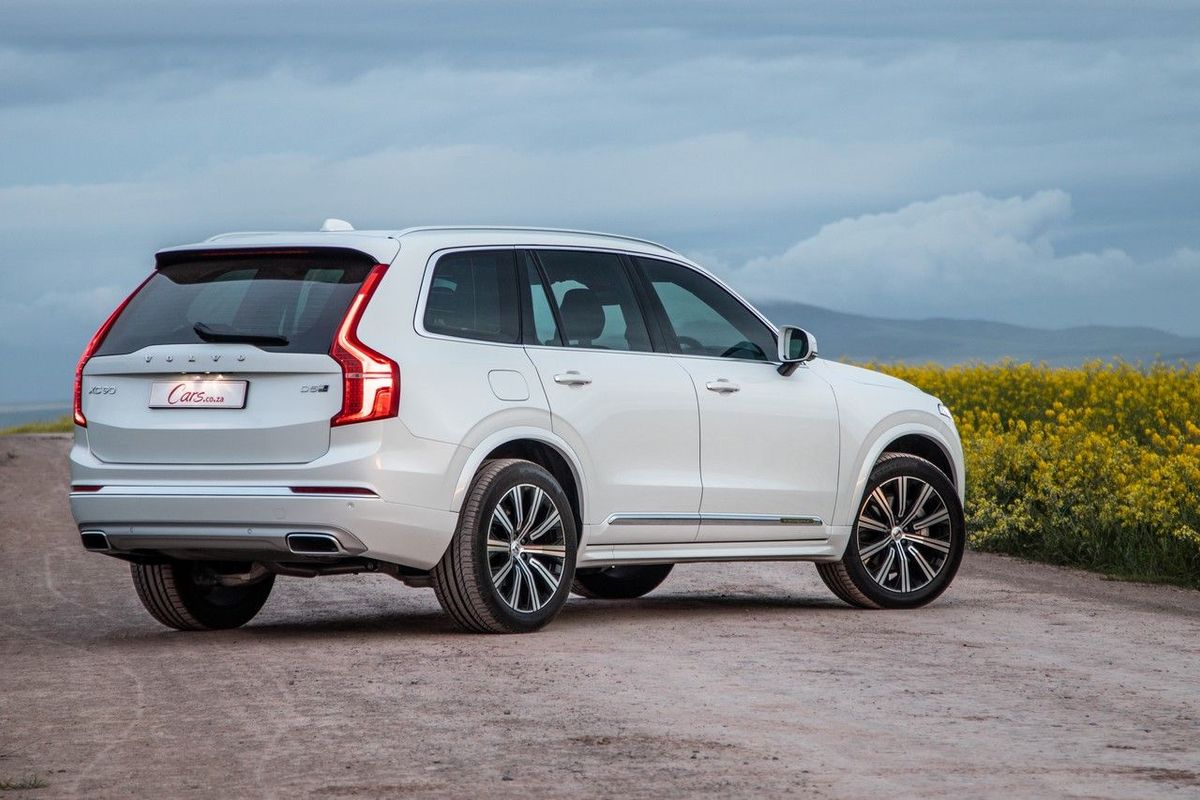
This is the updated XC90 and we had a chance to spend some quality time with the Premium SUV, which famously raked in a trio of #CarsAwards category wins (from 2016 to 2018) in pre-facelift guise. While the updates are not immediately apparent, does the Swede still have enough going for it in an increasingly competitive segment?
We like: Safety, styling, build quality, refinement, strong engine
We don’t like: Engine could be more refined, options can get pricey.
Fast Facts
Price: R1 131 600 (Price as tested R1 269 400)
Engine: 2.0-litre turbodiesel
Power/Torque: 173 kW / 480 Nm
Transmission: 8-speed automatic
Fuel economy: 5.7 L/100 km (claimed)
Load space: 314-692-1947 litres
Where does it fit in?
The Volvo XC90 is the brand's flagship offering and is available in petrol, diesel and plug-in hybrid.
The XC90 sits at the summit of Volvo's SUV line-up. This generation of the car has been around since 2015 and it has won numerous awards, including 3 consecutive Best Premium SUV trophies in the #CarsAwards – powered by WesBank. It also marked a turning point in the Swedish brand's recent history, because the XC90 was completely designed and engineered by Volvo (it didn't share parts with Ford, Land Rover or Jaguar products). Thanks to Geely's massive investment, Volvo could ensure its new XC90 was as good as possible and when we sampled it, we were duly impressed by its style, refinement and build quality. All of a sudden, the Volvo was a genuine threat to the established SUV players in the segment.
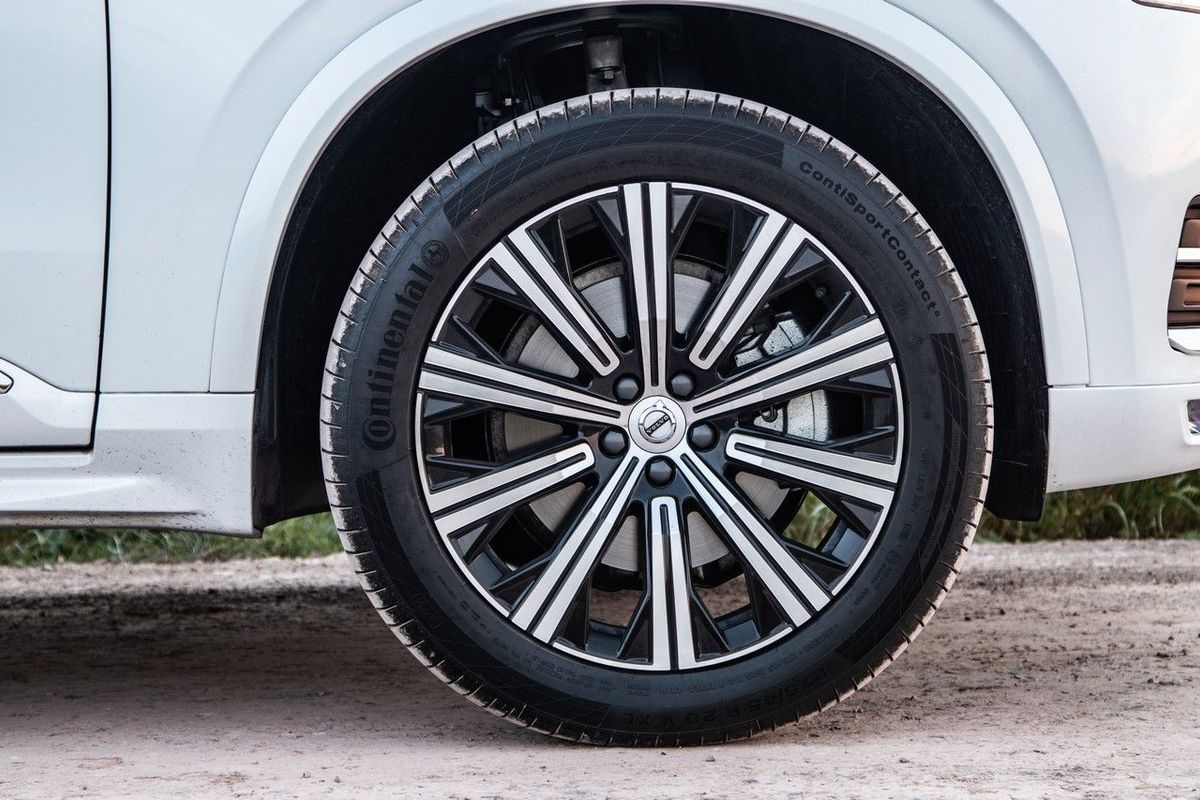
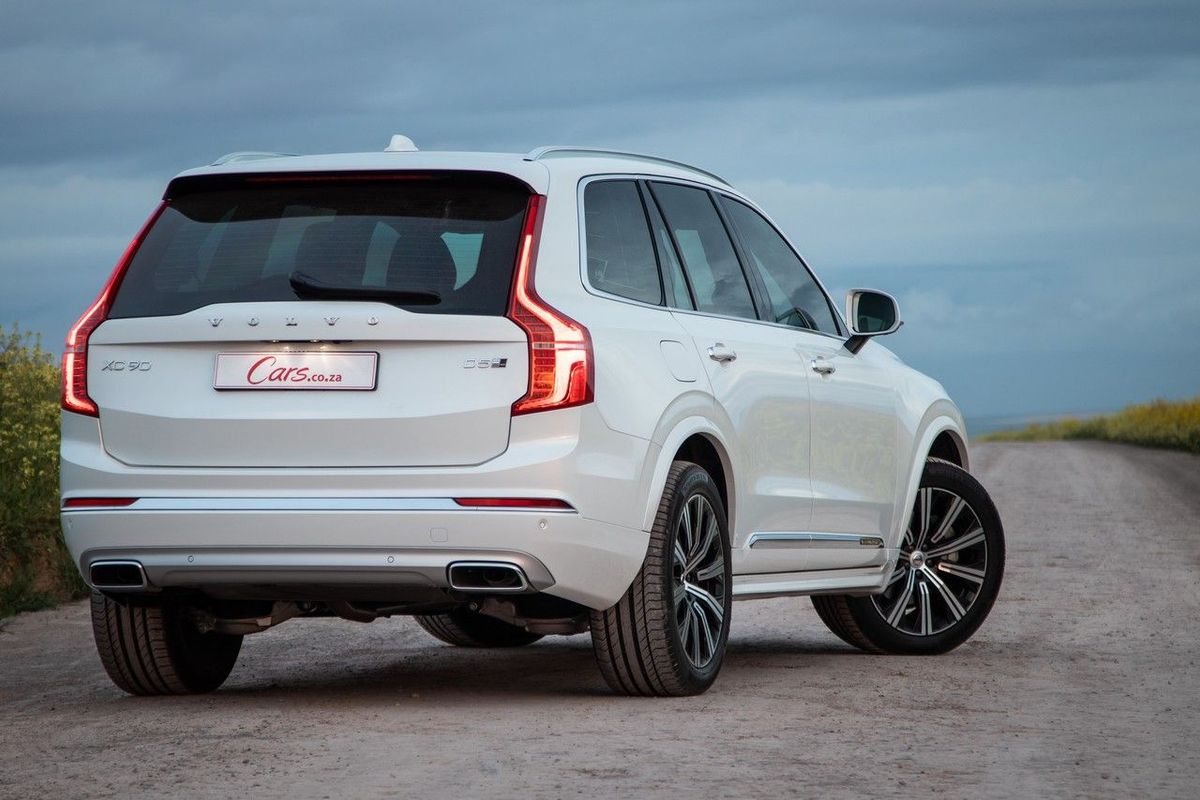
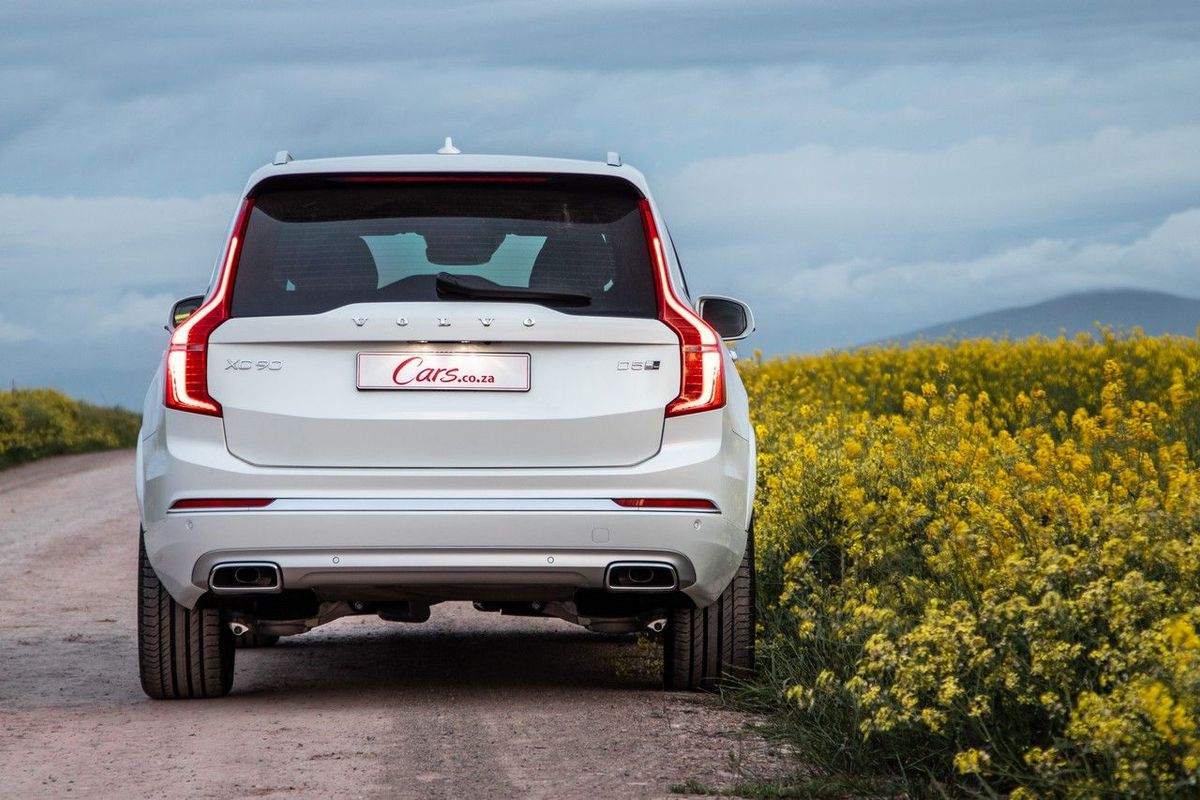
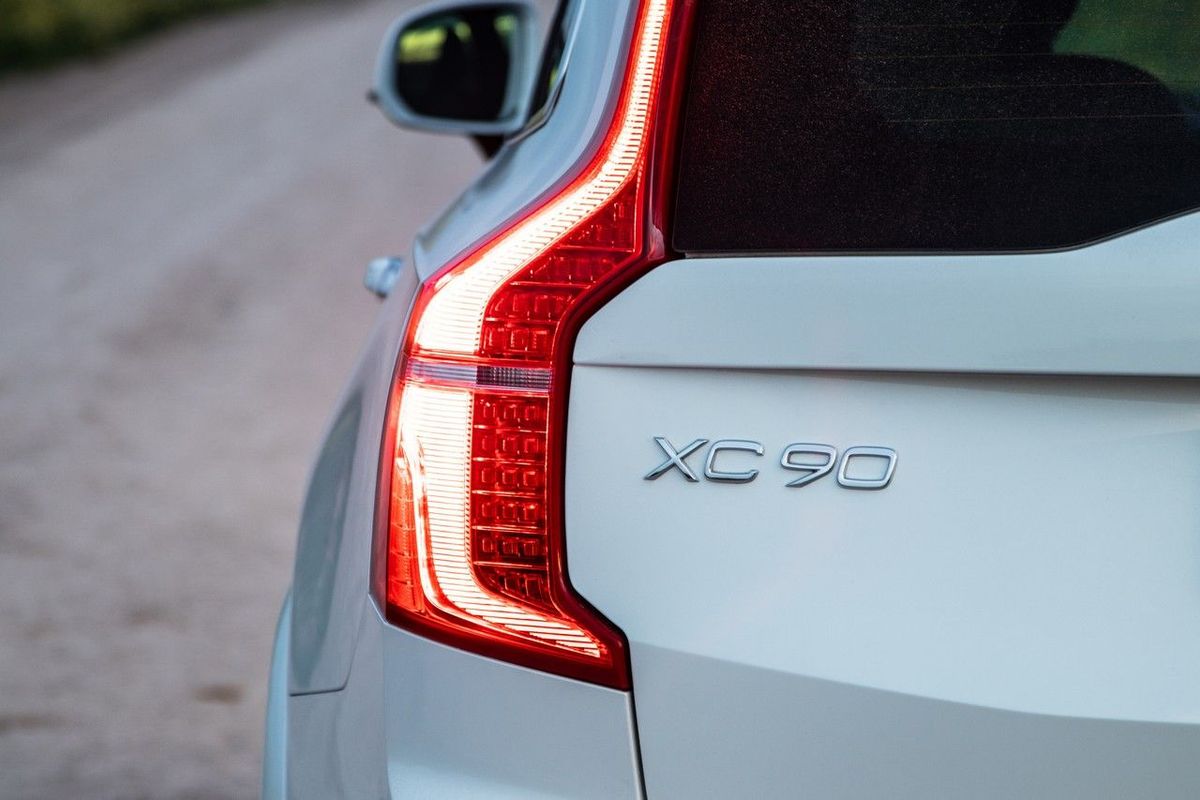
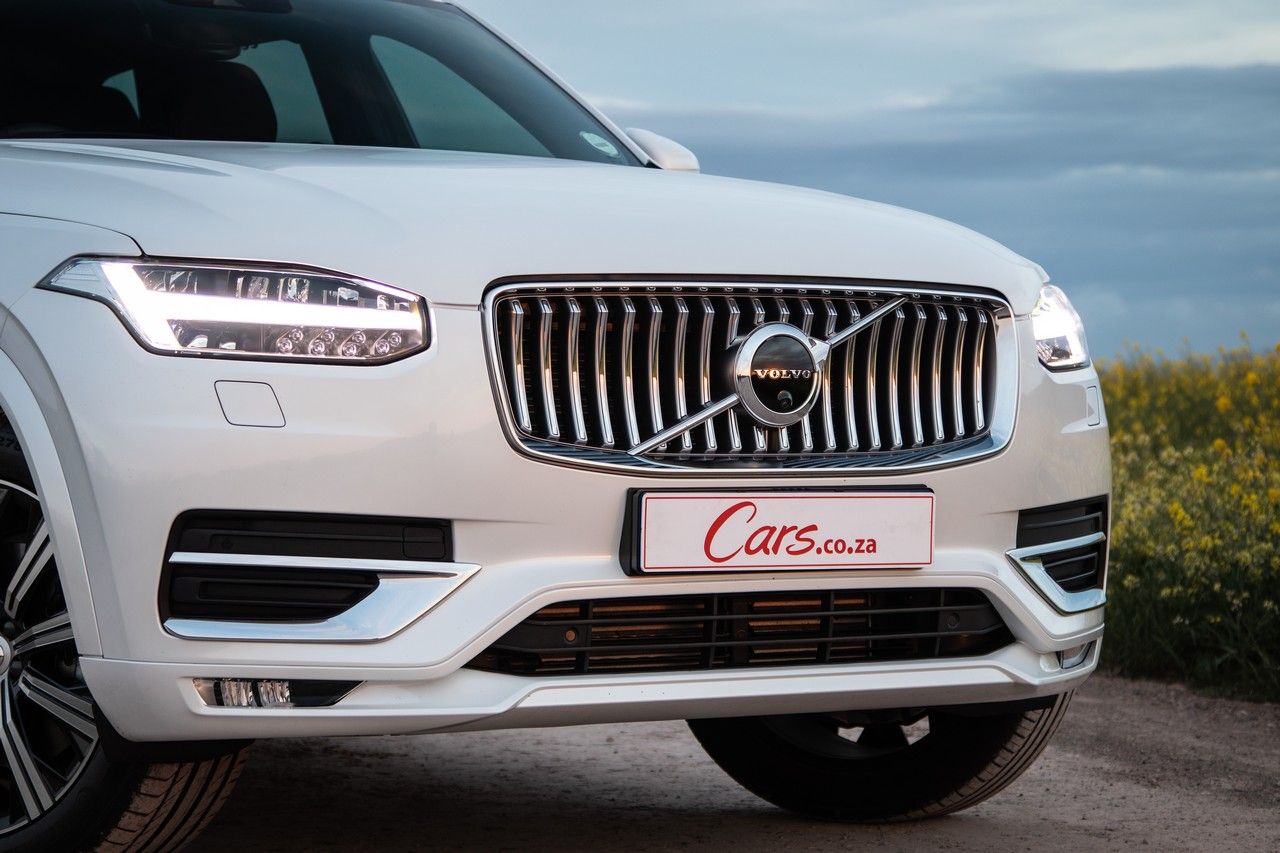
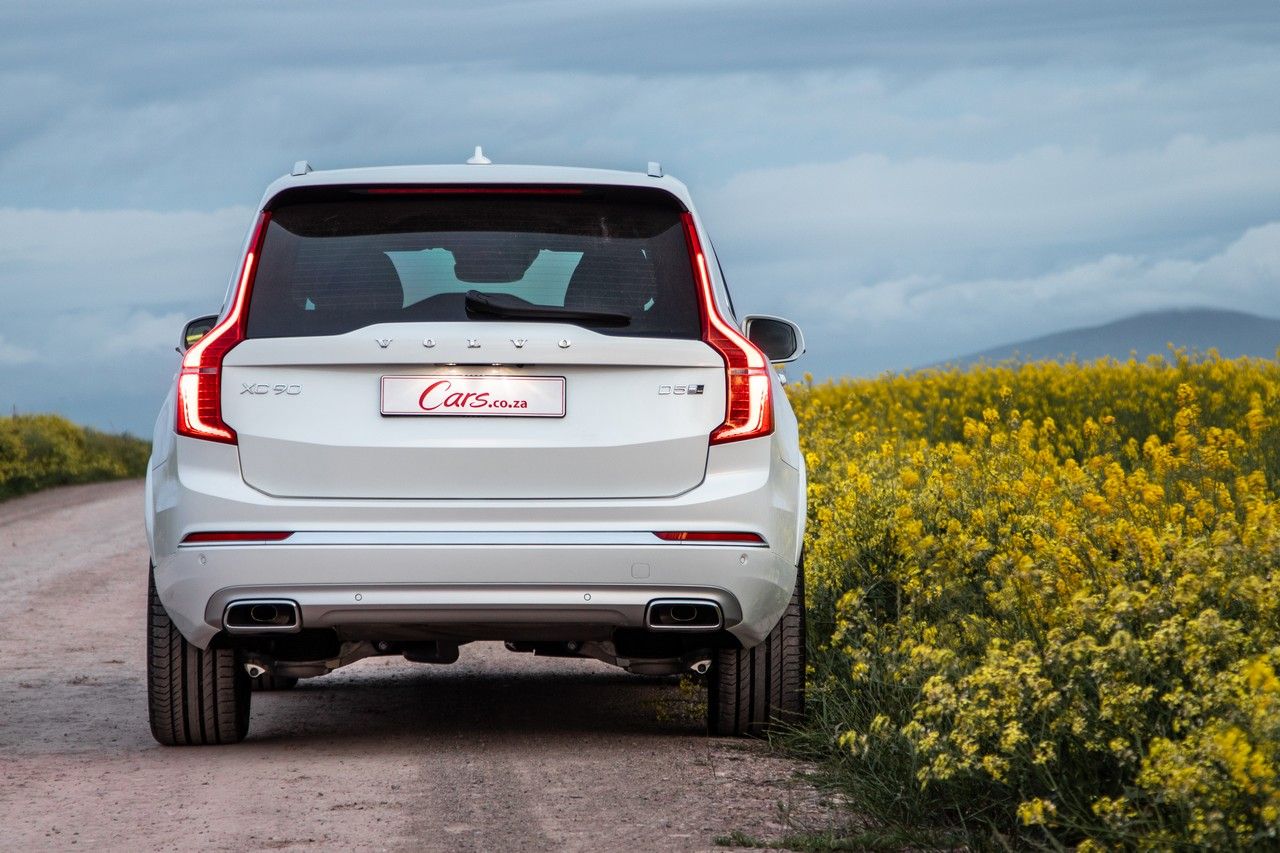
Now the XC90 has received a mild facelift mid-way through its lifecycle. There are minimal changes (so they're hard to spot), but if you look closely, there are revised wheel designs, some new colours to choose from as well as a neatly updated grille. Inside, a 6-seater configuration is available and Volvo's On-Call service has been introduced. On paper at least, the 2019-spec XC90 looks competitive, but the segment has moved on since 2015 and the Swedish offering faces stiffer competition from BMW, Audi and Mercedes-Benz. Can the updates give Volvo the necessary edge?
How it performs in terms of…
Performance and economy
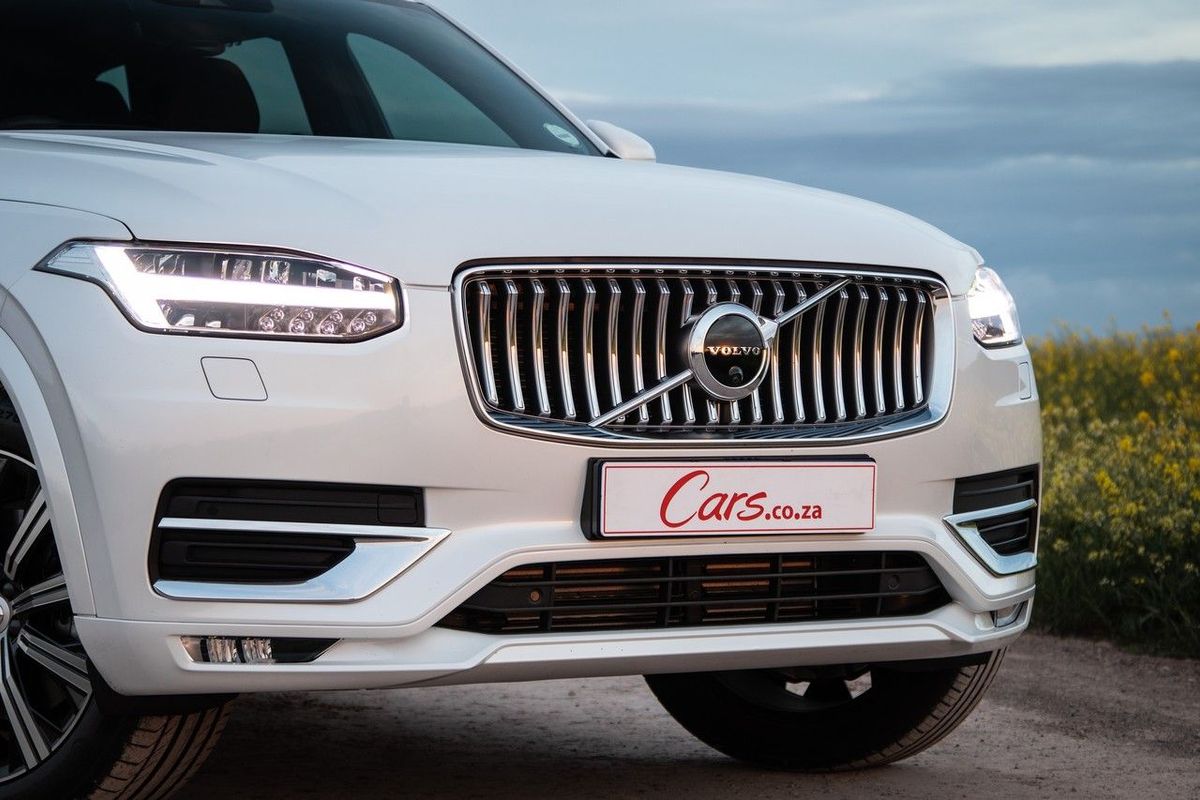
One of the easier-to-spot updates is this new-look grille.
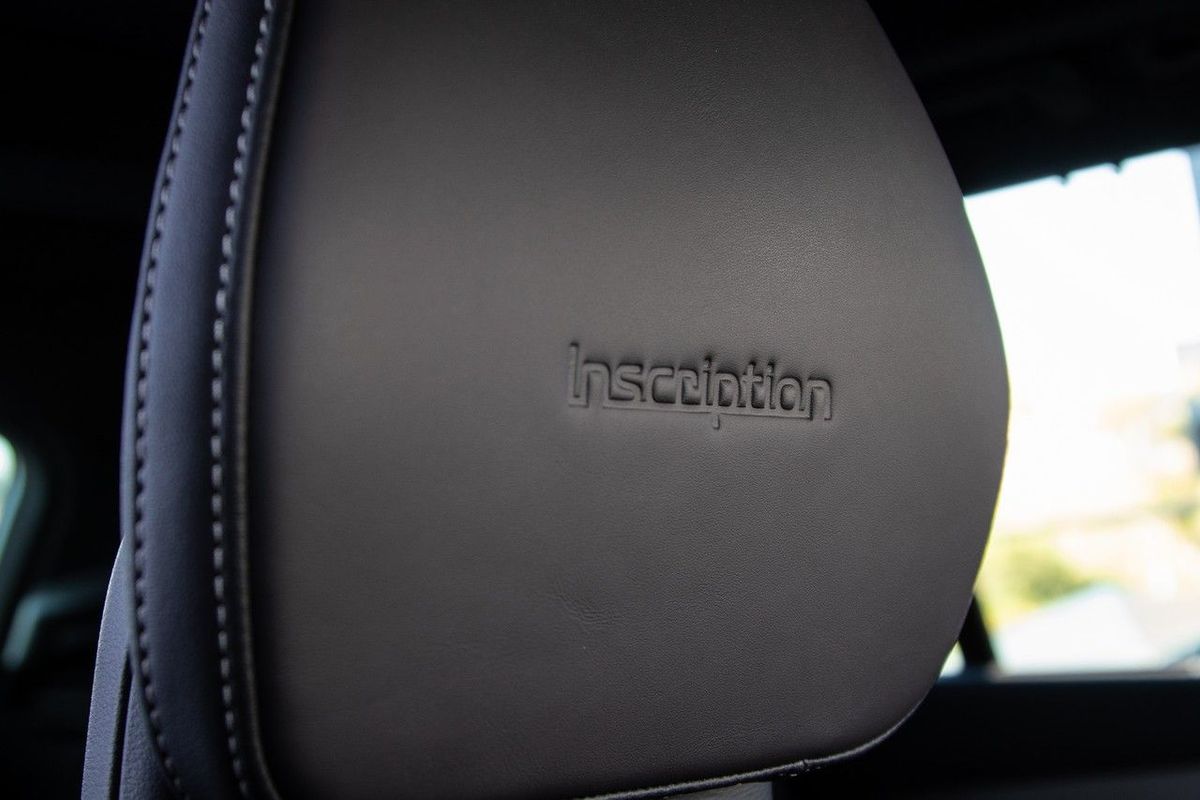
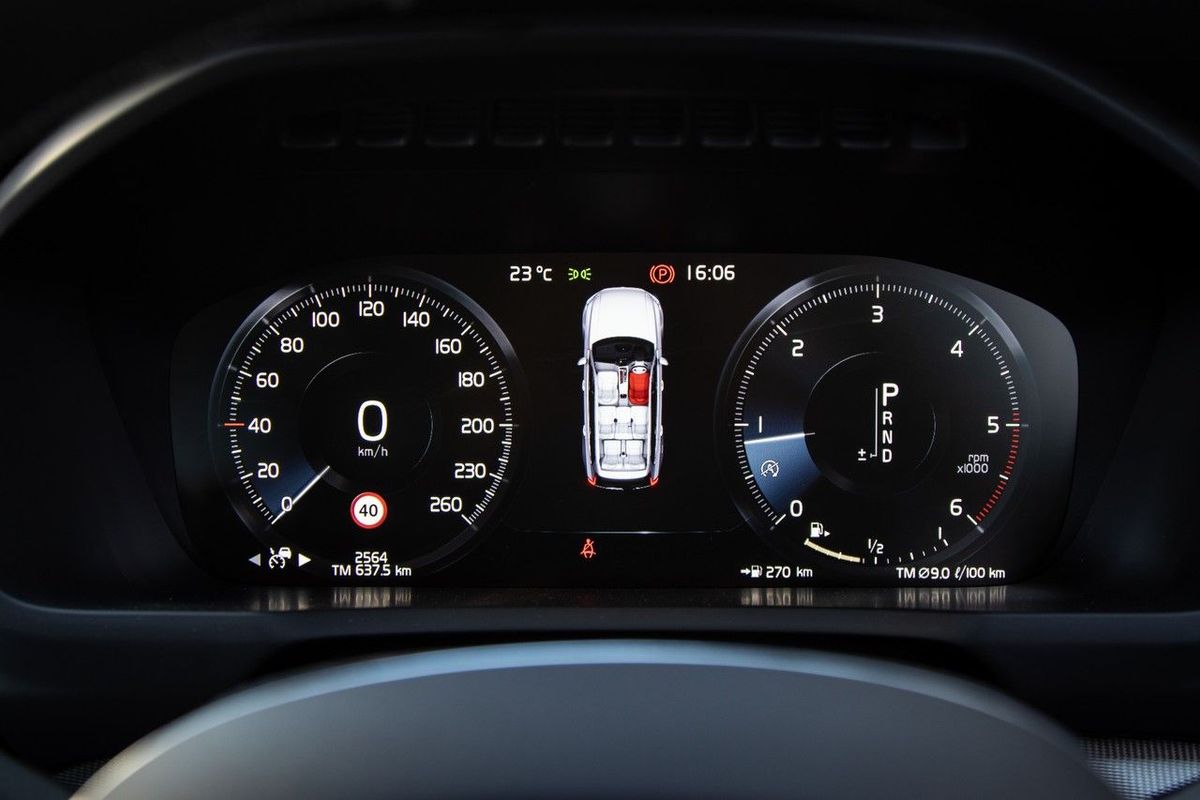
Tested here is the D5 Geartronic AWD Inscription derivative, which is powered by a 2.0-litre turbodiesel 4-cylinder motor. Don't let the motor's compact size fool you, however: it offers 173 kW and a solid 480 Nm, the latter of which is sent to all 4 wheels via an 8-speed automatic transmission. With a claimed 0-100 kph time of 7.8 seconds, the XC90 produces more than adequate performance for a capacious family SUV. The D5 powertrain further offers varying levels of responsiveness, depending on which driving mode you have engaged. Economy dials the throttle pedal's responsiveness way back and prioritises low fuel consumption, whereas Sport will sharpen things up a tad and delay upshifts as well.
The engine note itself is quiet and refined for a turbodiesel, but as the engine revolutions increase, so does the noise and, while you're not very likely to spend a vast amount of time near the redline, be mindful of the 4-pot motor's less-than-pleasant soundtrack at higher revs. Thankfully Comfort mode is where you should be spending the majority of your time and there's a great blend of performance and economy.
Speaking of economy, the Volvo XC90's fuel consumption can be quite frugal, especially on the open road, when it's cruising in its highest gear. Volvo claims an optimistic average of 5.7 L/100 km, but we saw indicated returns of around 9 L/100 km (although we drove mostly in the city during this test). We did take the updated Swede on a longer road trip up the West Coast; during that sojourn, it returned a commendable 7.9 L/100 km.
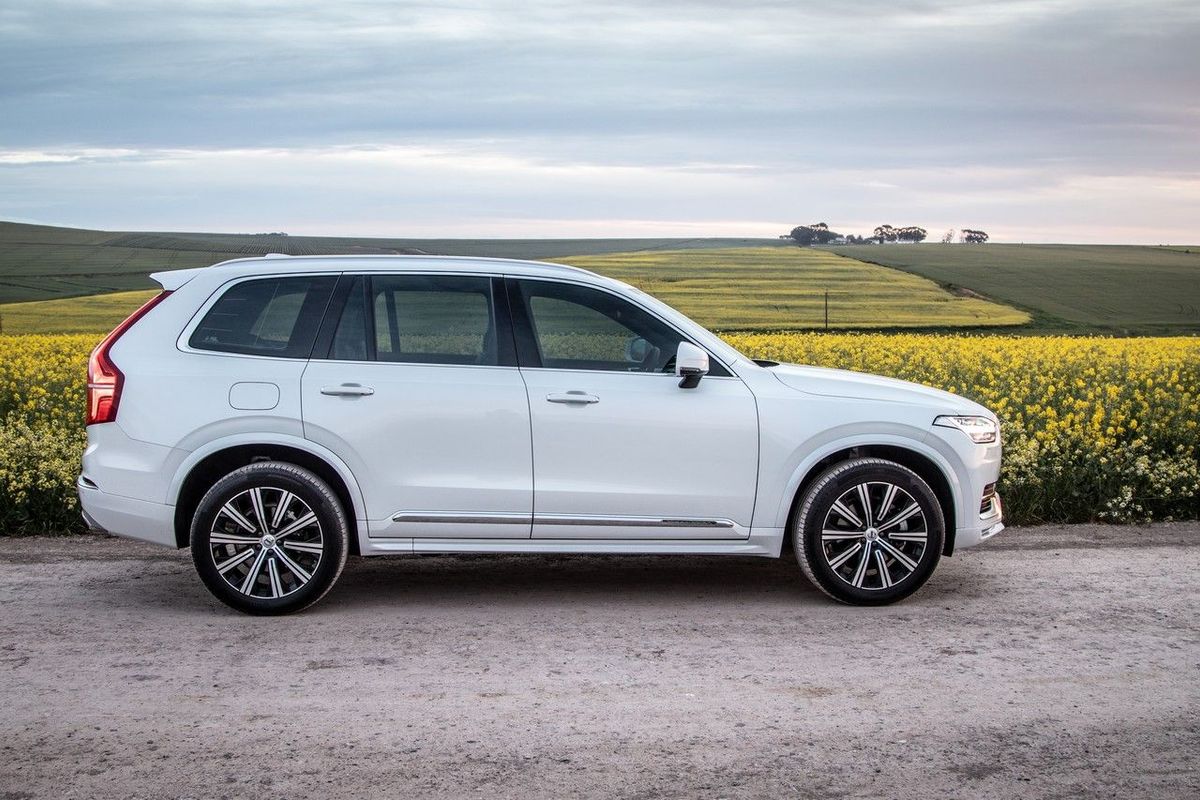
In terms of ride quality and comfort, the D5 Inscription 6-Seater delivers a refined and luxurious ride quality, which is to be assumed at this price point, especially seeing as the evaluation unit came equipped with the optional air suspension, which unobtrusively dials out many of the road's imperfections. Our test unit rode on 20-inch alloy wheels, which we think offer the best blend of style and on-road comfort.
Off-road capability?
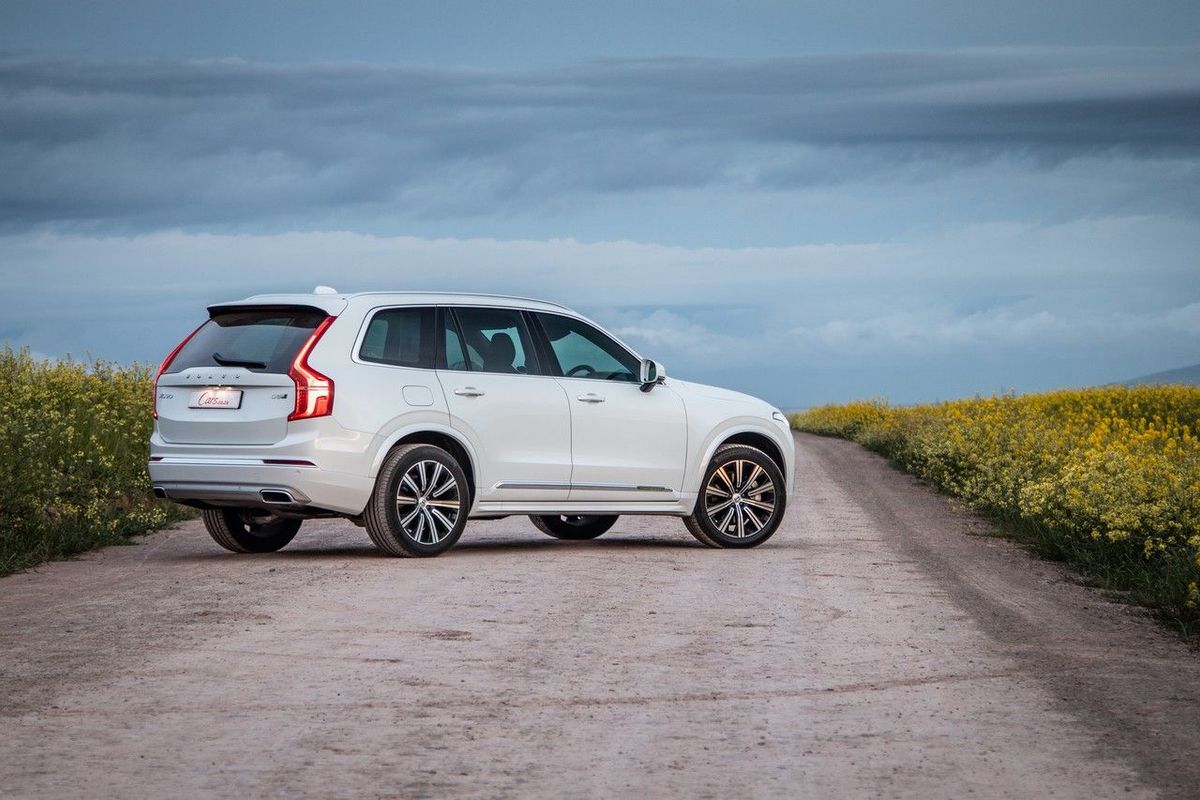
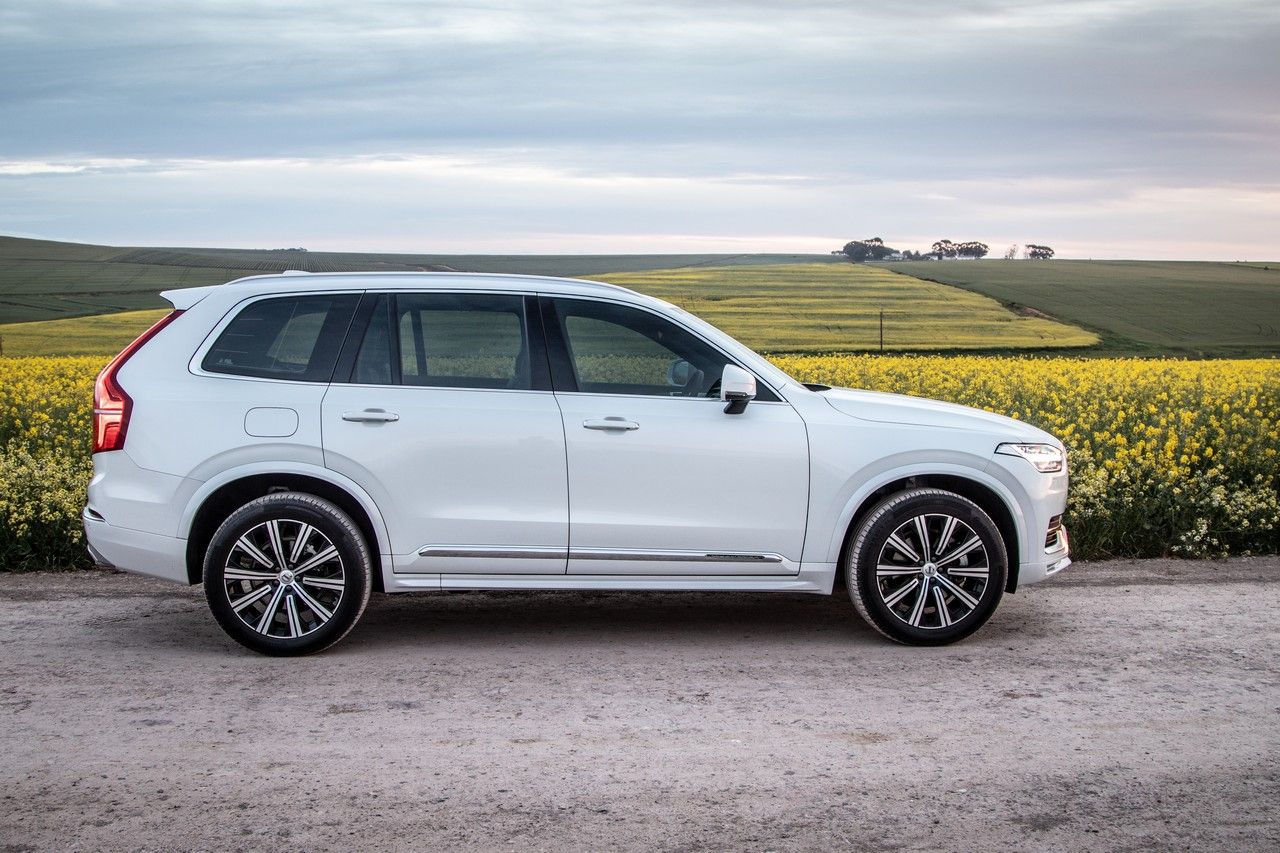
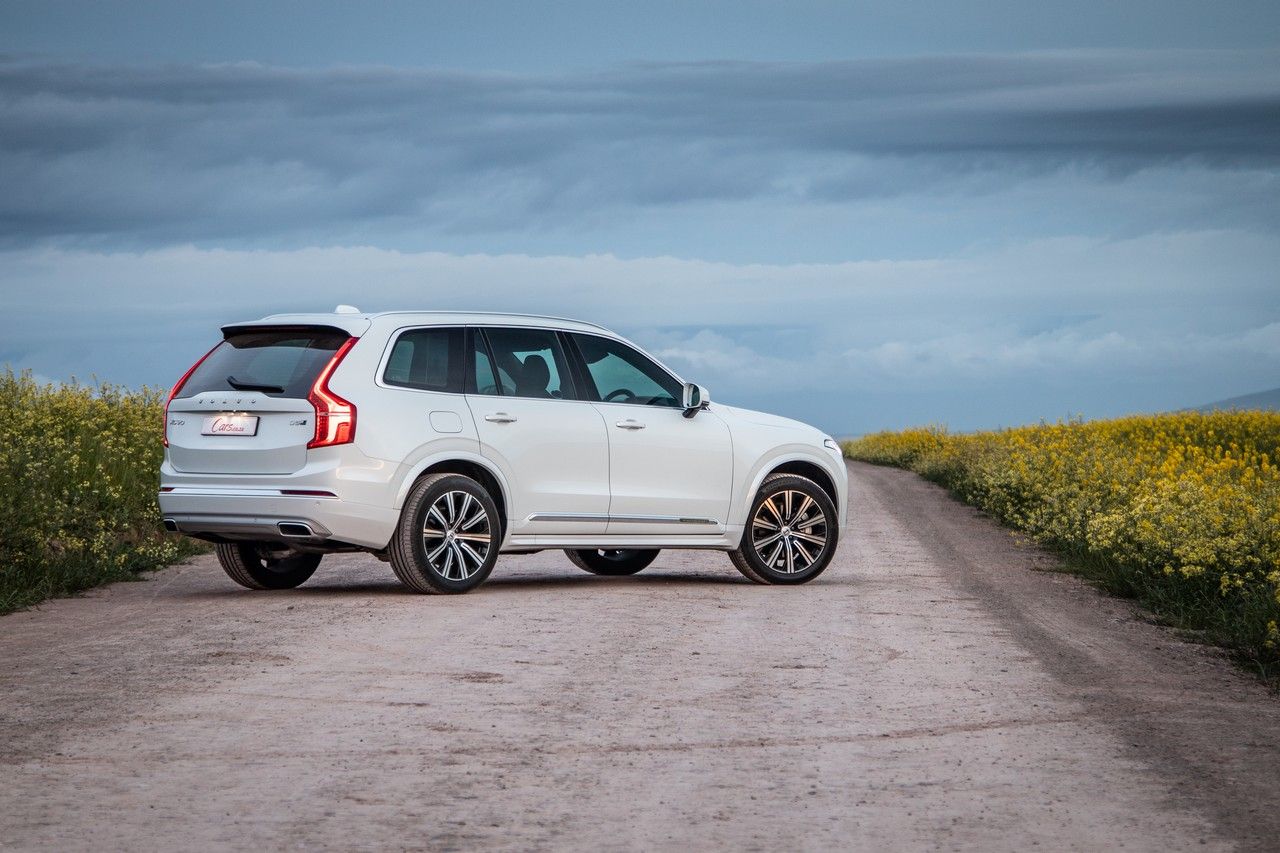
The all-wheel drive and strong diesel engine make light work of gravel roads
While the overwhelming majority of XC90 owners are unlikely to be bothered to drive their luxurious million-Rand SUVs off the beaten track, it's reassuring to know that the Swedish offering is quite adept when the tarmac ends and you find yourself on a sandy road. The XC90 comes with all-wheel drive and hill-descent control as well as an offroad driving mode which adjusts engine and transmission settings. The all-wheel drive's biggest boon is the abundant grip, something you'll need if you're in a hurry on a gravel road. We made judicious use of the all-wheel-drive and potent engine in a race against the sunset to bring you these photos. We wouldn't advocate taking the Volvo XC90 too far off-road as the risk of damaging those gorgeous wheels is high, but you can take comfort in the fact that your Volvo is not just a pretty face; it's more capable than you think.
Interior quality and features
The Volvo XC90 cabin is a textbook exercise in workmanship and refinement.
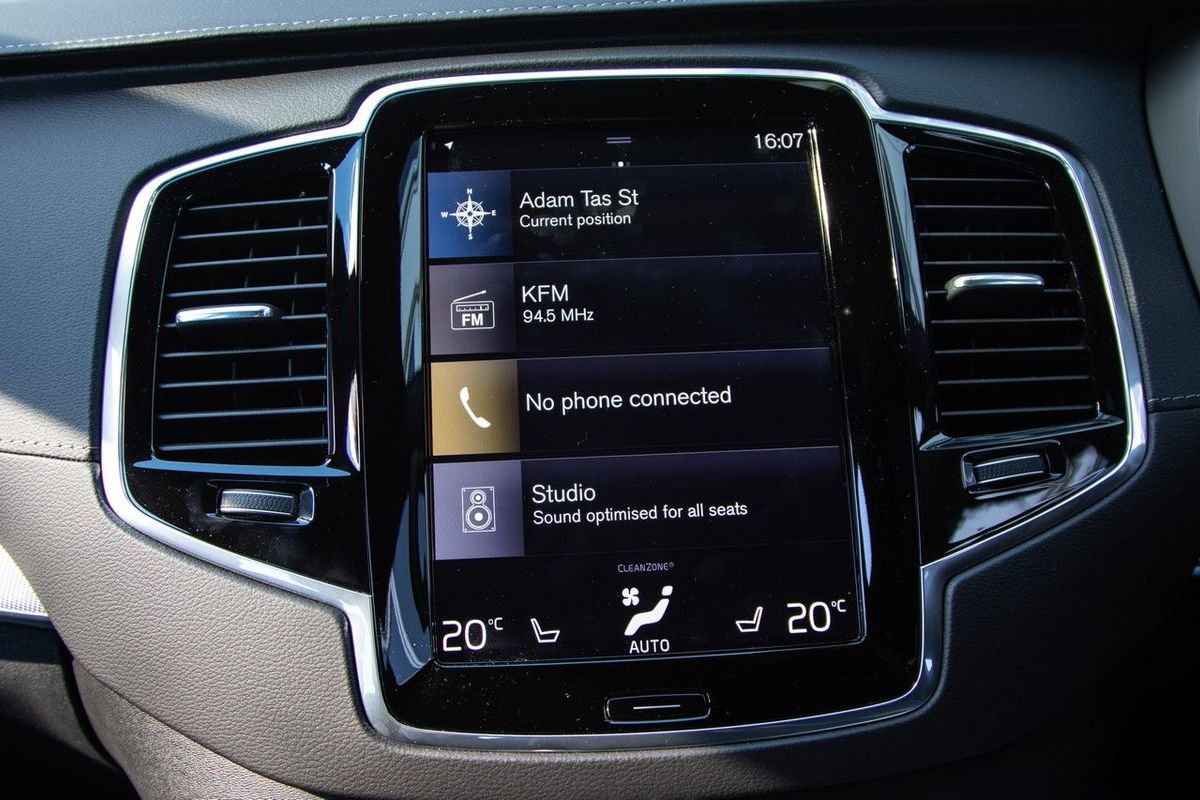
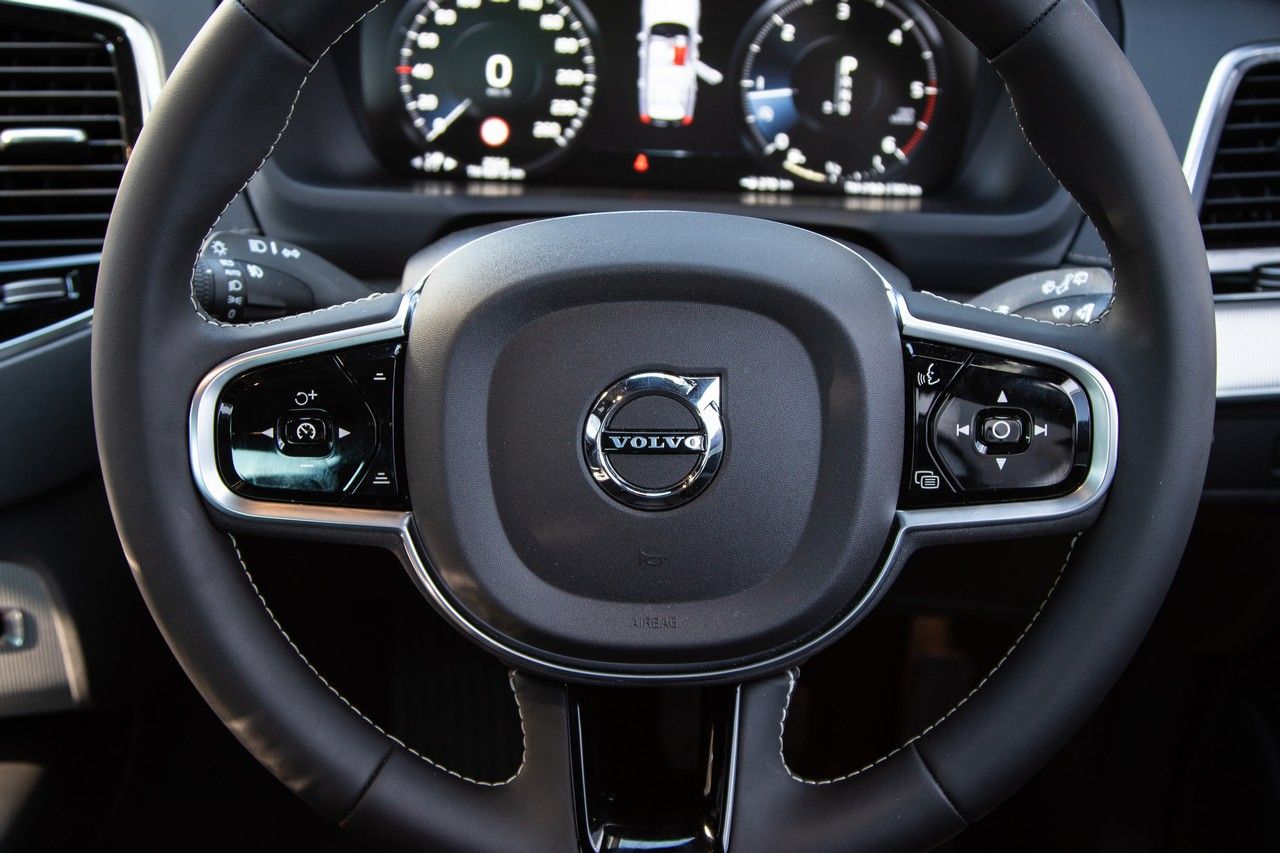
The build quality and design of the cabin continues to impress, and that pertains to both the old and new parts of the updated Volvo's plush interior. The materials used are exceptional and the XC90's cabin quality is still easily among the finest in the Premium SUV segment. Looking much like an Ikea showroom, the XC90's interior is stylishly minimalistic, with the Sensus central touchscreen managing nearly all in-car functions. It's a quick-to-learn interface and it adopts a smartphone-like user experience. Standard spec at this end of the market (let alone price point) is expected to be high and it is. However, there are some options that came with our test unit that are certainly worth looking into for additional safety and convenience.
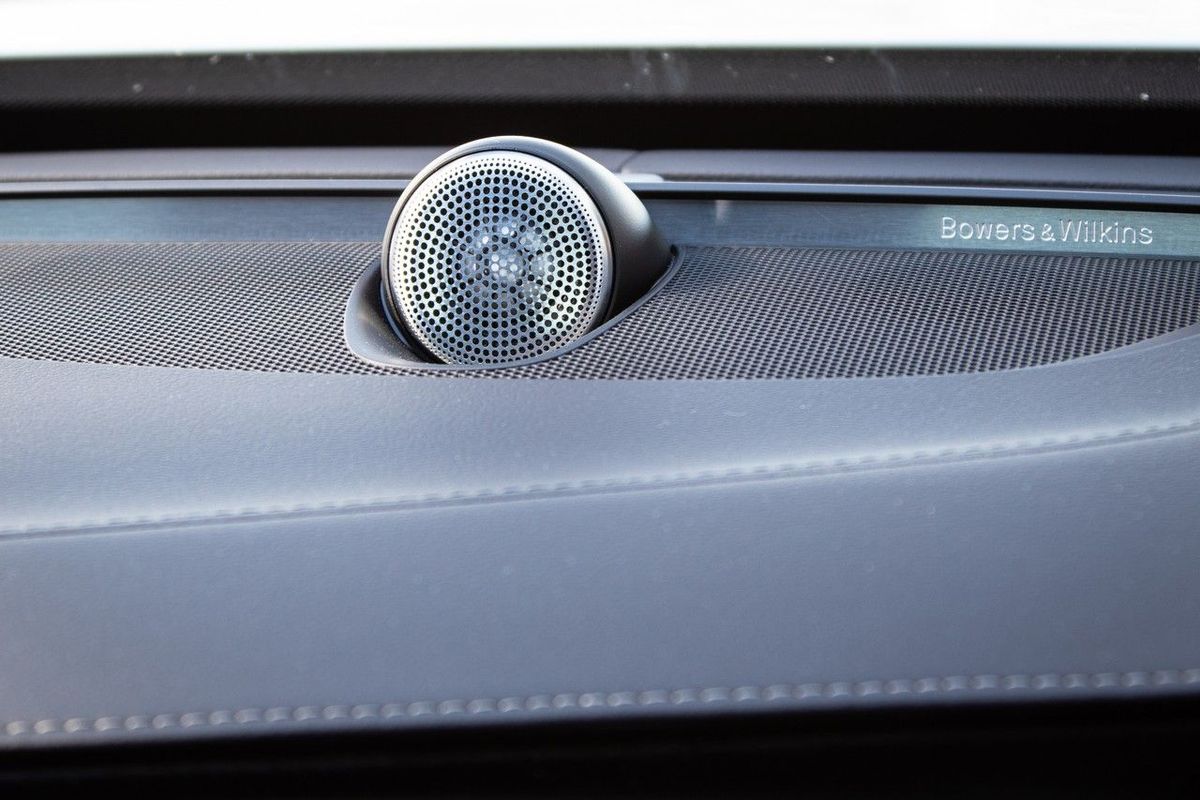
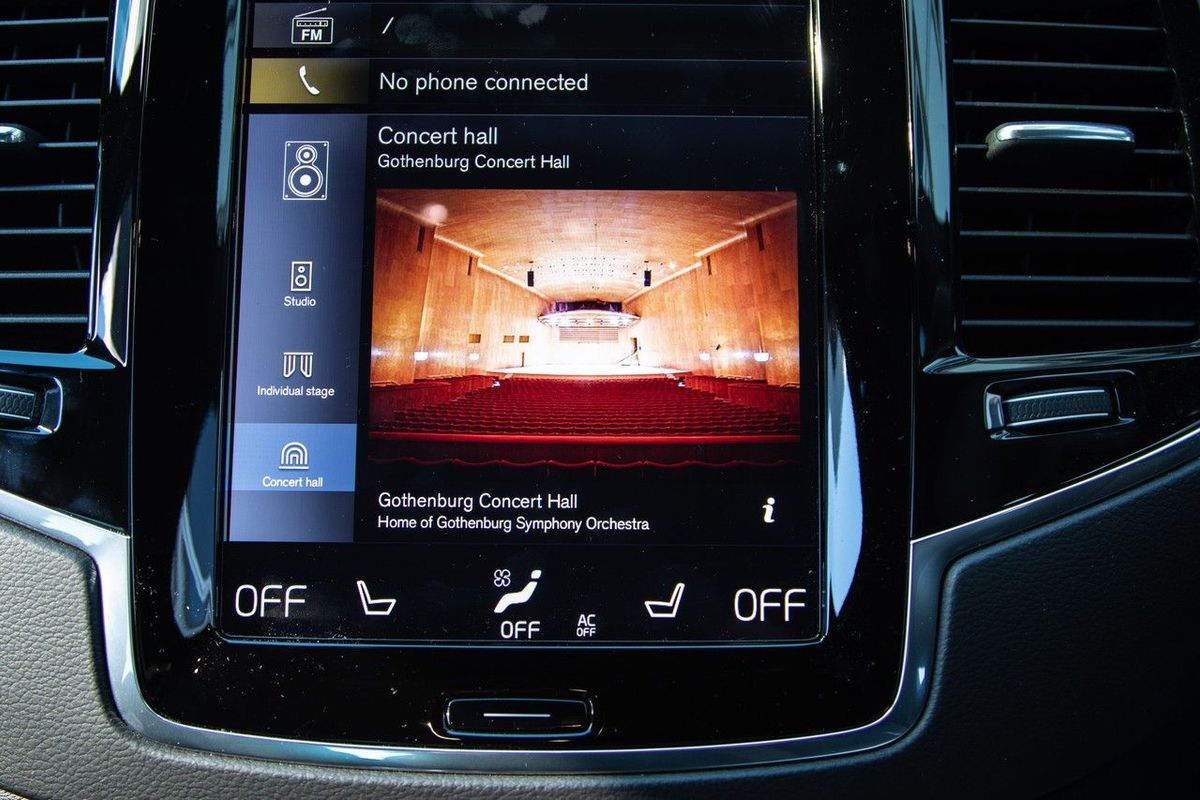
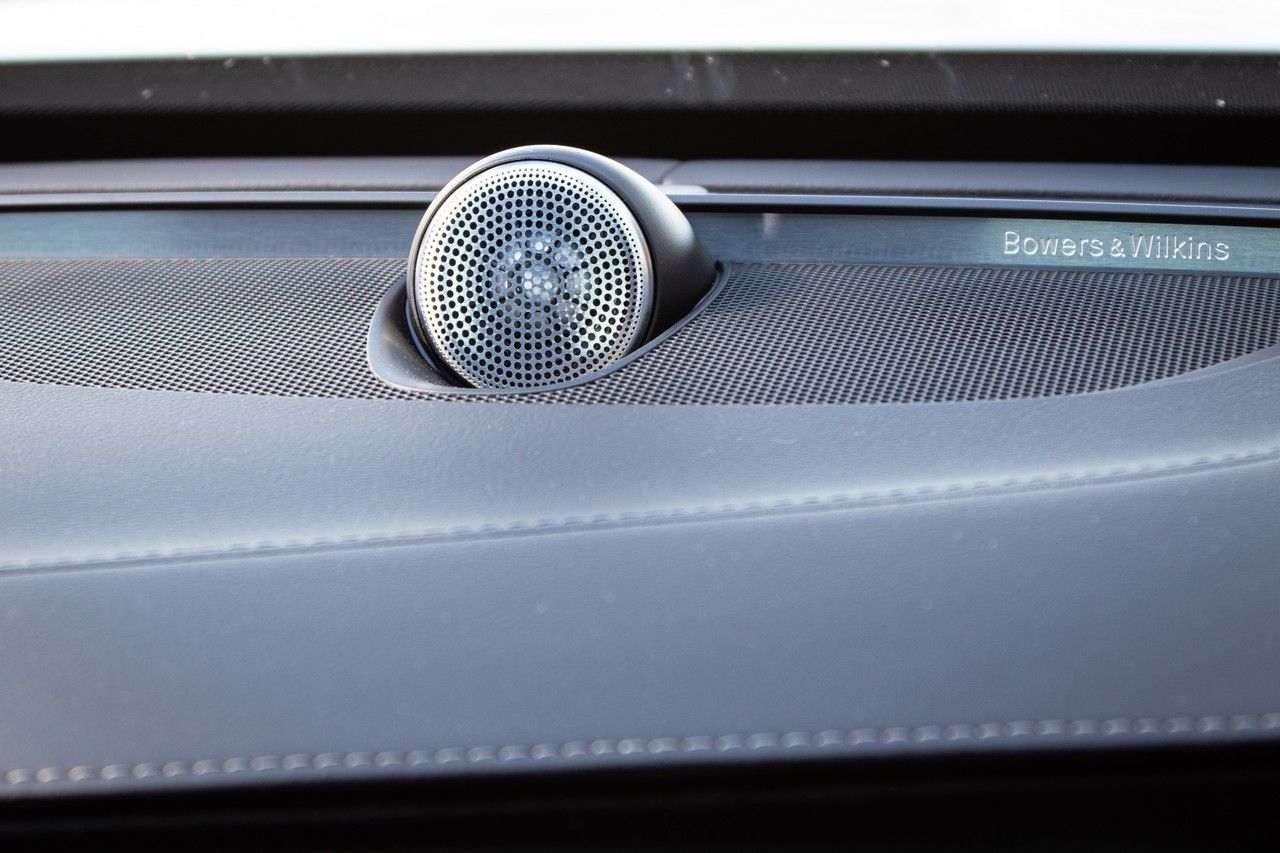
First up is the Premium Pack (R66 500*), which introduces niceties such as a head-up display, 360-degree surround camera system, uprated Bowers and Wilkins audio setup, a heated steering wheel, Apple CarPlay/Android Auto, keyless entry as well as a Blind Spot Information System. The 360-degree camera function alone is exceptional – there's really no excuse for self-inflicted parking incidents when you have such a detailed view of the car's surroundings. If you're an audiophile, the Bowers and Wilkins setup is arguably one of the finest in the world and with Gothenberg Concert Hall mode engaged, it'll feel like you're at a concert. The Luxury Pack (R10 500*) adds massage functionality for the front seats, which is a no-brainer for those who want maximum comfort. Volvo also specced a panoramic sunroof (R20 750*) and air suspension (R26 750*), inter alia.
The uprated Bang & Olufsen sound system is well worth looking into if you're a fan of quality car audio
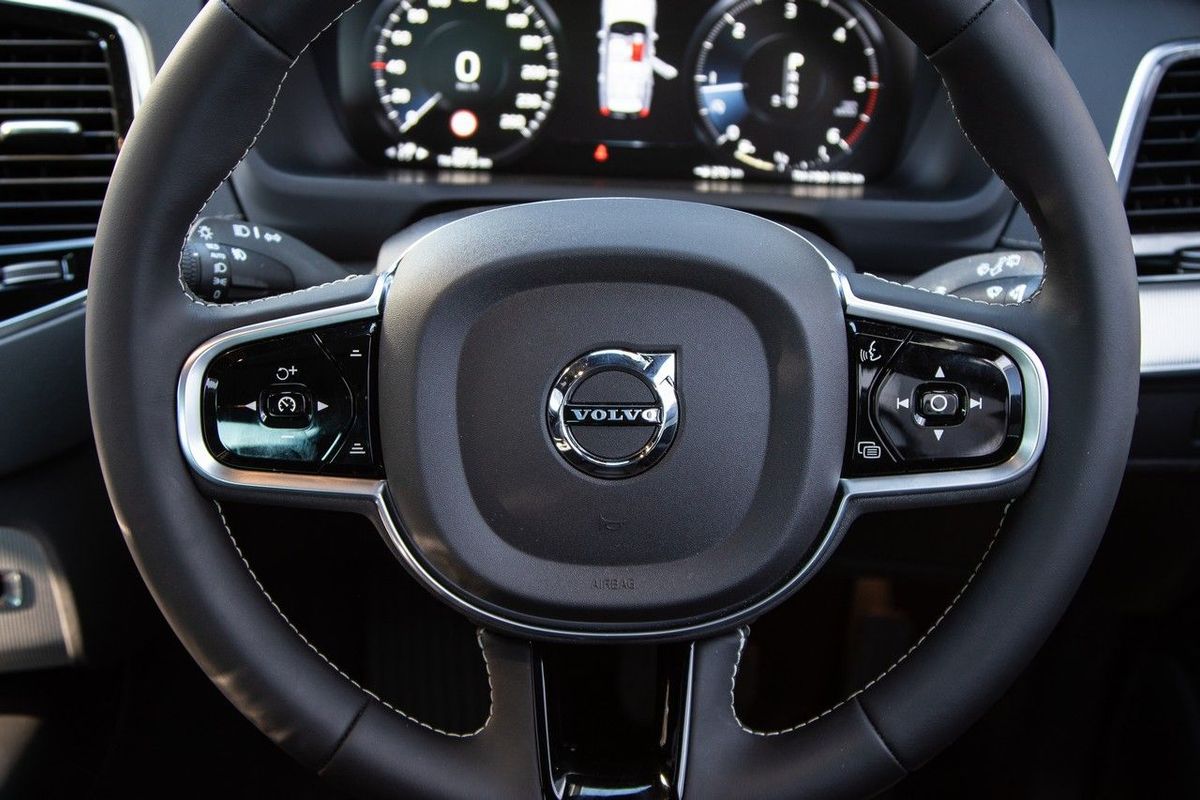
Standard safety features abound: Intellisafe will automatically apply the brakes if it detects the risk of colliding with pedestrians, cyclists or other vehicles; road sign recognition, full LED headlights (with active high beam), park assist (front and rear), as well as adaptive cruise control with Pilot Assist are also fitted. The latter is a form of semi-autonomous driving that takes care of the steering, accelerating and braking up to a certain speed, but it doesn't give you licence to take your hands off the wheel and "zone out"! Instead, we see it as an in-car assistant with a supervisory role.
Other noteworthy standard features are the heated front seats, power-operated tailgate and, making its debut in the 2019 XC90 (and all Volvo products from now on), is Volvo On Call. This is a free service and app (for 5 years) that offers features such as the ability to find your car in a parking lot, unlocking your vehicle using your mobile phone, switch on the heated seats before they get in, and so forth. The highlight for us is that in the event that you're in an accident, Volvo On Call will automatically dial the emergency services.
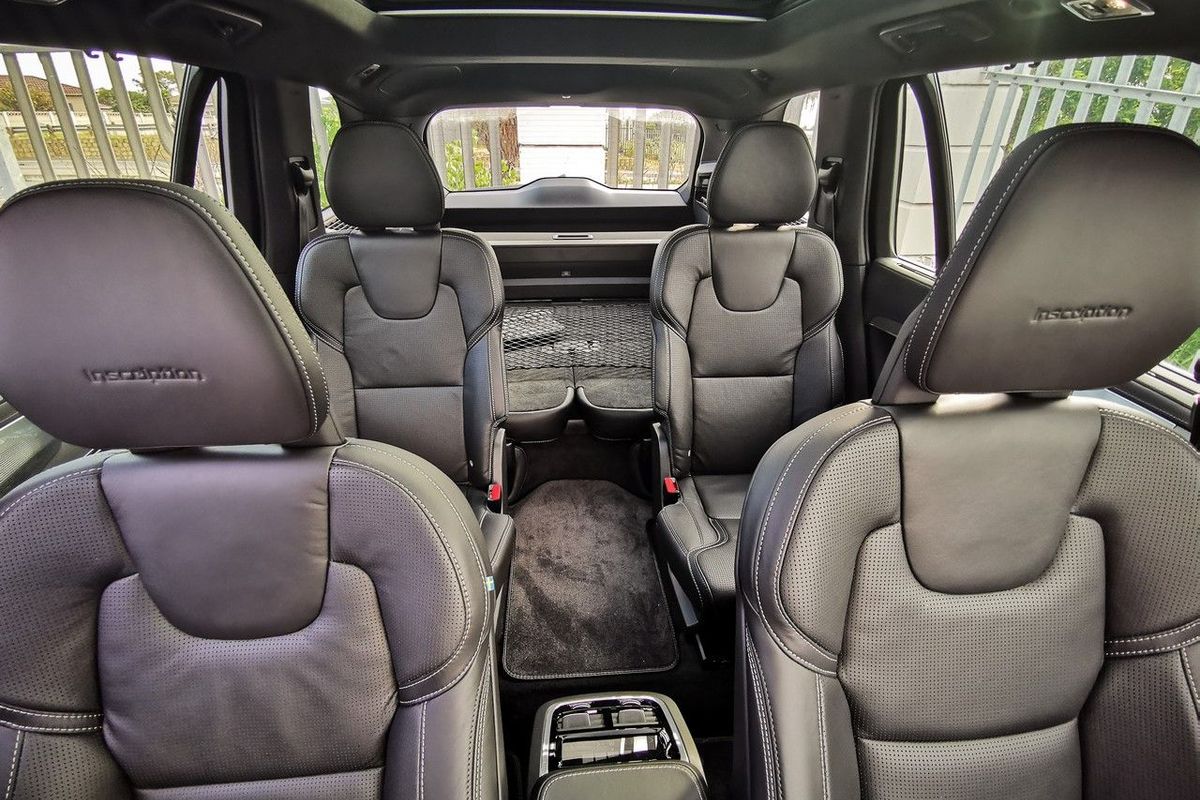
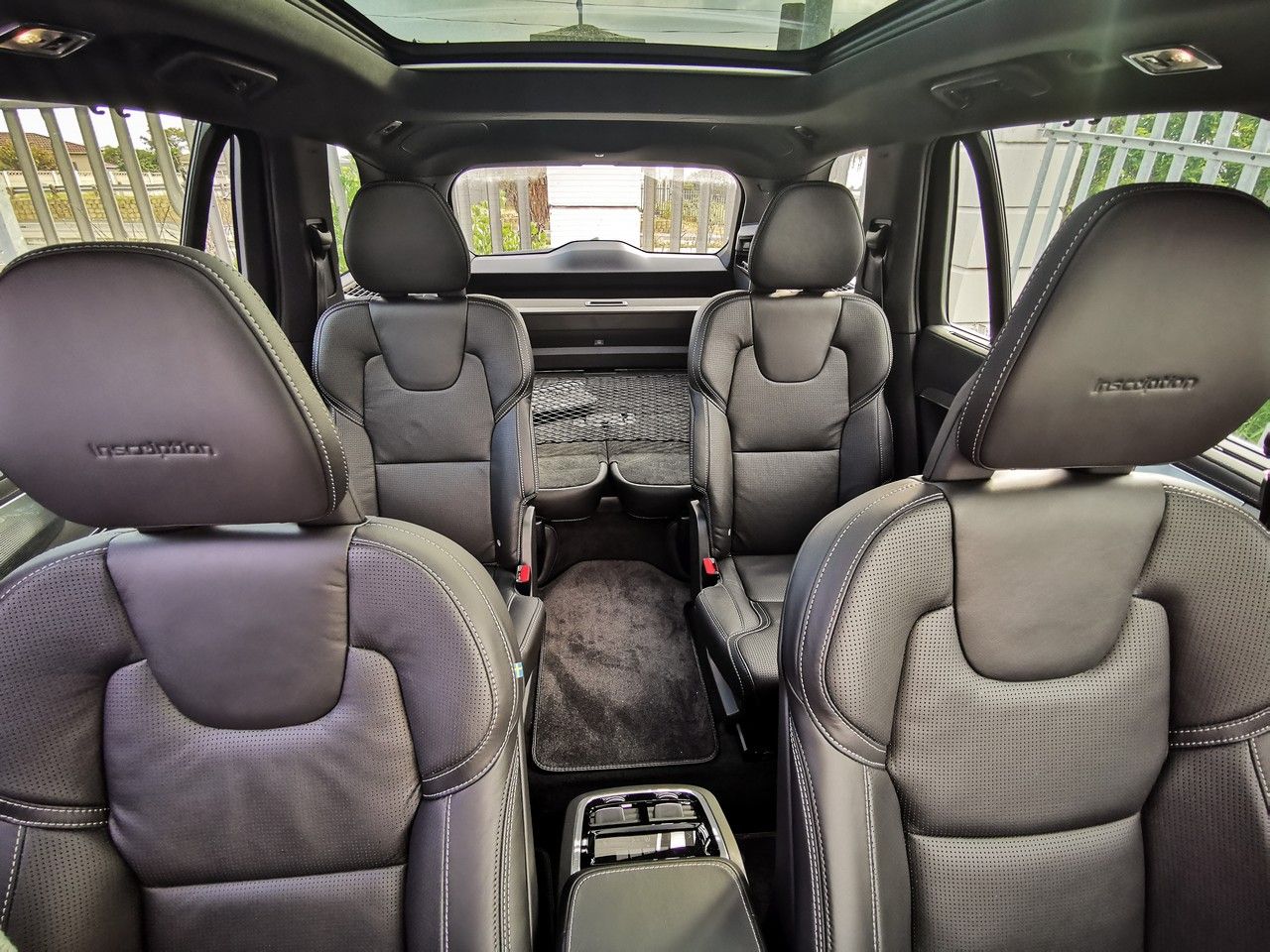
This view shows the difference between the standard 7- and optional 6-seater configurations. The 3rd row was stowed to increase luggage space.
Practicality
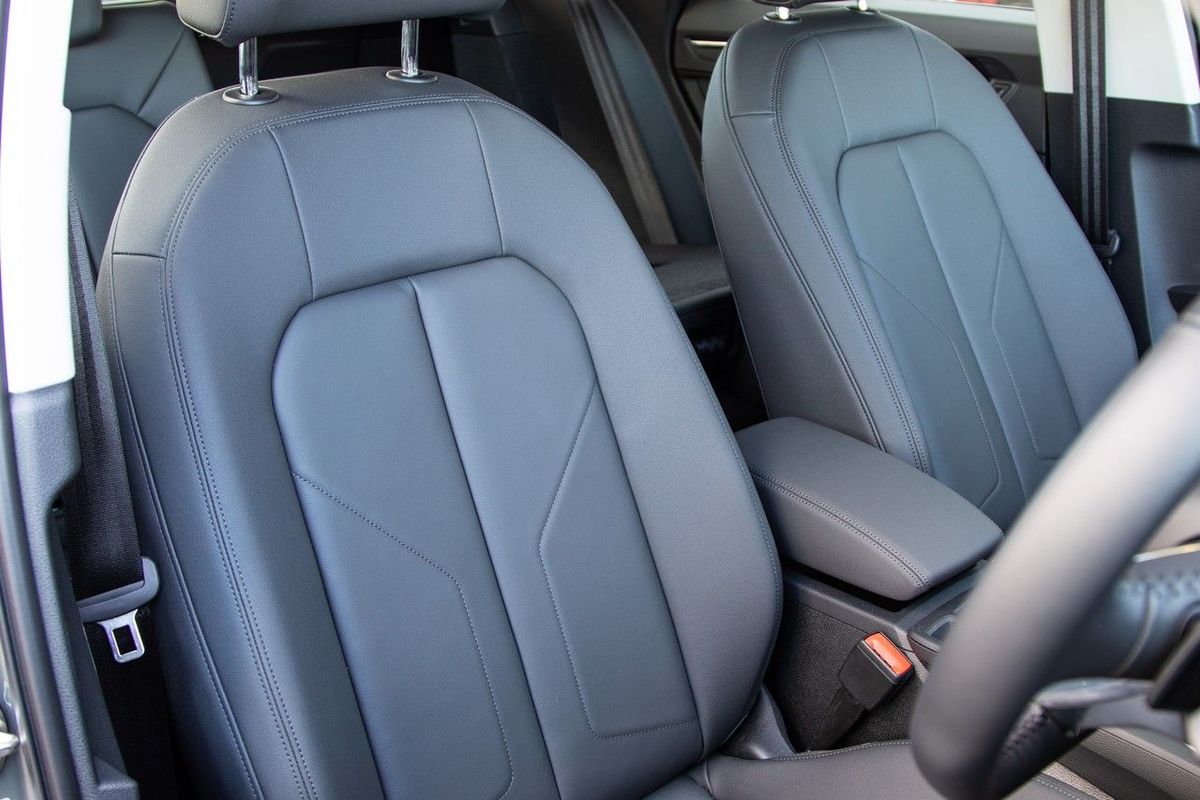
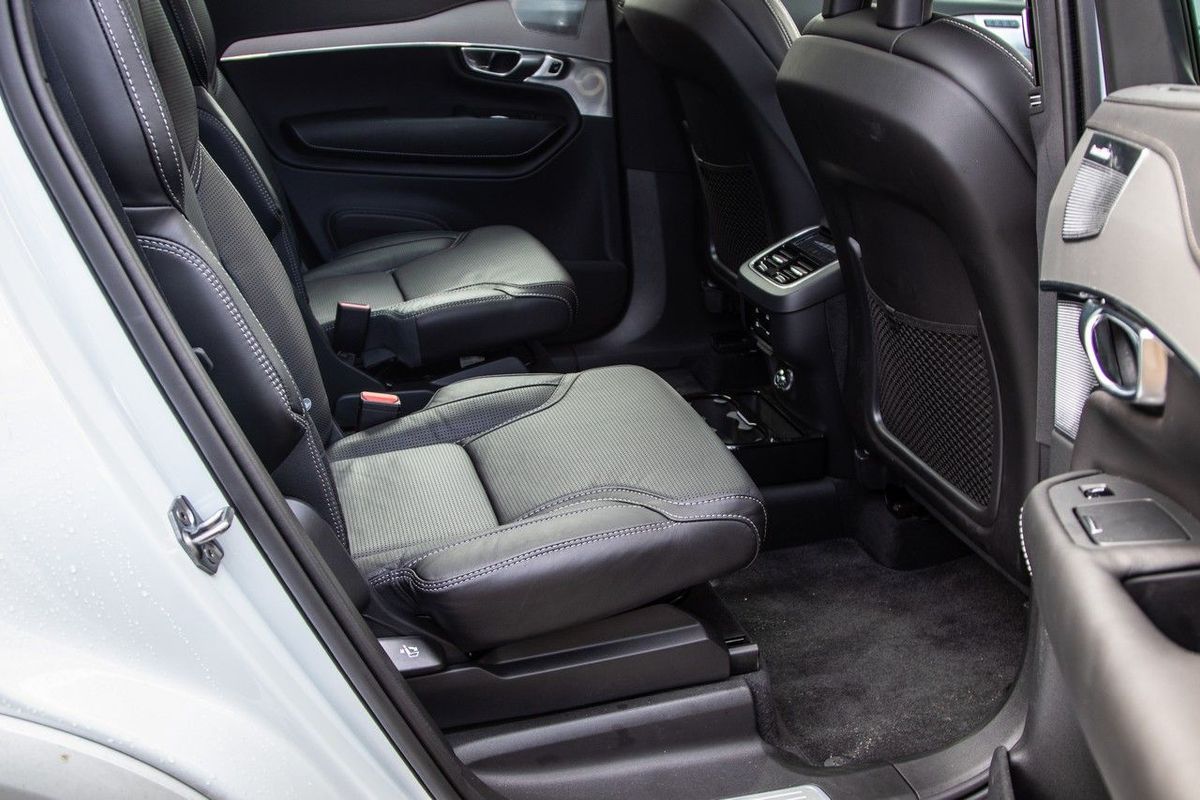
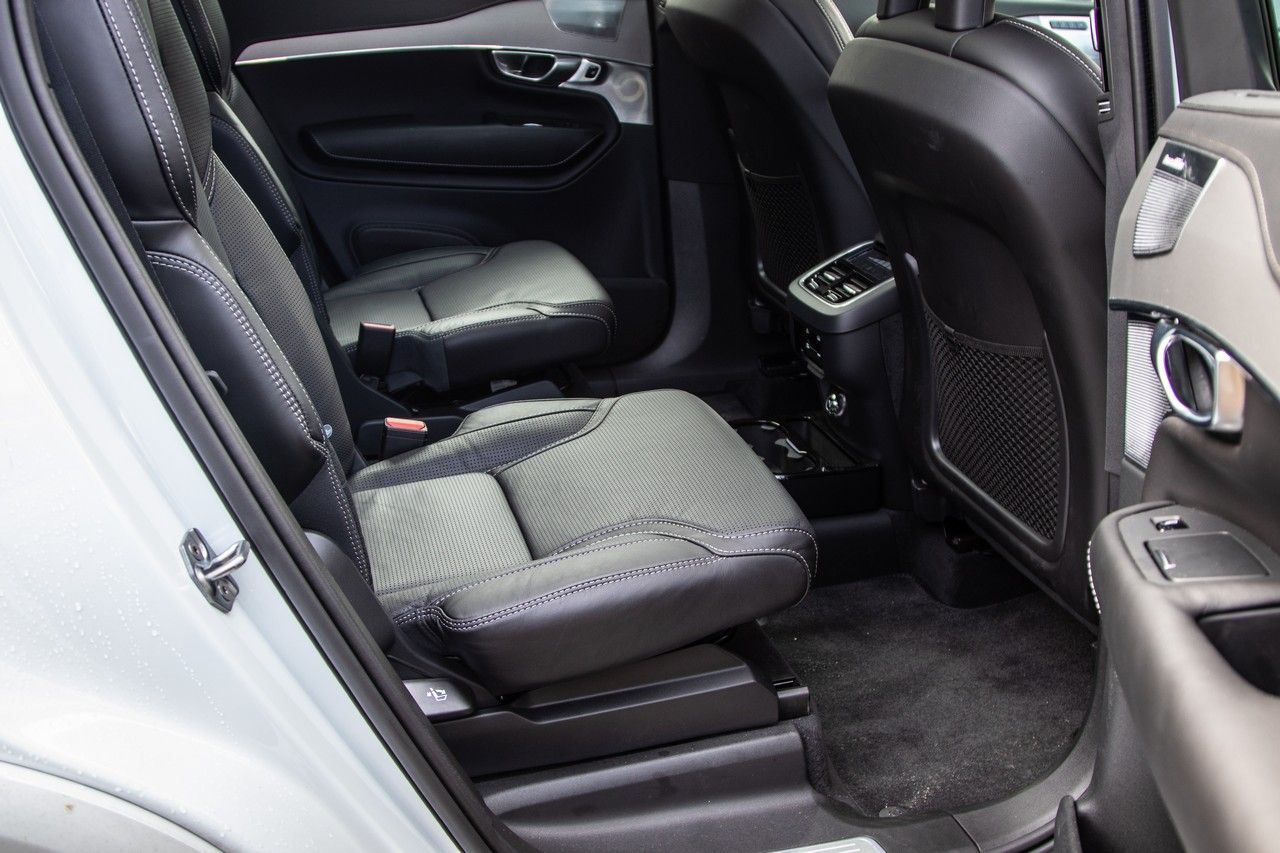
Our D5 Inscription evaluation unit came in 6-seater configuration, which means that there is a pair of single seats in the middle row. Not only do they offer more side support than what 2nd-row occupants would usually be afforded, but they have a neat storage area between them. The 3rd row of seats is still standard, but we kept it stowed to create the optimal luggage space. The 6-seater configuration will work especially well if you're transporting longer items; we can imagine this setup would be popular in the colder climates, where owners may wish to accommodate skis.
Volvo has evidently put a lot of thought in the carrying-capability of the XC90 and if you're a large family, you'll battle to fill the vehicle for a vacation, and yes, that is a challenge. The central armrest is deep and perfect for keys and mobile phones, while the door pockets will easily hold a large bottle and sunglasses. Rear passengers get their own cupholders too and can make use of the pockets in the front occupants' seatbacks.
The 2nd row of seats complete with climate controls and cup holders.
Price and warranty
The Volvo XC90 is sold in South Africa with a 5-year/100 000 km warranty and maintenance plan (Volvo Plan), with 5 years'/unlimited-mileage roadside assistance, as well as DataDot application.
The game has moved on a touch, but the XC90 is still an accomplished and polished product from Volvo
Suffice to say the Volvo XC90 is still an accomplished and polished premium SUV. Those who take the plunge and buy an XC90 (irrespective of which powertrain they choose) will not be disappointed with its luxury finishes, refined ride and exceptional technology. Not only does it look good inside and out, but it's laced with highly-advanced technology. We especially appreciated the Pilot Assist system (on long as well as short trips).
Should you buy one? Well, when the XC90 burst onto the global scene back in 2015, it was largely peerless as its rivals were headed towards the end of their lifecycles and at the top of writing this review, all of the XC90's competitors have either been substantially facelifted and updated, while some brands have launched all-new versions of their premium SUV models. These newcomers have brought a lot to the table and shifted the goalposts forward, meaning the Volvo XC90 isn't as invincible as before. There are now similarly priced competitors with (arguably) stronger brand names on the noses. That being said, if you look past the mainstream German brands and opt for the Volvo, you're unlikely to regret the decision.
According to unaudited month-end fuel price data released by the Central Energy Fund (CEF), fuel prices are set to decrease in November 2019.
Motorists in South Africa will get some relief in November 2019 as fuel prices are expected to drop marginally due to a strengthening Rand and reduced international oil prices.
The Automobile Association of South Africa commented, “The Rand has pulled back from its high point at the start of October. This ongoing decline in the average exchange rate has meant that most of its losses have been clawed back, and it will have only a modest impact on the fuel price. As a result, we are anticipating November drops of between eight and 18 cents for petrol, 14 cents for diesel, and 21 cents for illuminating paraffin”.
With the end of the year holiday season coming up, motorists will be hoping for further fuel price reductions ahead of Christmas.
Whatever happens to the oil price and Rand from this point affects the price motorists will be paying at the pumps at Christmas. It remains to be seen whether this month's reductions will continue for the rest of the year," the AA concludes.
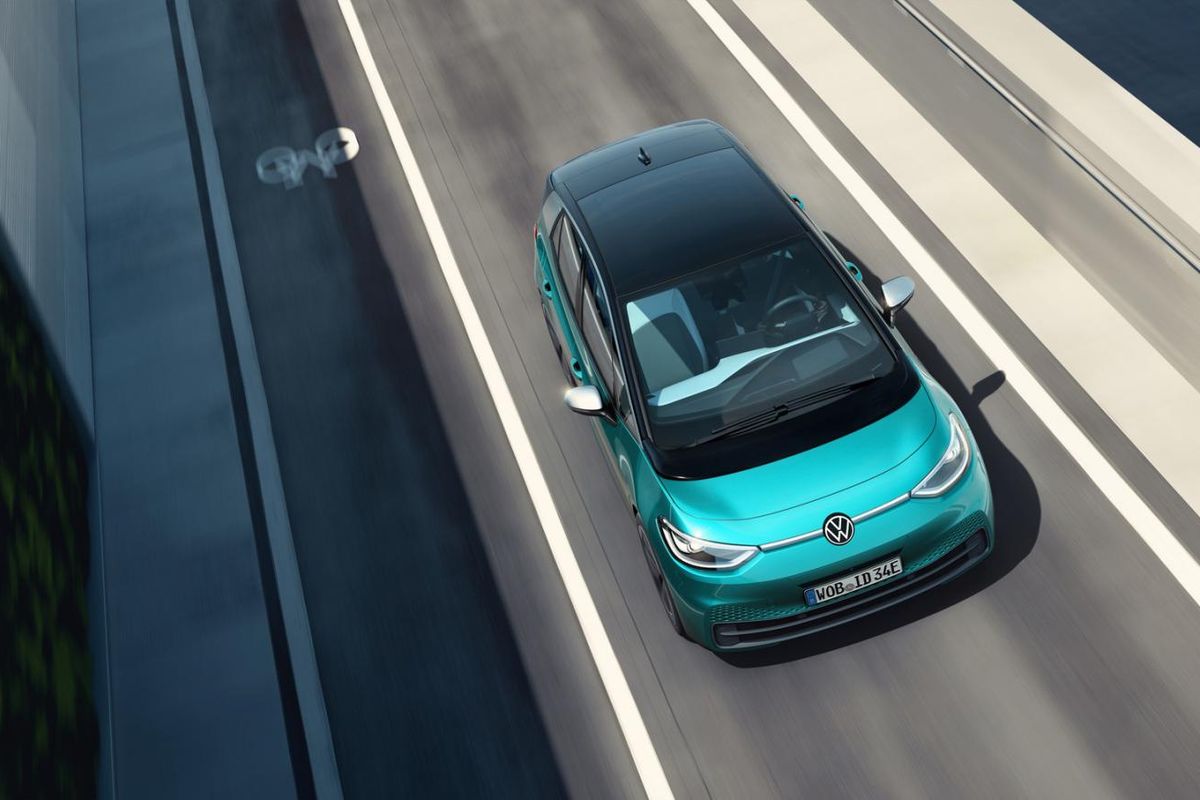
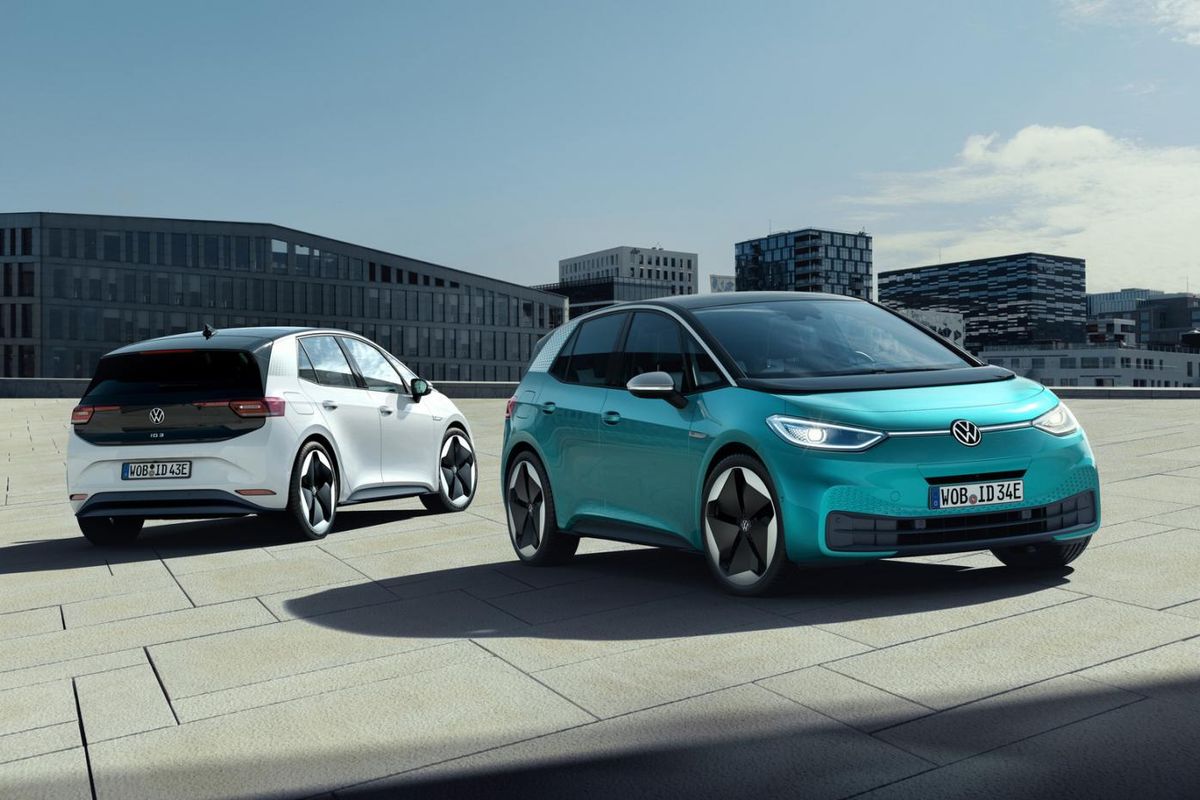
Volkswagen's ID.3 electric car – arguably the most important unveiling at the recent Frankfurt Show – is yet to be confirmed for South Africa. However, the 2nd member of the ID family to reach production: a medium-sized SUV likely to be labelled the ID.4, will come here. We spoke to the Head of the VW Brand in SA, Martina Biene, to find out more.
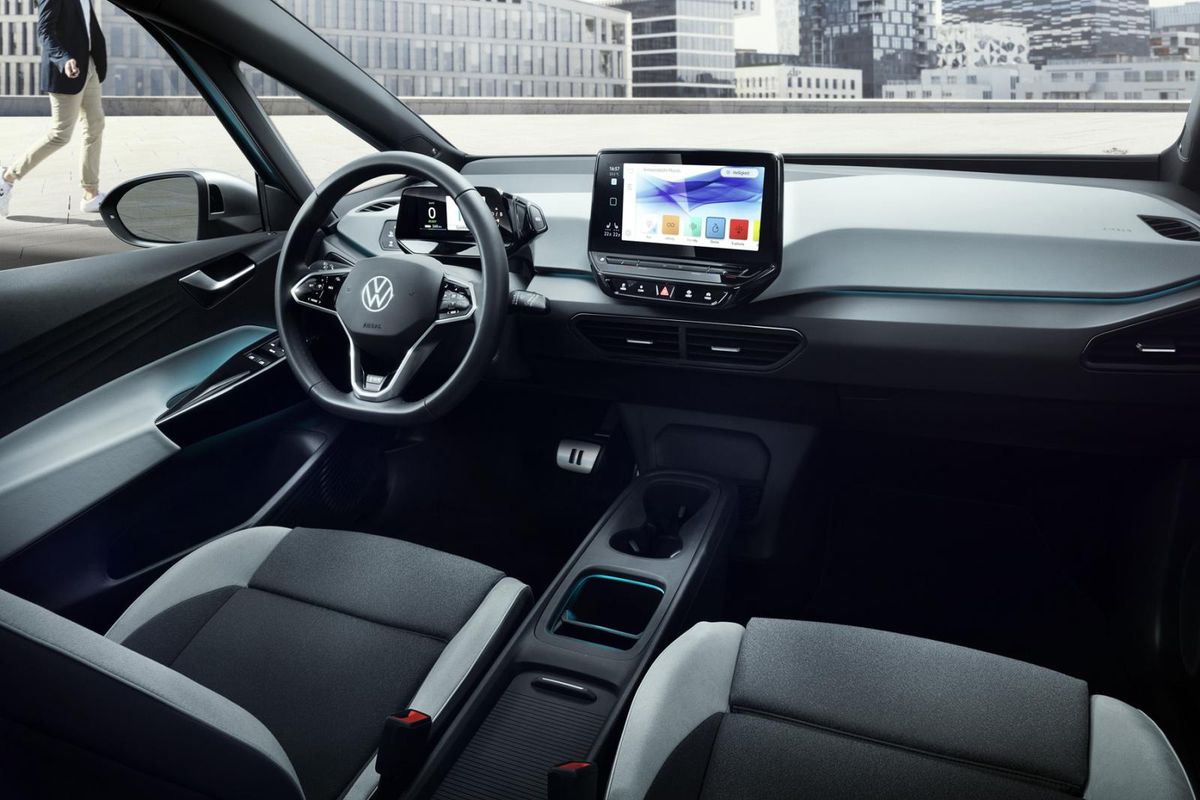
There's no denying it – Volkswagen's new ID.3 makes switching to an electric vehicle (EV) seem like a practical, even logical, option… The newcomer is similarly sized to the current Golf and, in Europe at least, it will be similarly priced, too (starting below Euro 30 000). And what about range and performance?, you may ask. Well, the mid-spec (58kWh battery) has a 150kW electric motor and offers an ideal range of 420 km, and a 160 kph top speed – it should also be swift, with an expected 0-100 kph time of around 7 seconds. The ID.3 will also be offered with a 45-kWh or 77-kWh battery. When equipped with the 45-kWh battery, the ID.3 will be able to travel up to 330km on a single charge. Opt for the 77-kWh variant and the range is said to increase to 550 km. When using a 3-phase 100kW quick charger, you will be able to get a 290-km charge in just 30 minutes.
No wonder there were already 30 000 pre-orders even before the official reveal in Frankfurt! In fact, Volkswagen insiders talk of the ID.3 as being the "third big moment" in the brand's history, the other two being the launch of the Beetle, and then the Golf. But what about South Africa?
Martina Biene, Head of the VW Brand in SA, wants at least 1 000 of Mzansi's people to put up their hands for VW's new EVs.
Volkswagen South Africa was one of our hosts on the Frankfurt trip, and while it was clear that, in Germany at least, the ID.3 represented nothing short of a fresh start for the brand, which is still struggling to shake off the shadow cast by the infamous Dieselgate saga. In South Africa, however, Dieselgate is the least of Wolfsburg-based brand's concerns – unreliable infrastructure, range anxiety and prohibitive purchase costs are the major stumbling blocks to EV acceptance. This country was not automatically included in VW's plans for the ID model roll-out. Volkswagen South Africa had to argue its case… and is committed to providing 1 000 names of interested customers. Martina Biene is confident that it can be achieved.
Cars.co.za: You have not rushed into rolling out electric vehicles in South Africa, even though there is a product (e-Golf) that is potentially available. Why is this?
Martina Biene: "We have been conducting studies into the viability and demand for electric vehicles in South Africa, as well as formulating a Volkswagen Electric Mobility strategy for South Africa. The new MEB (Modular Electric Drive Matrix) platform also provides us with a unique opportunity when it comes to bringing electric vehicles to South Africa because it addresses topics such as range anxiety as well as accessibility (from a pricing perspective) much better than e-Golf.
"We will be introducing an e-Golf test fleet to South Africa. Even though the e-Golf will not go on sale in this market, this fleet of cars will give us an opportunity to gain some valuable insights and feedback ahead of Volkswagen introducing electric vehicles in South Africa."
Volkswagen will be introducing a fleet of e-Golfs in South Africa to create awareness, but it won't go on sale here.
And when will that be, and with what?
"It will be at the end of 2021."
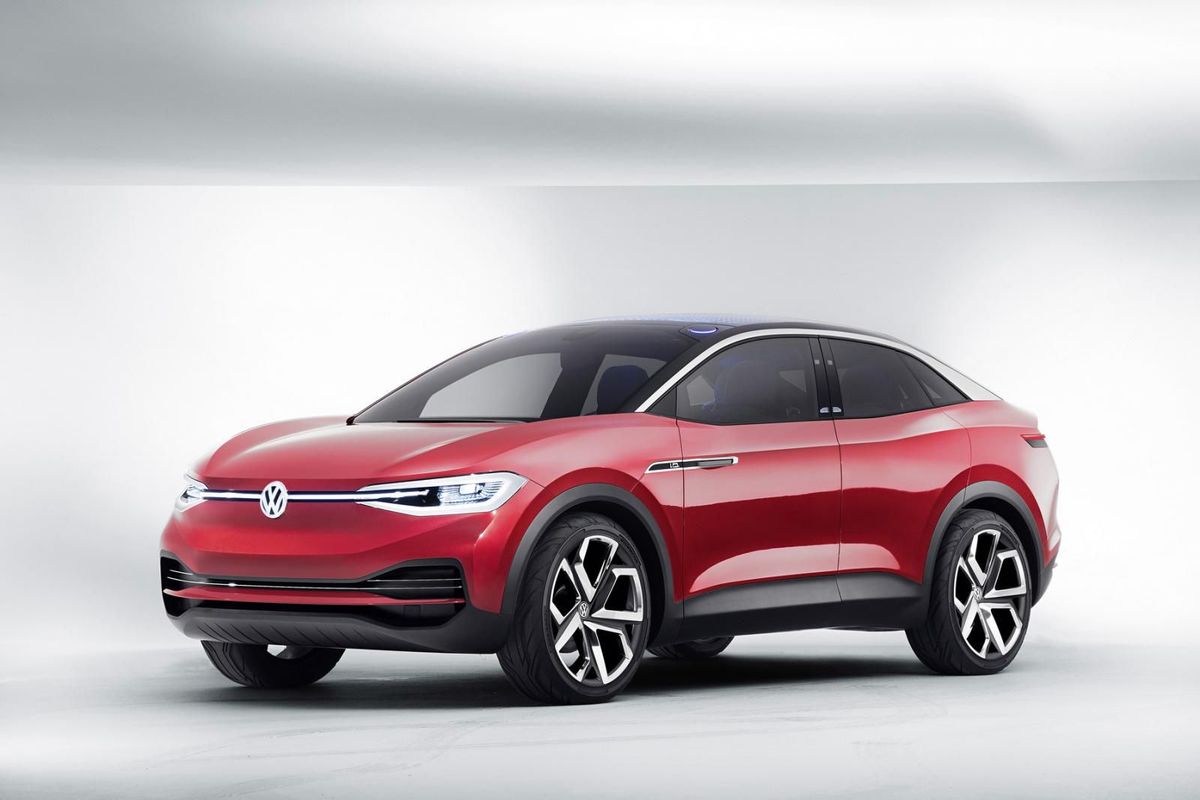
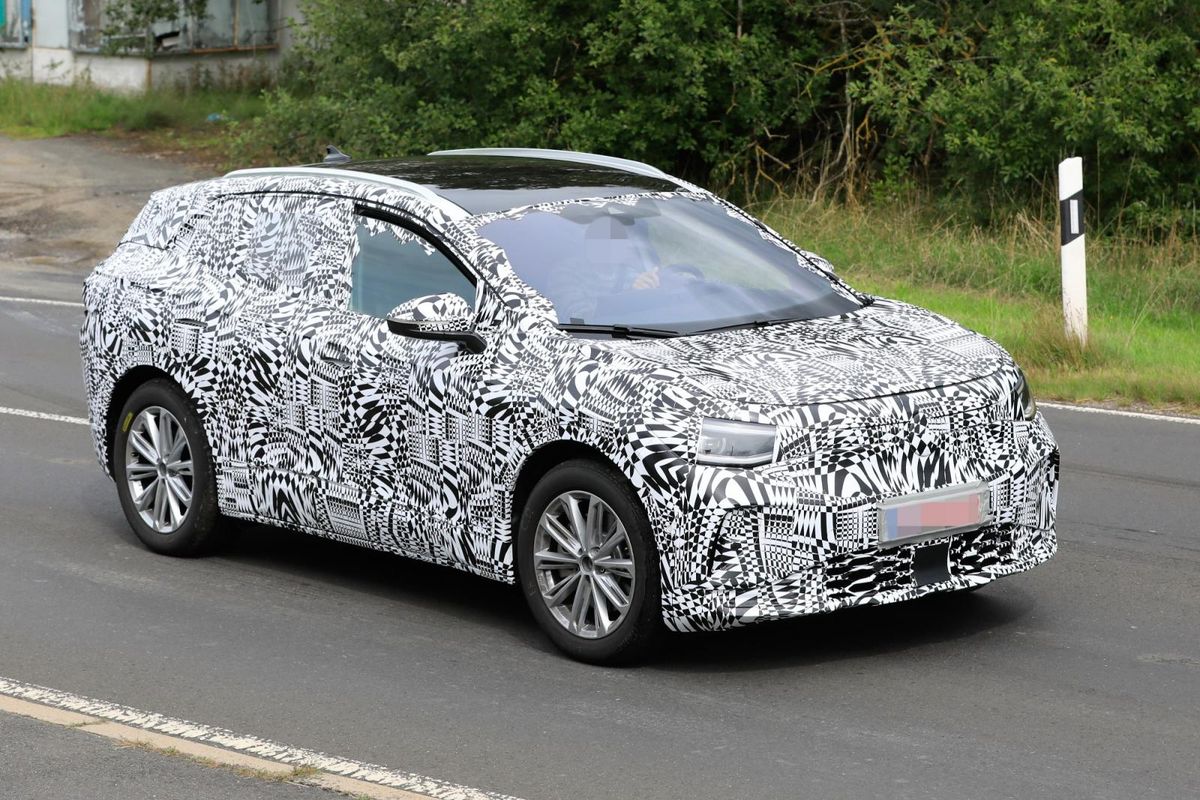
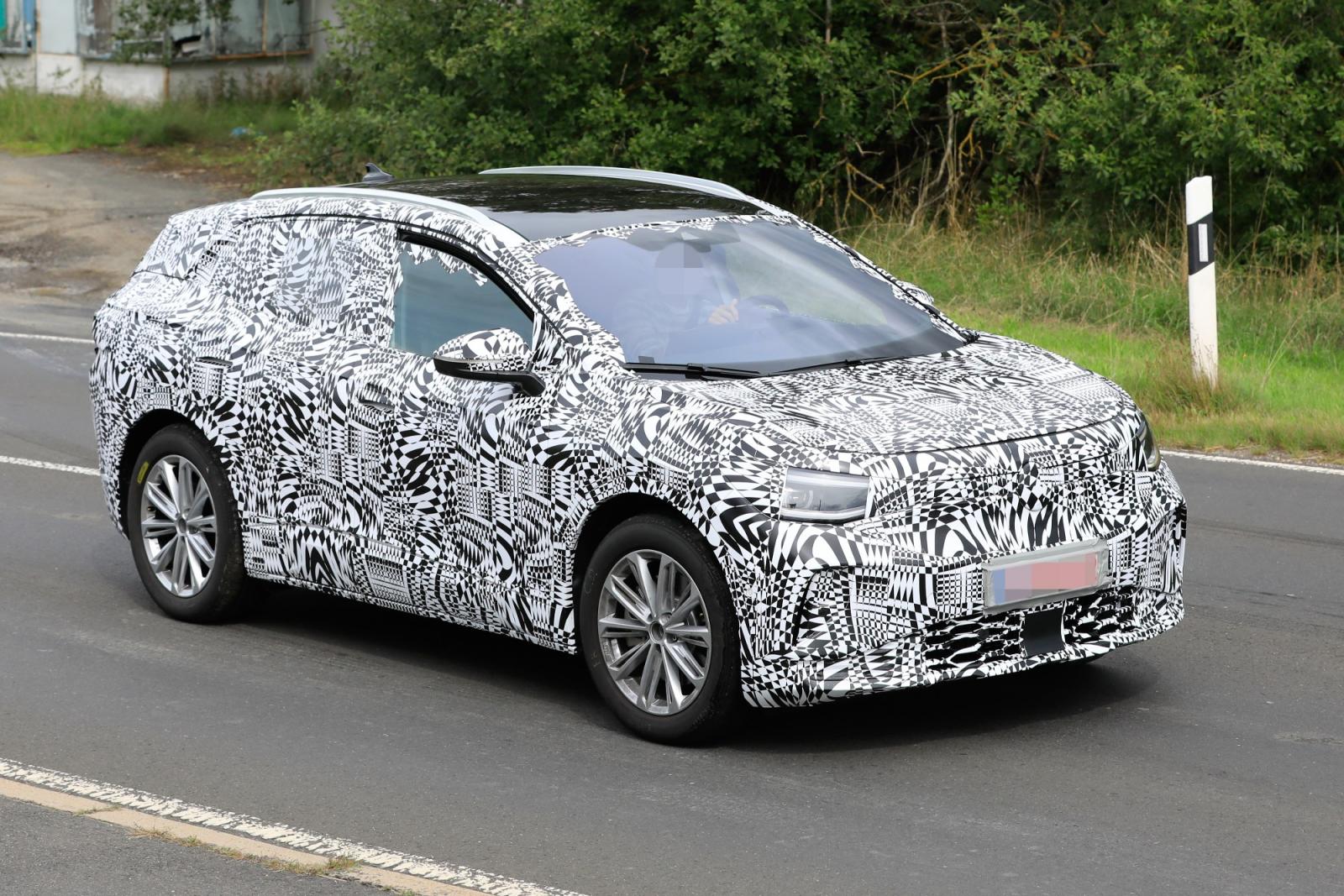
Some further digging has revealed that it will be the medium-sized SUV/crossover, likely to be called the ID.4, that will reach South Africa first. Interestingly, the company has yet to decide on the ID.3… Official information on the production ID.4 "Crozz" has not yet been released, but we can safely say it appears to be an SUV that's about the same size as a Tiguan. It runs on the same MEB platform as the ID.3, but the dimensions are stretched and due to the more compact packaging of its internals it could end up offering more interior space than the Tiguan Allspace.
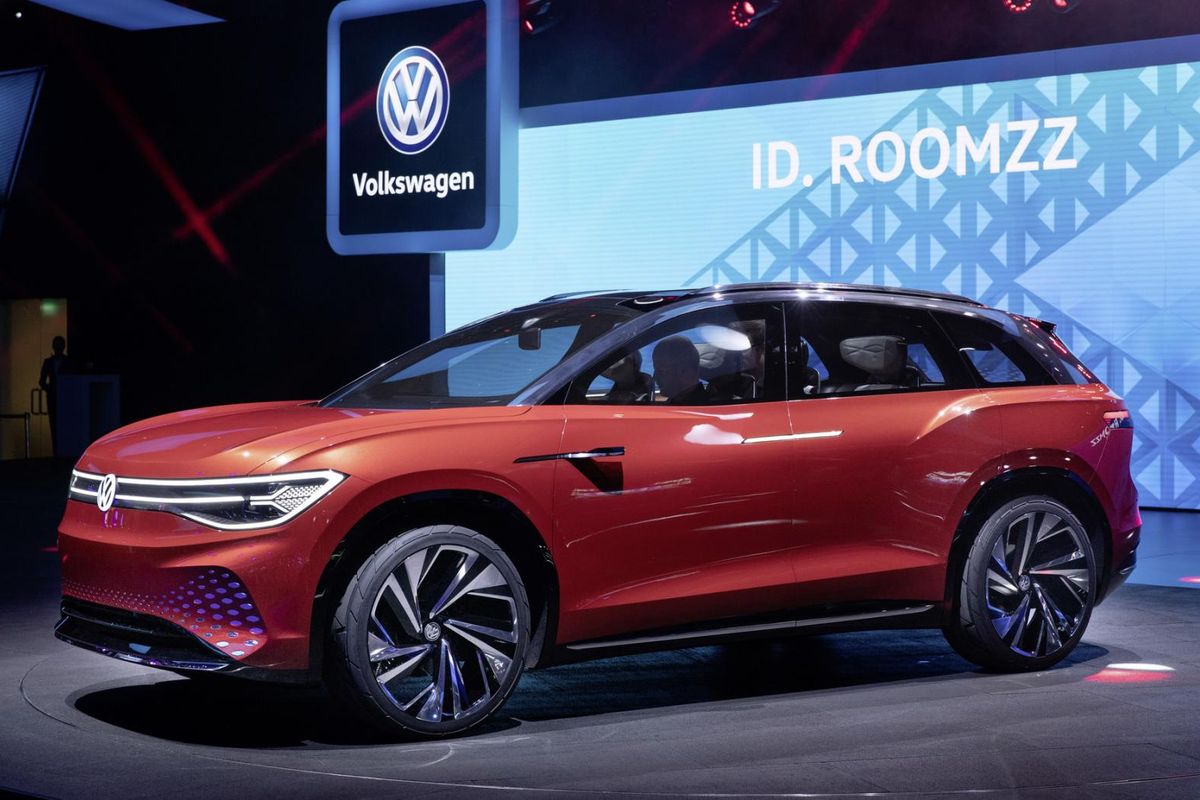
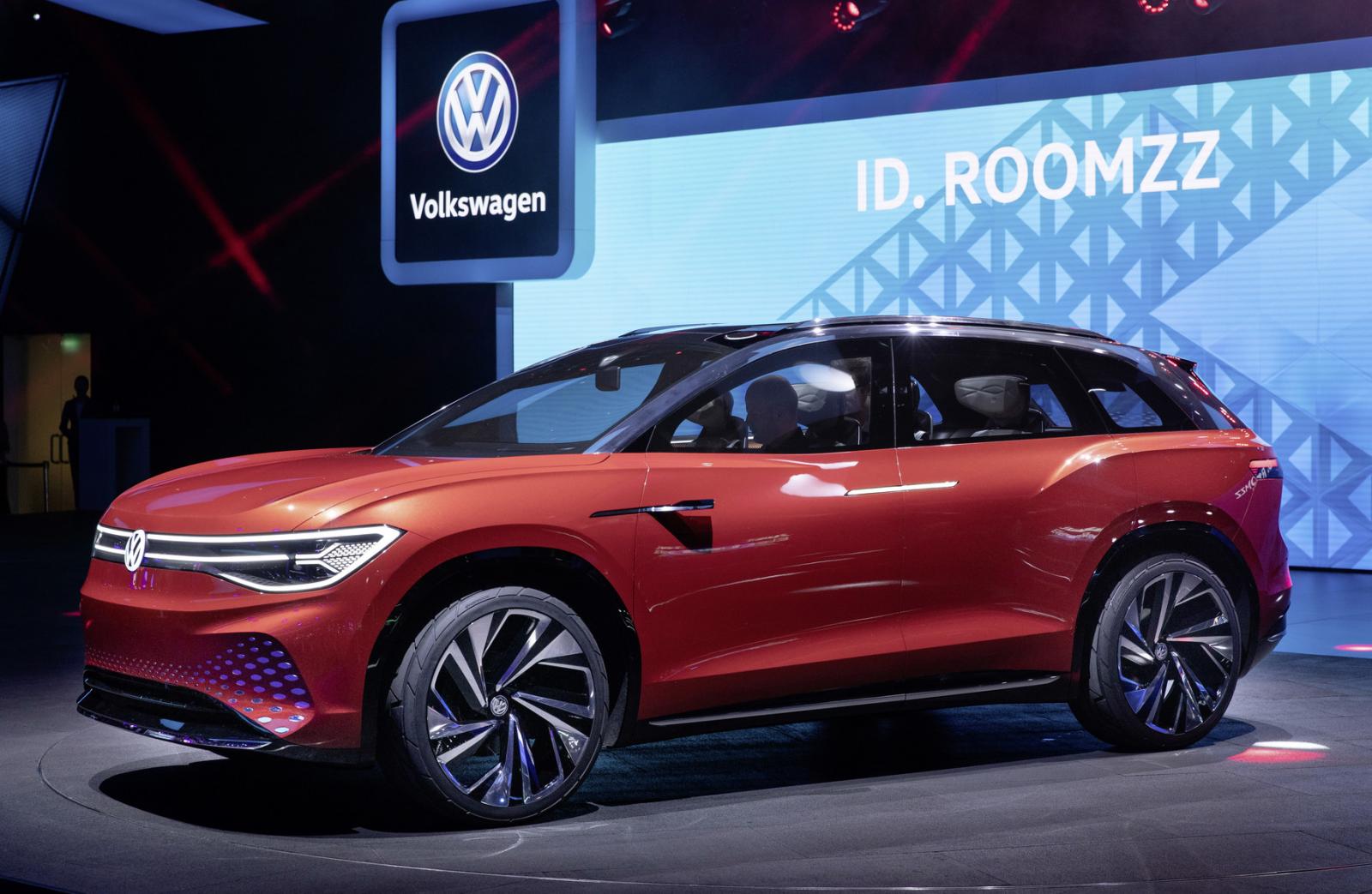
If the "Crozz" concept version makes it into production, it would suggest that an electric coupe-SUV variant could be on the cards. We suspect, however, that the final product will look similar to the "Roomzz" concept.
Volkswagen will likely use a similar powertrain for the ID.4 as it does in the ID.3, but speculation suggests that it will add a second electric motor to power the front wheels, adding around 75 kW of extra power and making it an all-wheel-drive vehicle.
The first ID variant to reach South Africa will be an SUV. Will it look a bit like the Roomzz concept? We think so…
How will your EV roll-out differ from other brands?
"We will be starting a 2-year rollout next year by bringing in an e-Golf pilot fleet and through that, we are not only building awareness and familiarity with electric vehicles, but we are preparing the country as well as consumers for electric cars from Volkswagen."
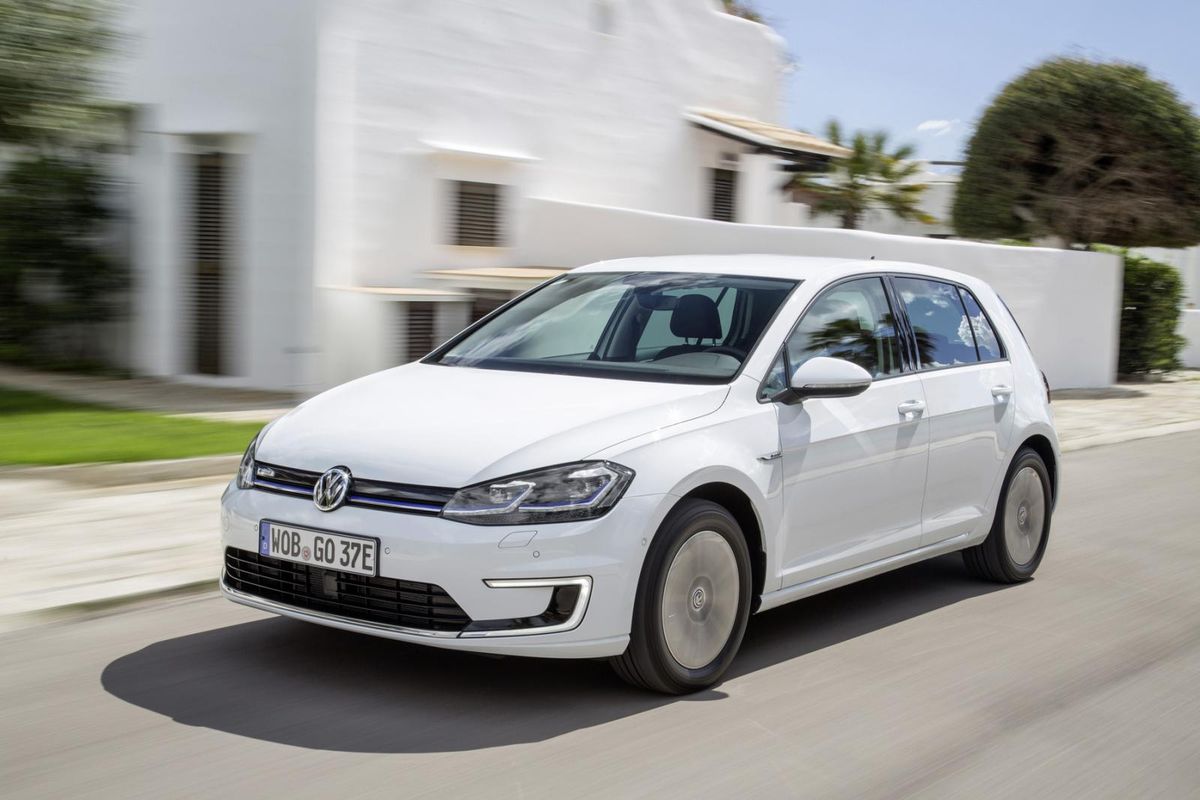
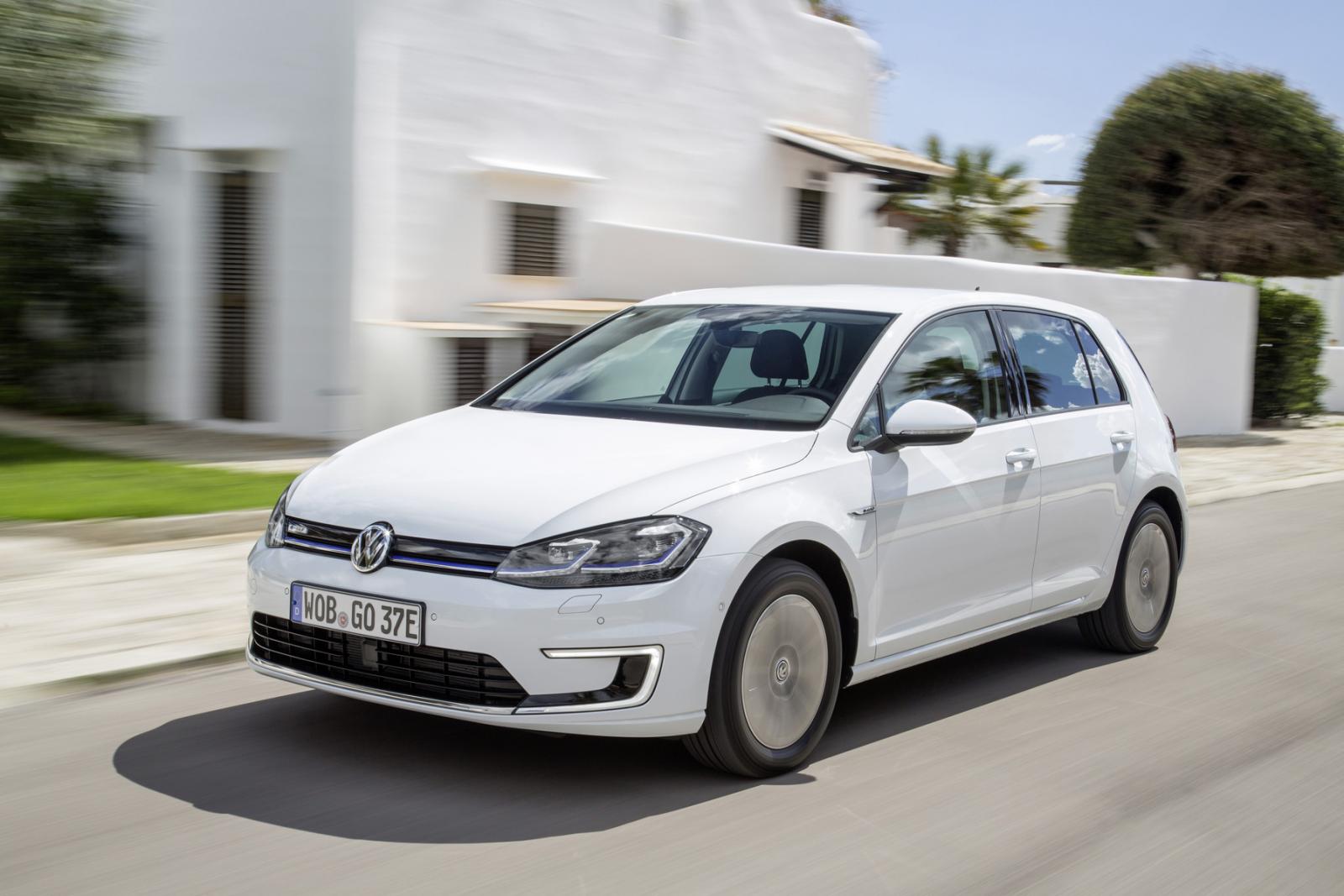
The e-Golf is nearly indistinguishable from its internal-combustion siblings, and has been on offer in Europe since 2014, but has been upgraded at least 3 times. With an output of 100 kW it offers a range of between 170 and 230 km. Due to economies of scale, its price has also come down in recent times. To gain further insights and reach more potential customers, Volkswagen has been using 1 500 e-Golf models in the “WeShare” carsharing programme launched in Berlin earlier this year 2019. In 2020 “WeShare” is also due to be launched in Hamburg and Prague.
The second member of the production ID family is almost ready, the ID.4 "Crozz" SUV. It will likely be the first VW EV to go on sale in SA.
Will you be cooperating with other brands locally from a charging station roll-out perspective?
"Collaboration in terms of infrastructure is something we are considering and are definitely open to."
In Europe, the Golf 8 and ID3 might be similarly priced. Will the same go for South Africa?
"South Africa would follow the same pricing strategy where the electric vehicle would be priced along the same lines as a well-specified diesel car."
A Tiguan 2.0 TDI 4Motion Highline R-Line currently sells for R616 150 (without options), which gives us some idea of the likely price positioning (in the current market) of the ID.4. It therefore looks possible that an ID.4 could be sold here for the same price as a base BMW i3.
Would you consider the VW ID.3 if it was similarly priced to a high-spec Golf turbodiesel?
You mentioned you need a 1 000 names – how will you be collecting those?
"We will have a ‘Keep Me Informed Page’ on the VW website where consumers who are interested in Volkswagen’s Electric Mobility will receive regular communication leading up to the official introduction of Volkswagen electric cars in 2021.
"We will also be partnering with media houses when it comes to the e-Golf test fleet and would be happy if consumers would follow these blogs, articles as well as features to get to know the e-Golf a bit better."
On another topic, what is the significance of the new logo, and when will we first see it on a car in South Africa?
"The new Volkswagen logo is more digital-friendly with it being 2D. The logo is clear and simple, flat, contrasting, focused, flexible, open, easy to use and reduced to the essentials. South Africans can see the new logo on our website, at the Volkswagen Sandton headquarters and Centurion Distribution Warehouse, as well as in key VW dealerships. As far all dealerships are concerned, there will be an 18-month rollout of the new logo.
"In South Africa, the Golf 8 will be the first Volkswagen vehicle that will have the new logo – it will be launched in SA towards the end of 2020."
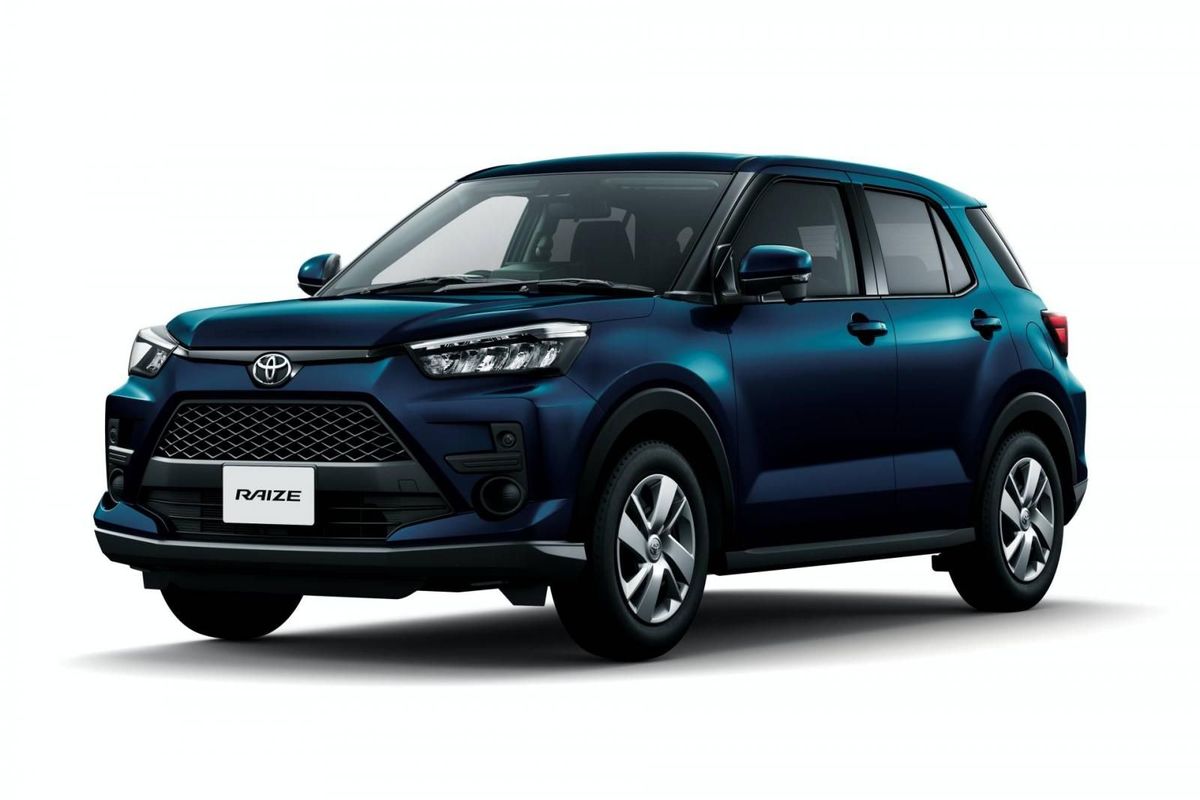
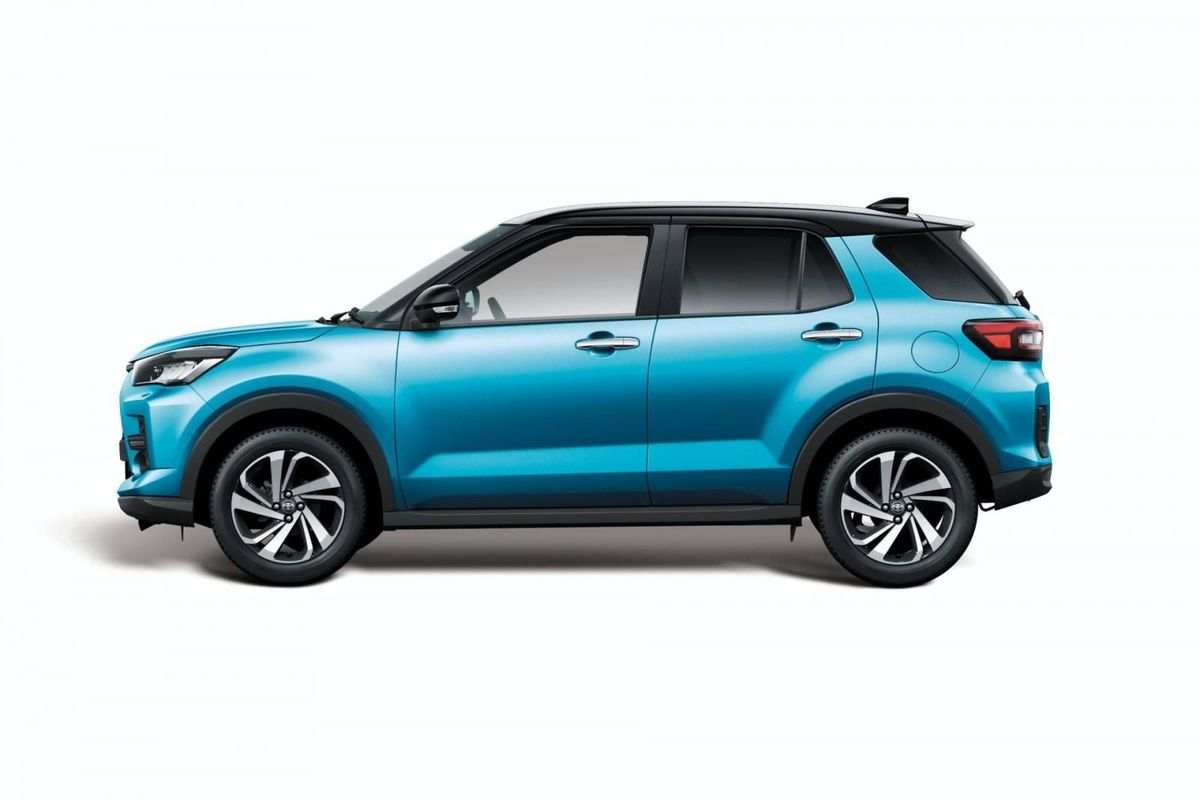
This is the Toyota Raize, a compact SUV which is scheduled for a reveal before the end of the year. However, thanks to some leaks, we can get a closer look.
First reported by Autocar India, the Toyota Raize shares mechanical and visual componentry with the Daihatsu Rocky compact SUV, which was revealed at the Tokyo Motor Show recently.
The Raize looks smart and upmarket, so kudos to the designers there. We can see LED daytime running lights and a bold front end, not too dissimilar to that of other Toyota compact SUVs.
Autocar India reported the Raize rides on 17-inch wheels and will boast a long list of accessories, as well as a TRD package. In terms of dimensions, the Daihatsu Rock is almost 4 metres long, 1.7 m high and 1.6 m wide, with a wheelbase of 2.5 m and we expect the TNGA platform or a variation of such to underpin the vehicle.
In terms of engine, the Toyota Raize SUV will feature a 1.0-litre 3-cylinder 12-valve turbo engine with 73 kW and 140 Nm, mated to a CVT, with the option of a 6-speed manual transmission to come later.
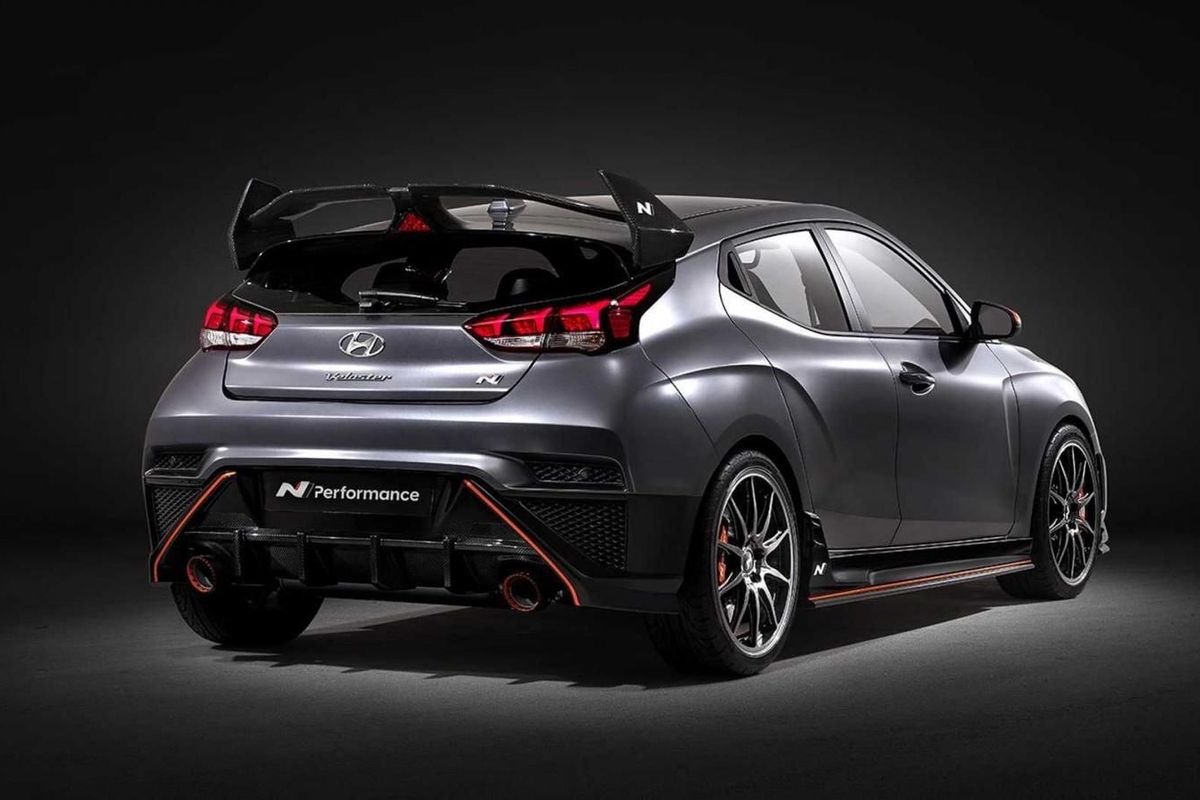
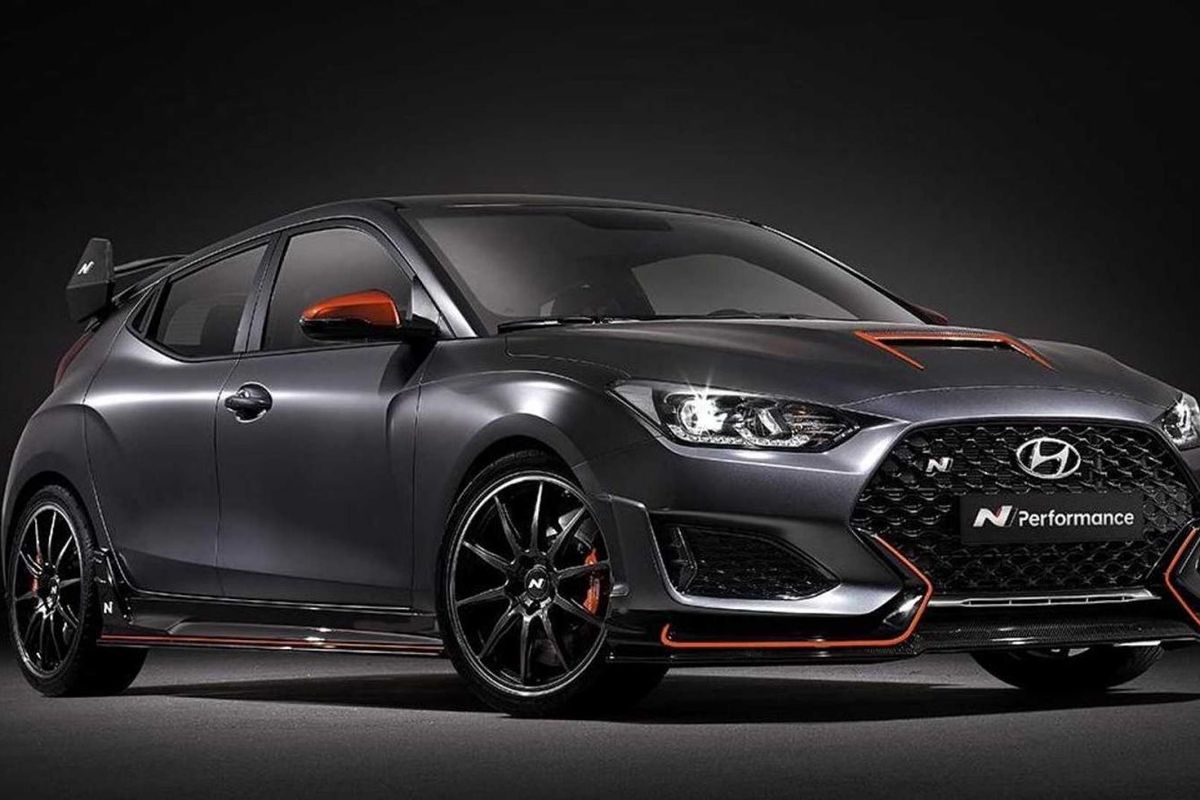
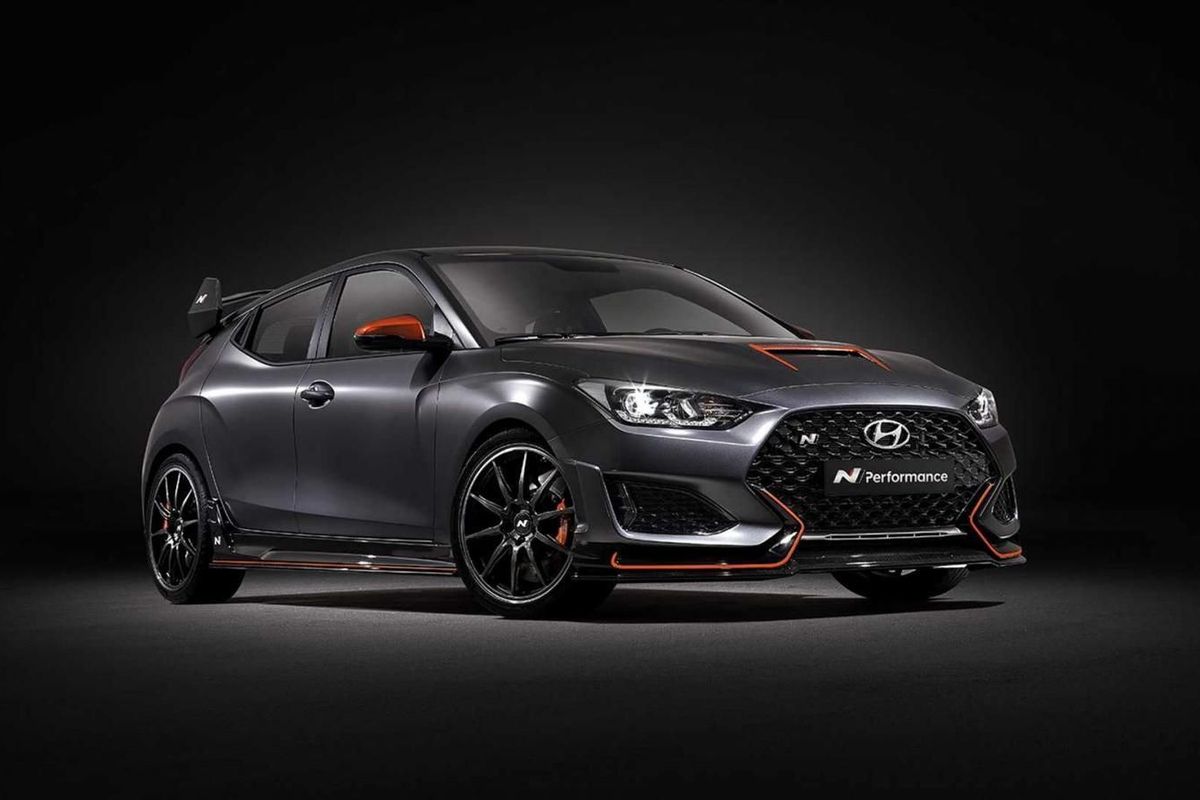
Lots of orange for Hyundai's latest hot hatch concept.
A month ahead of its SEMA 2019 debut, Hyundai has revealed an even more dramatic version of its Veloster.
This upgraded second-generation Veloster N Performance Concept has been assembled to show what Hyundai’s previously asymmetric door-configuration hatchback is capable of.
Although the i30 N is very much Hyundai’s performance car fo the moment, this Veloster features a range of modifications and orange detailing everywhere. And we mean everywhere.
Visually it has a new bonnet with additional vents, redesigned front grille and more aggressive front splitter. Around the rear there is a spoiler and diffuser combination, to improve downforce. All these new exterior bits have orange.
Viewed side-on, the Veloster N Performance Concept rolls 19-inch forged alloy wheels, sourced from Italian specialist, OZ. Keeping with the Italian supplier theme, these wheels are shod with Pirelli P Zero Corsa tyres.
At each wheel corner, Hyundai has also placed some improved stopping and suspension components too. Adjustable coil-over suspension shocks are from Extreme Racing, and they get support from H&R springs, whilst Daewon Steel anti-roll bars balance high-speed cornering loads.
Improving the Veloster’s overall platform rigidity, to make the most of its grippier tyres and reconfigured suspension bits, are front, centre and rear chassis braces. Brakes have also become more powerful, with 380 mm discs up front, actuated by six-piston callipers, whilst 360mm brake rotors ride at the rear, clamped by four-piston calliper. Those callipers are orange.
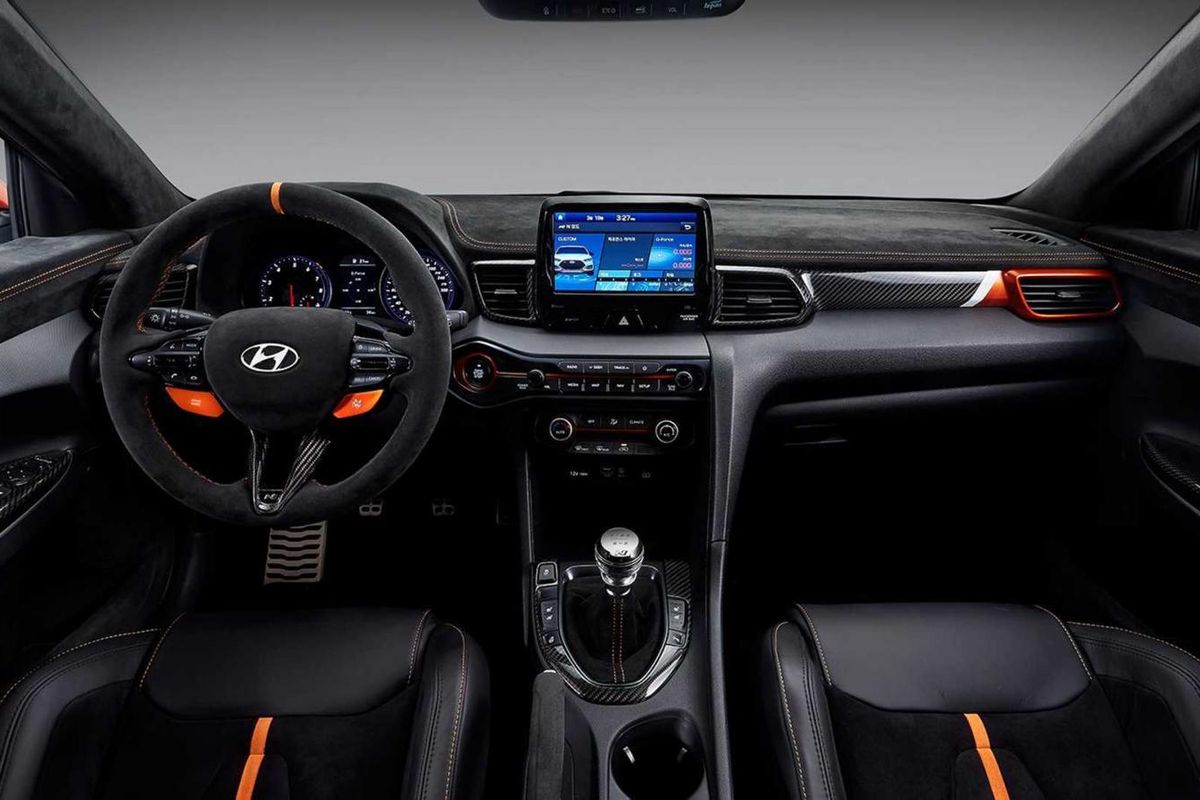
Inside the Veloster N Performance Concept has some slight design changes, most of them motorsport derived. There is an obligatory red starter button, whilst pseudo suede touch surfaces, contrasted with orange detailing, dominates the cabin.
With the predictably high cornering speeds, this Veloster N Performance Concept is capable of, it has seats that can hold the driver and front passenger better in place. Sabelt semi-bucket seats, with a carbon-fibre structure for lightness, replace the factory Veloster seats.
One aspect of the Veloster N which has not been changed in this Performance Concept trim is its engine. The 2-litre turbocharged four-cylinder still boosts 205 kW and 535 Nm, although it is now a touch more dramatic in its acoustic signature, thanks to a Caprisio cat-back exhaust system, which features orange exhaust tip internals.