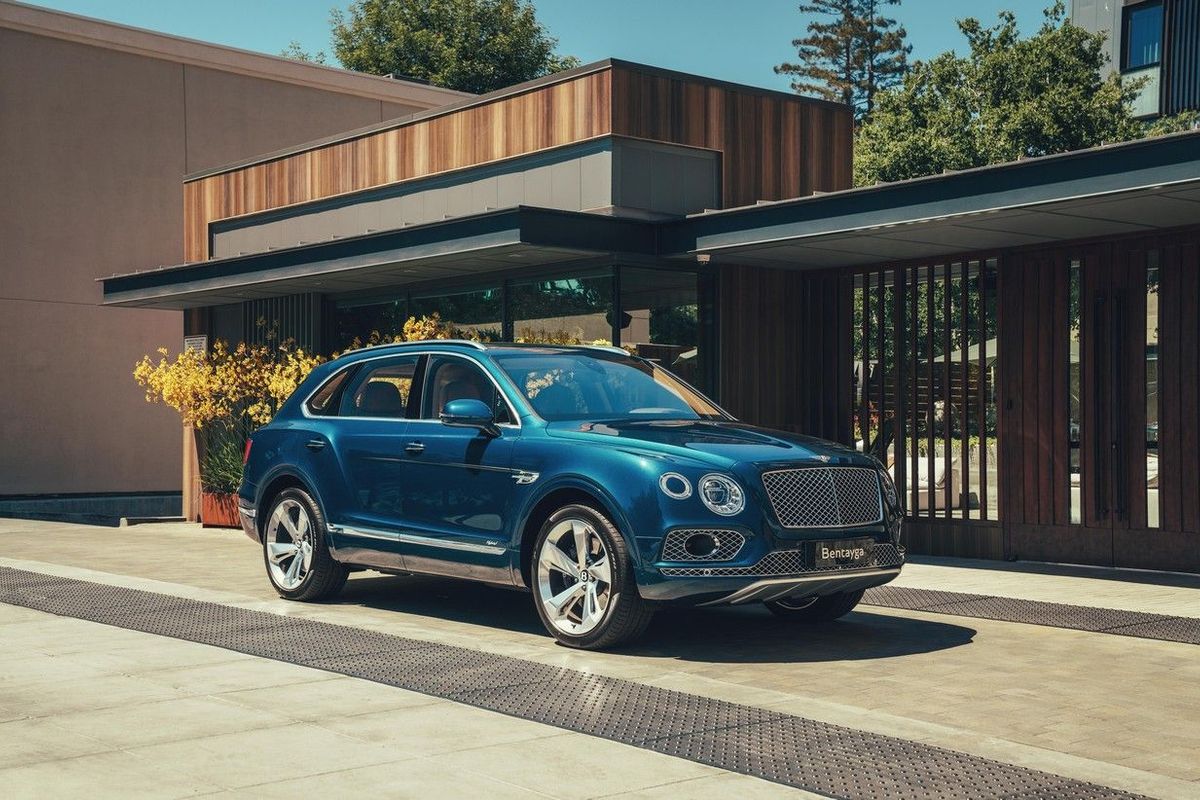
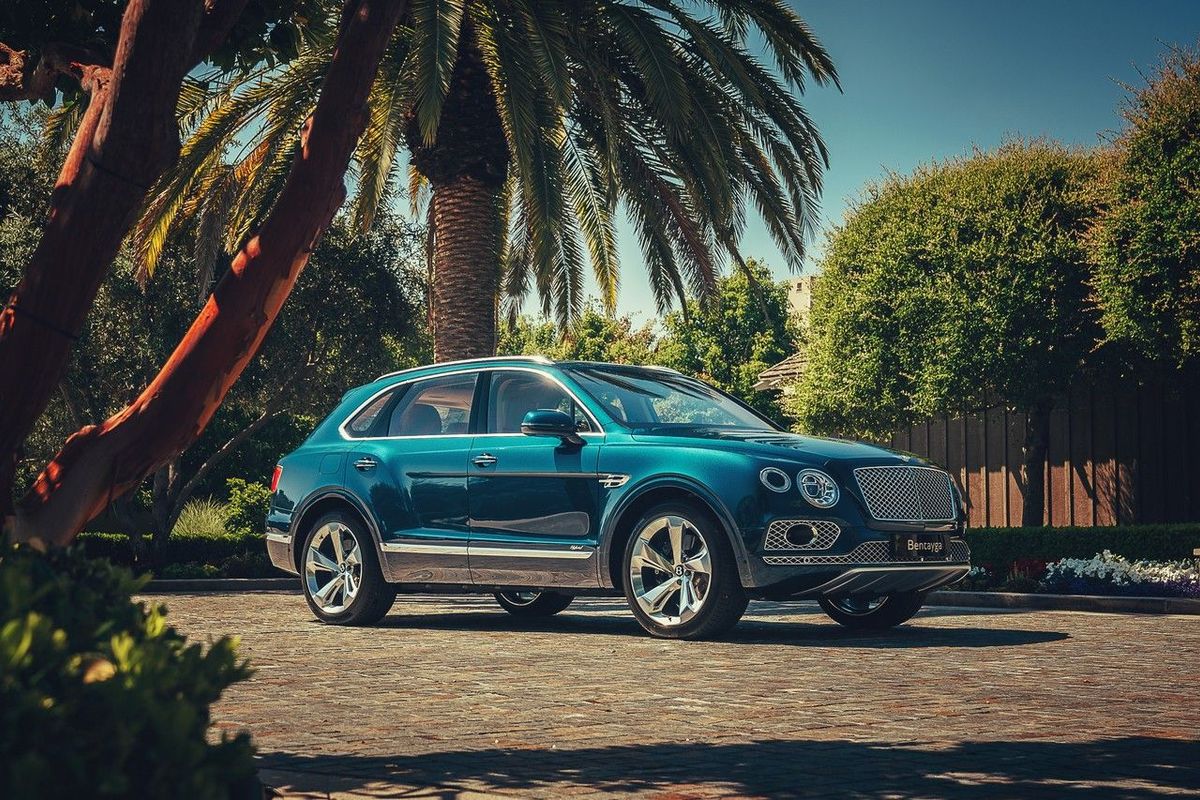
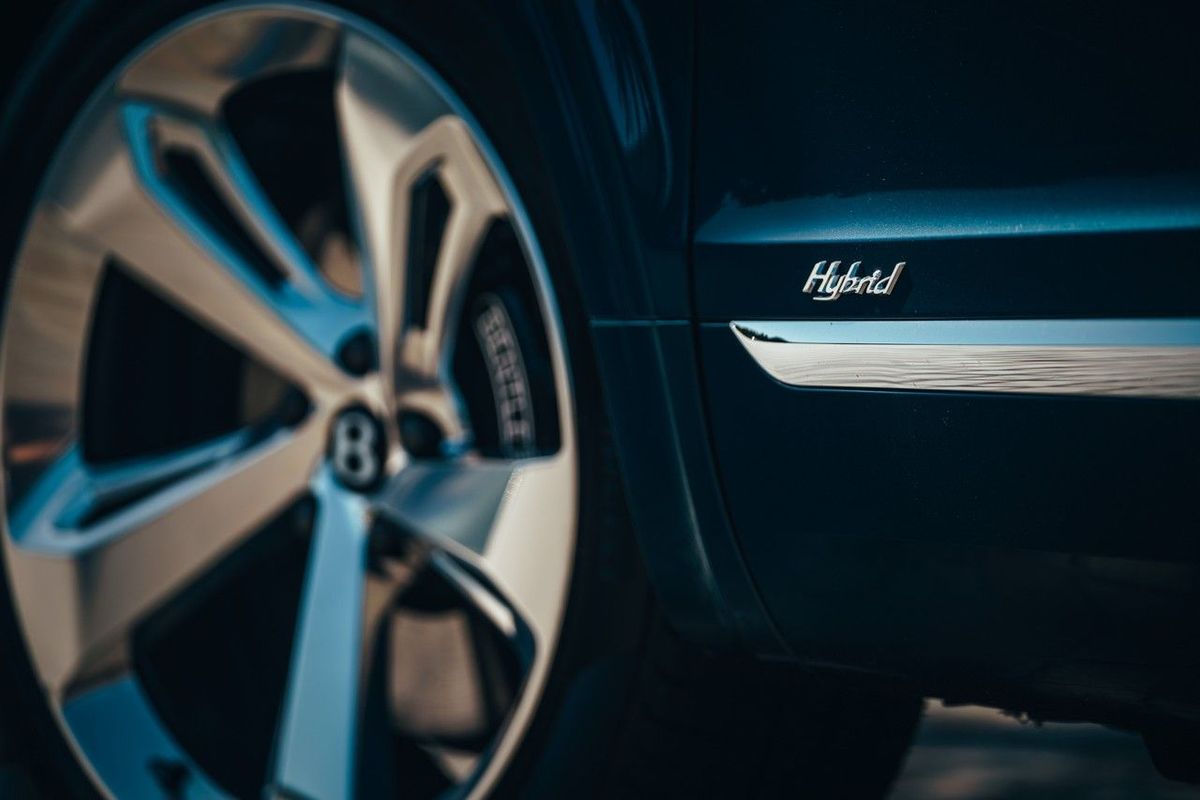
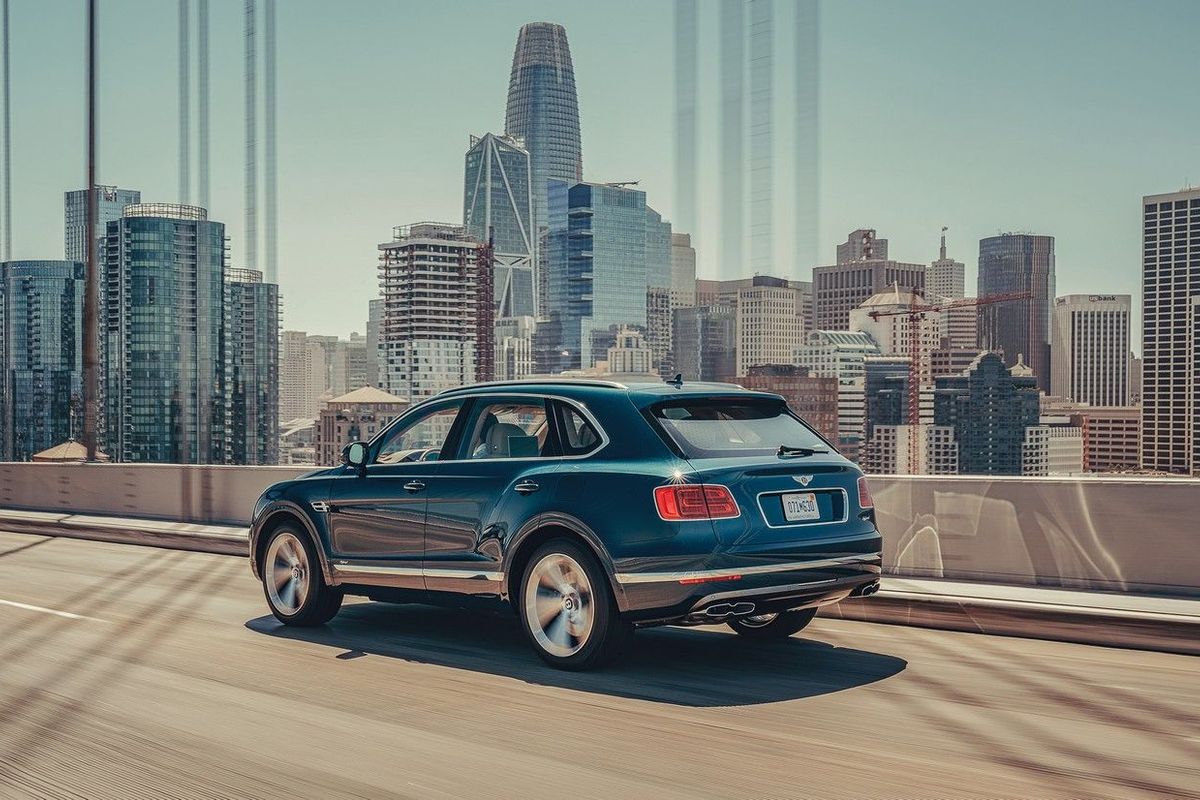
Luxury car brand Bentley has announced a hybrid version of its Bentayga luxury SUV. The numbers make for very impressive reading and the vehicle has just gone on sale in Europe. Some details…
Built in Crewe, England, the Bentley Bentayga comes to market with a highly-advanced powertrain. Using a 3.0-litre turbocharged V6 petrol engine mated to an electric setup, the Bentley Bentayga Hybrid promises fantastic performance without compromising on economy.
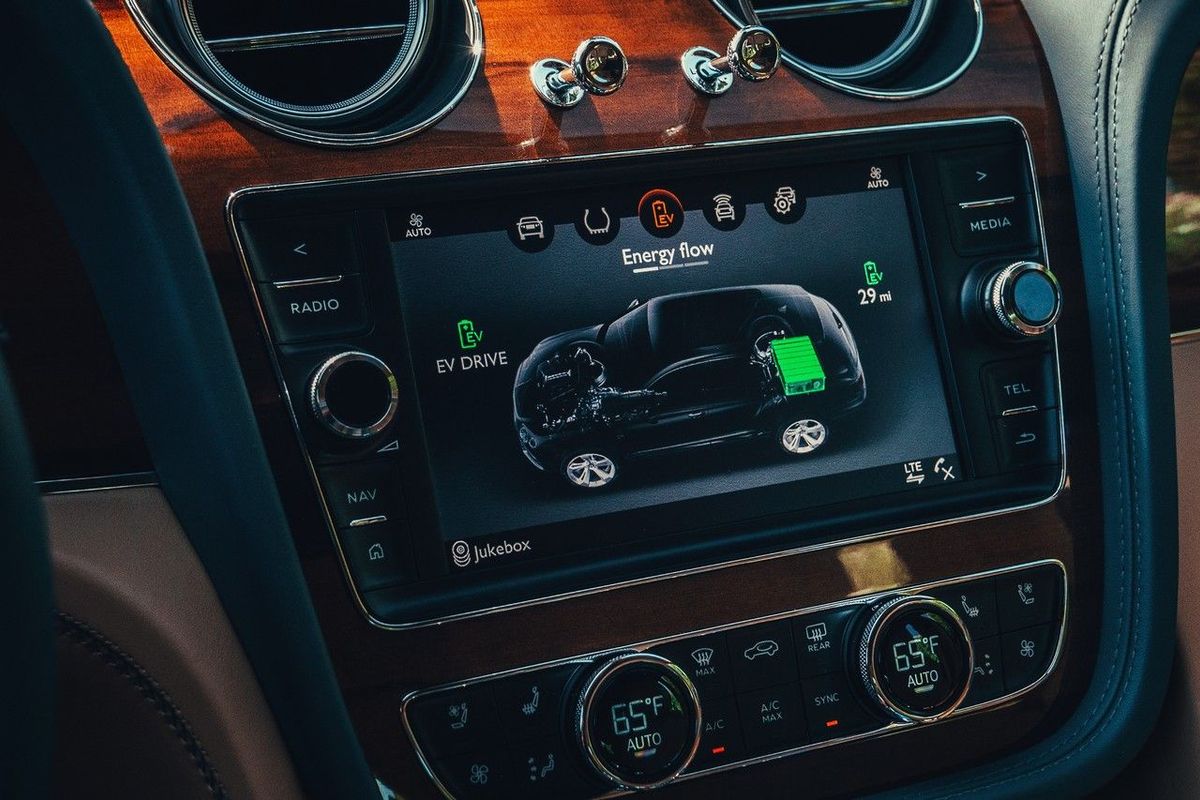
The advanced E motor serves up 94 kW and 400 Nm, mated to the petrol V6's 250 kW and 300 Nm, giving it total outputs of 330 kW and 700 Nm. In terms of performance, the Bentley Bentayga Hybrid can sprint to 100 kph in just 5.5 seconds and run to a top speed of 254 kph. The modern high voltage battery can be recharged in just 2.5 hours. Driven solely under electric power, the Bentley Bentayga Hybrid can go 39 km on the WLTP cycle, with total driving range claimed at 747 km. The fuel economy claim sounds almost too good to be true at 3.5 L/100 km.
There was a time when most of us could figure out the engine capacity of a car simply by reading the badge affixed to its rear end. Today, when you’re considering the purchase of a new vehicle, the seemingly random number that is emblazoned on its boot lid or tailgate trivialises the entire buying – if not ownership – experience…
Is car ownership still the ultimate form of self-expression? Is it an extension of your personality/identity and a celebration of your financial freedom?
What does it say about you? Well, it should say something and it did… once upon a time. But today, car shopping has been reduced to a joyless slog in which your choices are either limited, puzzling or contrived by manufacturers through their prioritisation of production efficiencies, profit maximisation and a complete denial of their roots.
Much of the motoring industry’s present ills are rooted in the psychology of eco-correct box-ticking, semantics and pseudo-futuristic, millennial marketing vape and an utter desperation to sound hip. Cars have ceased to exist – they are now “mobility solutions.”
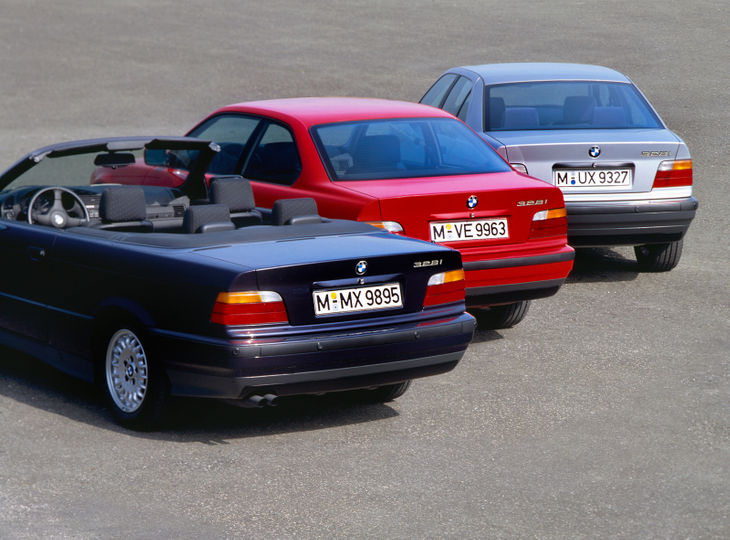
In the era of the E36-generation 3 Series, a 328i badge designated that a BMW was powered by a 2.8-litre engine.
And engines? Never heard of them. Instead, slide a sleeve-tattooed fist bump over towards “power units”. Car companies? What's a car company? Say hello to “lifestyle brands” with a R50 cup of artisanally crafted coffee while pensively stroking that hipster beard. The industry’s collective amnesia is shocking: does anybody still remember in how many ways the internal combustion engine defined the 20th century?
The way in which cars are engineered and built has changed, too – in the same ways that smartphones are made today: more or less generic with the same hardware and just one or two distinguishing features. What has this done to the tyre-kicking process?
It’s confuddled the crap out of everyone, that’s what. For a list of the top offenders, look no further than the premium German brands, which offer droves of derivative clones that necessitates the phenomenon of creative name-giving. What they come up with is often indecipherable.
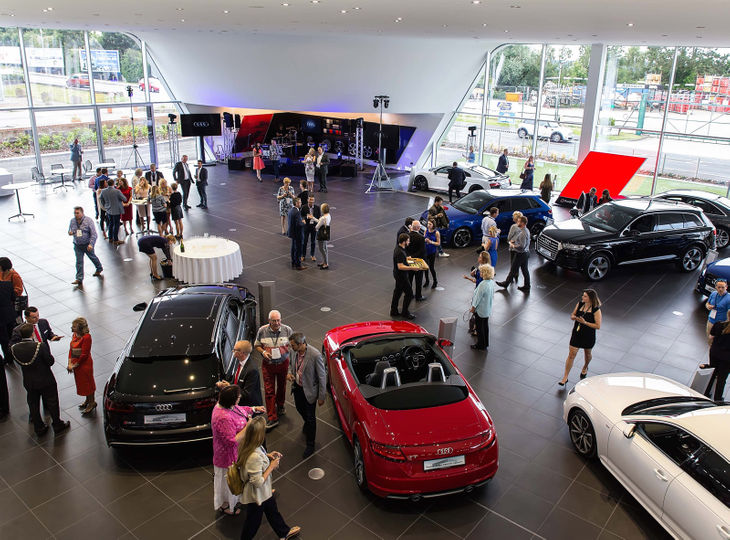
If you haven't got your head around Audi's new derivative-naming convention, it's tricky to tell derivatives apart from one another.
In 2017, Audi added double-digit numeral prefixes to their derivative names. The official reasoning, at the time, was that as ever-advancing technologies continue to drive combustion efficiencies, engine capacities will decrease to become increasingly irrelevant and power outputs will correspondingly rise: a necessary stance if you were caught and shamed in Dieselgate, for sure, but not a very practical one. Because it’s safe to assume that even if you hate cars, you’re far more likely to be aware of your own car’s engine capacity than how many kilowatts it develops.
So now, in increments of five, Audi derivatives’ prefixes range from 30 to 50, followed by 60 and 70 (55 and 65 are omitted most likely because they’re owned by Mercedes-AMG, which is awkwardly self-conscious. Why not just start at 10 and end at 50?). The idea behind these random numbers is to denote certain brackets of power-output regardless of engine capacity, given the voluminous degree of engines shared with Volkswagen – in various states of tune. However; the non-Audi driver is still no less uninformed as to what he’s just made way for in the fast lane, if not more confused than ever, other than being able to reasonably deduce that 30 means you can’t afford to go fast and on other the scale, at 70, well, you can. Which means that until you’ve figured out the numbers, Audi's naming convention remains somewhat of an inside joke.
In the old days, a few anomalies aside, BMW was a model citizen of badging simplicity. What was under the bonnet was exactly what was promised on the boot lid. Later, this changed for a couple of reasons: turbocharging and engine sharing.
Turbocharging has confused matters…
The 3.0-litre (then) twin-turbo 335i (released in 2007) was the first BMW to have a model designation reflective of neither engine capacity nor induction type, but when BMW started putting the same turbocharged engine into several products (some of which had different, model-specific outputs), "borderline confusing" turned "full ridiculous". A 30i is equipped with a 2.0-litre engine; while the 30d, 40d and 50d derivatives are all powered by a 3.0-litre turbodiesel. But 50i petrols have 4.4-litre engines. And the unloved 740e hybrid has – wait for it – a 2.0-litre petrol engine.
Surely that means that BMW salespeople have to be the smartest people on the planet. Or not, but that’s only because they’ve been spared having to learn the "Mercedes-Benz encyclopaedia".
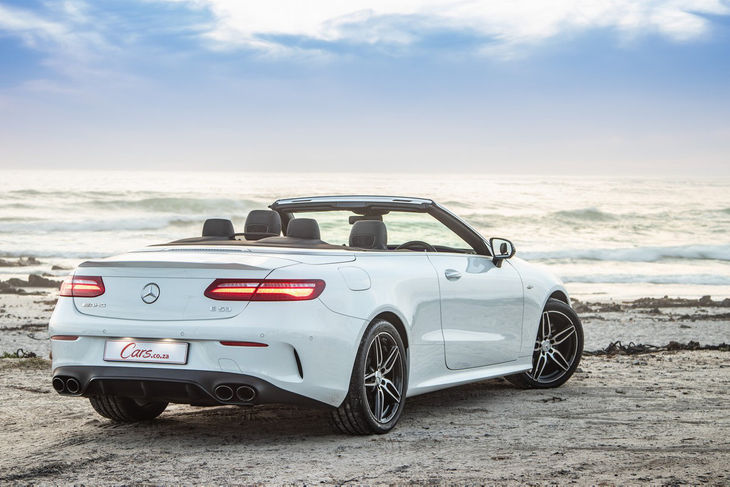
A Mercedes-AMG with a derivative name in the 50s used to suggest it was powered by a V8, but the E53 has a 3.0-litre straight 6.
Deep breath: A200s and B200s are powered by a 1.3-litre engine, but the C200 is powered by a 1.5-litre engine. Oh, and the C220D? That has a 2.0-litre “power unit”. 250d? Two-point-two-litres. C300? Two litres. AMGs? A colony of rabbits cannot keep up with the Affalterbach’s multiplication rate; and none of the AMG 35, 43, 45, 63 or 65 designations accurately describe engine capacity. And just to put an extra spin on things, in the case of the 63 models, the swept capacity is 4.0 litres, but wait, unless you're talking about the GLE or GLS or SL versions, where it’s 5.5 litres.
You can’t make this stuff up – because you can’t keep up. Imagine the debauched intoxication that would ensue if this were a drinking game.
Looking to the future, manufacturers’ new-found, hypocritical hatred for petrol engines is going to become a major headache for the creatives tasked with christening model derivatives. How, for example, will a range of EVs, or hydrogen fuel-cell cars from the same manufacturer be distinguished from one another apart from anything other than random, nonsensical digits? Tesla has models S, 3, X and Y (see what the spotty 17-year-old who came up with that did there?), but there’s nothing in there that subtly informs onlookers which side of the railroad tracks you live on.
A car's badge defines its owner's status
And that’s a problem that’s only going to get worse because no other accessory so overtly advertises – and is required to – one’s position on the social ladder than the cars we drive.
In Paul Verhoeven's classic sci-fi film, RoboCop, a tarted-up 1977 Pontiac Cutlass Supreme is parodied in a fake TV ad and marketed as the “6000 SUX”. The exact time of when the movie is set is undetermined, but it could not be far from 2019. It was released in 1987, when the Pretoria-born creator of Tesla, Elon Musk was – wait for it – 16 years old.
How apocalyptic. And how frightfully prescient.
Some of you may remember that the subtheme of the 2017 Frankfurt Motor Show was a somewhat introspective one: "Will we remember vroom?" Today, the answer seems no. Instead, it’s click. And ka-ching. And repeat.
With many of Suzuki’s South African market cars similar to those delivered to India, any new reveal in the world’s second-most populous country is important.
Suzuki’s latest product initiative is a production version of the Future S concept car, which was first shown in last year.
This new crossover will broaden Suzuki’s gravel travel vehicle offering and it has been renamed S-Presso. For loyal followers of the brand, the coffee naming association will not be new, as Suzuki’s once marketed a two-seater compact sportscar, named the Cappuccino.
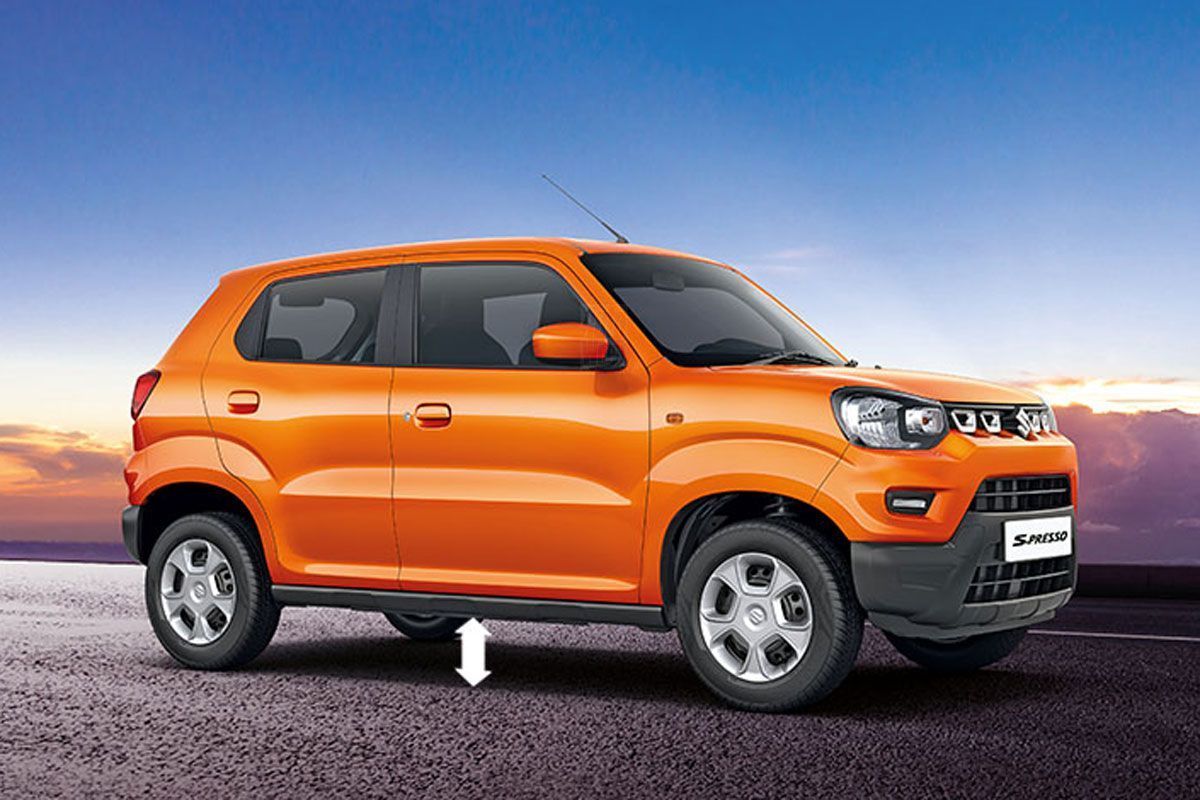
In terms of size, the S-Presso measures 3.67m bumper-to-bumper, 1.52m across and stands 1.55m high. Those numbers class it as very slightly smaller than the current Suzuki Ignis.
The styling features a faux grille with hexagonally shaped detailing and some interesting headlamp design, but the overall shape features a collection of quite simple stampings. S-Presso also rolls a choice of two wheel sizes, 13- or 14-inches in diameter, but there is no alloy option.
True to its purpose as a budget vehicle for markets with underdeveloped road infrastructure, S-Presso has ample ground clearance, rated at 180mm, which enables it to roll through potholes.
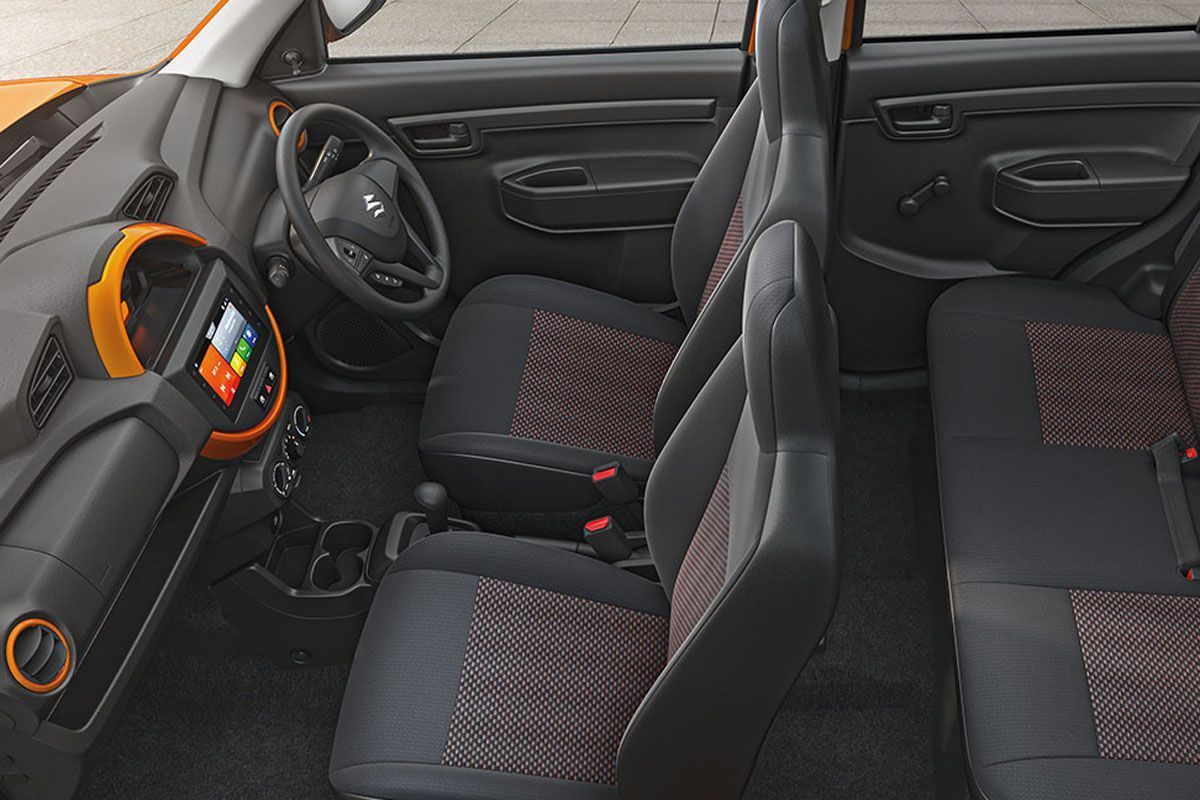
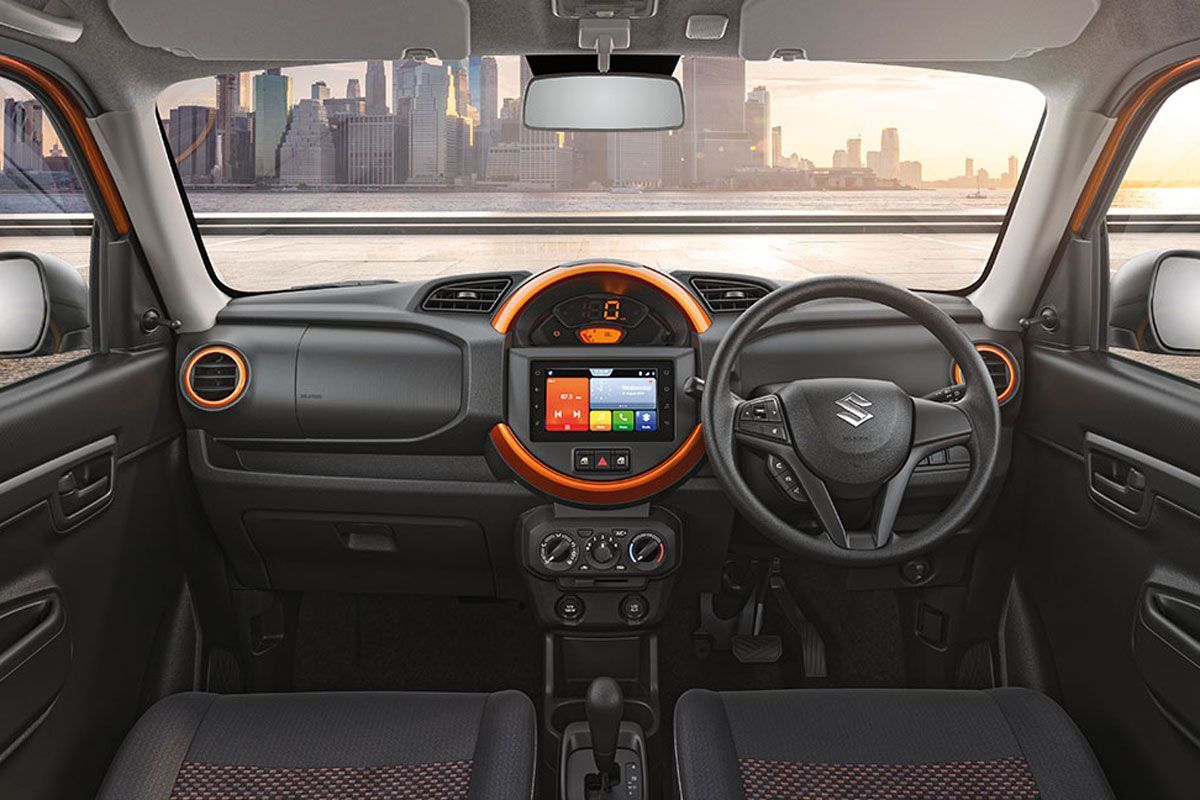
The higher-trim version of this S-Presso will feature a 7-inch infotainment screen two airbags, ABS and rear park sensors. S-Presso’s cabin layout has a pseudo-round centre stack, attempting to mimic what Mini has been doing for years. There is no instrumentation binnacle behind the steering wheel, either.
Powering the S-Presso is a naturally-aspirated 1-litre engine, with three cylinders, which is good for 50 kW. Suzuki is positioning the S-Presso as a rival to Renault’s Kwid.
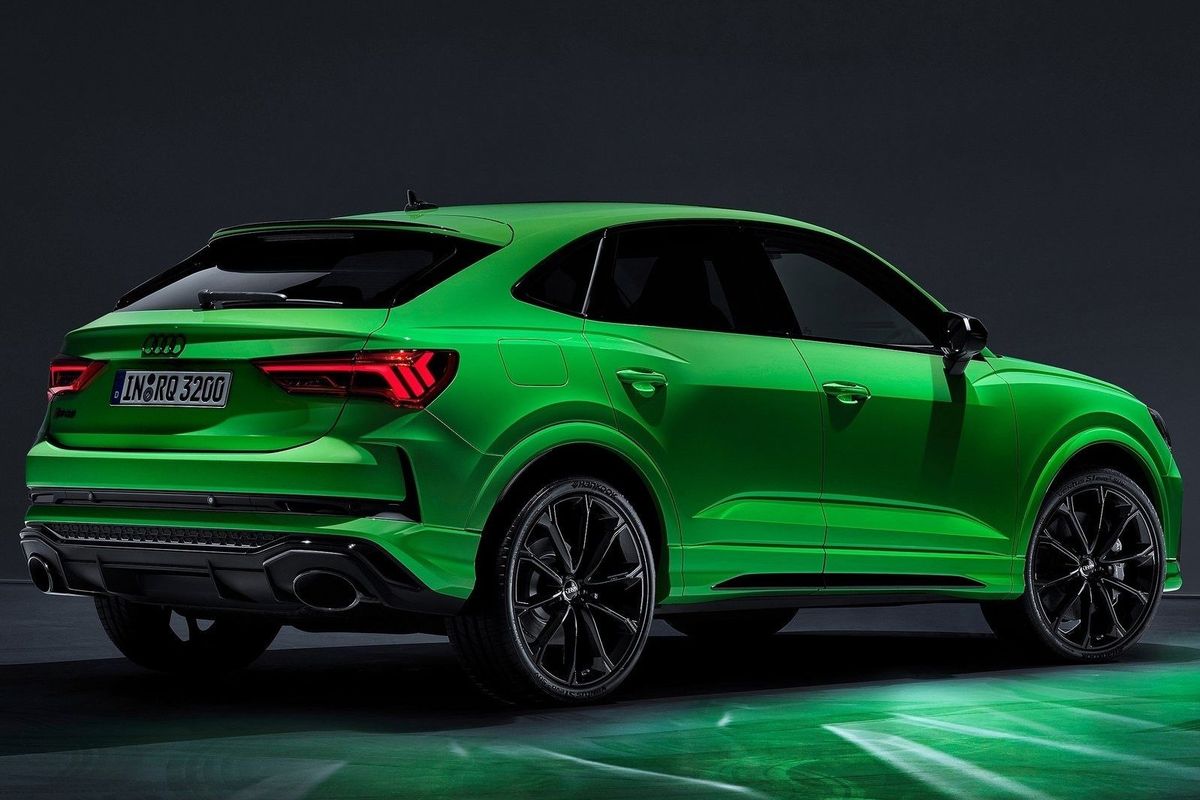
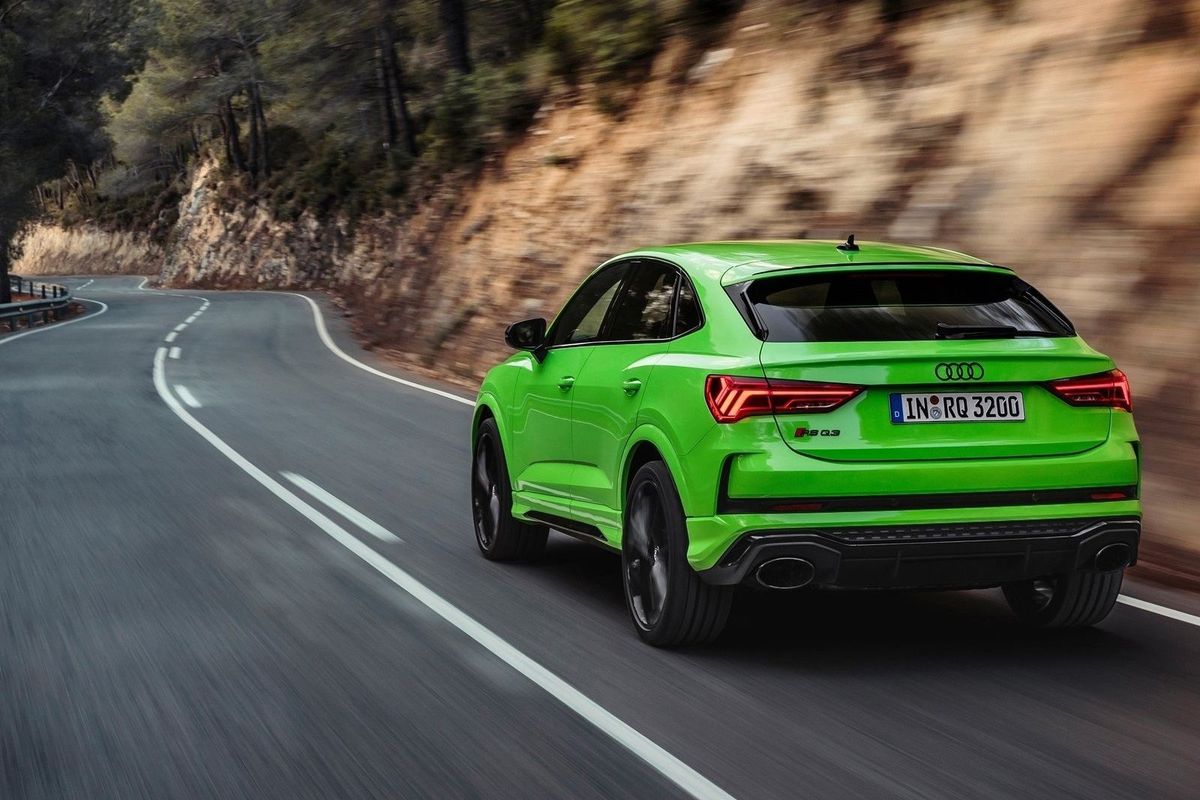
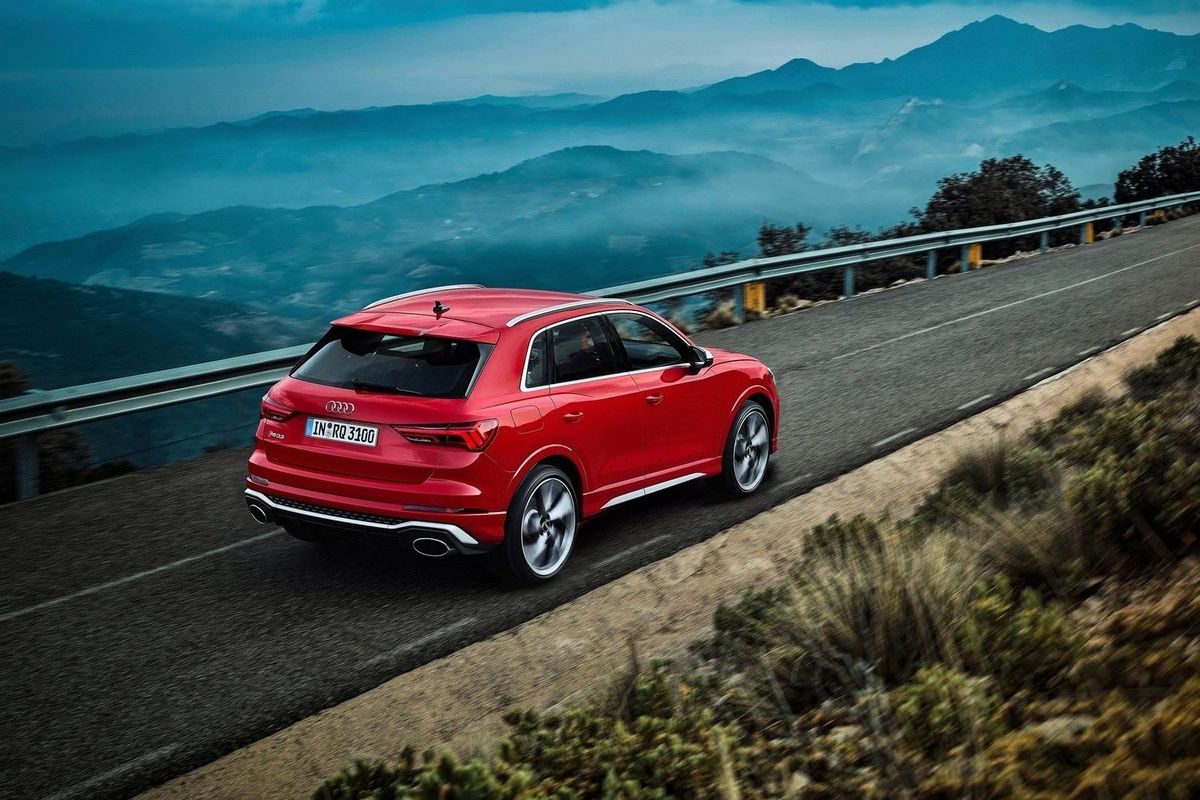
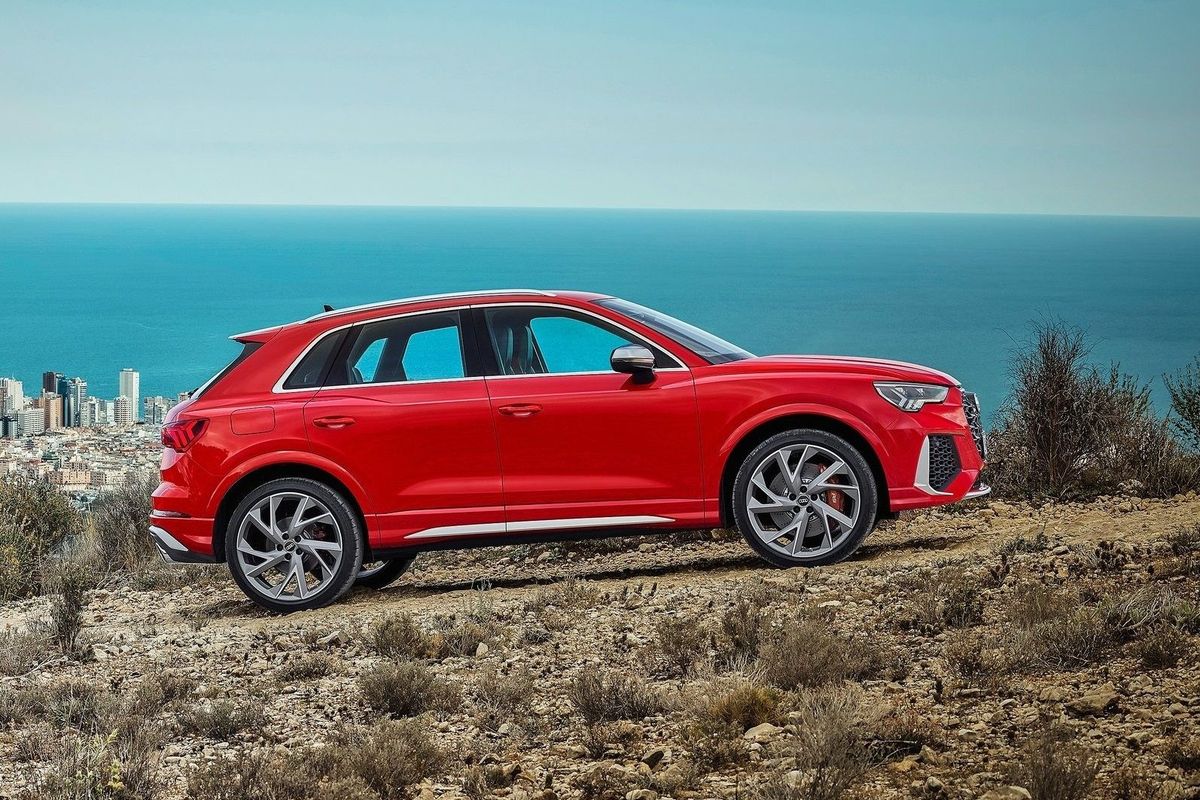
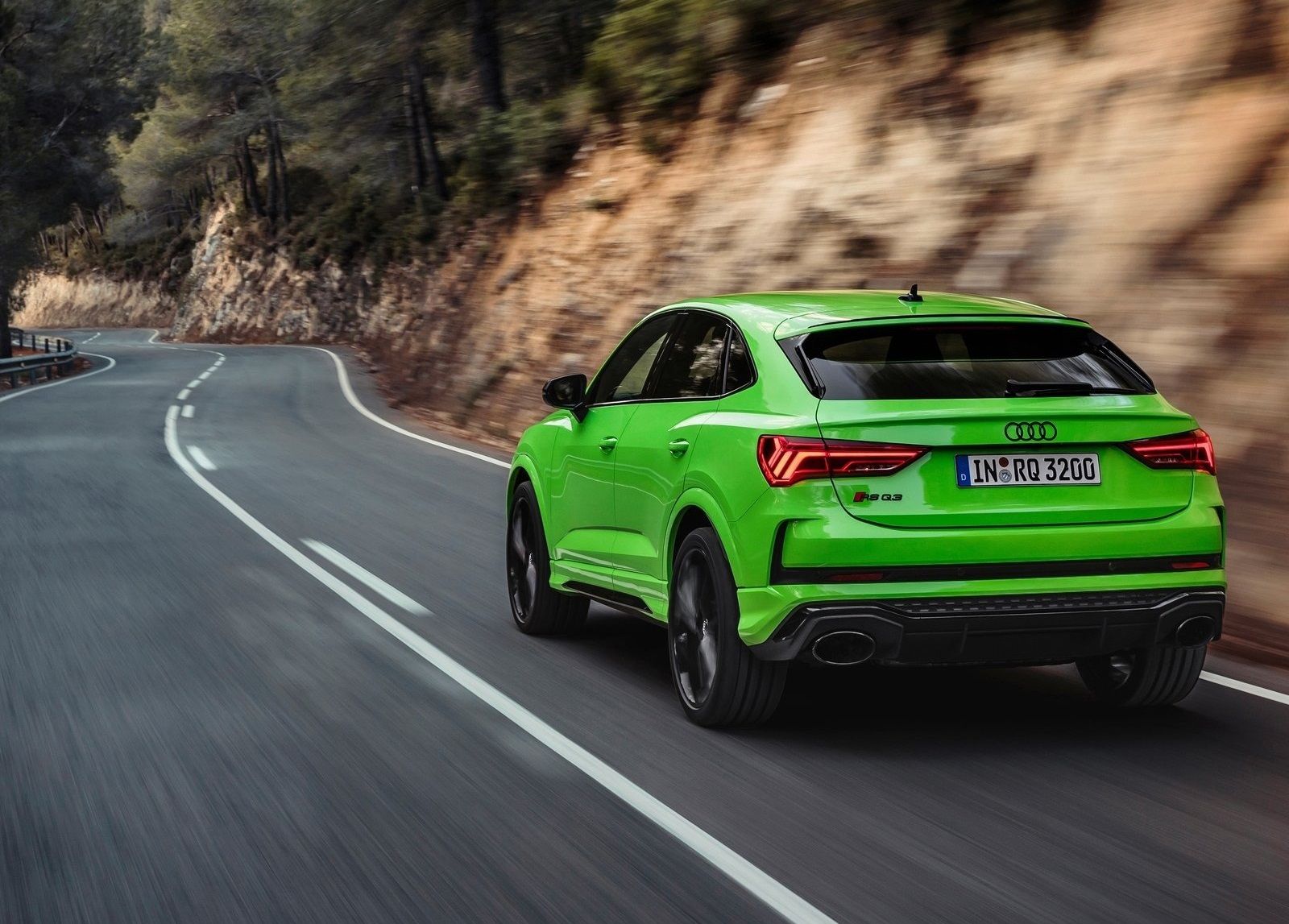
Audi has revealed its new performance-orientated Q3 in 2 flavours. Meet the RS Q3 and the RS Q3 Sportback. See details below…
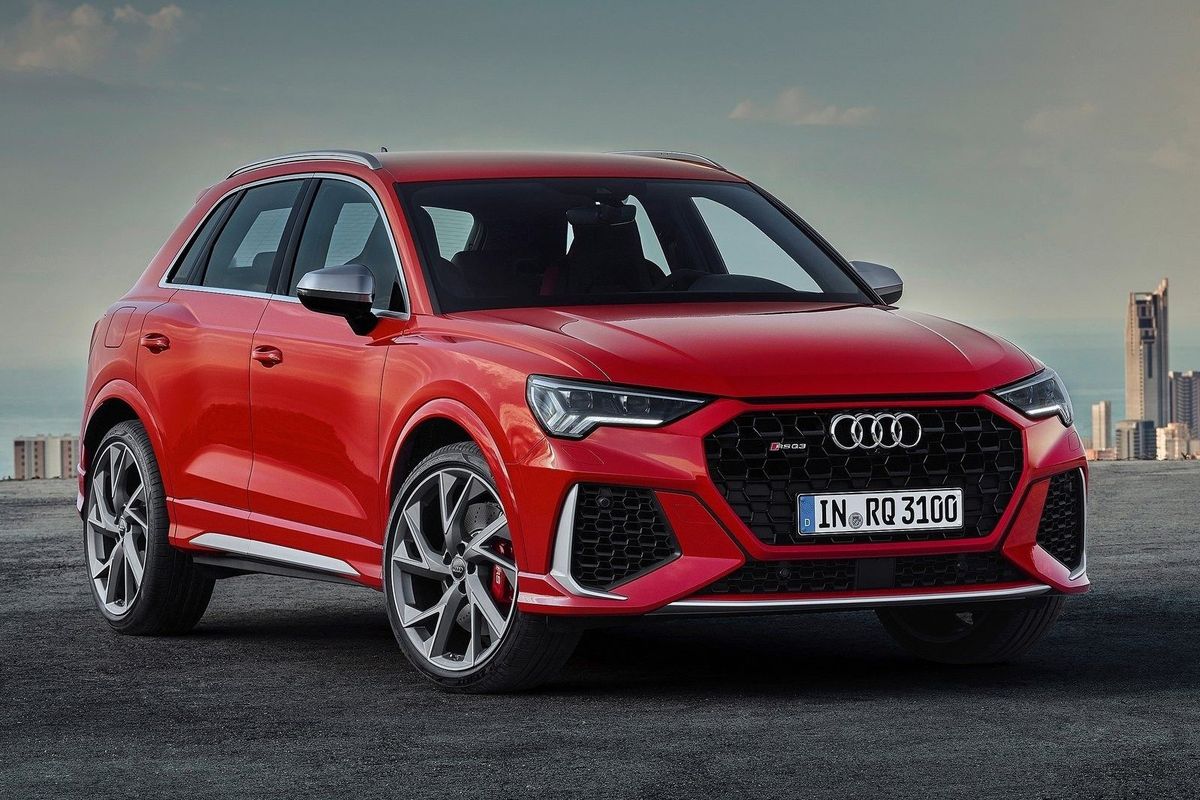
Audi recently launched its new Q3 premium family car in South Africa and it was just a matter of time before the Ingolstadt-based brand unleashed the RS variants. Here they are!
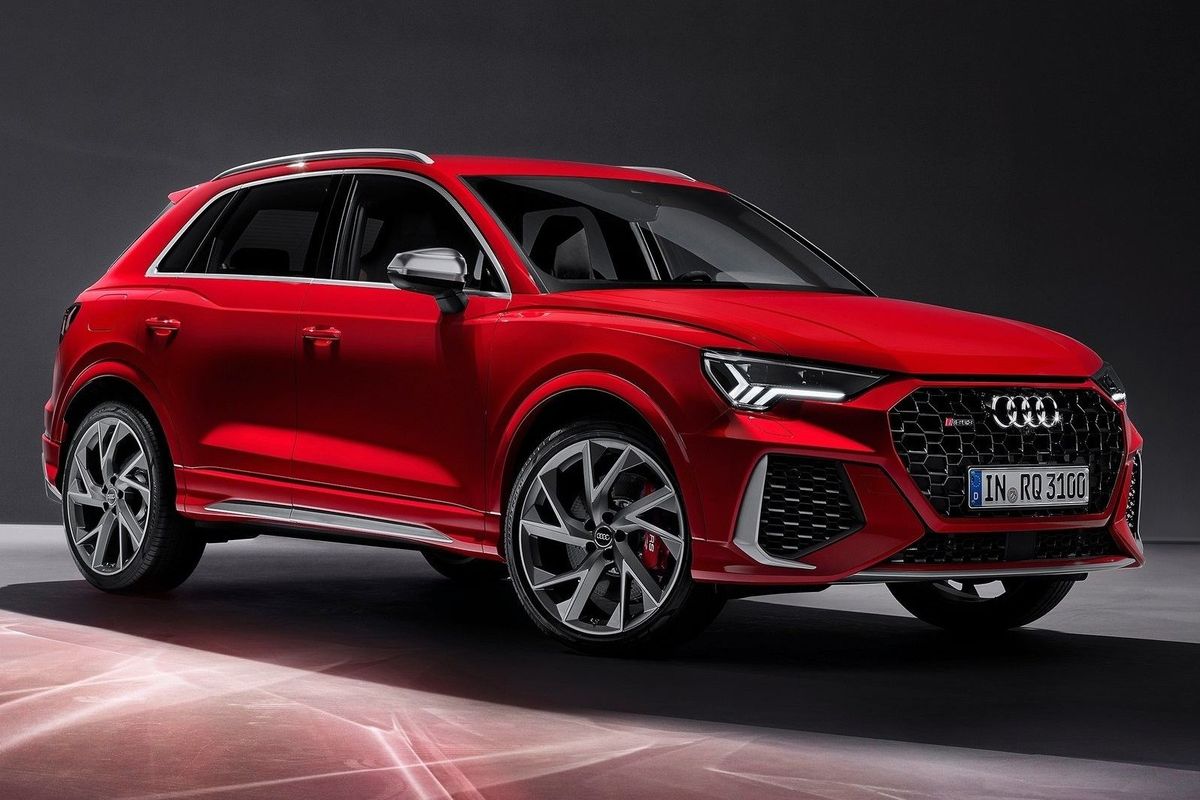
The front-end is striking with a large singleframe, gloss black grille with a 3D honeycomb structure that’s flanked by large air intakes that feature agreesive-looking boomerang-shaped blades. LED headlights are fitted as standard while Matrix LED headlights with dynamic indicators and RS-specific trim will be offered as an option.
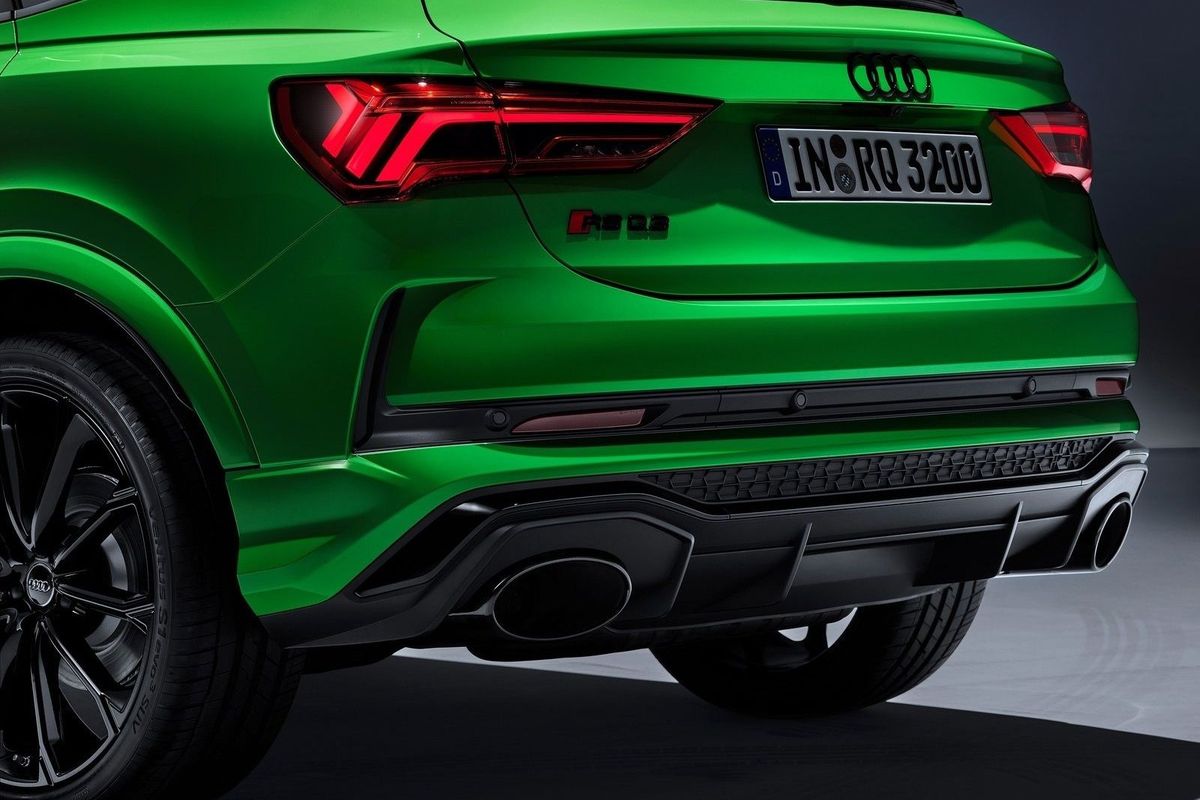
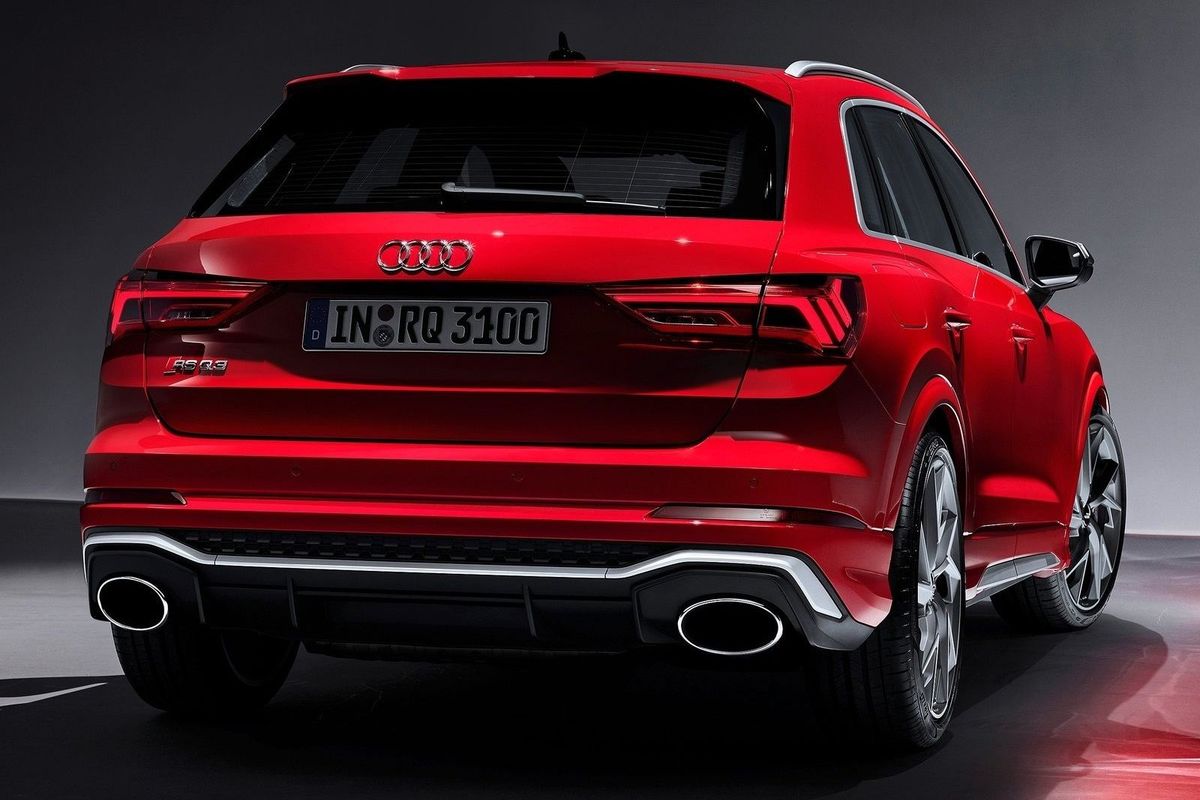
The RS Q3 Sportback, with its sloping coupe-like roofline, rides some 45 mm lower than the RS Q3 and flared wheel arches give both models some added presence on the road. At the rear, a dual-branch RS exhaust system is fitted for the first time and large, dual oval tailpipes communicate performance intent. An RS-specific bumper is fitted along with a rear diffuser with black horizontal blades.
Engine Power
Audi's turbocharged 2.5-litre, 5-cylinder engine is now lighter and more powerful than before.
Audi’s familiar turbocharged 2.5-litre, 5-cylinder engine has been updated for application in the RS Q3 and RS Q3 Sportback. Power output has increased by 17% and now sits at 294 kW and 480 Nm of torque. The engine itself is now some 26 kg lighter than before thanks mostly to the aluminium crankcase which saves 18 kg in weight.
Equipped with qauttro all-wheel drive and a 7-speed S tronic transmission, the RS Q3 and RS Q3 Sportback offer brisk performance with the sprint from zero to 100 kph taking place in just 4.5 seconds. Top speed is limited to 250 kph (280 kph optional).
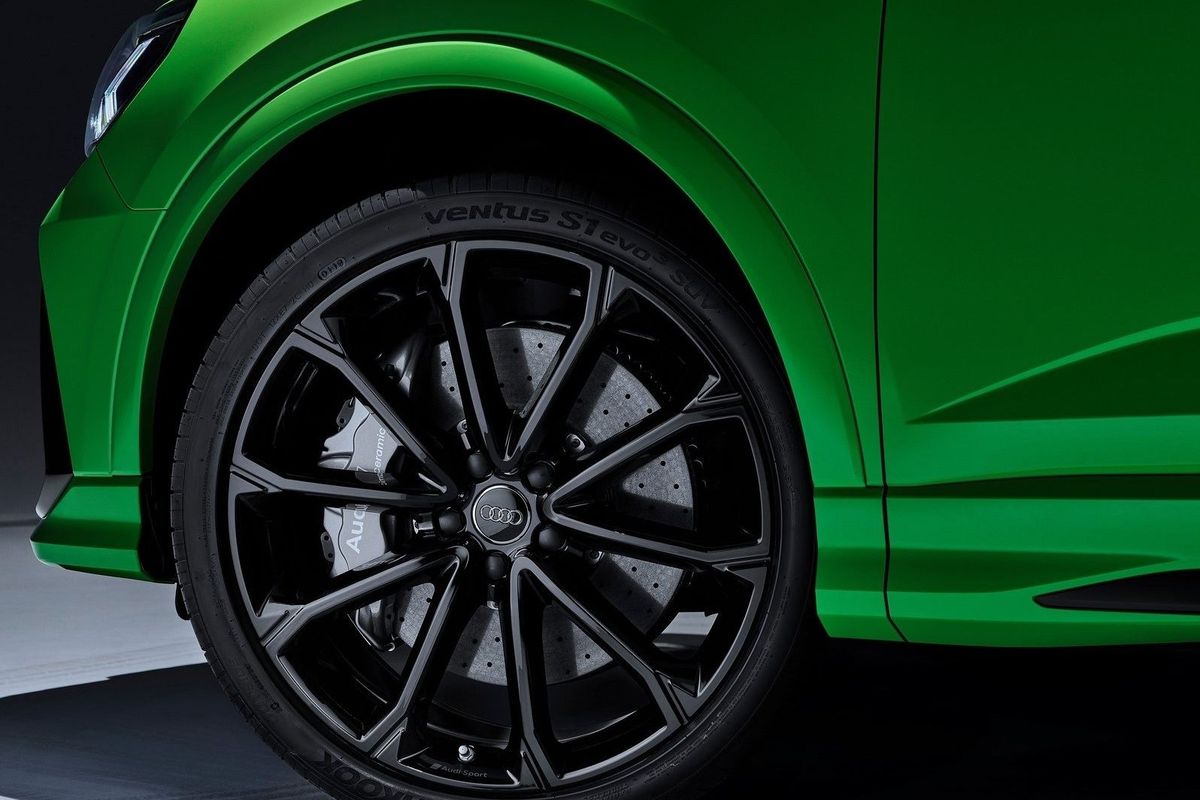
An RS sport suspension is standard, lowering the car by 10 mm compared with the regular Q3 and Q3 Sportback. RS sport suspension plus with Dynamic Chassis Control (DCC) will be offered as an option. 20-inch wheels are standard while 21-inch wheels are optional. A new 6-piston RS steel brake system with ventilated and perforated discs are fitted. RS ceramic brakes are optional.
Interior Features
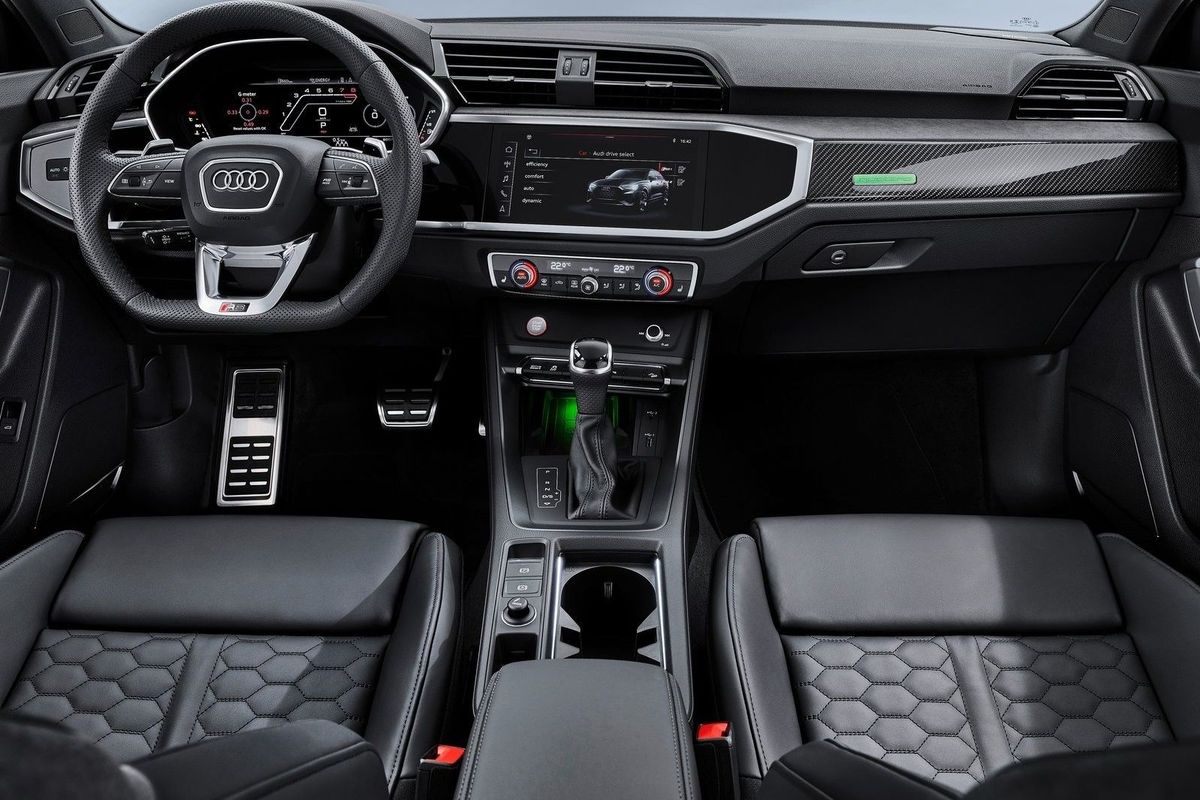
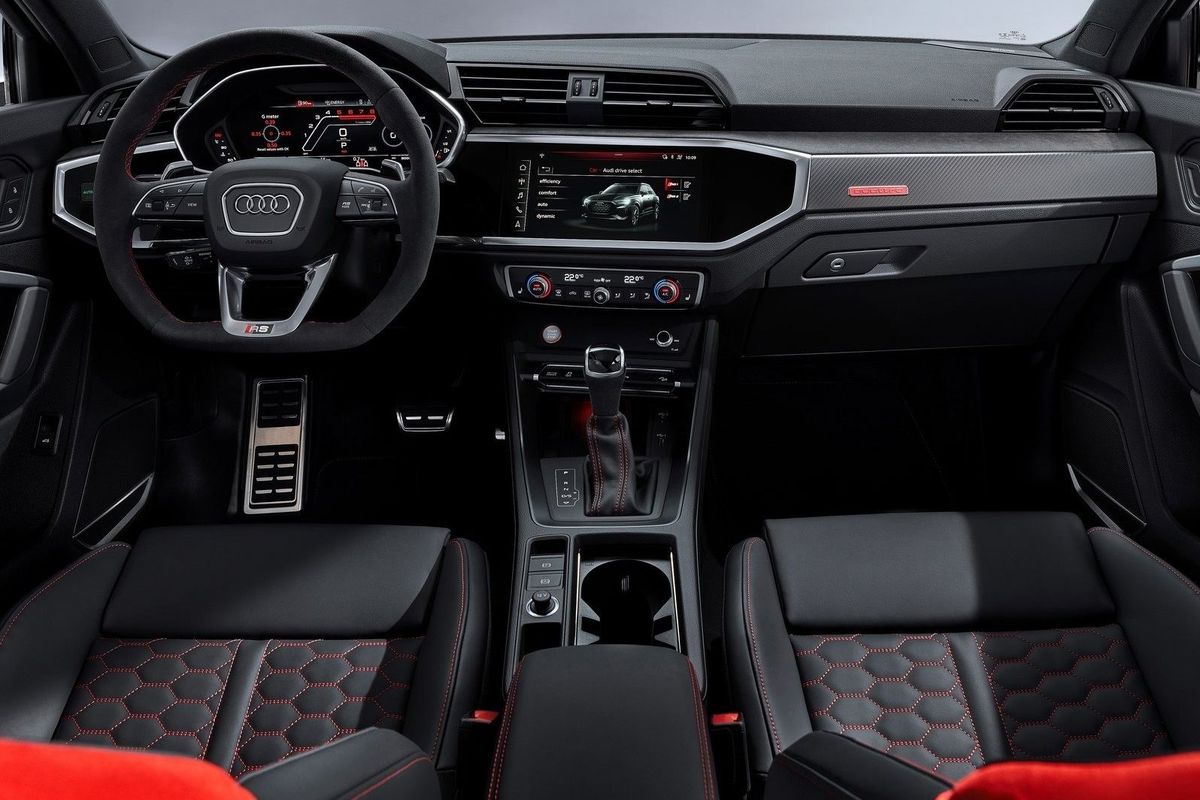
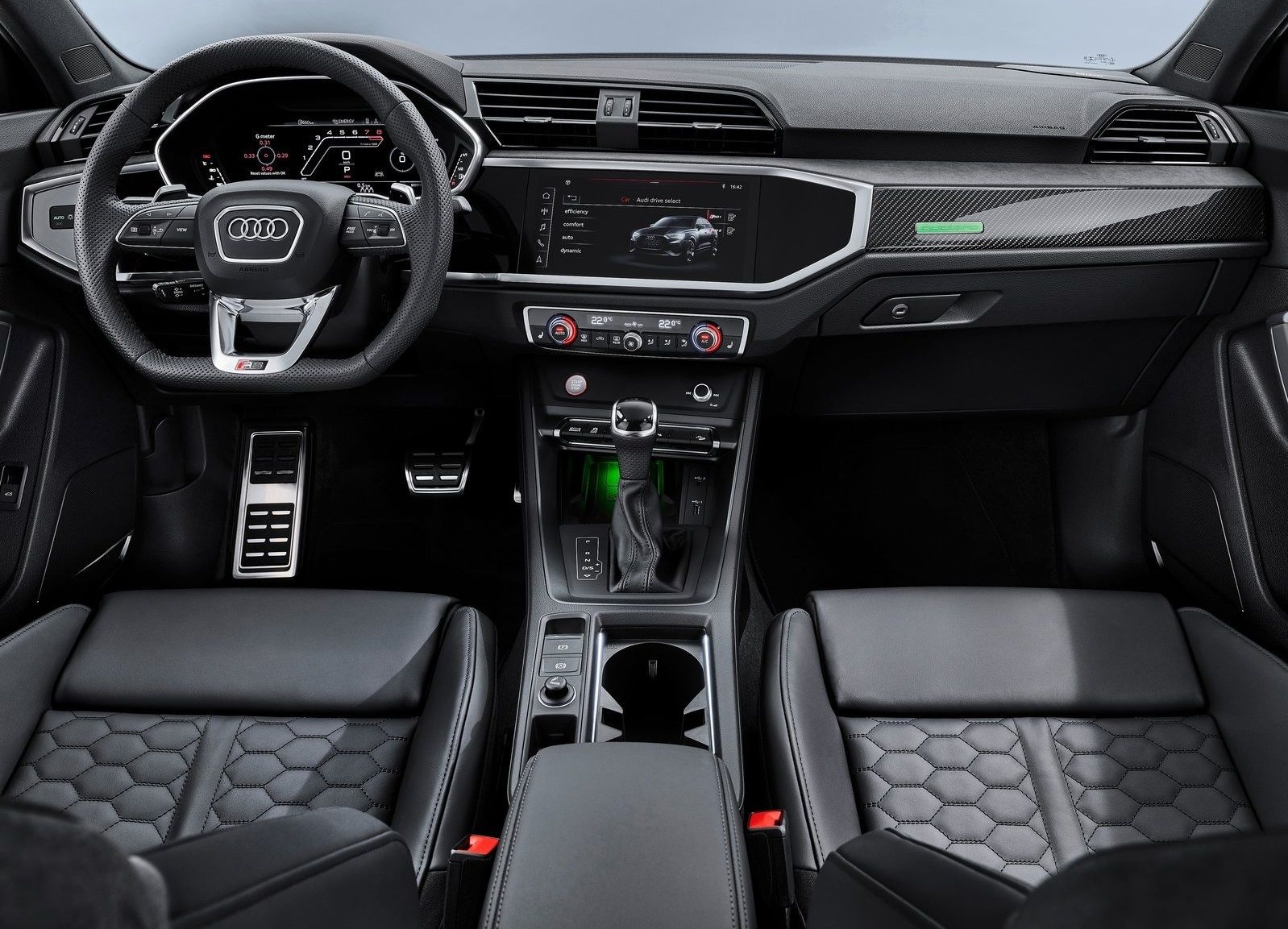
A sumptuously-styled interior with a dash of sportiness is what you can expect when you step inside the RS Q3 Sportback.
The interior is focussed around the driver with the centre console and MMI display tilted towards the driver for improved accessibility.
As you would expect Audi’s Virtual Cockpit in RS design elevates the interior (a larger version is also offered). The sport seats are wrapped in black leather and Alcantara with RS logos give a sporty touch to the cabin. Customers can also opt for RS sport seats in fine Nappa leather with an RS-specific honeycomb pattern and integrated head restraints.
The flat-bottomed RS steering wheel features newly-designed shift paddles along with multifunction controls.
In terms of practicality, both models have rear seats that can be moved fore and aft by as much as 150 mm in the RS Q3 and 130 mm in the RS Q3 Sportback. The rear seats are split 3-ways and can tilted in 7 stages. As for luggage capacity, 530 litres is offered which expands to 1 525 litres with the rear seats folded down.
Both models are slated for South Africa, you can expect to see them in SA in Q3/Q4 of 2020.
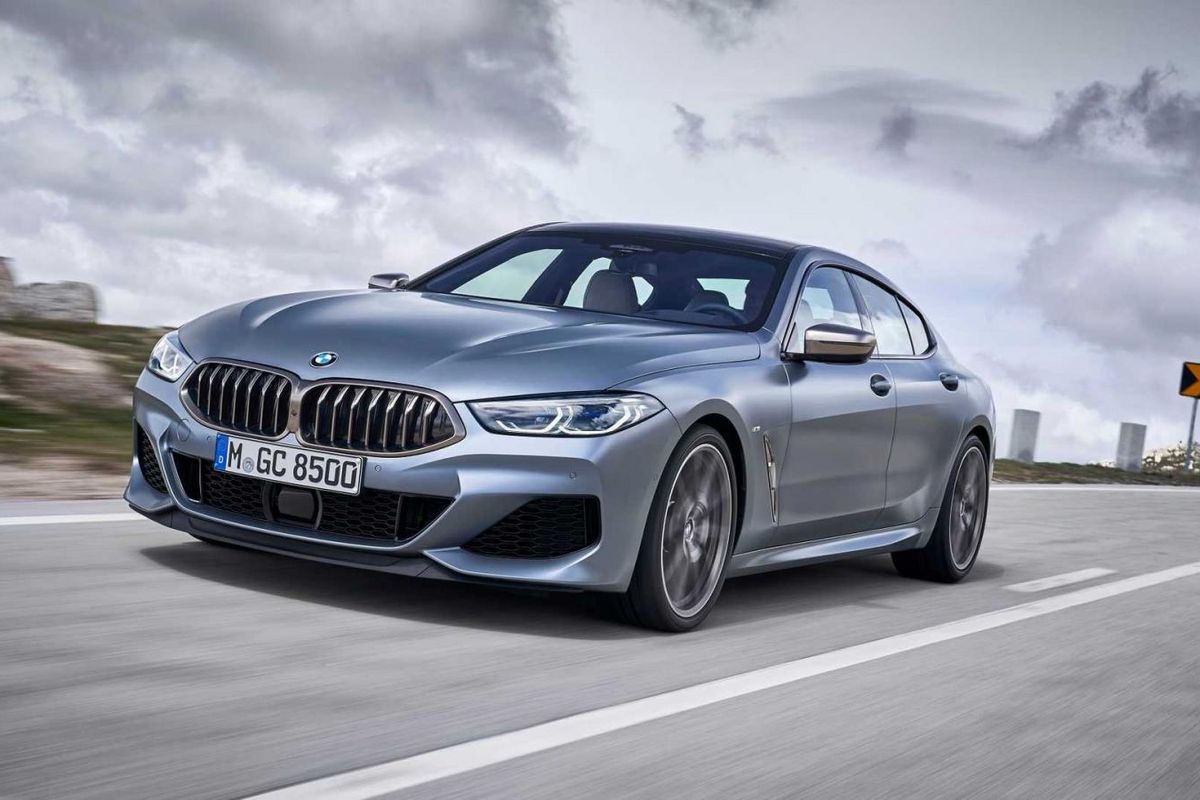
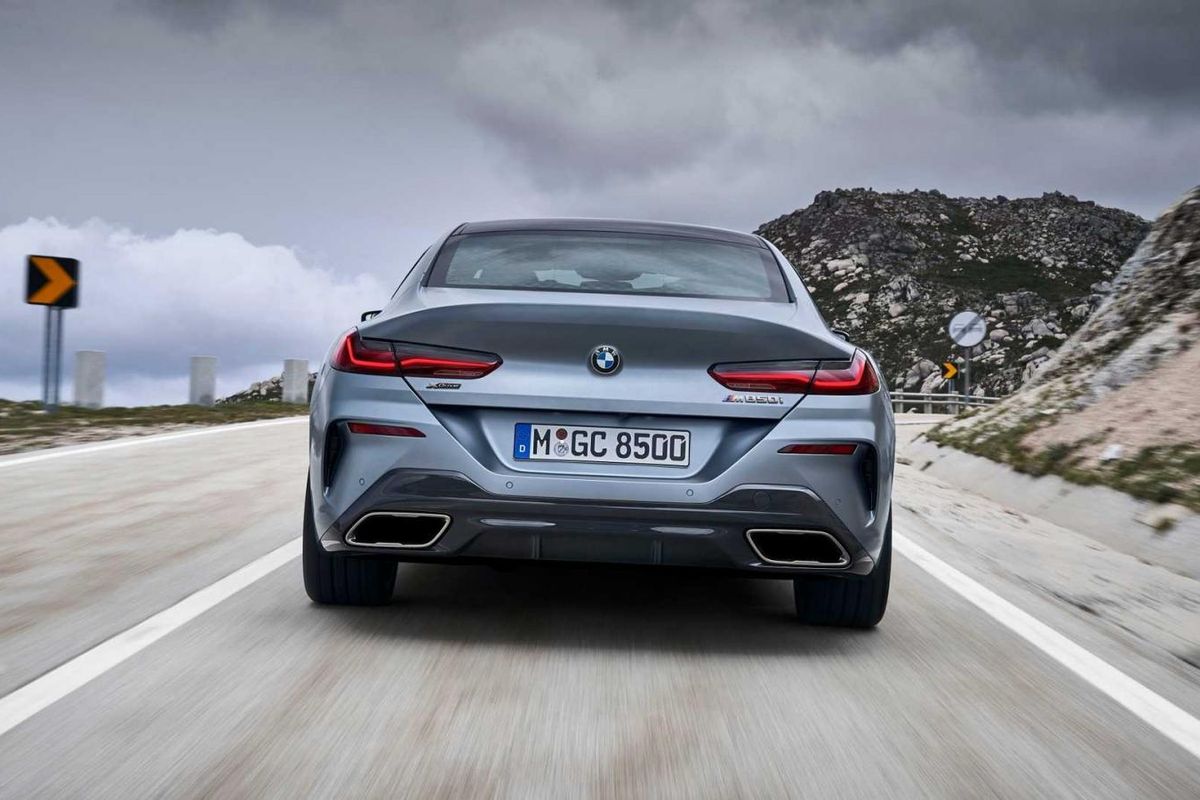
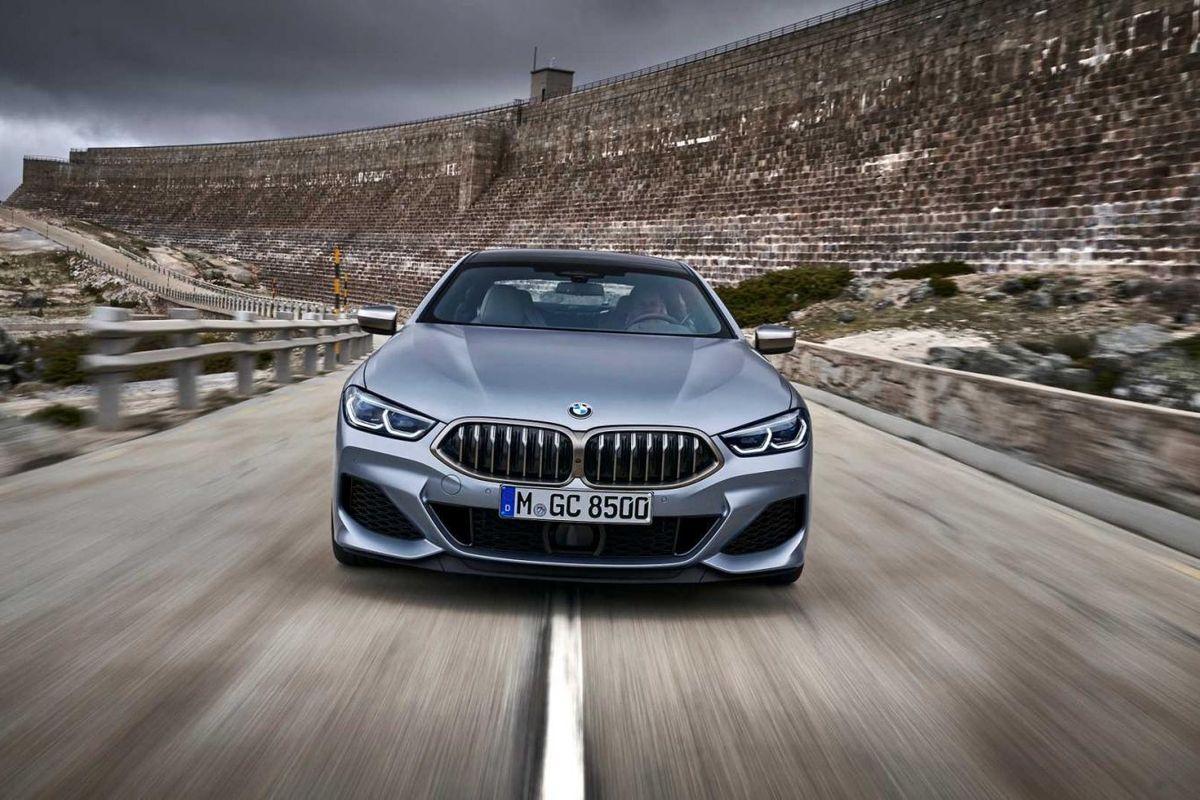
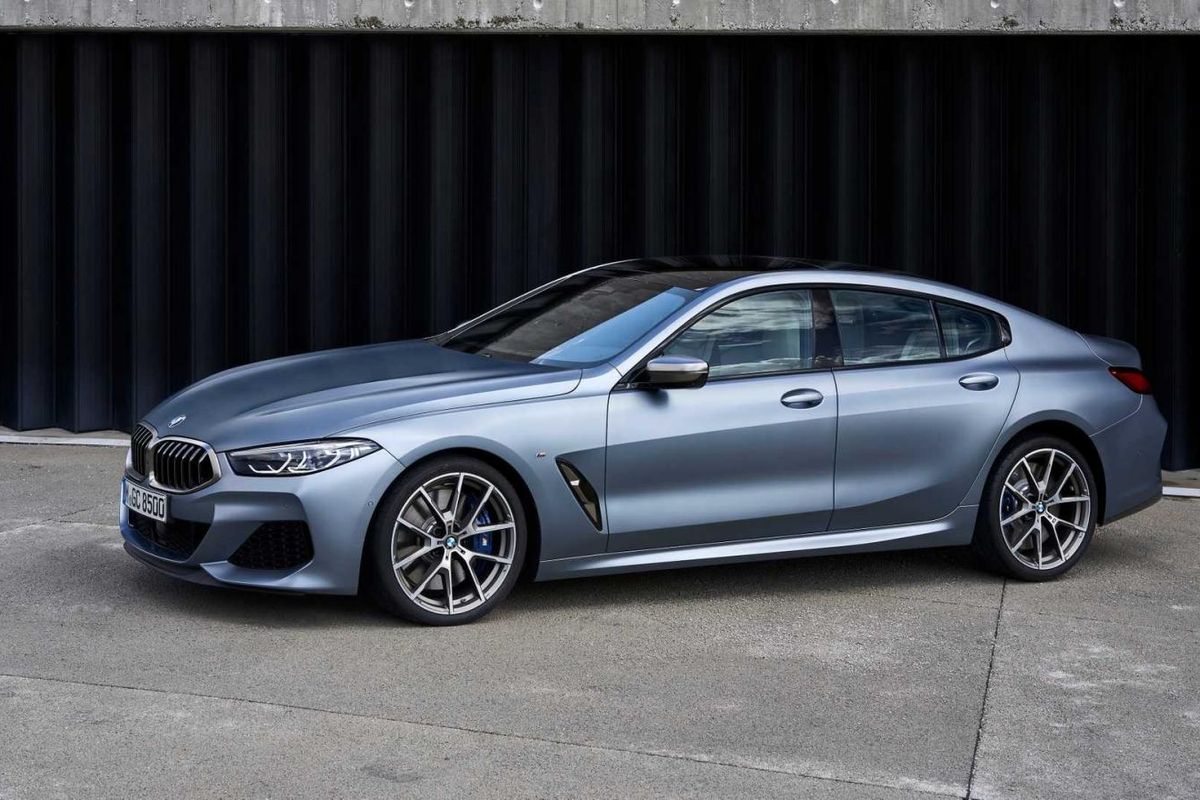
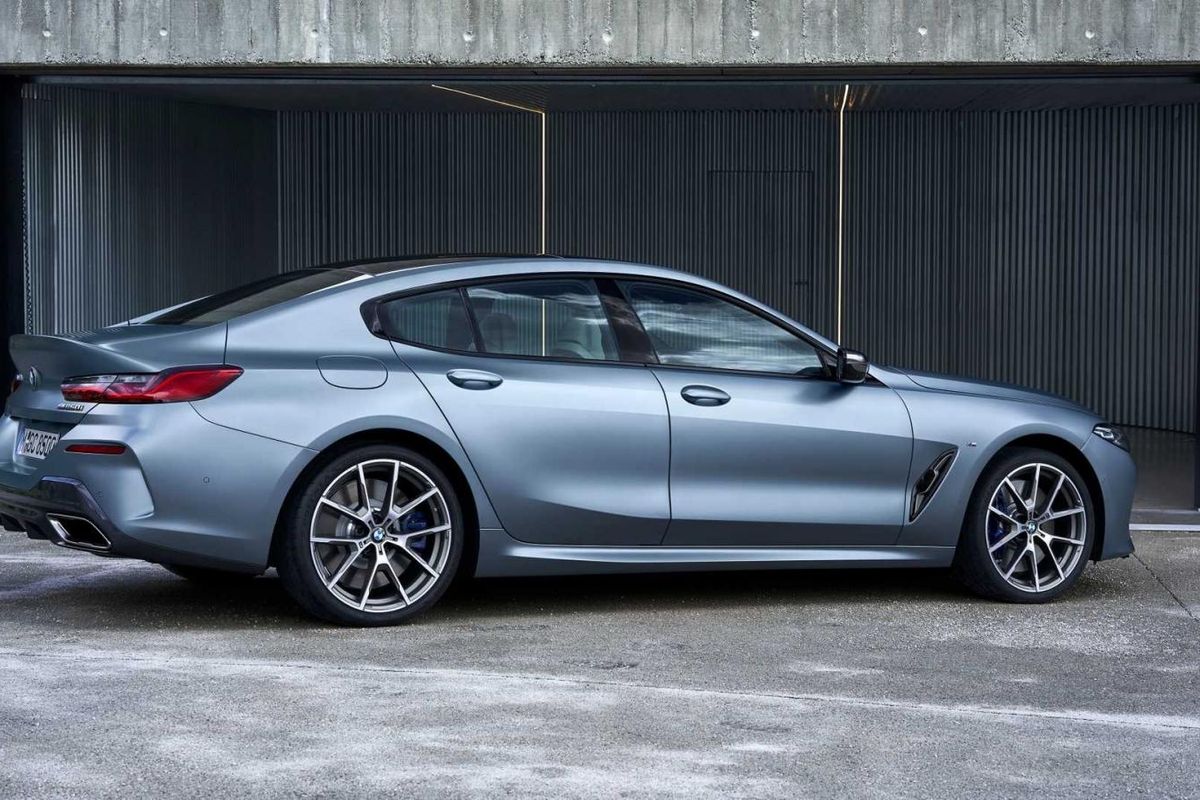
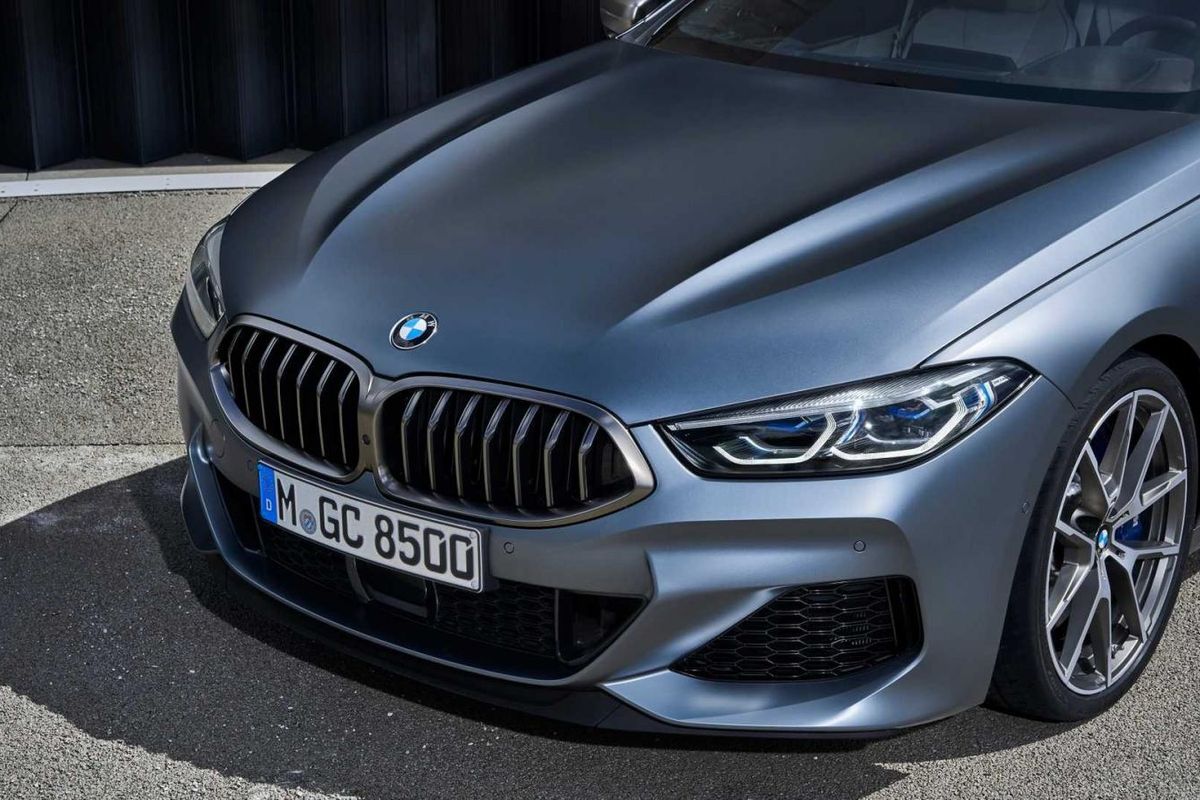
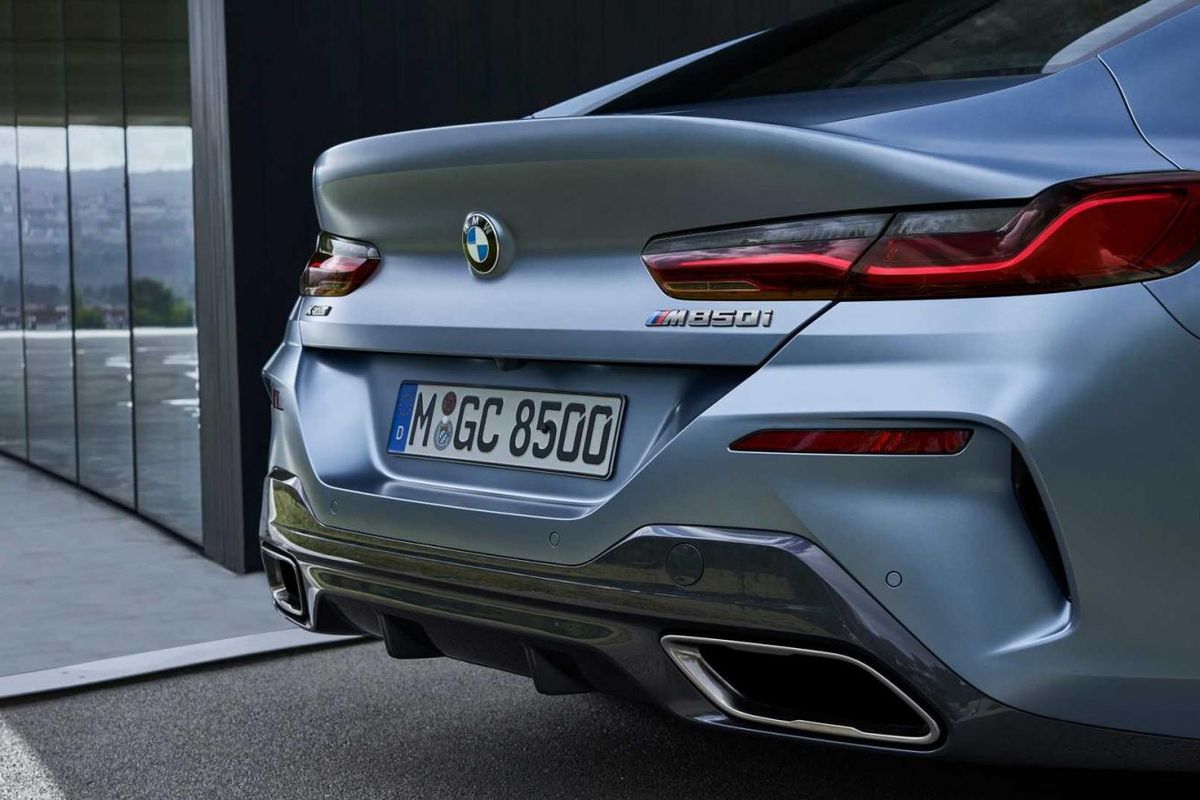
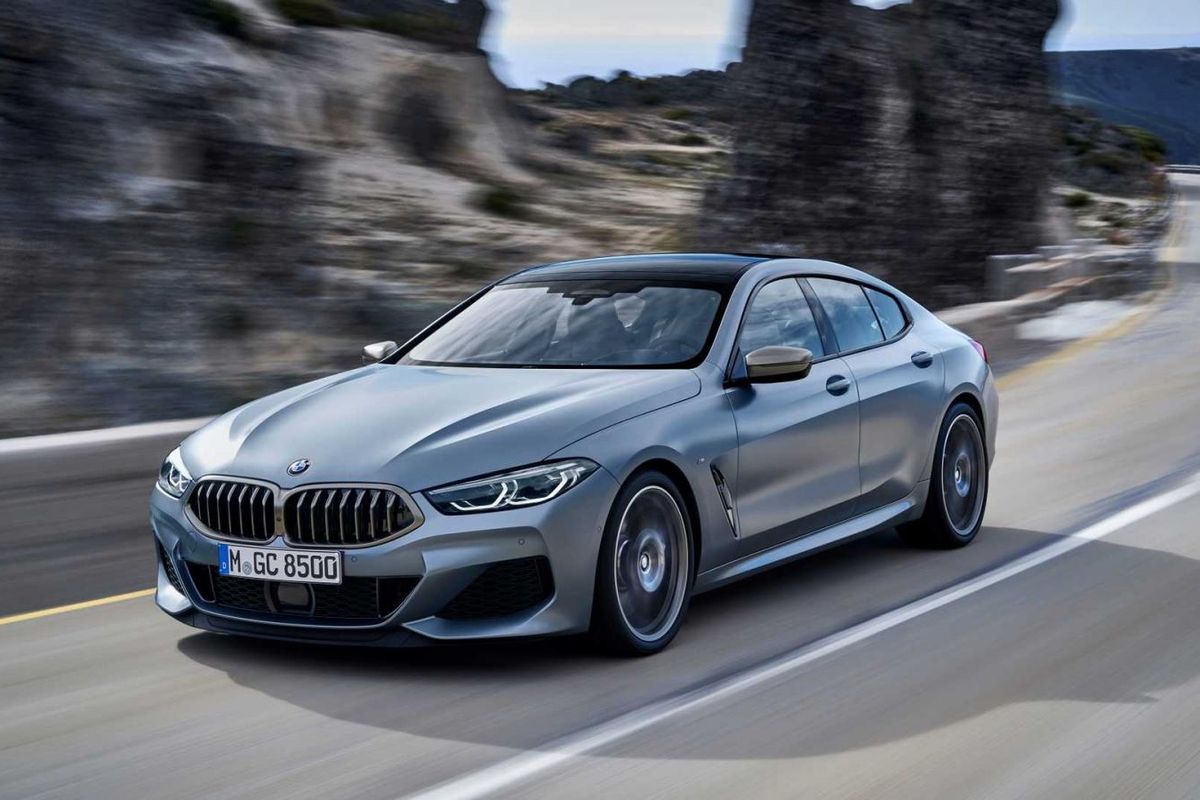
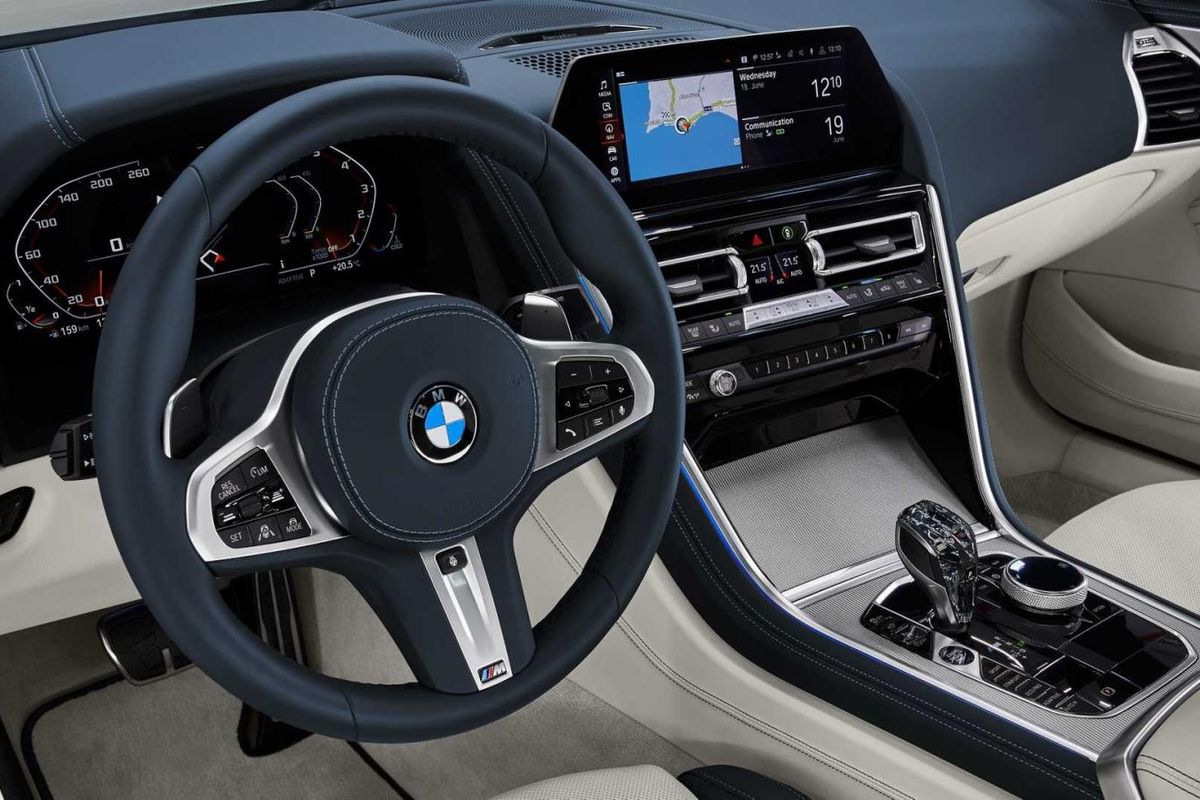
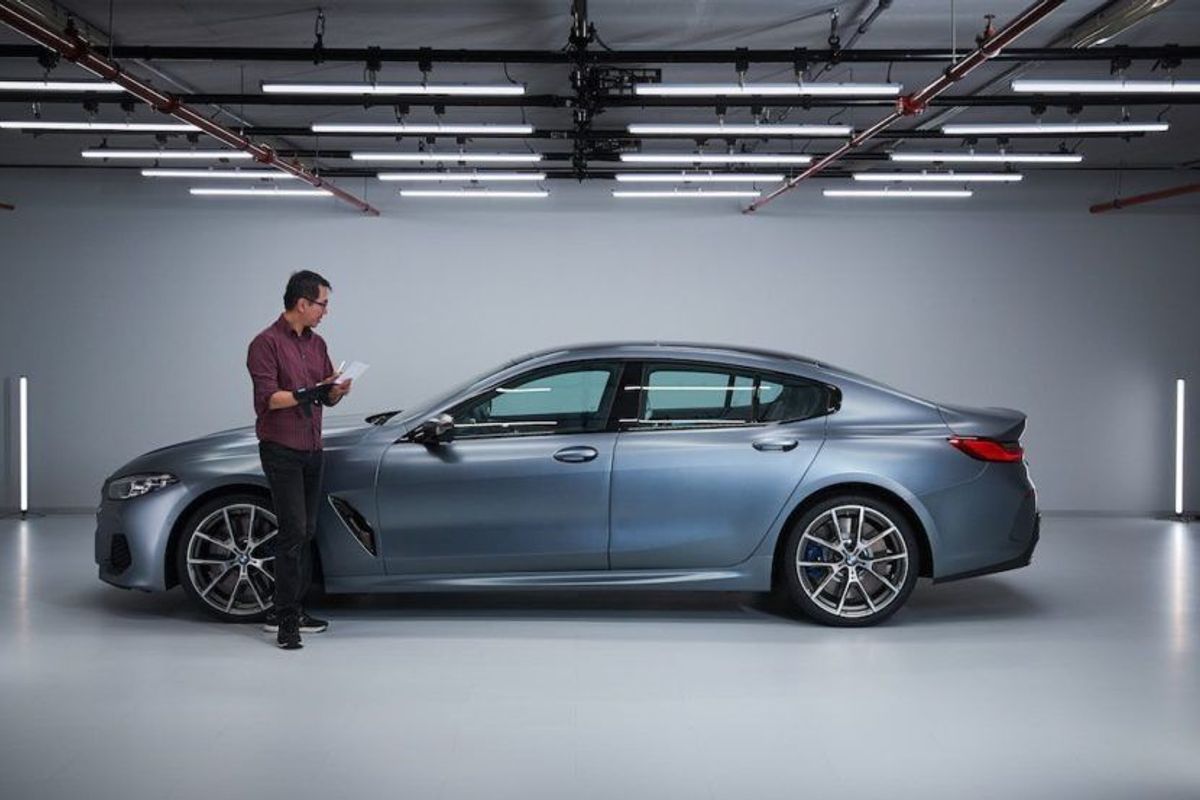
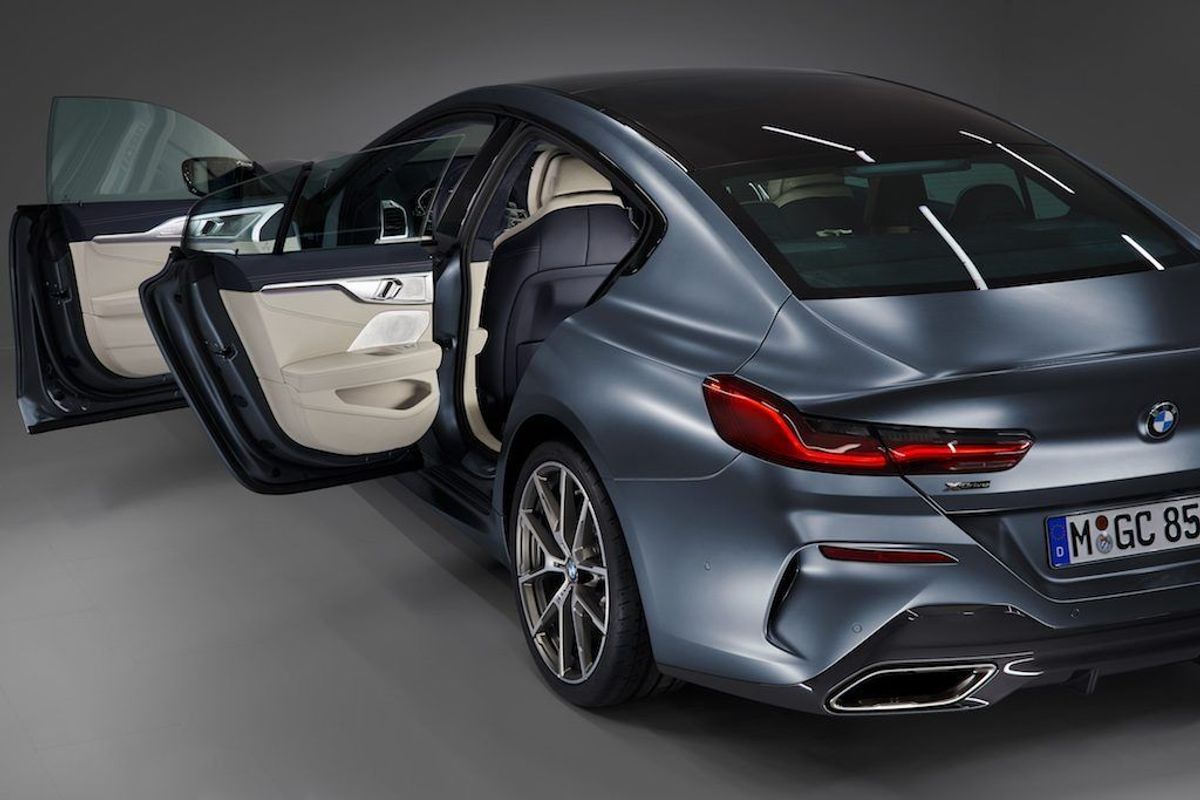
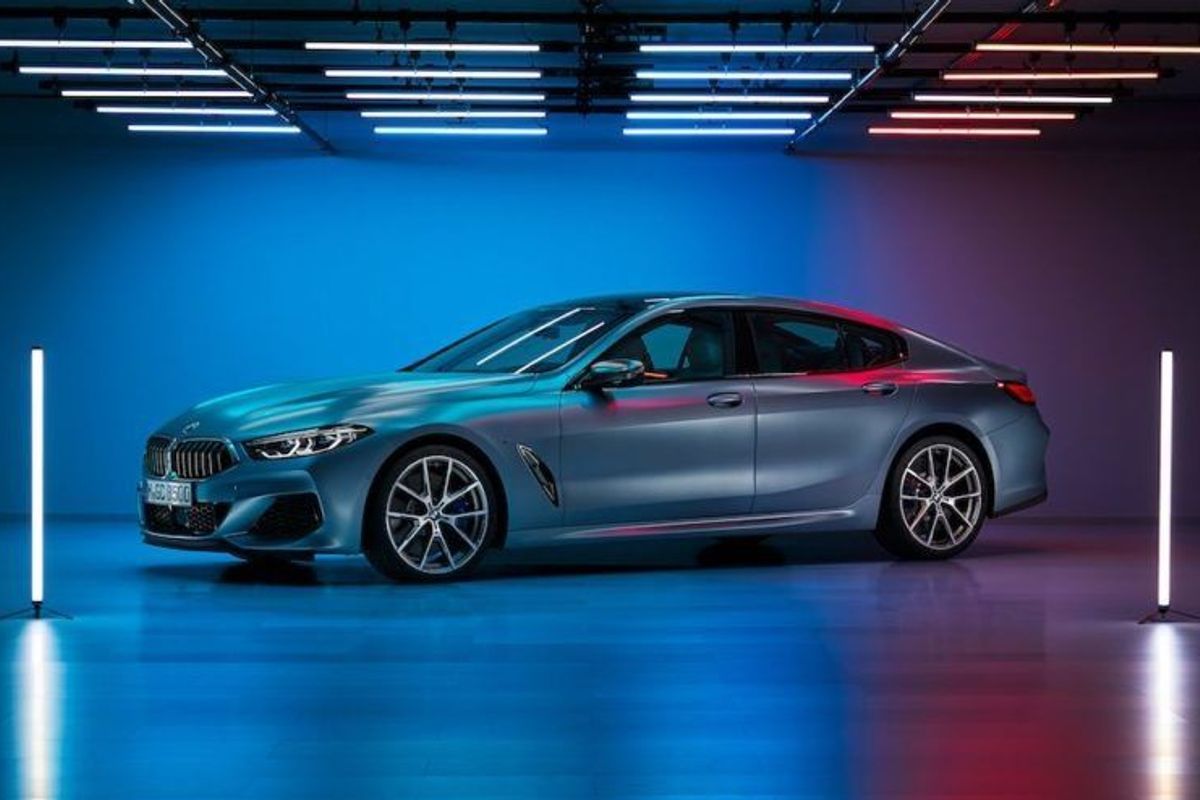
The BMW 8 Series Gran Coupe has been revealed and will arrive in South Africa in Q4 of 2019! Take a look at what this striking vehicle has to offer and how much it costs…
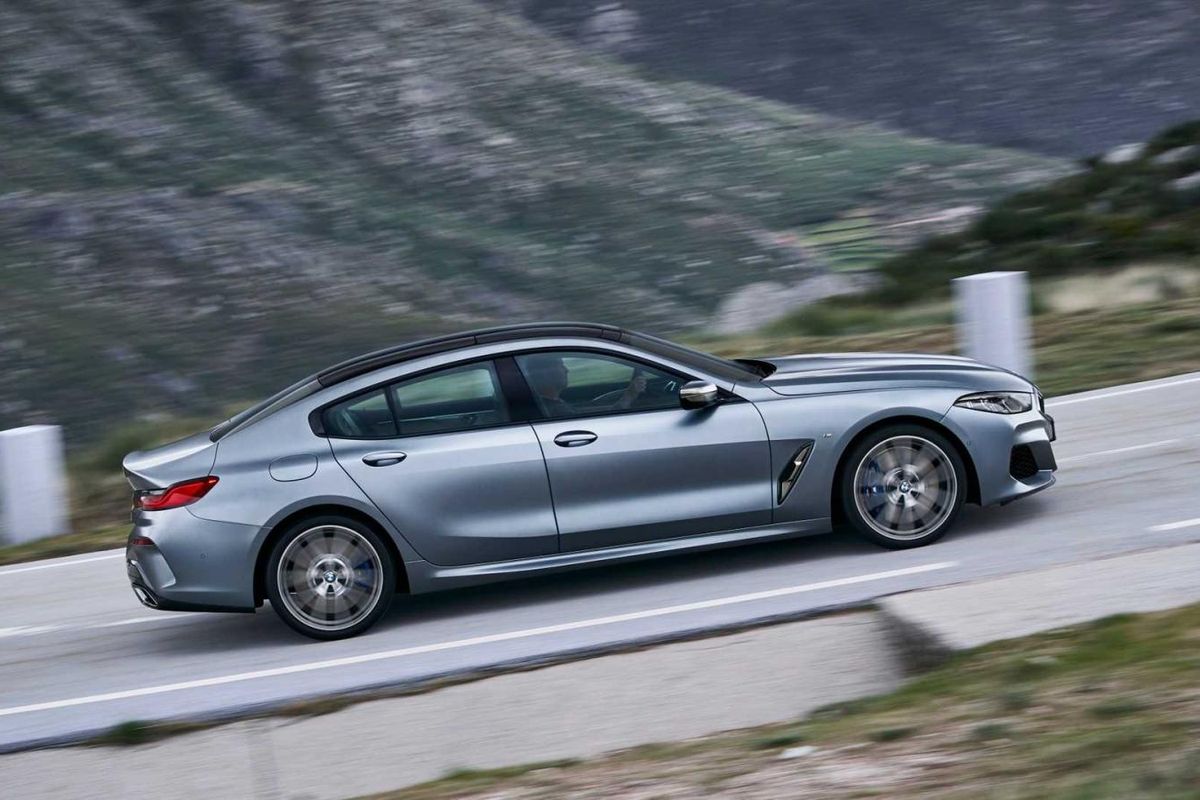
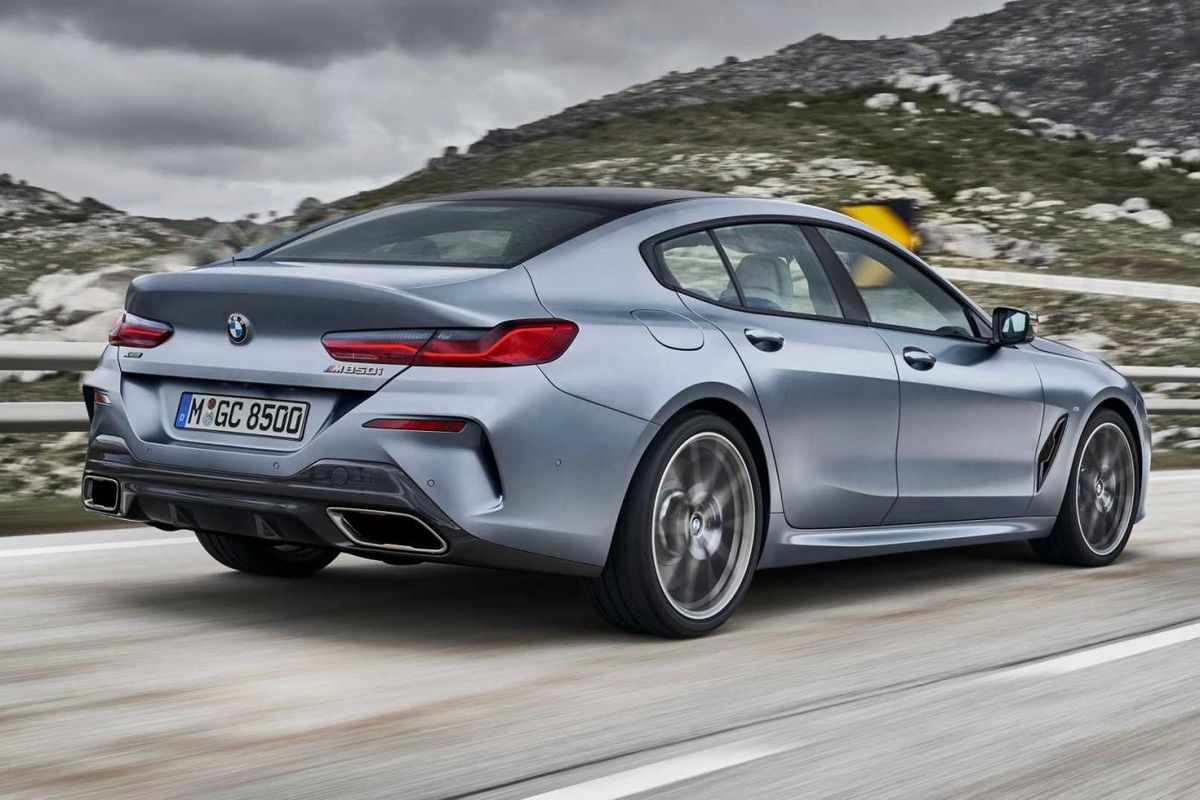
The BMW 8 Series is available in coupe and convertible versions, with an assortment of engines to choose from. The range has now been bolstered with the addition of a 4-door Gran Coupe which is due to make its worldwide launch in September 2019.
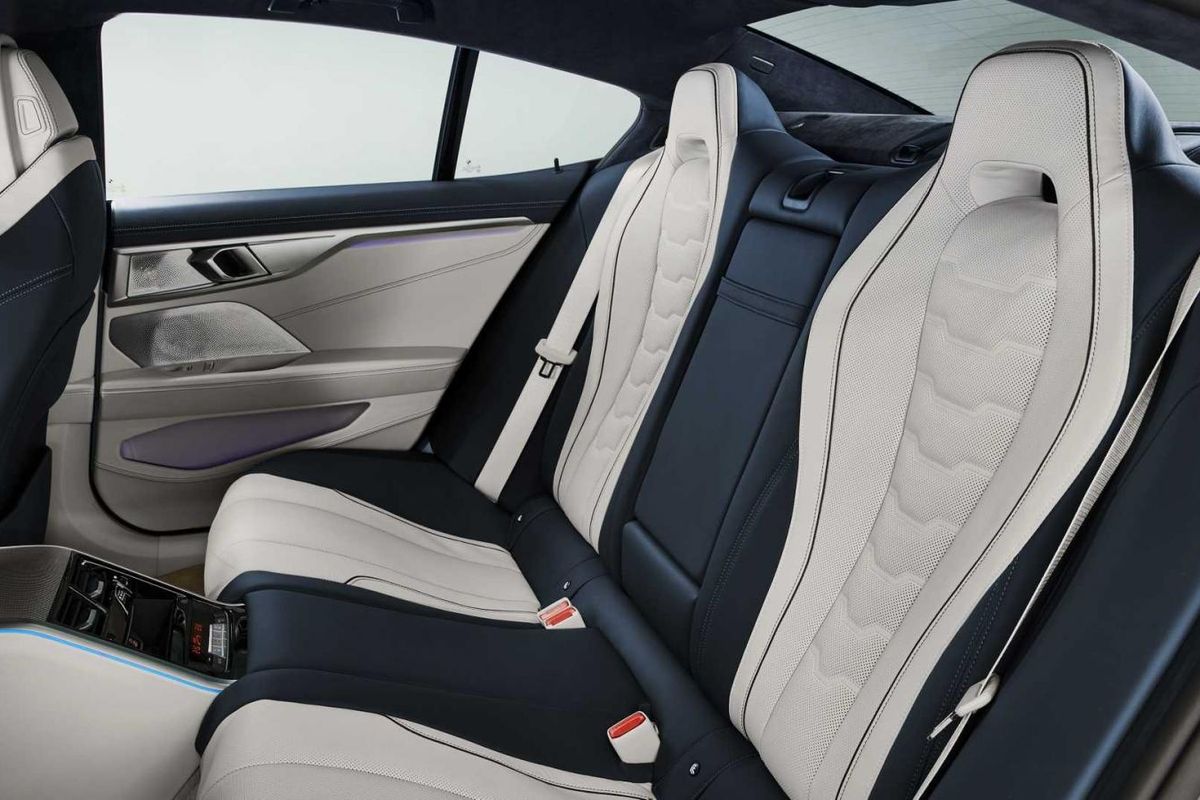
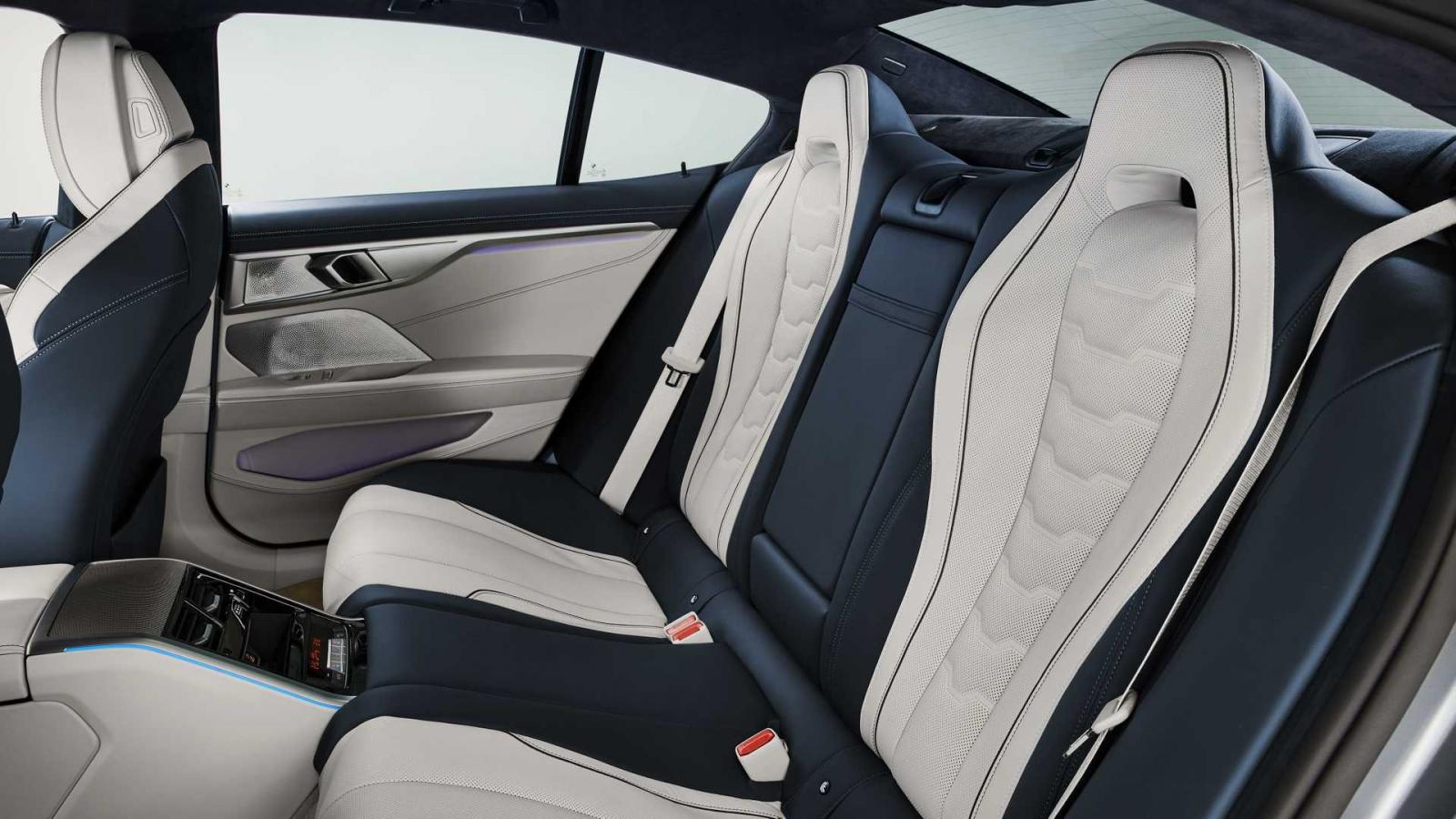
The addition of 2 doors means more cabin space, which rear passengers will appreciate and its wheelbase, at 3 023 mm, is 201 mm longer than the 8 Series Coupe and it stands 5 082 mm in length, 1 932 mm wide and 1 407 mm high. The 8 Series Gran Coupe's rear track width is the widest in BMW's entire lineup at 1 671 mm.
In terms of engines, there'll be the range-topping M850i with its 4.4-litre twin-turbocharged V8 producing 390 kW and 750 Nm and capable of sprinting from zero to 100 kph in 3.9 seconds. Fuel consumption is claimed at between 9.9 – 10.0 L/100 km.
A newly-developed, twin-turbocharged 3.0-litre in-line 6 engine with 250 kW and 500 Nm of torque in the rear-wheel drive 840i and all-wheel drive 840i xDrive will also be on offer. Zero to 100 kph will take only 5.2 seconds while the quicker rear-wheel drive version will take just 4.9 seconds. Fuel consumption for the 840i is claimed at 7.4 – 7.5 L/100 km while the 840i xDrive claims 7.7 – 7.8 L/100 km.
A 3.0-litre, 6-cylinder turbodiesel diesel engine which produces 235 kW and 680 Nm in the 840d is also available and zero to 100 kph will take 5.1 seconds. Fuel consumption is claimed at between 6.2 – 6.3 L/100 km. An 8-speed Steptronic transmission delivers power to the road and all engine variants have been confirmed for introduction in South Africa in Q4 of 2019.
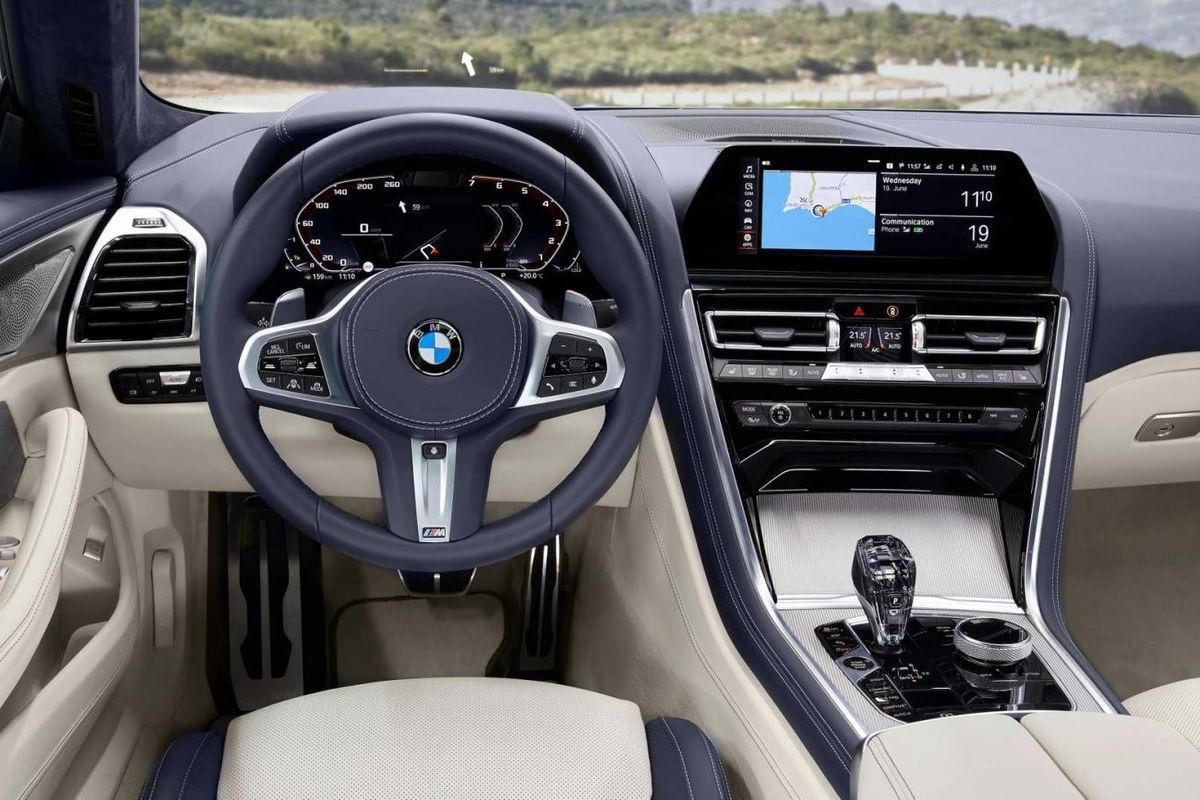
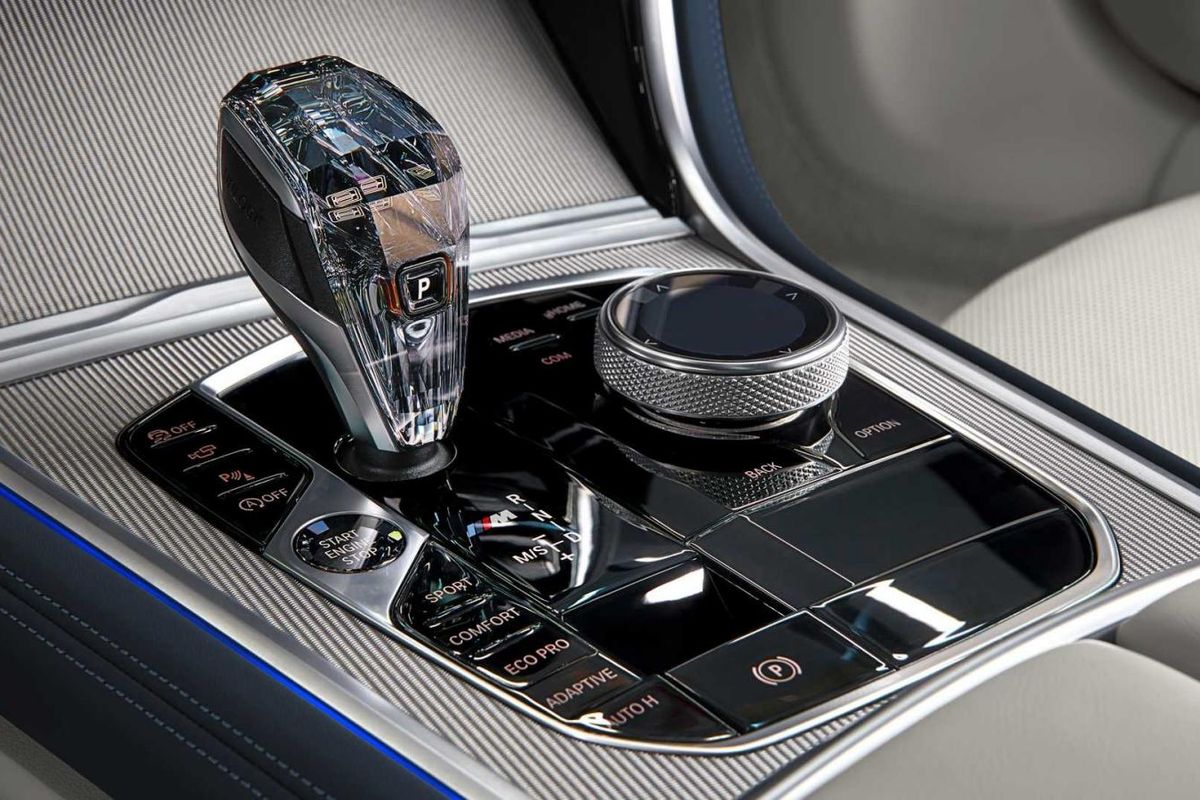
As you can expect, the interior of the 8 Series Gran Coupe is focussed not only on the driver, but also on offering luxury and comfort for all in transit. The cabin features high-quality finishes swathes of leather as standard. BMW's fully digital Live Cockpit Professional is standard, comprising the 12.3-inch instrument cluster and 10.25-inch control display which also houses a navigation system. As always a wide range of optional equipment will be offered so that you can customise your 8 Series Gran Coupe to your heart's desire and buyers can choose between a Harman Kardon Surround Sound System or a Bowers & Wilkins Diamond Surround Sound System.
BMW 8 Series Price in SA
The vehicle is scheduled to arrive in SA towards the end of the year.
BMW 840i R1 377 590
BMW 840d xDrive R1 462 916
BMW M850i xDrive R1 843 112
The addition of 2 doors improves practicality in the new BMW 8 Series Gran Coupe.
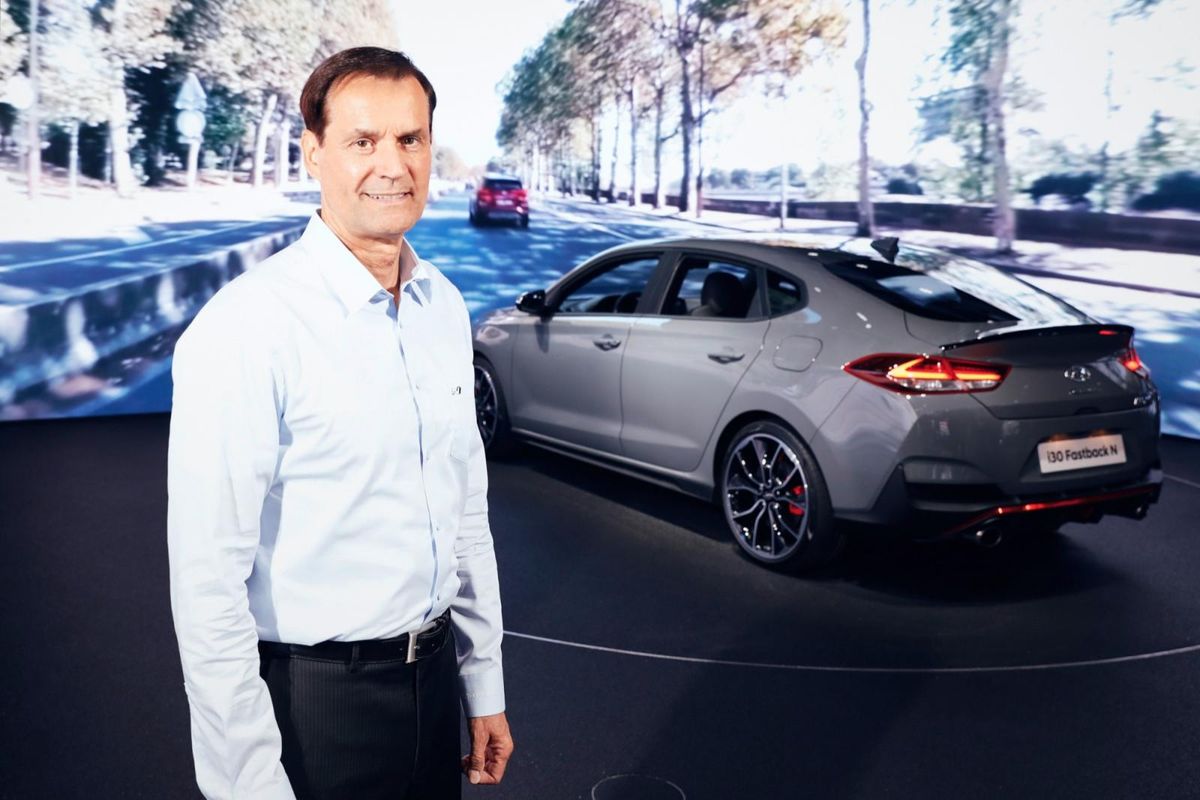
Premium, sporty and efficient – three things that seemingly every brand wants to be these days. So, within this challenging context, how does a global powerhouse create differentiation between its 2 main brands, Hyundai and Kia, nevermind a 3rd (Genesis)? We spoke to Thomas Schemera, Hyundai executive vice president and the head of Hyundai Motor Group's product division, to find out.
Few will disagree with the statement that Hyundai and sister brand, Kia, have come a long way since the days of the early Elantras and Sportages. These days, most South African car buyers will probably consider either brand's products when purchasing their next vehicles, along with a long list of other nameplates. But while this is all good and well (and has seen Hyundai, in particular, becoming a volume player in Mzansi), a lack of clear distinction between the 2 main brands (Hyundai and Kia) means that the one is often bought instead of the other – this is called cannibalisation.
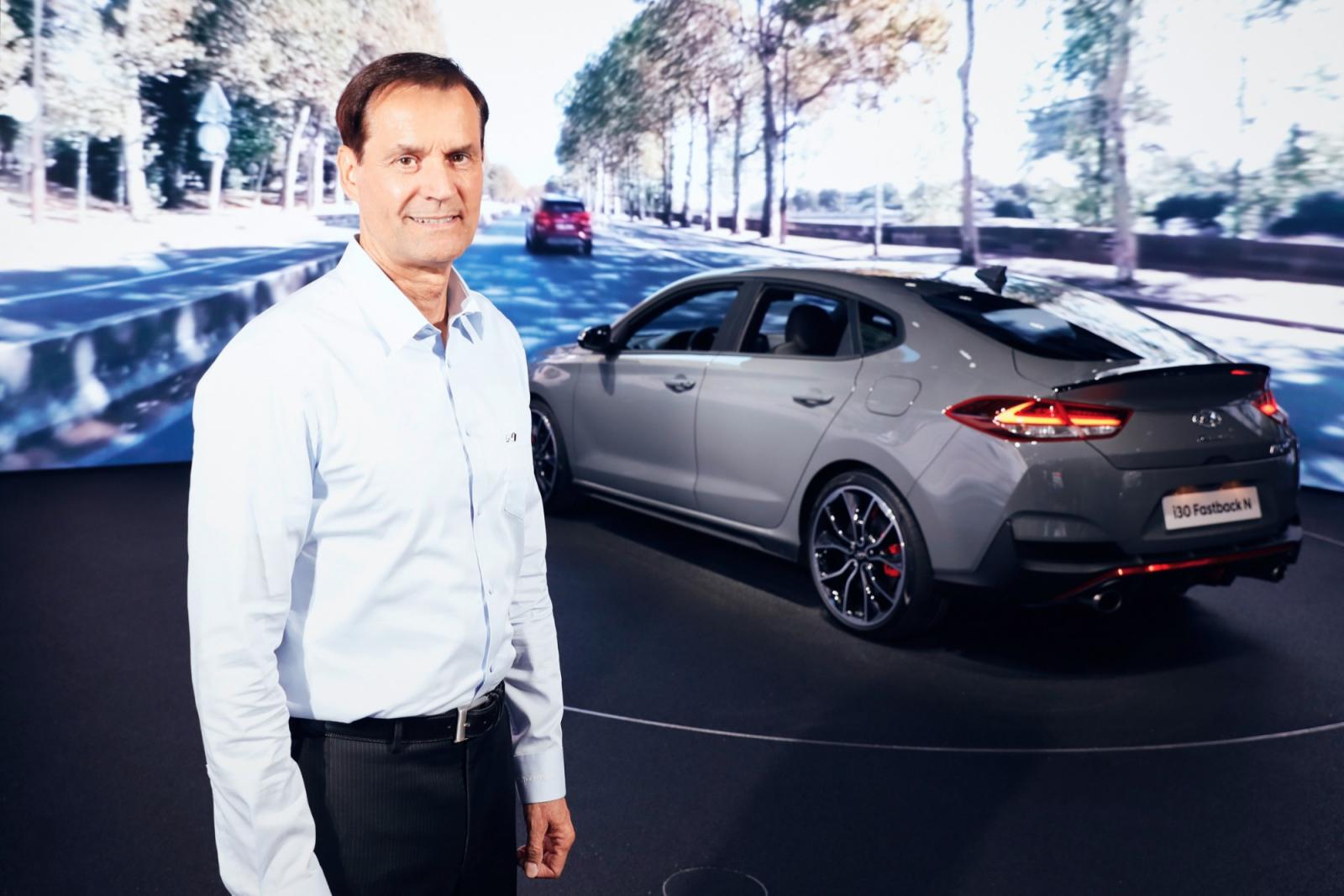
Thomas Schemera is another BMW M-man that joined the Korean marque in 2018.
We caught up with Thomas Schemera, an engineer with a long history at BMW M behind him, who joined Hyundai in 2018 as head of the Korean manufacturer's High Performance and Motorsport division, working closely with Albert Biermann, another high-ranking German engineer pinched from BMW (who oversaw the development of such cars as the Kia Stinger and Hyundai i30N).
Q: In a world where all the brands seem to want to be the same… premium, sporty and efficient… how do you create differentiation for brands such as Hyundai and Kia?
TS: "This is exactly what we've been thinking about… a lot. It is our first priority to differentiate the brands in terms of their roles in the medium to long term and also their respective products. So we are working – I don't want to tell you too much – on the assignment of new roles to each and every brand, because in former times, we were fighting – cannibalisation or substitution often occurred. This is exactly what we don't want.
"Don't get me wrong, competition is not that bad, but internal competition, or if you get customer feedback that suggests most of our customers have considered Hyundai and Kia in the same segment, this is a trend we have to curtail. And that's why we've said, in the foreseeable future we will set up products and services, for our customers first and foremost, but according to the assignment of the individual brand roles.
"It's also a matter of balancing the level of product diversification, working out what serves the market best and to provide products and services tailored to specific market requirements – this is what we really need."
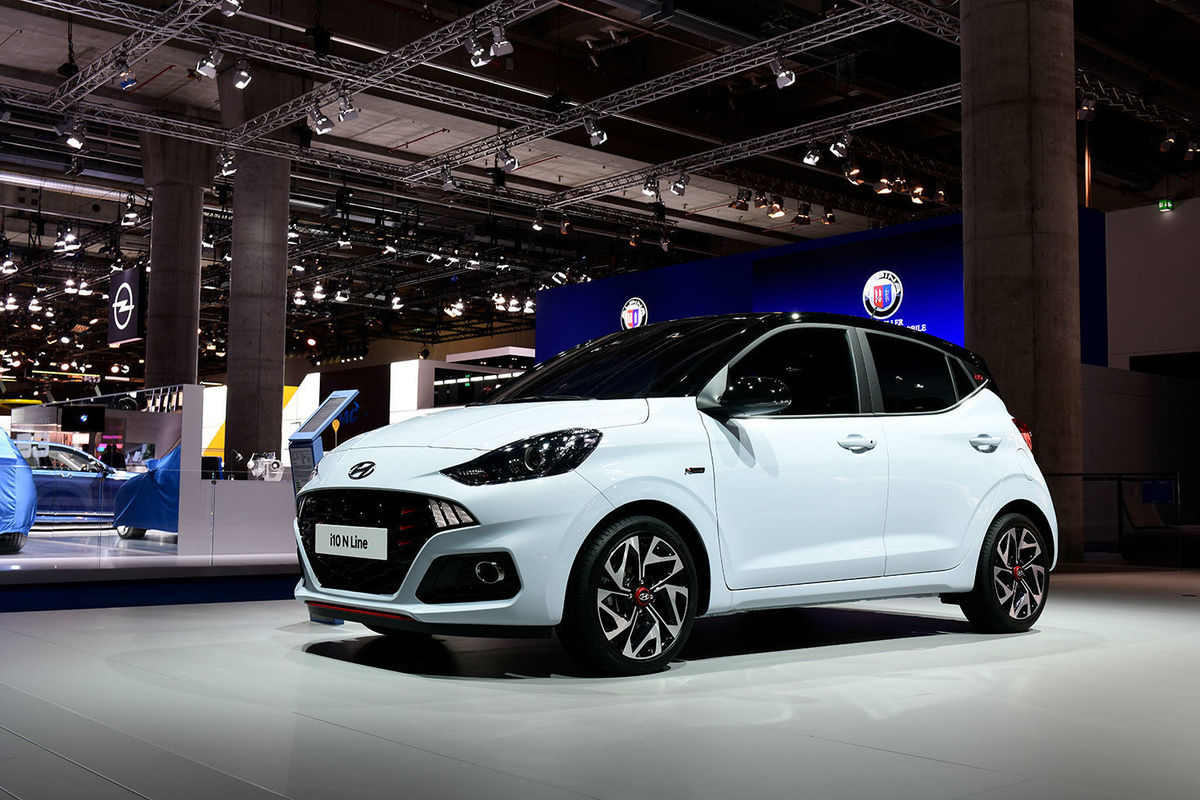
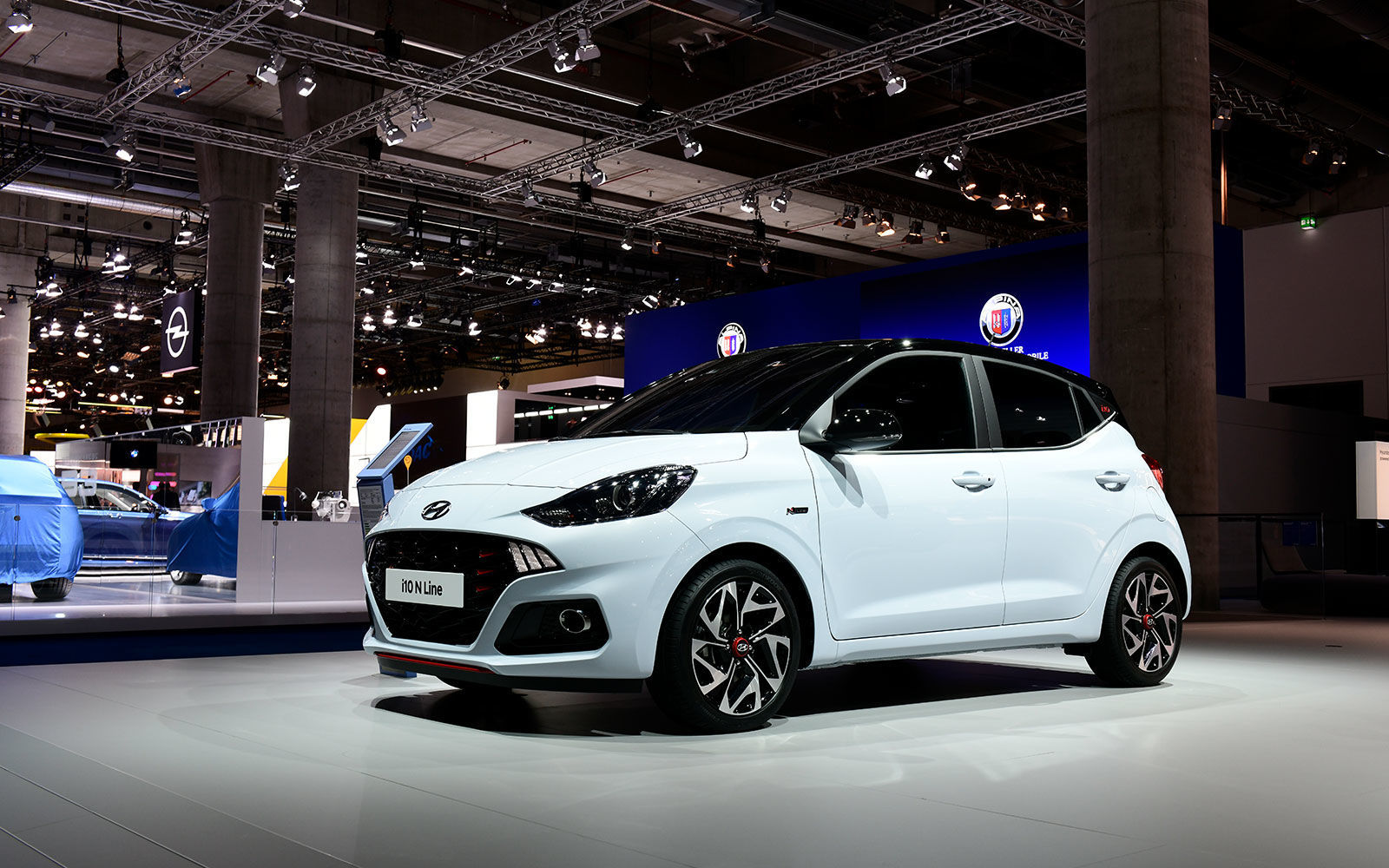
Hyundai launched its new i10 at the Frankfurt Motor Show, but South Africa's variant will be slightly different.
It's also worth noting that Luc Donckerwolke, head of design for the Hyundai Group, recently said that although design will play a big role in differentiating between the 3 brands, it is also keen to avoid the "cookie-cutter" method of design where each new model just looks like a bigger or smaller version of an existing one. Donckerwolke suggests that the Korean brands will bring in differentiation "by region and by segment".
Does that mean the Hyundai brand identity might be different in South Africa, to what it is, for example, in France?
"Yes, to a certain extent. We'd like to lessen complexity, to simplify things, also in the framework of electrification. Everything has to be simplified, but a Hyundai – in terms of sportiness, driving dynamics – needs to perform differently to a Kia. Kia and Hyundai must have distinct characters.
"Everything starts with the brand, and then trickles down to the segmentation of customers, and you have a design language which is based – and this is very important – on the brand identity and then trickles down to different product 'characters'. Each and every brand will get a specific role."
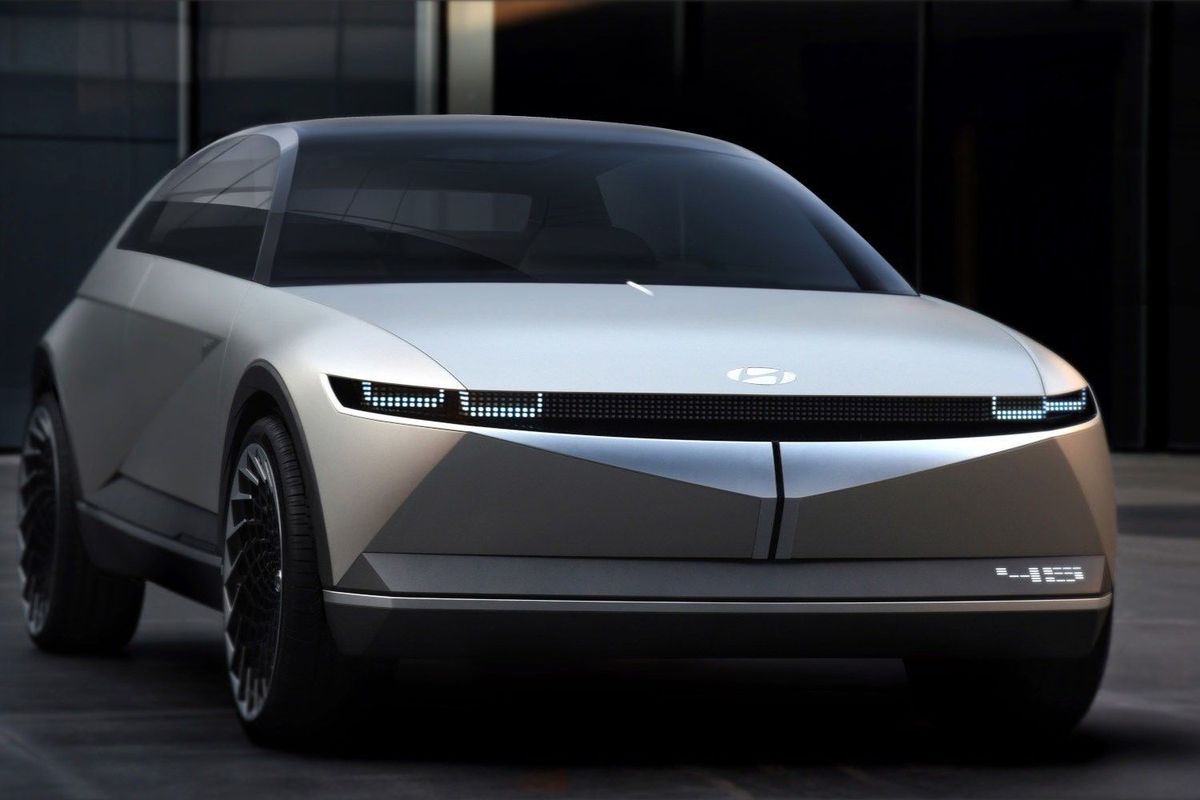
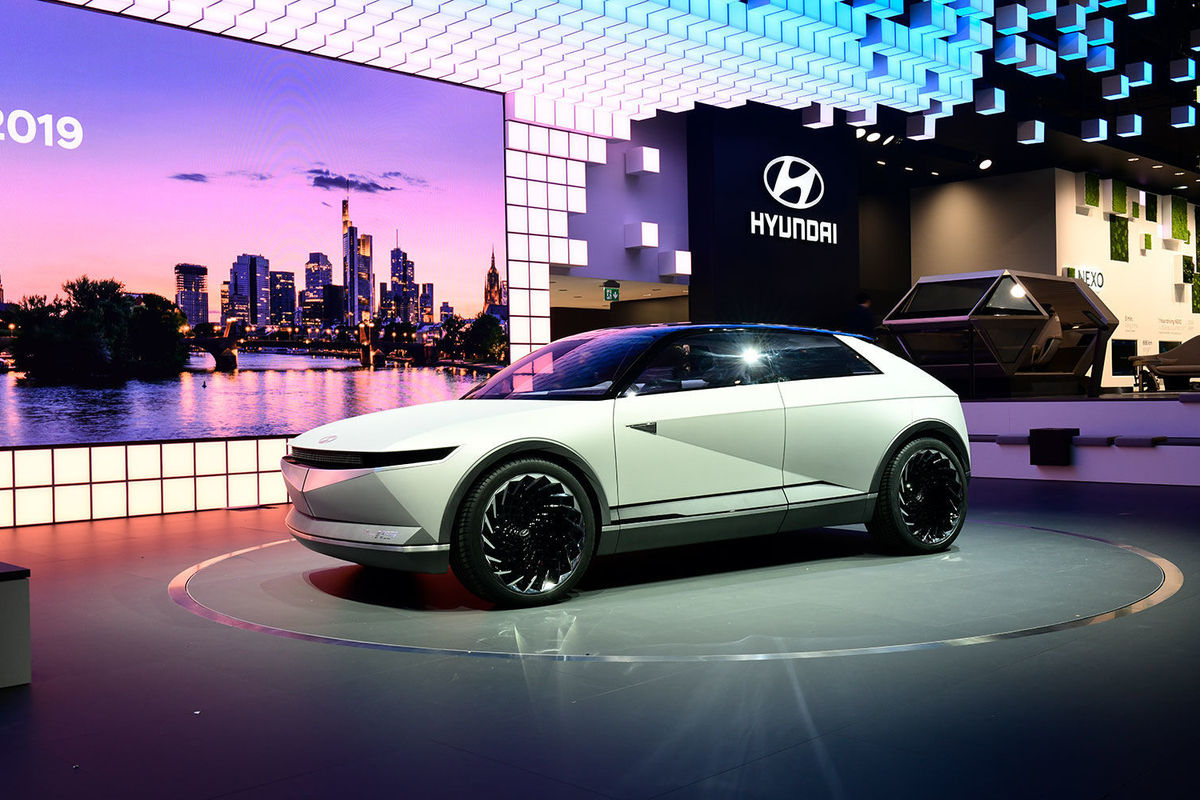
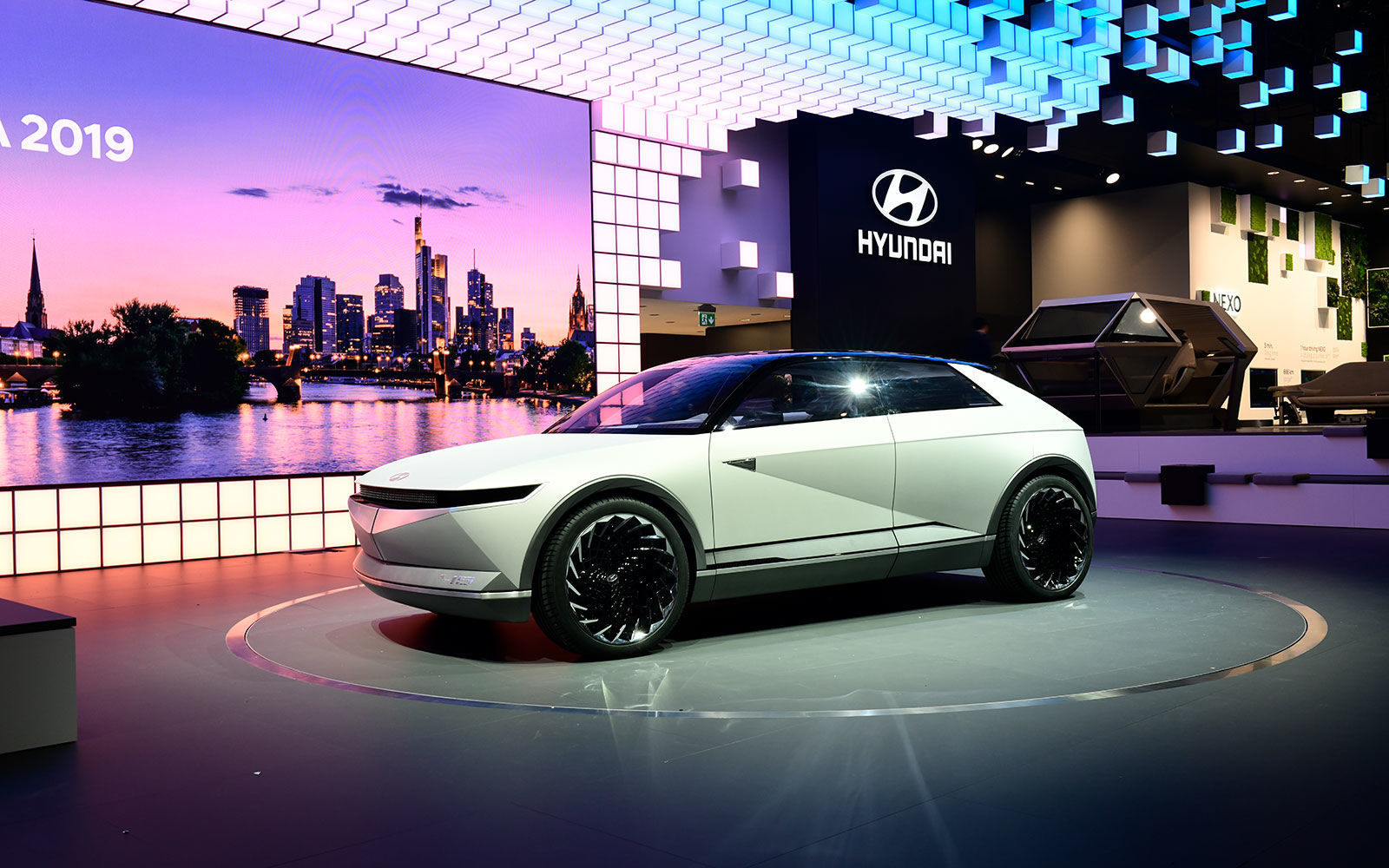
Inspired by the original "Pony", the 45 hints at the brand's new design identity (at least for the EVs).
In short, what will be the difference between Hyundai and Kia?
"Kia is a dynamic, young, sporty and chic brand that is keen to try new things, which are not really traits that it shares with Hyundai. Hyundai is more about 'sensuous sportiness', it's a more mature brand. Take Volkswagen and Seat for example… Volkswagen has a Golf GTI… a very sporty car, but Volkswagen stands for quality. This is what we think of for Hyundai as well… "modern premium", but that doesn't mean boring. We have a different idea and this starts with our new brand identity and a new brand role, which is still being defined. Our "45" is a Hyundai and anything not boring."
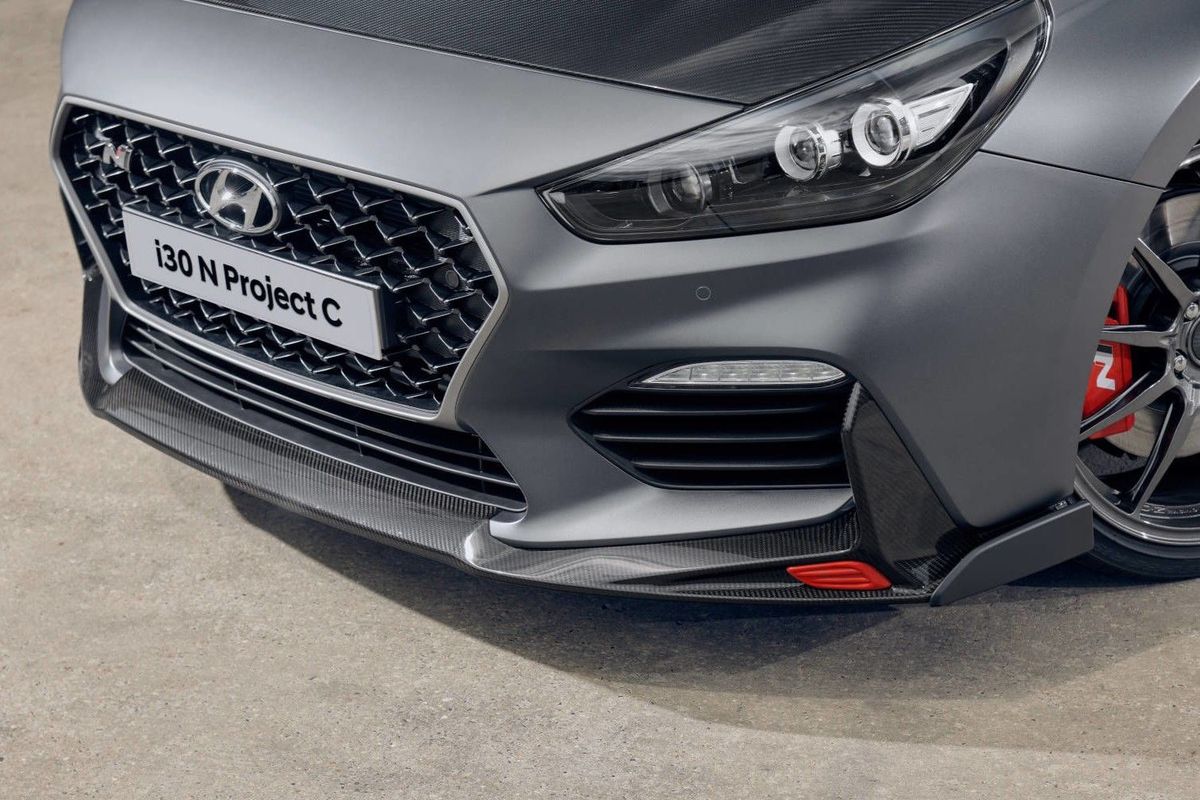
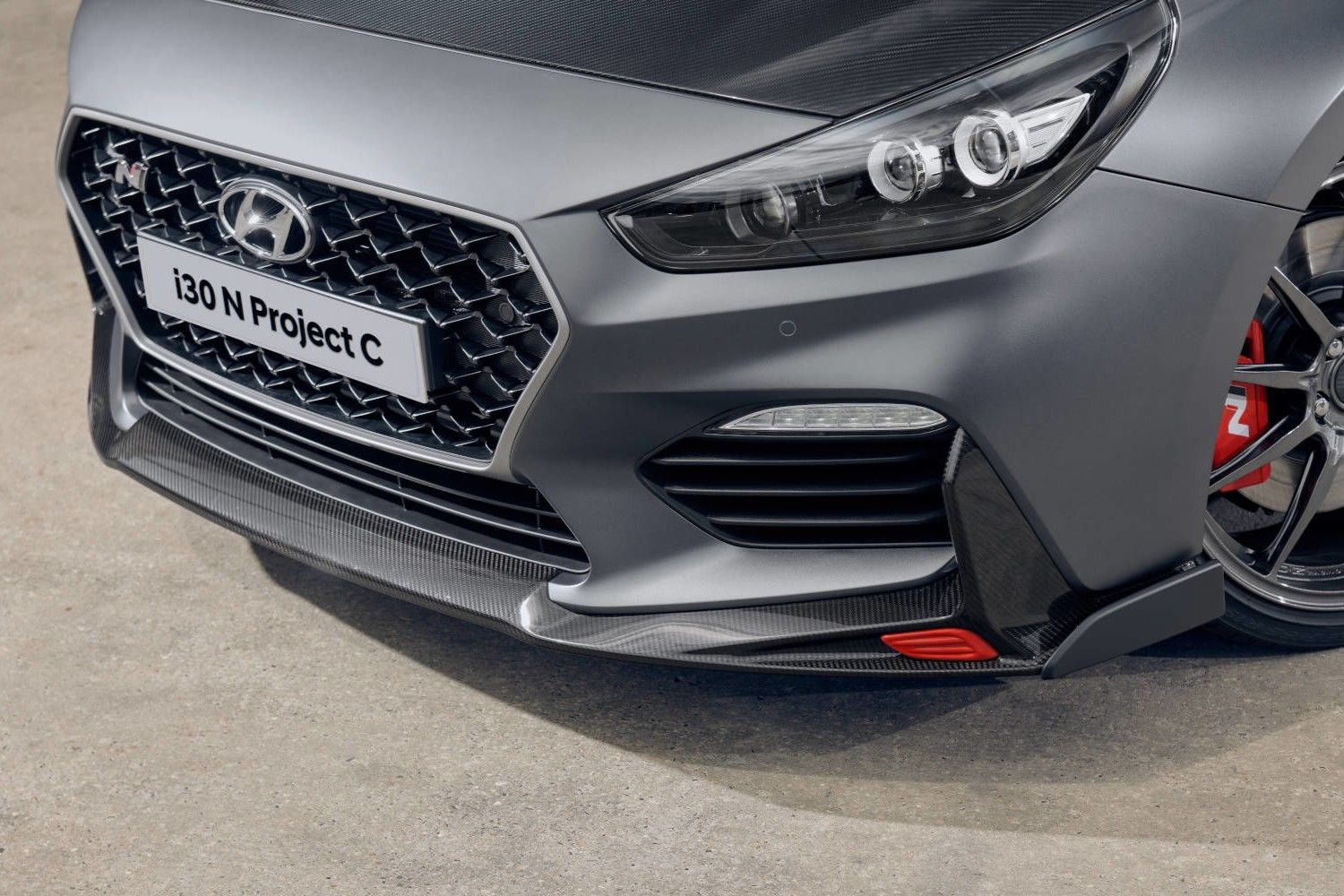
Lighter, and with a lower centre of gravity, the i30N Project C is Hyundai "just trying something".
Tell us about the significance of the i30N Project C…
"Project C is a slightly different story. Project C is a special edition (limited to a production run of 600 units) specifically for the European market. I guess 500 will go to Germany and a couple to the UK and the rest. This is a different story… A special edition we came up with to keep the fire burning. We are going to launch this model while we're waiting for the product life-cycle enhancement, just to try something out."
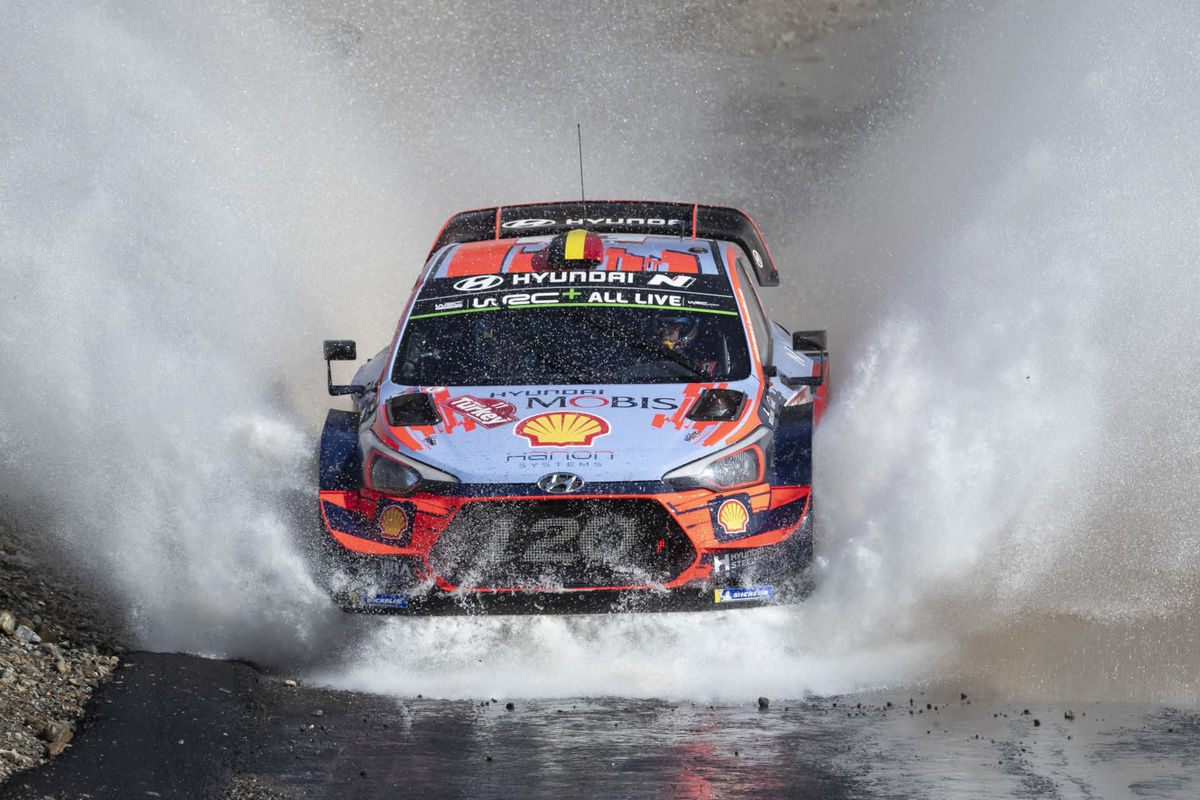
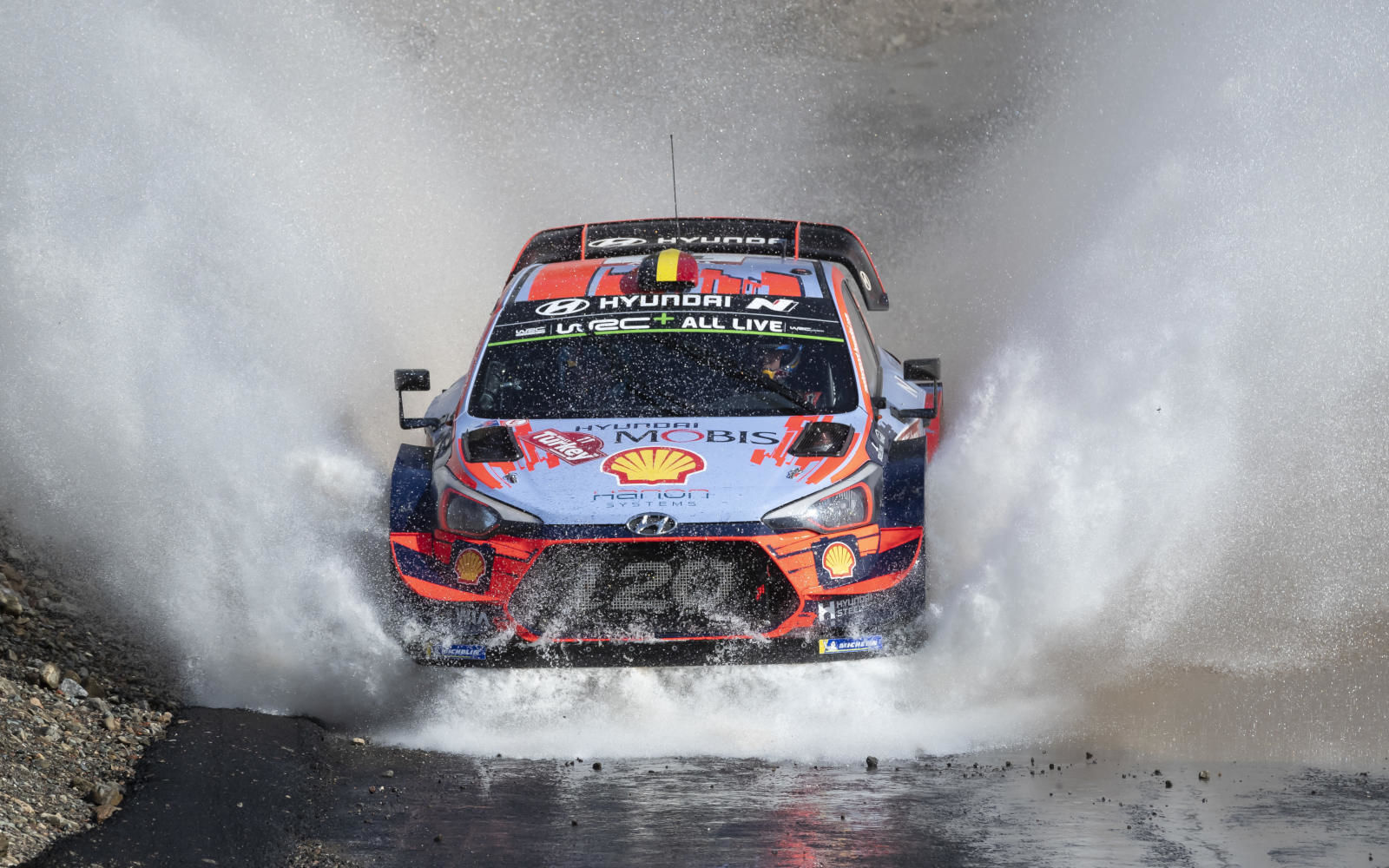
Hyundai uses motorsport not only as an emotional brand-building tool, but also to develop technologies for the road.
Finally… a more technical question. Is there a future for the dual-clutch transmission?
"It's a very good question – back in the days when I used to work for BMW M, many years ago, when we came up with the dual-clutch transmission, it was a like a racing gearbox; very durable, very precise, a little heavier… but faster. But the latest generation of automatic gearboxes… they are very competitive, and the question is valid: do we need to go the extra mile for dual-clutch 'boxes?
"In order to make a difference and to follow the route of the super sportscars maybe at least for the next generation we have something in mind and this new dual-clutch transmission that we are developing, perhaps it will (turn out to) be the best of the best, on a level that will be one level up, in terms of heat management, durability, how many laps you can go on the Nurburgring and so on."
Then, as we reached for our bag to dash to the next interview, Schemera added almost matter-of-factly, but with a glint in the eye: "It's not too far down the road…"
After an extensive overhaul of its dealership network, parts supply chain and staff, Peugeot has rolled out a brace of new models in South Africa. The all-new 5008 appeals to luxury- and practically-minded families. Is its generous specification, space and performance enough to pinch sales from the Volkswagen Tiguan Allspace, for example?
As we mentioned in our Peugeot 108 launch story, the PSA Group, comprising Peugeot Citroen DS and Opel/Vauxhall, has made serious inroads into the European sales charts with its offerings in the past 2 years. It is, therefore, odd that the French company's South African operations have floundered (note that Opel is locally distributed by Unitrans Automotive), so much so that many expected it would shut up shop. However, Peugeot South Africa has undergone a relaunch (with a catchy payoff line) and, behind the scenes, extensive work has been done on its dealership network.
Let's be frank, our Ownership Experience Survey shows Peugeot has a less-than-stellar reputation for after-sales service and product reliability; many of us know of someone who has had to wait uncomfortably long periods for Peugeot replacement parts to arrive from Europe, for example. However, under new boss Xavier Gobille, Peugeot SA has gone on the charm offensive and this relaunch is a multi-pronged attack on the market.
Sister brand Citroen is following hard on Peugeot's footsteps and will be relaunched in October 2019. Gobille is a charismatic Frenchman and has gained quite the reputation for being incredibly passionate and determined. He turned Renault South Africa's fortunes around some time ago and, following his successful stints at Jaguar Land Rover and Nissan, it would be a surprise if the Frenchman doesn't pull off a repeat performance.
Peugeot 5008
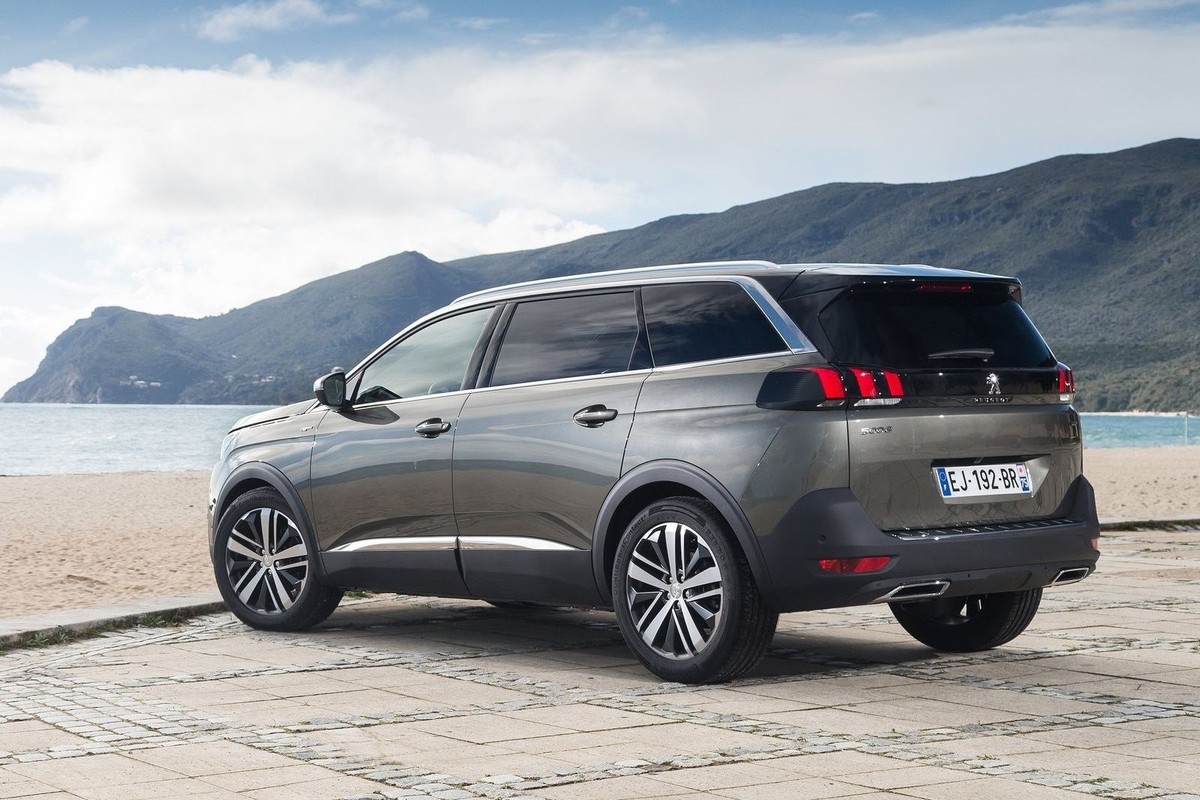
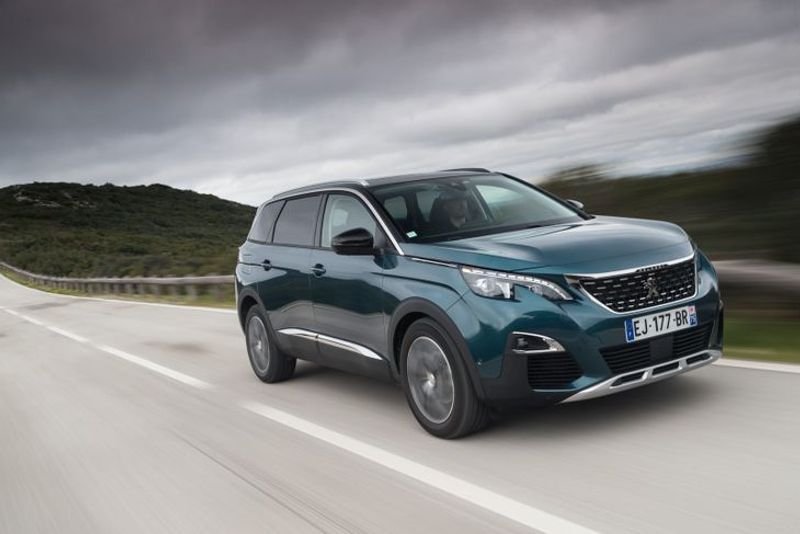
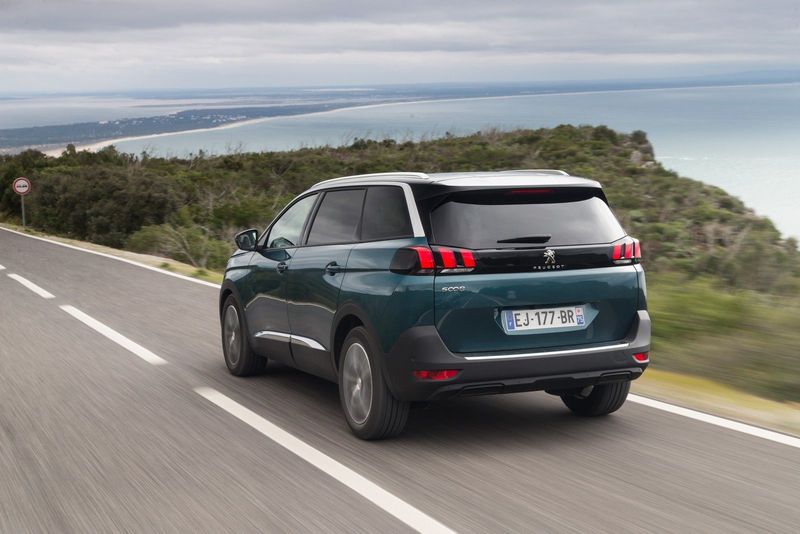
Sharing a platform with the Peugeot 3008, the 5008 adds in extra seating and space
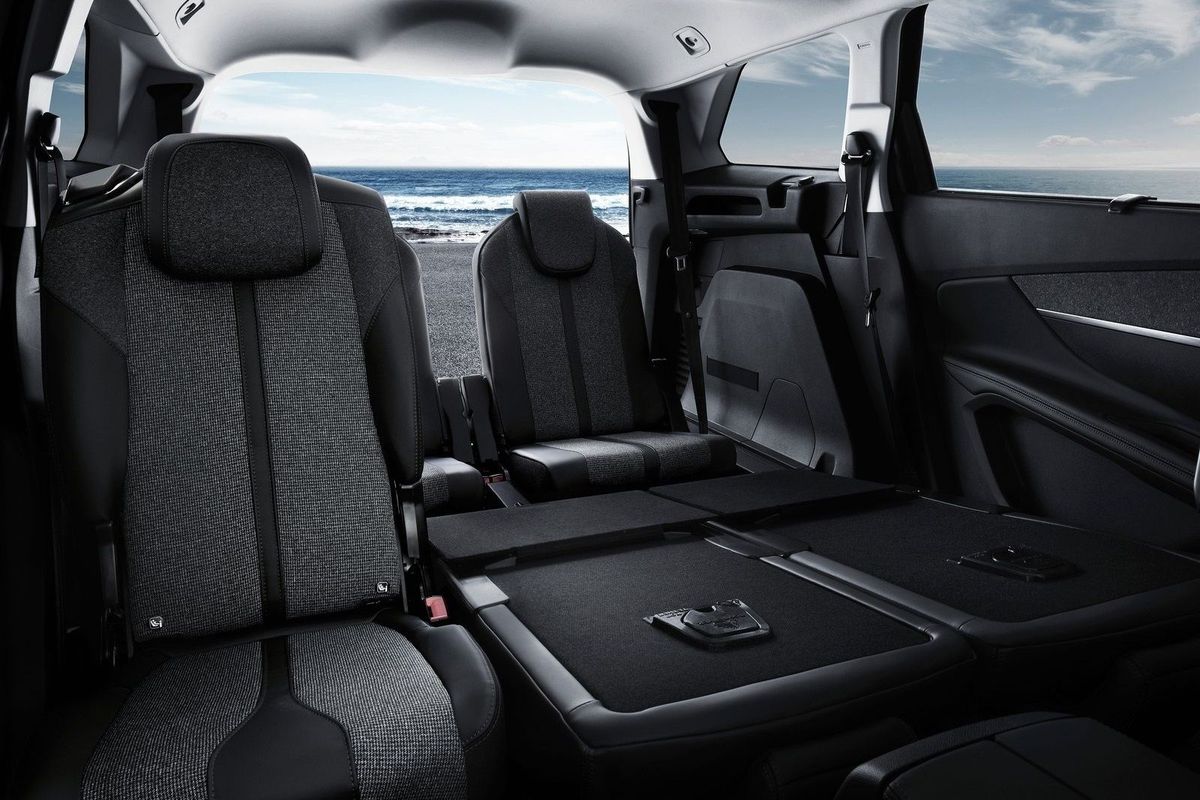
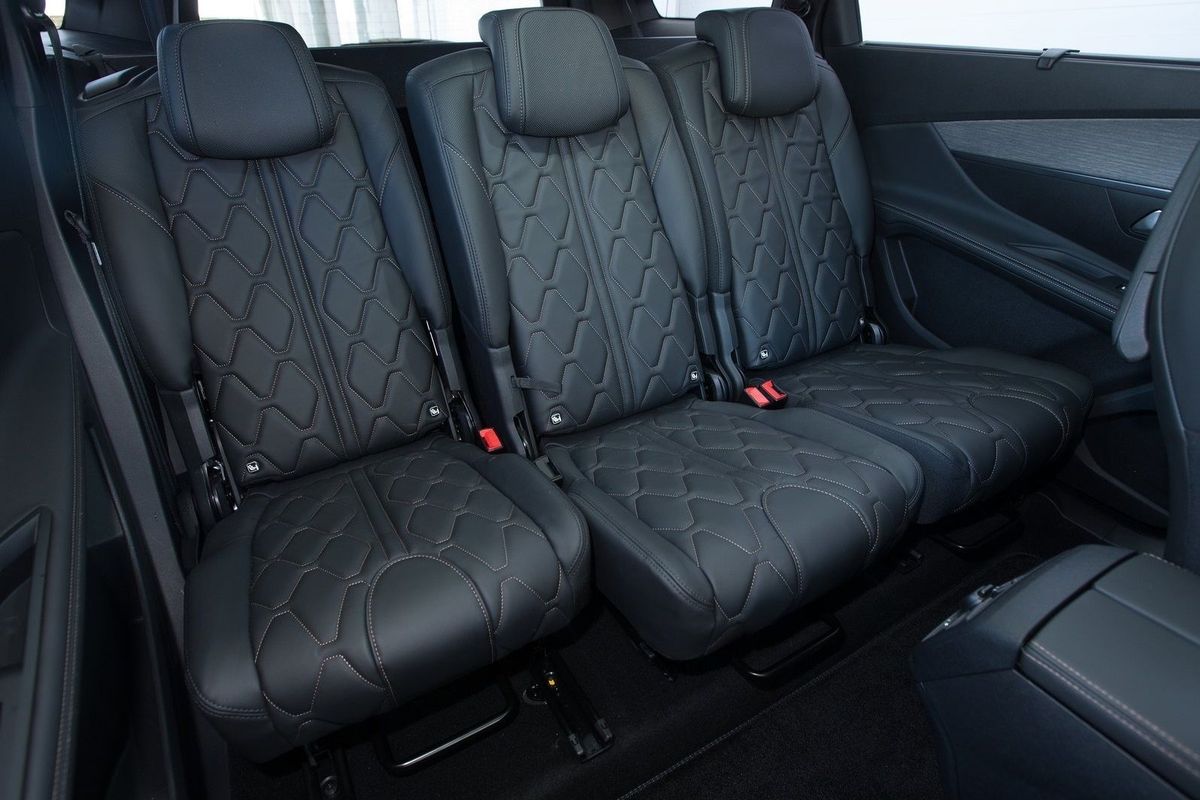
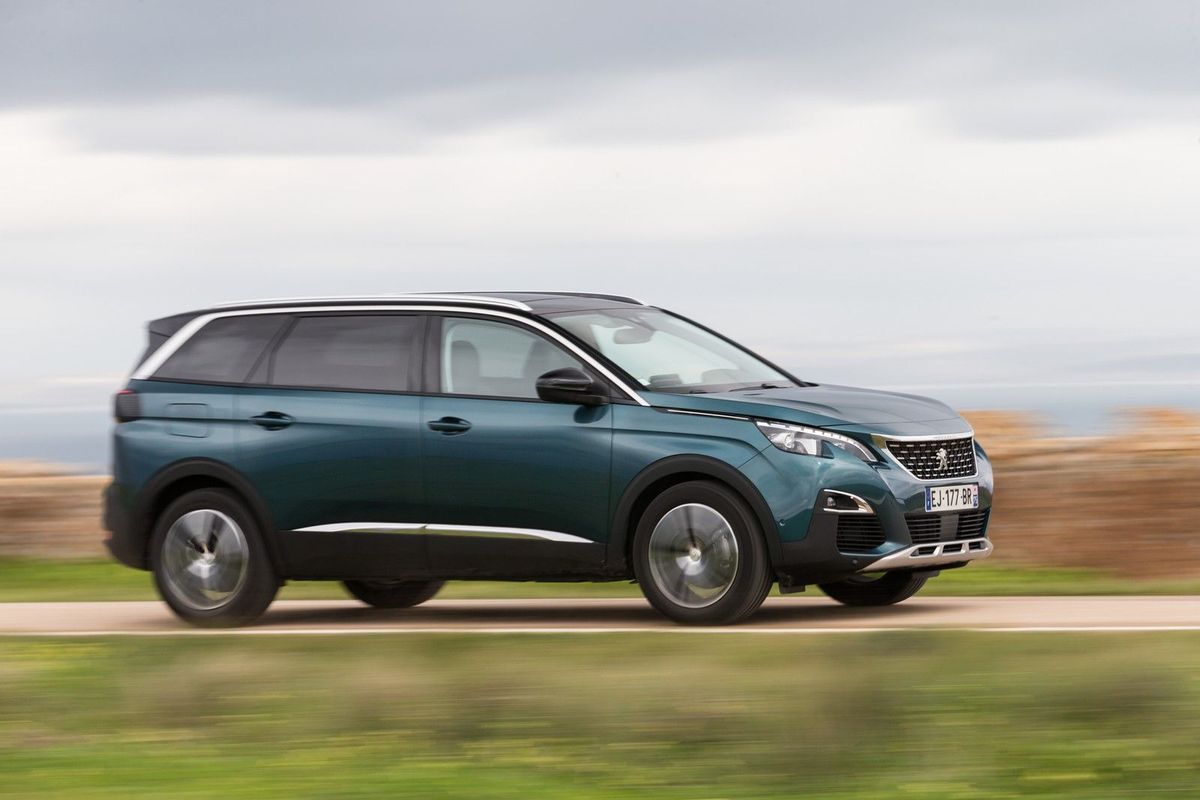
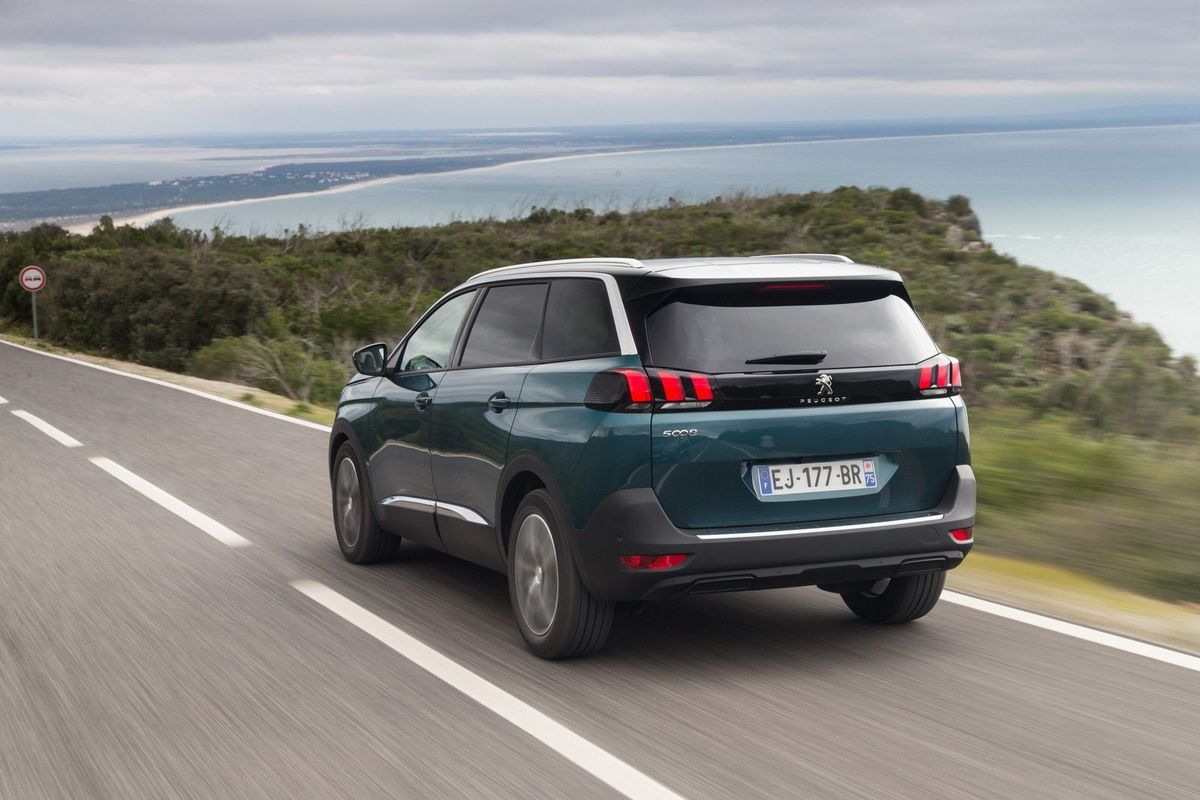
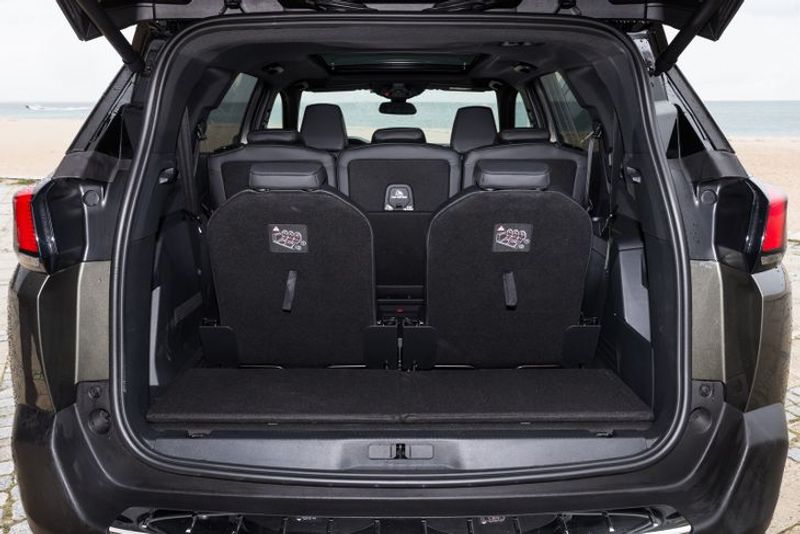
The Peugeot 5008 is a 7-seat family car. Based on the lauded EMP2 platform that underpins its 3008 sibling, the 5008 is available with a choice of 2 engines and 2 lines of trim. With a wheelbase of 2.84 metres, it's notably more spacious than a compact SUV. The pair of 3rd-row seats are removable if you require additional luggage space, not that the load bay is mediocre… Its claimed capacity is 780 litres in 5-seater configuration and 1 940 litres with 2nd and 3rd rows folded flat. The front passenger seat can also fold down, allowing you to carry longer items, such as curtain rails.
In terms of engine options, you can go for either a turbopetrol or -diesel powerplant. The 1.6-litre turbocharged (THP) 4-cylinder petrol-fed unit can be found in many PSA applications and, in the 5008, it delivers peak outputs of 121 kW and 240 Nm. For those who prefer their big SUVs powered by a torquey diesel motor, the 2.0-litre HDi pushes out 110 kW and 370 Nm. All Peugeot 5008 derivatives come fitted with a 6-speed automatic transmission. In terms of fuel economy, the petrol 5008 is said to consume 7.0 L/100 km, while its diesel sibling is more frugal at 4.8 L/100 km.
A vast array of features
The latest iterations of Peugeot products have always come highly-equipped and the new 5008 is no exception. Being a premium offering, it really is jammed to the hilt with comfort and convenience features. There are 2 trim levels on offer: Allure and GT-Line. The GT-Line is the more visually striking of the 2 versions and definitely the one I'd lean towards based on its aesthetic appeal (provided it's within your budget, of course).
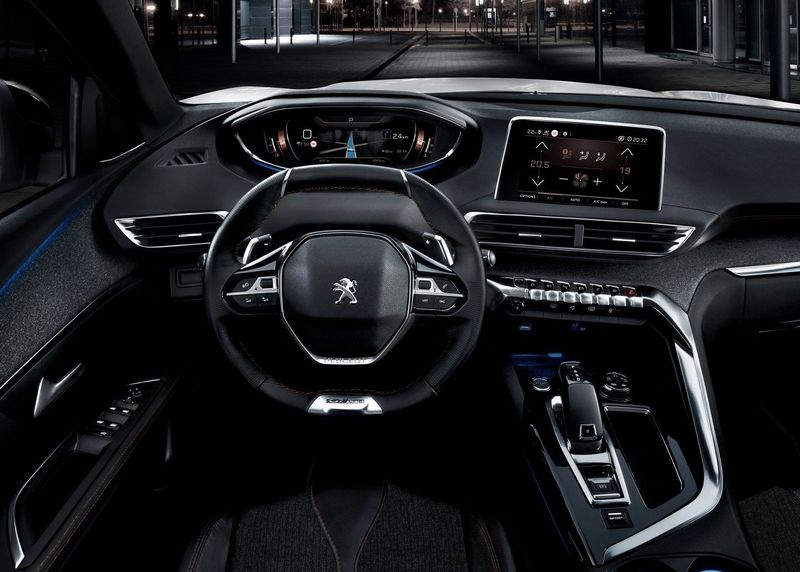
The Peugeot 5008's high-tech cockpit features a digital instrument cluster; its infotainment system is one of the best we've experienced
Peugeot 5008 Allure
18-inch alloy wheels
Tyre-pressure monitoring sensors
Hands-free tailgate
Auto headlamps and -wipers
Daytime running lights
Dual-zone climate control
Cloth/leather trim
Keyless entry
Parking sensors
Apple CarPlay/Android Auto
USB/Bluetooth connectivity
Peugeot 5008 GT-Line adds:
19-inch alloy wheels
LED Lion puddle lamps
Black diamond roof
Panoramic roof (optional)
Full LED headlamps
LED fog lights
Wireless charging pad
Nappa leather upholstery
Semi-autonomous safety package
180-degree camera
Satellite navigation
Upgraded audio system
Front-seat massage function
What's it like to drive?
The Peugeot 5008 gives you that big car luxury feel and is impressively refined to drive.
We had a brief chance to drive the Peugeot 5008 GT Line in 1.6 THP guise. The driver is afforded a perched driving position and, for those who are unaccustomed to Peugeot's unusually small steering wheels, the diameter will take some getting used to, but you'll find it surprisingly easy to wield.
Our launch route was frustratingly short and comprised mostly of open-road driving. Ride quality is good, even on the GT Line derivative, which is shod with 19-inch alloy wheels and tyres. You feel there's an element of sportiness dialled into the suspension, which can be felt when traversing potholes and ruts. On the open road, noise/vibration and harshness are largely suppressed and the French family car exhibits impressive levels of refinement. We also had the chance to pilot the 5008 on a gravel road and even though it's not all-wheel-driven, the 5008 offered adequate grip.
That small steering wheel requires minimal effort to turn, but perhaps it feels a bit too light for a 7-seater luxury SUV. The performance of the 1.6-litre petrol engine was less than enthusiastic too; we suspect a fully-laded 5008 THP derivative might feel sluggish. Besides, given PSA's reputation for making impressive diesel engines, a 2.0-litre HDi derivative may be the one to go for. If you're planning to transport your family on long trips, its generous 370 Nm and better fuel economy will be handy. Peugeot's renowned for making stylish small hatchbacks such as the 208/308, but it has fulfilled the large-luxury-car brief surprisingly well. Not only does the 5008 feel comfortable, but it evokes that "big-car feeling" better than its rivals.
It's a commendable effort, but considering that the 5008 is essentially a stretched-out 3008, it makes perfect sense. The 3008 is an excellent offering – it has made an appearance in 2 iterations of the #CarsAwards – powered by WesBank. The latter has garnered several awards globally and is at the top of the sales charts in Europe… Therefore, we look forward to getting to know the Peugeot 5008 a lot better when it joins our test fleet.
With the 2nd and 3rd row of seats stowed, the Peugeot 5008 is one of the most spacious family SUVs around.
Servicing and warranty
It's dubbed 'Peugeot Pride': every 5008 derivative comes standard with a 5-year/100 000 km comprehensive warranty, a 5-year/100 000 km comprehensive service plan and roadside assistance, access to a 24-hour customer-care contact centre, licence renewal reminder, as well as service plan and warranty expiry notifications.
Peugeot 5008 Price in South Africa (September 2019)
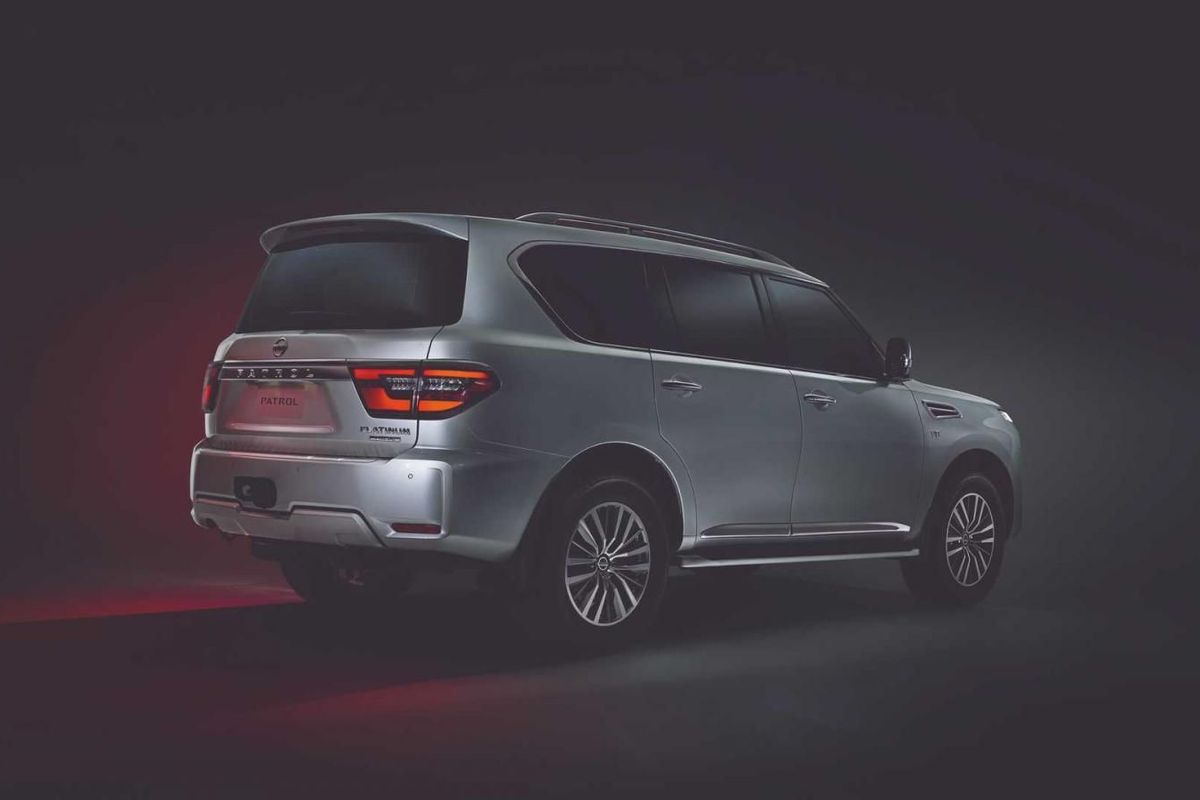
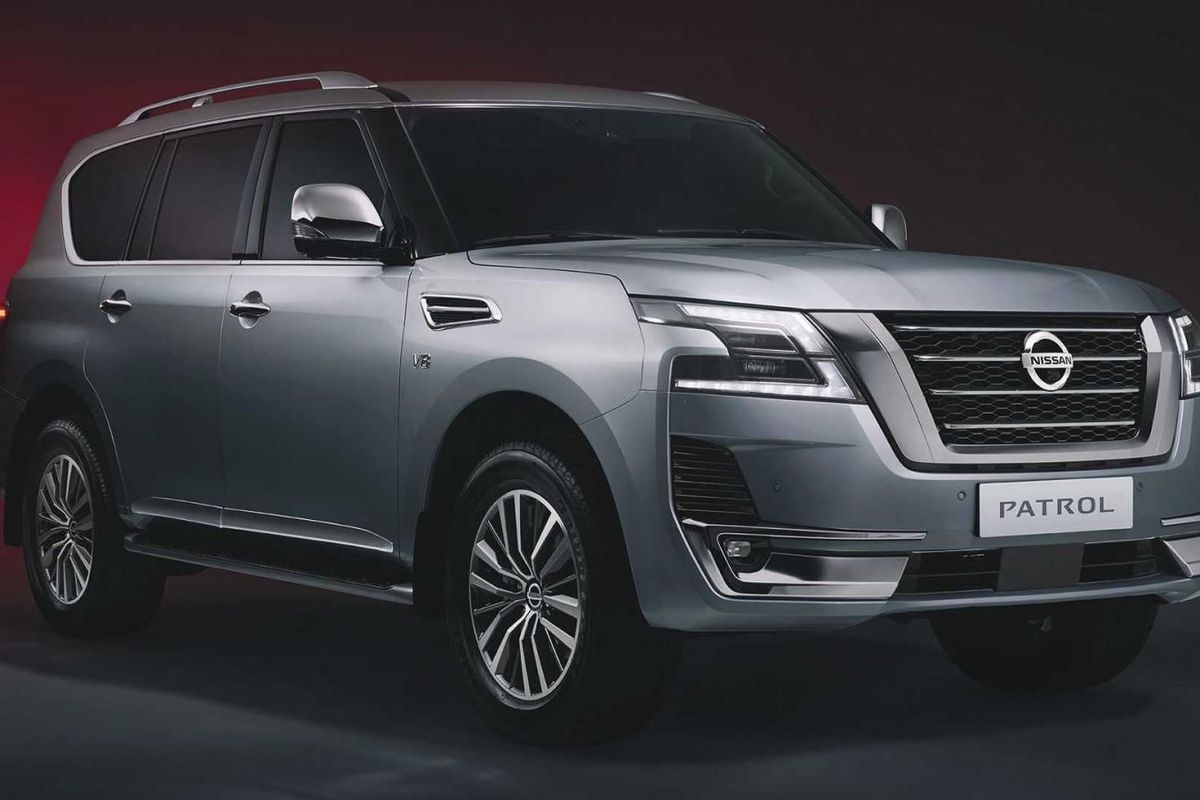
Nissan’s 6th-generation Patrol has received a significant styling upgrade. See details below…
Although it's now running on a platform that is nearly a decade old (first launched in 2010), Nissan’s designers have notably reshaped the Patrol’s front styling.
The brand’s characteristic V-shaped grille has been reshaped and is now framed by much broader edges. Most noticeable are the headlamps, which now feature body colour switchblades, cutting into the glass surface.
Around the rear, there isn't a remoulded bumper shape or tailgate profile, but Nissan has sourced new taillights, equipped with a sequential illumination indicator function.
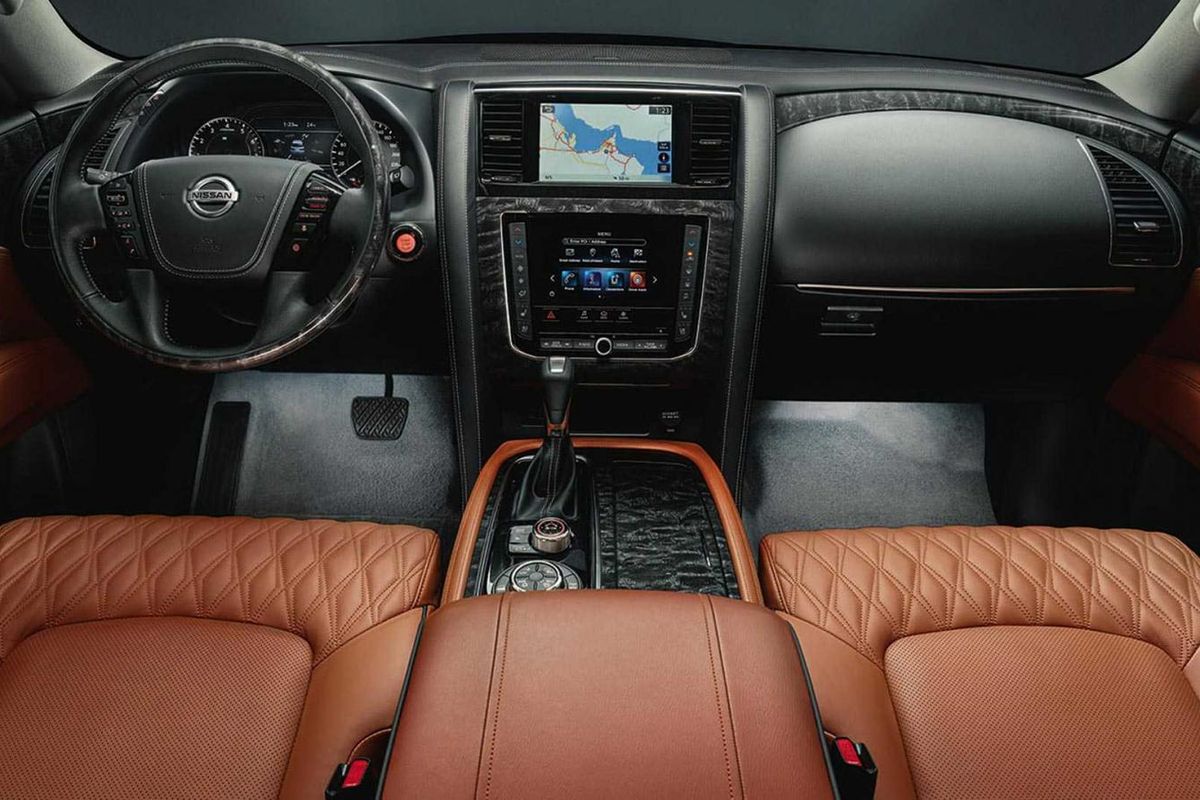
The Patrol still offers high levels of comfort and Android Auto and Apple CarPlay is on offer.
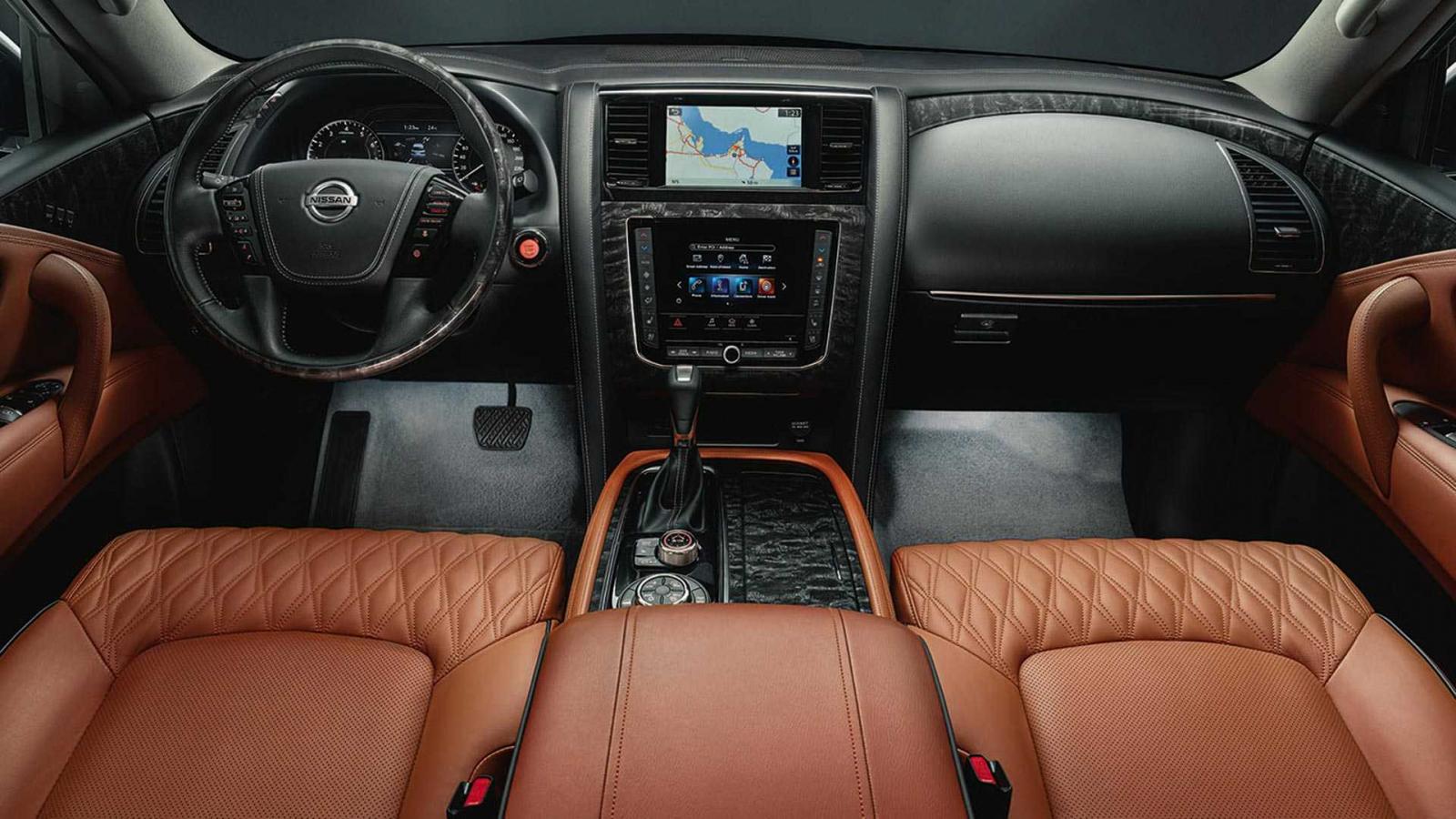
Inside the 2020 model year Patrol, passenger comfort has been improved. Quilted leather seats should provide superior seating comfort, especially on long-distance gravel road journeys.
Nissan has expanded the Patrol’s infotainment offering too, with a dual centre-stack display, which integrates Apple CarPlay and Android Auto. Despite not being a visible upgrade, Nissan’s acoustics engineers have made the Patrol cabin quieter too.
Safety specification enjoys a slight upgrade with the presence of pedestrian detection, now programmed into the emergency braking system.
Mechanically, the Patrol’s power- and drivetrain options continue unchanged. Power is sourced from 2 naturally-aspirated petrol engines, either a 4.0-litre V6, good for 205kW and 394 Nm, or an enormous 5.6-litre V8, rated at 298kW and 560Nm.
The Patrol’s ladder frame chassis might make it an ungainly vehicle though corners, but with low-range gearing and a lockable rear-differential, it has legendary off-road ability.
Patrol’s configuration makes it a rarity amongst luxury off-road vehicles, with ladder frame construction, in a world of monocoque SUVs. Only Nissan, Toyota (Land Cruiser 200), Lexus (LX570) and Mercedes-Benz (G-Class), still produce vehicles which combine robust body-on-frame construction with contemporary luxury trim.
We are waiting to hear from Nissan South Africa regarding local availability but we expect the latest Patrol to hit the SA market sometime in 2020.
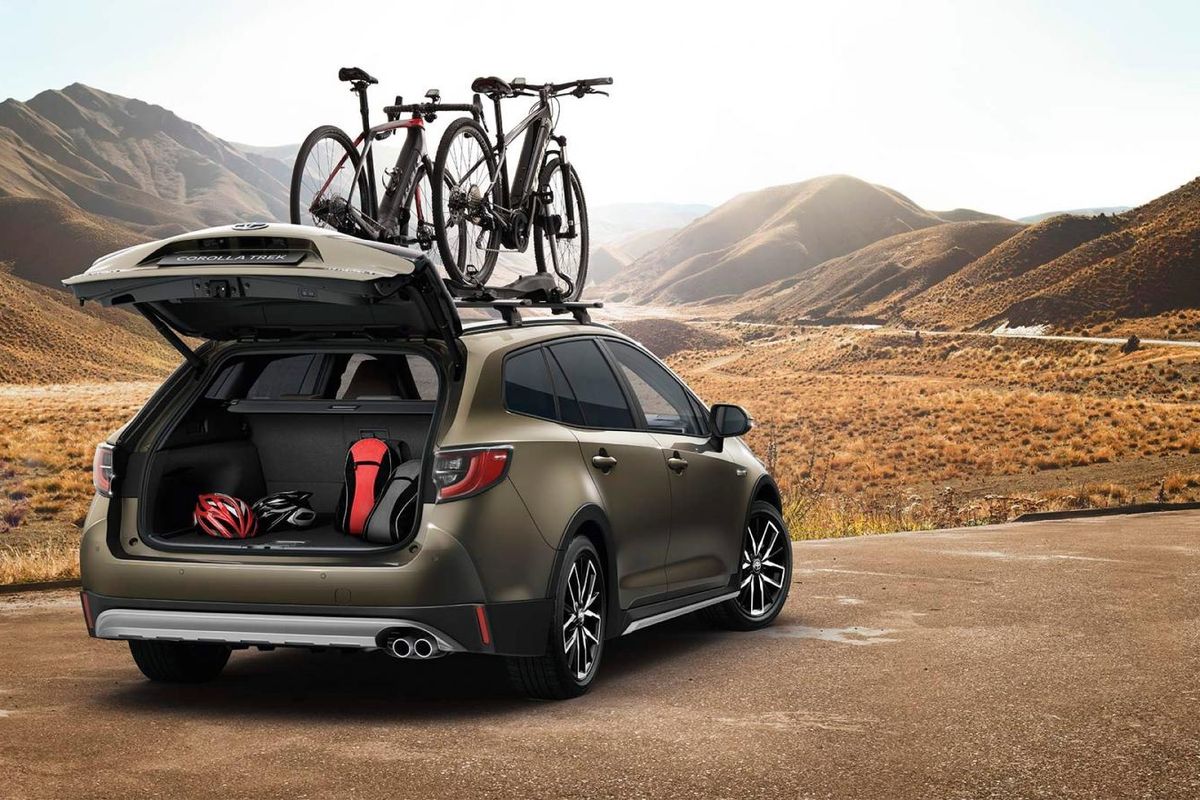
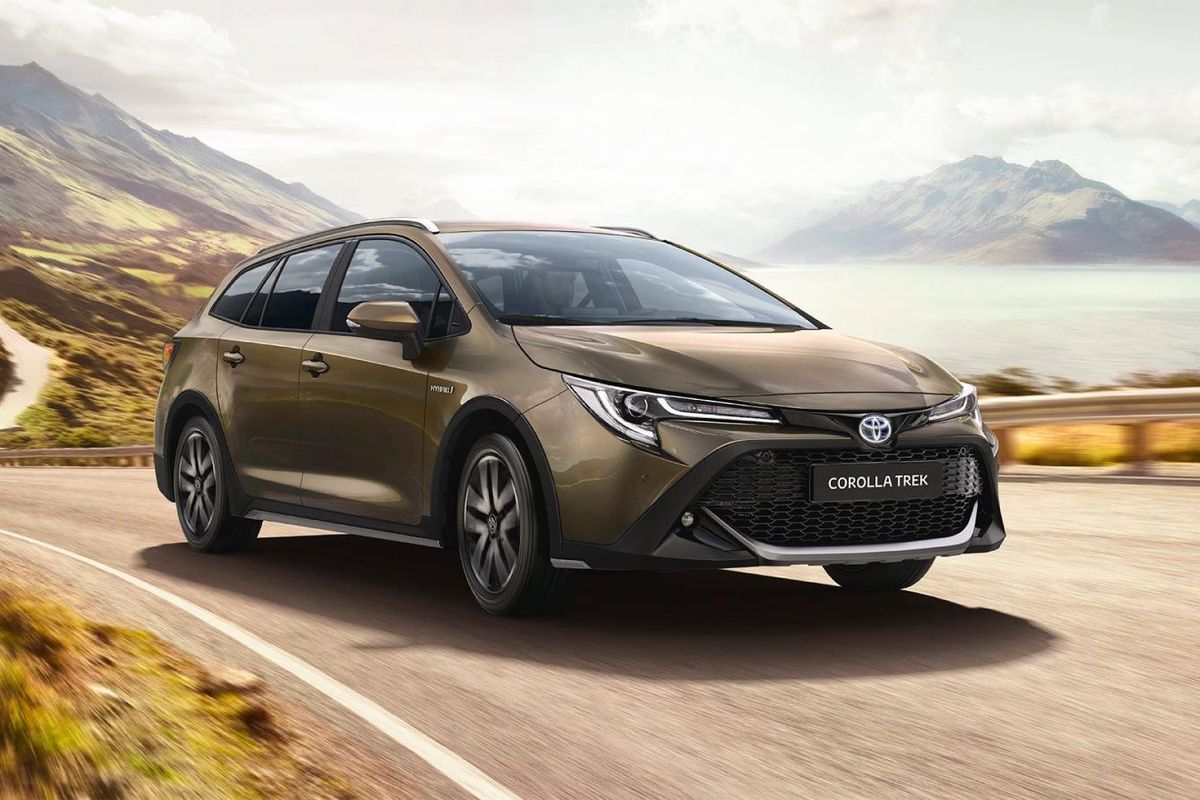
Toyota is making good on its promises to offer a diverse Corolla portfolio. Targeting the outdoor enthusiasts comes the Corolla Trek.
What you're looking at is the estate version of the Toyota Corolla, dubbed 'Touring Sports'. Sadly the SA market has never really responded to station wagons so it's highly unlikely it'll make its way down here, but for those who don't want an SUV, it's an interesting proposition.
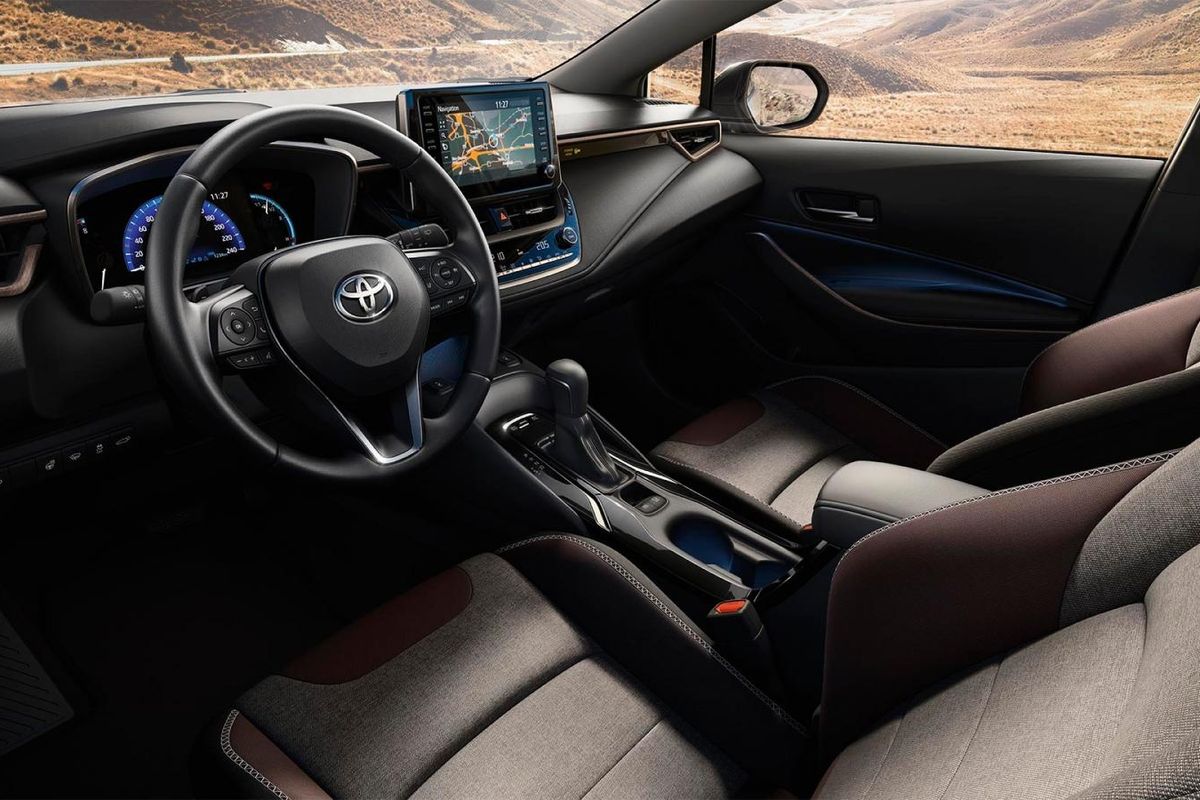
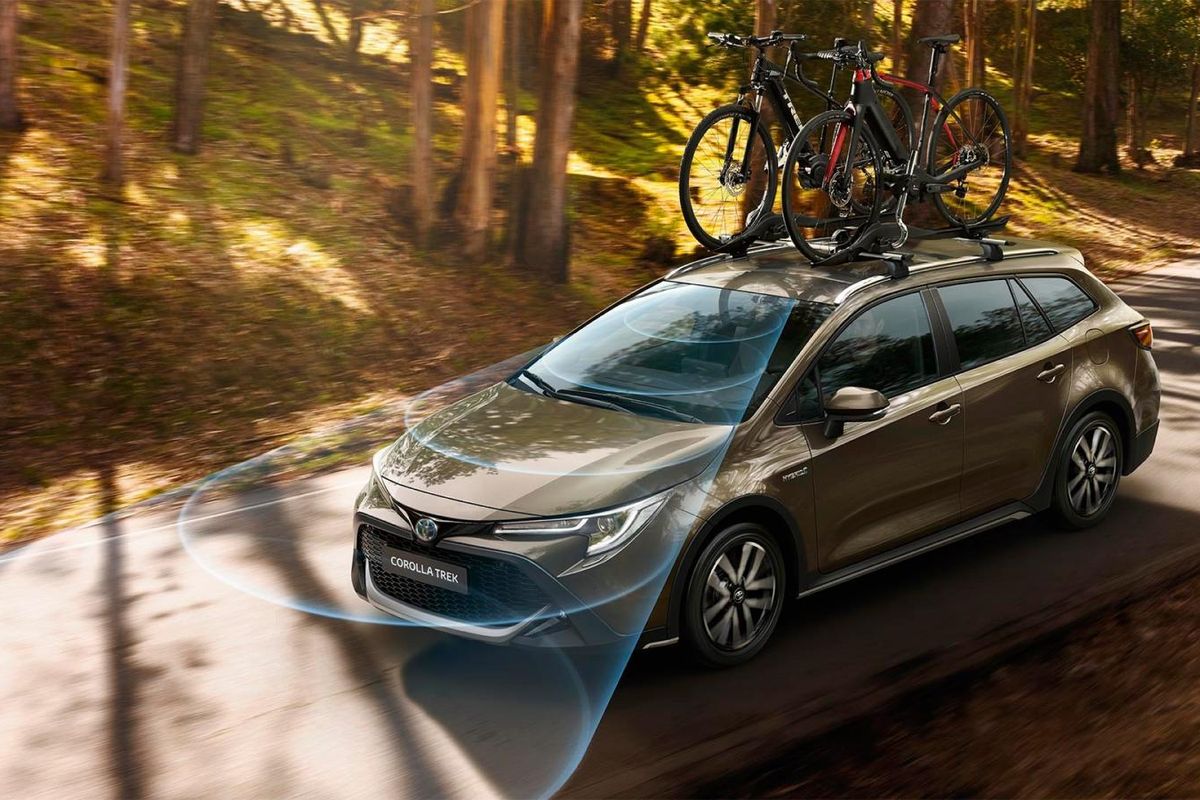
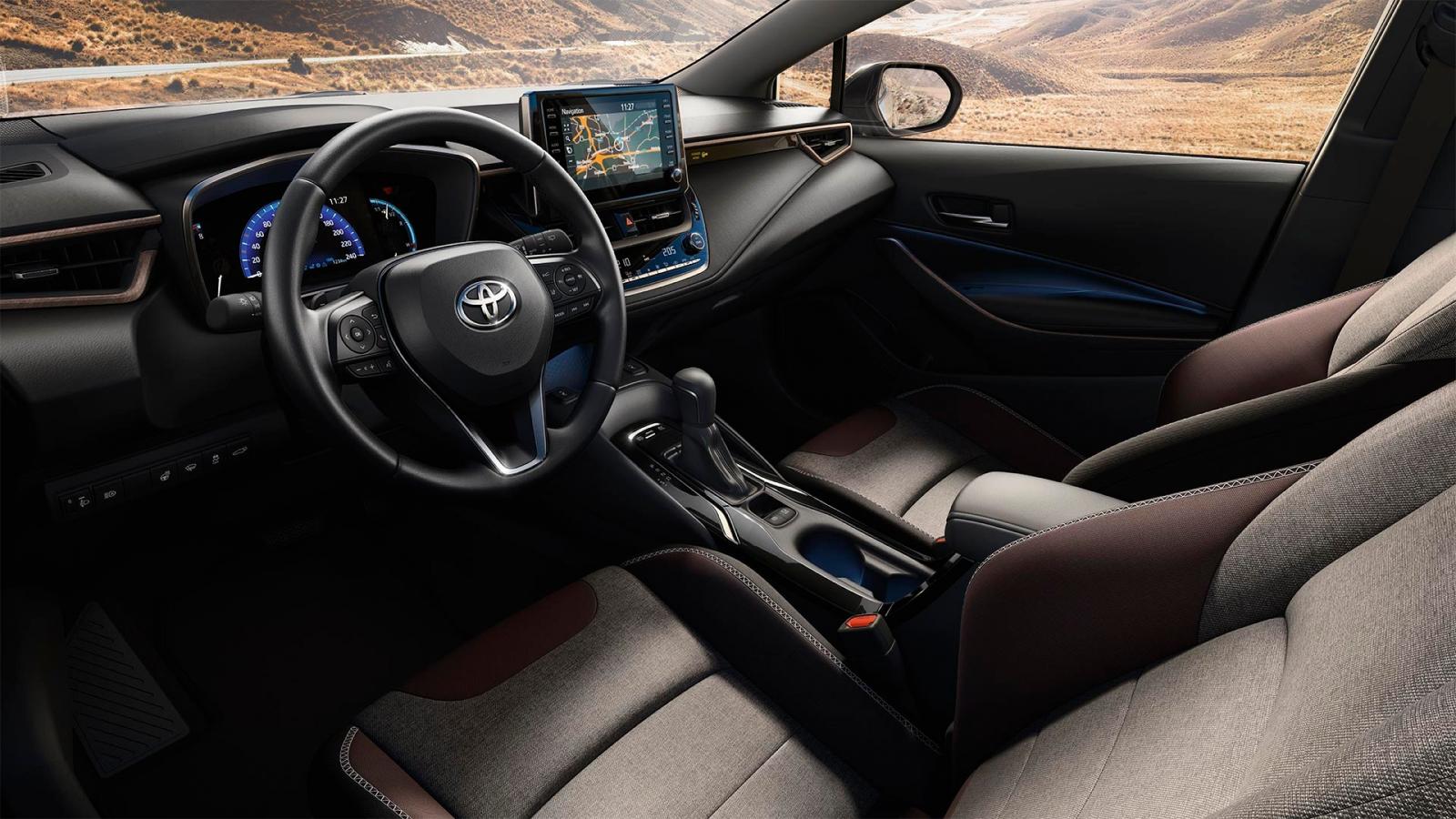
The Corolla Trek features 20mm additional ground clearance, a new-look grille, plastic cladding, 17-inch alloys, LED headlights, fog lights and some Trek badging. Inside, there's 2-tone upholstery, wood trim and Trek badging on the door sills. It also boasts the semi-autonomous Toyota Safety Sense which comprises auto high beam, traffic sign recognition, lane assist, pre-collision safety, pedestrian/cyclist detection as well as adaptive cruise control with auto start/stop.
In terms of engine options, Toyota has made available its 1.2-litre turbo, 1.8-litre naturally aspirated and a hybrid option.
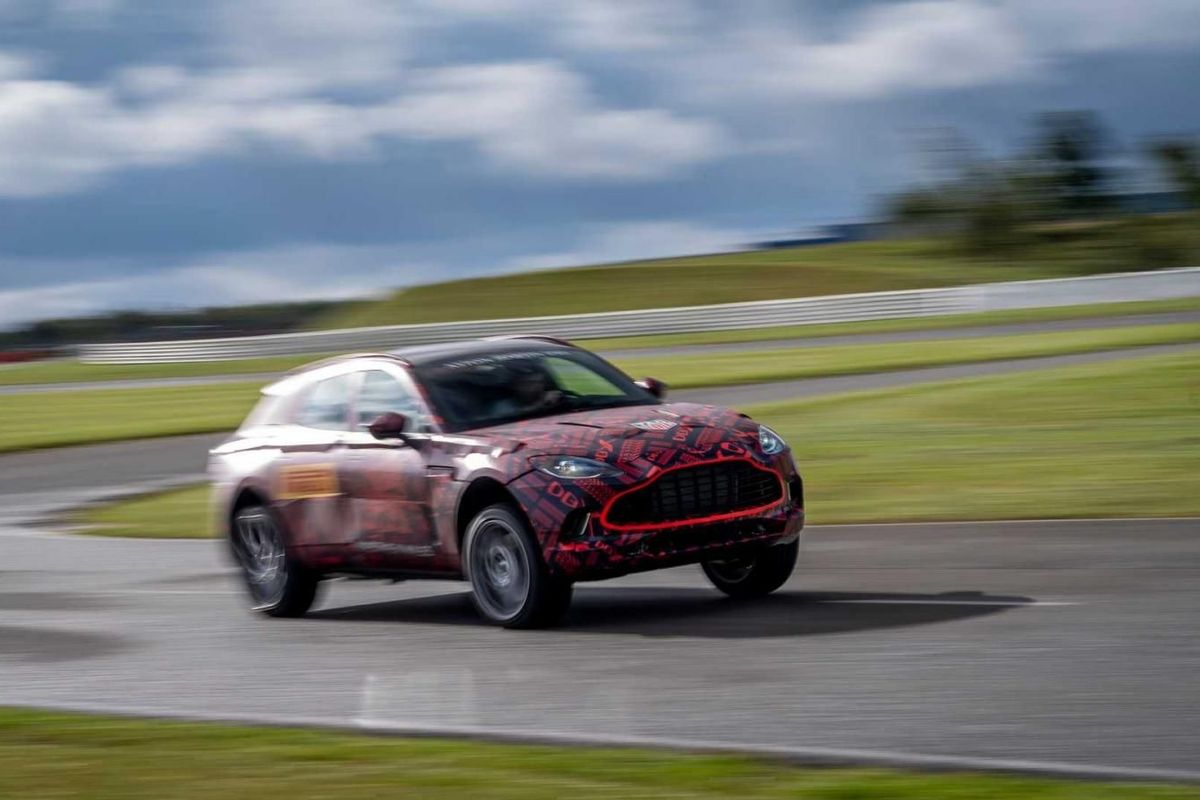
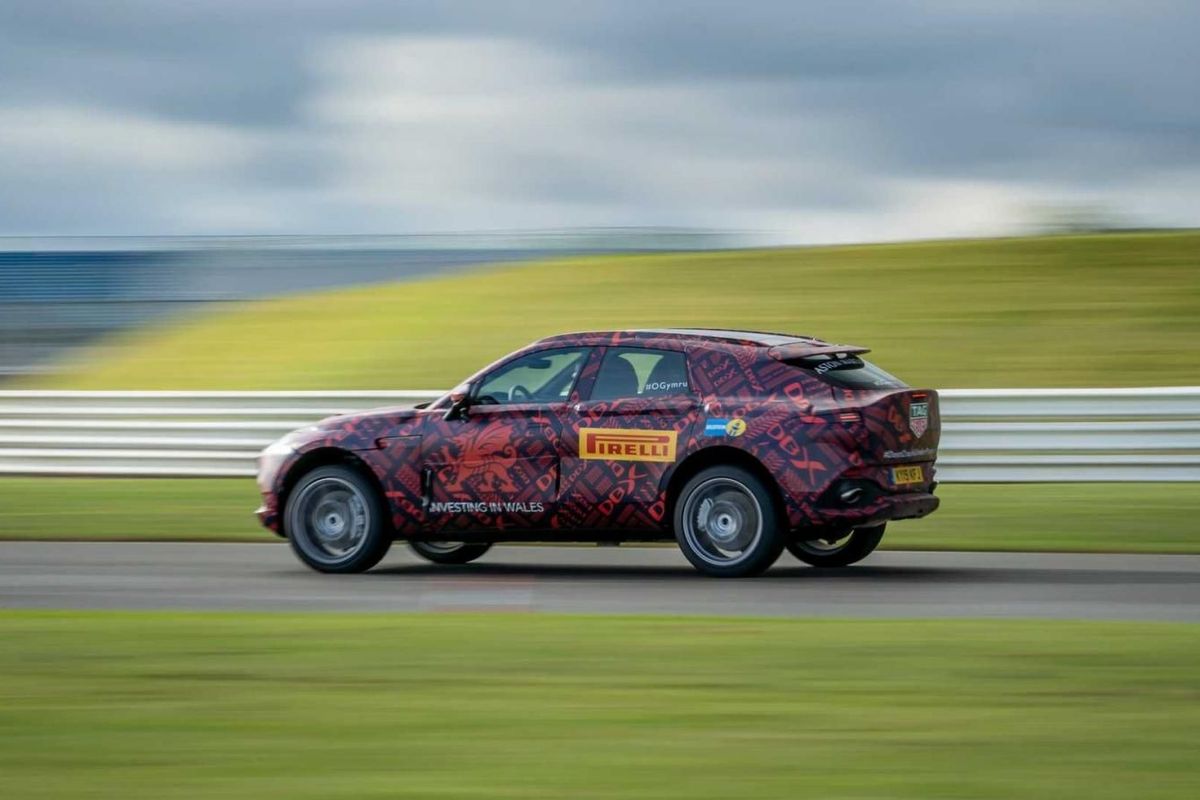
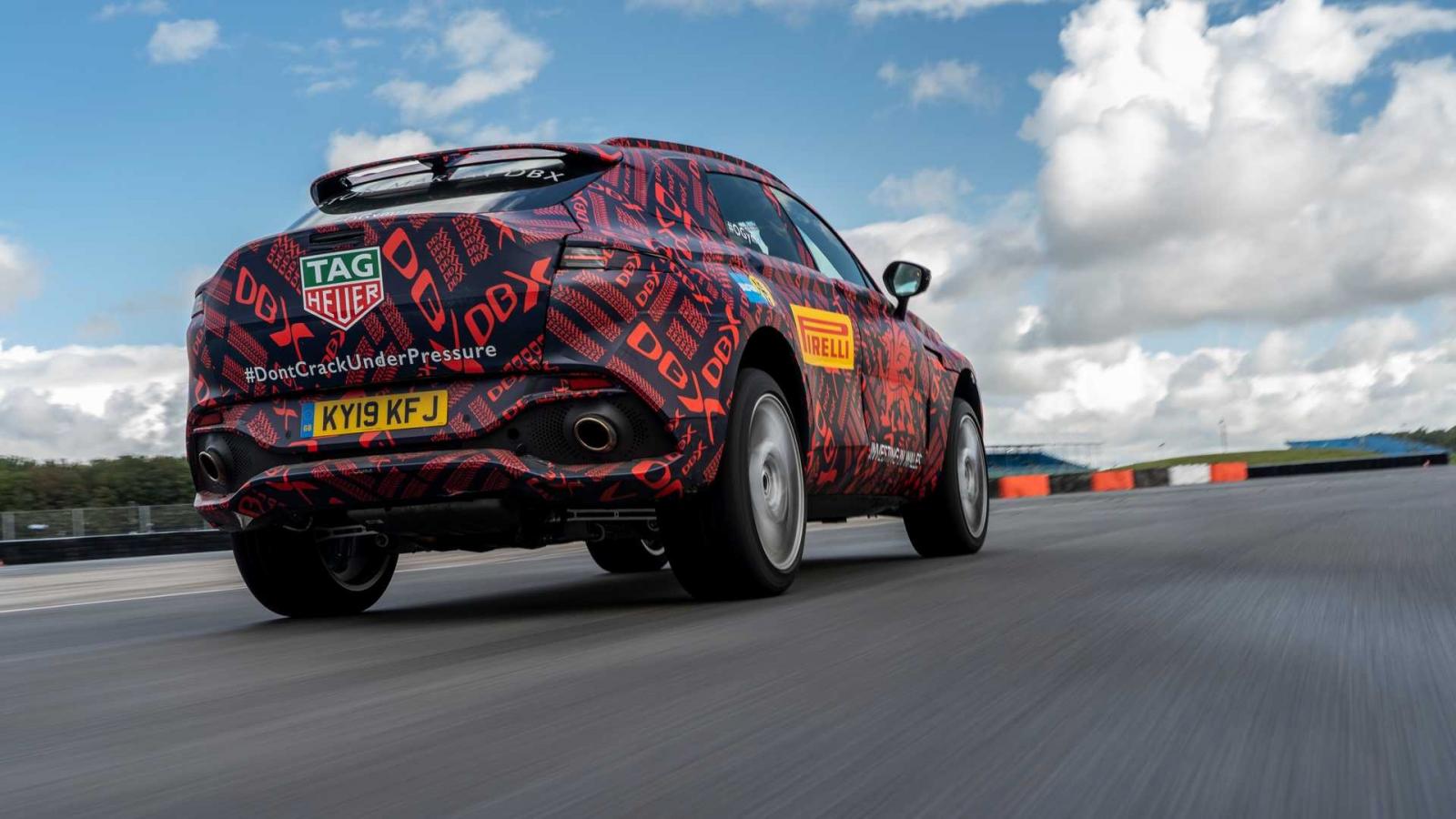
Aston Martin is making an SUV, a first for the Gaydon-based firm. The Aston Martin DBX will be fully revealed in December 2019.
SUVs are hugely popular and even performance brands are jumping on the SUV trend. Think Porsche, Lamborghini and you get the idea. Aston Martin is one such brand that is set to unleash its very first performance SUV on the world. It will be called DBX and it’s expected to be fully revealed in December 2019.
While we wait to see the final product, Aston has dropped a few details of its new DBX.
Firstly, it will be powered by Aston’s 4.0-litre twin-turbo V8 engine that’s tuned to deliver 405 kW and 700 Nm.
Aston Martin states that the DBX’s cornering ability is n par with the Vantage and that its stopping power is superior to that of the DBS Superleggera. The DBX has also regularly achieved sub-8-minute lap times at the Nurburgring Nordschleife during testing. A top speed of more than 290 kph has also been achieved on numerous occasions.
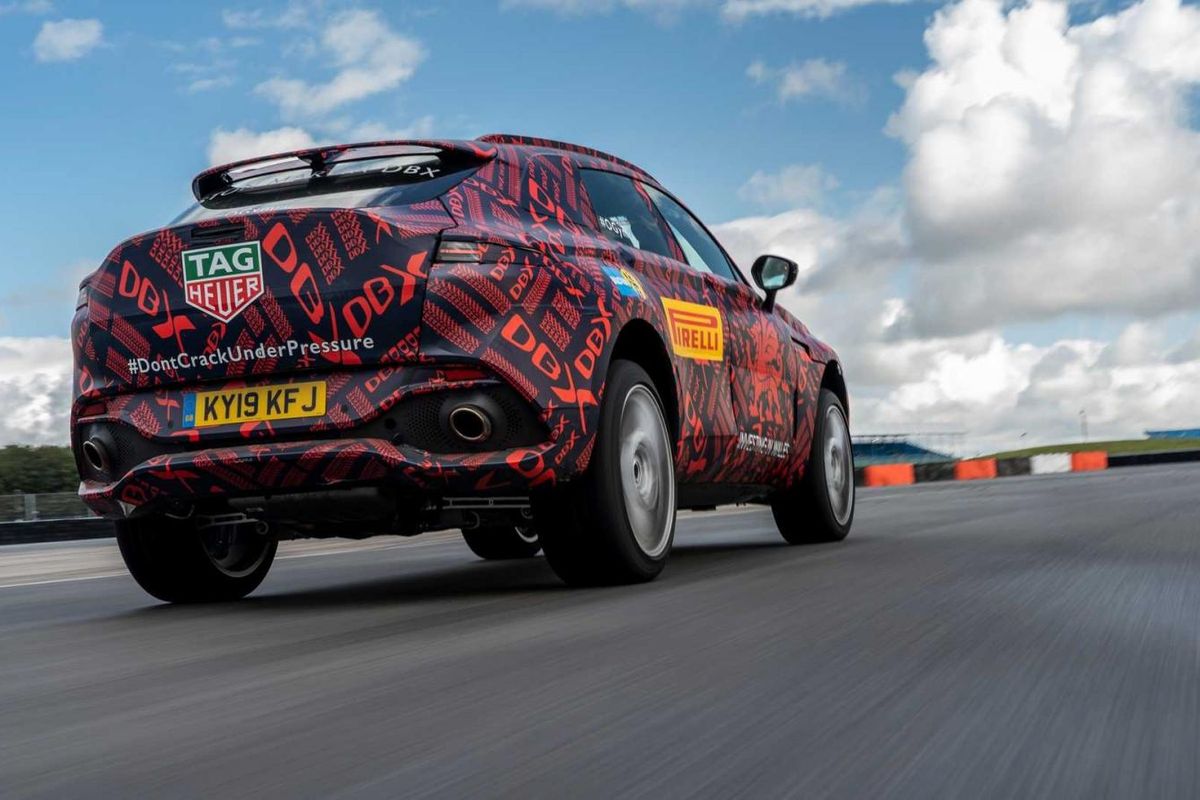
Engineers have also paid particular attention to the sound delivered by the DBX’s exhaust system with the intention of creating a “broader and more solid acoustic note” with a deep base with increasing mid-tones. The DBX should, therefore, deliver a booming exhaust note when driven in sportier modes.
Those dual exhaust tips are expected to deliver a marvellous V8 soundtrack.
Matt Becker, Aston Martin’s Chief Engineer commented, “We have concentrated our work to ensure that the calibration and tune of this 4.0-litre twin-turbo V8 delivers both the everyday usability and refinement expected by SUV owners. However, we have also focused heavily on matching that with the engaging driving dynamics that are commanded by our brand and inherent in every Aston Martin and early indications of the car’s overall performance have been incredibly promising.
The next few months will be extremely important to us, as we continue to hone the powertrain credentials and a dynamic setup that will help make this the most exciting SUV on the market”.
We will keep you updated as soon as more details become available.
Listen to the sound of the Aston Martin DBX's engine note below!