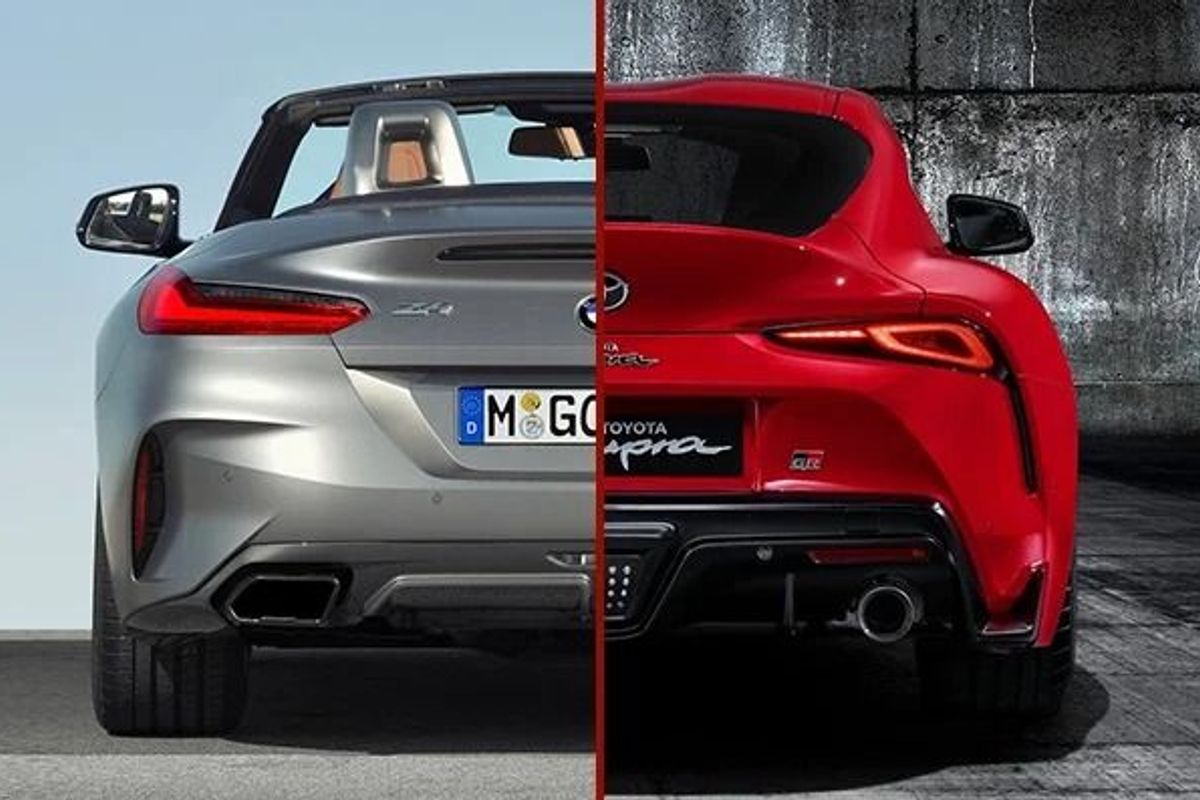
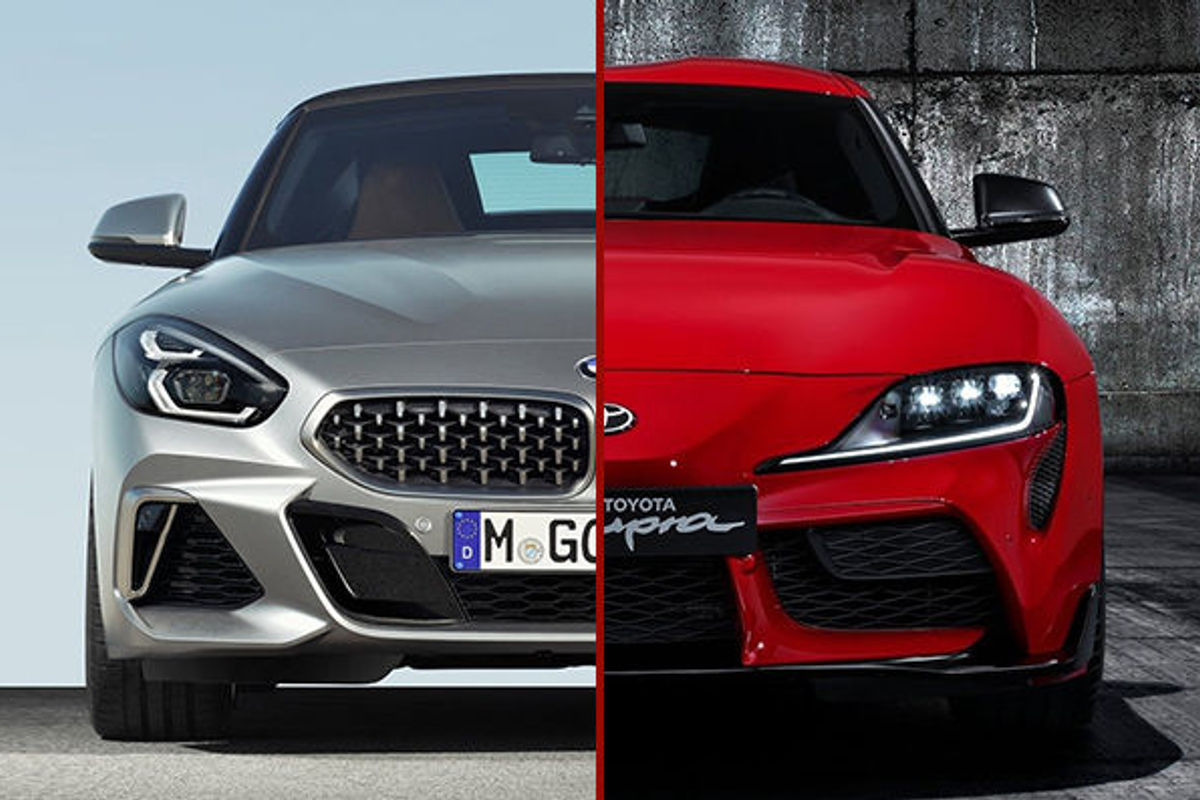
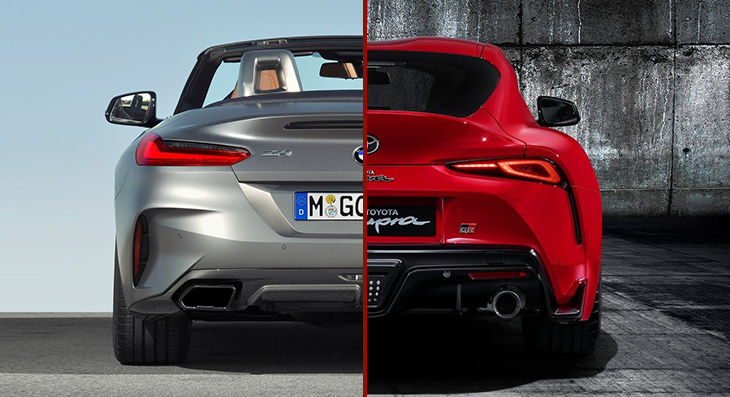
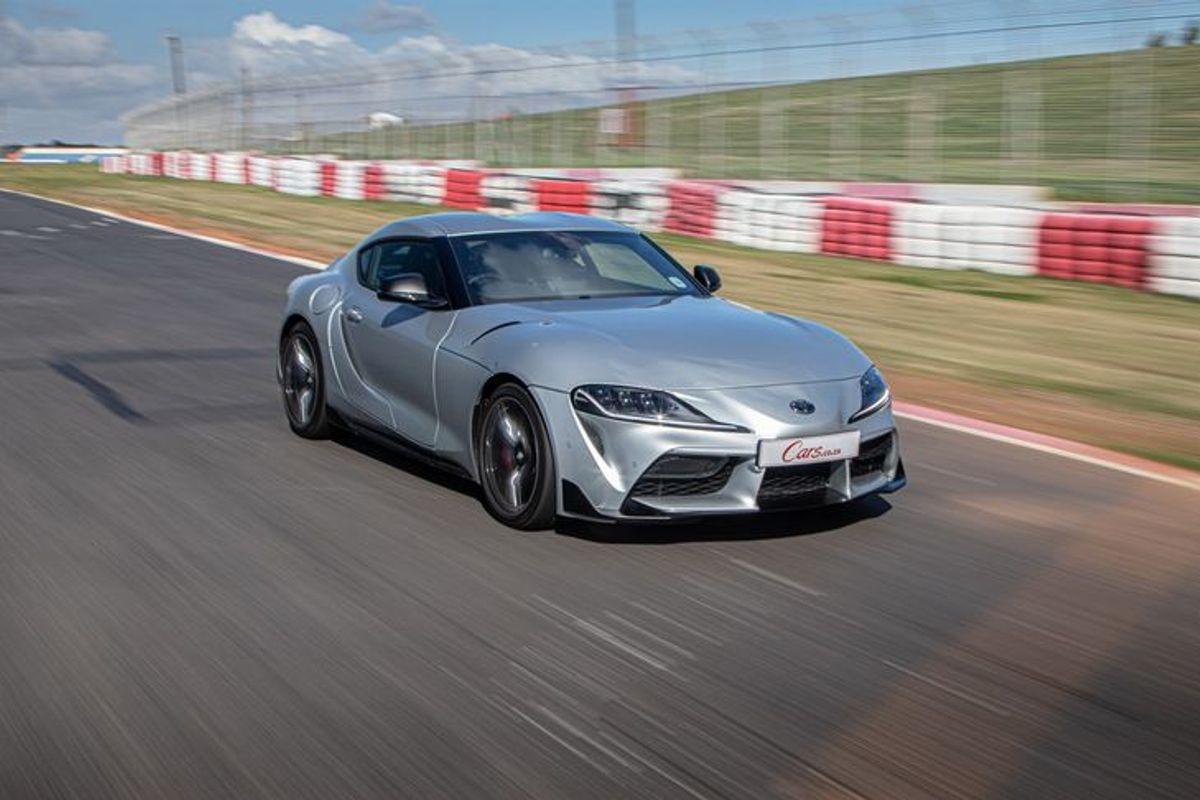
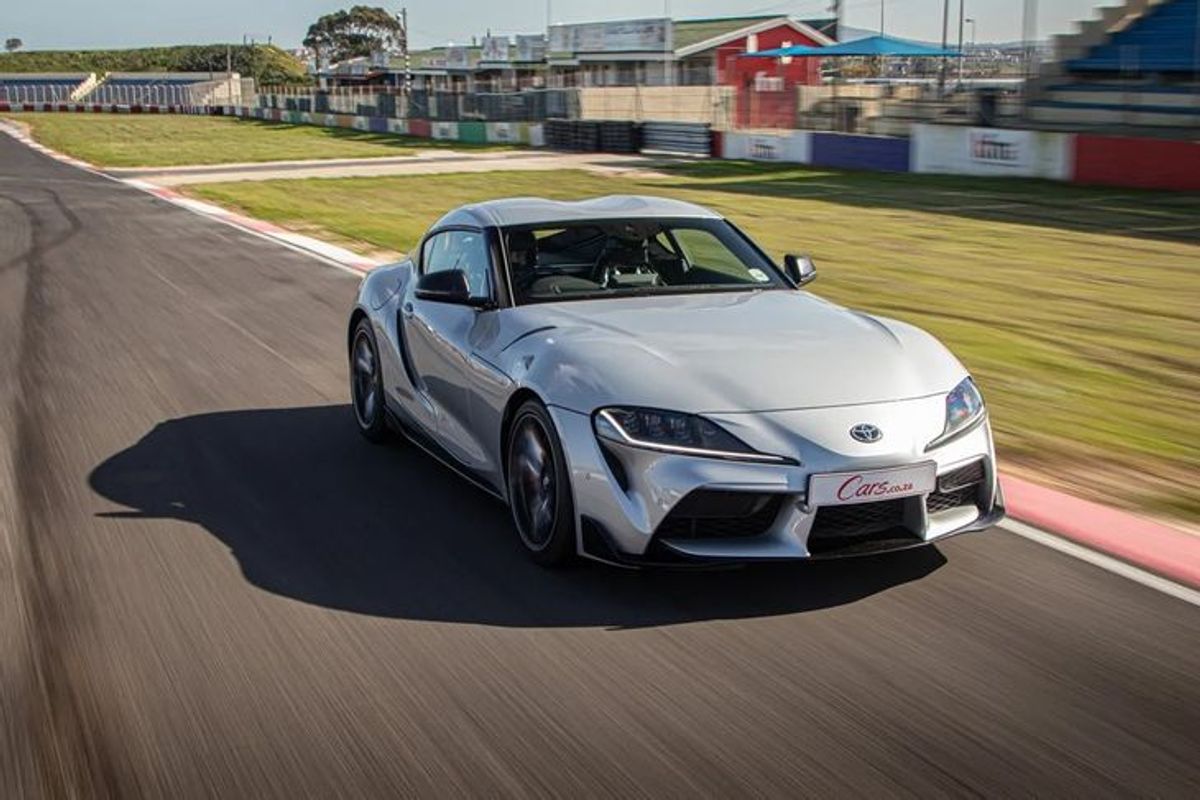
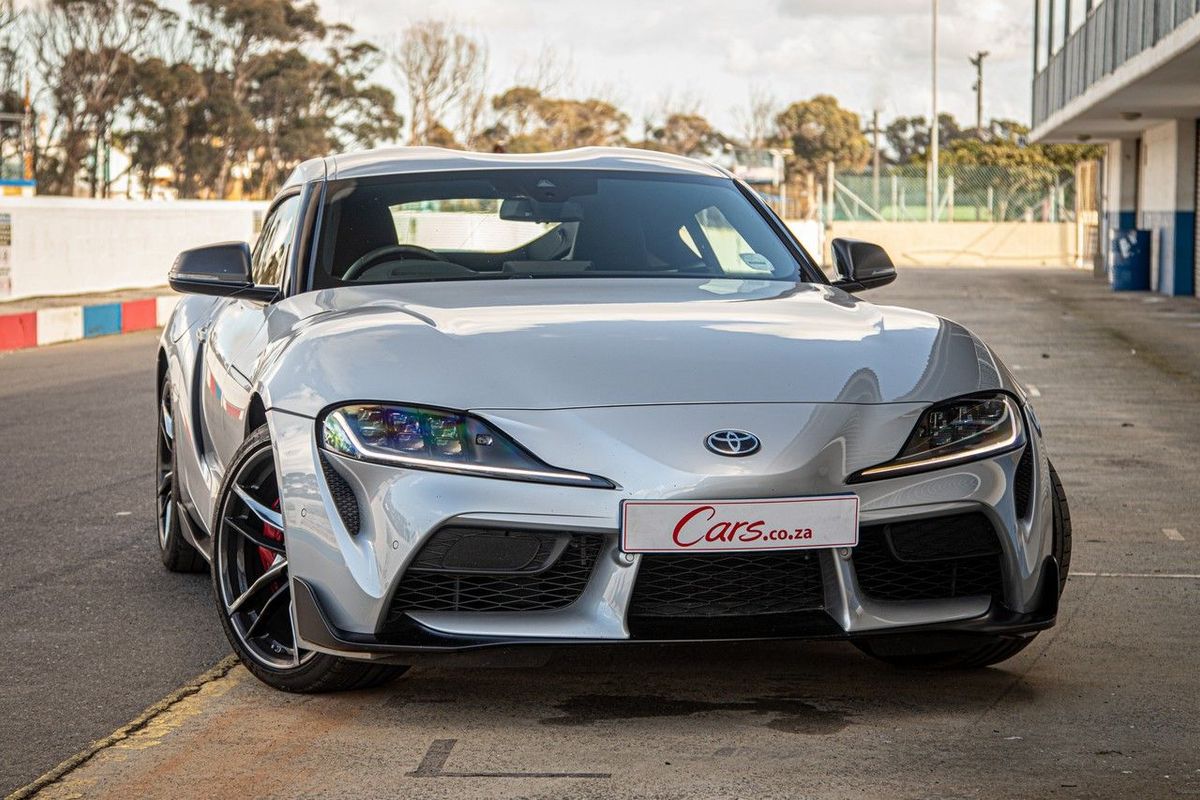
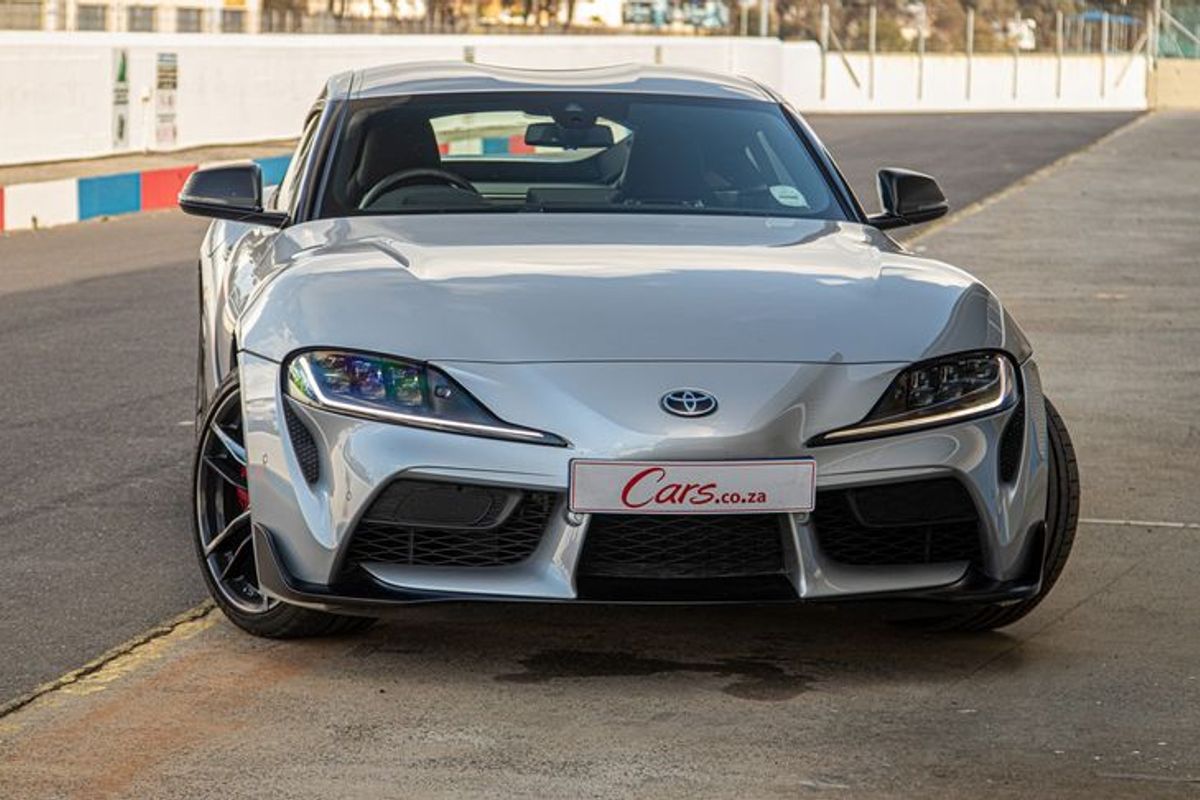
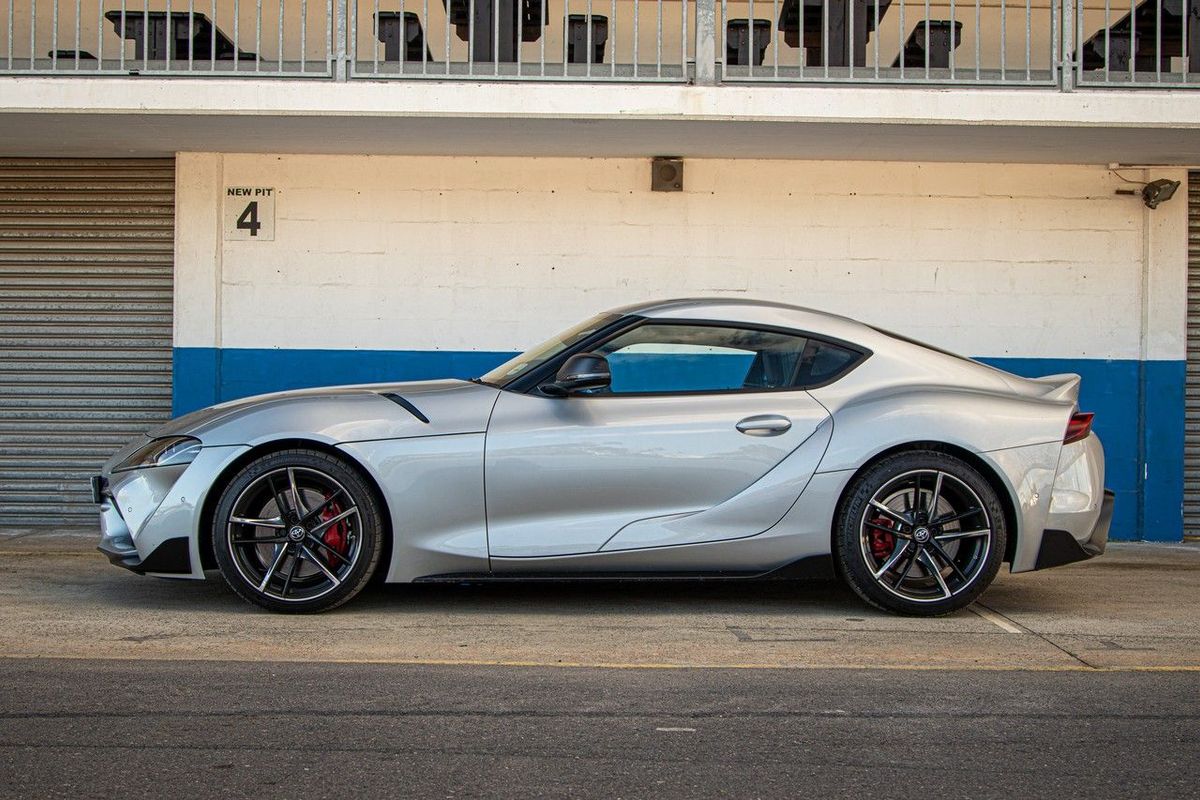
This week's headlines have been dominated by the launch of the new Toyota Supra. Cynics have been quick to label the eagerly-anticipated newcomer a Toyota-badged BMW Z4, but how closely are the Supra and Bimmer related?
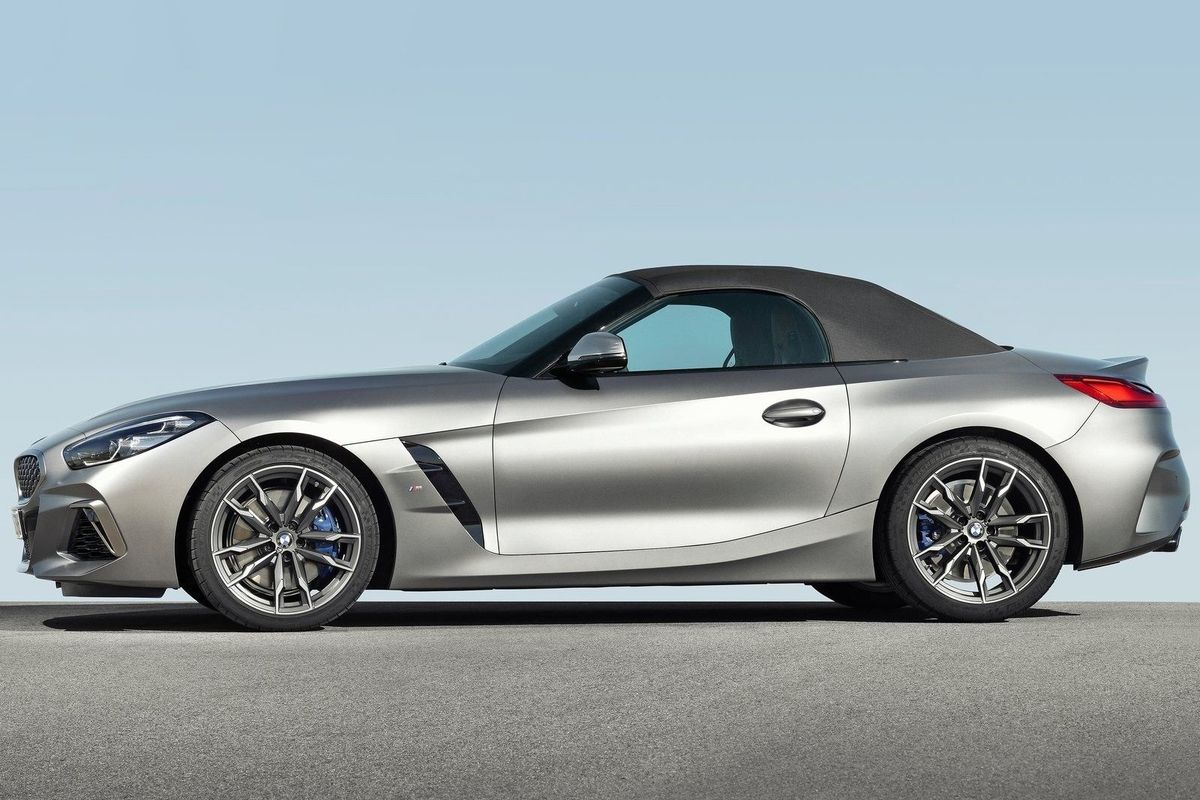
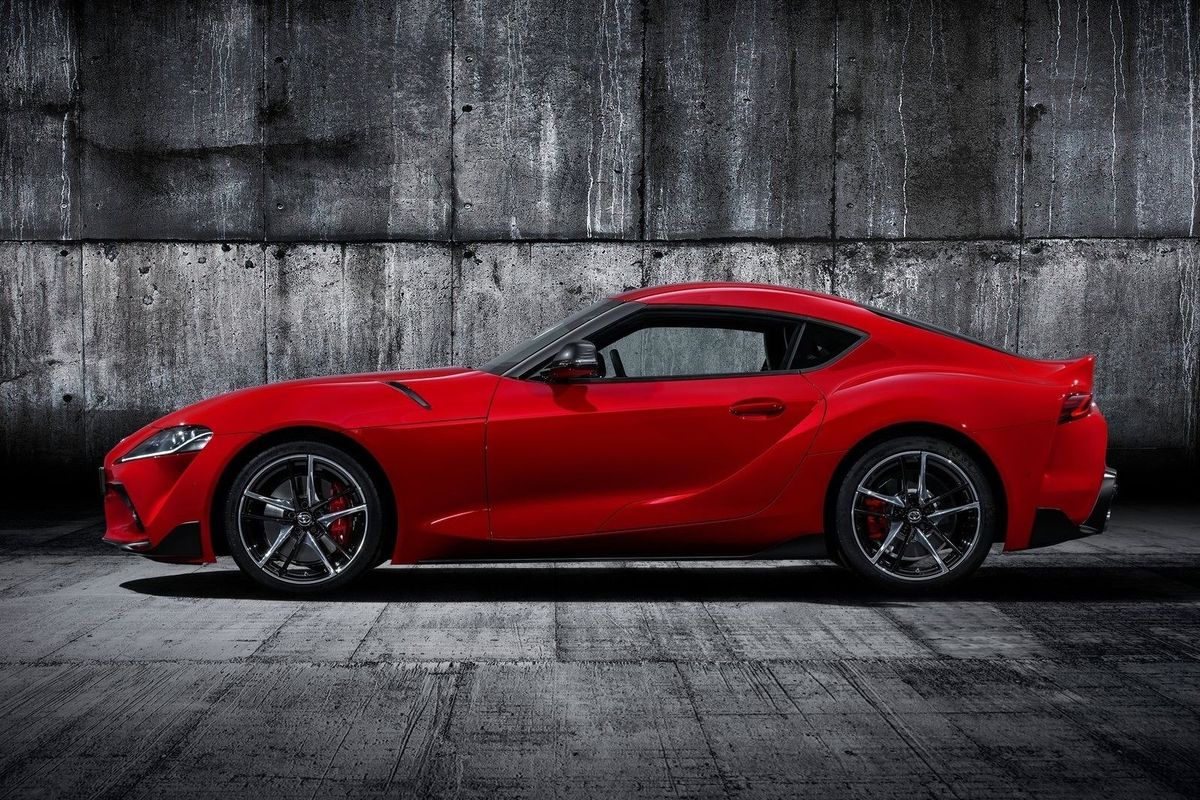
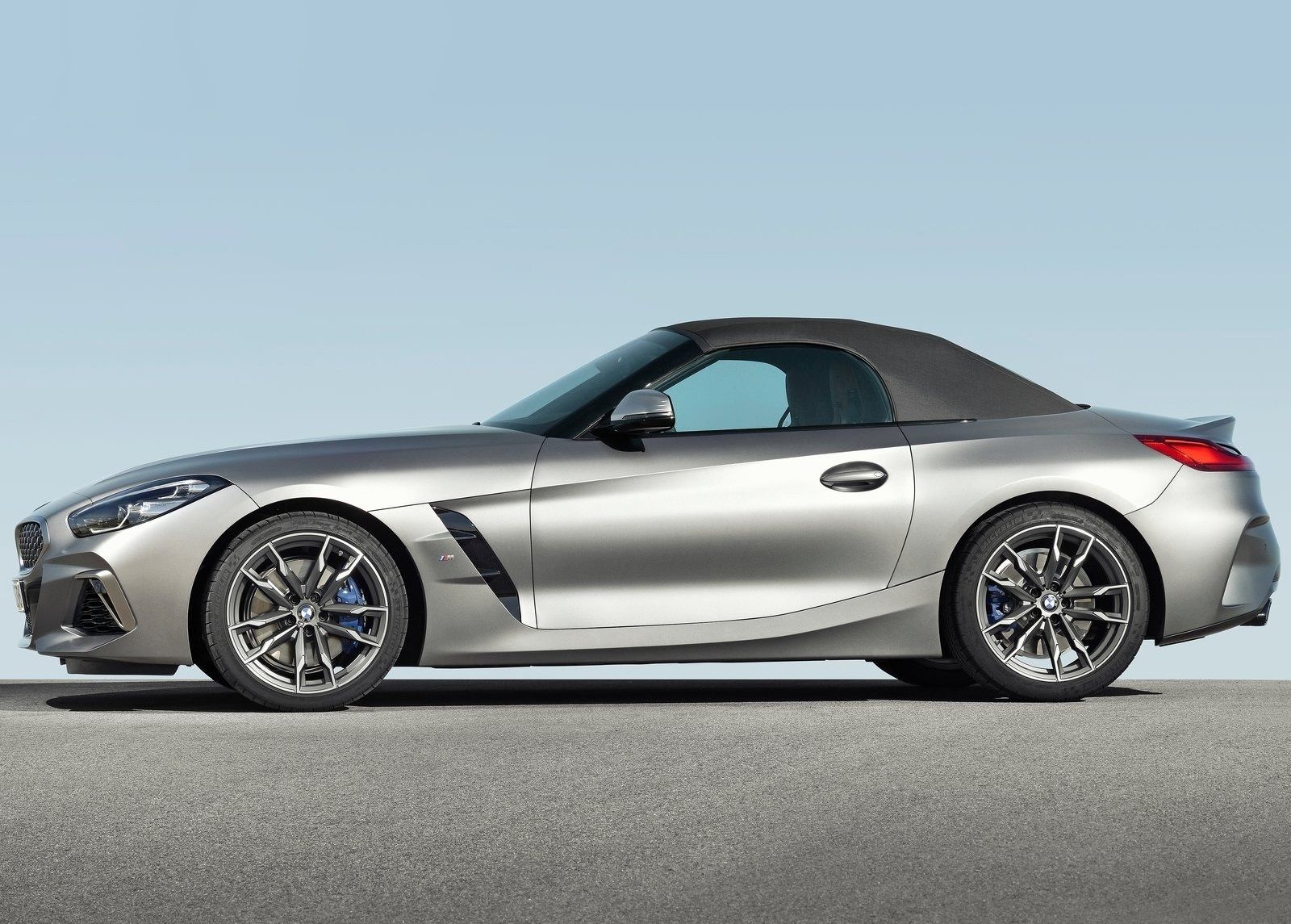
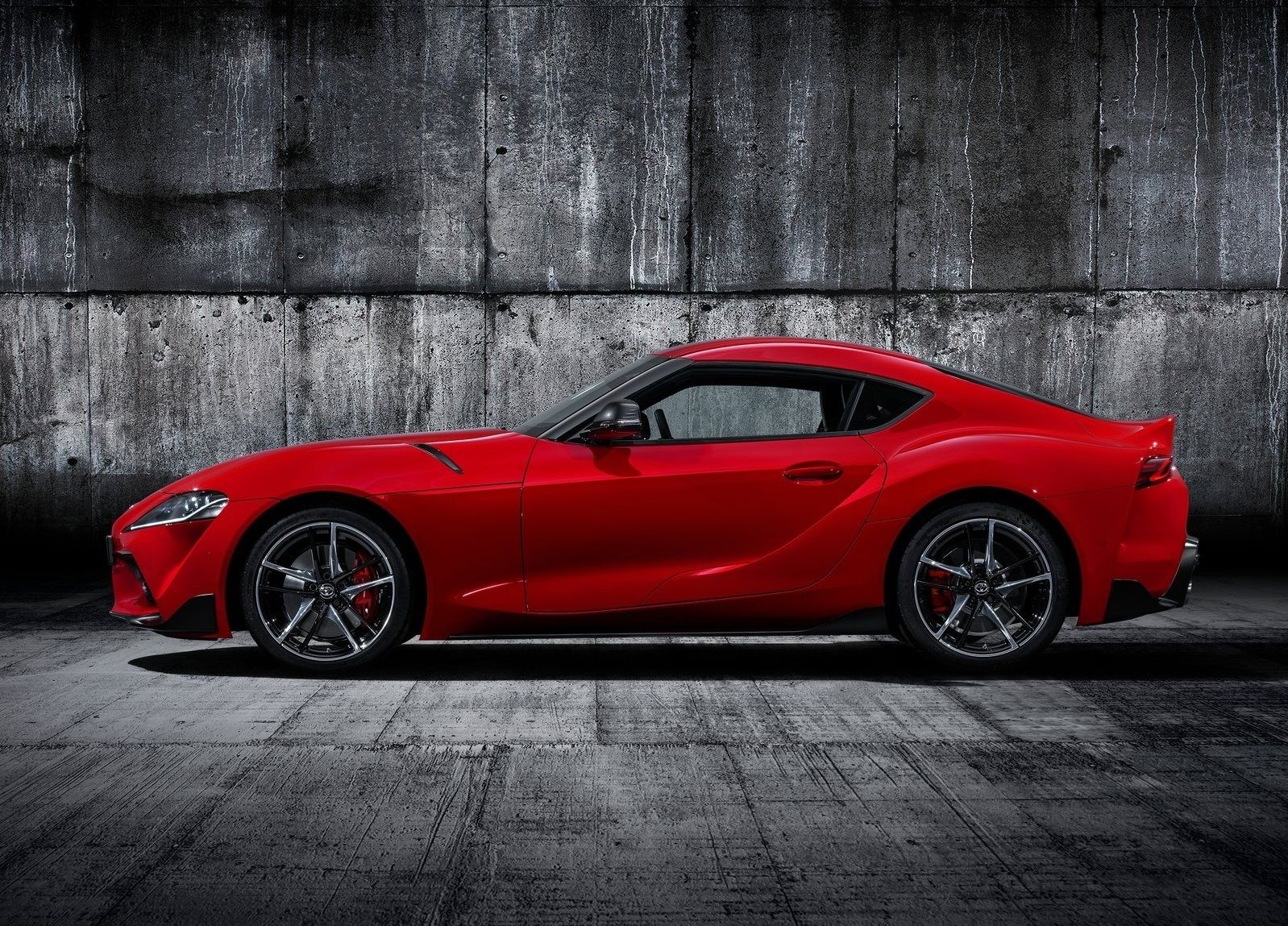
The 2020 Supra is the result of a collaborative effort between Toyota and BMW. A few months ago, the Munich-based released its new Z4 and the Supra's based on its platform, but while there are mechanical similarities, the two cars are quite different in execution. What's more, the Supra has bespoke suspension and traction control tuning, to offer a markedly different driving experience. Also, when you compare body styles, the Z4 is strictly a roadster, while the Supra is a coupe, which means the latter will have better torsional rigidity and should hold the edge in terms of handling.
However, when you look under the respective cars' sheetmetal, it becomes a challenge to differentiate between them. For example, the BMW and Toyota share the same engine, albeit in different states of tune. The engine – the B58 3.0-litre turbocharged straight 6 – is made by the German firm. In Z4 M40i application, it produces 250 kW and 500 Nm, while in the Supra it has the same power output and fractionally less torque (495 Nm).
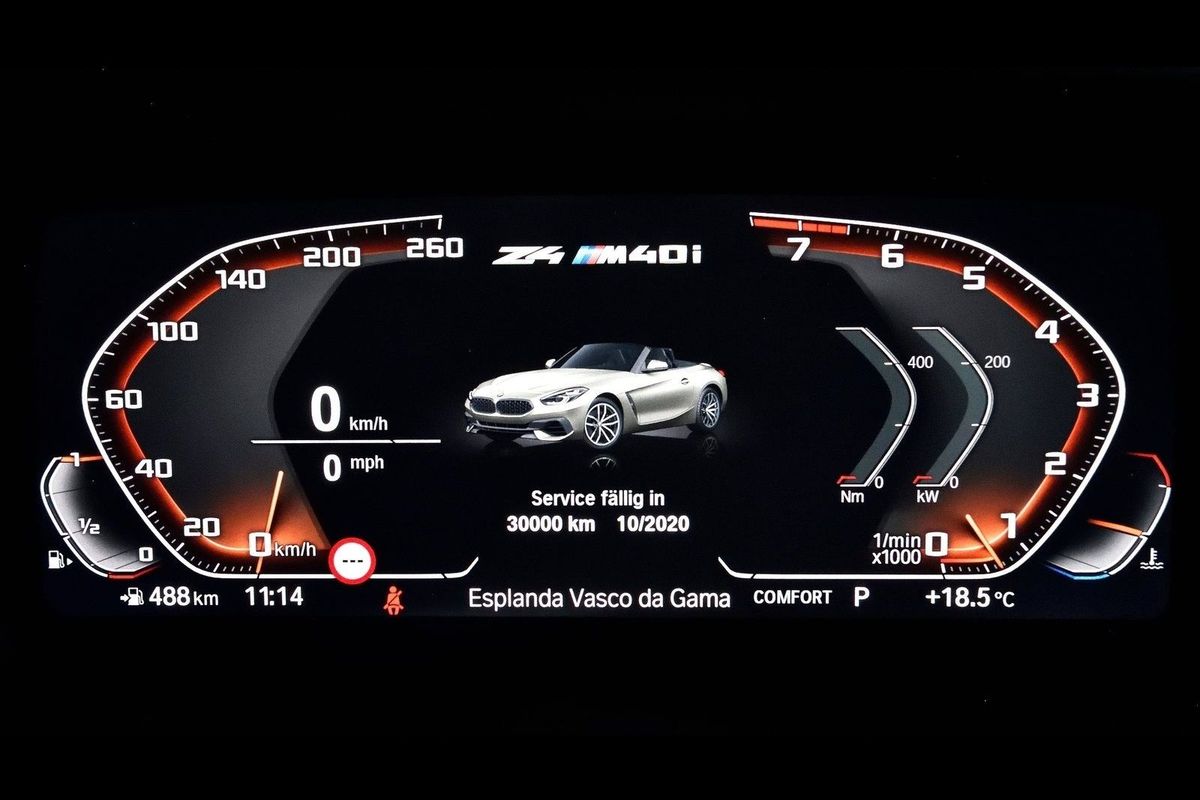
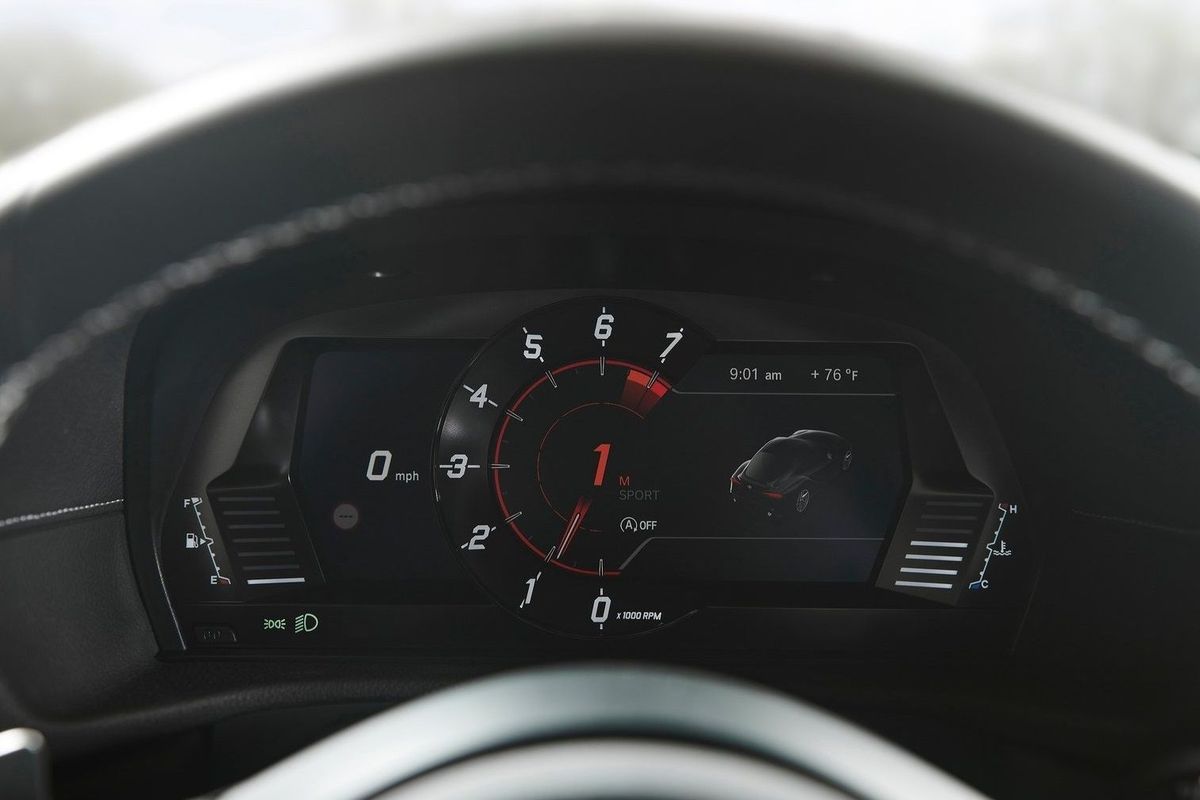
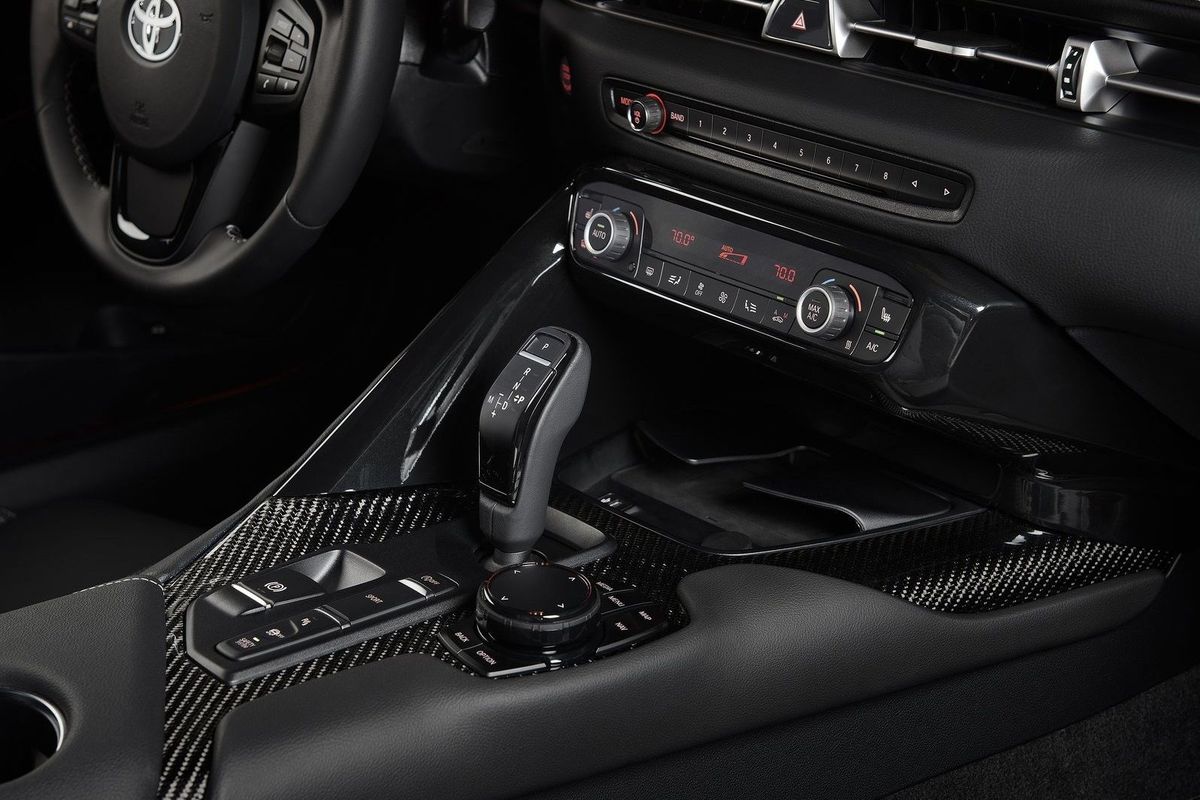
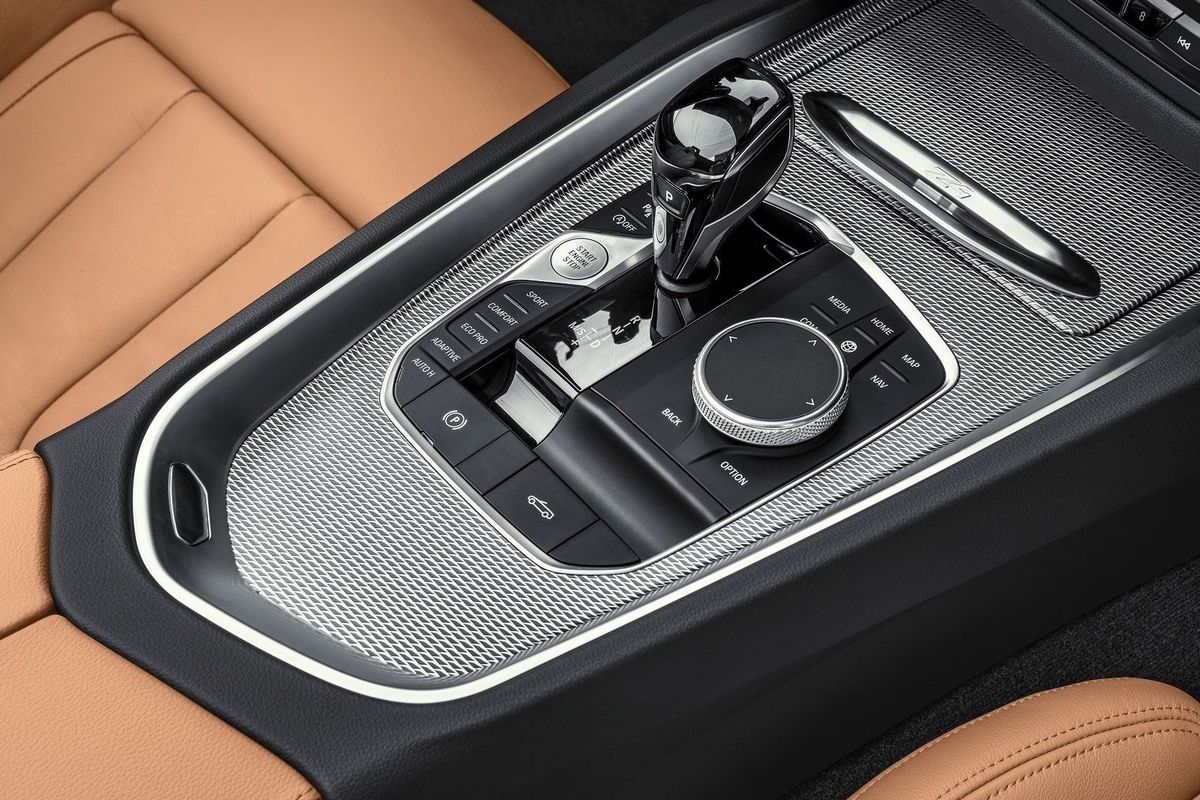
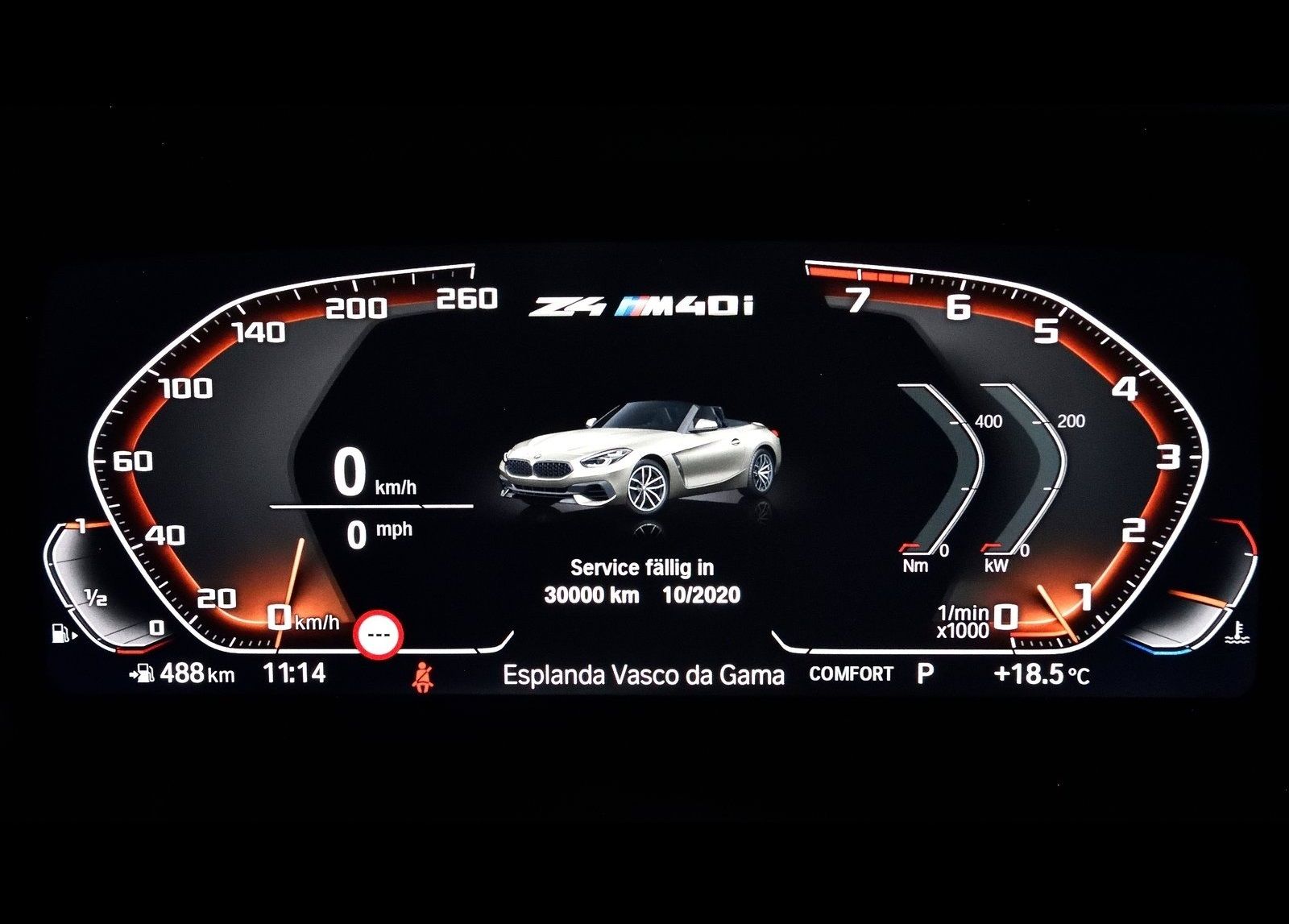
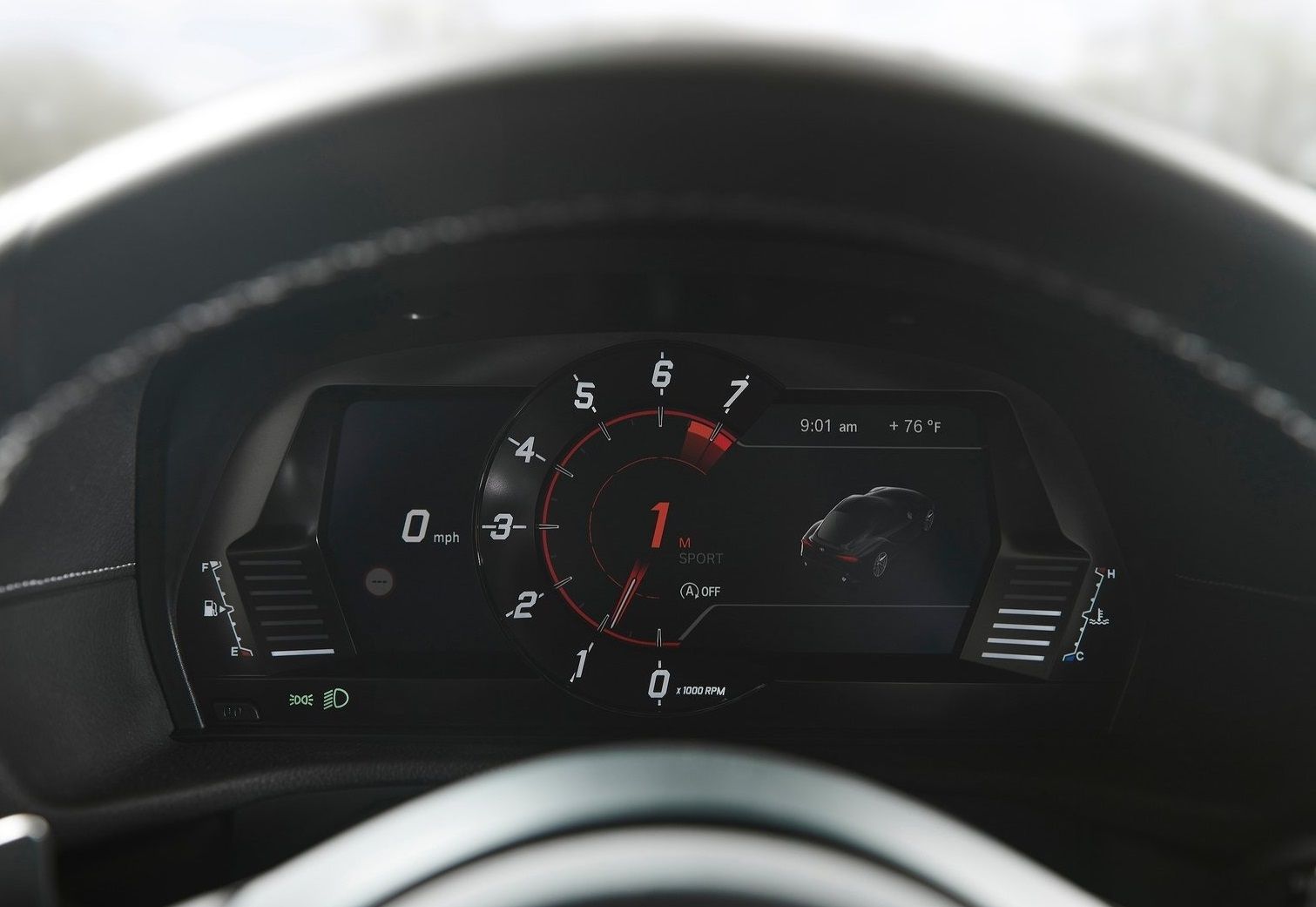
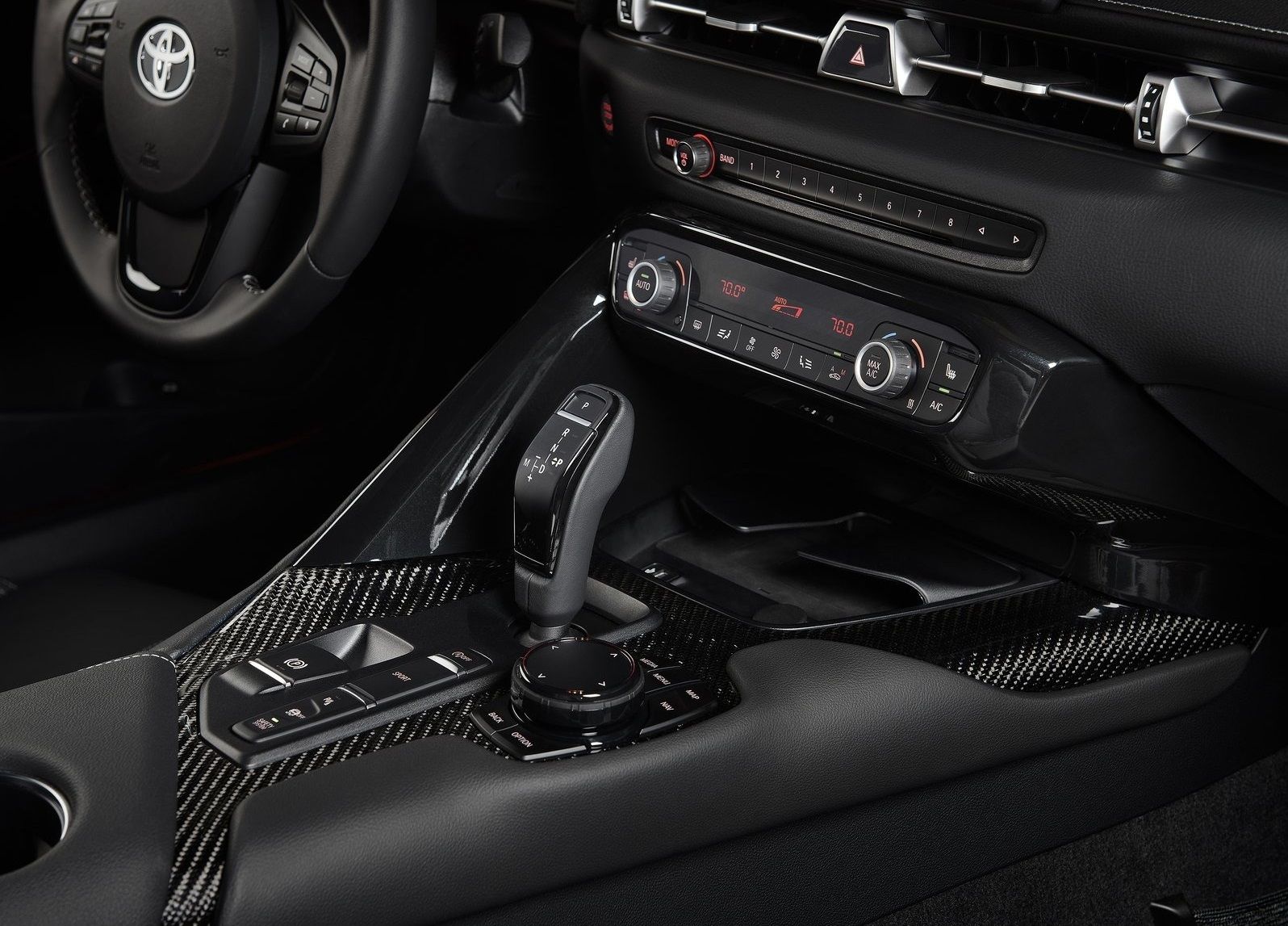
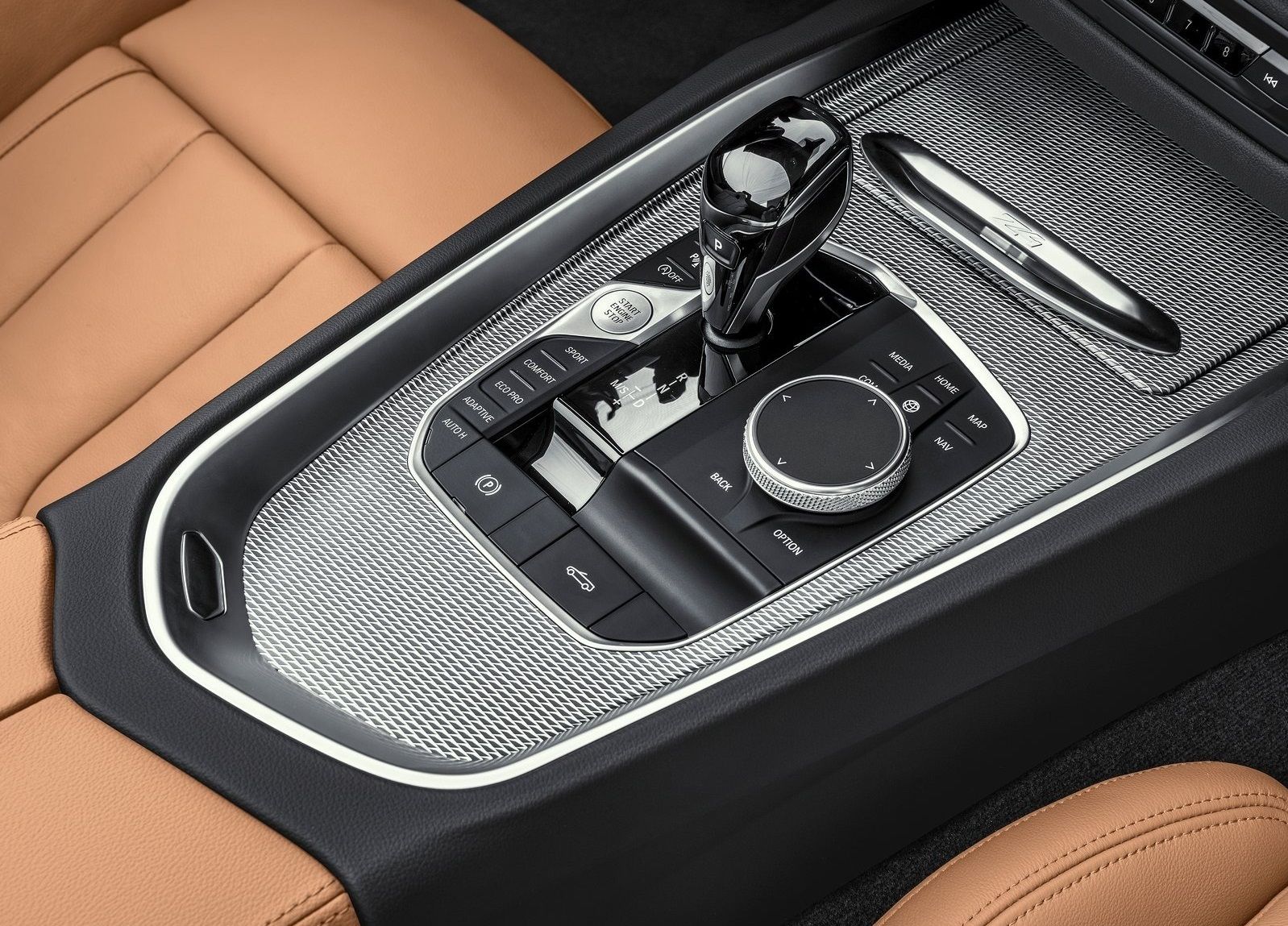
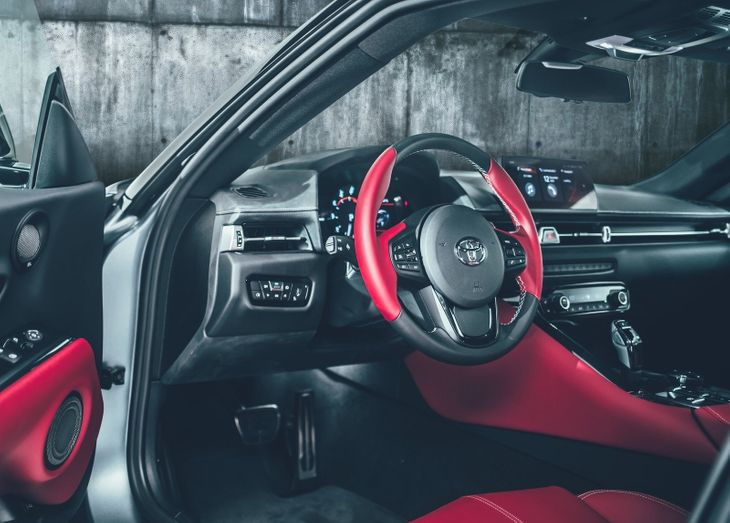
When you compare the Z4 and Supra's interiors and their respective switchgear, it is obvious that there are more than a few overlaps. That being said, the BMW Z4 M40i has a nicer looking dashboard cluster in our opinion, while Toyota has its own version of a digital gauge cluster.
It's interesting that the Supra's transmission lever looks remarkably like the one found in the latest Mini products. The font and icons applied to the switchgear are typical of contemporary BMW models and the rotary selector knob for the Toyota's infotainment unit is quite obviously based on BMW's iDrive controller. The whole thing package appears to be more BMW than Toyota, if not clearly from the outside, definitely on the inside.
The BMW Z4 M40i's cabin has taken a big leap forward in terms of perceived quality and premium look.
Summary
When we heard that BMW and Toyota were collaborating on the new Supra, we were concerned that this was going to be another case of Toyota (GT) 86 and Subaru BRZ – two products that are so similar in execution (and in terms of the driving experiences they offer) that, to this day, it's difficult to understand why both need to exist. The hope with the Supra/Z4 collaboration is that the Japanese and German cars each have a unique character and, having one as a coupe and the other as a roadster, will hopefully go some way to ensure that their target markets don't overlap.
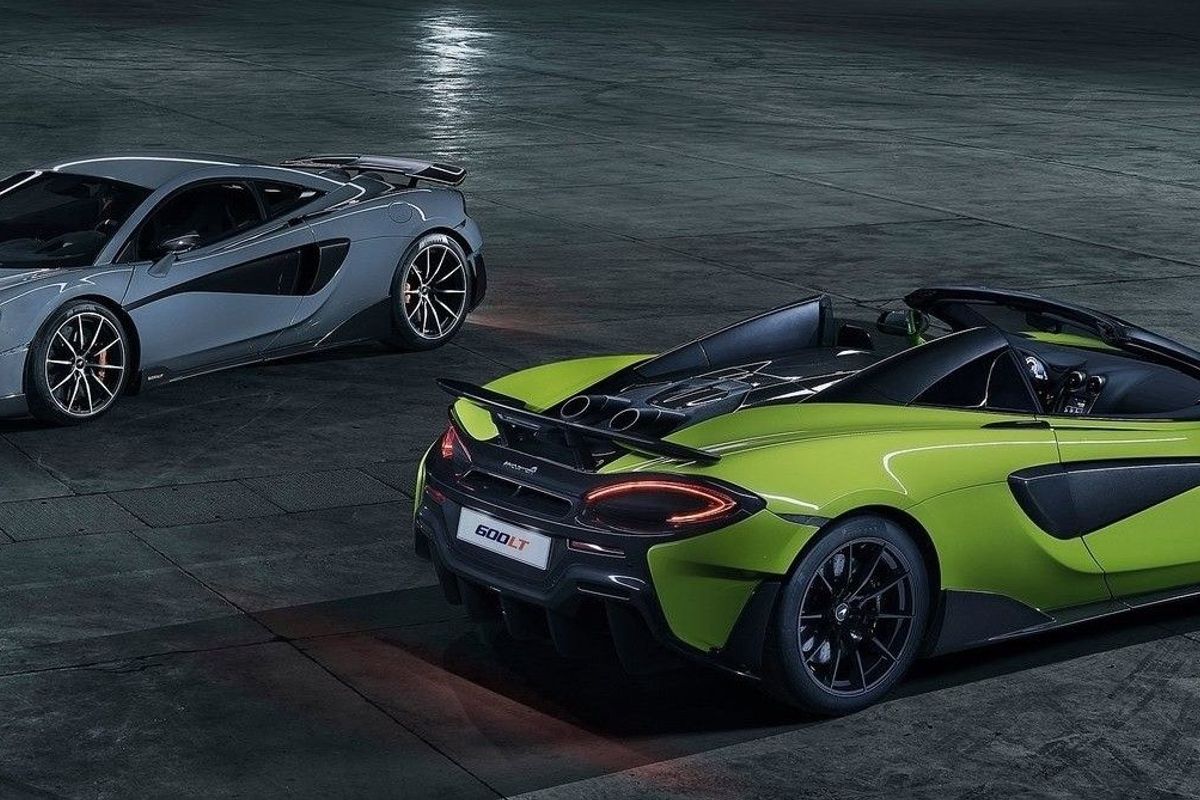
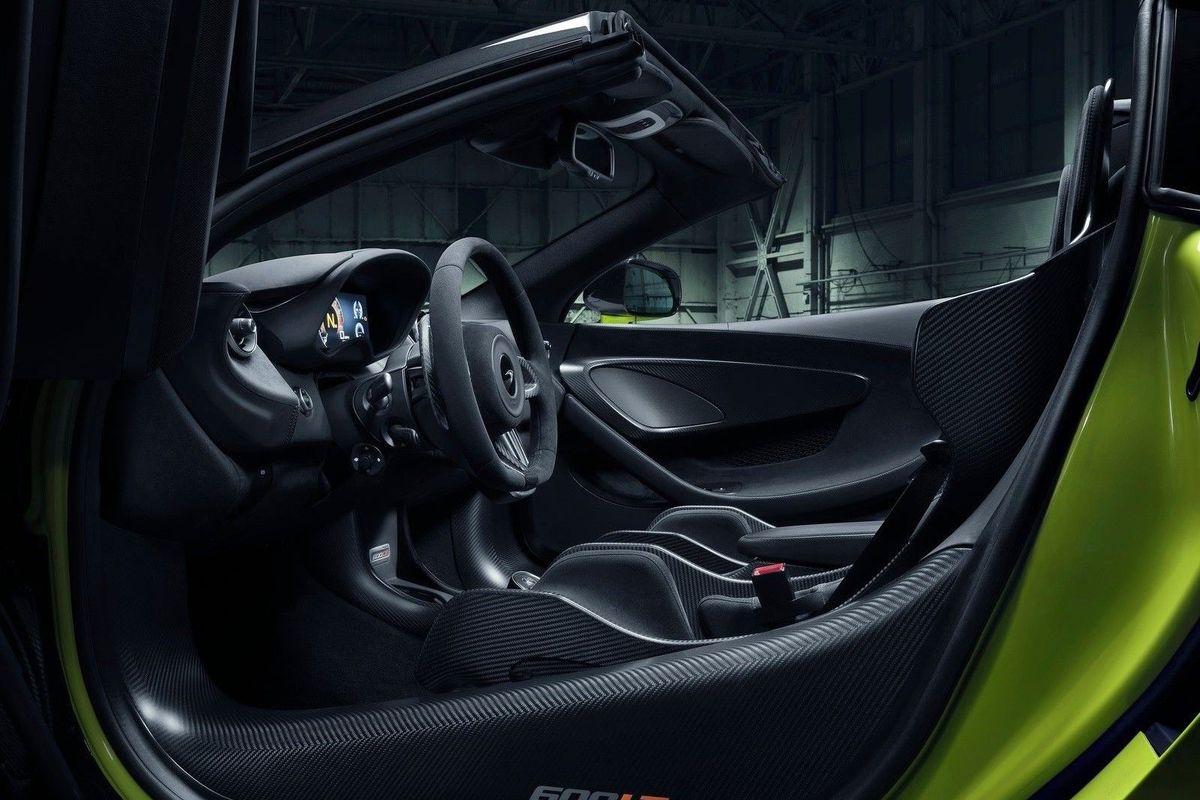
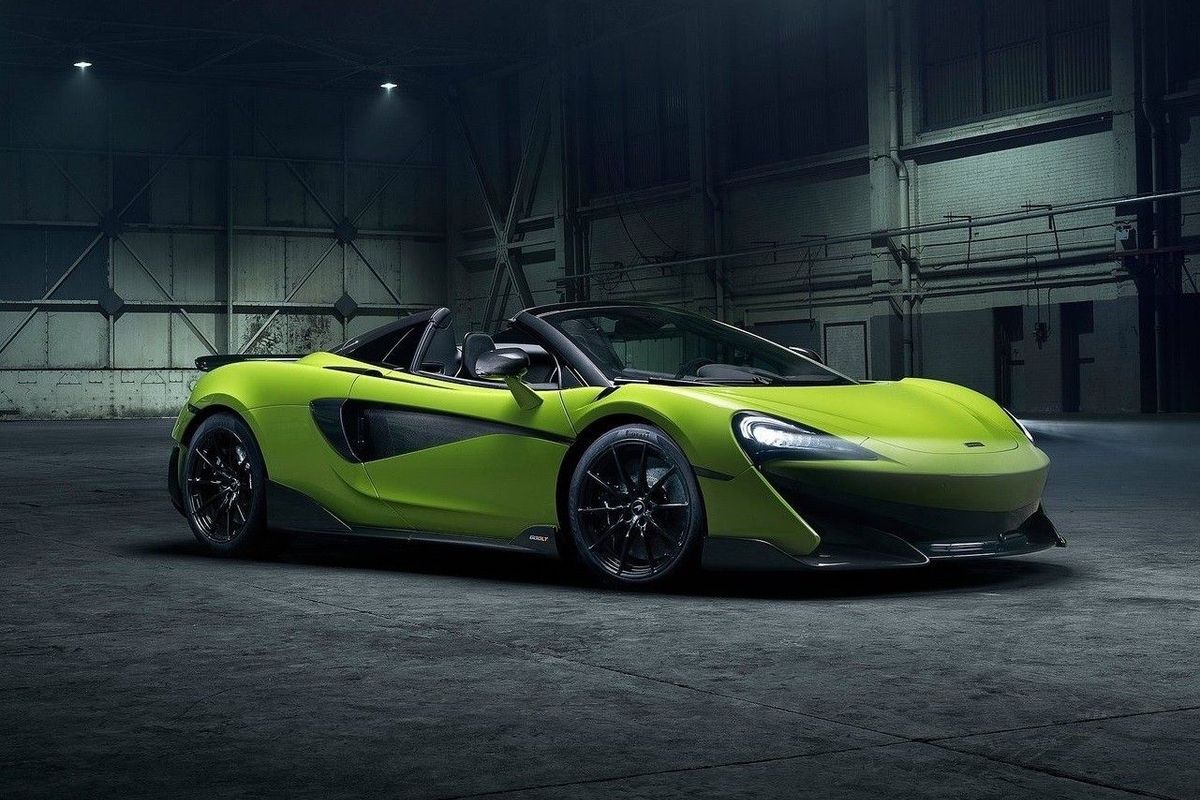
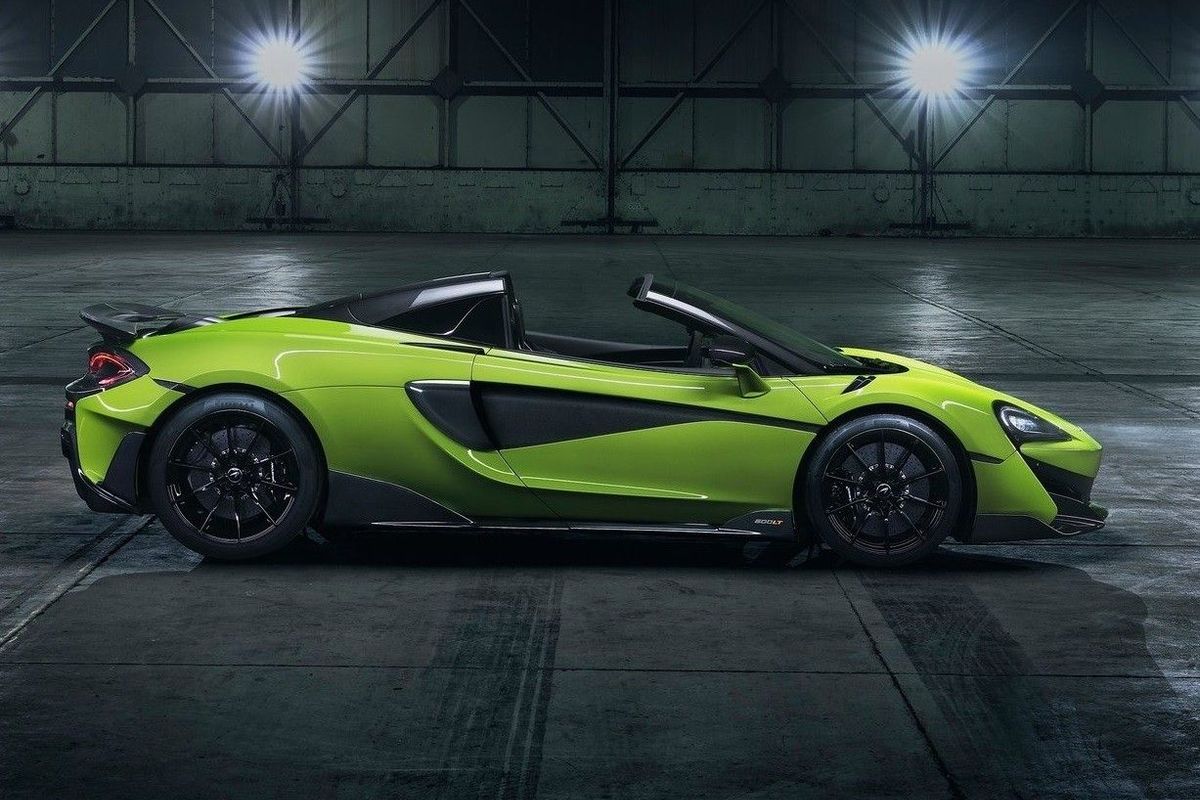
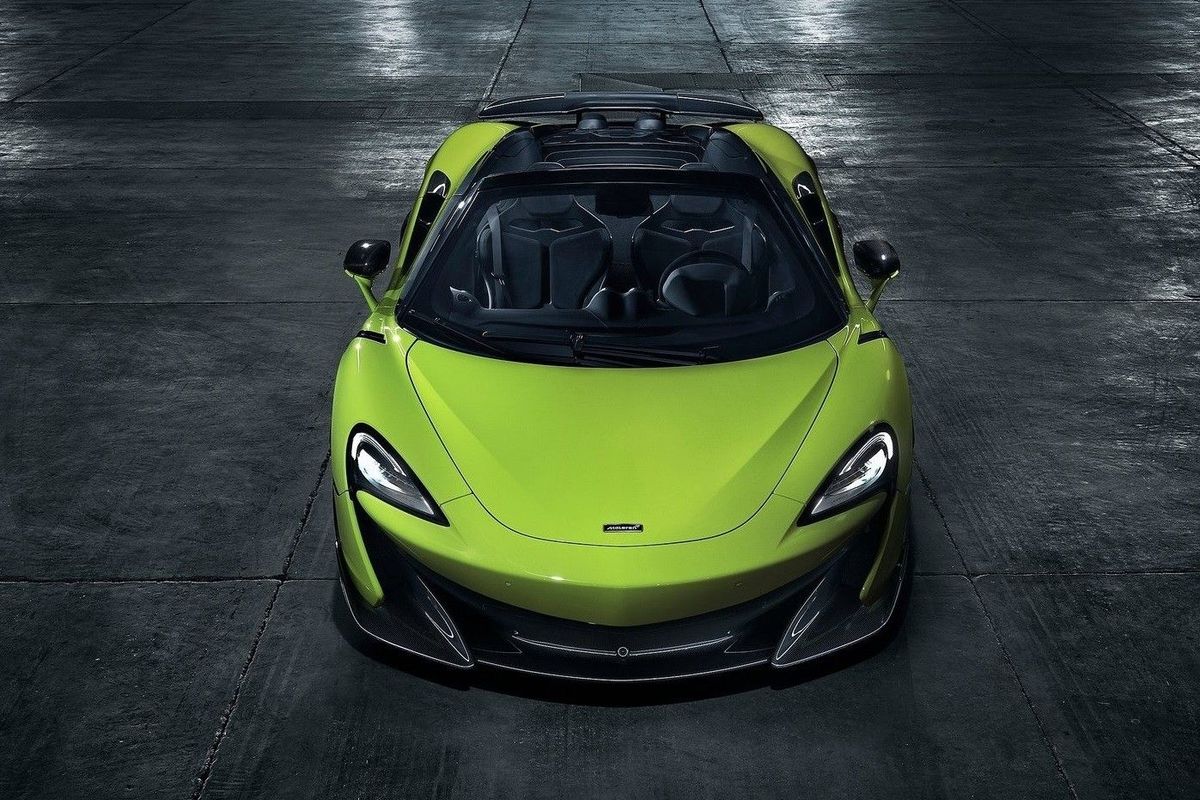
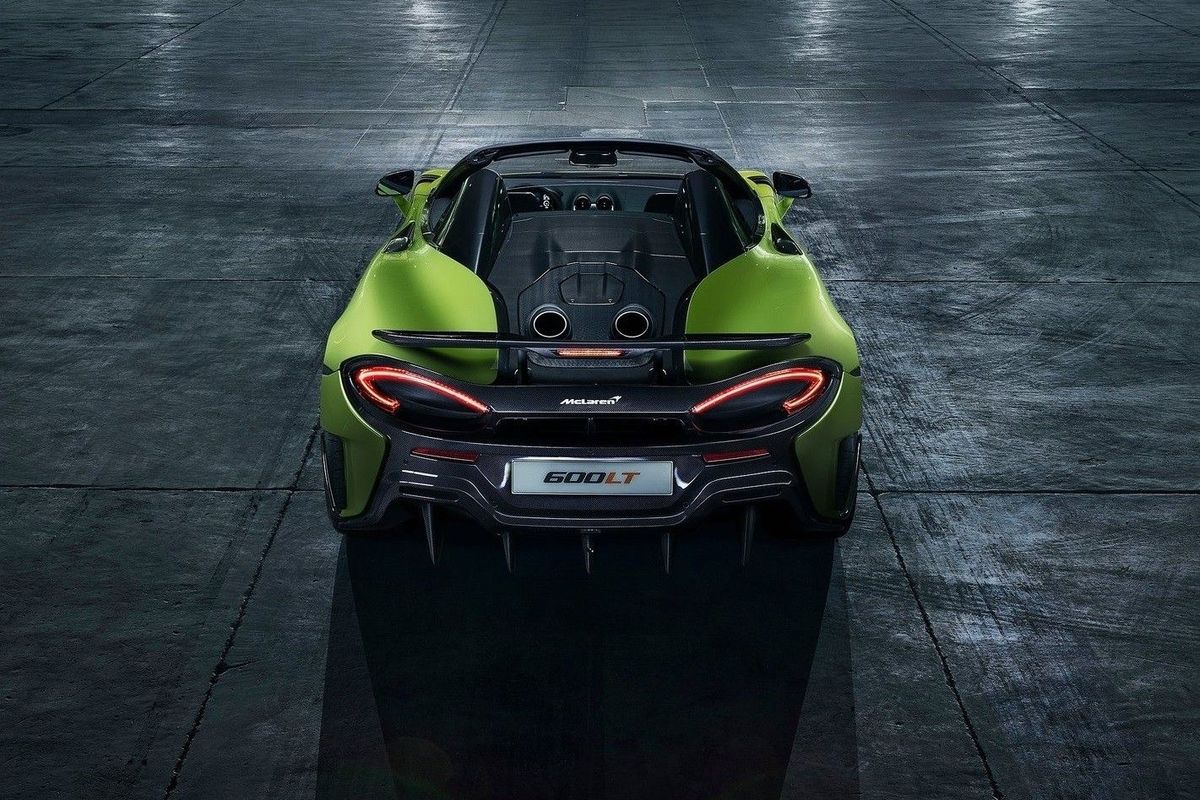
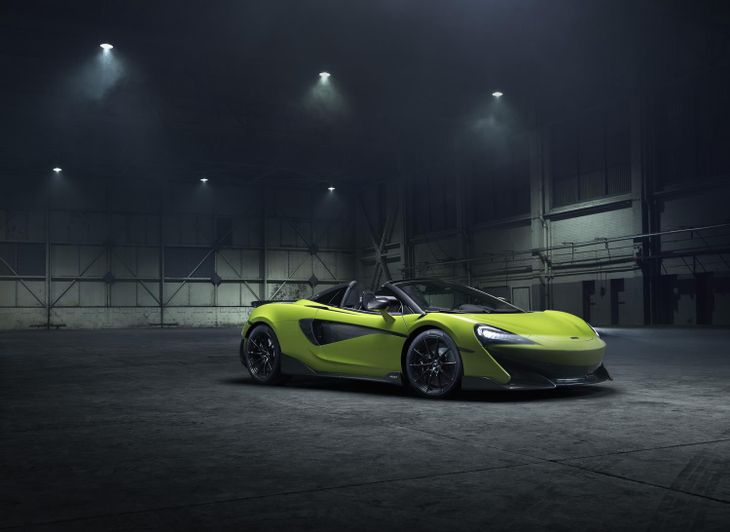
McLaren has dropped the top of its 600LT supercar and created the McLaren 600LT Spider. The newcomer is the 3rd new model in McLaren's £1.2bn Track25 business strategy and the 5th car to carry the Longtail name
McLaren Automotive has announced the arrival of the 600LT Spider and it's the 5th car to carry the Longtail name. The McLaren Longtail program focuses on increased power, reduced weight, optimised aerodynamics, track-focused dynamics and limited availability. Speaking of availability, McLaren says build slots scheduled around other Sports and Super Series models will be available and the car will be hand-assembled at the McLaren Production Centre in Woking, Surrey, England.
The 600LT has been on a strict diet and the McLaren engineers managed to shave 100 kg off in comparison to the 570S Spider. Thanks to its strong carbon fibre MonoCell II chassis, the Spider has the same rigidity as its coupe sibling and is just 50 kg heavier. The roof setup is a 3-piece powered retractable hardtop and can be lowered or raised at speeds of up to 40 kph.
The McLaren 600LT Spider is powered by a 3.8-litre twin-turbocharged V8 engine, producing 441 kW and 620 Nm, giving it enough shove to reach 100 kph in a claimed 2.9 seconds. 0-200 kph is dispatched in 8.4 seconds, making this one really quick convertible. Maximum speed comes in at 324 kph. Customers will be able to customise their 600 LT Spiders with a ton of options, including further weight-saving tricks like removing the audio and climate control systems. Seats from the McLaren Senna are also available.
A McLaren dealer in Cape Town estimated that the first 600LT Spiders will be arriving in July 2019.
The Road Traffic Management Corporation (RTMC) is proposing a number of amendments to the laws that govern driving on public roads in South Africa, including making it mandatory for drivers to be retested every 5 years…
It's widely agreed that the South African road rules and testing methods need to be extensively overhauled to help reduce the alarming number of road accidents that occur each year. The Road Traffic Management Corporation (RTMC) thinks it can alleviate some of the carnage by changing some of the laws that pertain to driving and testing driver competence. Here a few of the proposals that the RTMC will submit to Government:
A driver will need to be retested every 5 years when they renew their license.
A recently qualified motorist may not take long road trips in their first year of driving (more than 150 km).
A newly-licenced driver must be accompanied by an experienced driver for the first 6 months.
There will be additional testing for taxi-, bus- and truck drivers.
A driver will not be allowed to apply for a heavy-truck license unless they already have a car license.
There are also talks of completely overhauling the often-criticised K53 driving test. The K53 is essentially a copy of the British testing system that was implemented in the 80s, and it's in dire need of a revamp, to say the very least… The rules are outdated for modern vehicles (such as constant blind-spot checking, engaging the handbrake excessively), while evils such as ignorance of traffic-circle rules and "under-taking" need to be addressed.
At this stage, everything is still under discussion and finalised proposals will need to be published in the Government Gazette.
Good in principle, but…
We've given the RTMC's proposals thorough consideration… and we anticipate there'll be a few issues that may hamper their implementation. For one, a retest every 5 years seems like a costly logistical nightmare. In the UK, pensioners (over 70) are tested more frequently (every 3 years) to assess their reactions, as well as screen for health conditions that could impair their driving ability. This seems like a more feasible solution locally.
Newer drivers that are required to have experienced drivers alongside them for longer journeys is another system the UK has effectively put into place. It has shown promising results but seems to point fingers at a driving test that doesn't qualify capable drivers.
Additional testing for taxi and truck drivers can only be a positive thing, as they carry the lives of much of South Africa's workforce on a daily basis.
These proposed new rules come in the wake of another tumultuous festive season, where the 2018/19 road death toll increased to 1 612 (from 1 527 the previous year). Human factors accounted for 90% of those road deaths.
Facelifted BMW 7 Series Announced – Coming to SA in Q2 2019
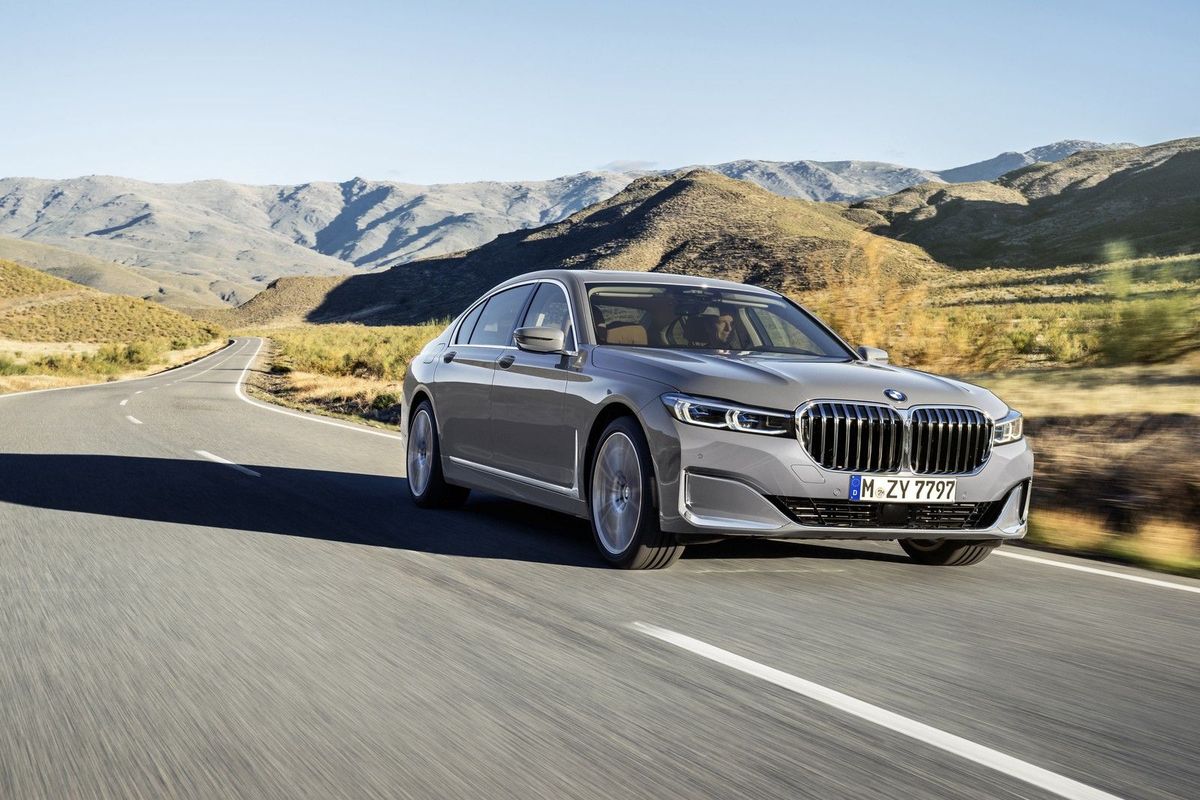
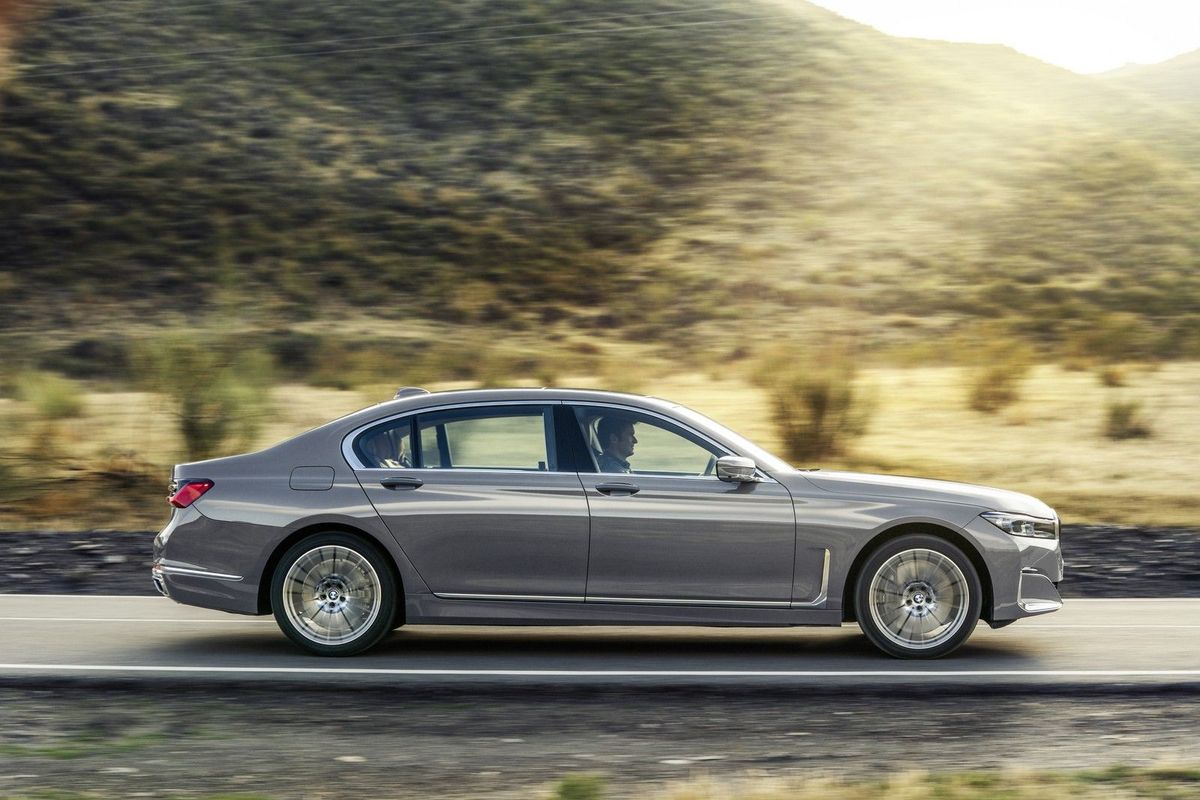
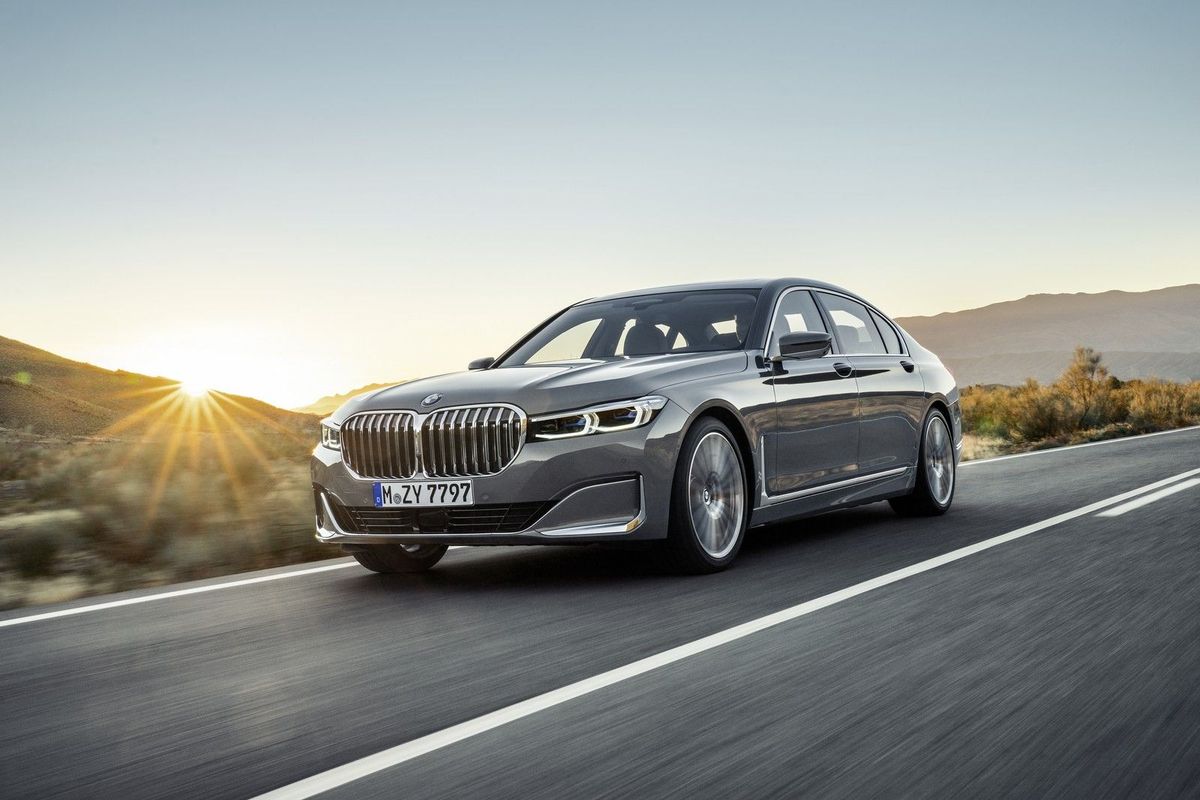
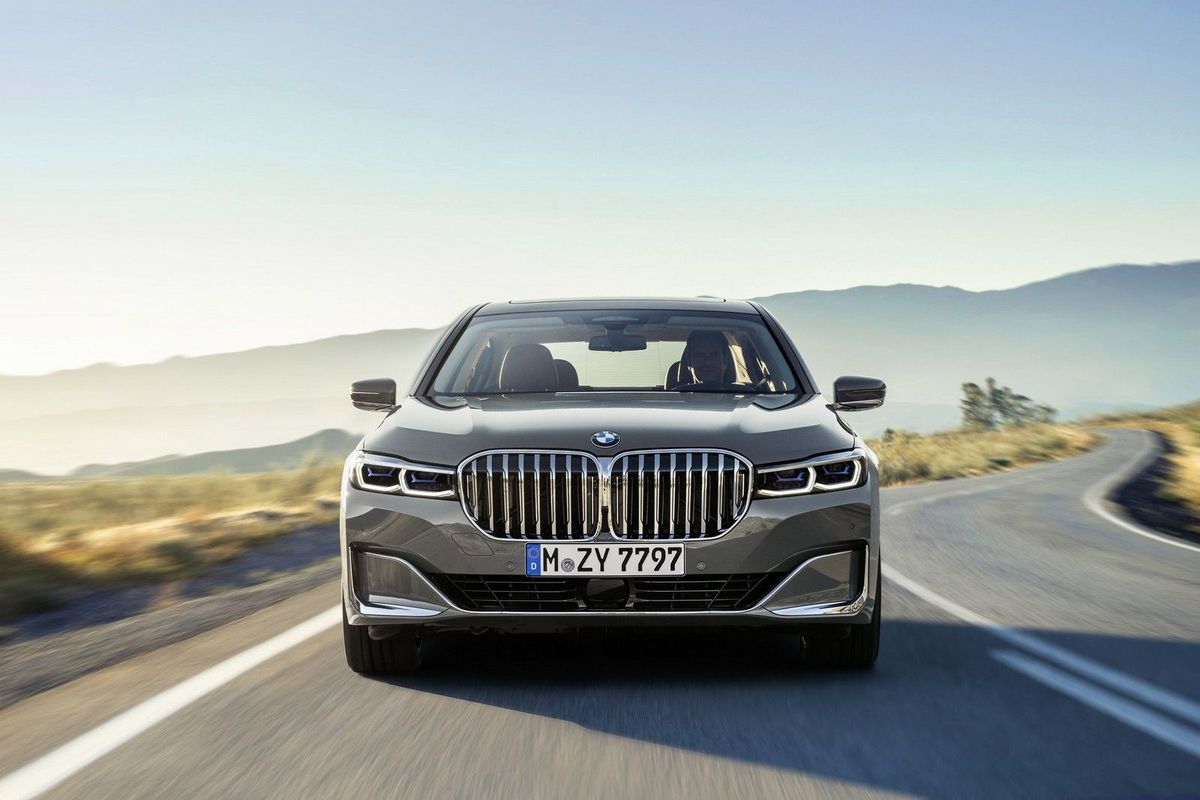
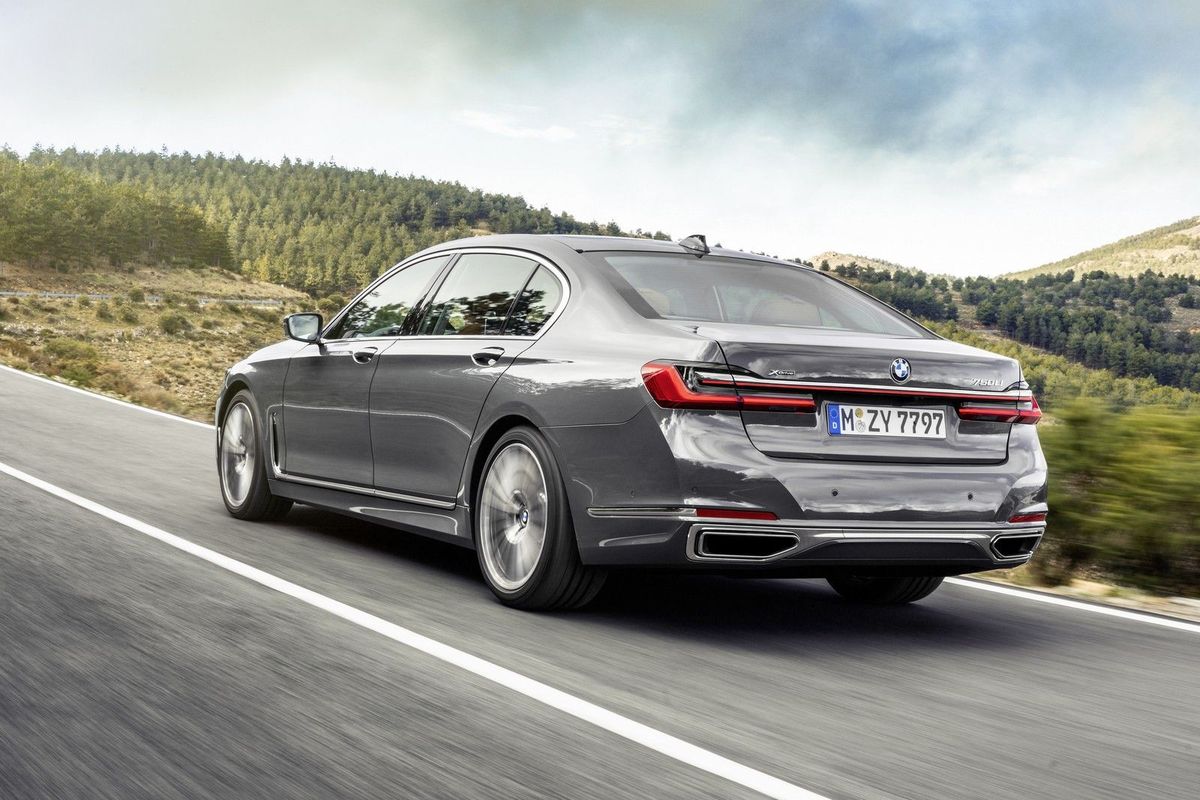
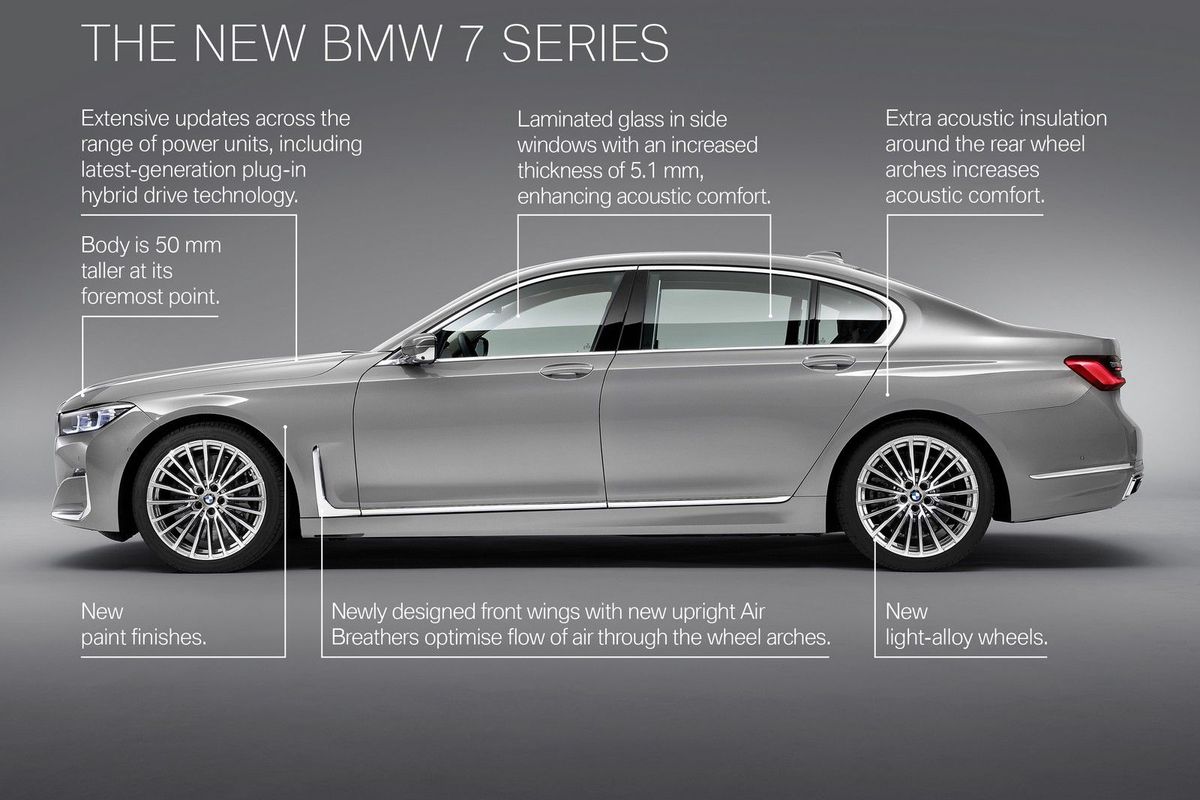
The BMW 7 Series has undergone a facelift. The LCI 7 Series receives new engines, more tech and has been confirmed for a South African market introduction in the second quarter of 2019. Here's what you need to know about the newcomer.
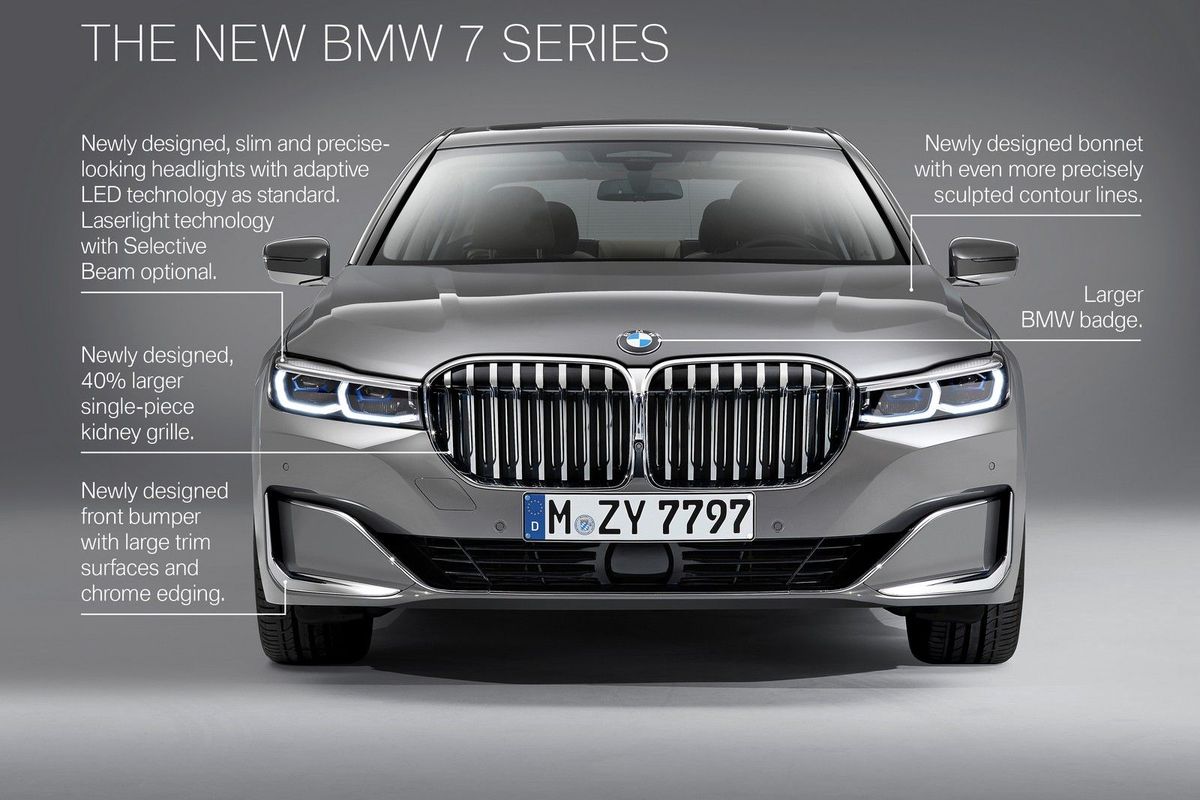
The big BMW 7 Series rattled the luxury sedan market back in 2016 thanks to advanced technology, new levels of comfort and Newton's Law-defying driving dynamics. Now for 2019, BMW has given its luxury sedan a nip and a tuck both inside and out. The BMW 7 Series will be offered in 2 body styles, but the SA market will only be getting the long wheelbase options. The newcomer is 5 260 mm long and total length has been increased by 22 millimetres. The new 7's height and width remain the same.
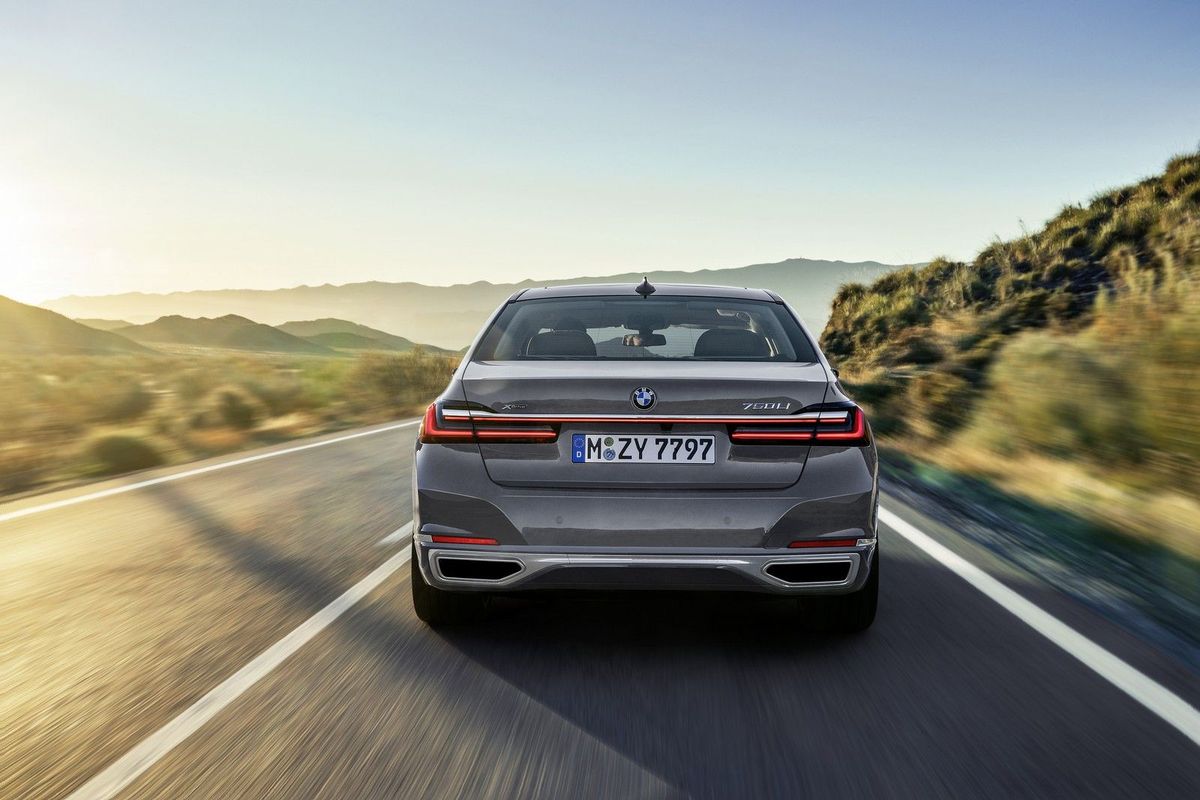
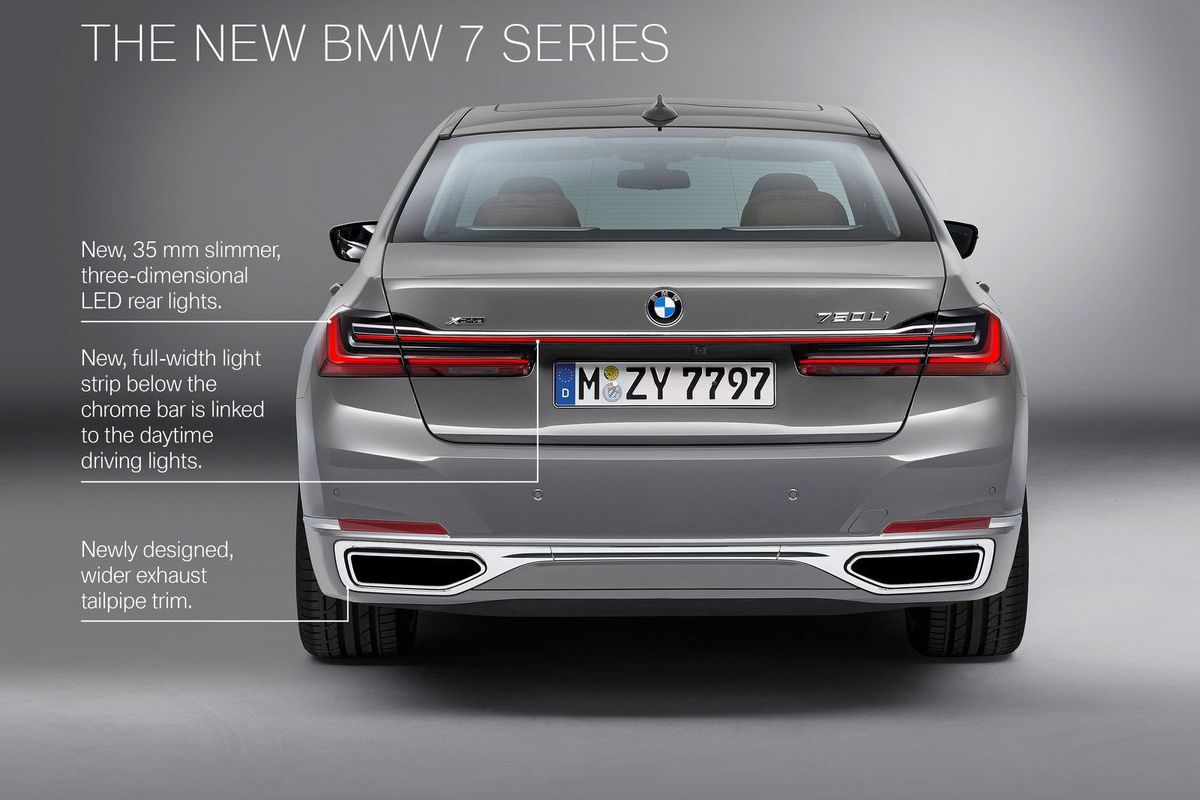
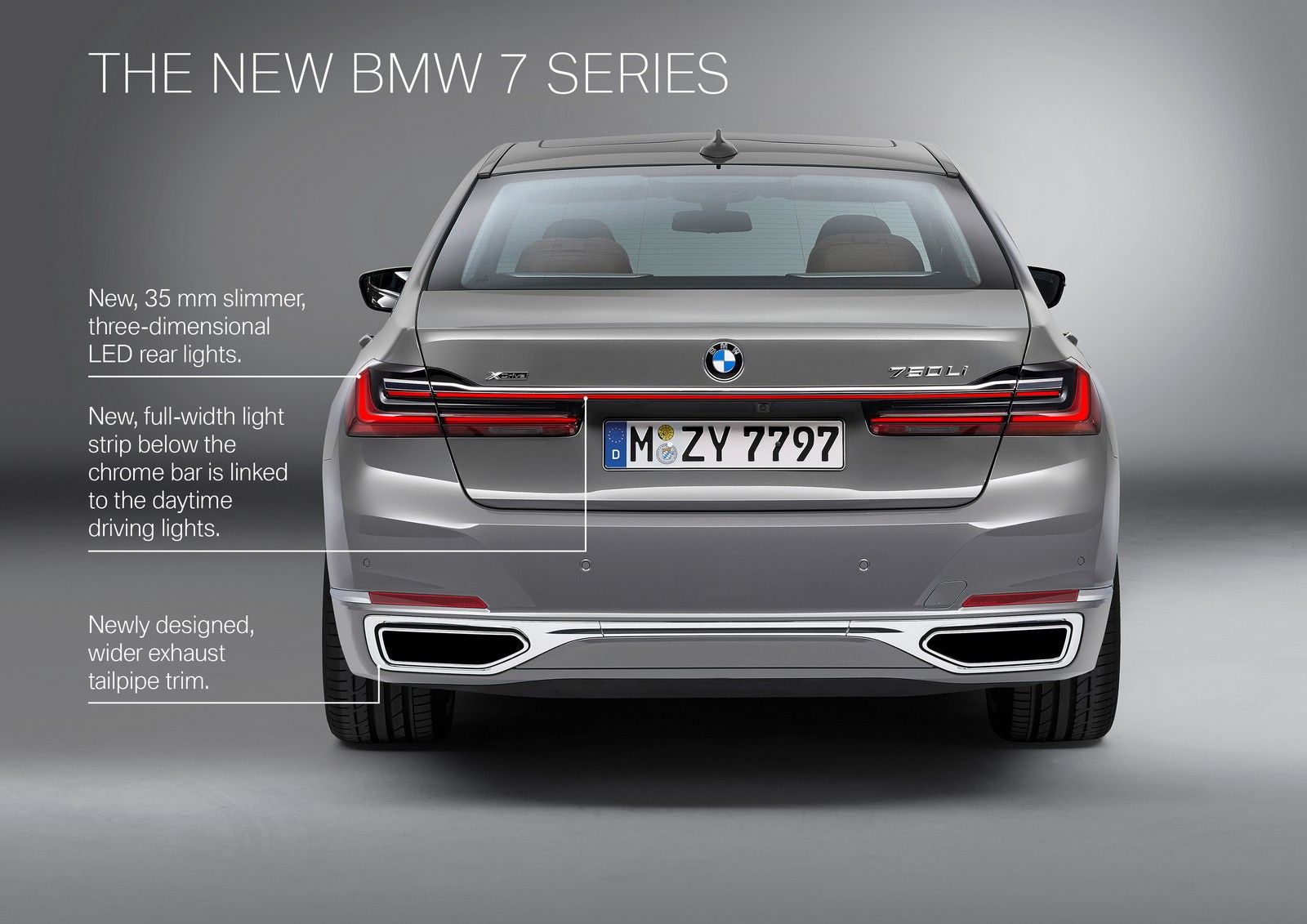
That front end is a massive talking point. Not only does the gaping grille dominate the front as it has increased in size, but the entire front unit sits higher. The rear has changed too and adopts integrated exhaust tailpipes as well as LED taillights. There's also a neat thin light strip which stretches across the width of the rear bumper and connects the rear taillight units.
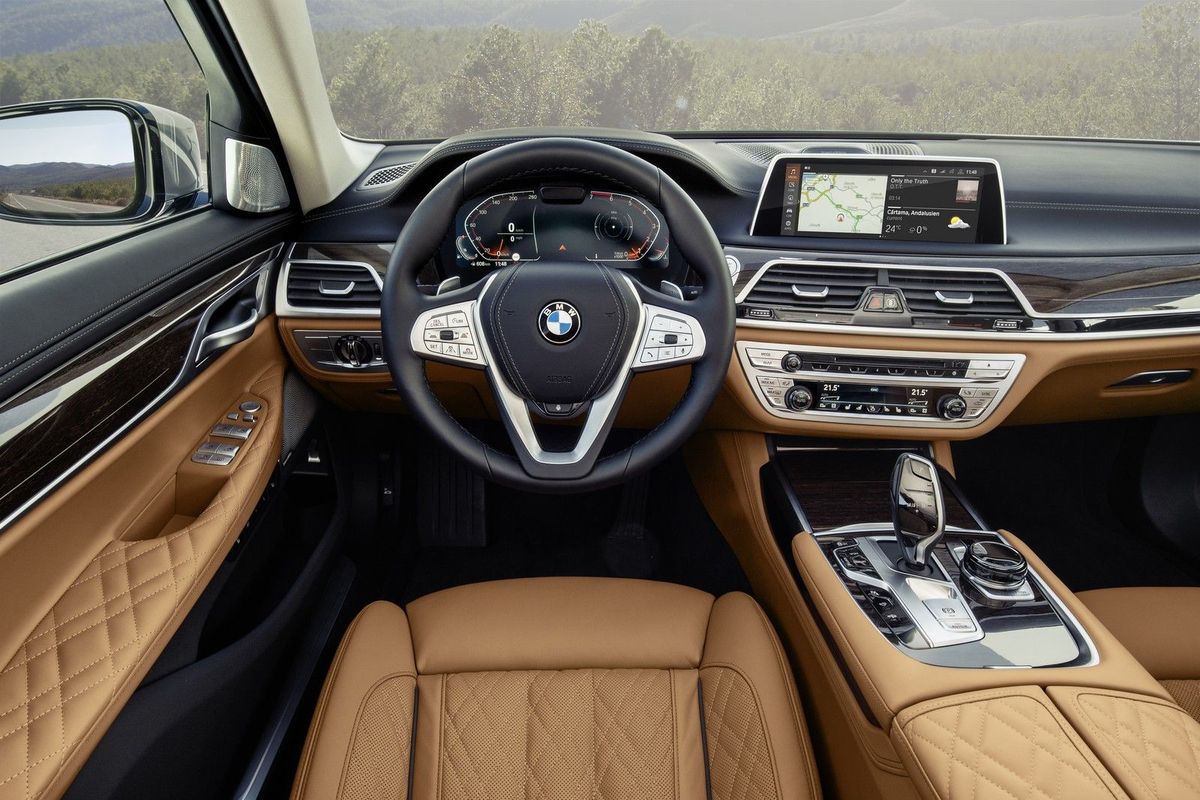
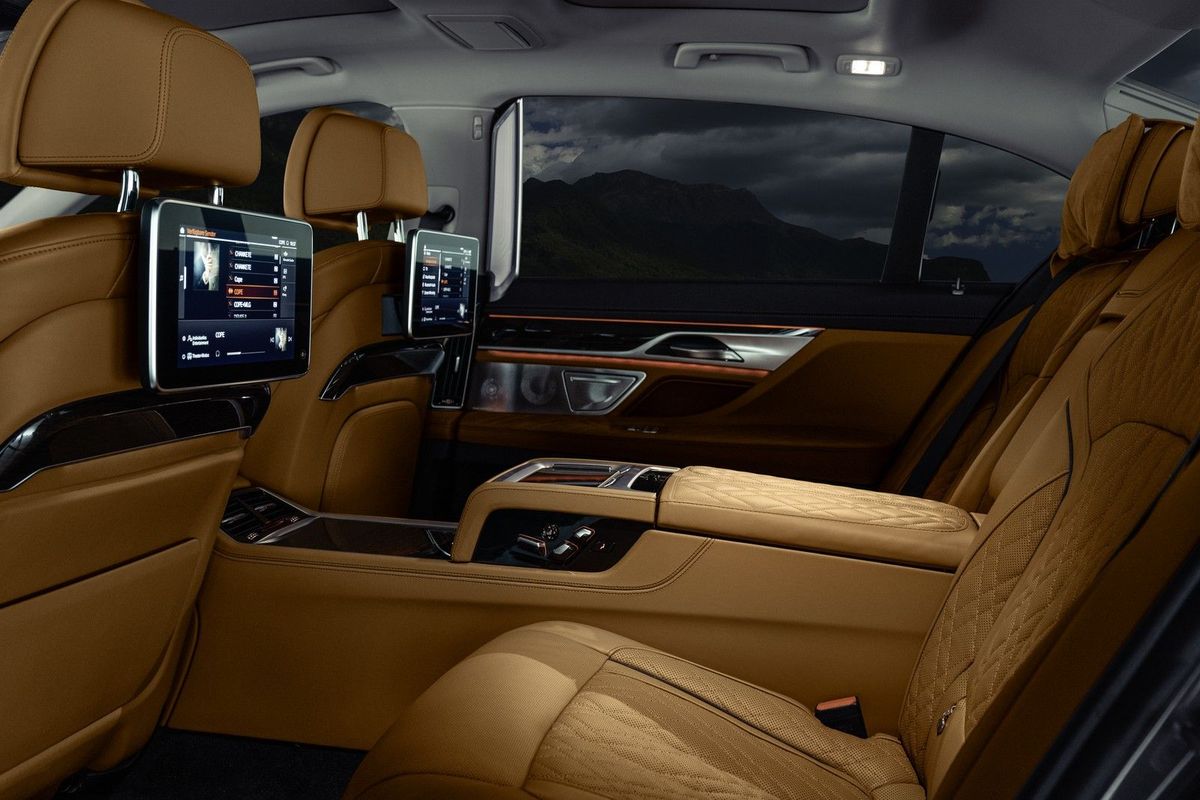
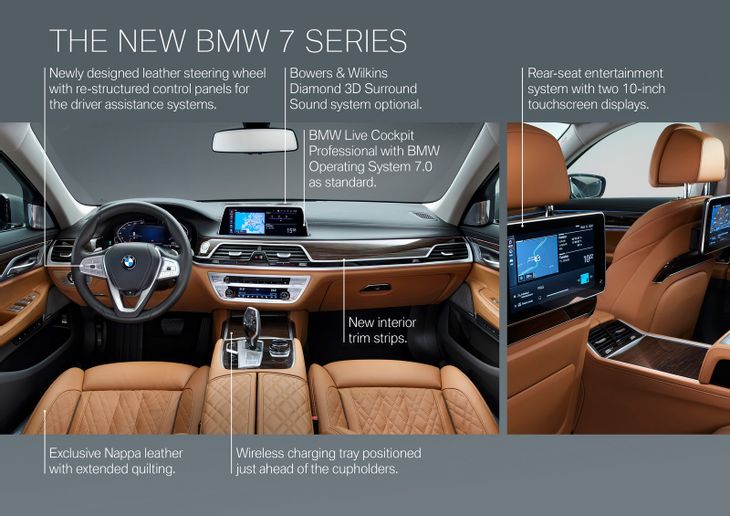
Inside, there's a bit more passenger space and more trim options like extended quilting and fine wood strips. There's a focus on reducing the outside noise from inside the cabin and BMW has refined the rear wheel arches and B-pillars in an effort to make the rear of the new 7 Series a quiet and peaceful place to sit.
The tech has changed too. From the digital dashboard adopting the latest style of BMW dials to the new BMW Touch Command rear-seat control unit with its updated hardware and new software. The screens at the back are 10-inch full HD units and there's now a Blu-ray player. BMW has also added its Intelligent Personal Assistant to the new 7 Series. Activate him/her with “Hey BMW” and you can control many functions of the vehicle like interior lighting, air conditioning, fragrancing and shading, not to mention seat massage, heating and ventilation.
South African specification
BMW South Africa confirmed that the following derivatives will be reaching our market in 2019: 745Le, 750Li xDrive, M760Li xDrive and 730Ld. At the top of the range sits the M760Li xDrive with 430 kW. Next up is the 750Li xDrive with a newly-developed turbocharged petrol engine with 390 kW.
There will be a specially adapted six-cylinder inline petrol engine and a more advanced high-voltage battery doing duty in the 745Le. Together the petrol and electric engine push out 290 kW, while BMW claims consumption sits between 2.6 and 2.1 L/100 km. BMW also claims this vehicle can drive between 50 and 58 km on electric power alone. For those wanting the frugality of a diesel, the 730Ld pushes out 195 kW and consumes between 5.5 and 5.3 L/100km.
We'll have final confirmation on pricing, specification and features closer to the vehicle's launch.
Brexit: What Does it Mean for Car Industry and SA?
All the renowned British car brands (Aston Martin, Bentley, Jaguar, McLaren, Mini, Land Rover and Rolls-Royce ) are represented in the South African new vehicle market. But how will an unstructured Brexit disrupt that?
Although Germany remains the most important geographic region for incubating automotive technology and influencing the development of virtually any (and all) vehicle-related innovations, the United Kingdom (UK) isn’t an insignificant shareholder within the global car industry.
Its production (and sales) volumes might pale in comparison with Germany’s vehicle exports, but the UK hosts some of the oldest automotive brands and its technical universities produce graduates who are notably skilled at finding original and elegant engineering solutions.
Aston Martin. Bentley. Jaguar. McLaren. Mini. Land Rover. Rolls-Royce. Those names all add a desirable diversity to our realm of choice, or at least aspiration, as customers and car enthusiasts. And the most significant challenge to their future viability has come from a most unexpected source.
There are more British manufacturers than you think, but most lie in the premium space, where duties would hurt.
Specialisation is what has makes the modern automobile work, but car companies cannot manage the technological burden of developing a product in complete isolation (by themselves). Across the world, various people and companies do very small things, with exceptional expertise, to create a global supply chain that allows all those technologies and components to be assembled as a finished model and delivered to customers.
Free and efficient trade policies are crucial: they enable the engineered components that make up a modern car to be scaled and delivered to their destinations within an agreeable timeframe. Mess with that freedom by implementing constraint, and the consequences are catastrophic.
Could Brexit kill British brands?
After a brilliant recovery in the last decade, the British auto industry is in trouble again. Land Rover has been an unintended victim of the global demand reversal for diesel-powered SUVs and traditional sportscar brands, such as Bentley, have been too slow adapting to unprecedented demand for expensive, premium and first-class SUVs.
It's a far from ideal scenario – and one which has been made a great deal worse by the looming spectre of what a post-Brexit British auto industry could possibly become. The rejection this week of a provisional Brexit deal has only compounded the doubt and sense of foreboding.
Decades ago a former Peugeot CEO insightfully commented that Britain was like an "aircraft carrier, threateningly offshore": ready to destroy the European car industry. This was true in the time when Japanese manufacturers invested heavily to establish assembly facilities in the UK, thereby circumventing European import trade barriers. Now it appears that Britain’s car industry could not survive without Europe…
McLaren uses a lot of precious and expensive materials in its manufacturing process, many of which are imported.
Europe is crucial to the British auto sector. It serves as a destination market, taking 54% of British built-vehicles. If Brexit collapses distribution into the EU, there is the possibility that China and North America could absorb an export realign for premium brands such as Aston Martin and Bentley
The real risk isn’t on final product export scenario. It’s how much slower, expensive and complex some of the vital bits that constitute an assembled vehicle might become to organise and acquire. Look, that specialised supply chain cannot be replaced overnight! European component suppliers, which have committed to long-term contracts with British brands, cannot simply be substituted. Validation engineering and safety requirements for new suppliers into a mature design are always undesirable – and would prove disastrously expensive.
It’s not a small problem either, as 78% of imported automotive components for the UK industry are sourced from Europe. Manufacturers can stockpile parts, but there are physical constraints on how much of that you warehouse. Even the most aggressive futureproofing for a Brexit disaster in 3 months’ time will only stockpile enough parts inventory to keep factories going for a few days of production, certainly not a month.
The 10-year cycle
A decade ago the British auto industry started its resurgence. Jaguar-Land Rover (JLR) was recapitalised by Tata and surged to unprecedented success. McLaren restarted its road car division and recorded 40% year-on-year growth in 2018. Tragically, this all appears to be at risk.
As politicians dither about executing an unhappy divorce that Britons voted for, the consequences are clear – and the warning signs for the UK automotive industry are equally ominous. JLR has the broadest product portfolio of any British legacy brand and it is preparing for 4 500 redundancies this year, in addition to culling its workforce by 1 500. Upsettingly, many of the planned retrenchments are engineering staff, which have been crucial to revitalising JLR in the last few years, positioning the product portfolio as a credible rival to traditional German luxury brands.
Bentley is in trouble too, having made a loss in 2018. Many of its current and future models are configured for the VW Group's 4.0-litre twin-turbocharged V8 engine, sourced from Germany. Gearboxes are primarily German too, sourced from ZF in Friedrichshafen. Although ZF builds gearboxes in different sites, including America, it would be far simpler to ship across the channel as opposed to the Atlantic…
Bentley had an unprofitable 2018 and Brexit will only make things more difficult.
Aston Martin endured a torrid financial year in 2018, too. Its listing has seen a share price collapse and the risk of a bad Brexit deal is huge, with the Gaydon-based firm owning an engine production facility in Cologne, Germany.
For Aston Martin and Bentley, who import engines and gearboxes from Europe, both crucial components which could carry crushing import duties in a post-Brexit world, the pricing pressure will be huge. Although Bentley and Aston customers are hardly moved to doubt by price considerations and might tolerate price inflation, wealthy buyers hate waiting… for anything. And if trade barriers cause supply and build disruptions, with lagging delivery schedules, it would severely test the patience of aspiring Aston and loyal Bentley customers.
Bentley has said it could move production to Europe in an emergency – and this could be the solution for the low-volume British brands as well. A contract manufacturer such as Magna Steyr, in Graz, Austria, builds lower volume vehicles on consignment for many brands, including I-Pace, for Jaguar. Having one model line on contract manufacturing in Europe is not an issue, but JLR’s cumulative volumes are too high to make a mass relocation of production viable. In the mess that is a no-deal Brexit, the Solihull-based brand will be most vulnerable.
A lesson from Down Under – and potential for South Africa
Australia had an auto industry until quite recently. There were numerous reasons for its failure, including high labour costs, and the enduring lesson is that once automotive engineering and assembly jobs are reduced, they rarely rebound – and once they are lost, they never return.
Frictionless borders are crucial to enable any integrated supply chain work. It’s why we have products of quality, at relatively affordable pricing – without too much supply disruption or price instability.
If a "hard border" (trade restrictions) would arise from a failed Brexit trade exemption deal, it would be disastrous for the British car industry, with parts piling up at ports and half-built monocoque shells sitting like skeletons on production lines in Coventry or Solihull.
A new Defender is on the cards for 2019/20. Could it make sense for JLR to open a manufacturing base for RHD cars in SA?
Although the British automotive industry accounts for a significant 13% of UK exports, it is not a political entity. The draft Brexit white paper, which has not appeased insistent conservative politicians in Westminster, has specific caveats about remaining within the EU customs and trade union – which would be least disruptive to the likes of JLR and others. After the Prime Minister’s Brexit proposal was rejected this week, there appears to be no way of avoiding a bad deal and unstructured Brexit in the very near future.
Should South African car enthusiasts and buyers be concerned about all of this? Nissan and Toyota both have assembly plants in the UK and in a worst-case scenario, could prioritise South Africa to make up for any discrepancy in production. The Toyota UK facility produces Corolla and South Africa has a history of building the sedan. Nissan is currently refurbishing its Rosslyn facility and if the tension between Renault and Nissan revert the South African production asset to Japanese ownership, it could be well positioned to absorb some of Nissan UK's production responsibility.
More immediate is the risk that those British brands which trade in South Africa, servicing a loyal audience, could face disruption in terms of delivery schedules. In the short term, however, some models could become cheaper as the Sterling weakens…
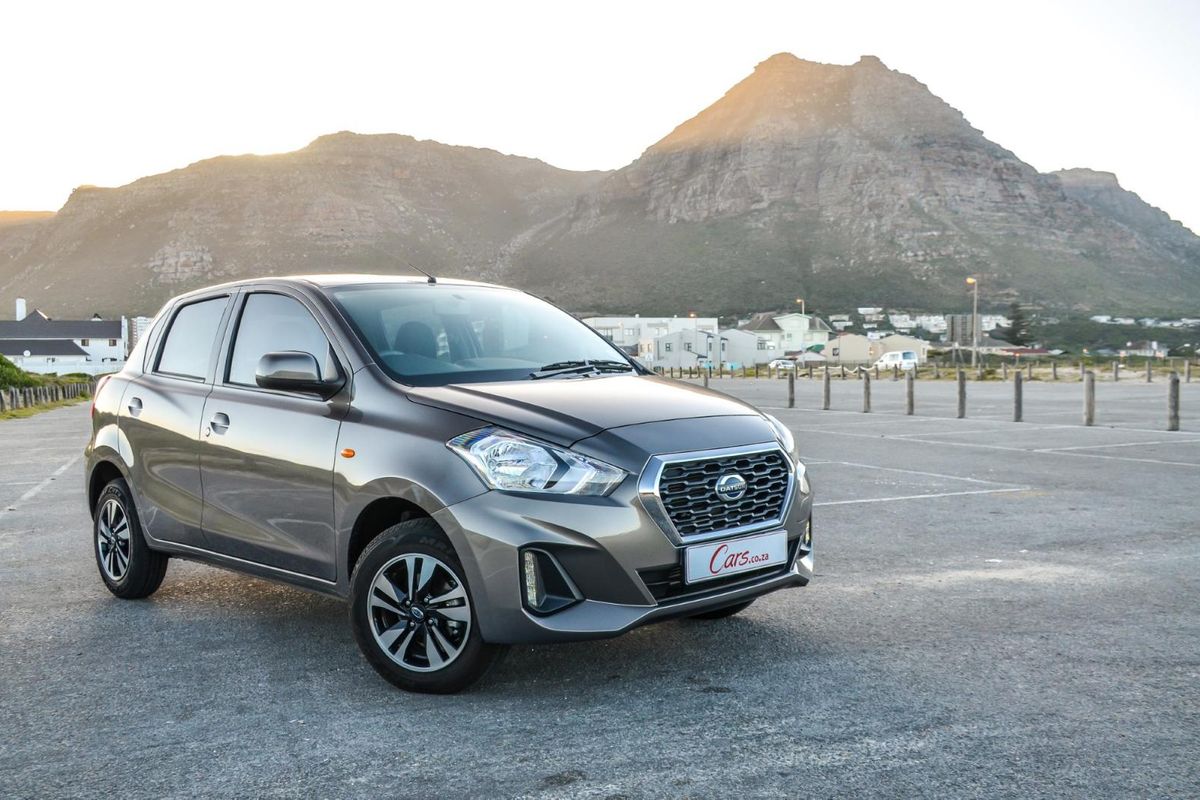
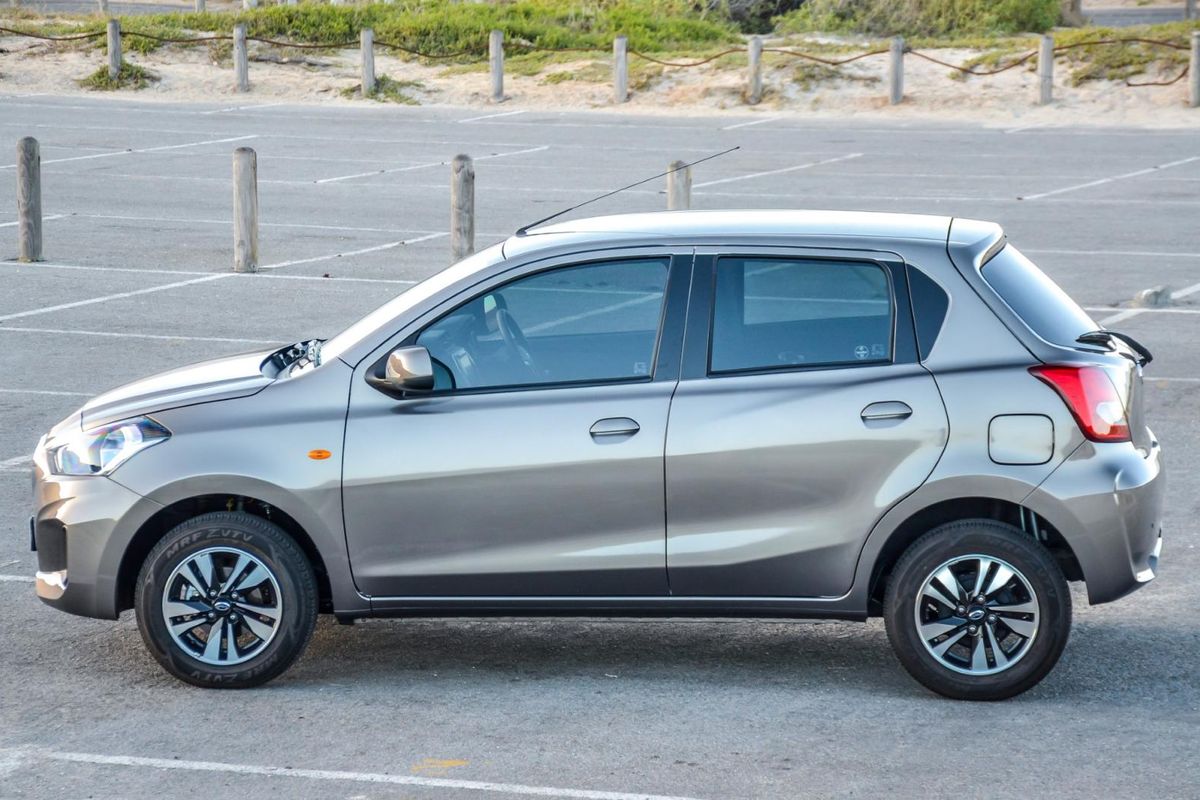
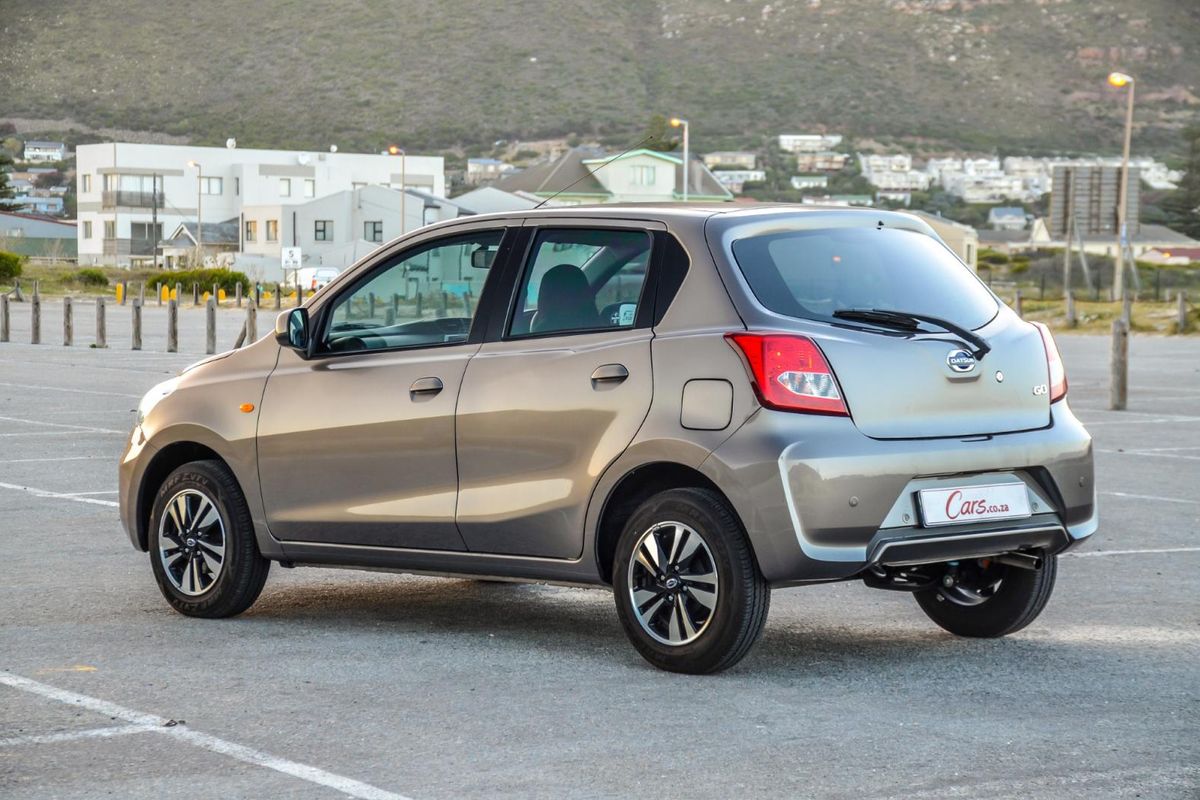
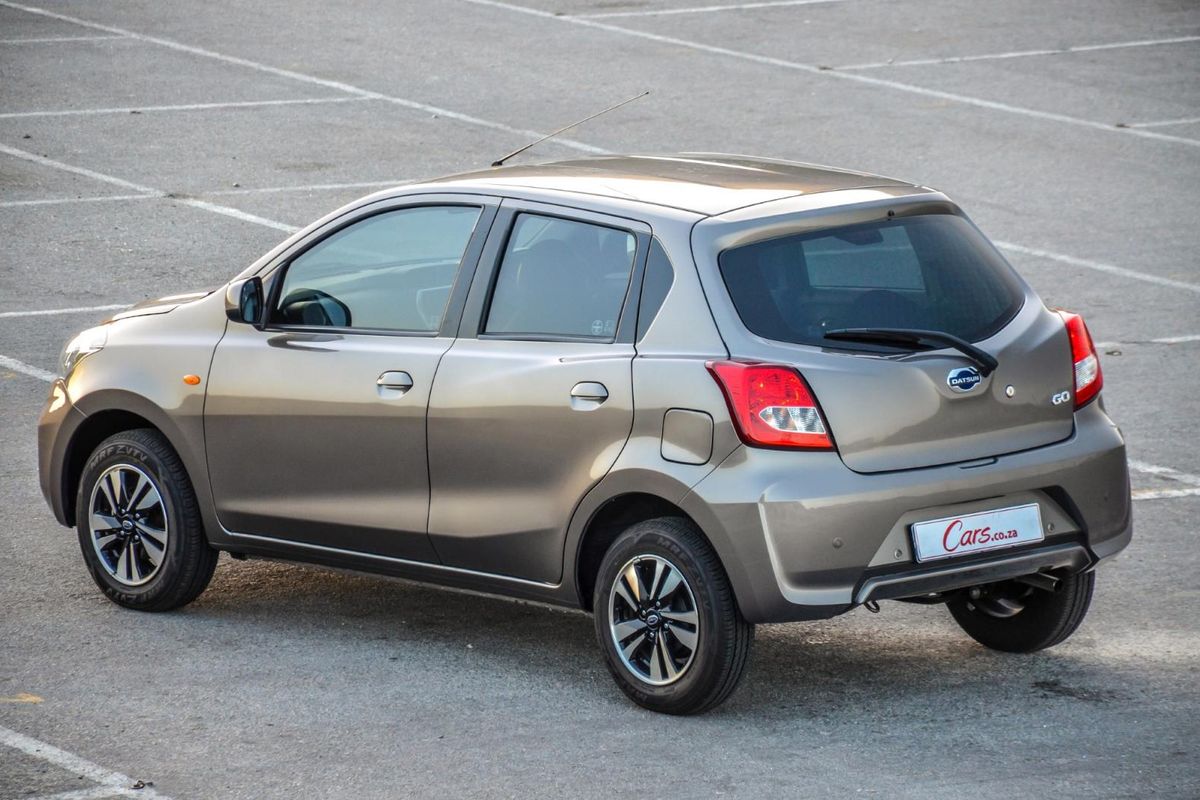
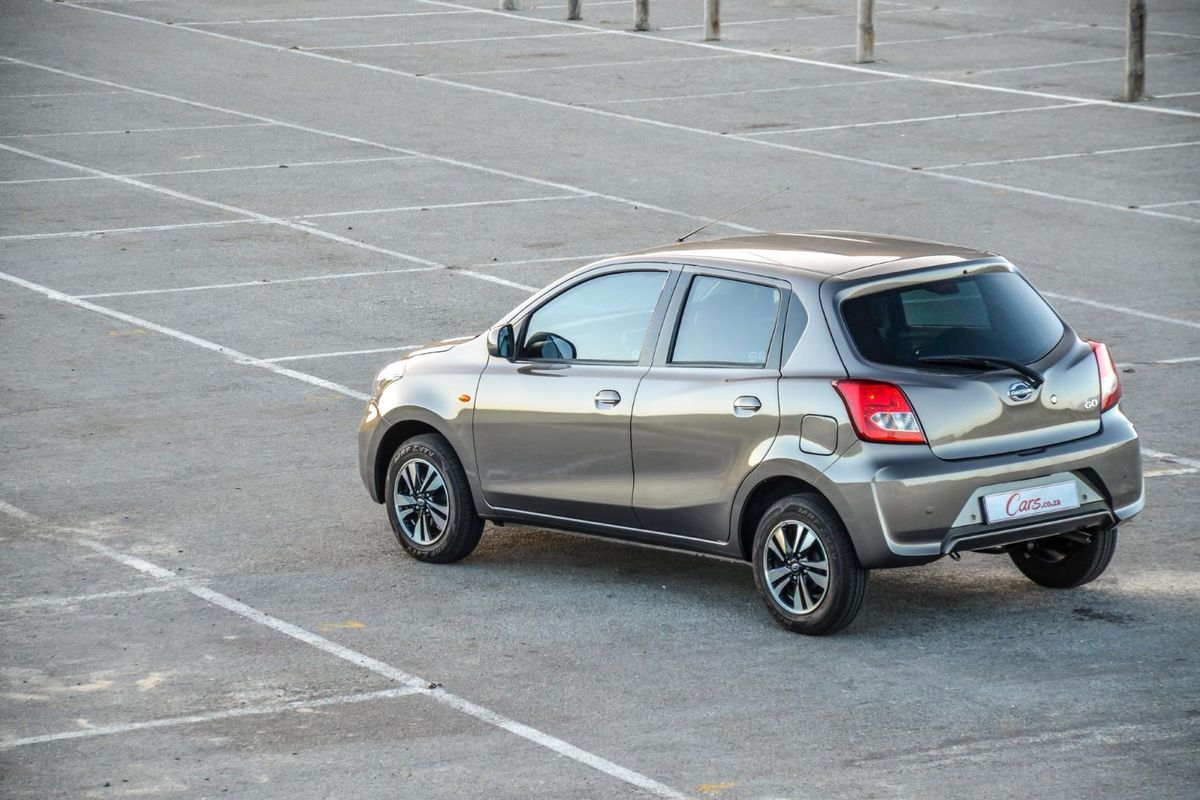
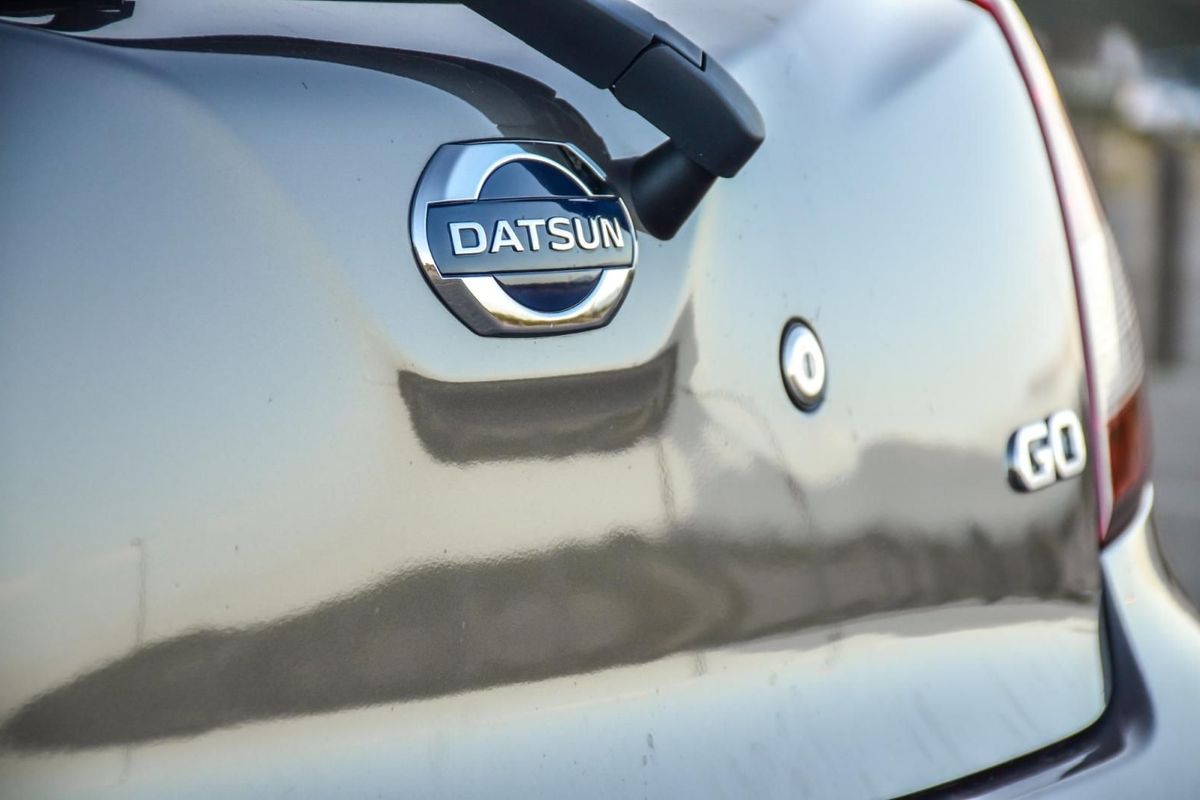
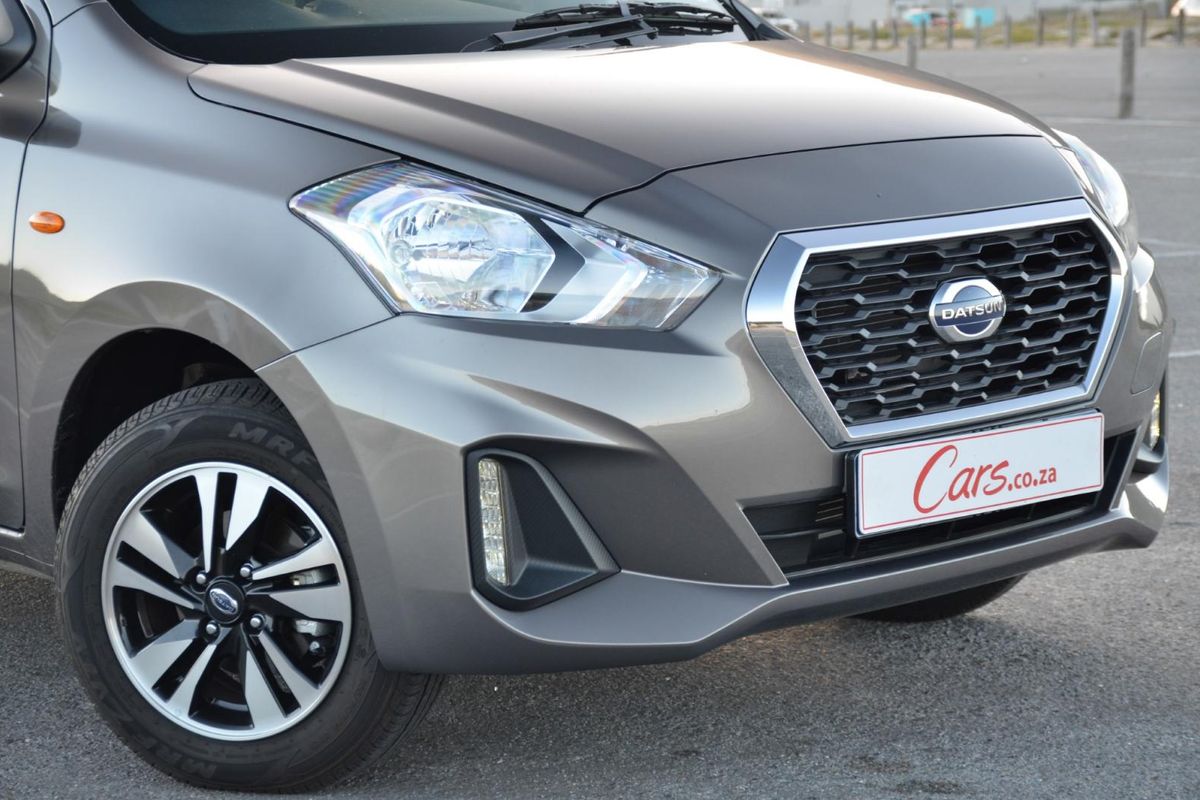
The Datsun Go was recently updated and not only does it look better, it also received a much-needed safety upgrade, as well as improved in-car connectivity, which local budget buyers will undoubtedly appreciate. As a result, pricing for the Go has been adjusted upwards and in that regard, it’s no longer the most affordable new passenger vehicle in the local market. Is the latest Go 1.2 Lux worth its price tag? We recently put it to the test in an effort to find out…
We Like: Better safety specification, performance and fuel economy, new touchscreen infotainment system
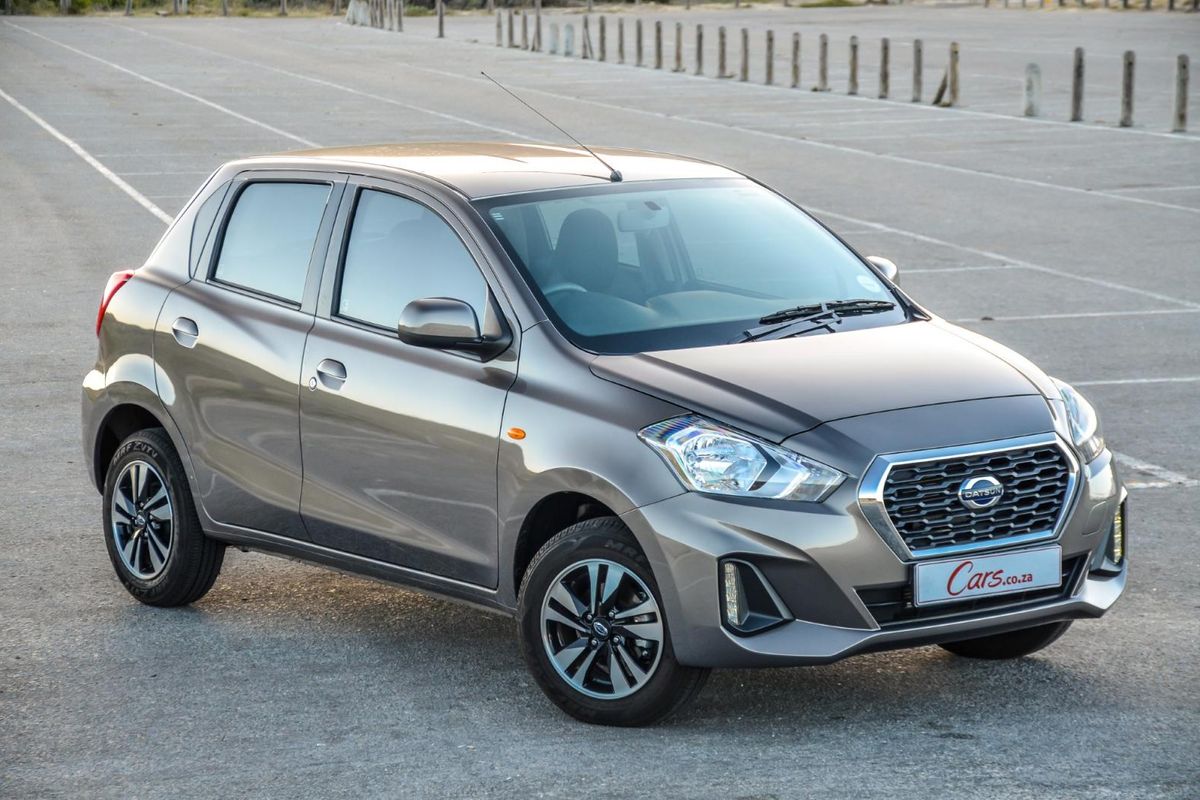
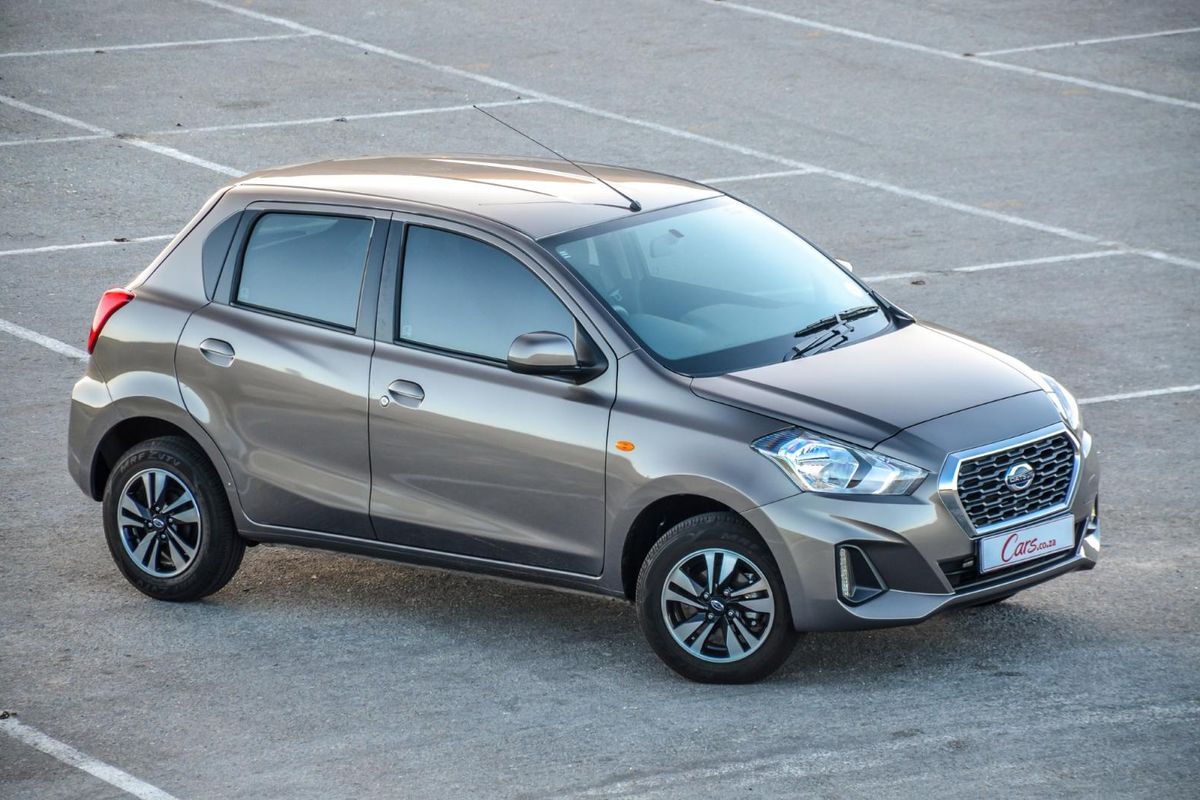
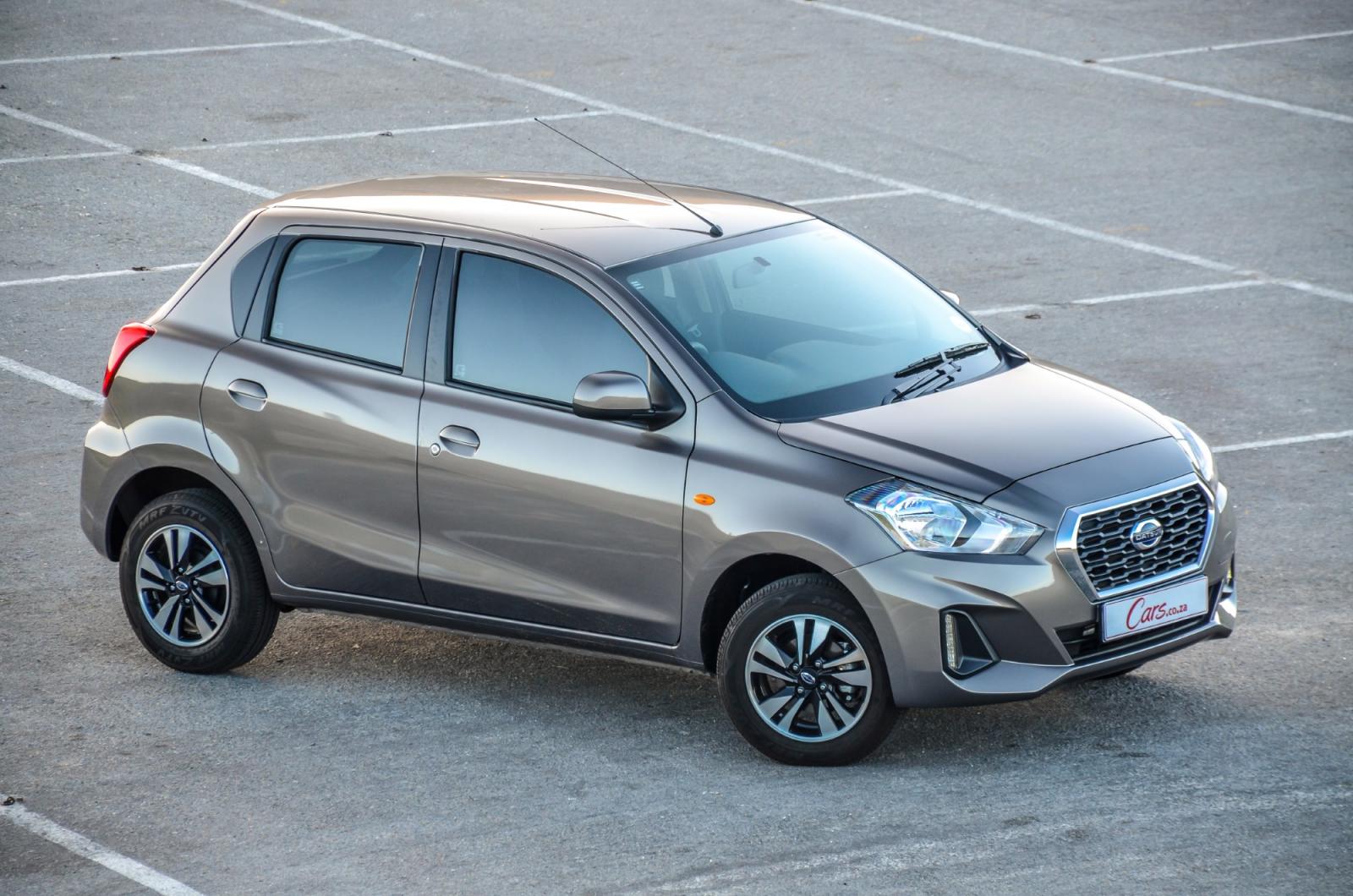
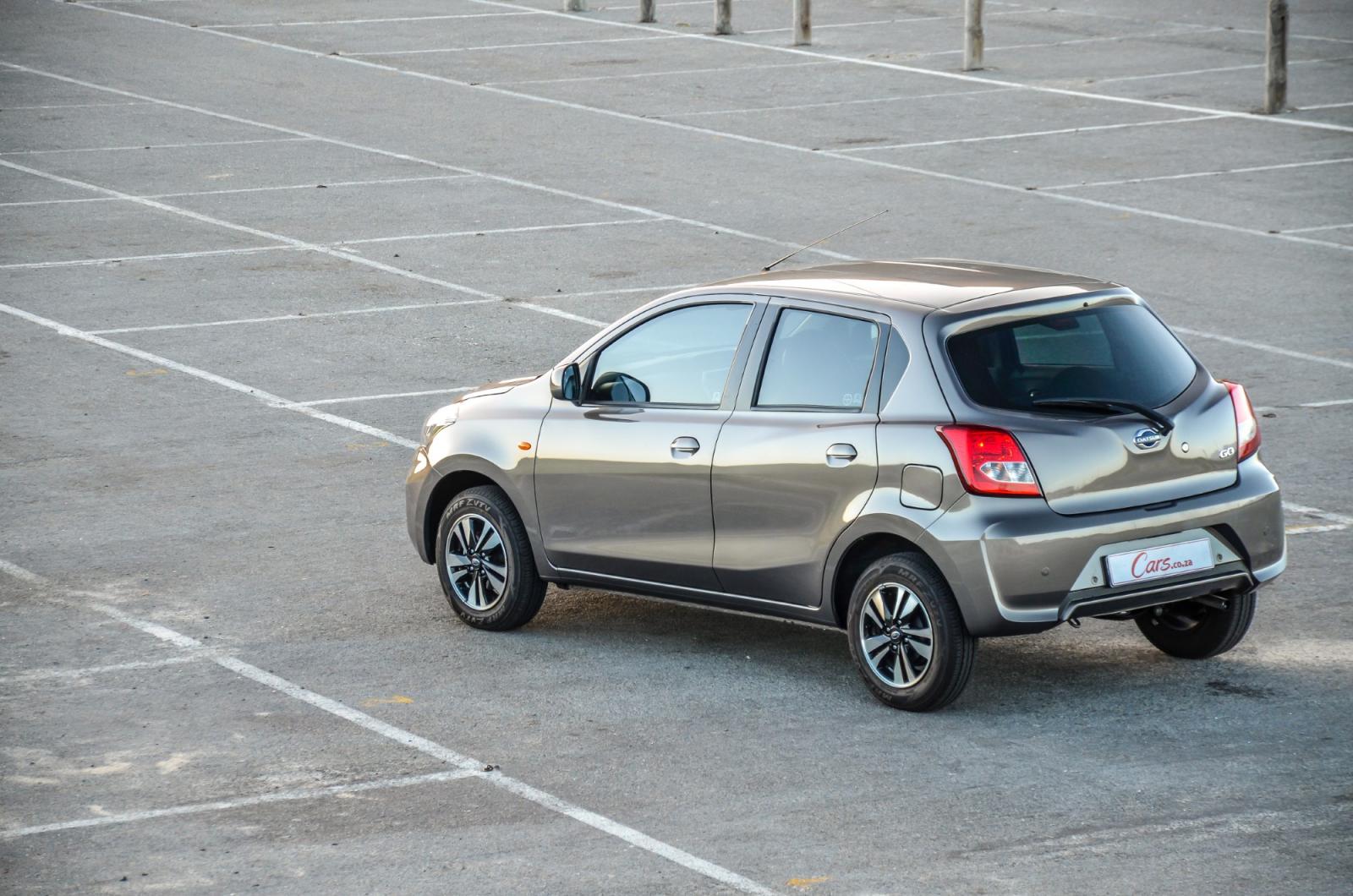
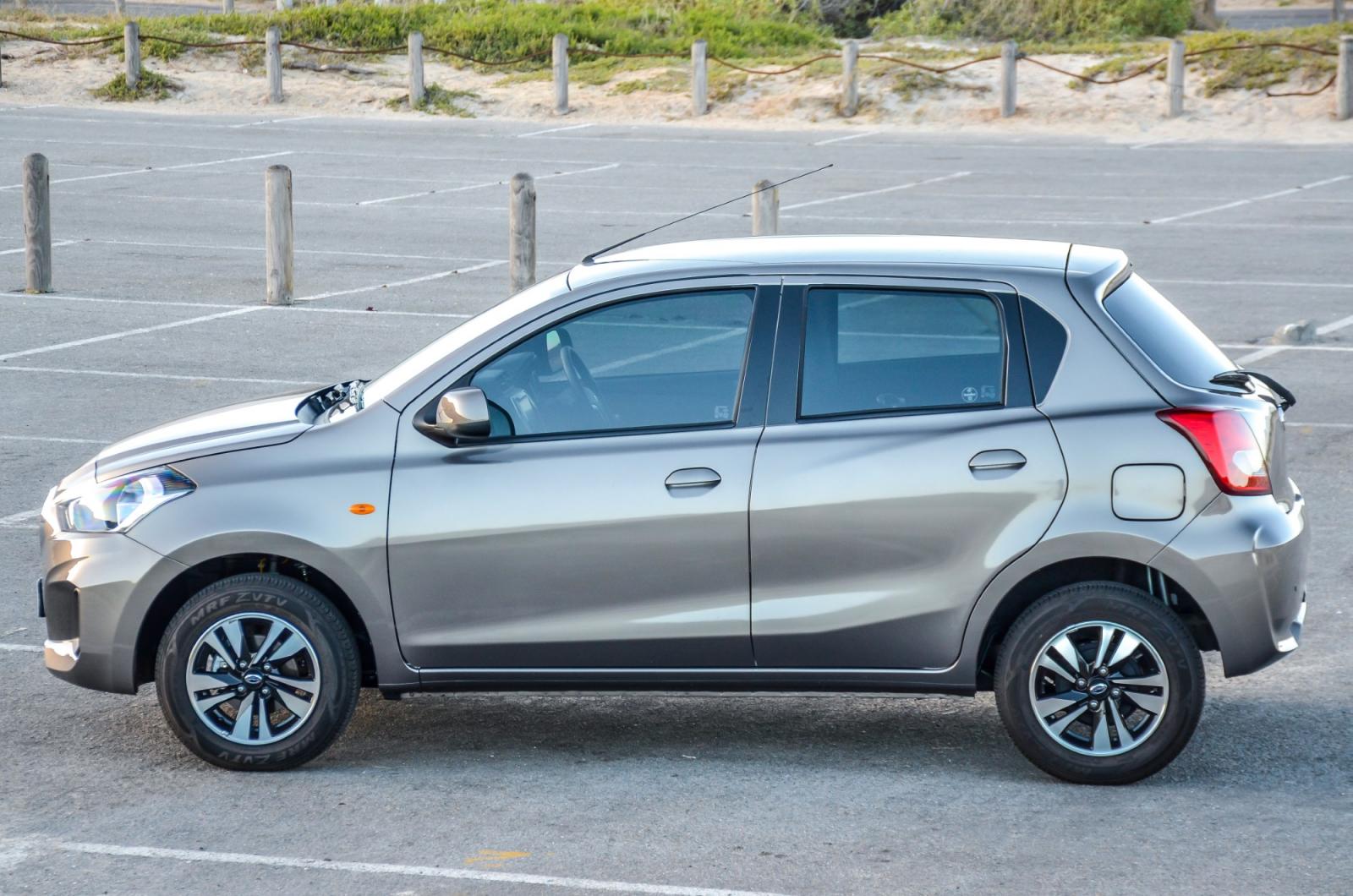
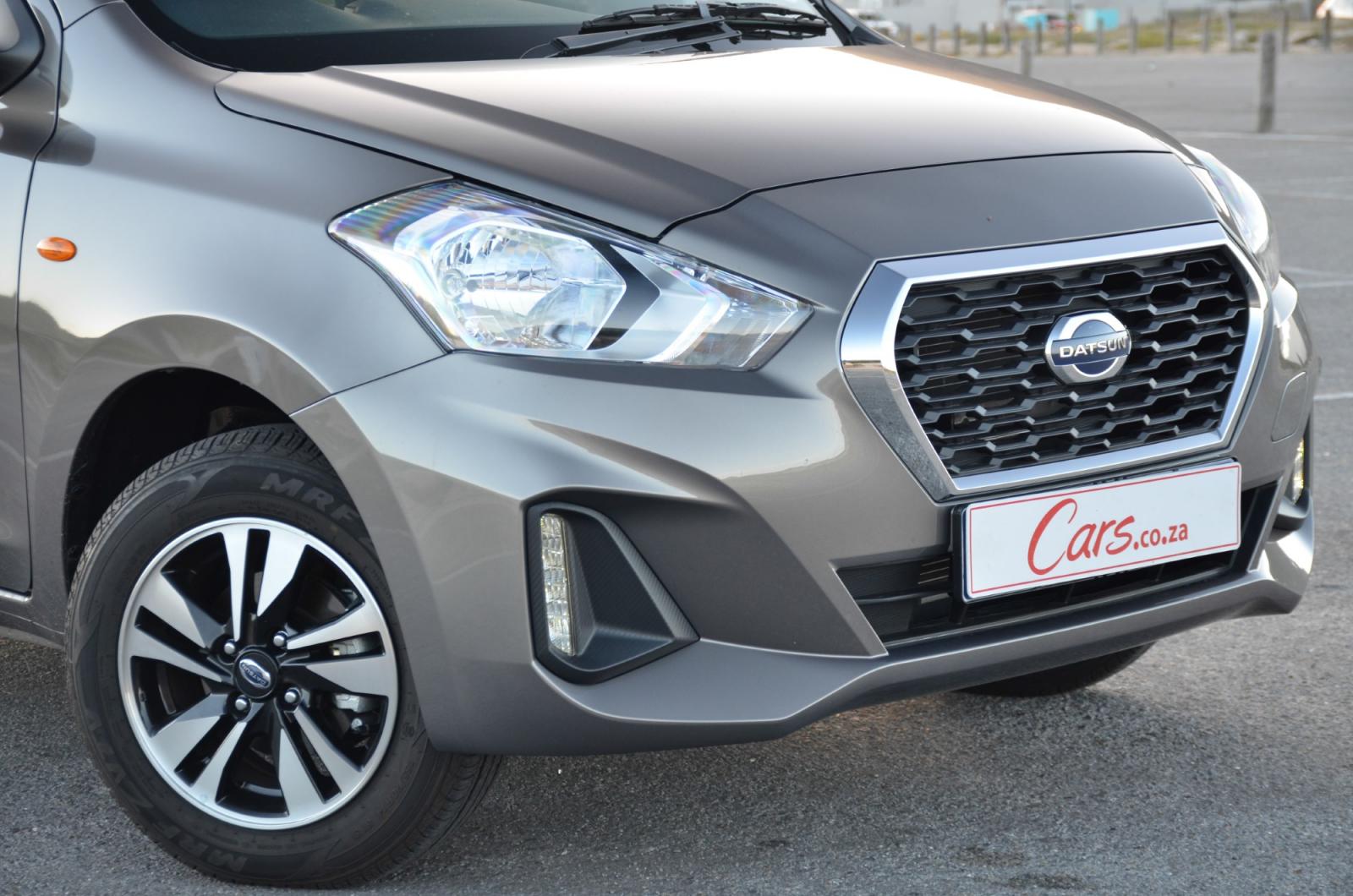
The Datsun Go now has a more refined look and rides on 14-inch alloy wheels in Lux guise.
The Datsun brand made its return in 2014 with the launch of the Go budget car and despite lacking critical safety features such as airbags and ABS, the Go and its 7-seater Go+ sibling have been well received by the local market with well over 20 000 units sold since its introduction.
Late in 2018, Datsun welcomed a revised Go to market, which not only offers enhanced styling but better safety features with the fitment of 2 (front) airbags and ABS. Moreover, the interior now benefits from a 7-inch touchscreen infotainment system with Android Auto and Apple Carplay compatibility, which is a boon in this segment. Should the latest Datsun Go be on your budget-car shortlist? Let’s see how it performs…
The Good
Respectable performance and fuel economy
A plucky 1.2-litre engine gets the Go moving, while returning good fuel consumption.
The Go has a kerb weight of only 788 kg, which means it’s a relative lightweight; its naturally aspirated 1.2-litre, 3-cylinder petrol engine, therefore, doesn’t have to work too hard to get the Go, um, going. Fifty kW and 104 Nm of torque drive the front wheels through a 5-speed manual 'gearbox.
The rate of acceleration is far from mind-blowing, but the Datsun gets up to speed reasonably quickly and has little trouble keeping up with traffic at the highway speed limit. You will, however, have to gear down (to keep the 3-pot in its sweet spot) to execute swift overtaking manoeuvres.
The major gripe we have with this engine is that it emits an insipid hollow noise at higher revs, but when driven with restraint the Go's powerplant is adequately subdued and relatively unobtrusive. As a side note, due to its weight (and skinny tyres – a staple of budget-oriented models), the Go is easily blown around in stronger winds, leaving the driver to hacksaw at the steering wheel to keep the car in its lane on the highway.
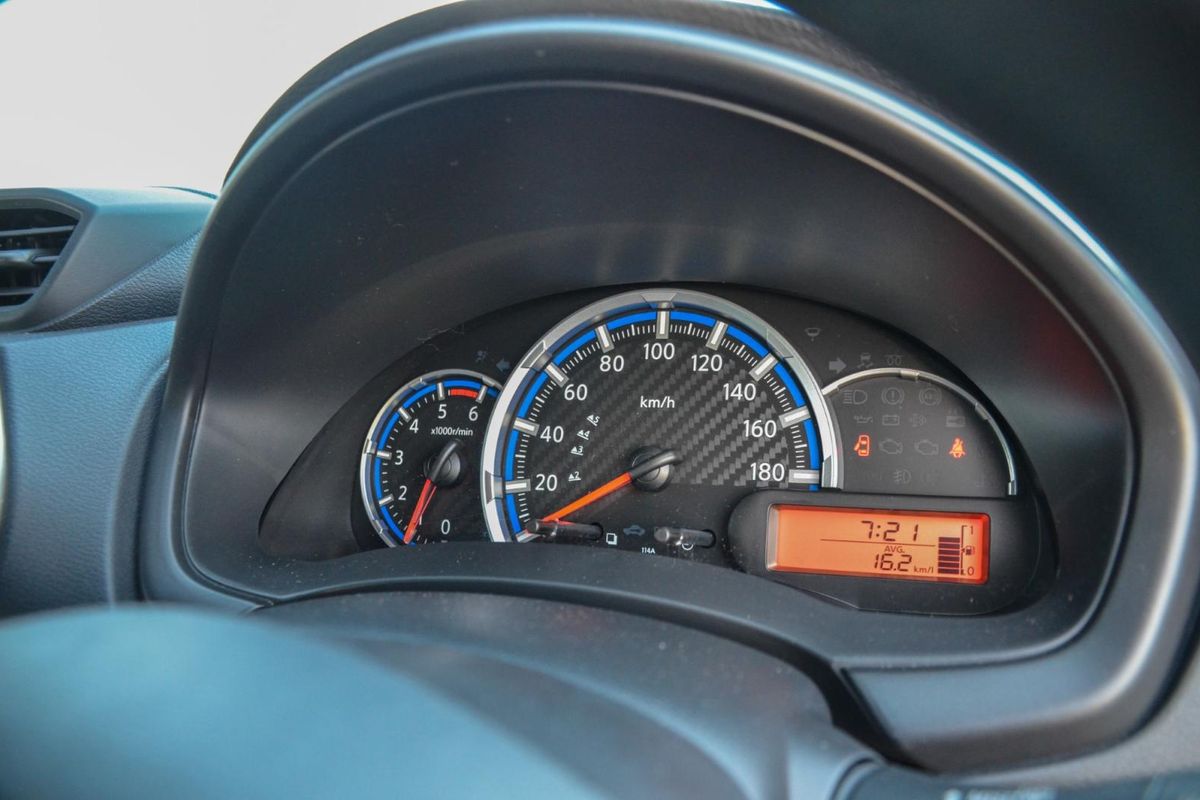
In terms of efficiency, however, the Datsun shines. The firm claims an average fuel consumption figure of 5.2 L/100 km and during our test, the 1.2 Lux returned figures of around 6.1 L/100 km, which suggests it's a sensible urban runabout for those looking to cut down on exorbitant fuel costs.
Much-improved interior
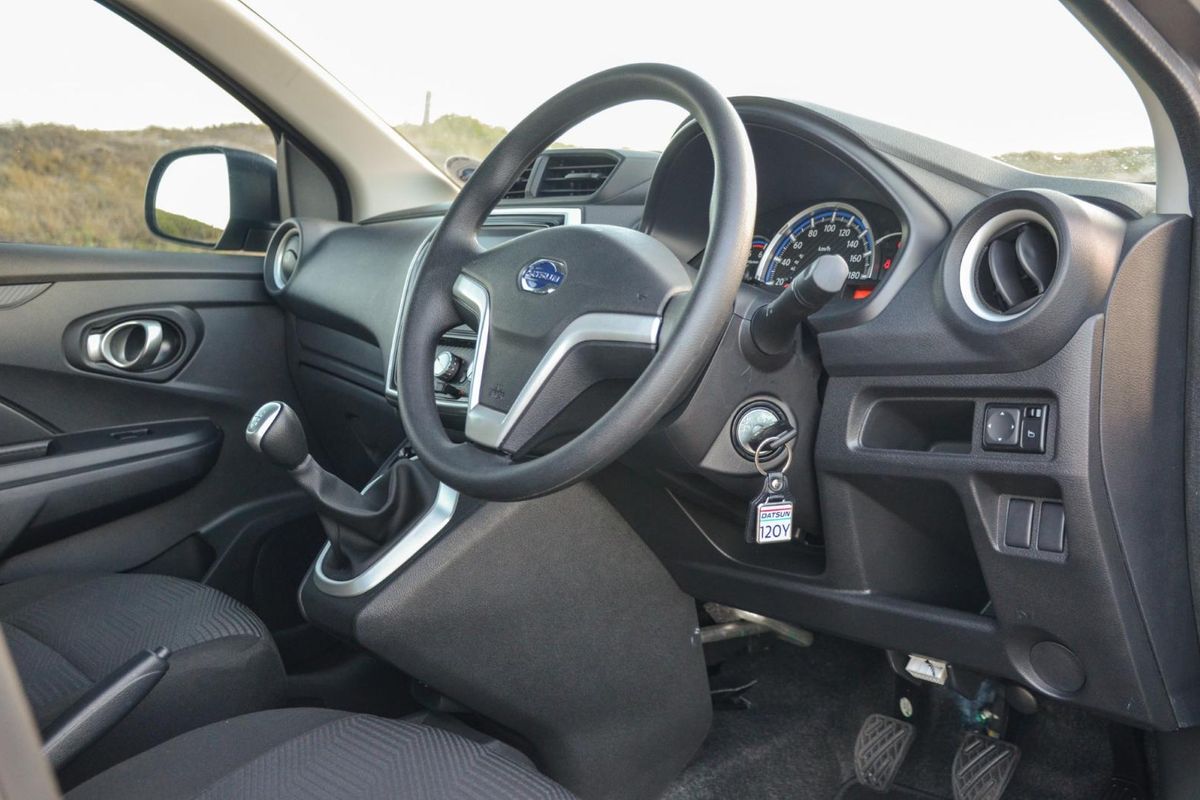
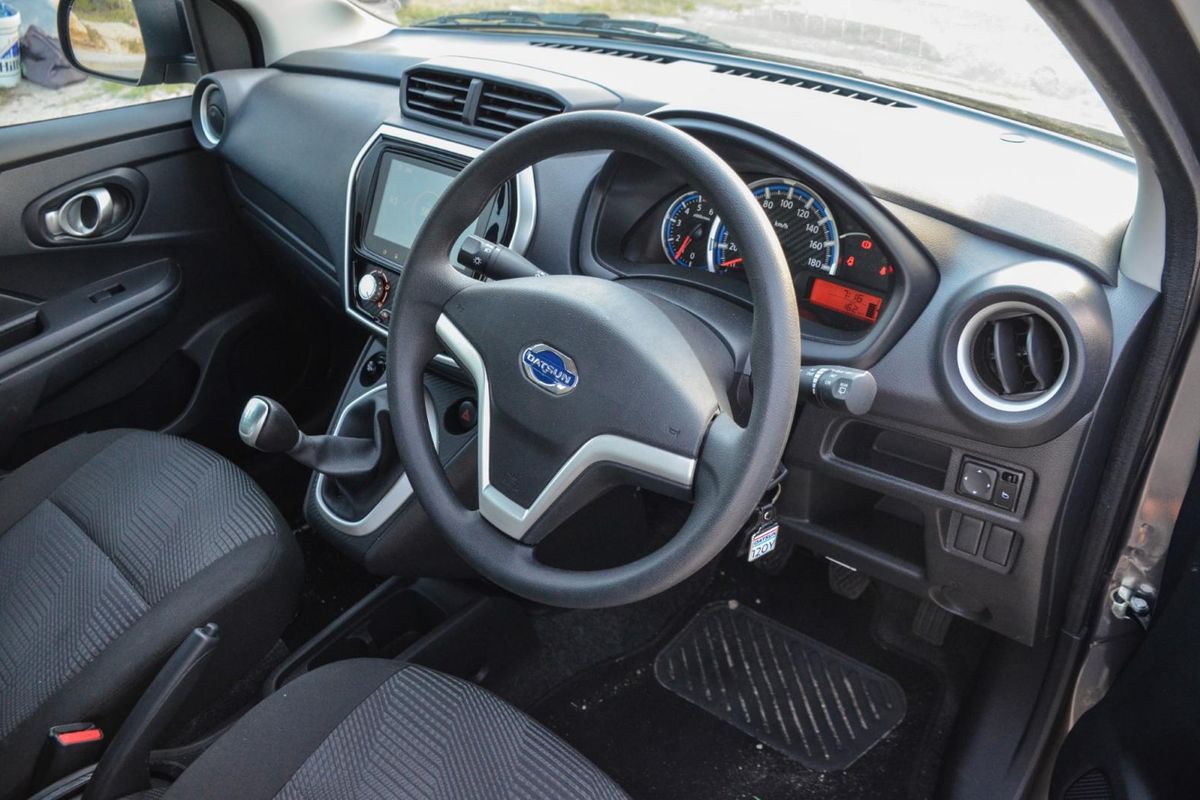
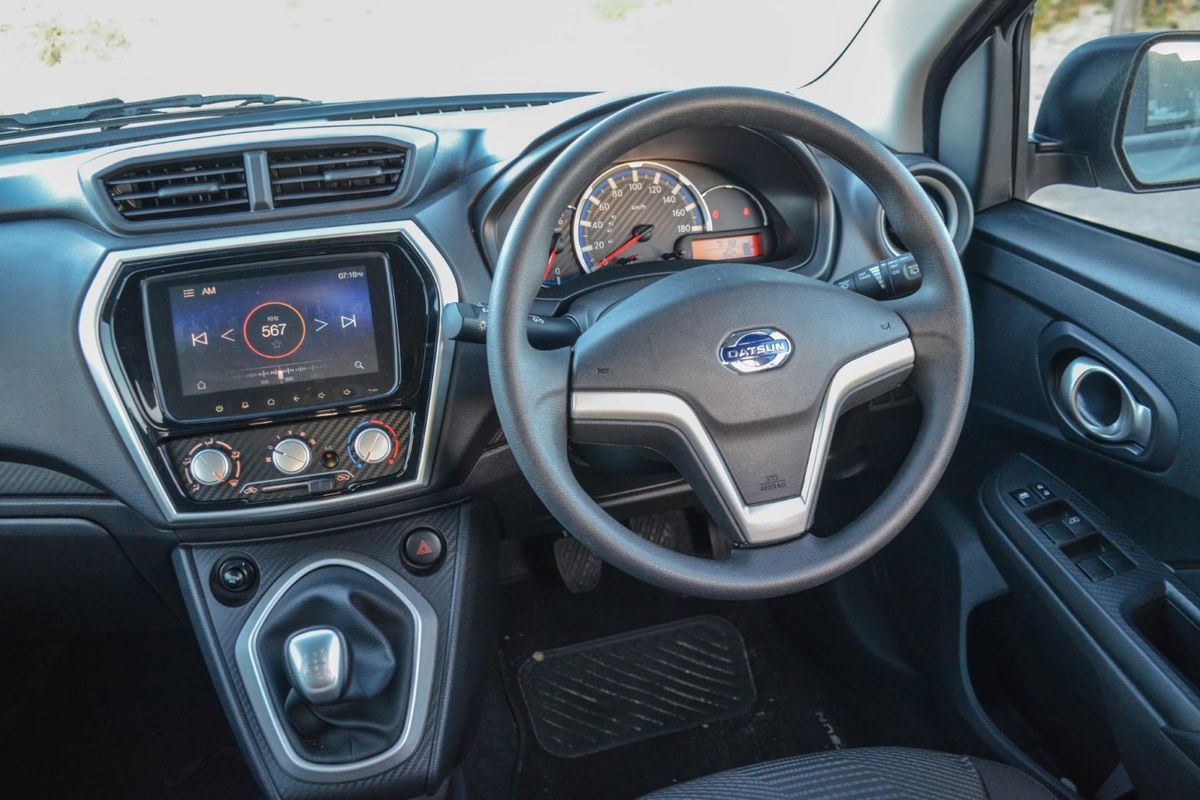
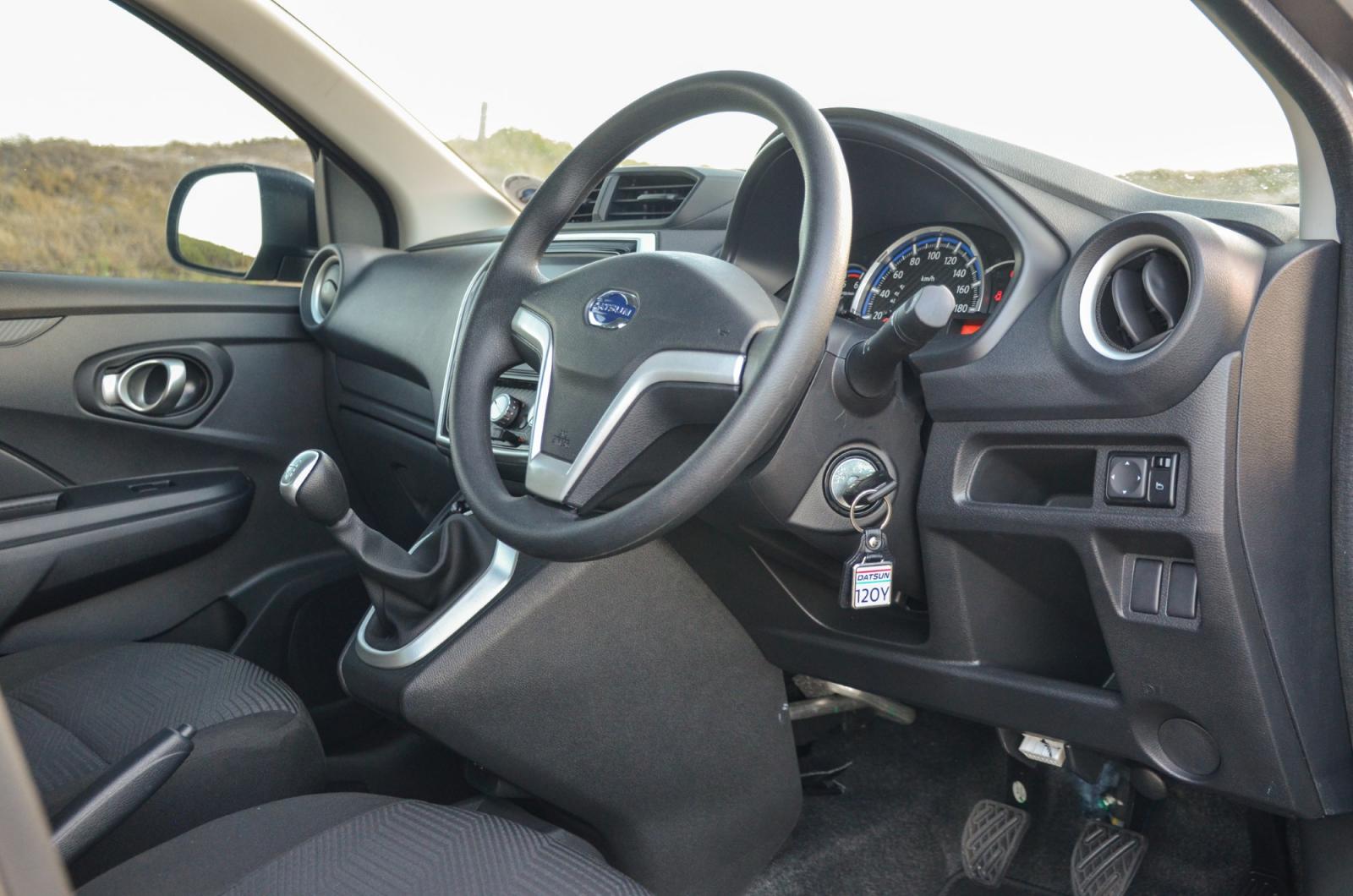
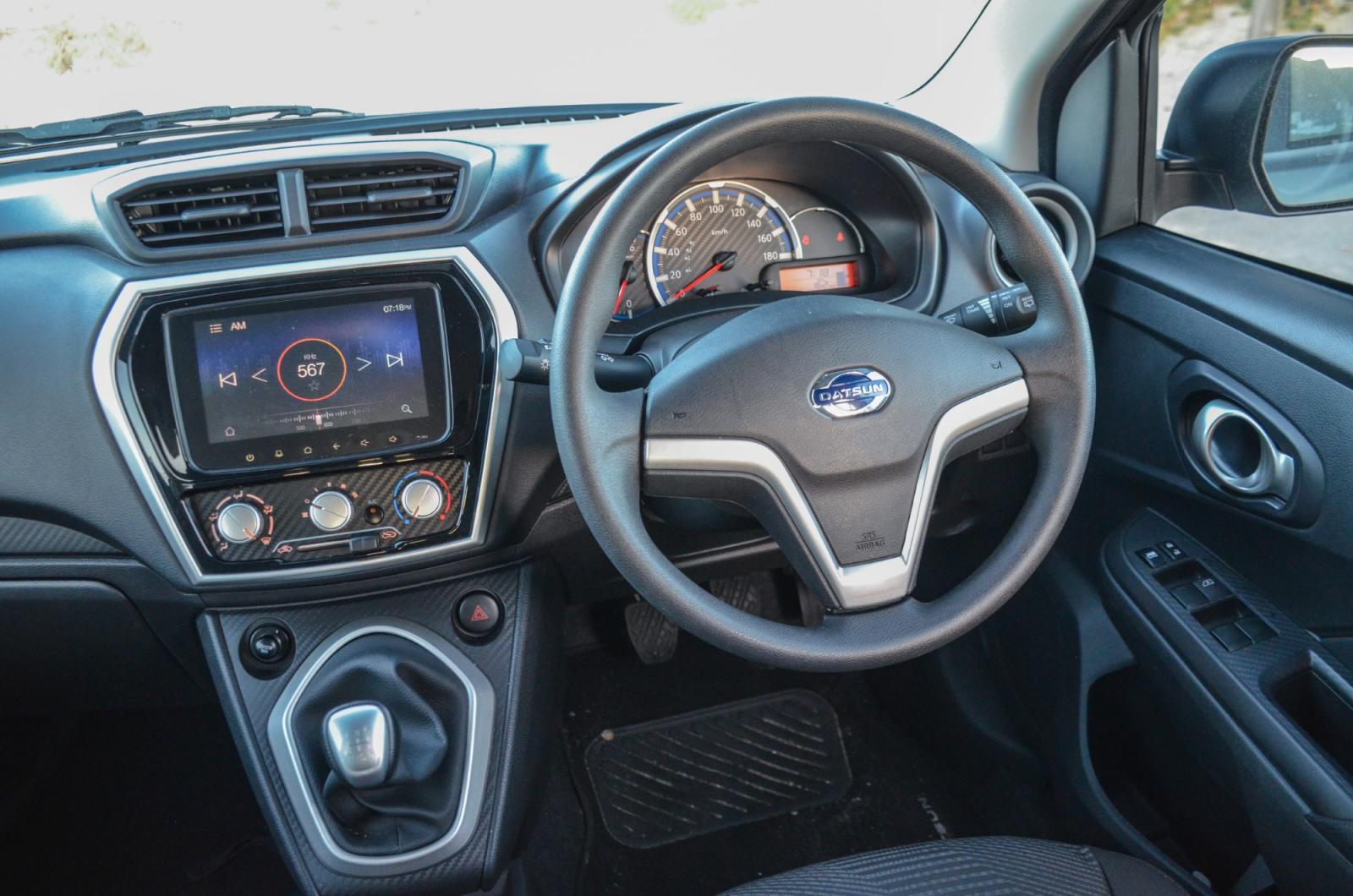
Simple, functional and fuss-free best describes the interior of the updated Go.
Gone is the single front bench and awkward umbrella-handle handbrake; they've been replaced by 2 individual front seats and a conventional 'brake lever. Thank goodness! Although hard, dare I say, cheap plastic finishes dominate the cabin, the effect is more aesthetically pleasing than before.
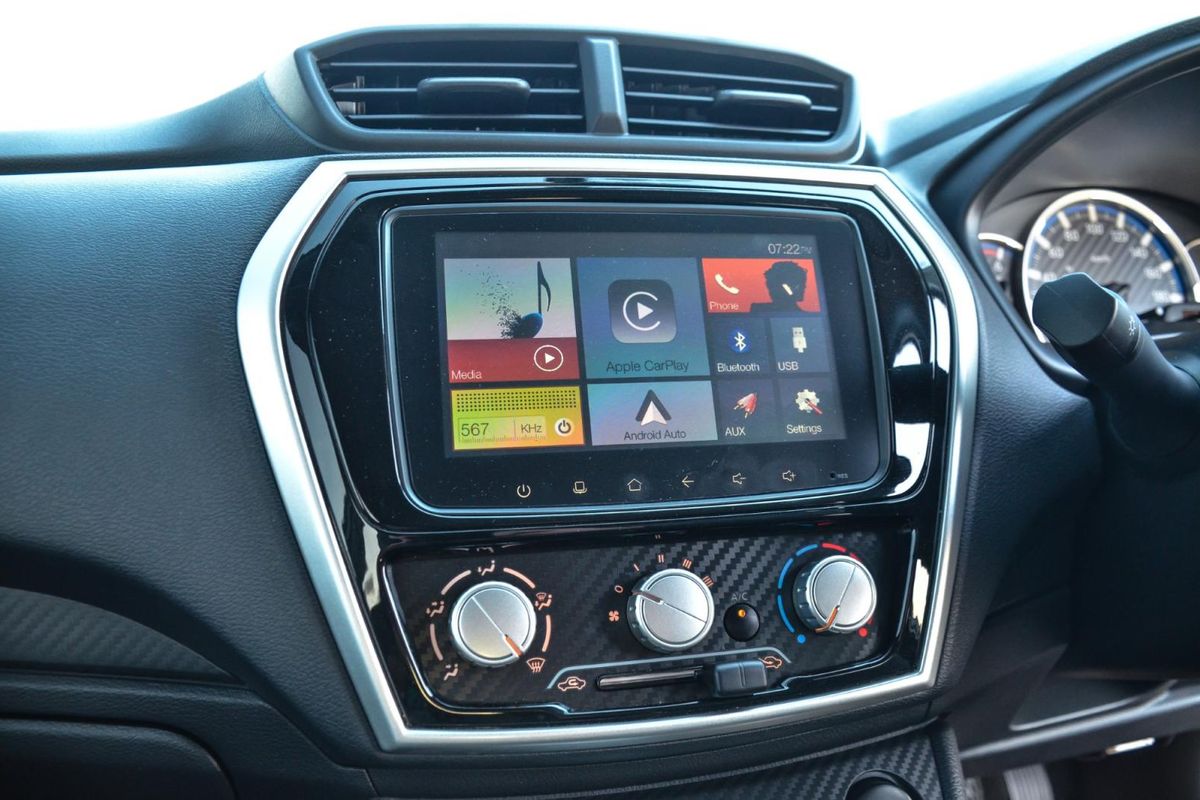
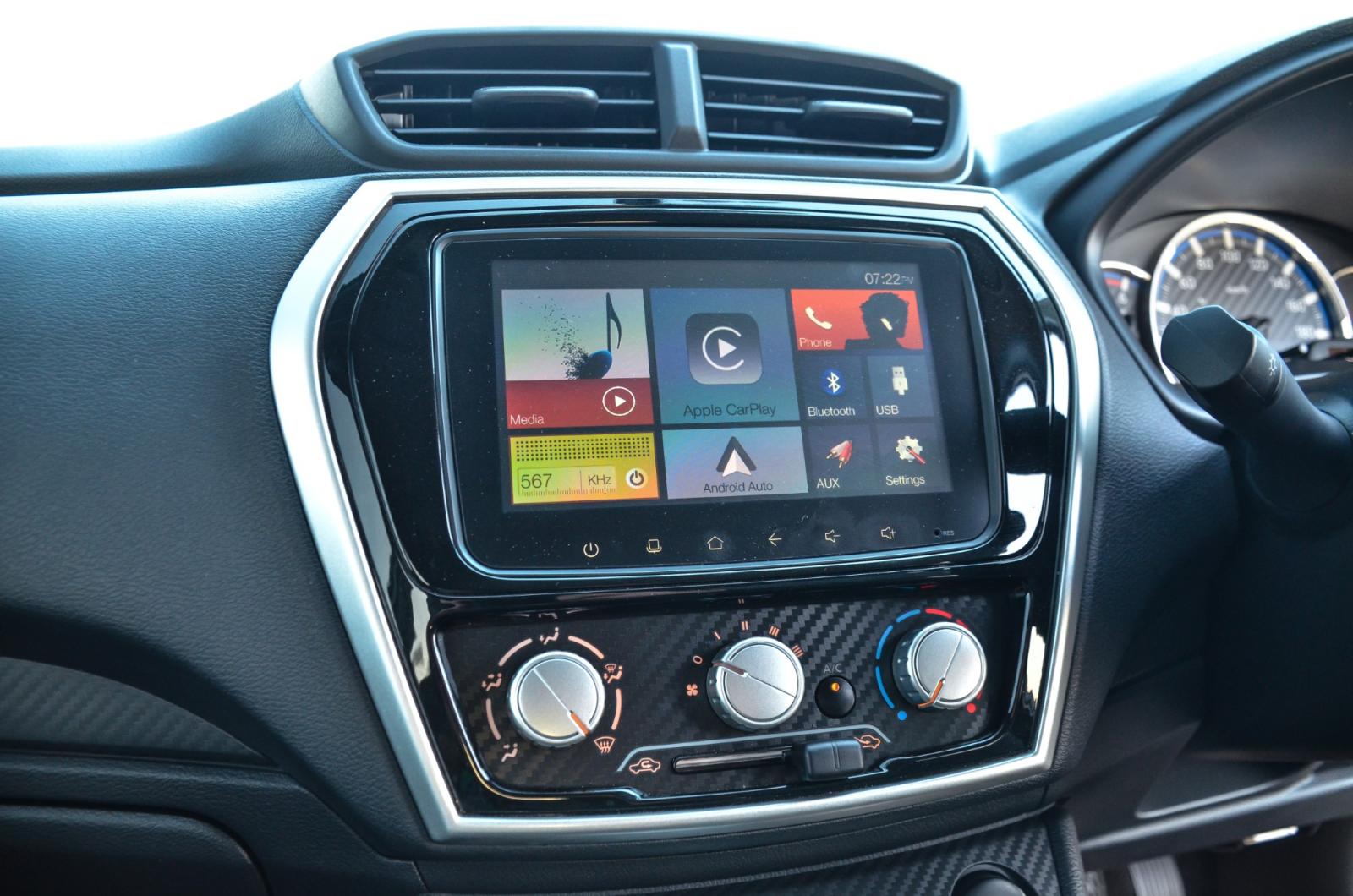
The major highlight inside this latest Go is the fitment of a 7-inch touchscreen infotainment system that offers Bluetooth connectivity, but, more importantly, Apple CarPlay and Android Auto. The system is basic and easy-to-use, but volume is adjusted via the touchscreen, which might annoy some people. Nonetheless, it’s great to see this technology making its way into the budget segment and it’s a big leap forward for the Go…
A new touchscreen infotainment system with Apple CarPlay and Android Auto sets the Datsun Go apart from its rivals.
Other notable standard features include USB and auxiliary ports, electric windows and side mirrors, air conditioning and rear park distance control.
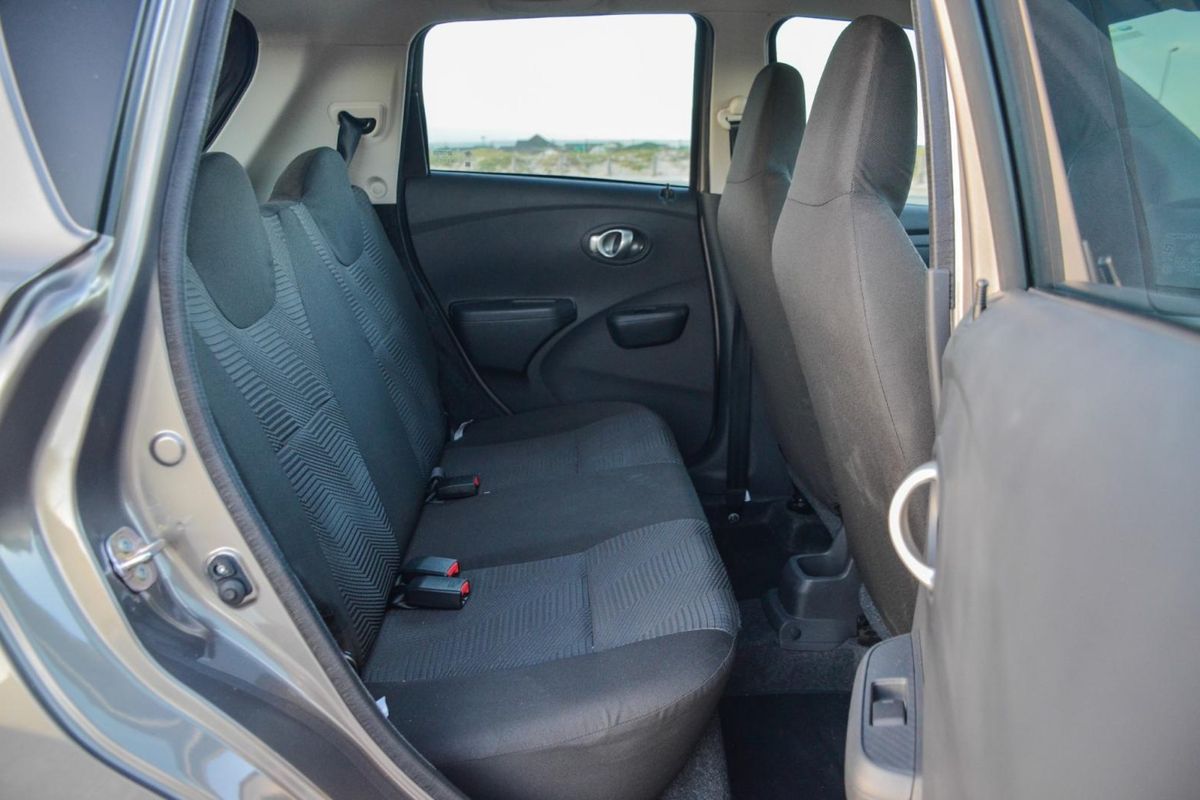
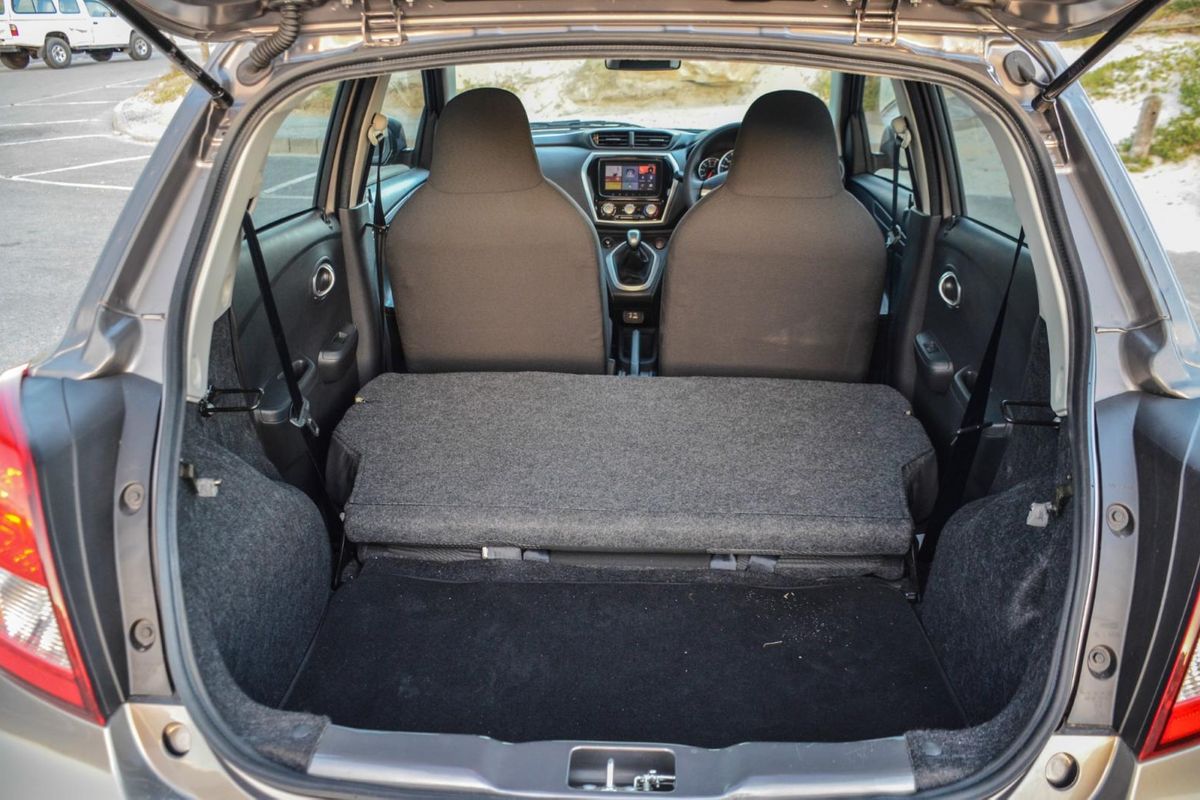
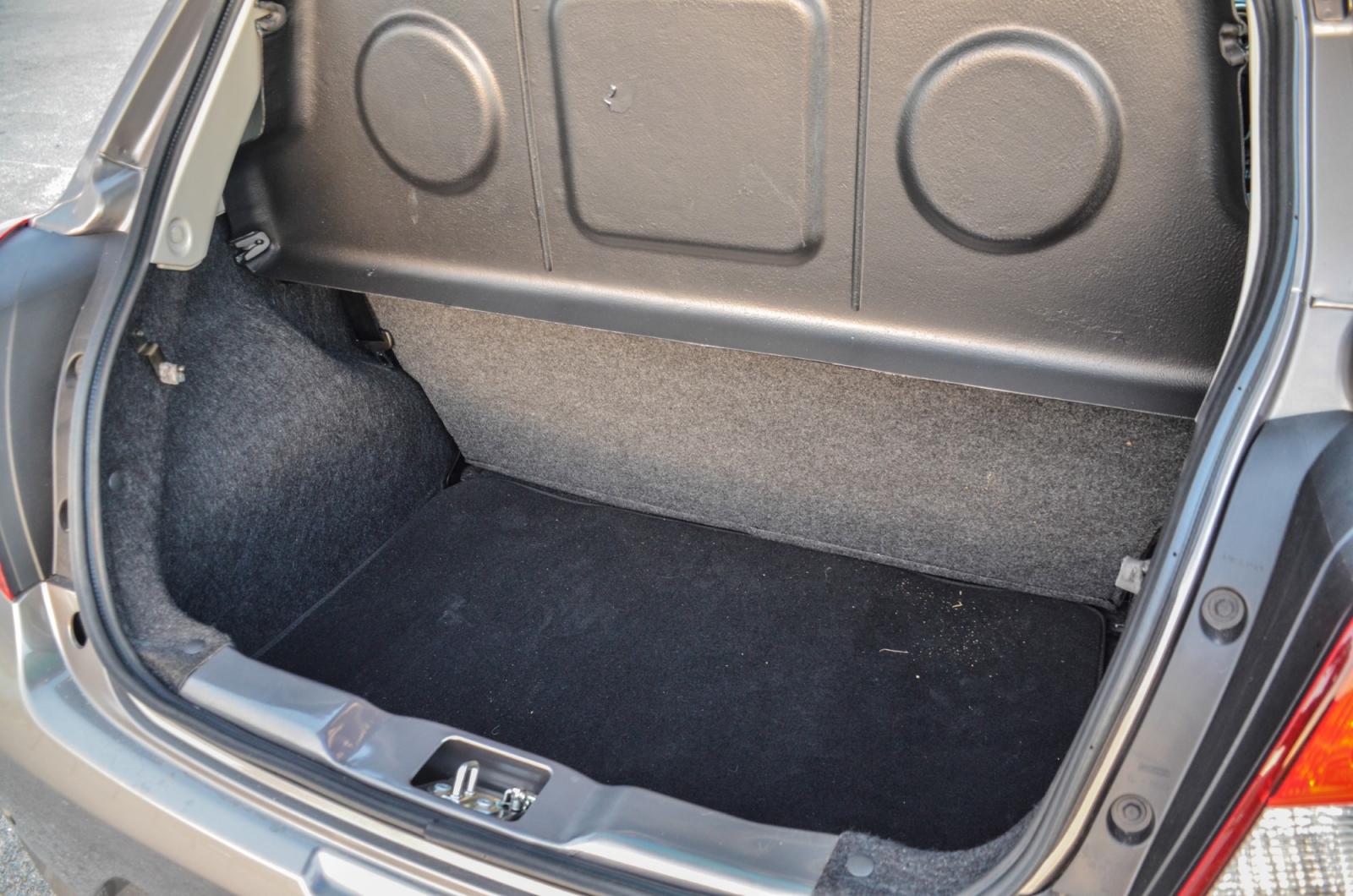
In terms of practicality, the Datsun Go is average. The load bay offers 265 litres of space and the rear bench does not split (the entire seatback folds down) and the load floor isn’t flat as the seat creates a large lip. Taller rear passengers will feel cramped by virtue of minimal leg- and headroom.
Improved safety
Now with 2 airbags and ABS, the Go is ostensibly safer than its ever been.
While buying trends show that South African budget buyers tend to prioritise value-for-money over safety, Datsun deserves praise for fitting 2 airbags and ABS as standard on the updated Go – the lack (or late addition) of these features drew a fair deal of criticism to the earlier model.
However, until Datsun and independent bodies can confirm otherwise, the integrity of the vehicle structure remains marginal. Local crash tests of the Go+ derivative (conducted by Global NCAP and the Automobile Association of South Africa in 2017) highlighted poor adult occupant protection (despite having 1 airbag fitted) and the vehicle structure was found to be "unstable". As a result, the Go+ only received a 1-star safety rating.
Nonetheless, with airbags and ABS, the Datsun Go is now far easier to recommend on the grounds of safety than before and it’s pleasing to see improvements being made in this regard.
The not-so-good
Poor general build quality
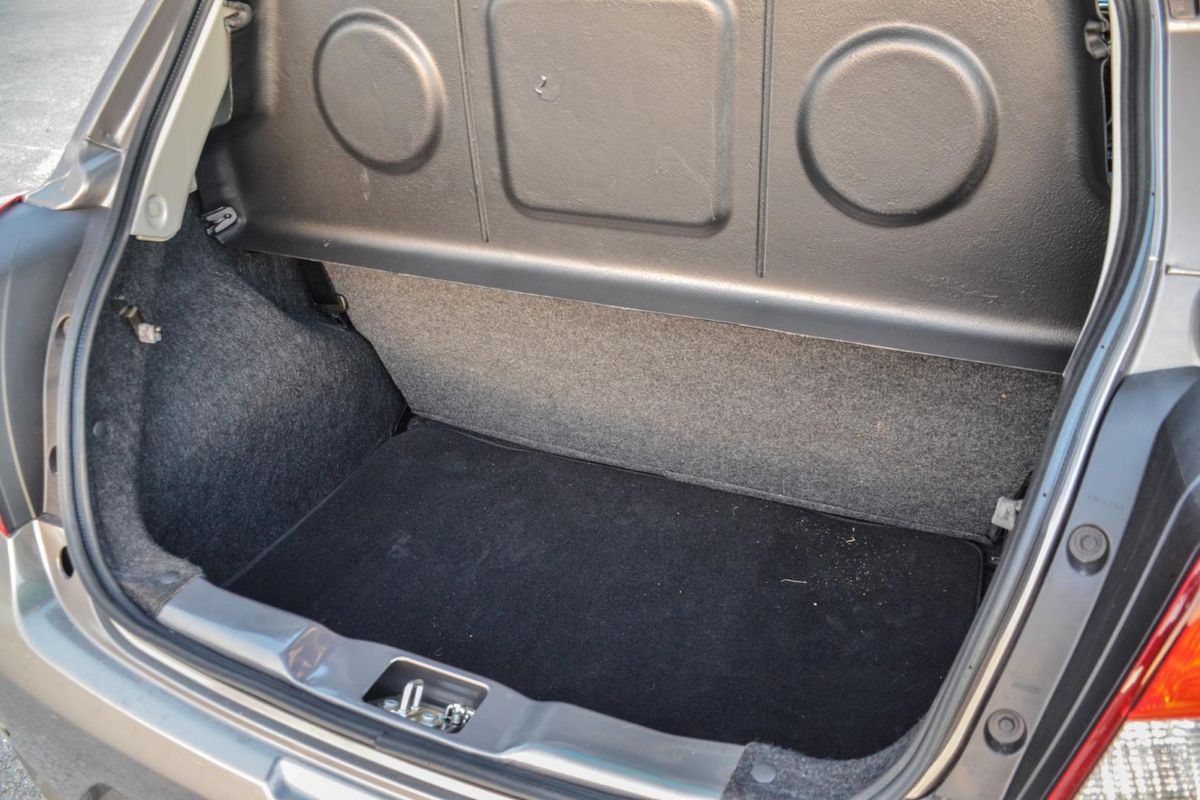
The parcel shelf with its poorly finished rubbers is an eyesore. The load bay, however, offers 265 litres of luggage space.
Even though the switchgear looks and feels "toy-like", the driver’s cabin is arguably of acceptable quality for a budget car at this price range. However, there are some details that call the overall build quality into question. If you open and close the doors and/or tailgate or tap the headliner with your fingertips, you're more than likely to hear just how thin and insubstantial they are.
The finishing of the parcel shelf is less than desirable with poorly glued parts already coming undone on this new test unit. The seats are hard and uncomfortable with little support. Exposed areas underneath the dashboard and around the transmission tunnel are unsightly. We can "Go" on…
It’s interesting to note that when the Datsun Go was first launched in South Africa, it was priced under R100k, and for that money, you could somewhat accept its flaws because ultimately, you get what you pay for in that price range. Today though, this 1.2 Lux derivative is priced at R165 500 and apart from airbags, ABS, a touchscreen and a few styling tweaks, it’s the same car, just a whole lot pricier.
Wooden steering feel
The overall driving experience is marred by an uncommunicative and wooden steering feel.
We were not particularly impressed with the steering feel of the Datsun Go, either. The steering is not very communicative and it feels quite insular and wooden. You never quite know what the front wheels are doing and there’s a fair amount of body roll when cornering with any sense of urgency. As a basic city runabout, the Datsun Go works, but it fails to offer anything resembling a pleasing drive.
Pricing and Warranty
The Go 1.2 Lux is priced from R165 500 and is sold with a 3-year/100 000 km warranty and, at the time this review was published (January 2019) 1-year comprehensive insurance (subsidised) OR R6 000 deposit assistance.
For the money, the Datsun Go 1,2 Lux is not as convincing as we had hoped it would be.
The Datsun Go makes a stronger case for itself by offering improved safety features and an advanced touchscreen, which is bound to secure more sales in this tightly-contested segment. However, while its engine offers acceptable performance and returns good fuel consumption on a daily basis, the Go disappoints in terms of its overall driving feel and iffy build quality (not that that would matter to all budget-market new car buyers).
At this price point, buyers have lots of choice, including cars such as the Kia Picanto, Suzuki Celerio, Hyundai Grand i10, Toyota Aygo (to name a few), all of which are worthy contenders in the budget segment and we suggest that potential buyers test drive all of them in an effort to make an informed decision. Is the latest Datsun Go 1.2 Lux worth its price tag? Based on our experience, we think it falls a little short.
As an alternative to the above, if you are seriously considering the Datsun Go, you may want to consider forking out an additional R12 400 and hop into the new Suzuki Swift 1.2 GL (R177 900) which is a #CarsAwards Budget Car finalist and one of the best offerings in this segment.
Alternatives (Click on names for specification details)
The new Swift has come of age and not only is it more spacious than the Go, it’s also more refined and drives and handles better. The Swift offers more power and torque too with 61 kW and 113 Nm of torque developed by its 1.2-litre petrol engine. The Swift 1.2 GL is priced at R177 900.
Priced at R168 995, the Kia Picanto 1.0 Style is a sound offering. Its plucky 1.0-litre petrol engine produces 49 kW and 95 Nm of torque and it’s arguably more stylish than the Datsun Go.
If it’s more space you are after then the Celerio is a good bet. It offers 50 kW and 90 Nm from its 1.0-litre petrol engine and is cheaper than the Datsun Go with a price of R156 900.
With a comprehensive warranty and spacious interior, the Grand i10 is worth a test drive. Its 1.0-litre petrol engine offers 48 kW and 94 Nm. this derivative is priced from R164 900.
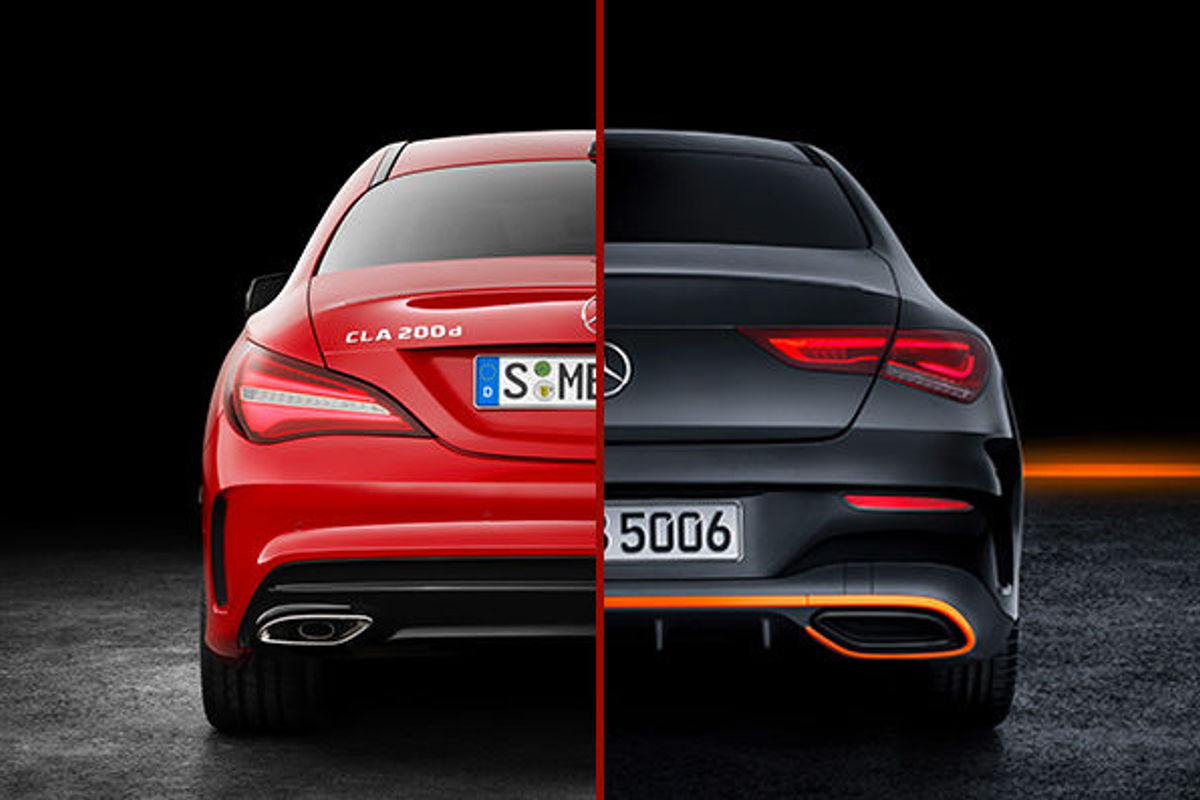
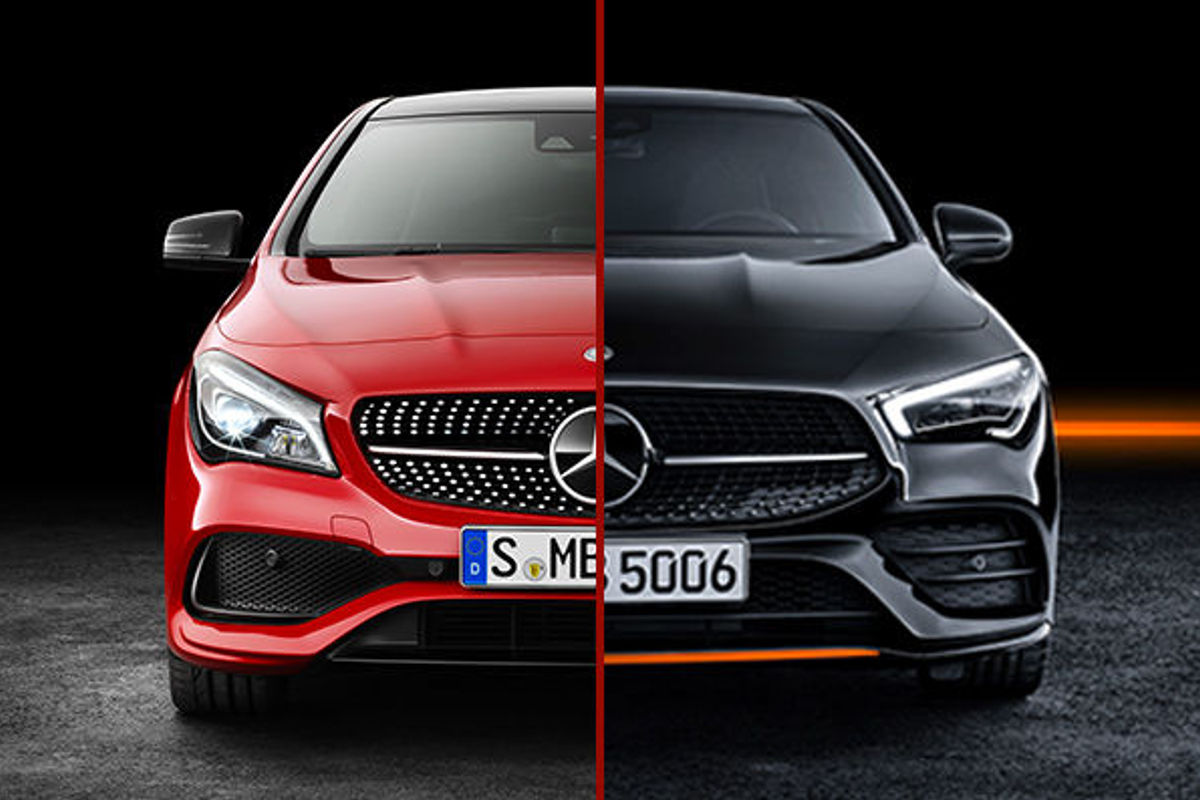
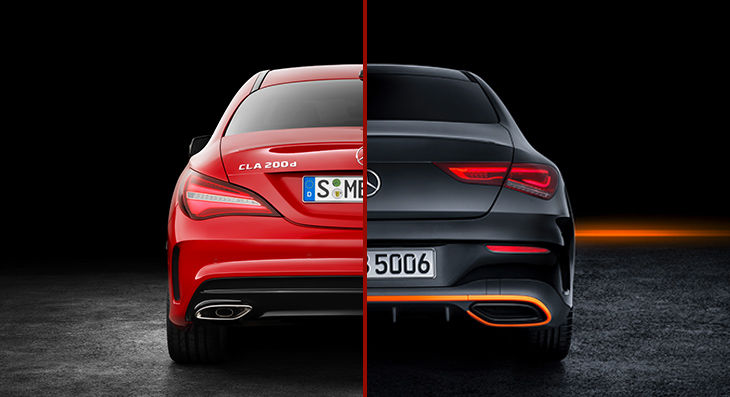
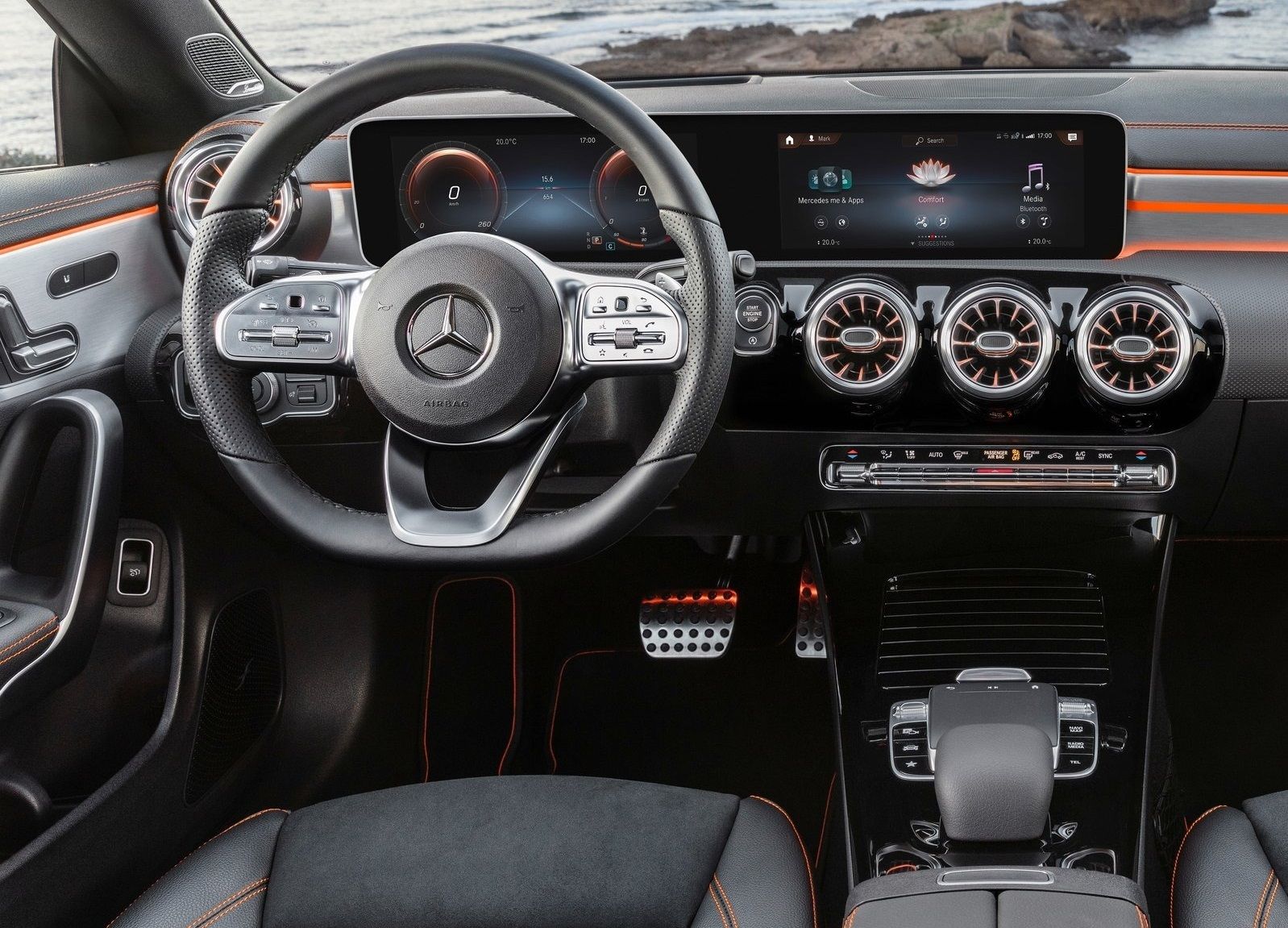
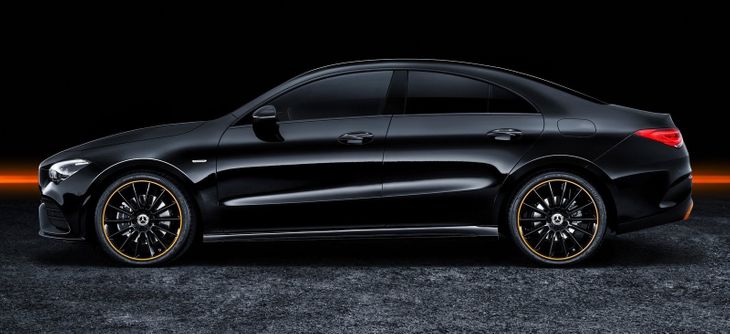
The new Mercedes-Benz CLA was revealed in early 2019 and that got us thinking. How does it compare to the outgoing Mercedes-Benz CLA, which the South African market received back in 2016? We put them side by side.
When it was introduced globally back in 2013, the Mercedes-Benz CLA was well received. It was facelifted in 2016 and in that period more than 1 million units have been sold around the globe. The facelifted version also proved popular and tallied up an extraordinary number of sales. It was available in a number of flavours: petrol, diesel, AMG and in some markets, you could even get in a Shooting Brake estate body style.
2019 sees the all-new Mercedes-Benz CLA reach global markets (South Africa included) and the changes are numerous. Physically, the new CLA is 48 mm longer, 53 mm wider and its wheelbase has been extended by 30 mm. As a result, the CLA now stands 4 688 mm in length and 1 830 mm wide. This will address some criticisms that cabin space, especially in the rear, where things were a little cramped.
Cabin
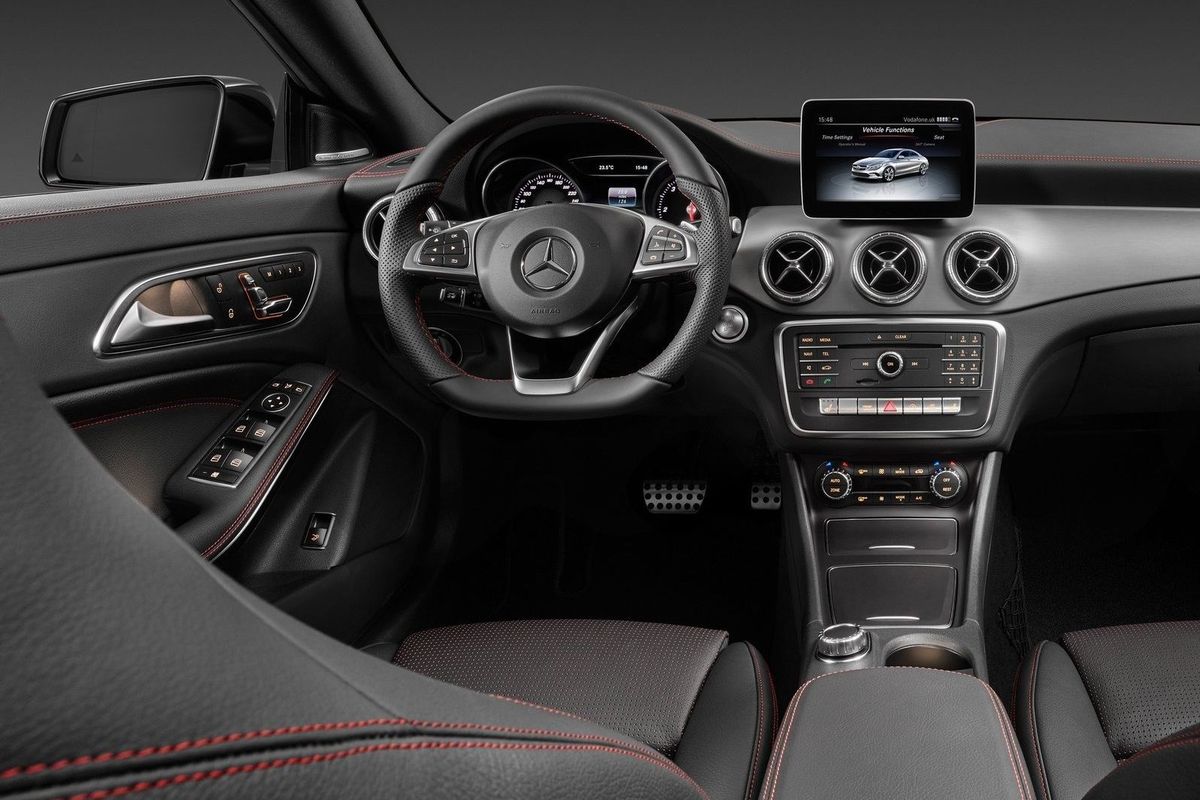
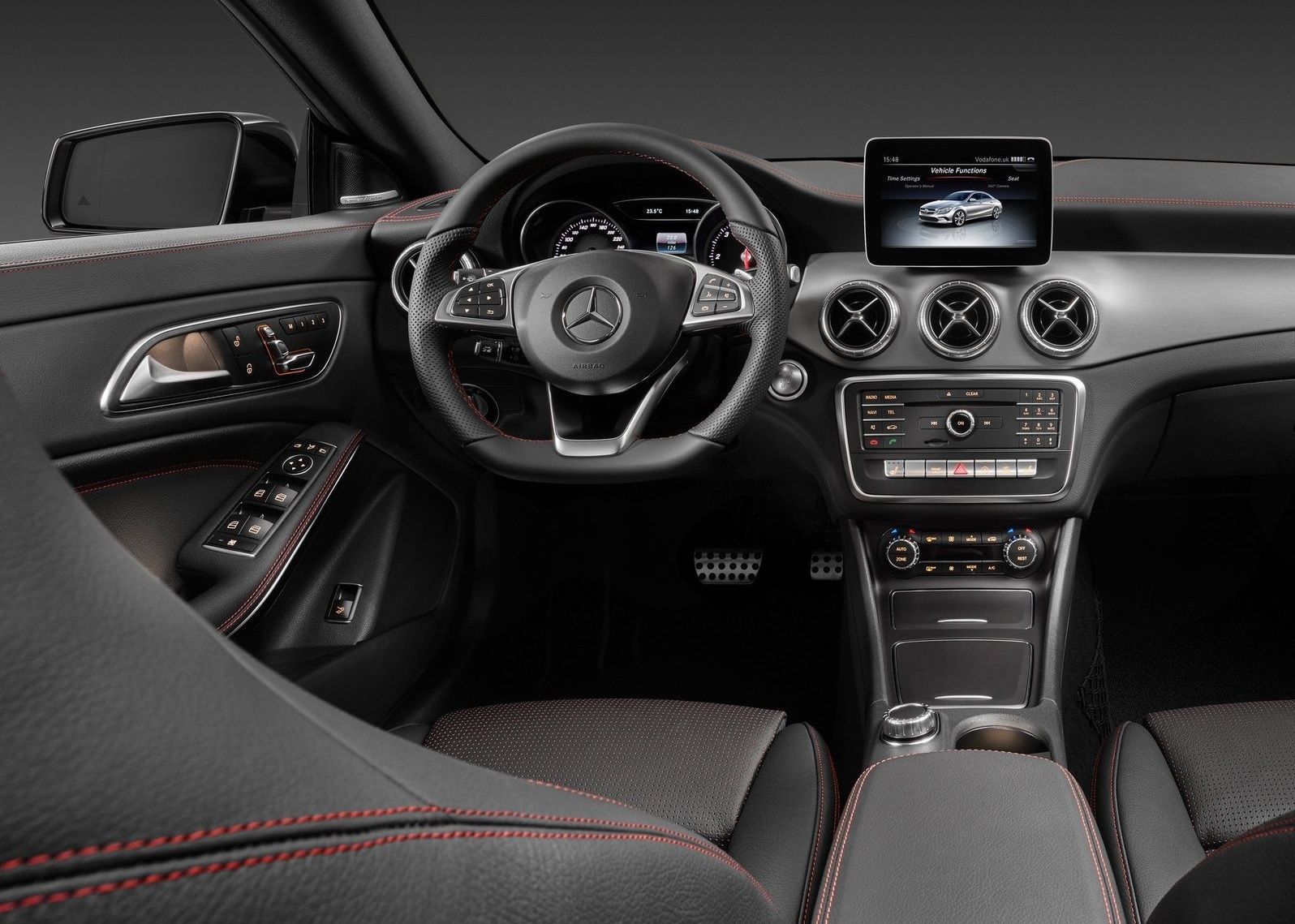
The outgoing Mercedes-Benz CLA cabin has dated quickly.
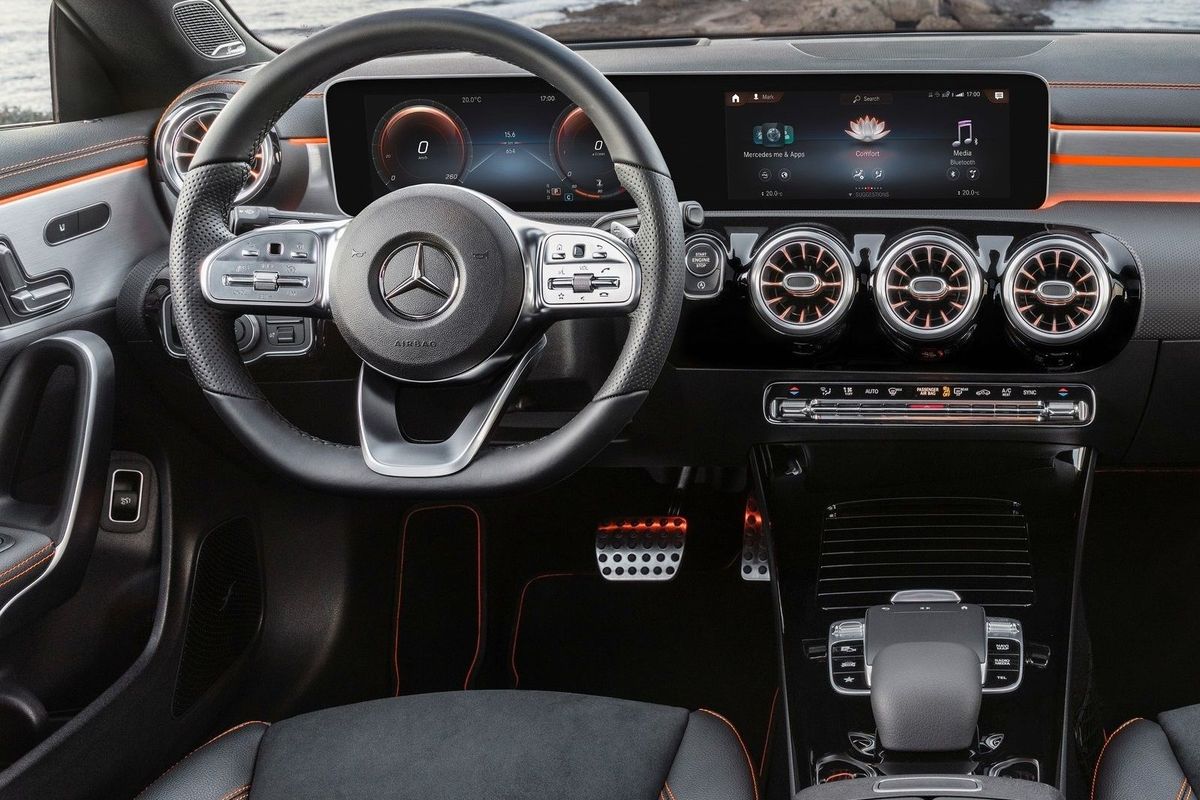
The biggest changes occur in the cabin, where there's a big shift towards making the Mercedes-Benz CLA one of the more advanced and digitally connected vehicles in its segment. We have yet to drive the CLA and have therefore not felt or explored the cabin quality, but if its anything like the current iteration of Mercedes-Benz A-Class, the quality has improved in leaps and bounds. Both the previous generation A-Class and CLA suffered from rattles and squeaks at higher mileages, and some of the plastics used were not representative of what Mercedes-Benz stands for.
The 2019 Mercedes-Benz CLA cabin is fresh, modern and technologically advanced
Engines
The previous generation of Mercedes-Benz CLA had a plethora of engines to choose from. Starting with the lowly CLA 200d (100 kW and 300 Nm), CLA 200 (115 kW and 250 Nm), CLA 220d (130 kW and 350 Nm) to the fiery CLA 250 Sport (155 kW and 350 Nm) and the mighty CLA 45 (280 kW and 475 Nm). The option of 4Matic all-wheel drive was thrown in for the CLA 250 and CLA 45 AMG.
We know so far that the new Mercedes-Benz CLA will come in many AMG flavours such as CLA 35, CLA 45 and CLA 45 S. Leaks have suggested that the flagship model will have over 300 kW. We also know there will be a CLA 250 with 165 kW and 350 Nm, as well as many other petrol and diesel options. Mercedes-Benz has also claimed that a manual gearbox will be offered.
Summary
The changes and difference between the old and new CLA are night and day, and we look forward to sampling the newcomer. The all-new Mercedes-Benz CLA will be built at the Kecskemét plant in Hungary and will go on sale in May 2019 and is expected to arrive in South Africa later in the year.
Each year starts off with a bang in Las Vegas, which hosts the largest annual consumer electronics show in the world. We saw a plethora of TVs, robots, AI and typically weird and wacky gadgets at CES 2019, but it was also abundantly clear that vehicle manufacturers' involvement in the tech expo shows no sign of abating.
With each passing year, an increasing number of carmakers are choosing to display both their over-the-top concepts and useful tech innovations at CES to demonstrate the directions they are heading. We’ve rounded up the most interesting ones from 2019 below:
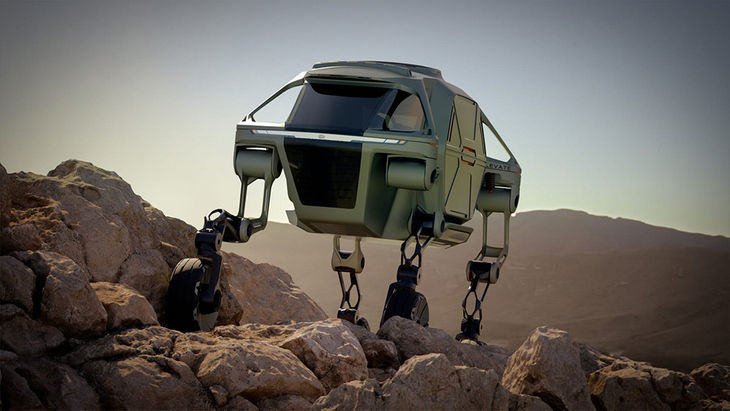
1. Hyundai Elevate
Hyundai showed off a straight-up crazy concept at CES: a 4-legged walking car, with spider-like flexibility to reach places normal cars typically can’t get to… perhaps not even on planet Earth? This car-robot mash-up is what Hyundai is calling an Ultimate Mobility Vehicle (UMV). It has a small modular body that takes on different forms, with adjustable legs that can drive like any other vehicle and additionally climb walls, cover unusual terrain, assist wheelchair passengers when used as a taxi, or for rescue missions. When not in use, the legs can be stowed for drive-mode, so power isn’t wasted. According to project engineers, the UMV is powered by a 66-kWh electric motor.
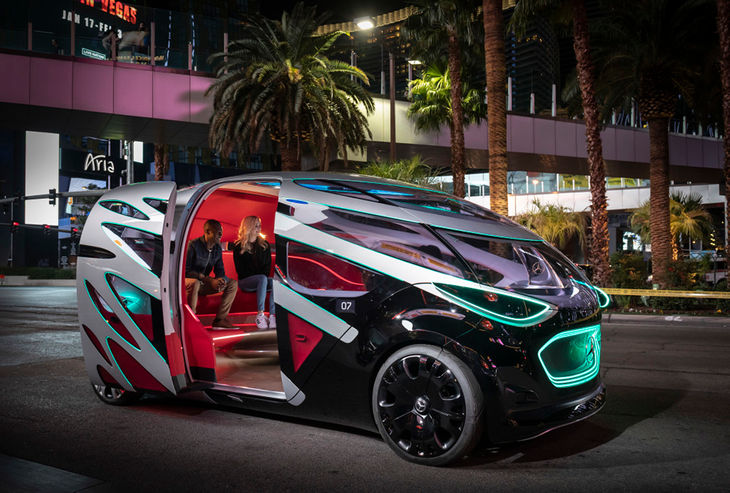
2. Mercedes-Benz Vision Urbanetic
Mercedes-Benz unveiled an autonomous part-taxi part-delivery vehicle called the Vision Urbanetic… and it looks like it's jumped straight out of a sci-fi movie. The electric concept vehicle is more of an autonomous pod that carries either passengers (up to 12) or things for delivery, which can be summoned with an app. It features panels outside the vehicle that displays messages to pedestrians or cyclists to acknowledge them. Suffice to say it looks unlike any Mercedes-Benz we’ve ever seen – with brightly coloured lights and panels making up the exterior. The interior looks like a high-end yacht, with fancy lounging areas and wireless charging for smartphones. According to the company, the taxi and delivery modules can be swapped out in 5 minutes. Before we get carried away, let’s not forget it’s only a concept and highly unlikely to make it to production phase.
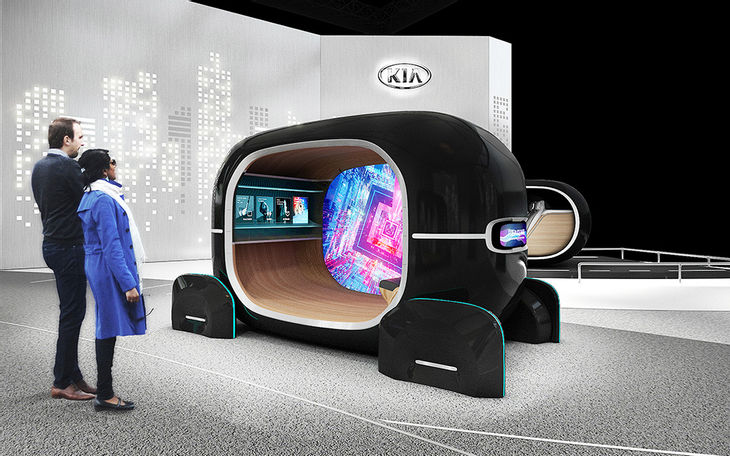
3. Kia R.E.A.D
Kia has showcased a "Space for Emotive Driving" with its Real-time Emotion Adaptive Driving (R.E.A.D.) system aimed at a future where autonomous driving is the norm. The company says it’s a world-first emotional AI-based optimised and interactive in-cabin space centred around human senses. This means artificial intelligence will analyse human emotions with sensors to read facial expressions, heart rate and electro-dermal activity, and personalise the cabin space accordingly. It will, as such, adjust air-conditioning, seat massaging and ambient lighting settings, plus play appropriate music, based on the interpretation of its sensor readings. If you like the idea of being monitored constantly by AI, this may appeal to you.
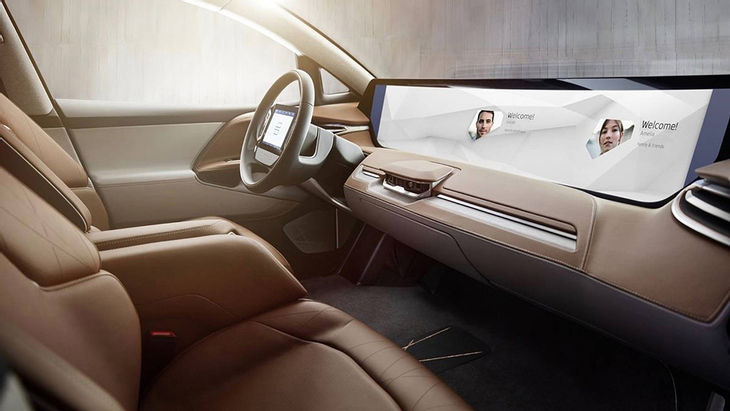
4. Byton M-Byte
Last year, Chinese start-up Byton introduced its electric SUV at CES 2018 and has yet to reveal a production version of that concept, but the firm took to CES 2019 to show the vehicle's production-ready cabin, which features a monstrous 49-inch touchscreen panel. We know what you’re thinking, but the “Shared Experience Display” (SED) complies with all safety and crash standards in markets it will be sold in, at least so the company claims. Still, a 49-inch screen across the dashboard just looks distracting (the equivalent of 7 iPads), despite not interfering with the driver’s line of sight. If that wasn’t enough, there is another 7-inch touchscreen located within the steering wheel, allowing the driver to configure the car and customise its functionality. What's more, there are screens at the back for passengers that links to the infotainment system.
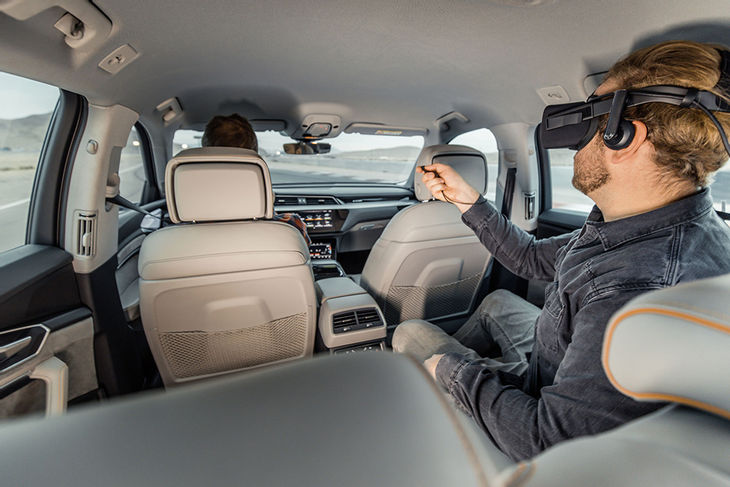
5. Audi Experience Ride
Audi demonstrated its new backseat VR concept on its e-tron (which we recently drove, see a link to that article below) with Marvel’s Avengers: Rocket’s Rescue Run, which allows passengers to experience movies, video games, and interactive content in a more realistic manner. If you thought VR already did that, Audi wants its technology to adapt the virtual content to the movements of its vehicles in real time. This would mean that if the car turns left, the spaceship in the video game being played would turn left too. Audi claims the system, which combines geodata, vehicle- and content data, counteracts motion sickness. The company has partnered with a start-up called Holoride to make this possible…
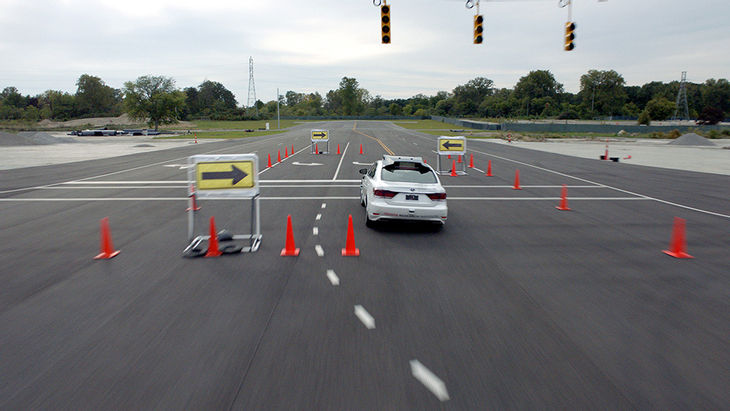
6. Toyota Guardian
The Toyota Research Institute has come up with an automated safety system (named Guardian) that works both in an autonomous environment or with a human driver to avoid accidents. In the case where a person is behind the wheel, they will always be in control, except when the technology anticipates or identifies a potential incident and offers a corrective measure, co-ordinated by the driver’s input. The company says that Guardian combines and co-ordinates skills and strengths of the human and the machine, inspired by modern fighter jets. The tech isn’t proprietary and is open for all manufacturers to use. We’re all for anything that causes fewer accidents on the road and hope to see more of this in the next decade.
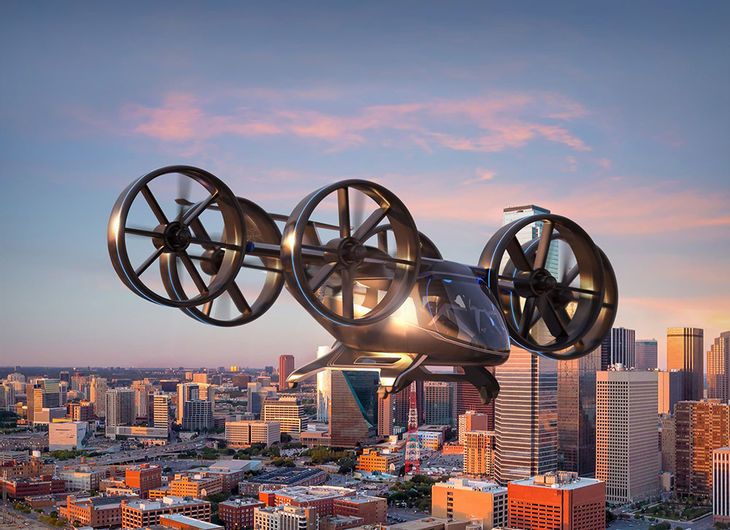
7. Bell Nexus
Oversized drone, or flying taxi? You tell us. Ride-hailing service Uber and Bell Helicopter unveiled an electric aircraft that is expected to be in service by 2023; it seats a pilot and 4 passengers. The Bell Nexus is a flying taxi that will take-off and land vertically and is powered by a hybrid-electric propulsion system, which makes it quiet and more efficient than traditional helicopters. It has a range of 240 km and can reportedly cover that distance in an hour. Hey Uber, if this is what the future looks like, sign us up immediately!
After what feels like an eternity of teasers, the eagerly anticipated Toyota Supra has finally been officially revealed. We can share all the official details and confirm that it is coming to South Africa in the middle of 2019.
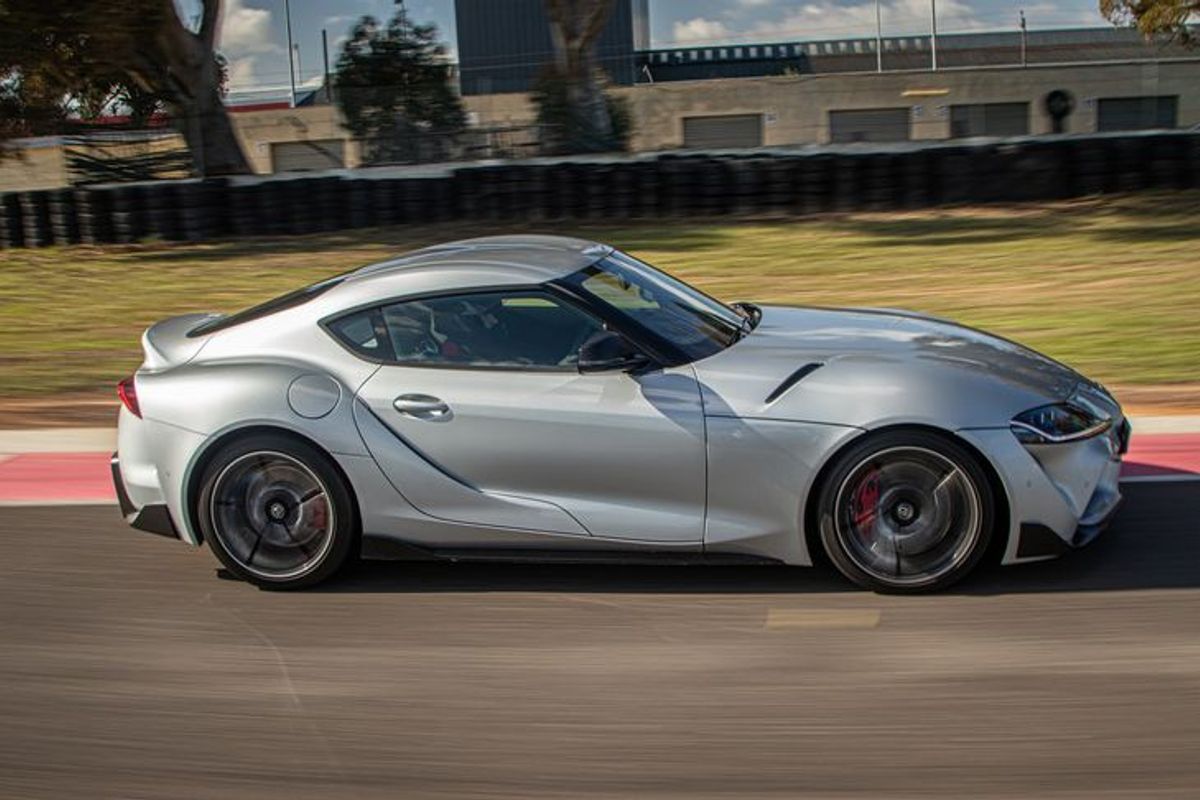
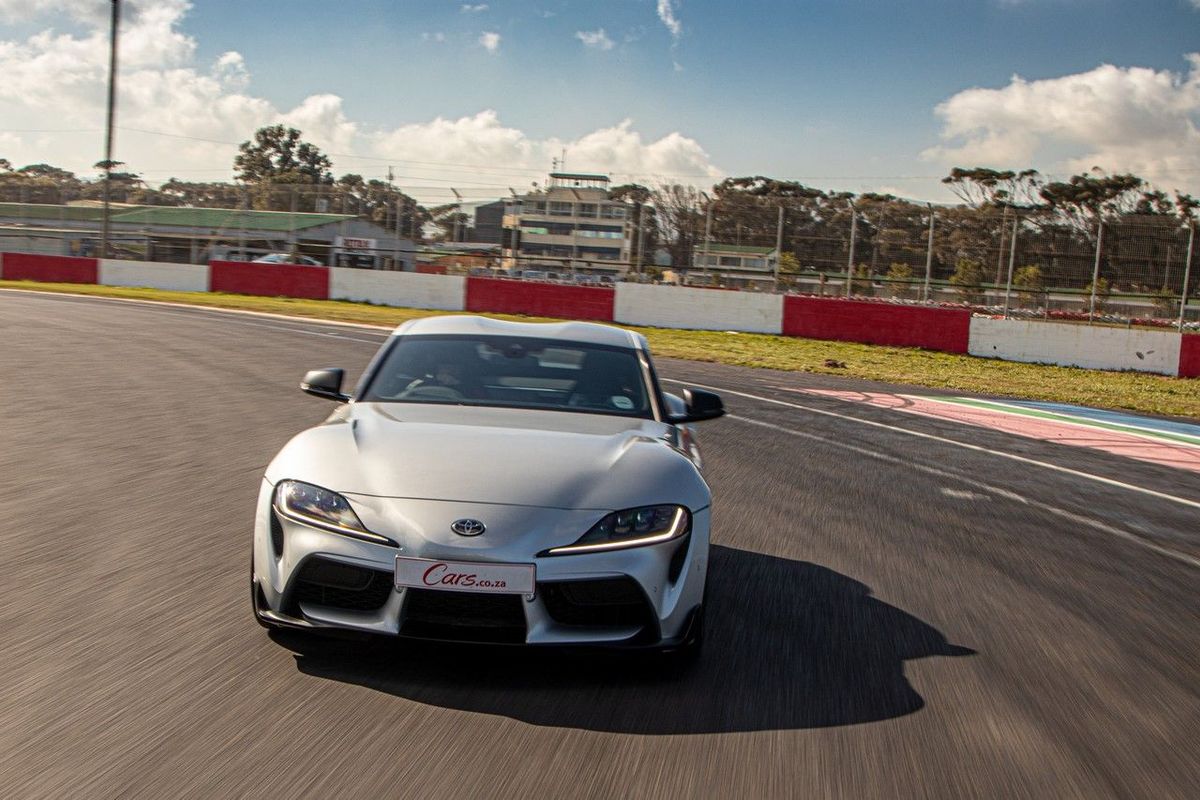
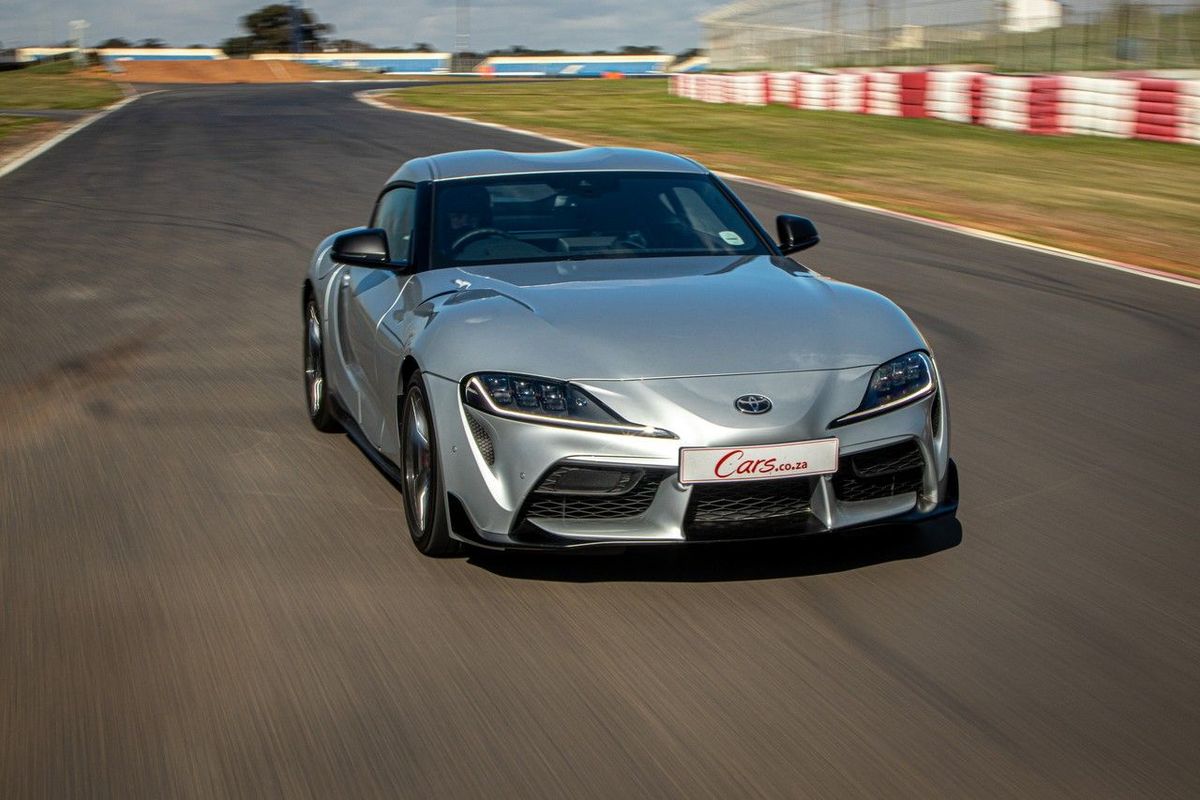
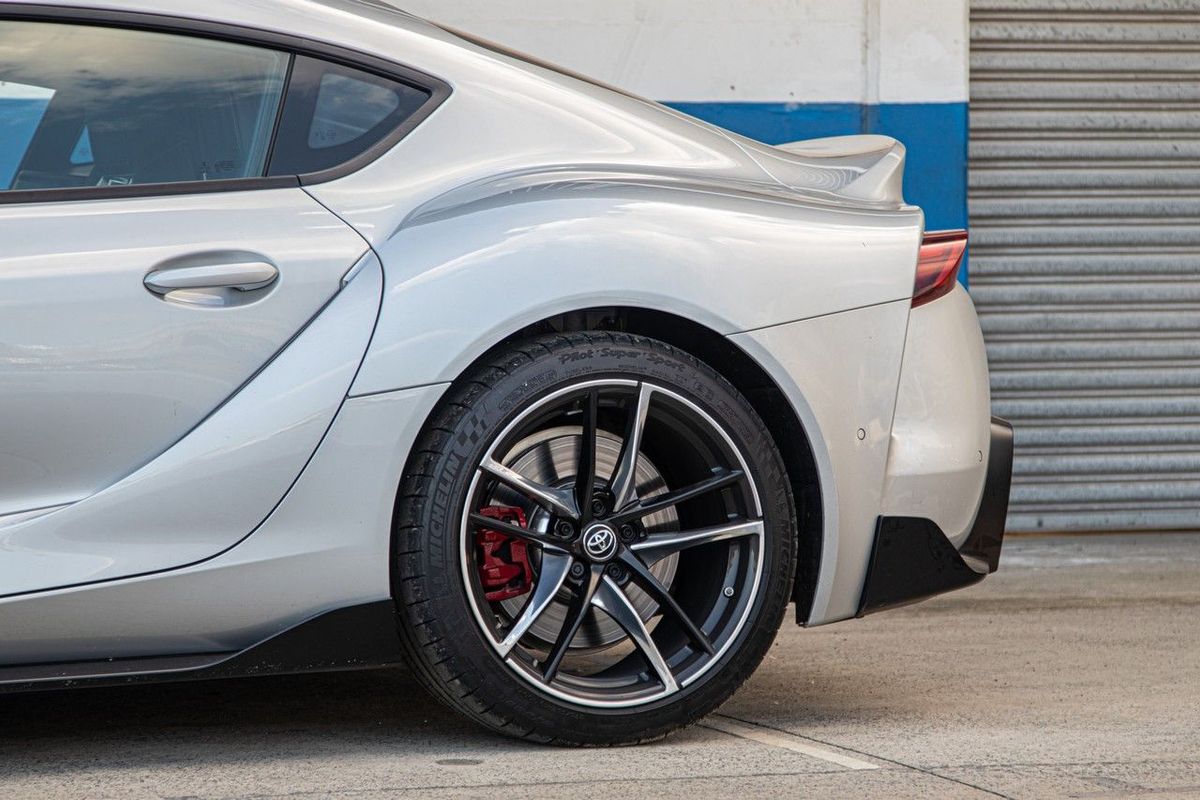
Fans of the Toyota Supra can finally breathe. After 17 years, the all-new Mk 5 Toyota Supra has been officially revealed at the 2019 Detroit Auto Show. Based on the outrageous FT-1 concept from 2016, this new Toyota Supra looks bold and aggressive, which should keep petrolheads happy.
For those who aren't aware, the 2020 Toyota Supra is a result of the Japanese brand and German brand BMW working together. The Germans created the new BMW Z4 and while there are mechanical similarities, the two cars are quite different in execution.
Under that curvy and striking body is a 3.0-litre twin-scroll turbocharged 6-cylinder motor. It produces 250 kW and 495 Nm. Power goes to the rear wheels via an 8-speed automatic transmission and Toyota claims that it's offering will hit 100 kph in just 4.1 seconds.
It's the under-the-skin details which have us interested. Toyota is claiming a 50/50 weight distribution, high structural rigidity, and a low center of gravity which should make for an entertaining drive. While the platform is shared with BMW, Toyota tuned the spring and shock absorber settings for the new double-joint spring strut front suspension and multi-link rear suspension. Toyota also set specific parameters for the Supra's stability control system performance. Adaptive Variable Suspension is standard and features 2 modes: Normal and Sport. There is also an active differential.
Toyota is marketing its new Supra as a premium Grand Tourer and there will be considerable premium features fitted like Keyless Smart Entry, dual automatic climate control, auto-dimming rearview mirrors, rear camera, rain sensor windshield wipers, garage door opener, power folding mirrors, and a leather-wrapped steering wheel will be standard. There will be a high-end multimedia setup, satellite navigation, Apple CarPlay as well as a JBL audio system, but we're going to wait for official local confirmation to see what SA-spec Supras will receive in terms of tech.
The latest safety features will be fitted too and these range from forward collision warning, automatic emergency braking with pedestrian detection, lane departure warning with steering assist, automatic high beam and road sign assist. Toyota claims there will be additional features such as adaptive full speed cruise control, blind spot monitor, rear cross traffic alert and rear-end collision warning.
The 5th generation Toyota Supra will come in various levels of trim and while it hasn't been officially confirmed, there are talks of 4-cylinder turbo motors too. A leaked document from gearbox specialists ZF suggested that another BMW engine has been chosen. The 2.0-litre turbocharged B48B20 pushes out 195 kW and should be revealed in the coming months.
We're hoping that the similarities between the new Supra and the new Z4 are just on paper, and the two are completely different animals to drive.
There is quite a bit of BMW componentry in the Toyota Supra, but we hope it does not detract from the driving experience.
Fuel prices may drop further at the end of the month according to the AA, based on unaudited mid-month data released by the Central Energy Fund.
Some good news for South African motorists is that fuel prices are likely to decline further come February 2019. The international price of crude oil has risen slightly since the beginning of the year but it’s still lower than the December’s average and the Rand/US Dollar exchange has strengthened in the first half of January which should translate into fuel price reductions at month end.
Based on current data, the price of petrol is predicted to fall by roughly 12 c/l while the price of diesel could see reductions of around 36 c/l.
We will have to wait until the end of the month to see what impact the exchange rate and international oil prices will have, but we are definitely holding thumbs for bigger decreases going forward into 2019.