It’s been 30 years since the original M3 was introduced. BMW celebrates with a limited edition of the current generation.
The BMW M3 “30 years of M3” is limited to just 500 units worldwide. It will also be sold in just one colour – Macao Blue Metallic. The colour is a throwback to the original M3 where the hue featured as a special option.
As for the details of the new special edition, it takes the Competition Pack M3 as its base and builds on from there. Power remains the same at 331 kW and the special edition also packs the Adaptive M Suspension as standard. Dynamically the special edition remains the same as the Competition Pack M3. Zero to 100kph remains the same at a blistering 4-seconds flat.
In addition to the Competition Pack, special 20-inch light-alloy wheels with a 666 M star spoke design are part of the deal.
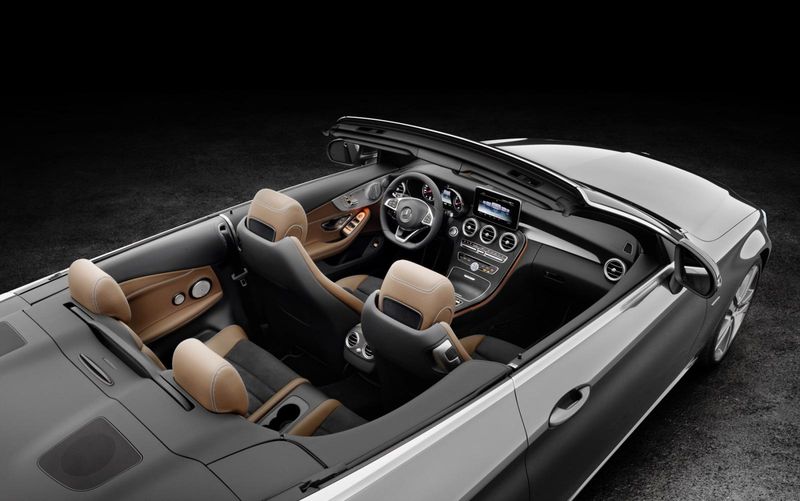
Inside this special edition, there a few other subtle changes. The logo “30 Years M3” is etched on the front doorsills. The wording “30 Years M3 1/500” on the carbon fibre interior trim strip of the instrument panel gives an indication of the exclusiveness of the BMW M3 “30 Years M3”. “30 Years M3” is again embroidered into the front headrests.
The cost of the “upgrades” for the special addition model amount to 10 000 Euros (est R170 000) on top of the Competition Package which, sells for R1 186 076 currently. South Africa has received confirmation that 30 units will be making their way here, so start saving now as the vehicles will be arriving around the third quarter of 2016.
Hyundai’s N division, the Korean marque’s performance arm, is planning to launch a sportier version of its i30 hatchback in 2017.
Last year, Hyundai introduced a sportier, N-inspired Sport version of its i20 hatchback in South Africa that offered 85 kW and 160 Nm of torque and although it offered marginally more power, racier packaging and a louder exhaust note than the standard i20 (74 kW/133 Nm), there wasn’t much for hot hatch aficionados to get excited about.
However, that may very well change if Hyundai goes ahead with the production of the i30 N, which recently took part in the Nürburgring 24-hour endurance race. According to reports, Albert Biermann, Hyundai’s Head of Vehicle Test & High Performance Development has confirmed that the i30 N will go into production in 2017.
Turbo Power for i30 N
The Hyundai i30 N is powered by a turbocharged 2.0-litre engine and even though its peak power and torque figures have not yet been confirmed, Hyundai has hinted that the engine should be capable of producing at least 194 kW and 309 Nm of torque. The powerplant will be mated with a manual transmission with a possibility of a dual-clutch automatic transmission being introduced at a later stage. The i30 N is expected to be a front-wheel driven model, but an all-wheel-drive configuration has not been ruled out.
According to Biermann, the i30 N will represent a "more affordable" alternative to other hot hatches on the market, such as the Volkswagen Golf GTI and the Ford Focus ST.
Given the fact that the i20 Sport is on sale in South Africa, there’s a strong chance that the i30 N will be offered to the local market in 2017, but this has not been confirmed… yet. We will keep you updated when more detail becomes available.
Given the importance of the A4 for Audi, it is understandable that the Ingolstadt-based brand would take its time to get this model just right. With an updated BMW 3 Series and superb Mercedes-Benz C-Class to contend with, it had to be good. Based on our experience with the new model thus far, it is indeed a strong challenger for best-in-class honours. Can the new A4 (in 2.0 TFSI S tronic Design guise) reinforce the solid first impressions?
We like: Refinement, build quality, relaxing drive, interior design
We don’t like: Lengthy options list
Alternatives:
For more snob appeal: Mercedes-Benz C200 Avantgarde auto.The Mercedes-Benz badge still carries more "status". Its interior is eye-catching and smart, but the Audi's cabin is better built.
Something sportier: BMW 320i M Sport auto. It has been written so often, but it's always worth repeating: the 3 Series remains the dynamic champion in the segment. However, the 3 Series' ride isn’t quite as smooth as the Audi’s and its cabin feels (and looks) dated by comparison.
For more flair: Jaguar XE 25t Prestige.The Jaguar offers a sense of style and exclusivity that its rivals can't quite match. Rear occupant space is tight, but it’s arguably the best-looking vehicle in the segment. Unfortunately, XE derivatives are overpriced.
For better value: Volkswagen 2.0TSI R-Line autoFor a little less money, you can get behind the wheel of a Volkswagen Passat that offers similar levels of refinement as well as a more potent engine. It may not sport a premium badge, but it offers excellent levels of refinement and more space.
The Audi A4 2.0TFSI S tronic Design incorporates a number of options that differentiate it from the standard offering. You get 17-inch wheels with a 10-spoke crystal design, a radiator grille in high gloss dark chrome with inlays in chrome, a diffuser in dark matt chrome with diffuser in chrome, chromed exhaust ends, aluminium inlays (high gloss package), as well as a 3-spoke multifunction leather steering wheel. In the early morning sunlight and with the car covered in dew, it drew admiring glances from onlookers driving past. Despite its safe, evolutionary styling, it remains a desirable vehicle.
Tick the box marked Audi Virtual Cockpit. Trust us on this one.
Audi is renowned for the progressive design and exceptional quality of its interiors, and the latest A4 is no exception. The design and layout are clean and minimalistic, but upon closer inspection you’ll see the devil’s truly in the details. Some would say it's over-engineered, but we like it that way.
The fascia has a neat, uncluttered layout, with the traditional big infotainment screen perched atop the centre of the dashboard. The infotainment selector is aided by a nifty piece of ergonomic design: you can rest your wrist on the transmission lever handle while you browse the menus. The cabin, and entire car, for that matter, feels meticulously built. We'll go out on a limb and say that it makes some of its rivals’ interiors feel obsolete…
There’s a lot of room too, even with four adults ensconced in the vehicle. Helped by a concave front seatback design, there’s decent knee- and headroom for tall adults in the rear. And, those who require a large luggage capacity will be satisfied by the A4's cavernous boot. The reason behind this increase in space? Compared with the previous A4, headroom has increased by 11 mm, cabin length by 17 mm and the rear legroom by 23 mm.
Audi's buttons are well made and have a weightly, positive action to them.
Performance and efficiency?
Before we discuss the abilities of the powerplant, bear in mind the A4’s body is around 120 kg lighter, which aids performance and efficiency. The engines in the A4 are all 4-cylinder units with capacities of either 1.4- or 2.0-litres. In this application, there’s a 2.0-litre turbocharged motor under the bonnet (anoraks will note it’s the EA888 unit, as found in the Volkswagen Golf GTI). In this derivative, the motor produces 140 kW and 320 Nm.
Power reaches the front wheels through a 7-speed version of Audi’s dual-clutch S tronic transmission. While this derivative is available with a manual ‘box, we suggest the slick S tronic is preferable. It delivers ultra-smooth shifts and allows the Audi to shine in the efficiency department.
Thanks to excellent gearbox/engine mapping and a slippery drag coefficient, this A4 is claimed to consume only 4.4 L/100 km in freeway driving conditions. You can set the Audi Drive Select to Economy mode and while Audi claims an average of 7.0 L/100 km (and we tried our best to get close to that), the relentless traffic jams in Cape Town wouldn't allow us to get consumption under 7.9 L/100 km, which is still a commendable figure.
Comfort and features?
The transmission lever is a nifty resting point for your wrist as you navigate through the menus.
The Audi A4 is positively laden with state-of-the-art technology, even if some of the features aren't immediately visible. Audi’s Matrix headlights, heated and cooled seats, automatic parking, Virtual Cockpit digital dashboard and adaptive suspension will make your life safer, smoother and infinitely more comfortable. Granted, some of these features are optional, but if you can tick those boxes, you're unlikely to be disappointed.
The safety specification of the new Audi A4 is comprehensive too. There are extra-cost features such as Audi active lane-assist, Audi pre-sense, side assist, as well as City Assistance and parking assistance packages, but the standard car includes such systems such as Audi pre-sense city, secondary collision brake assist, ABS with EBD, stability control and a plethora of airbags. Our advice would be to tick the City Assistance package, which will add in a self-parking system and a reverse camera, Audi side assist, rear-cross traffic assist, Audi pre sense and exit warning systems.
Ride quality and handling ability?
The A4 driving experience is a relaxed, refined affair. Drive Select affords the choice of different driving modes such as Dynamic, which sharpens everything up, and Eco, which leans energy usage and curtails throttle responsiveness. There’s also Comfort, Auto and Individual, which lets you customise your settings. You can set your steering feedback to sporty, while retaining an eager engine and pliant suspension settings.
Forget the drive modes for a second. The core purpose of a premium sedan that costs R500 000 should be to provide a driving experience that’s comfortable, quiet and absorbent by default. The A4 delivers that by the bucketful… Some would go far as to say the drive is almost too clinical, even sterile, but when you’re driving to the office and back every working day, you’re unlikely to require a lively, hands-on and dynamic experience.
Select Dynamic mode and take control of the gears with the steering-wheel-mounted shift paddles and the A4 will tighten up and do its utmost to deliver more driver involvement. Is it as sharp and exciting to steer as its rivals? Almost, but that's not what this sedan was designed for. The firmer suspension and great chassis will placate driving enthusiasts, but otherwise, the Audi strikes a fine balance between refinement and performance.
Subtle changes to the exterior looks are dwarfed by the massive improvements in ride, drive and interior.
Verdict
Irrespective of the fact that the arrival of the new-generation A4 felt overdue (perhaps because its predecessor was considered conservative and staid even when it was new), the newcomer remains an impressive and accomplished product. Some observers may have expressed mild disappointment with the sedan's "underwhelming looks", but under-the-skin changes show how modern, efficient and complete this vehicle is.
In 2.0-litre turbocharged guise, the A4 delivers a relaxed, refined performance that will please Audi's target market. You could be forgiven for daydreaming in gridlock traffic: it’s that comfortable and quiet. That engine is smooth and while the 1.4-turbo looks like it offers a great blend of performance vs economy, we'd still recommend the 2.0-litre because it offers flexible performance, even if the latter's not the vehicle's speciality.
Spec your Audi A4 carefully – an eagerly-ticked options list could easily add R100 000 to the vehicle's asking price, but don’t discount the extras out of hand: there are some worthwhile options that will significantly enhance the vehicle's overall appeal. Audi’s Virtual Cockpit is a must in our opinion as its underlines what a techno-fest the Audi A4 is. The Bang and Olufsen audio system and the Audi Connect system are worth a look as well.
It’s a great effort from Audi. While the A4 doesn’t shout loudly (like most of its rivals do), no-one should underestimate this solid, premium offering.
The Audi A4 is priced from R472 000, with this particular model costing R528 000 before options. Every A4 comes with a standard five year/100 000km Audi Freeway Plan.
In our latest batch of spy photos from Europe, we're getting a look at a prototype of the upcoming Mercedes-AMG GLC 63 SUV.
Almost every model in the Mercedes-Benz lineup has either an AMG or an AMG-Sport model in it, so we're not surprised to see images of a GLC 63 prototype undergoing testing. The images reveal the large trademark grille on the front of this mule, which is a sure sign of a monster engine lurking beneath the hood. As for engines, well there's a wide selection of high-power engines at AMG's disposal.
Remember that the badge on the rear no longer refers to engine capacity, so while it carries a 63 badge, there may not be a 6.2-litre inside. Reports suggest that AMG has opted for the 4.0-litre biturbo engine used in the AMG GT and Mercedes-AMG C63. This engine is surprisingly compact thanks to the positioning of both turbochargers within the two banks of cylinders.
We will likely see two GLC 63 derivatives on offer including a standard version with no less than 350 kW and 650 Nm of torque, as well as a GLC 63 S with 375 kW and 700 Nm of torque.
You can expect the GLC 63 to feature 4Matic all-wheel drive, which will give it an estimated 0-100 kph sprint time of about 4.5 seconds. The GLC 63 and its coupe sibling are on course for launch in 2017.
Track Race: Audi RS3 vs Merc-AMG A45 vs Honda Civic Type R vs BMW M2 [Video]
The first major storm of the Cape winter is about to hit us. We’re parked at Cape Town's Killarney race track, praying for a break in the inclement weather that will be long enough to allow us to film, photograph and track test the assembled crew of 3 hot hatchbacks and a coupe. It’s a near-perfect lineup of pint-sized performance machinery.
The hot hatch game used to be all about extracting compelling levels of performance from otherwise run-of-the-mill hatchbacks. These days, however, 5-door performance cars are all about terrifying levels of power and torque, sophisticated electronic systems, trick differentials and track-ready handling but, at greater cost to your bank balance. Yes indeed, whereas old school hot hatches were reasonably affordable, some of these cars cost almost R1 million.
A trio of hot hatches
Three cars, 3 different philosophies, 4 and 5 cylinders, front and AWD.
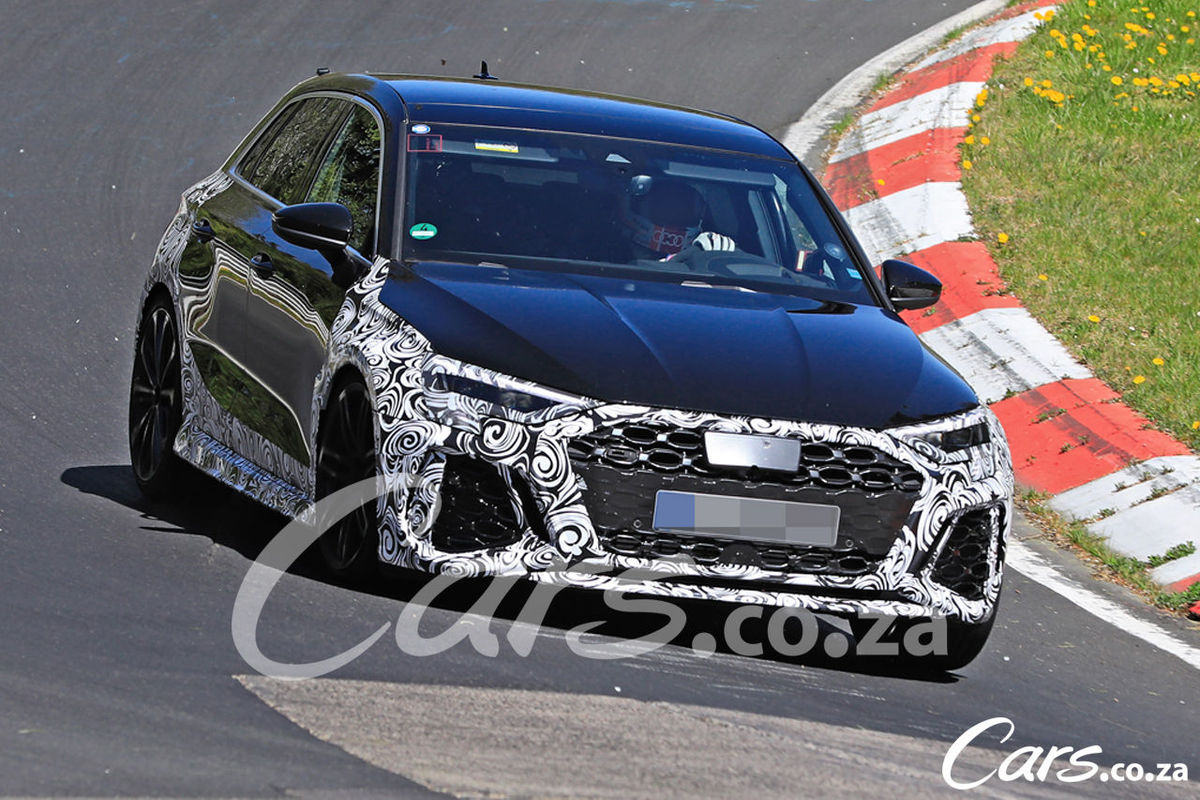
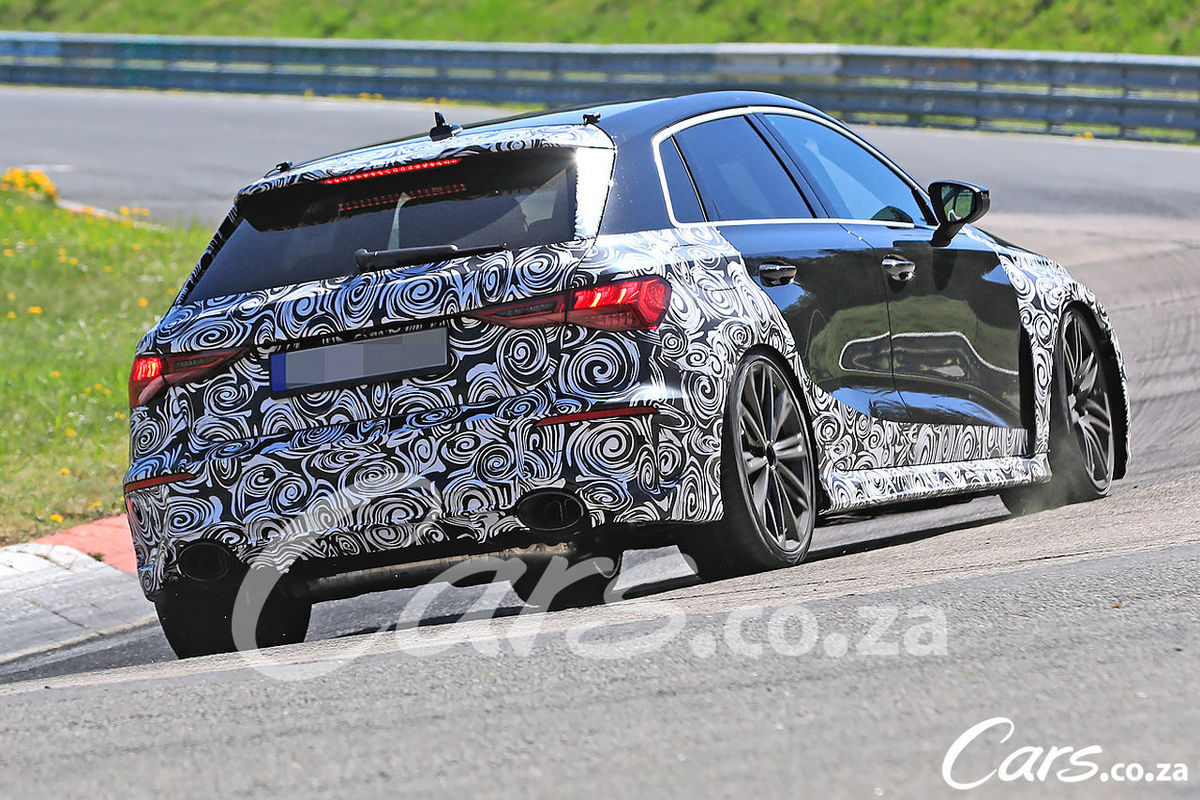
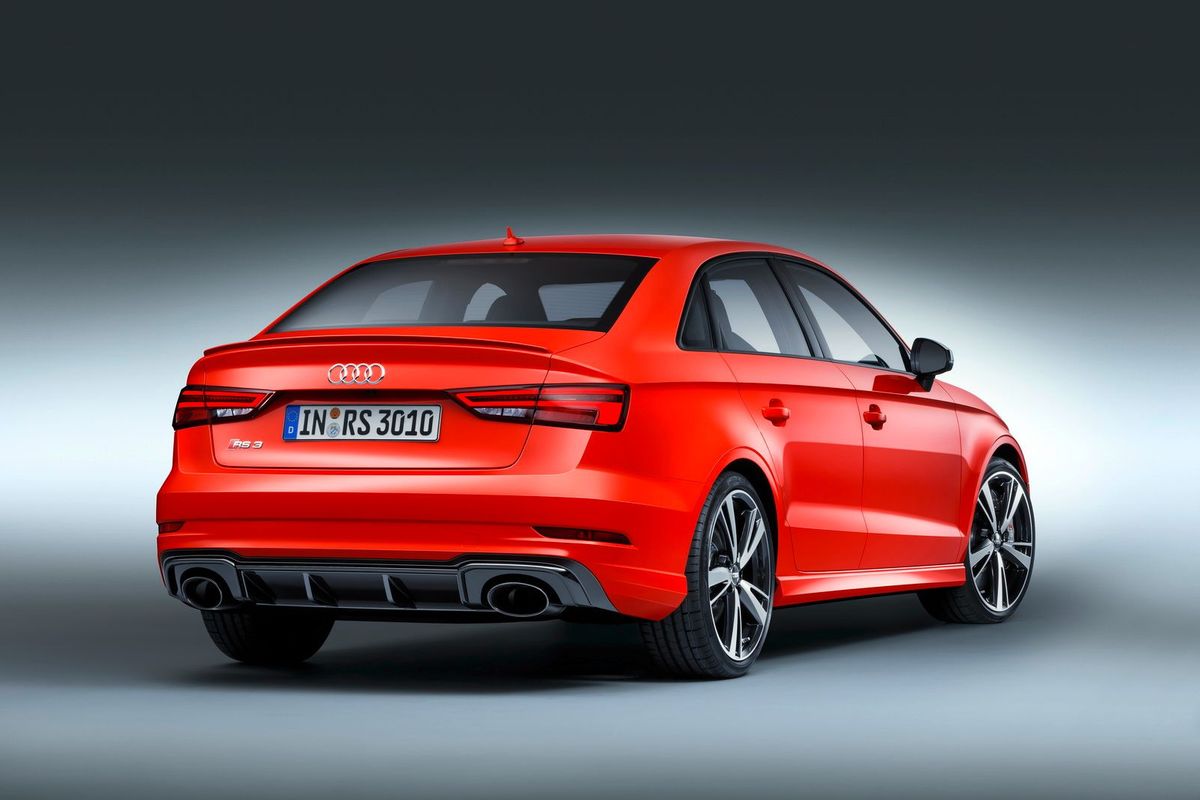
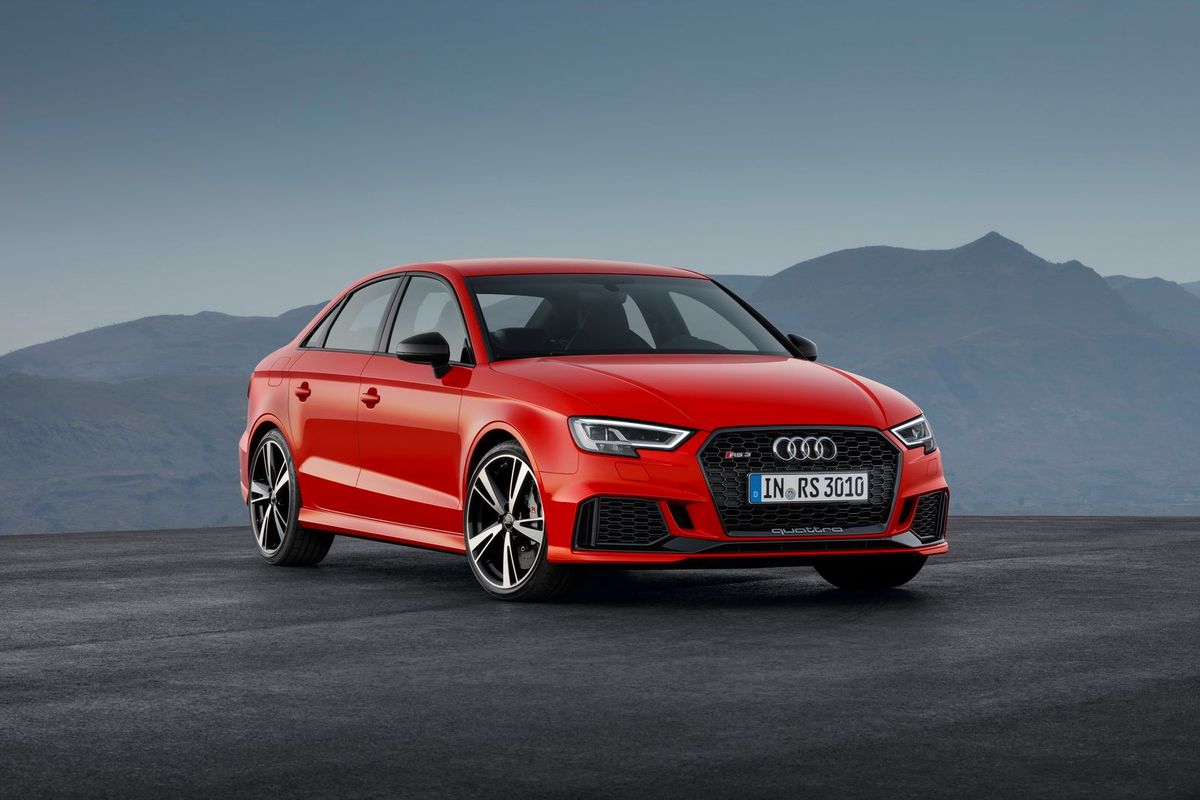
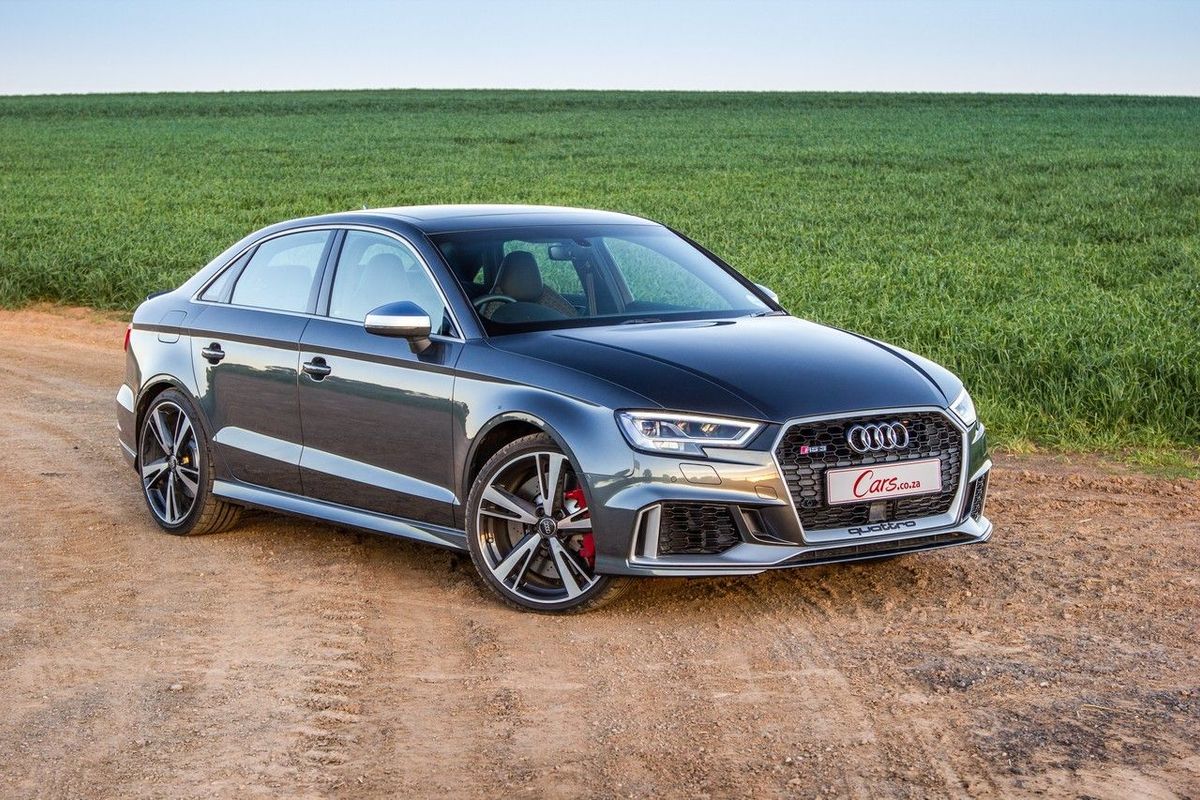
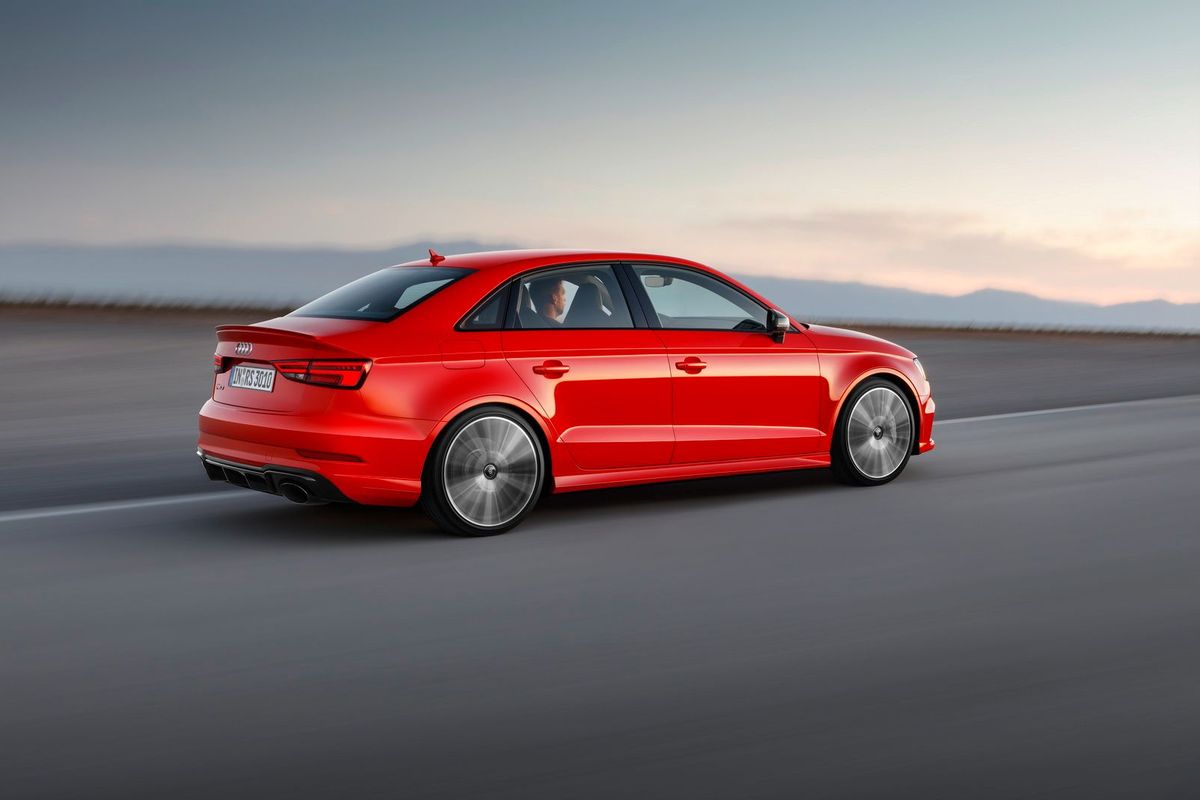
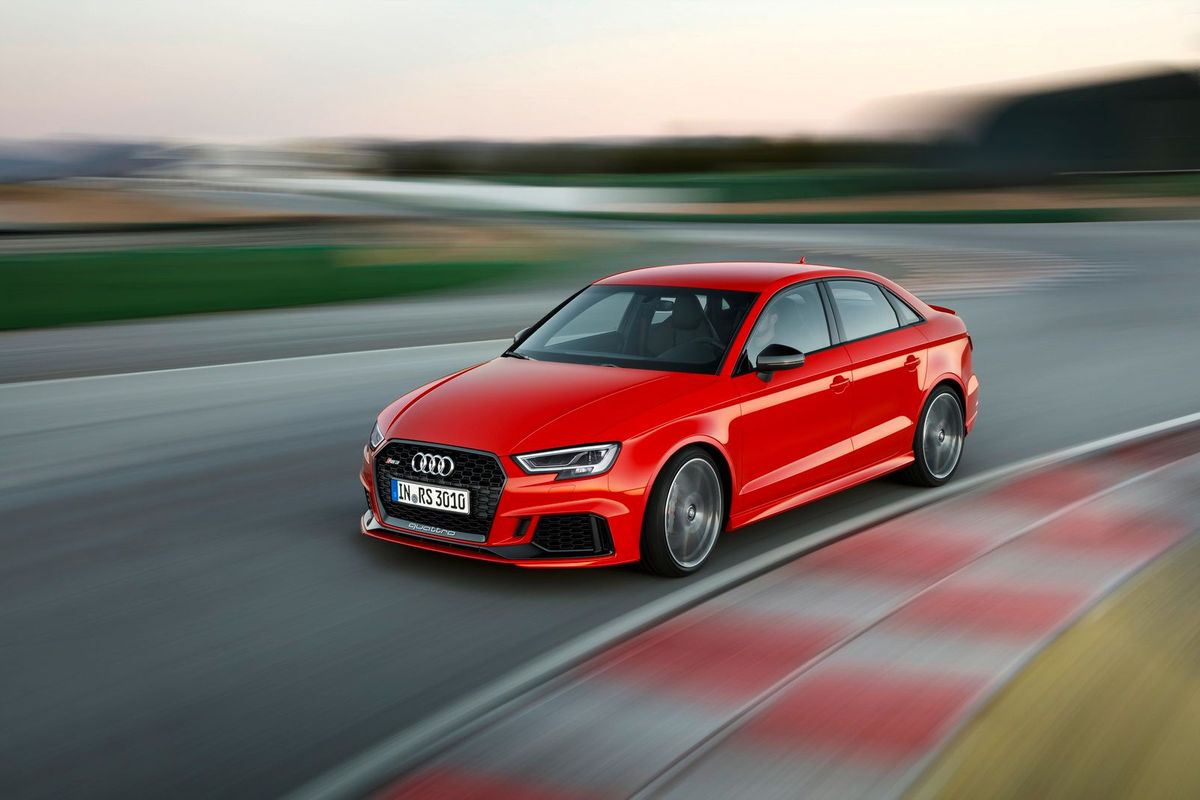
First to arrive is the Audi RS3 Sportback with its Sepang Blue paint scheme. Its turbocharged 5-cylinder mill is, somewhat surprisingly, the most vocal of the trio of motors. With its exhaust flaps engaged, it lets rip with cracks and pops on upshifts and when you lift off the throttle. This partly explains why the Audi gets driven much harder than many of its peers. To just inch the Audi slightly forward requires a blip of the throttle and, when that happens, a furious micro-thunderstorm rages from within. The much-loved 2.5-litre motor is positioned in the RS3’s nose and power is distributed to all four wheels.
The Audi RS3 has a bellowing exhaust note and the best launch control system.
In its favour: stylish looks, raucous exhaust note, creamy power delivery and generous all-wheel grip in tricky conditions.
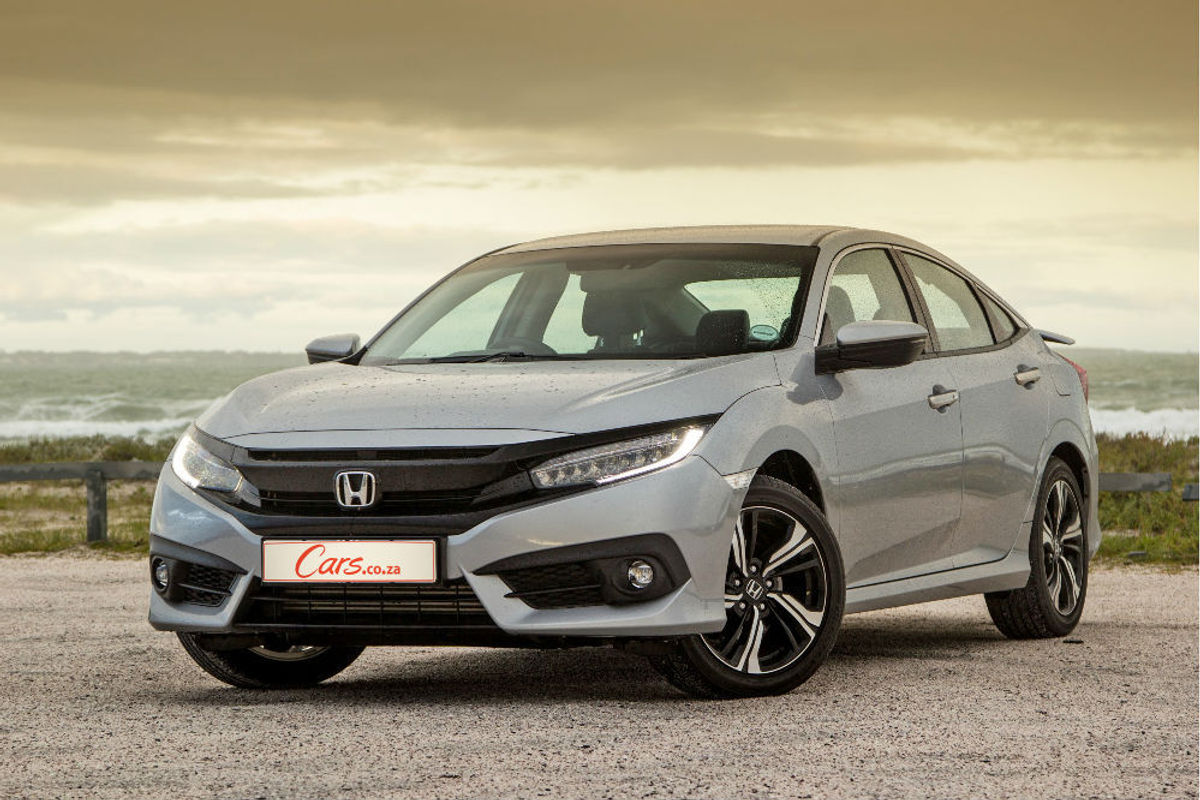
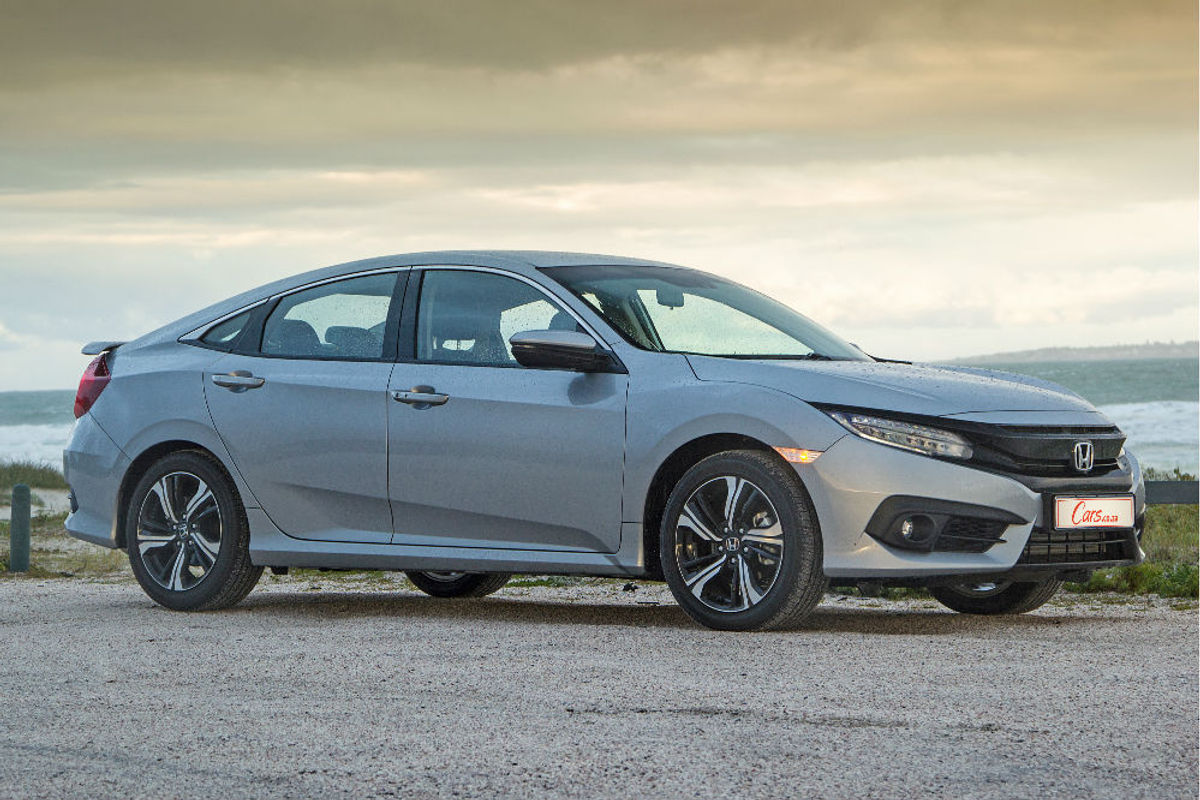
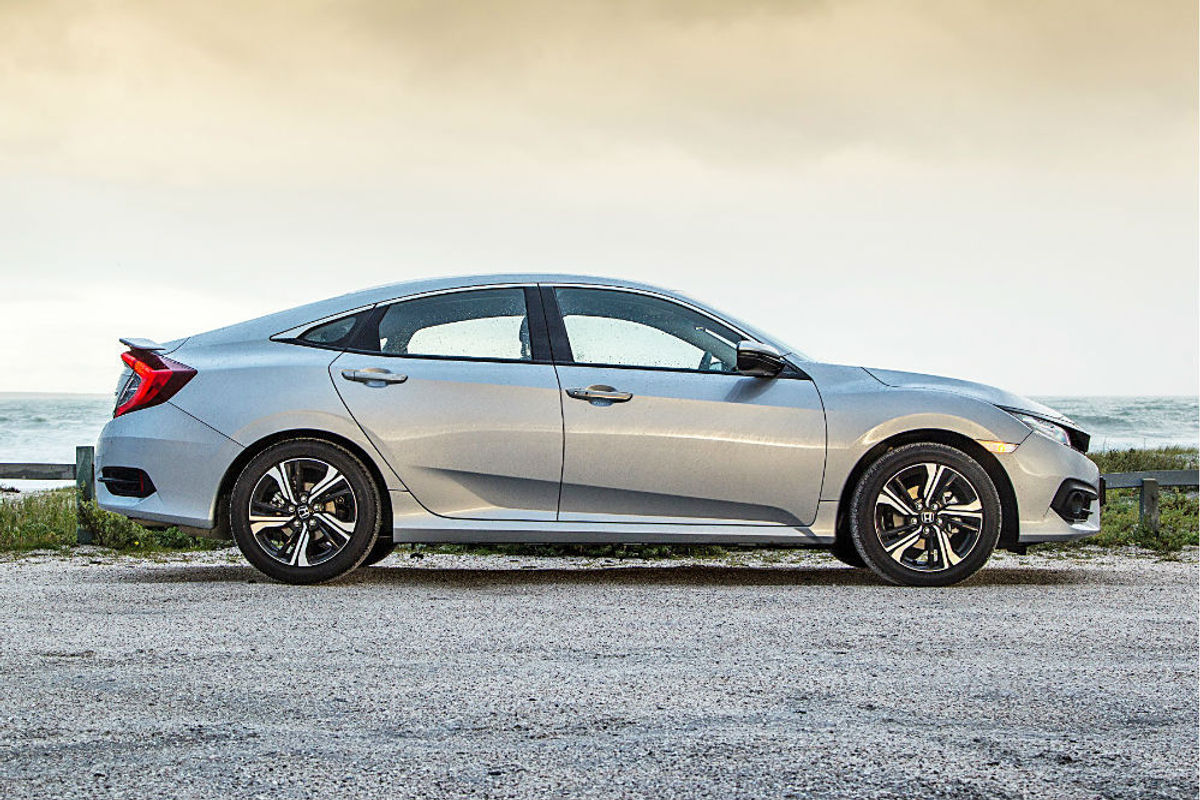
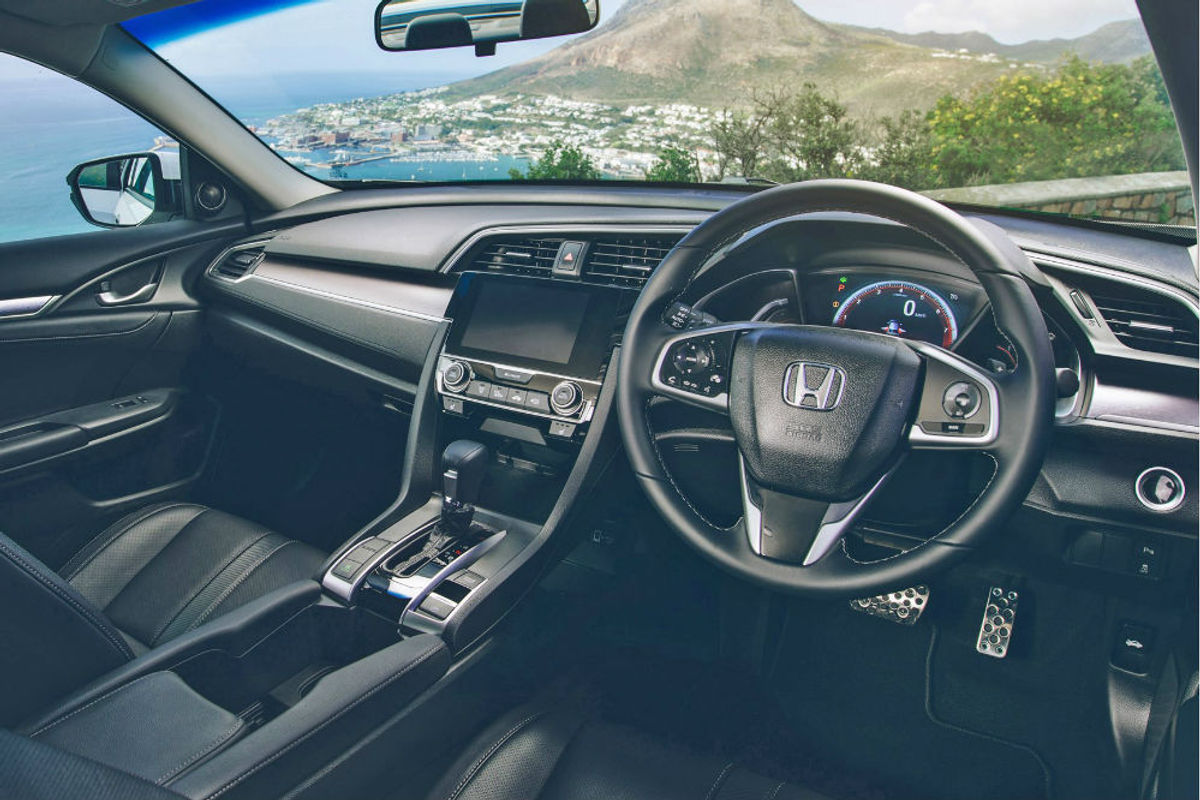
Next up is the Honda Civic Type R. Judging by the car’s exterior appearance, the Honda’s designer must have watched a 7-movie marathon of Fast and the Furious before incorporating every ostentatious detail he saw in the new Type R. Each little winglet or air dam has a purpose, either to aid airflow or to improve cooling. The car thrums at idle in a much more sedate manner than the RS3. Just look at it; a mad, blabbering exhaust note on top of that might have been too over the top.
It’s the least powerful of the three, but it’s here as an underdog; to keep the more powerful cars on their toes. The Type R will shine come track time. It does, however, seem that Honda arrived a little late with its turbocharged engine and stupefying front differential… With the power that front-wheel drive cars can effectively put down seemingly at its limit, manufacturers are moving to all-wheel drive propulsion as the battle for hot hatch supremacy reaches fever pitch.
The Civic Type R requires familiarisation, but proves itself every bit a track weapon.
In its favour: Crazy Japanese styling and trick technology
The Mercedes-AMG A45 rocks up last. It splashes through a puddle and slithers to a halt. As it ticks itself cool, we ponder why on earth it looks so understated. The Benz’s exhaust note even sounds tame compared with the RS3’s. Maybe white isn’t its best colour? Then it dawns on us that the Benz doesn’t have the AMG Aero package. The latter adds a massive rear wing that gives the A45 its distinctive look. At the track, among these rivals, it needs to puff out its chest and boast a little more. It does admittedly have the most powerful production 2.0-litre engine in the world under its bonnet. Also, AMG has worked hard at reducing understeer and making the A45 a more effective track weapon.
The A45 is the most powerful and has a sophisticated AWD system.
In its favour: most powerful
Track time
The rain is staying away for now, but a 50 kph headwind is pumping down the main straight. The clouds are low and heavy, so we crack on with the hot laps. The RS3 is parked closest to the pit lane's exit… its almost as if it is eager to attack the track first. A plethora of noises and echoes ping off the facebrick walls surrounding Killarney. Even when ensconced in the car, wearing a full race face, it’s hard not to crack a smile at the lunacy of the ‘pipes on the Audi. The out lap is all about assessing conditions and checking for standing water, but there’s none — Killarney drains well.
When the RS3 lines up on the start line, it’s by far the easiest car to launch. The Audi has a no-fuss system that is happy to fire off repeated launch starts without a single moan from the car’s computer nannies. Set the traction control to Sport and the transmission to manual (with a flick of the brushed aluminium paddle shifter) and then feed in the throttle with the left foot on the brake. The revs climb to around 4 000 rpm. Slip your hoof off the brake pedal and the RS3 positively bullets off the line. Even if you only have an ounce of mechanical sympathy, the sheer force of the RS3’s launch control system will make you cringe. It is absolutely brutal.
There’s almost zero wheel slippage as all 4 tyres munch into the asphalt. In an instant, the RS3's transmission seamlessly snatches second and, 4.3 sec later, 100 kph is reeled off; and all that in a hatchback: it's madness. The Audi's steering is heavily weighted to compensate for the insulated nature of the electronic power steering system, but at the cost of feel and feedback. The front end feels a tad numb on turn in, but the RS3 changes direction nimbly and adroitly. It’s easy to “wring the neck” of the Audi, but we wish it was a bit more involving to pilot. It’s very safe and predictable in the bends, but loses time mid-corner compared with the others, because you have to wait a bit longer before you can jam the throttle back down.
Pit lane was wet over the course of the day but the track remained dry (thankfully).
It’s finally possible to say that the RS3’s brakes are very good. Enthusiasts have, in the past, complained that fast Audis’ brakes cook quickly and are prone to fading. The final corner in Killarney requires deceleration from 208 kph to just 68 kph in around 4.0 sec. The Audi stops confidently and is the most stable over the bumps when it needs to scrub off speed. If you want a car that thrills the aural senses, looks impressive, can win most light-to-light sprints and isn’t going to show you up on the track then the Audi hits the mark.
Next to take to the track is the Mercedes-AMG A45. Just from sitting in the car you can tell it’s an edgier proposition than the Audi. The Alcantara-clad steering wheel feels racier and the driver’s seat holds you tighter around the thighs. The moment you pull away, the A45 seems comparatively tighter and more rigid. Rigidity is good for the race track, but not so good for the road. Thankfully we’re on the former and the A45 is dialled into Sport+. In this setting, the traction and stability control systems are less intrusive.
The Benz’s launch control procedure is more finicky than the RS3’s and the A45 is prone to cancelling Race Starts for no apparent reason. Eventually, the Benz allows us a successful launch, but it spins up the front wheels for much longer than the Audi before it squirts off at full pace. Benz claims the A45 is a tenth quicker from zero to 100 kph, but on this low-grip surface we’d say the Audi gets off the line more effectively when you launch it from a standing start.
The stiffer chassis of the A45 instantly feels more alive into turn one. The Benz’s rear end is more dextrous, which helps the front end turn in sharply, plus the car’s quicker to rotate in slower corners. That means you can get back on the power earlier and less time is spent waiting for the car to change direction. The steering is also heavy (if less numb than the Audi’s), but, as with all electric steering systems, it lacks direct feedback from the wheels to your hands.
Type R displays its mad personality, making the other hot hatches look a touch plain.
Where the A45 AMG really starts to impress is when you lay down the power on corner exits. The advanced all-wheel-drive system shifts power around to extract optimal traction and you can physically feel that underneath you. The outside wheels begin to shift the car inwards, quelling understeer without killing power. It works brilliantly and the difference is immediately noticeable on the timesheets. The A45’s engine also has supreme mid-range grunt – it seems to have better acceleration when accelerating from 60 kph. The top speed comparison confirms this: the A45 reached 212 kph, 4 kph more than the RS3.
Next to warm up its tyres is the underdog: the Civic Type R. The Honda is going to struggle on a track like Killarney, where mid-range power is deemed more important than slick handling prowess. The Type R takes some getting used to, because the front-wheel-driven car feels vastly different to the other two (all-wheel-driven) machines on the track. It’s also has a manual 'box and that requires further familiarisation.
It’s a light, agile car, but its tyres take a while to warm up before optimal grip levels are available. The red R button to the right of the steering begs to be thumbed. This is a track, so the button’s pressed down and the dashboard lights up in an incandescent red. The Type R is the most track-focused car here, it was designed entirely to smash lap times over and over again. Once warmed up, the Type R livens up. The front end is very light even though all the power is heading only to the front wheels. The lightness translates into agility and nimbleness… it makes the other cars seem like lumbering oafs.
The manual shifter sends the Honda's engagement factor into hyperspace. Your focus increases and your heel-and-toe technique needs to be spot on or you’ll disrupt the Honda’s balance. It too has an amazing differential, but it interferes with the steering more than in the A45. It tugs the steering inwards much earlier and the best method is just to hold a light grip on the wheel and let the electronics take over.
The Honda darts into apexes with its sharp steering and the chassis is so taught that it sustains incredible corner speeds where the other cars started to squeal for grip. So much so, that through the medium speed corners it actually claws back time on all the other cars. The top speed on the back straight is only 204 kph and its lack of launch control lost it over a second on the lap.
The Type R is eminently engaging to drive and its lap times kept improving the more time it spent on the track. It’s a car in which you can really spend a lot of time honing your driving skills and pursue quicker lap times. The Honda can get a little loose under braking as it adopts a lift-off oversteer technique to get its front end to turn in faster. It’s the most fun to drive and the most driver-focused car (so far), it just lacks the outright grunt to match the others.
And then along came an M2
The BMW M2 dropped in to spoil the front- and all-wheel drive party.
Better late than never. The BMW M2 arrives in the pitlane, straight from its local media launch in Cape Town and sporting a brand new set of brake pads and Michelin Pilot Sport tyres. It’s different to all the other M cars in that it’s not a standalone creation, but effectively a superheated M235i replete with selected performance addenda from the M3/4. It’s much better for it, however, and the shorter body gives it a muscular, angry stance. It looks the part.
For the first time in a while, it’s also an M car that sounds the part. It has a rough exhaust note at low rpm and a real guttural tone that’s not electronically enhanced like those M5/6 and M3/4. When experienced from outside, the M2 is hitting all the right notes, then.
Climb aboard and it’s just like in an M235i, save for a carbon fibre transmission tunnel and some weave on the dashboard and door handles. BMW can up its game a little with the interiors of its M models, there’s more they can do to give their cockpits greater senses of occasion.
This is the DCT model, so BMW’s lightning fast dual-clutch gearshifts are engaged by pounding the shift paddles on either side of the steering wheel. The responses from the transmission are prompt and accurate every time you call for a gear – it’s an excellent gearbox for track conditions. The launch control system is infuriating (much like the A45’s, in that regard); perhaps 1 out of 3 launches happen successfully. In order to get the best launch, the tyres need to be warm and sticky, otherwise the M2 will just spin its rear wheels and complain about an overheated clutch or gearbox. Drive it slowly for a few minutes and everything comes back to life; the warning lights disappear.
The BMW M2 proves to be both enjoyable on track as well as an aural pleasure.
Get the launch right and the M2 lights up its back tyres for just a split second and jiggles its posterior as it hunts for traction. The new rubber gives it that added grip and it bolts down to turn one. Everything discovered from driving the other three cars gets tossed out the window as the M2’s back starts to dictate proceedings. It’s not snappy at the tail, but a consistent, manageable slide wakes up the senses and sends the adrenaline rushing to all extremities.
The M2 goes in sideways, kisses the apex with the front and then goes out sideways with the power on. It’s not alarming, hooligan-like sideways action, just a little bit of rear happiness to let you know there’s a limit to the grip levels. The power delivery from the turbo straight 6 is smoother than those of the four- and five pots here. It’s also happy to rev like no other turbocharged car around, tapering off only right atop of its 7 000 rpm limit. The smooth delivery also helps the handling feel more manageable on the track, in other words, less oversteery when you lay down the throttle.
It wins in the faster corners where it has more grip and its front wheels are uncorrupted by power. In the tighter corners, it’s a different story, however… the power has to be fed in more progressively where the all-wheel drive cars’ throttles can just be hammered down on exit. It loses time there, but after the laps with the M2, the driver will feel like they have had a mild workout. To drive, the M2’s fun, enthralling and, most of all, fast. Like the Civic, the more time you spend with it, the more you learn about its handling nuances and the more the lap times improve.
Picking a winner
Once all the cars had completed dry laps it was time to look to the lap times to pick a winner.
This is a track test and, after 2 days of hard driving at Killarney, a winner must be chosen. For a driver who wants to explore their performance machine on a track, which of these cars would we rate as the best, most satisfying vehicle to experience those much-craved adrenaline kicks?
The slowest car around the track was the Honda Civic Type R. It lost out mostly due to its lack of outright power and the manual standing start, where it argaubly lost most of its time. The Civic is easily a match for the others in outright circuit pace once it’s up to speed, its suspension and trick differential are unbelievably effective, but the Honda feels as if it’s doing all the work for you at times. Having a manual gearbox does make it entertaining – and utterly involving – to hustle and if you’re obsessed with lap times there’s always a little more you can squeeze out of the Civic.
Third place on the time sheets went to the Audi RS3, even though it gave us the most aural pleasure. It’s also an absolute rocket out of the blocks, posting the fastest sprint time of the lot. It’s very easy to drive fast and has dependable brakes that last longer than a few hot laps.
Second place on the timesheets (by a mere 0.01 sec) was the Mercedes-AMG A45. It surprised us with its mid-range grunt and its ability to stave off understeer on corner exit. It gained so much time on the others on corner exits where its power and torque advantage was put to full use by its excellent all-wheel-drive system. The system can lead you into a false sense of security, one in which you start to push the car beyond the levels of adhesion. There’s a strange lack of sensation of speed in the A45 — you only really realise where its limits are when you’ve gone well past them.
That leaves the BMW M2 as the fastest car, but by no more than a whisker. The M2 is the most balanced contender going into bends and you can really feel its rear end teetering on the edge of adhesion as you feed in the power. It’s a visceral sensation to feel the rear end at the very edge of its limit and still maintain that forward momentum that allows you to get the best lap times. Given more laps there’s no doubt that the M2 would go even faster as you get braver and more in tune with its handling. Fortunately for us, the first storm of the Cape winter lashed down on the track not moments after we got the last shot and last lap in the M2. It’s a deserving winner when you considering that conditions didn’t favour it. It might just be our favourite M car as well.
The iconic Beetle has just received an update for the 2017 model year. Let's check out the new model.
As usual, two variants are on offer: a Coupe and a Cabriolet with a host of customisation options, plus special Denim and Beetle Exclusive derivatives, which will please Beetle enthusiasts.
There's a new palette of exterior finishes available, while the exterior treatment receives an update through the introduction of sportier bumpers. Furthermore, you can tick the box for Volkswagen's R-Line equipment, which further enhances the look. LED rear lights and enlarged alloy wheels (17-inch as standard, 18-inch optional) round off the visual upgrades. The cabin receives some tweaks in the shape of brighter instrument panel lights, new instrument dials and you can choose from three new upholstery materials. You can also pick a colour-coded paint finish for the centre console.
Meanwhile, there are three petrol engines and two diesel motors to choose from. Power outputs range from 77 kW to 162 kW.
The Denim version looks decidedly retro, but it's part of its appeal. Based on the 1974 Jeans Beetle and featuring a stonewashed blue metallic paint job, this derivative comes replete with denim details in the interior. The denim-coloured convertible roof and 17-inch wheels with chrome caps add nice cool touches. The seats are covered in blue with storage pockets in a jeans style. There's also an aluminium-blue matt-coloured dash pad.
Not so long ago, rumours were rife that Renault's performance arm, RenaultSport, was planning to introduce the ultimate Clio. It's finally confirmed and it's every bit as wild as predicted. Meet the Renault Clio RenaultSport RS16…
Rumours? We had leaked photos of this car last week! Let's get the bad news out the way first – it's a concept car, meaning it's most likely a one-off project to give some idea of where the company is headed. So, don't expect to see hoards of them on the roads anytime soon. The good news, however, is that the Renault Clio RS16 is the ultimate version of the Clio RS. Given the brand's illustrious success with the bigger Megane RS, many wondered if it was possible to transfer some of that goodness into the smaller Clio.
It sounds crazy, but in just under five months, RenaultSport managed to build this Clio RS16. It features the 205kW and 360Nm 2.0-litre turbocharged four-cylinder engine from the Megane RS275 Trophy-R as well as a whole host of go-faster racing goodies. There's an enhanced chassis, revised suspension, 19-inch alloys and a body that's 60mm wider. It looks manic and with that sort of power lurking under the bonnet, it will be fast too.
Renault Clio RS16 Origins
Where did this mad thing come from? MD of RenaultSport, Patrice Ratti, wanted to celebrate the 40th anniversary of RenaultSport in a big way and during meetings with his team, engineer Christophe Chapelain pointed out that a Clio chassis would be able to handle the performance levels of a 300bhp (205 kW) engine, based on his rally expertise. "We all recalled the impact made by Clio V6. We wanted to create a technical concept car with extraordinary performance levels but which was more realistically priced. We therefore had to keep our feet on the ground and use simple, ingenious solutions to achieve a vehicle that could be type-approved. Furthermore, we wanted this project to be entirely developed by RenaultSport," said Patrice Ratti.
"In theory, a Clio R.S. fitted with our most powerful engine – the 275bhp, 2.0-litre turbo engine – was an attractive proposition, but we had to conduct more serious checks as regards its feasibility. In less than a month, a small team had completed a preliminary study that confirmed it was possible to house this engine under the bonnet."
What's Under the Hood?
As mentioned earlier, the engine, gearbox, and cooling from a Renault Megane RS275 Trophy had been selected and dropped into the Clio's engine bay. However the 2.0-litre unit is bigger than the current 1.6 and that meant a few changes were needed to make it all work. Parts from a Megane, Kangoo and Espace were used to make everything fit. The exhaust also received a makeover and an Akrapovi? twin-exhaust silencer was fitted. RenaultSport's skill and focus is on handling and the new Clio RS16 features the same damper system as the Megane RS275 Trophy-R as well as one-way adjustable shock absorbers. The brakes are also from the Megane with 350mm discs up front while the rear axle was taken straight from the Clio R3T rally car.
Just Look At It
With a wider bodykit, big wheels, outrageous rear wing, yellow paint and graphics, the Renault Clio RS16 certainly looks the part. A big diffuser at the rear is not just for show as it provides 40kg of downforce at 200kph. The daytime running lights have been cleverly designed in the RenaultSport vision logo shape and the cabin has also received some treatment in the form of bucket seats and six-point racing harnesses. The rear seat bench and air conditioning unit have been taken out to reduce the weight of the car.
The Renault Clio RS16 will be shown off to the crowds at the Monaco Grand Prix in May 2016 and will make an appearance at the Goodwood Festival of Speed.
The petrol price is set to increase sharply in June 2016, with a further increase planned not long after that. Here's how much petrol will now cost, according to the Automobile Association (AA) of South Africa.
A report supplied by the Central Energy Fund has indicated that global petroleum prices have continued to recover and rise, and coupled with a poor Rand/US dollar exchange rate, the consumer is likely to bear the brunt of this fluctuation. Petrol will be increasing by 52 cents per litre while diesel will go up by 78 cents. The prices will apply from June 1.
If forecasts are to be believed, there is potentially an over-supply in the coming months which will help combat further increases. However the immediate market supply is under pressure as Nigeria, Columbia and the United States all reduced outputs in the past month. We only have ourselves to blame as the weak South African economy and its weakening currency will not be of any assistance should there be any decreases in the global oil price.
Following on immediately from the launch of the 2017 Nissan GT-R, Nismo has got its hands on the GT-R and cranked it up even further.
The 2017 Nissan GT-R benefits from a raft of updates over its predecessor (which can read about here) and in order to continue the hype, the track-focused Nismo edition is now ready to blast some lap records. The 2017 Nismo edition has the new visual keys from the standard GT-R, like the restyled front bumper. Nismo cranks things up a notch with enlarged grilles, a reinforced bonnet that doesn’t warp at high speed and canards underneath the Daytime LEDs that improve downforce and airflow. The overall shape and plethora of carbon fibre winglets and splitters mean this car generates more downforce than any other Nissan production car.
The interior also features more upmarket materials. Alcantara leather has been splashed around on bits like the armrest and steering wheel. The number of switches inside the cabin has been reduced from 27 to 11 in order to simplify its use. Unique to the GT-R NISMO are the leather-appointed Recaro carbon bucket seats with red Alcantara inserts.
The 2017 car’s more rigid structure has allowed the Nismo engineers to further tweak the Nismo’s shock absorbers, springs and stabilizers all of which, are said to improve handling prowess. The official result from Nismo is 2% improved cornering ability compared to the previous Nismo.
The 3.8-litre twin-turbo engine is beefed up from the standard 419 kW to a hefty 441 kW along with 652 Nm of torque. The engine features a pair of large diameter turbochargers that are similarly used on the GT3 race car. Power is directed to the tarmac via a 6-speed dual-clutch gearbox.
The Nismo will be offered in 5 colours and is exclusively hand-assembled in Japan. Nismo also notes that because the 2017 GT-R is a more balanced car than before, this Nismo version is more capable of tackling a real road or mountain pass, not just track times.
GWM in South Africa – Big Corporate Changes and Haval Arrival
Great Wall Motor Company Limited of China has announced that it will directly enter the South African motor vehicle market by granting distribution rights to Haval Motors South Africa (Pty) Ltd, a wholly owned subsidiary of Great Wall Motor Company Ltd, China.
The announcement follows months of rumour and speculation and coincides with official confirmation that the Haval premium SUV sub-brand will arrive in South Africa shortly.
"This strategic decision is confirmation of the importance attached to the long-term future of the GWM brand in the region and is a very positive factor in ensuring the sustainability of the GWM brand," reads the press release.
The previous distributor, Great Wall Motors SA (Pty) Ltd. started distribution of GWM vehicles in 2007 under the leadership of Durban businessman Tony Pinfold and has successfully established a strong national dealer network of over 60 dealerships and sold over 50 000 vehicles, mostly its Steed pick-ups and Hover/H5 SUV, into the South African market over that period. The relatively large vehicle park makes GWM easily the most successful of the Chinese brands in South Africa.
The Haval H8 is a BMW X5-sized rival powered by relatively smalll-capacity 2.0-litre engines.
“The South African market plays an important part in our International Expansion Strategy and going forward we will continue to distribute vehicles, offer parts and service support as well as administer warranties through the already established dealer network,” says Charles Zhao, Managing Director of Haval Motors SA.
It is worth pointing out that, in recent times, all of the Chinese brands have been under pressure in South Africa, largely due to uncompetitive pricing (related to the decline of our currency) as well as ageing product. The announcement of this direct investment can only be good news for existing and future customers of this brand, but it remains to be seen whether solutions can be found to pricing difficulties. After all, establishing a new premium brand is difficult, as proven by the likes of Lexus and Infiniti… It will take time and lots of marketing for Haval products to become commonplace in South Africa. More importantly, improving the pricing competitiveness of existing GWM products will be key to dealership viability.
New Haval products
The Haval H2 is a compact crossover rival for, among others, the Nissan Qashqai.
From a product point of view the more exciting news is the confirmation that the Haval line-up of premium SUVs will arrive in South Africa "in the near future". We believe models such as the H2, H6 Coupe, H8 and H9 have already been spotted in South Africa. According to Haval, this range of SUVs will be very well suited to the South African motoring public’s needs, and will offer a "fantastic alternative" to the established brands in the SUV segment. We will report in detail on model information as soon as those become available.
The Haval H9 is the flagship, body-on-frame SUV from the Chinese brand.