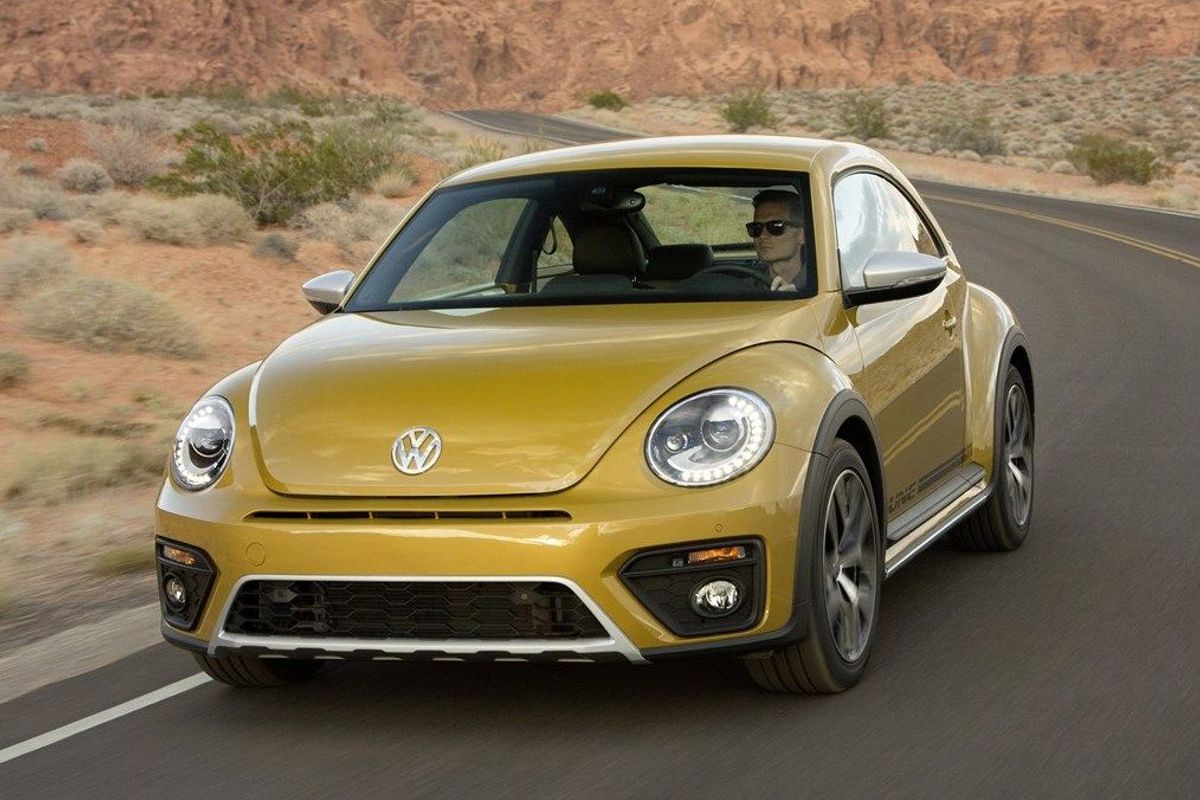
Volkswagen’s Beetle Dune concept was first shown at the 2000 Los Angeles Motor Show and now, 16 years later, it has made it to production and is available in South Africa.
If you’re old enough, you will remember the beach buggy – based on a standard original Beetle, but equipped with a raised ride height, chunky tyres to tackle off-road tracks and, hopefully, a rollover hoop… Volkswagen has evoked the memory of the memorable buggy with the introduction of the Beetle Dune, which features a raised body that’s wider than that of the standard Beetle, and comes fitted with 18-inch Canyon alloy wheels.
The Beetle Dune is only offered with a 1.4 TSI engine that produces 110 kW and 250 Nm of torque and is mated with a 7-speed DSG transmission.
The Beetle Dune is 7 mm wider at the front and 6 mm wider at the rear with an increased ride height (by 14 mm) compared with the standard Beetle. It’s equipped with new front and rear bumpers and diffusers while the round headlights are still a prominent feature. There’s a large central air intake up front with a black honeycomb screen set within a Reflex Silver frame. Meanwhile, foglights and indicators are set in matt black inserts.
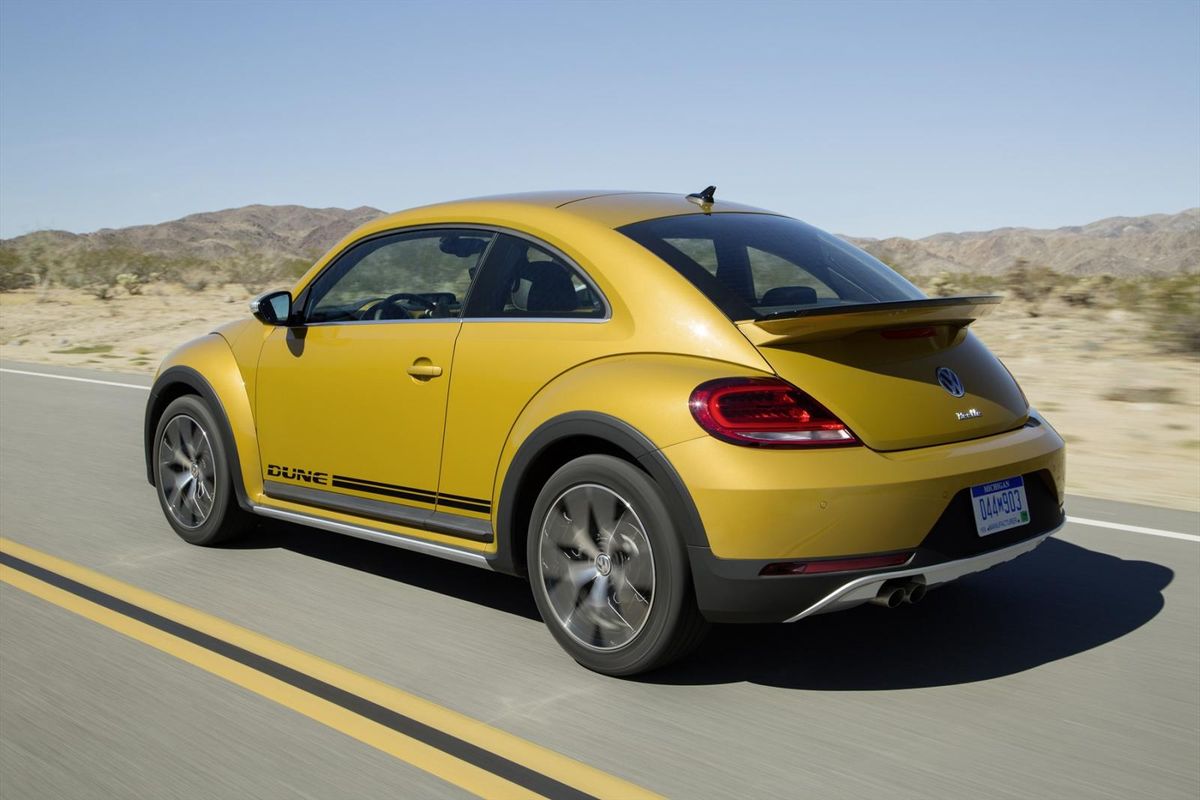
The newcomer's profile is characterised by rugged-looking black wheel arch cladding and side mouldings, while the window trims are finished in anodised aluminium and exterior mirrors are in Reflex Silver. Black double stripes are seen above the side panels with a ‘DUNE’ signature.
Towards the rear, you will notice a large rear spoiler and new LED taillights. The rear spoiler is painted in gloss black on the top section while the bottom is painted in body colour. The rear diffuser is also finished in Reflex Silver.
Buyers have the choice of three colours for the Beetle Dune, including Pure White, Reflex Silver or the new Sandstorm Yellow (as shown here). An optional black painted roof is also available.
Interior features
The Volkswagen Beetle Dune can be fitted with a rather epic Fender sound system as an option.
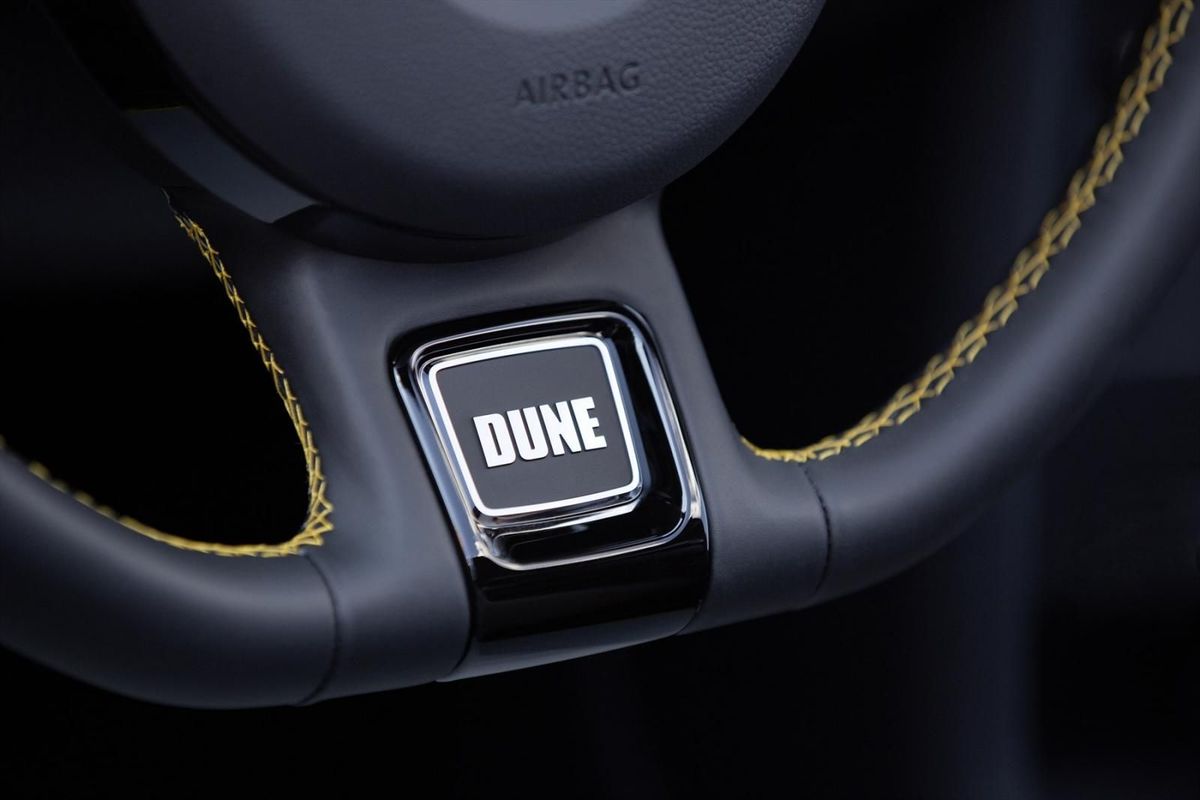
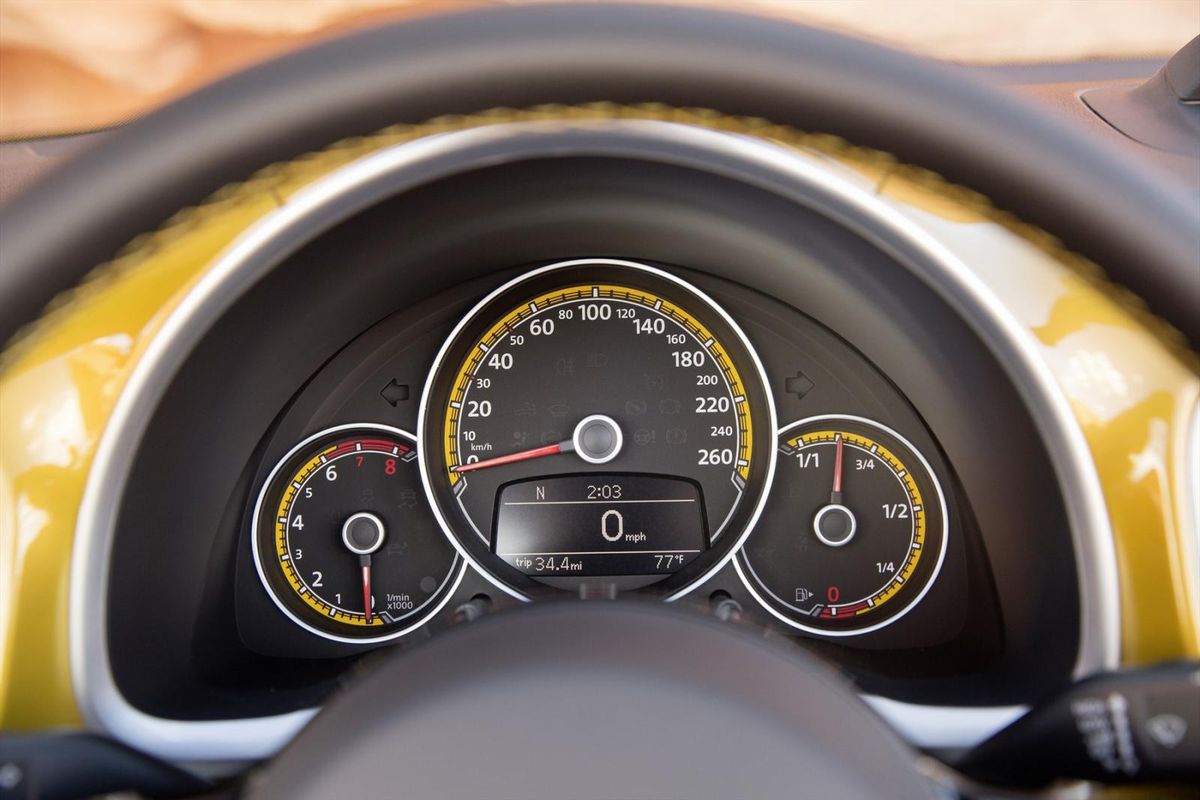
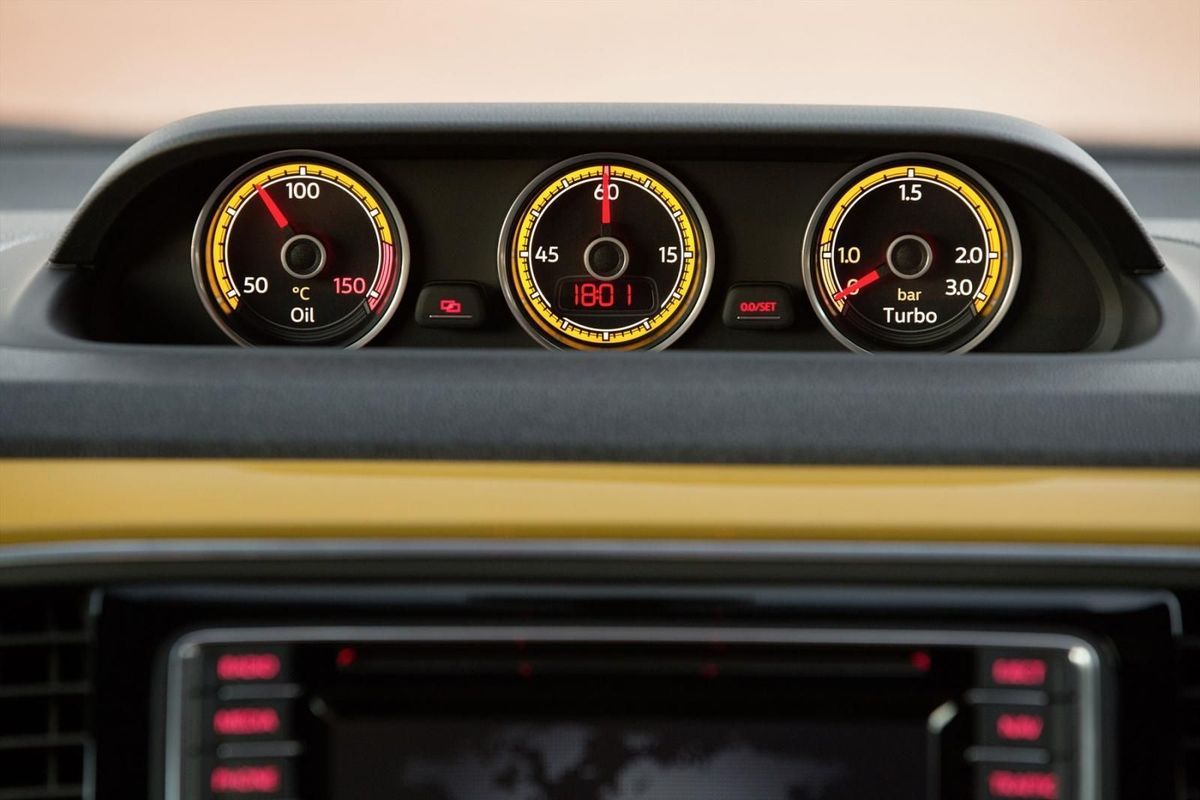
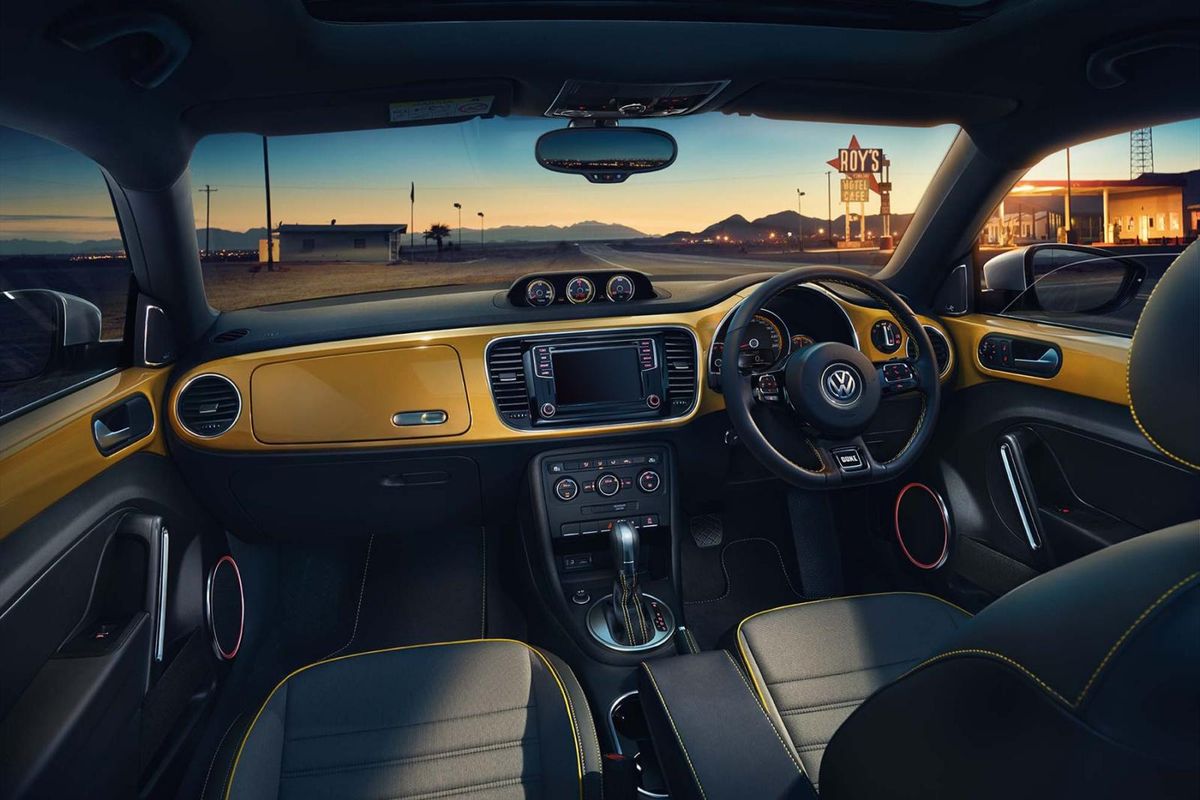
Three design elements define the interior of the Beetle Dune. The dashboard is painted in Sandstorm Yellow Metallic as standard along with the window ledges, which can be changed to black if you so choose. Secondly, the dial surrounds and main instruments are also finished in Sandstorm Yellow and lastly, contrasting stitching in Yellow Curry is found on the rear seats and front sport seats as well as on centre armrest, handbrake lever, gear lever and floor mats. The front seats also feature "DUNE" logos.
Equipment-wise, the Dune is fitted with Volkswagen’s Composition Colour infotainment system that incorporates a Radio/CD player (with 8 speakers) and a 5-inch touchscreen. The system is MP3, Bluetooth compatible and an SD card slot, USB and auxiliary ports are also included. The 6.5-inch Composition Media and Discover Media system with navigation is offered as an option and can be had in conjunction with a Fender sound system.
The Fender system includes three adjustable ambient lighting colours (white, red, blue), lighting around the door speakers, four tweeters, front and rear woofers as well as a bass box subwoofer located in the boot. The system is powered by a 10-channel amplifier with a power output of 400W.
Other interior upgrades include automatic headlight activation, manual lumbar support (front), illuminated make-up mirrors, cruise control, automatic dimming rear-view mirror, rain sensing windshield wipers, front and rear park distance control and Hill Hold Assist. Optional features include sport seats with Vienna leather in Titanium Black and Bi-Xenon headlights with separate LED daytime running lights.
Volkswagen Beetle price in South Africa
1.2 TSI 77kW Design Manual R312 400
1.4 TSI 110kW Sport Manual R383 600
1.4 TSI 110kW Sport DSG R399 600
1.4 TSI 110kW Dune DSG R416 700
The new Beetle comes standard with a 5-year/60 000 km Automotion Maintenance Plan, 3-year/120 000km warranty and a 12-year anti-corrosion warranty. Service Intervals are at 15 000km.
With our hot hatch (plus a BMW M2) track race video doing so well, many of us are hankering for a reasonably affordable practical performance hatchback. Therefore, we decided to look around the Cars.co.za classifieds to find some hot hatch bargains that can still get the blood pumping.
The formula for producing the best-possible hot hatch has remained the same for decades: take a practical hatchback and add more power, torque and handling ability. Steadily however, their engine outputs have increased so much that 5-door performance cars now deliver outputs that rival those of pukka sportscars of a few years ago. Along with ludicrous power, the price tags have shot through the proverbial roof… An Audi RS3 costs more than R800 000 and even a front-wheel-drive, warm hatch like the Fiesta ST still strikes fear into your bank account (R313 900).
We decided to delve into the used car inventory and find pocket rockets from the 2000s. Guess what? There are some serious bargains to be found.
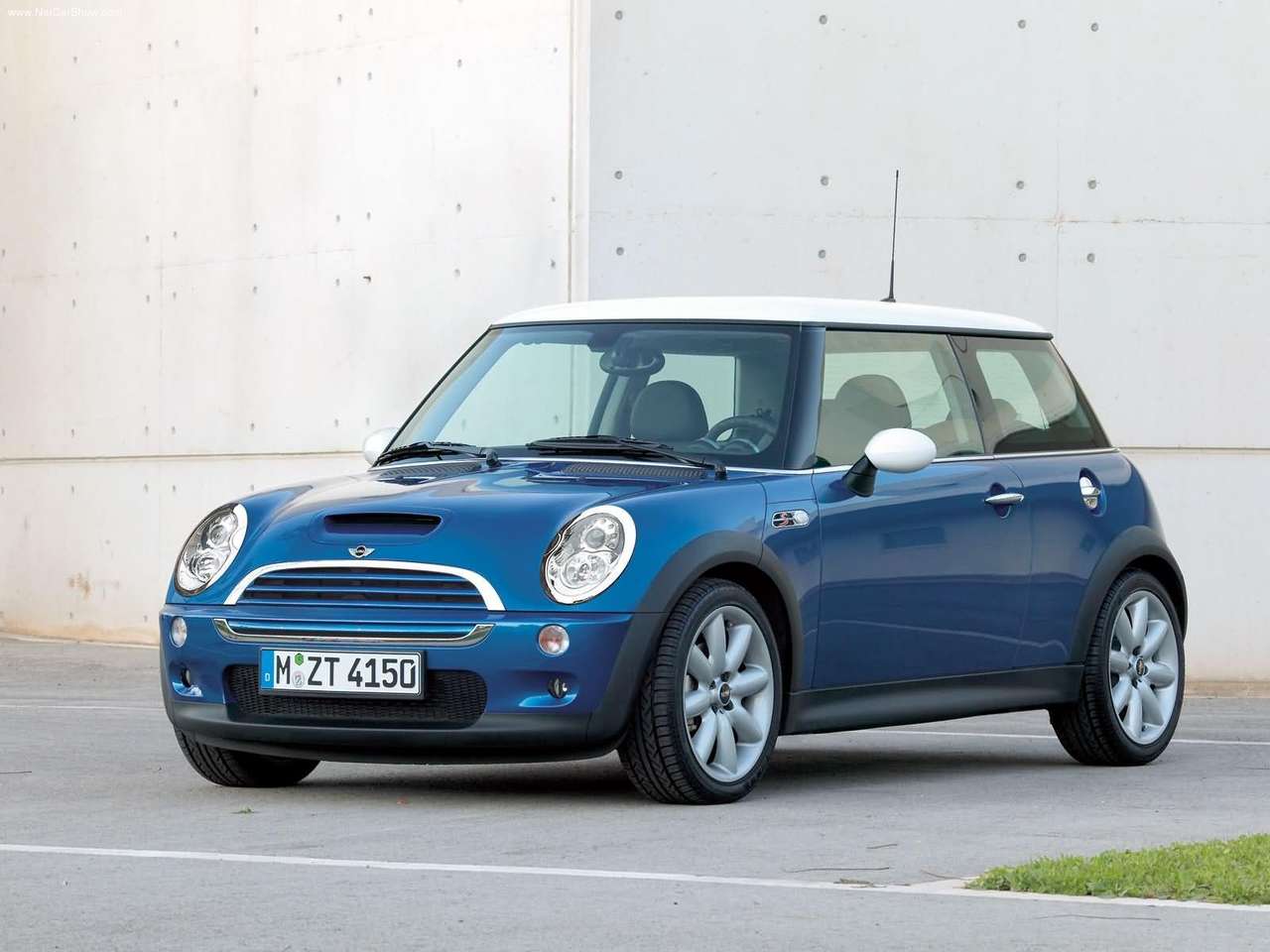
1. Mini Cooper S (2000–2006)
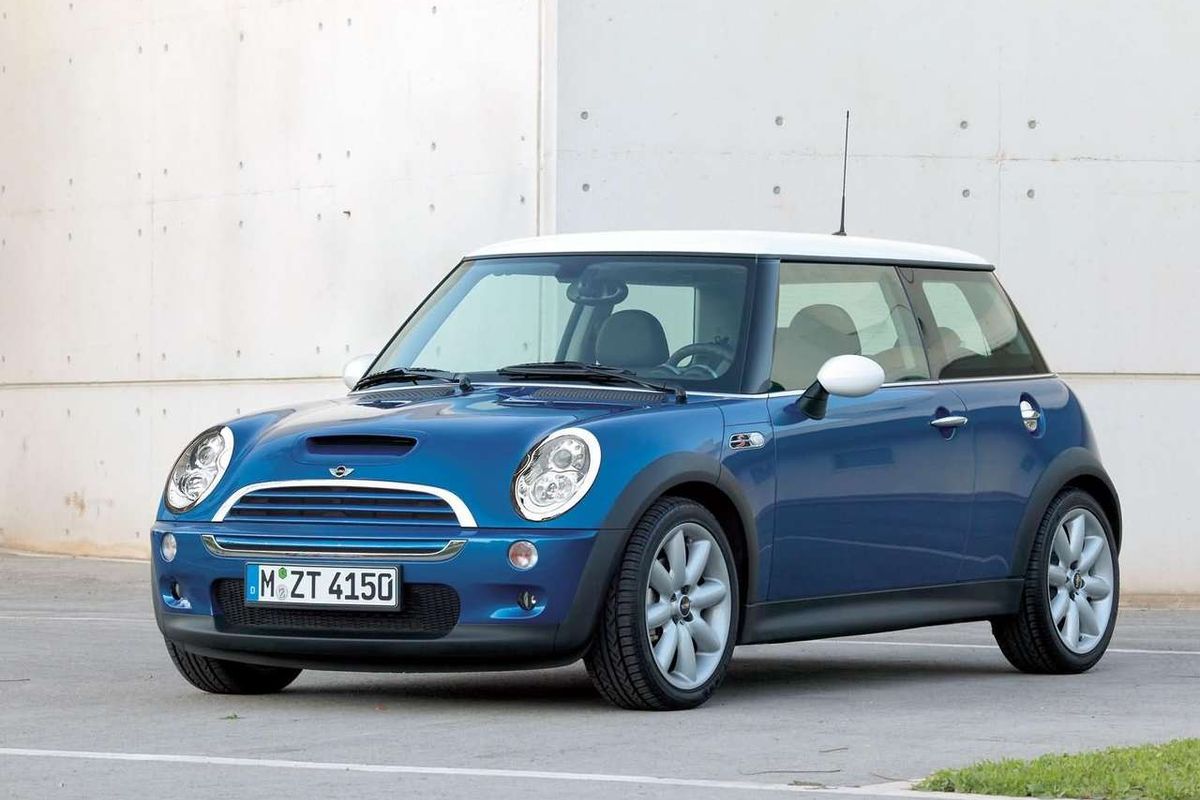
Those 8-spoke rims (often finished in bright white) and bonnet scoop were tell-tale Cooper S cues.
The Cooper S, almost single-handedly, made the new (BMW-era) Mini cool. It came with a supercharged 1.6-litre engine that whined and hissed, making the Cooper S a laugh a minute to squirt from point to point. There’s a healthy 120 or 125 kW on tap (so power is ample) and the Mini will sprint from 0-100 kph in 7.2 seconds (7.4 for the pre-facelift) – which is still good, even by today’s standards. The steering wheel style and shape is not to everyone’s taste and neither is the central speedo and RPM dial (options were available to change both of these to more likeable variants). It is quirky, though. Expect to pay between R75 000 and R120 000.
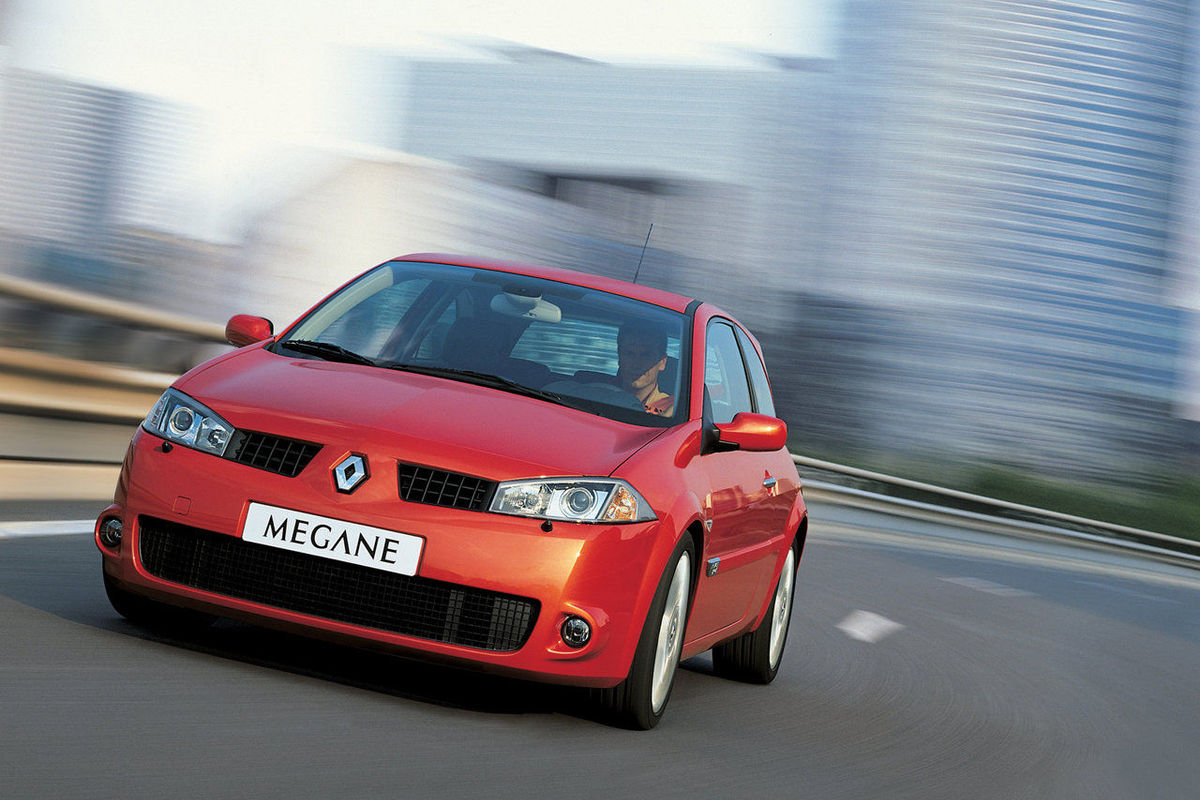
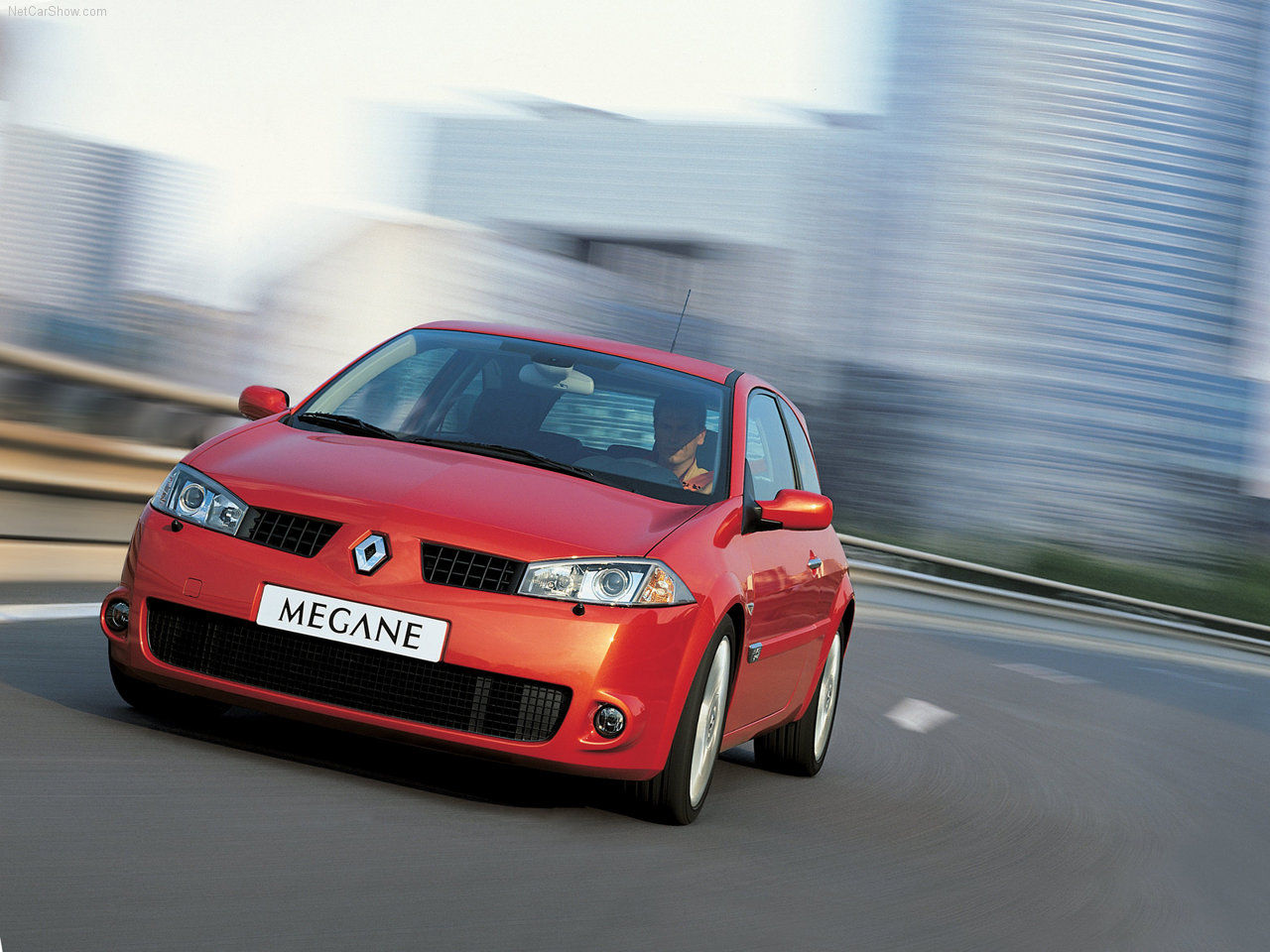
Not everyone was a fan of this generation Megane's "bustle" rear end, but the front styling was quite crisp.
The Megane Sport is generally regarded as the best handling hot hatch of its generation – a theme that Renault has proudly continued in later RS iterations. For around R100 000 you can get 165 kW and a rather excellent chassis. It’s a bargain if you can find one that’s still in good condition, which shouldn’t be too hard considering the car is 8 years old. This generation Megane was also particularly safe, with traction control and crash prevention electronic systems to go with a load of cabin airbags. The Megane II has also seemingly aged rather well. Priced from R75 000 to R110 000.
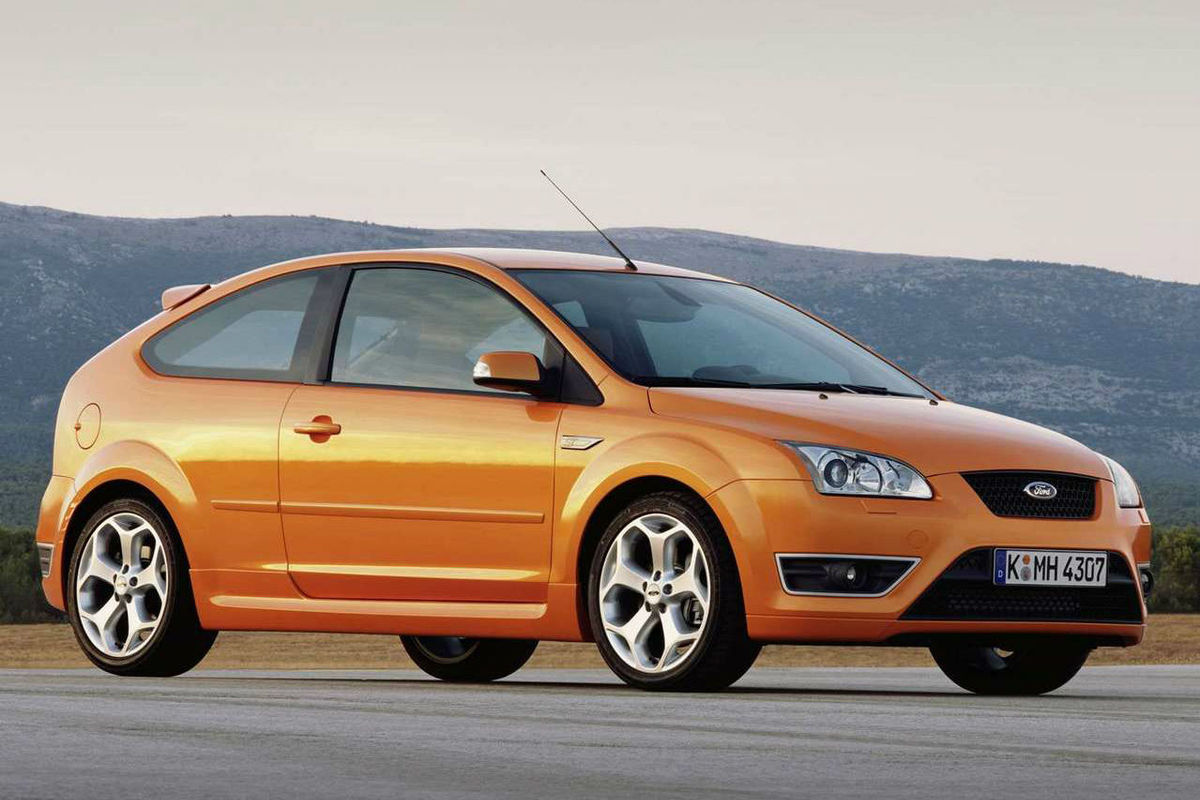
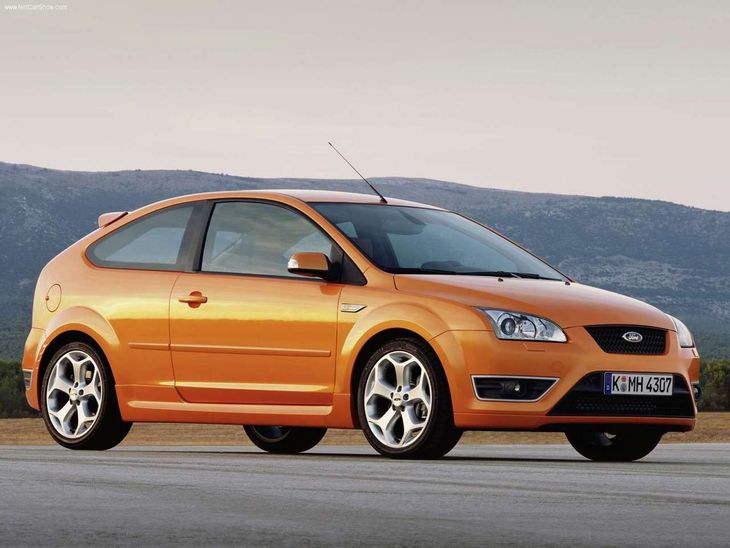
The second-generation Focus was headed by a turbocharged ST model. Somehow, Ford crammed a 2.5-litre 5-cylinder motor under the bonnet that growled when you trod on the throttle. There’s 168 kW under the bonnet, and an excellent chassis that was nimble through the bends, but quite pliant over bumpy and choppy roads. It can be rather thirsty, though. Hence, Ford changed to a smaller 2.0-litre in the latest ST. Expect to pay from R100 000 to R150 000.
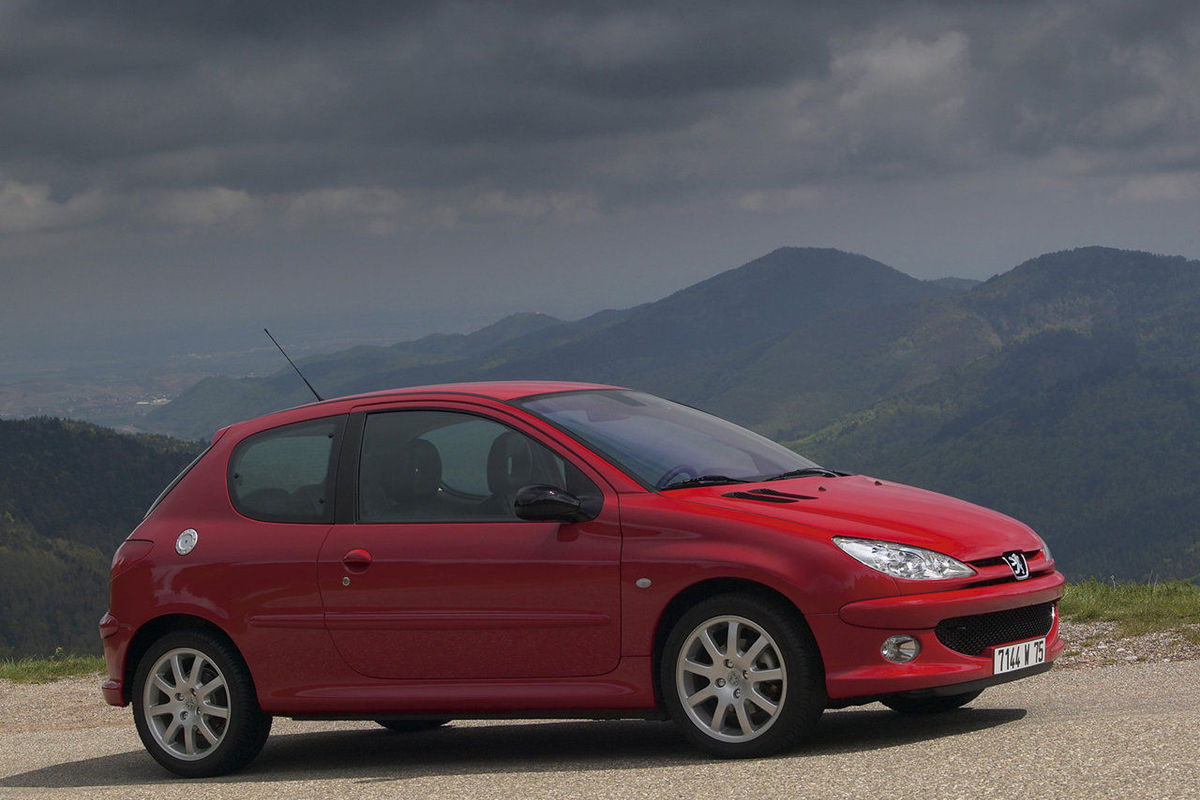
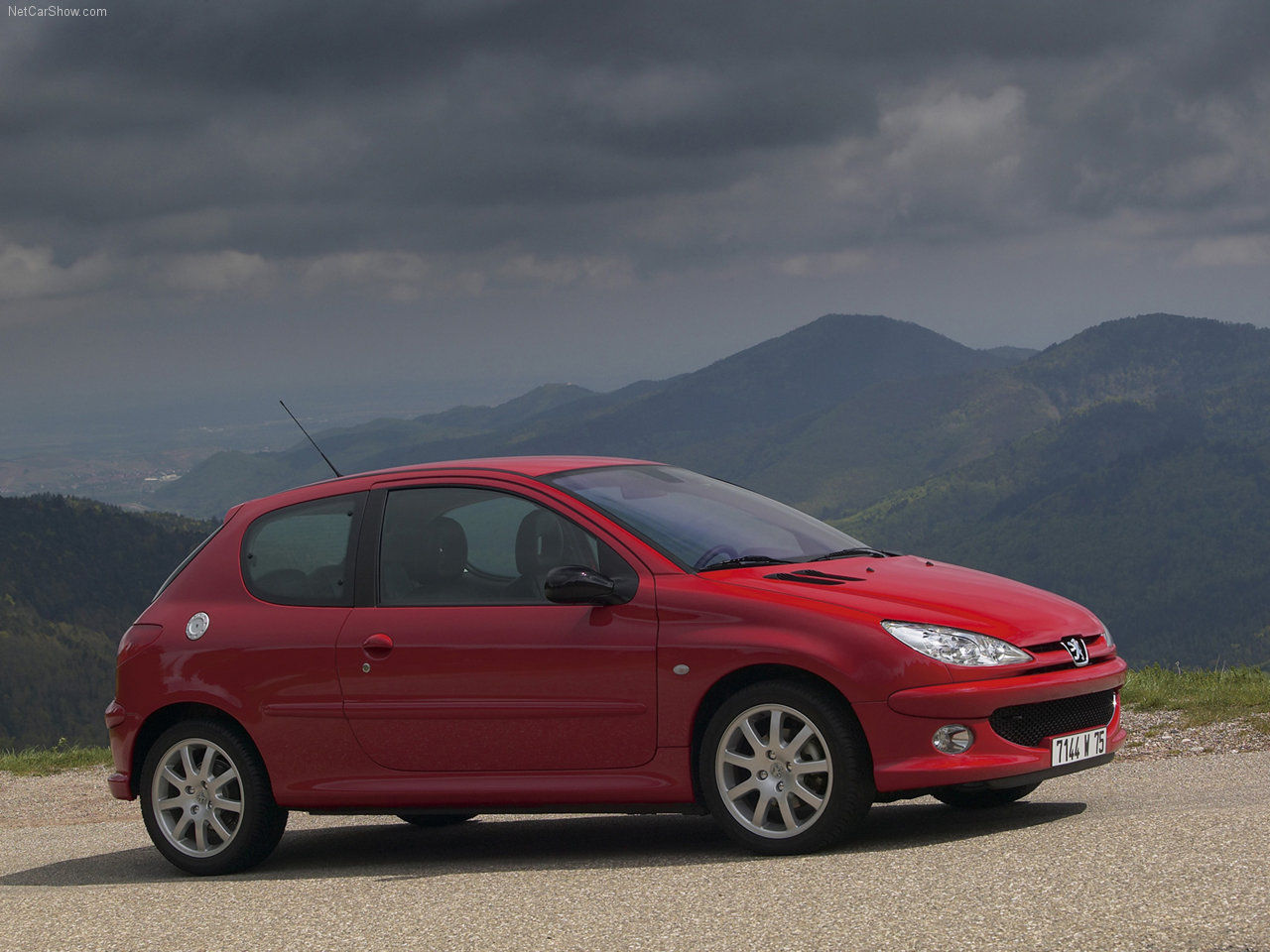
The 206 GTi dates from the period when Peugeots had cute, sharp frontal styling. It's aged very well.
The 206 GTi is a cool, small street racer. It had some good-looking body add-ons like the aluminium fuel cap. It initially came with a 2.0-litre naturally aspirated engine with 130 kW. A few years later Peugeot brought out the 206 GTi 180 which offered a slightly higher power output. Handling is agile and the engine is willing to be revved hard. Be careful of the gear lever linkage as it’s a weak part of the package, but it is quite a cheap and quick fix. What’s more, you can pick up a low-mileage model for under R100 000. Priced from R50 000 to R100 000.
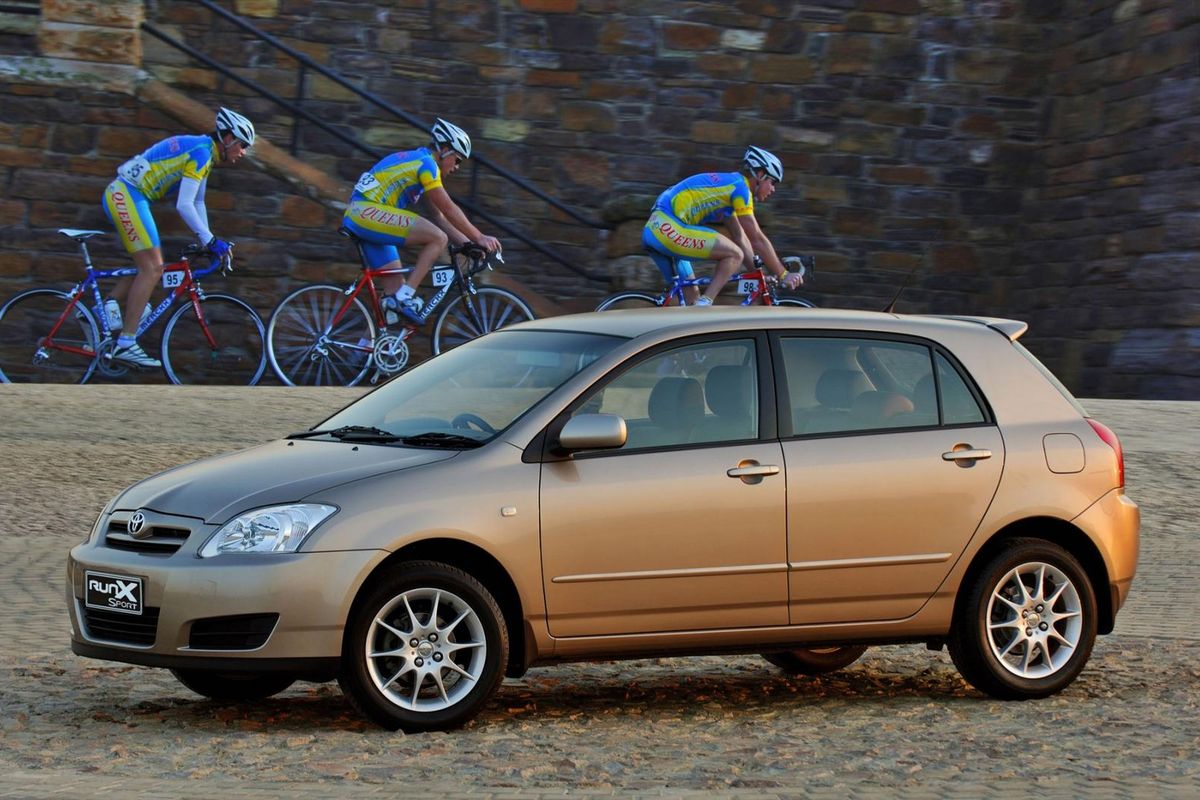
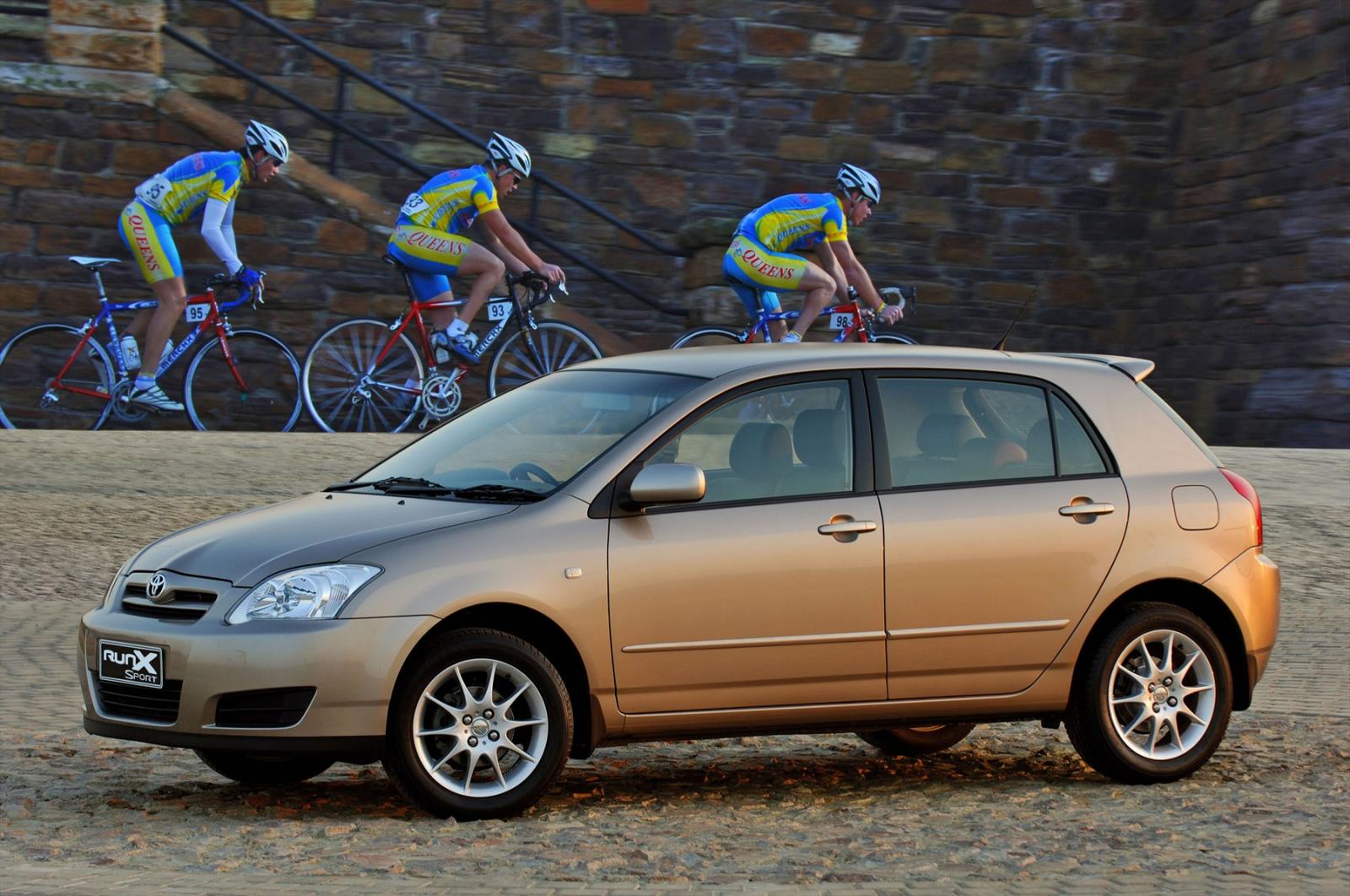
Here’s something that’s probably not going to give you any trouble or sleepless nights about repair bills. The RunX RSi has a great 1.8-litre naturally aspirated engine that revs to beyond 8 000 rpm and produces 141 kW. The RSi is quite hard to come by and a bit of a collector’s item among Toyota loyalists. The 180i RX, which produces only 100 kW, is more widely available; it promises much performance potential. Expect to pay from R80 000 to R100 000.
Kia has announced an all-new 5-year/unlimited mileage warranty for its products in South Africa.
This new warranty is effective from 1 June 2016 and applies to the entire Kia range: from the entry-level Picanto small hatchback to the Sorento premium SUV and Grand Sedona people carrier, and it pertains to the K2500 and K2700 light commercial vehicles as well. There's not a major difference to the previous (already-comprehensive) 5-year/150 000km warranty except for the deletion of the mileage restriction, but Kia Motors South Africa has further upgraded its standard Roadside Assistance programme from 3-years/unlimited mileage to 5-years/unlimited mileage.
“The class-leading global quality of our cars have already been firmly established through our exceptional achievements in the J.D. Power Initial Quality Survey, and the new warranty we offer proves just how reliable Kia vehicles are, regardless of how much driving you do,” says David Sieff, marketing director for Kia Motors South Africa.
“Taxis, sales representatives, long-haul transporters and other drivers who can easily exceed 30 000km a year will see great value in this offering,” adds Gary Scott, the sales director for Kia Motors South Africa. “Second-hand buyers will also benefit from knowing that the first owner’s mileage has not impacted on their warranty cover. We believe this will support even stronger residuals than currently experienced by KIA in South Africa.”
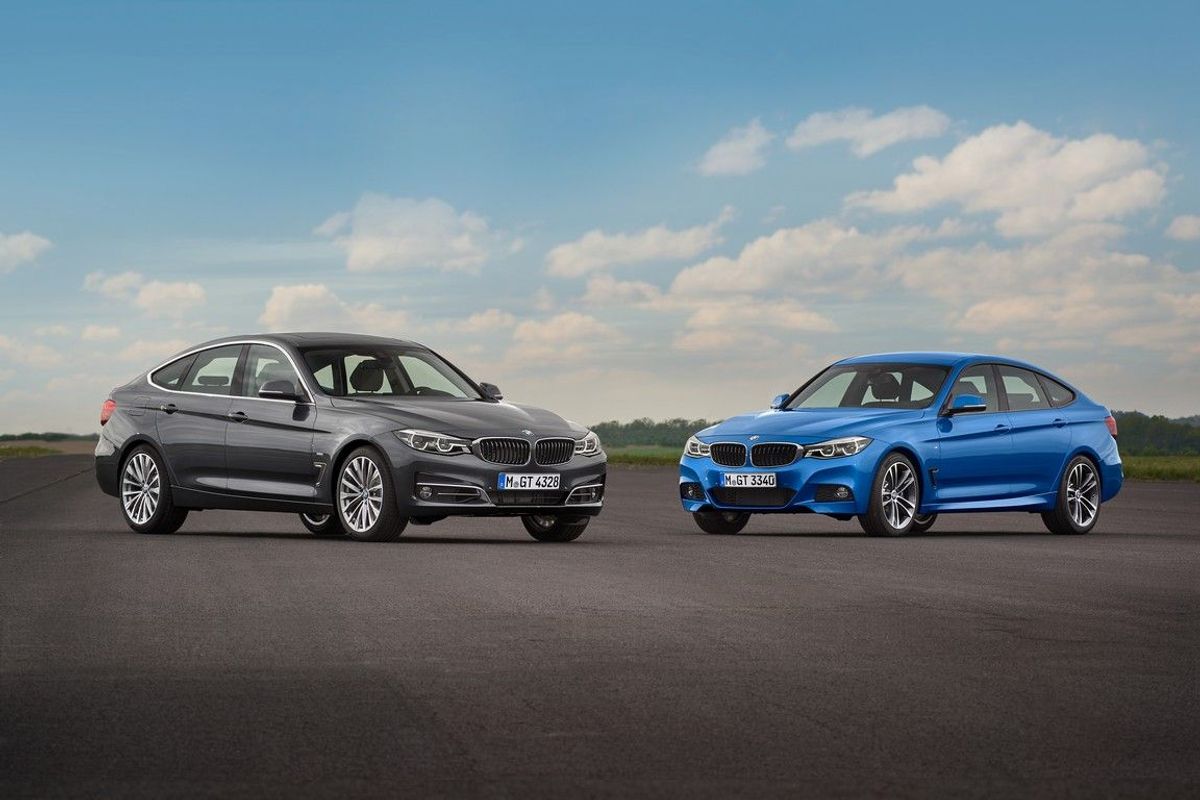
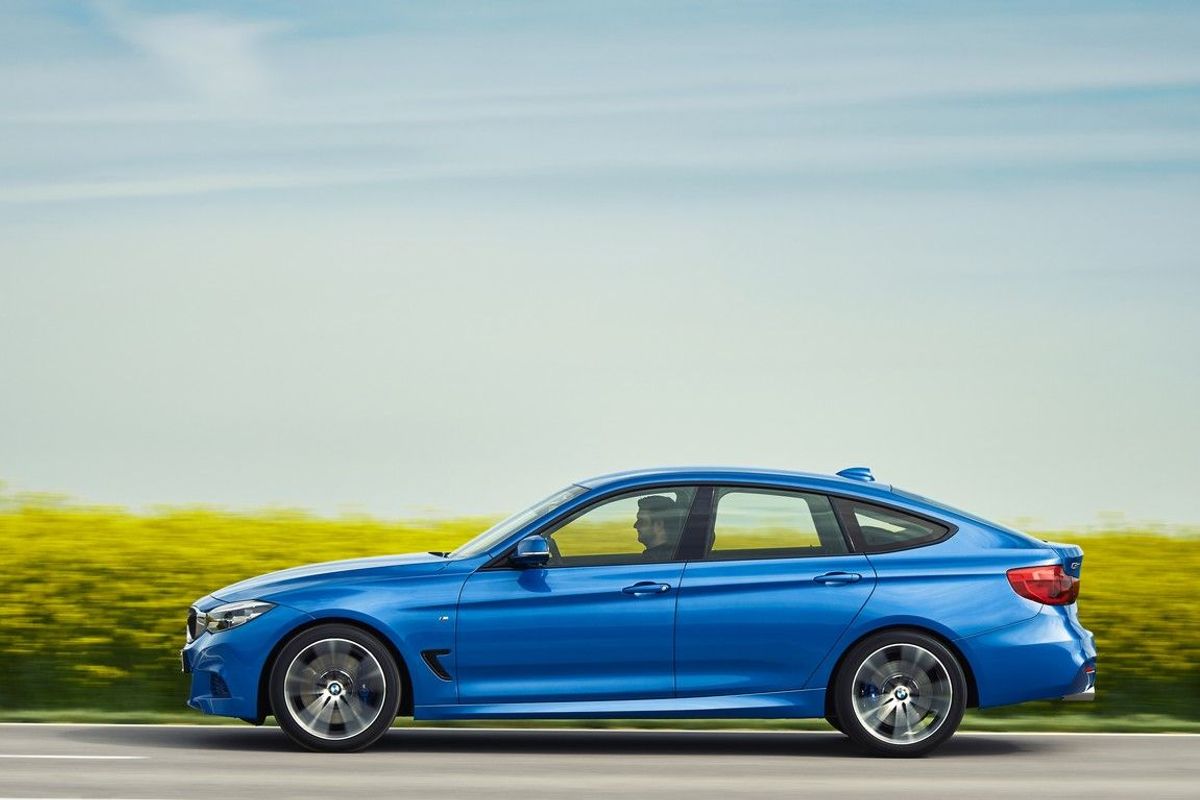
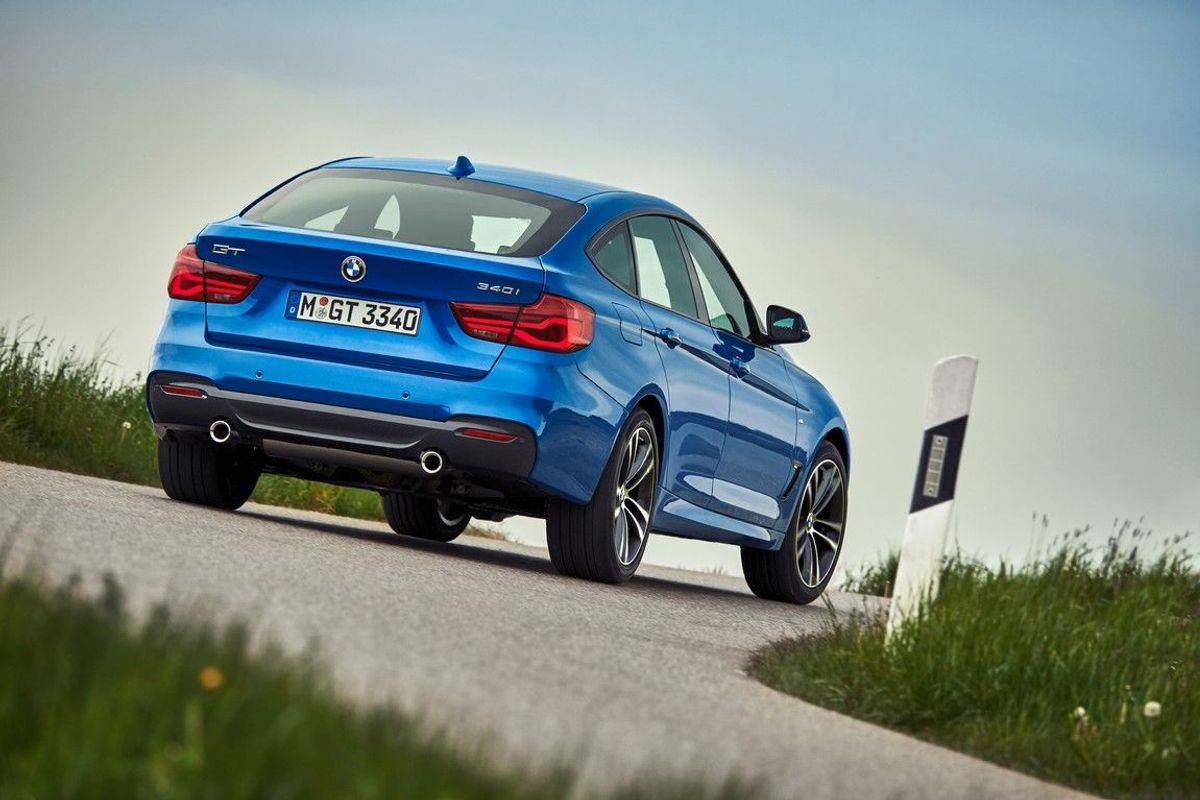
BMW has released details and images of its new 3 Series Gran Turismo. Stylistically, it still represents a tantalising melange of coupe, sedan and station wagon cues.
Much like the facelift of the F30-generation BMW 3 Series, the GT variant features only minor changes to its exterior appearance. Most of the enhancements come in the form of technology updates and the inclusion of new engines from BMW.
Longer 3 GT
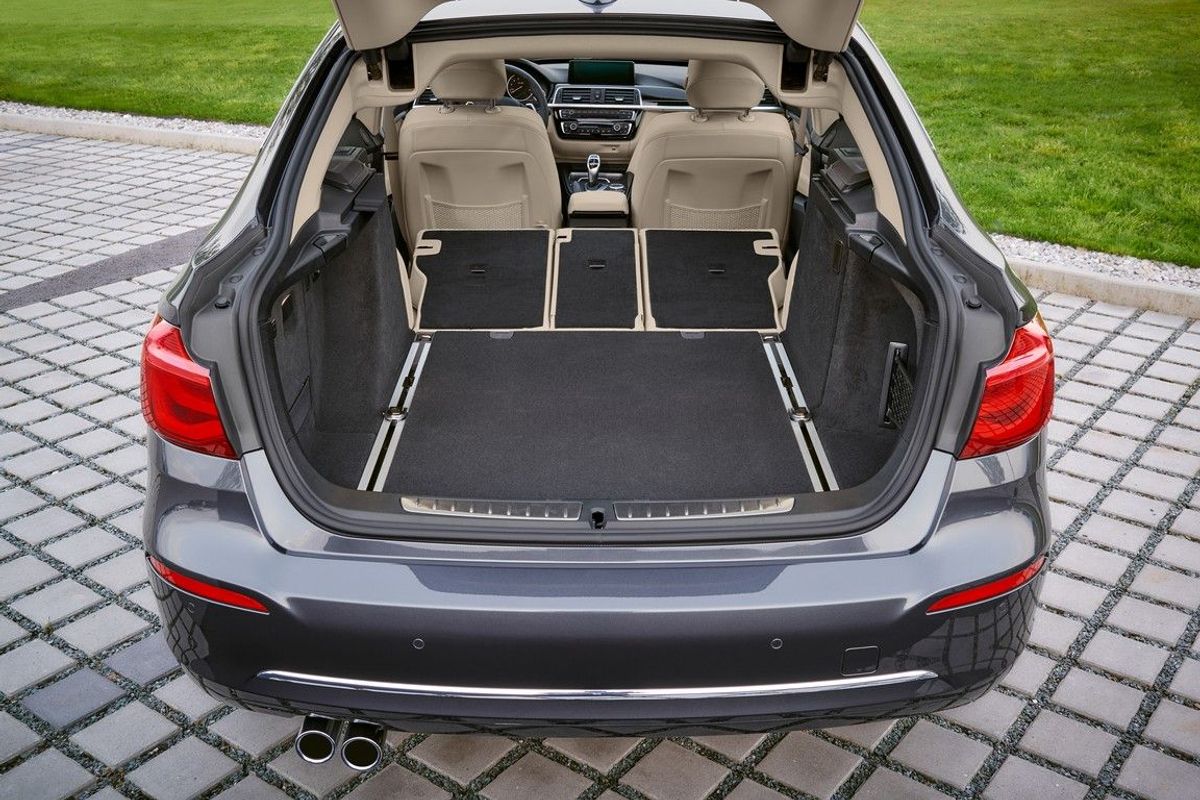
Length-wise the facelifted GT is 200 mm longer than before thanks, in part, to its wheelbase being lengthened by 110 mm. There is more legroom for rear occupants and the luggage bay is claimed to hold 520 litres with the rear seats up and 1 600 litres with the seatback folded down.
LED headlamps are now fitted as standard on the Gran Turismo, LED foglights are available and rear LED lights top off the exterior changes.
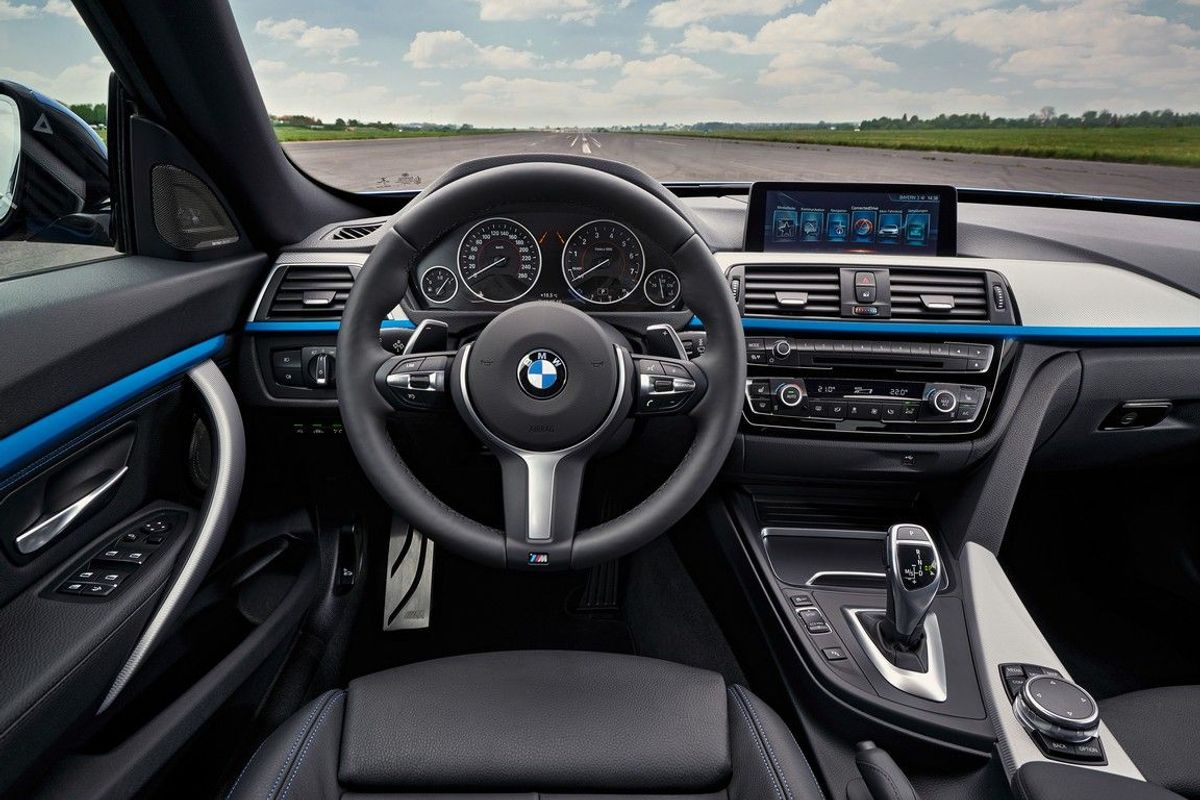
Updates to the interior include the latest version of BMW’s navigation system. Wireless charging for your Smartphone is also available.
New engines
The range of new engines for the South African market consists of two all-new petrol units developing 135 kW and 240 kW and one turbodiesel engine producing 140 kW. The focus of the new engines was reduced fuel consumption and in the 320d GT, there is said to be a 13.8% improvement in efficiency. The 320i Gran Turismo and 320d Gran Turismo come as standard with the six-speed manual gearbox, but can also be ordered with the eight-speed Steptronic automatic transmission as an option. The BMW 340i Gran Turismo exclusively features the Steptronic automatic as standard.
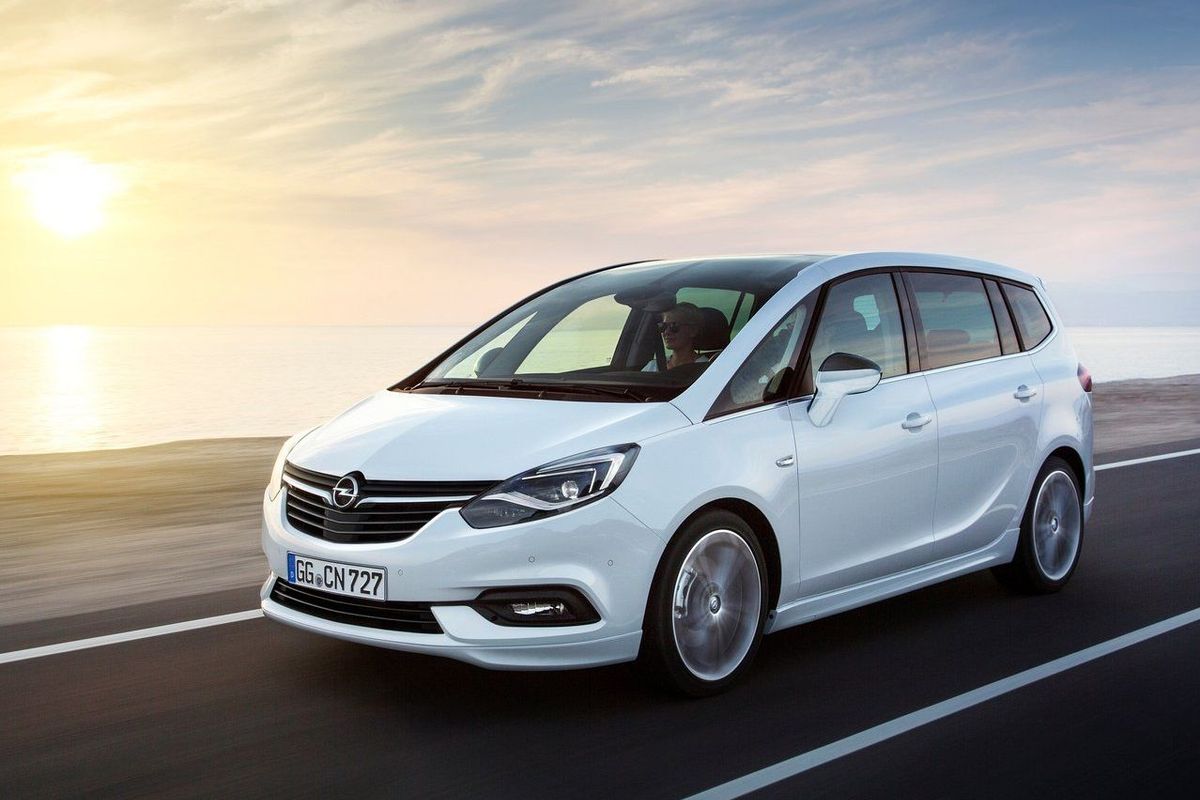
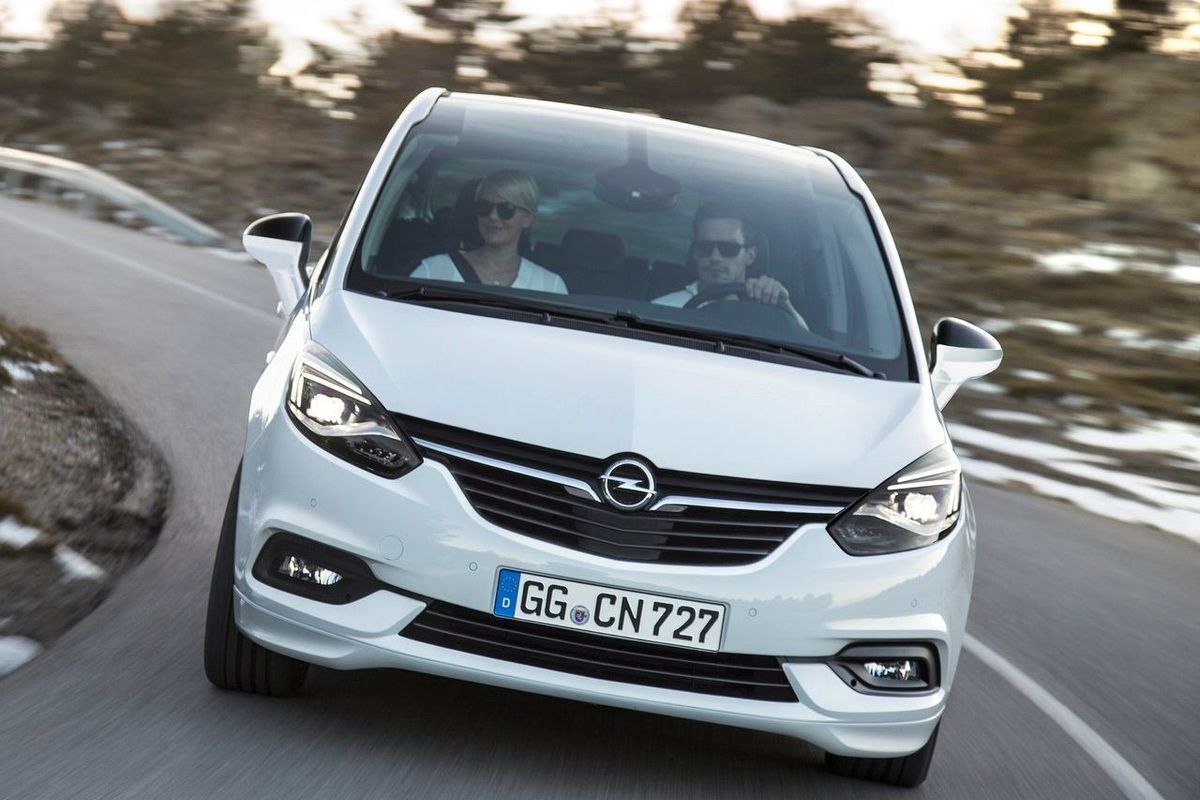
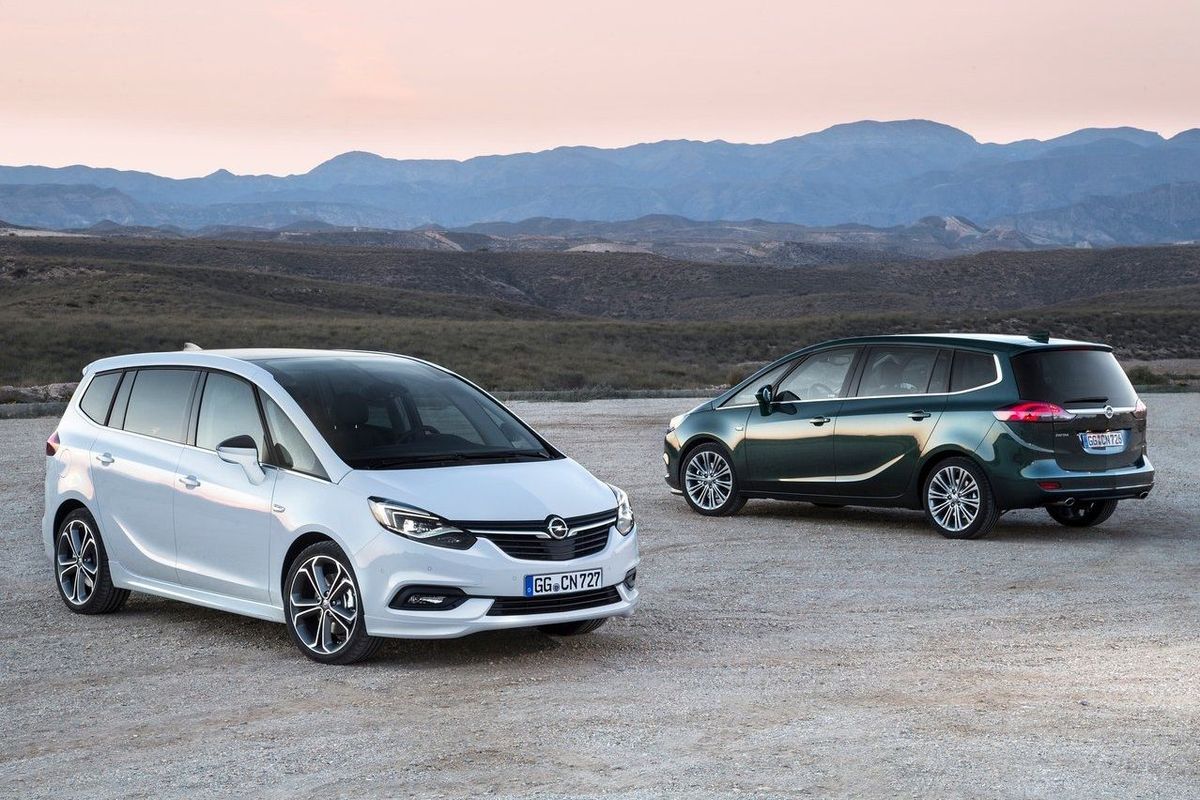
Opel has unveiled an all-new version of its popular multi-purpose vehicle. Let's check out the 2016 Opel Zafira.
Since 1999, 2.7 million Opel Zafiras have been sold and it's easy to understand why. It's a spacious MPV capable of transporting its occupants in comfort on long distance trips and the best part? It's good value for money. The new Opel Zafira will go on sale in Europe in September 2016 and features new technology along with its Flex7 seating configuration, as well as supportive front seats, a bicycle carrier and adaptive damping.
What's new?
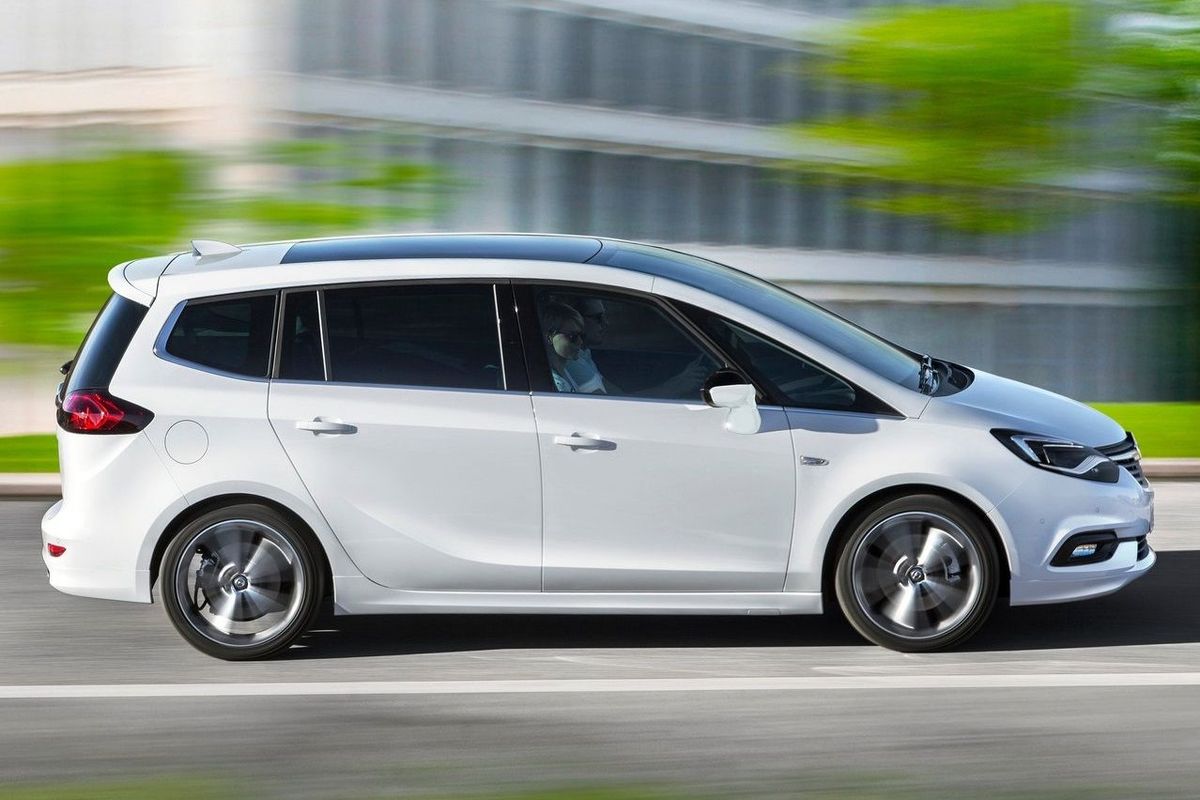
Some of the new technology incorporated in the new Opel Zafira includes Apple CarPlay, Android Auto, Opel OnStar (4G/LTE Wi-Fi hotspot connectivity) and full LED adaptive forward lights. The big change is the obvious one: the looks. This newcomer is quite handsome and there are purposefully sporty design details all around the vehicle.
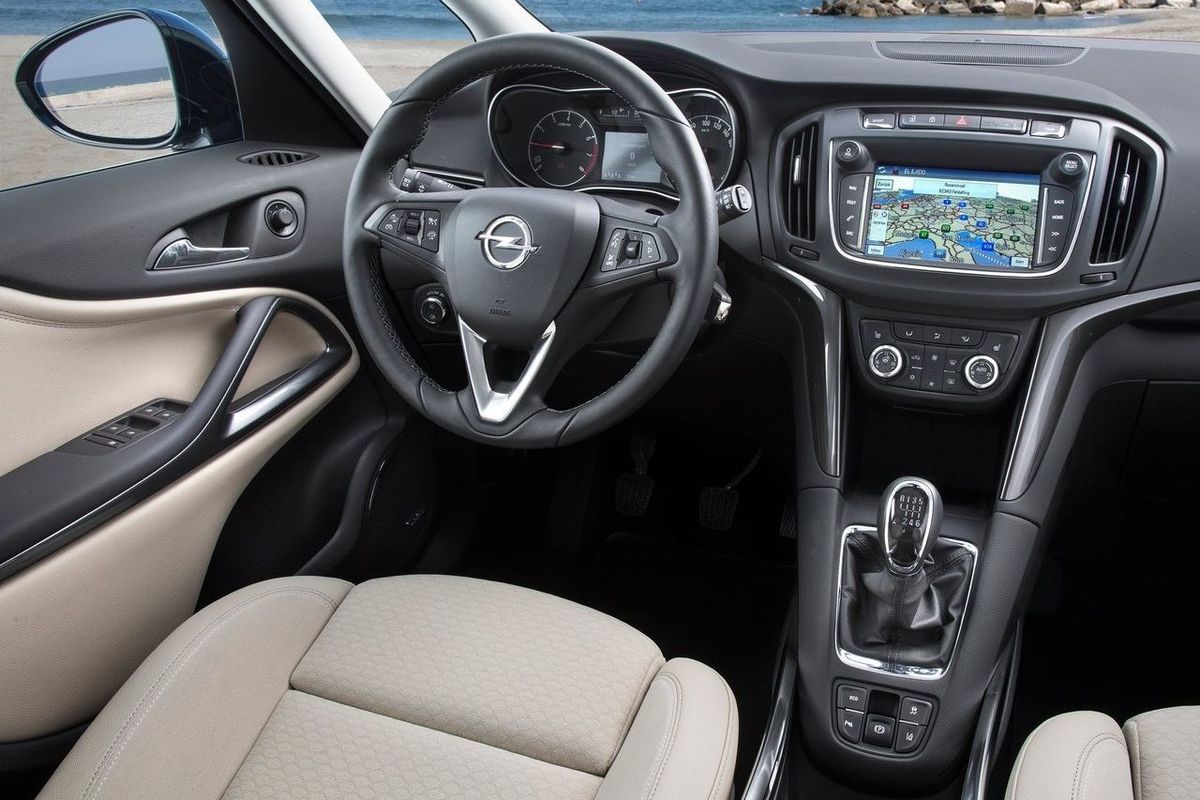
"The front design of the new Zafira takes over the major characteristics of the one of the award winning new Astra, and anchors it in Opel's new portfolio. Its sharp, precise double-winged daytime running lights convey a new level of sophistication, which is also reflected in the interior by a completely redesigned instrument panel. It is purer, clearer and easier to use," said Mark Adams, Vice-President, GM Europe Design.
Redesigned cabin
The elegant-but-simpler layout is dominated by an integrated infotainment touchscreen that has eliminated the need for the myriad buttons that cluttered the dashboards of previous-generation Zafiras. Apart from the latest version of the brand's Intellilink system (a version with navigation will also be offered), Opel OnStar allows up to 7 devices to be connected to the in-car wifi. The ergonomically-certified seats and FlexRail console system have been retained.
The interior space has increased too… Customers can tick the box for optional Lounge Seating, which allows the back of the middle seat in the second row to fold down and be rotated to offer armrests for the two outer seats. All the seats can slide fore and aft to adjust the legroom afforded to passengers in the second row. Luggage capacity is a claimed 710 litres with all the seats up and with the second row folded down: 1 860 litres.
Safety
The new Opel Zafira boasts a number of all-new safety features. The automatic adaptive LED headlights can adjust their lighting patterns so that drivers in oncoming traffic are not dazzled. There are nine lighting patterns which can be selected, such as town light, country light, curve/cornering, reverse lights, eco lights and tourist mode. The Zafira also features high beam assist, traffic sign recognition, following distance indicator, forward collision alert, lane departure warning, adaptive cruise control, to name but a few.
Opel's Strategy
Opel will be launching the Zafira to the European market in September of 2016 and the current array of petrol, diesel, compressed natural gas and liquified petroleum gas engines will be applied to this new model.
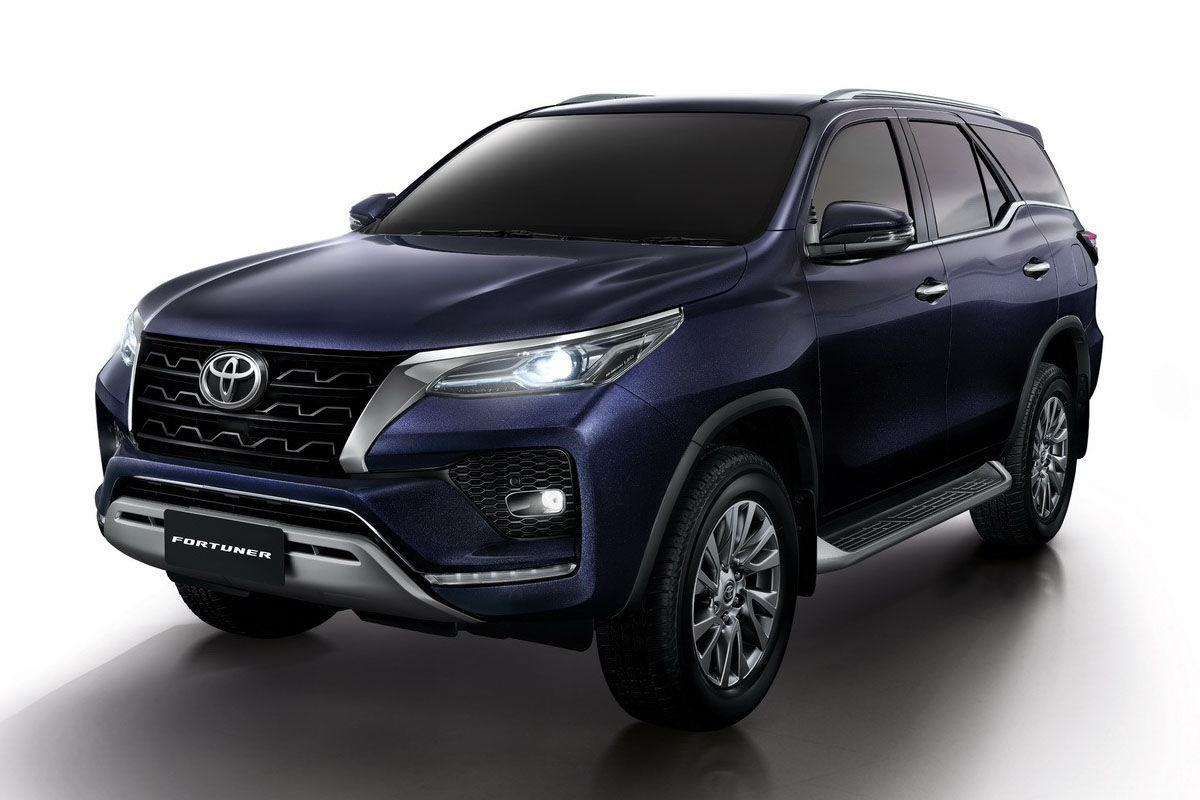
It’s not often that the entry-level derivative of a new vehicle model range represents the sweet spot in the product’s line-up. Meet the 2016 Toyota Fortuner 2.4GD-6!
If you’re in the market for a 2016 Toyota Fortuner 2.4GD-6, then this review will help you make an informed buying decision!
We like: Refined and powerful engine, value for money, rugged nature, likely resale
For greater practicality: The Chevrolet Trailblazer 2.5D LT offers a better third-row seating arrangement. The seats fold flat into the floor, resulting in a more versatile, wider loading area.
For more comfort: Although there’s nothing wrong with the manual transmission in this Fortuner, we’d recommend spending the extra R20 000-odd for the automatic derivative. This makes town driving (in particular) a more relaxing affair.
For greater value: It’s impossible to trounce the Fortuner in this department (if you’re looking to buy a brand new vehicle). It is not only the most affordable bakkie-based SUV, but also offers the widest spread of talents. Keep an eye out for a rival Ford Everest, powered by a 2.2-litre turbodiesel engine, later this year.
Toyota Fortuner 2.4-GD-6:It’s the baby, but is it the best?
We recently pitted the Fortuner 2.8GD-6 Automatic 4×4 against its fiercest competitor, the Ford Everest, in a comparative test that was just too close to call (read it here). But whereas the flagship Fortuner has some pretty tough competition, the market segment for entry-level, manual transmission, seven-seater body-on-frame SUVs is relatively sparsely populated. Chevrolet’s underperforming (in the sales charts) Trailblazer is theoretically the Fortuner’s strongest rival, and Mitsubishi’s soon-to-be-replaced Pajero Sport is only offered with an automatic transmission (and costs a fair bit more). Ford’s 2.2-litre turbodiesel Everest derivatives can’t arrive soon enough to give the Fortuner a serious run for its money.
Until then, however, and even on its own merits, this entry-level, 2016 Toyota Fortuner appears to have all the boxes ticked. It looks every bit as smart as its more expensive siblings, offers a punchy, refined new turbodiesel engine and comes with an impressive mix of standard comfort features. What, then, is not to like?
How does the 2016 Toyota Fortuner fare in terms of…
Standard comfort and safety features?
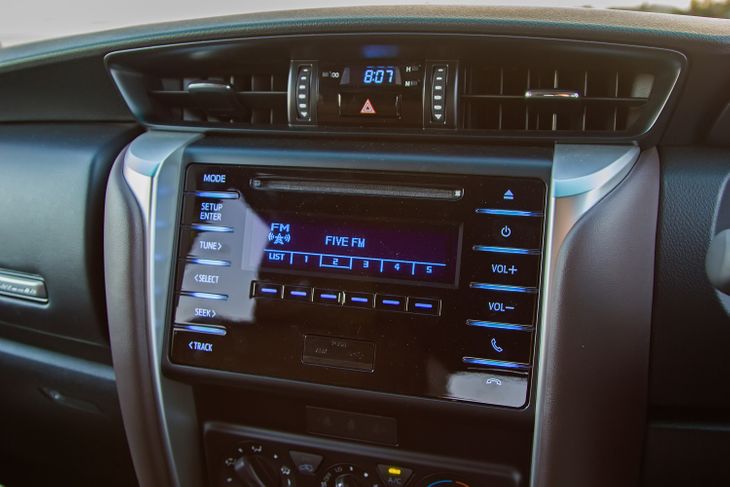
The touch sensitivity of the infotainment system’s buttons take a while to get use to. Note the flap over the USB and auxiliary input sockets.
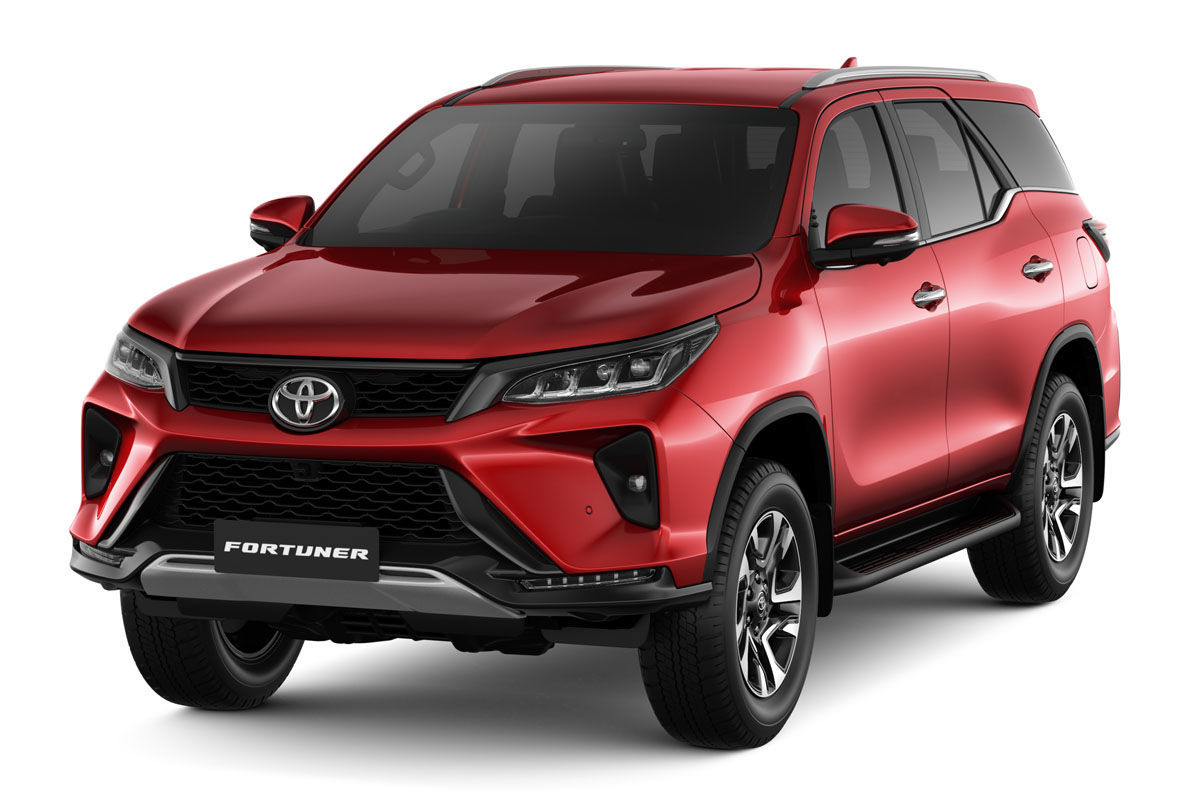
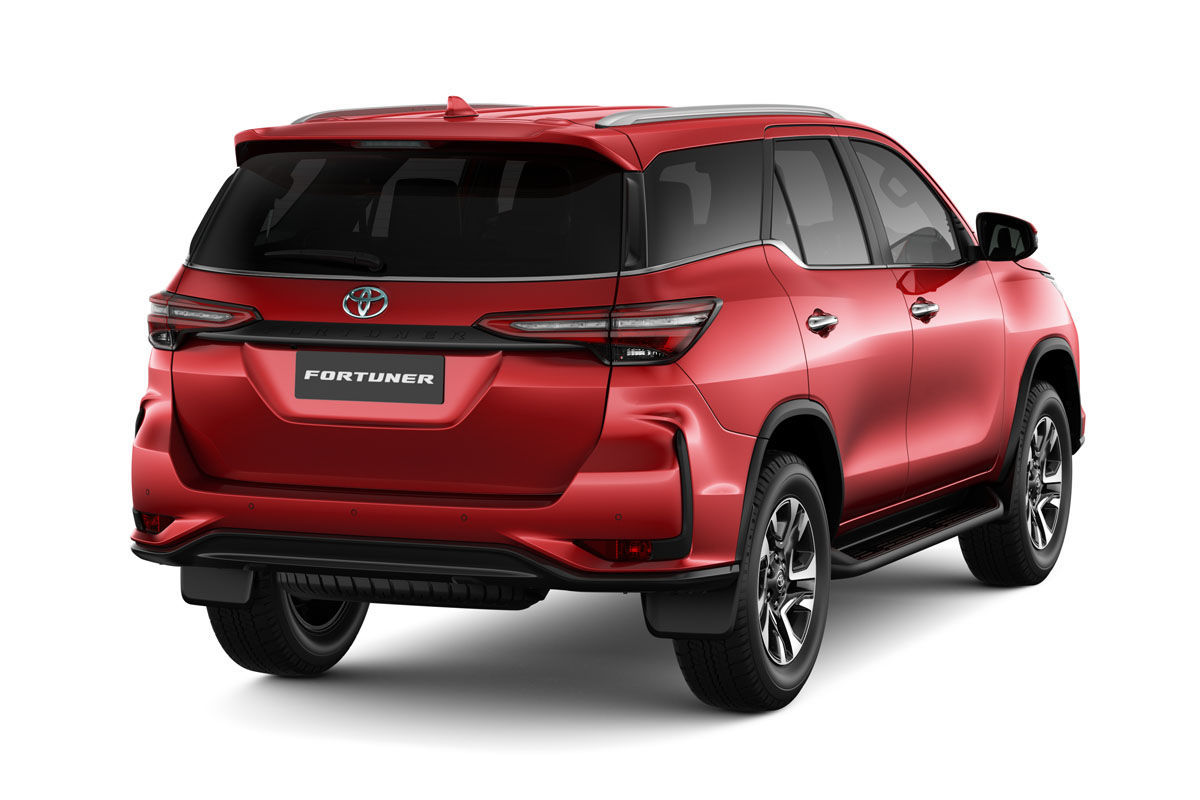
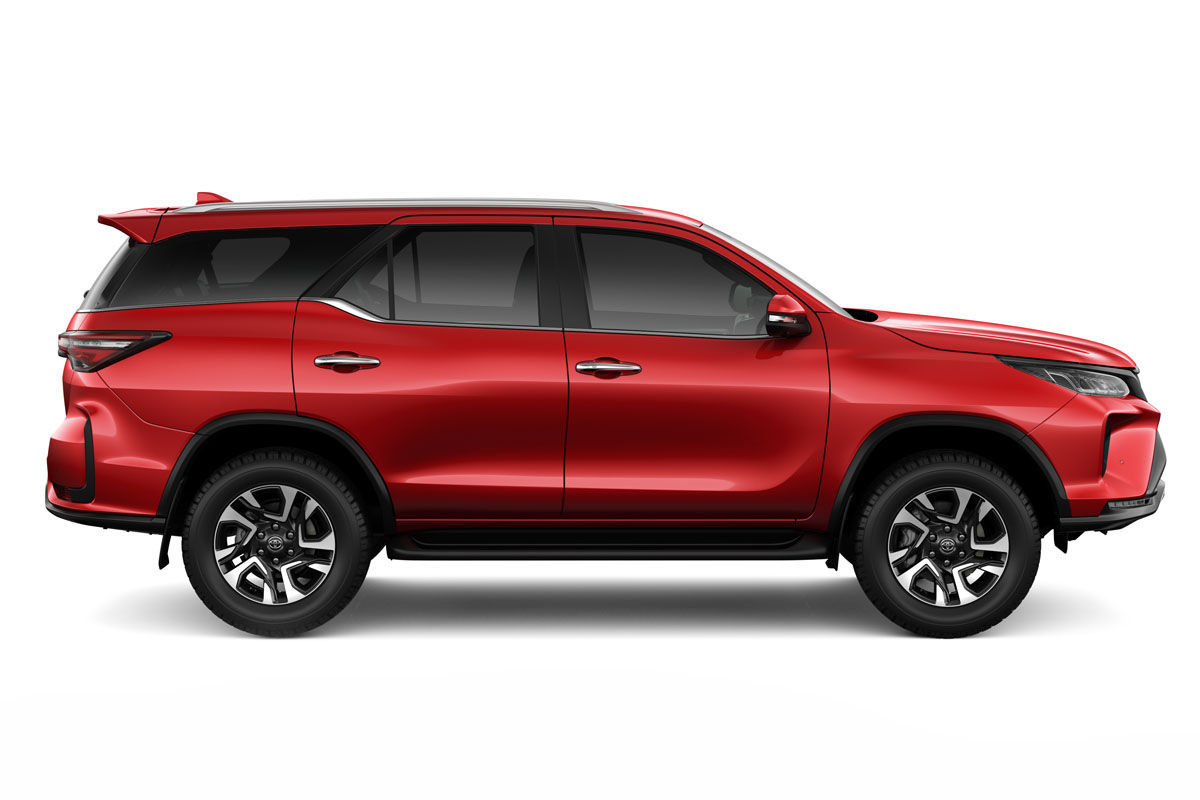
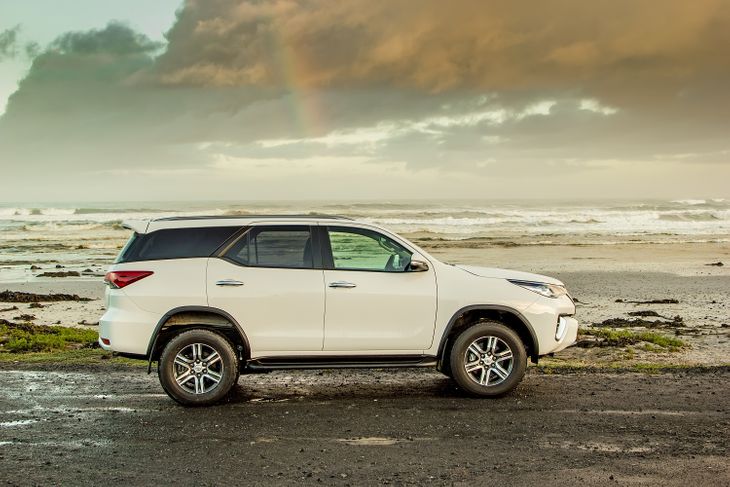
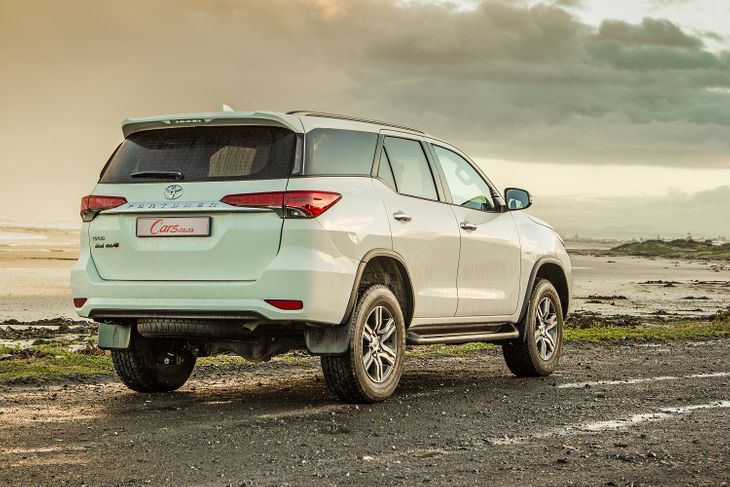
Seeing that this is the entry-level Fortuner derivative, you may expect it to be rather sparsely equipped. Thankfully, that is not (entirely) the case. From the outside, in fact, you may easily confuse the baby Fortuner for the flagship version. It still features shiny and attractive 17-inch alloy wheels, rear privacy glass, as well as roof rails. Look closely and you may notice the absence of LED detailing in the headlights, or the fact that a rear-view camera and parking sensors are not present, either. The latter, in particular, were missed very much. Manoeuvring and parking a sizeable vehicle such as the Fortuner within in the confines of the city make a parking assistance system a virtual necessity.
Climb inside the cabin and you’ll probably notice the absence of leather upholstery immediately. The dark-brown cloth upholstery looks hard-wearing, though, and didn’t appear to show dirt too easily. The driver has very little reason for complaint, seeing as the driver’s seat is adjustable for height, while the steering column offers rake- and reach adjustment. Even in its lowest setting, you sit high in the Fortuner, with a commanding view over fellow road users. The front seats are of a new design, too, and proved to be very comfortable on longer trips.
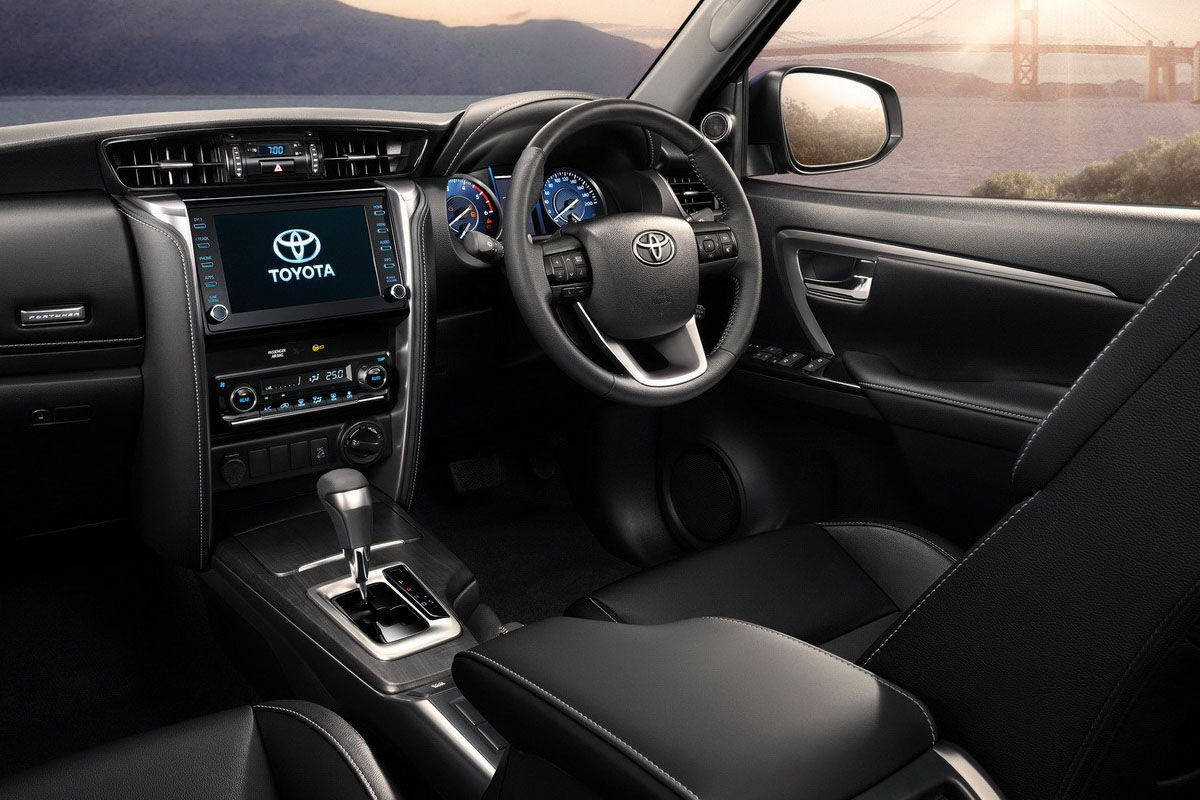
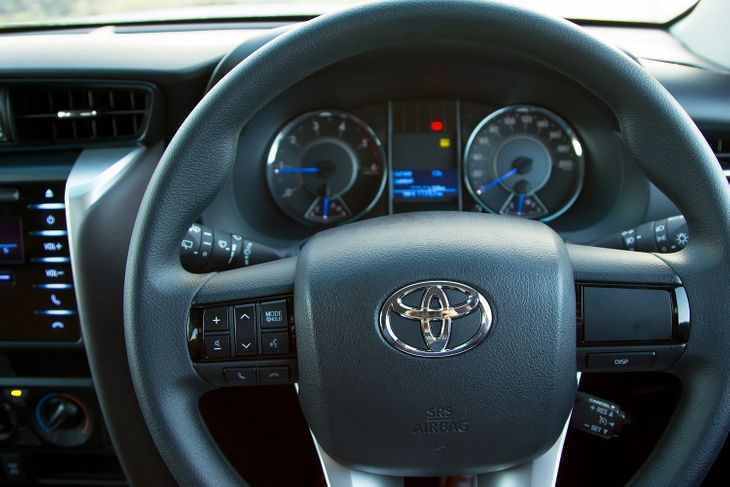
An item missing from this model is the 2.8GD-6 model’s slick touchscreen infotainment system. Toyota has tried hard to give the more basic system in the 2.4GD-6 a high-tech appearance, but to be honest we found it fiddlier to use than it needed to be. The buttons need to be pressed very “precisely” to activate, which is not great when driving. However, this minor irritation could be overcome with time and the system does offer Bluetooth, USB and aux-in functionality. Behind the steering wheel (with its awkwardly “blanked out” right spoke) is an instrumentation panel with a far simpler trip computer display than in the 2.8. But… again, it needs to be pointed out that it arguably offers everything you really need. Besides, you also get cruise control, one-touch up/down windows and the upper of the two glove boxes even includes a cooling function!
In terms of safety specification, however, we have some concerns. Yes, when it comes to active safety systems such as VSC (electronic stability control), trailer sway control, ABS with EBD and BA etc., the Fortuner appears to have all the bases covered. But the fact that it only has three airbags as standard (driver + knee/front passenger) is downright confounding. Curtain and side airbags are reserved for the more expensive models, but surely buyers wouldn’t mind spending a little extra to get these on the 2.4? At least there are Isofix child seat mounts in the second row.
Performance and economy?
With standard cruise control, the Fortuner 2.4GD-6 is a very comfortable and refined cruiser.
This 2016 Toyota Fortuner is powered by the new-generation 2.4-litre turbodiesel engine that made its debut in the new Hilux this year. Following a drive of the Hilux 2.4GD-6 SRX 4×4 in Mozambique, we were convinced that it would be a great match for the Fortuner. We were not left disappointed.
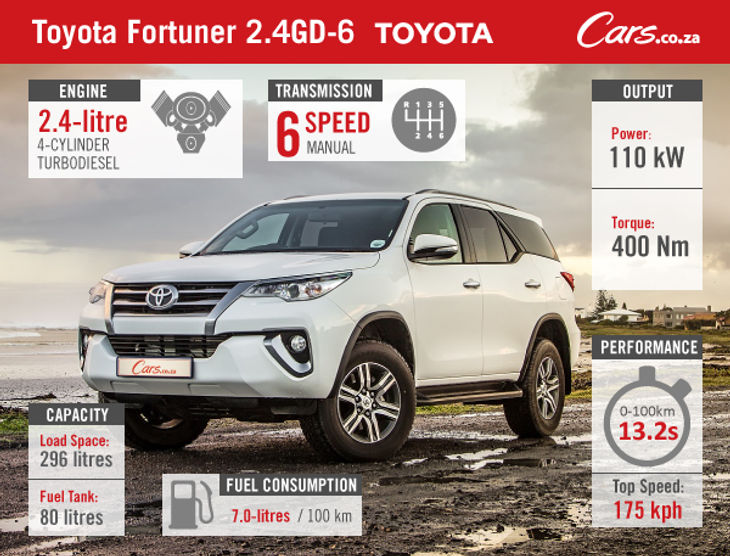
It may not deliver the most power in this segment (110 kW), but it churns out more torque (400 Nm) than its rivals and does so from lower engine revolutions (1 600-2 000 rpm). Power goes to the rear wheels via a six-speed manual transmission that feels both slick and reassuringly robust. In short, the drivetrain is sublime, delivering effortless and strong performance in a very refined way. We expect there will be a few times that you may wonder whether the extra outlay for the 2.8 would be worth it.
And yet, somehow, Toyota’s claimed figures paint a more gloomy picture. With a claimed 0-100 kph time of 13.2 seconds, the 2.4GD-6 is supposedly slower than both the Chevrolet Trailblazer 2.5 and Mitsubishi Pajero Sport. Then again, such sprint figures are of relatively little relevance here and in real-world conditions the Fortuner feels more than spritely enough. As is the case with the 2.8, three driving modes are offered (Power, Sport and Standard), and depressing Sport results in an immediately sharper throttle responses. Over longer distances, the Fortuner also impressed with its overtaking grunt, even when cruising at near the national speed limit.
It is also impressively economical, although matching Toyota’s claimed average consumption figure of 7,0L/100km proved difficult. Nevertheless, in a vehicle of this size and during normal driving, you should easily achieve a consumption figure of around 8.5 L/100 km, which is very good indeed, especially considering the good range a large (80 litre) tank avails.
Packaging
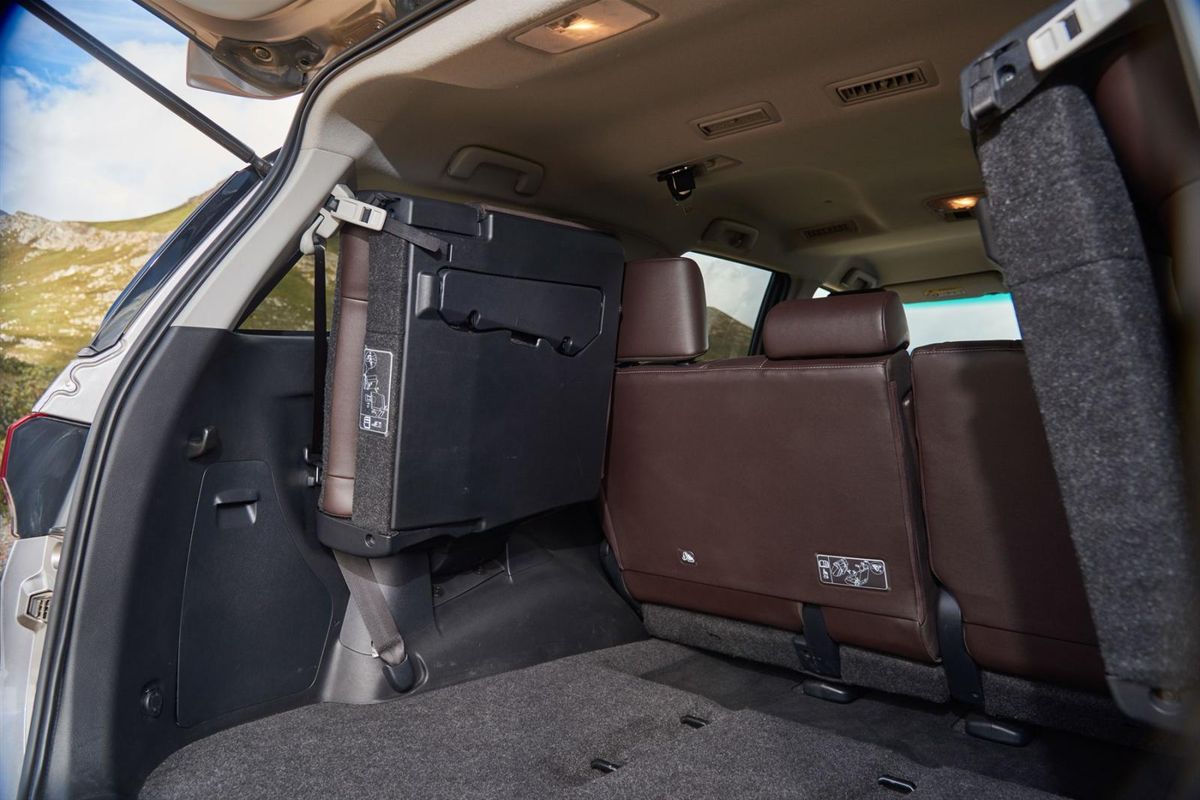
The Fortuner’s third-row seating arrangement continues to cause much debate. (2.8GD-6 shown)
Whether you are going to use the full 7-passenger carrying ability or not, the fact that it is available when needed is a big contributing factor to the success of this type of vehicle. The new Fortuner is appreciably more comfortable – for all passengers – compared with the previous model. Access to the third row is gained using an easy one-touch tumble function. And while those rear seats are most definitely not ideal for fully grown adults, the sliding and reclining functions of the second row can be used to afford those in the rear some more kneeroom. Ventilation outlets are provided for second- and third-row passengers.
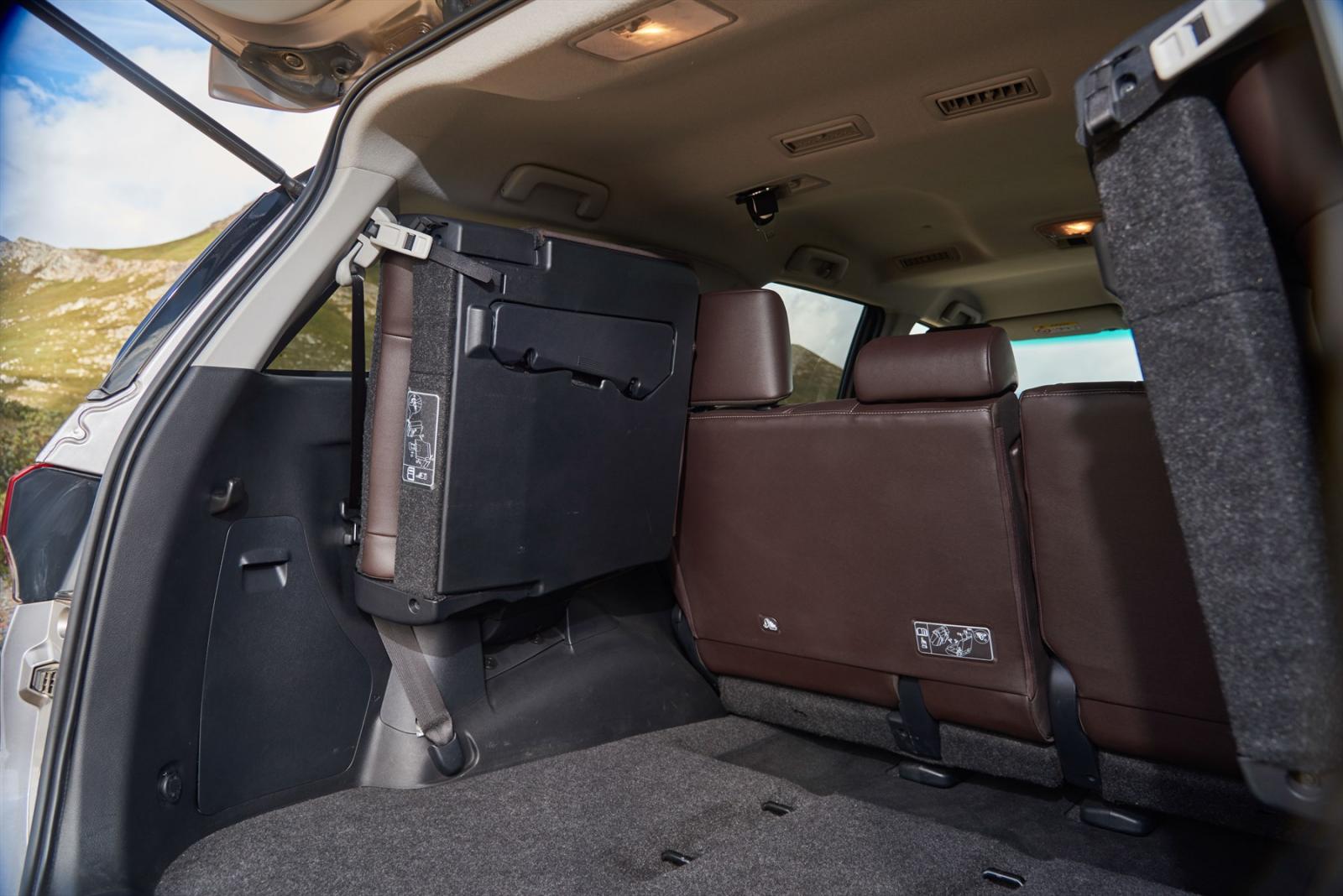
As per usual, with all rows of seats occupied, boot space is limited, which is why you’ll almost always see these vehicles equipped with a tow hitch. This model is rated to tow a 2 500 kg (braked) trailer. But what about boot space with only five passengers? Well… this is a highly debatable topic. As before, the seats can be stowed against the sides of the luggage area (unlike the Trailblazer, for example, where they fold flat into the floor). Toyota says its research shows that customers prefer it that way and that, with some light spanner work, you could remove them altogether. But we’re still not convinced… We think they impact not so much on space necessarily, but limit the shapes and sizes of things that can be accommodated.
Moving to the front of the cabin, a feature worth highlighting is a secondary, higher-placed compartment above the usual glovebox. It’s particularly useful for keeping things cool, as air-conditioned air can be piped into it.
Ride and handling
With its high stance and firm underpinnings, the Fortuner is not as smooth on-road as most rivals.
As we reported in our first review of the Toyota Fortuner, improved ride refinement and general stability were key areas targeted for improvement during the development of the new Fortuner. After all, much loved as the previous model was, it was often criticised for its overly firm, bakkie-like ride and relative “loose” feeling on poor surfaces, especially corrugated gravel.
The good news is that the new model is significantly improved all round. The ride quality is most definitely better, as is the NVH (noise/vibration/harshness) control. As a consequence, the Fortuner’s cabin is a much quieter, comfier place than before, especially for those seated in the rear of the vehicle. The bad news is that it is still not as smooth and supple as a Ford Everest, or a Chevrolet Trailblazer, for that matter. And it remains decidedly less confident-boosting on corrugated gravel than either of those vehicles. That said, it does offer VSC (electronic stability control) so there is a safety net and the ride improves markedly when the vehicle is lugging a load.
But… in most instances and on most surfaces, the improvements are significant. Importantly, these enhancements have not come at the expense of the Fortuner’s “off-road” ability. This may be the 4×2 version, but with generous ground clearance, great approach/departure angles, hill-assist control and a rear diff-lock, it will confidently go places where unibody/crossover SUVs would never dare to tread. This genuine and rugged versatility is core to the Fortuner’s enduring appeal.
2016 Toyota Fortuner: Pricing and warranty
The Toyota Fortuner 2.4GD-6 sells for a very attractive R445 100 and comes with a 3-years/100 000 km warranty and 5-years/90 000 service plan. Frustratingly, however, the service intervals are still conservatively pegged at 10 000 km, but in the long run, this may turn out to be a very good thing.
Verdict
There’s nothing “budget” about the entry level Fortuner’s exterior. Note impressive (279 mm) ground clearance.
Locally made, well-priced and with the support of the country’s leading servicing network, the cheapest Fortuner was virtually guaranteed to be a sales success in South Africa. As was the case with the previous-generation model, however, this baby Fortuner’s spread of abilities make it a very desirable product, even when you don’t factor in the peace-of-mind that comes from Toyota’s extensive after-sales back-up. More stylish and refined, and therefore better suited to town and city driving, while retaining the all-road, rugged versatility of its predecessor, this Fortuner is a very appealing prospect for thousands of South African families. More’s the pity, then, that it doesn’t offer a better complement of airbags…
The Fortuner is a 7-seater SUV with three rows of seats, designed to accommodate a driver and up to six passengers.
What is the ground clearance of the Toyota Fortuner?
The Toyota Fortuner has a ground clearance of approximately 225 mm to 279 mm, depending on the model year and specific variant. This high clearance makes it well-suited for off-road driving and navigating rough terrain.
What are the engine and transmission options for the Toyota Fortuner?
The Toyota Fortuner is available with two diesel engines, with some derivatives featuring 48V mild-hybrid technology to improve efficiency. Engines include a 2.4-litre and 2.8-litre turbocharged diesel engine. Transmission choices typically include both a 6-speed manual and a 6-speed automatic gearbox, with some variants offering a 4×4 drivetrain.
What are some key features of the Toyota Fortuner?
Key features of the Toyota Fortuner include a high-strength body-on-frame chassis for durability, an 8-inch touchscreen infotainment system with Apple CarPlay and Android Auto, leather seats, automatic climate control, and a suite of safety features such as multiple airbags, ABS with EBD, and traction control. Higher trims may also offer a premium JBL sound system and a powered tailgate.
What is the fuel tank capacity of the Toyota Fortuner?
The Toyota Fortuner has a fuel tank capacity of 80 litres.
Mercedes-Benz was determined to make the new E-Class one of the market's most sophisticated sedans. The new E-Class, launched in South Africa on June 1 2016, isn’t just about integrating motoring life with your smartphone – it incorporates amazing new developments in the safety and autonomous driving departments.
Here are just some of the highlights of the new E-Class.
1. You can park it with your smartphone
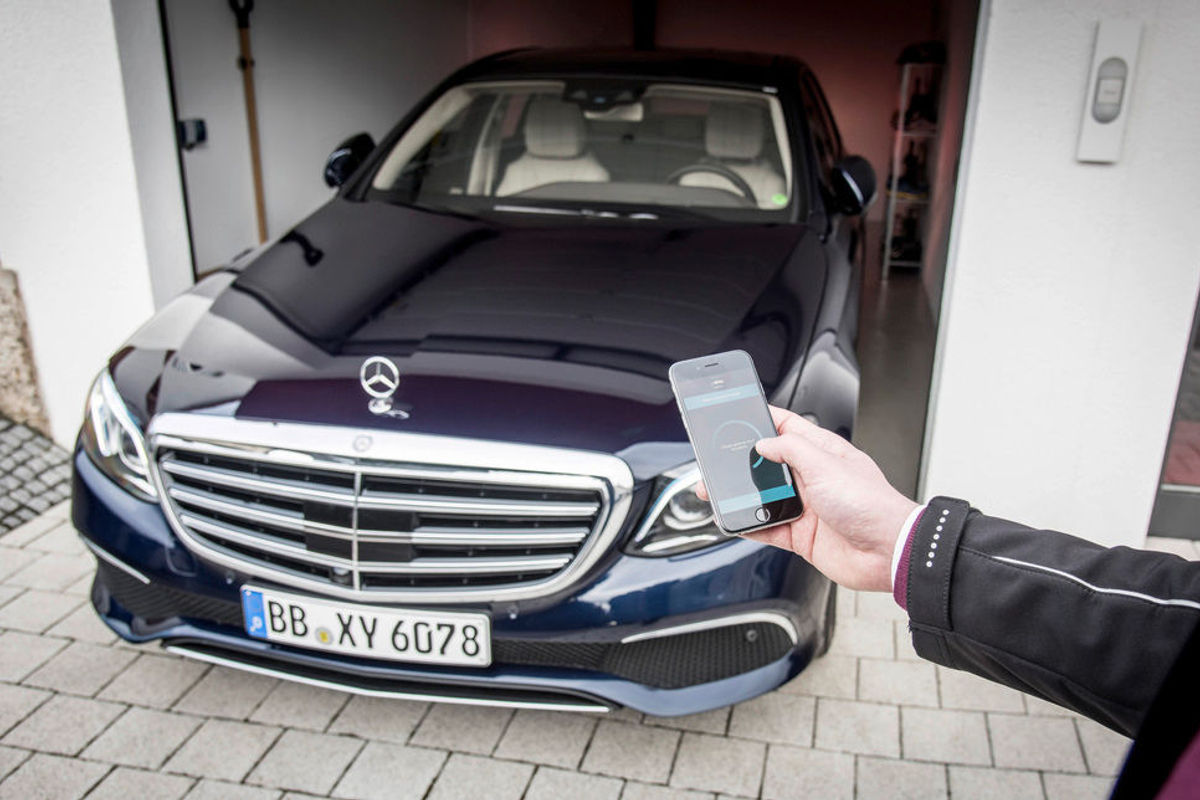
Do you have a really tight garage with lots of things in the way? Or maybe you want that last spot in the car park, but it's located adjacent to a wall? These situations would usually make you think twice about squeezing your premium sedan into a tight parking spot. But, by using the E-Class' automated-parking app, you can get out of your car and park it remotely by rotating your thumb forwards and backwards on your phone's screen. To get it out of the spot, just reverse the procedure. Although in South Africa, the BMW 7 Series will shortly be able to offer this function soon, the E-Class will be the first executive sedan, as opposed to grand saloon, to be available with this technology. Check out the Instagram video below to see it in action.
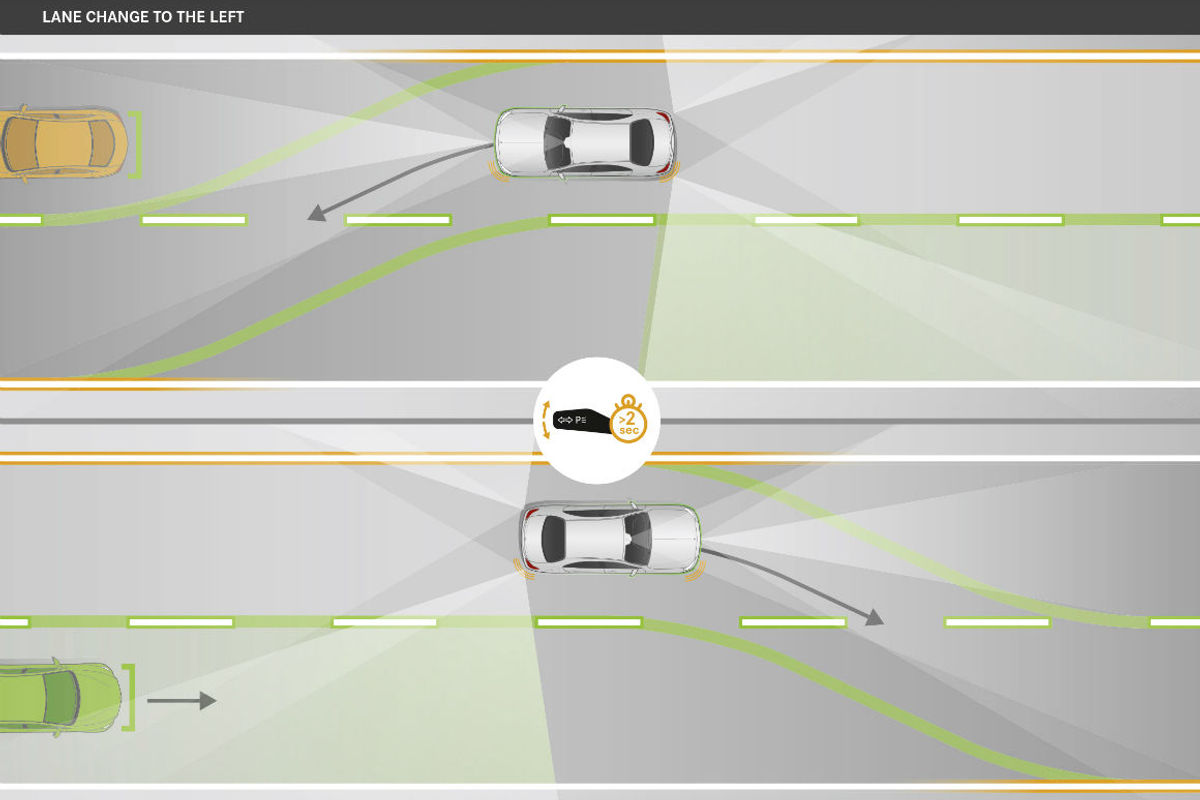
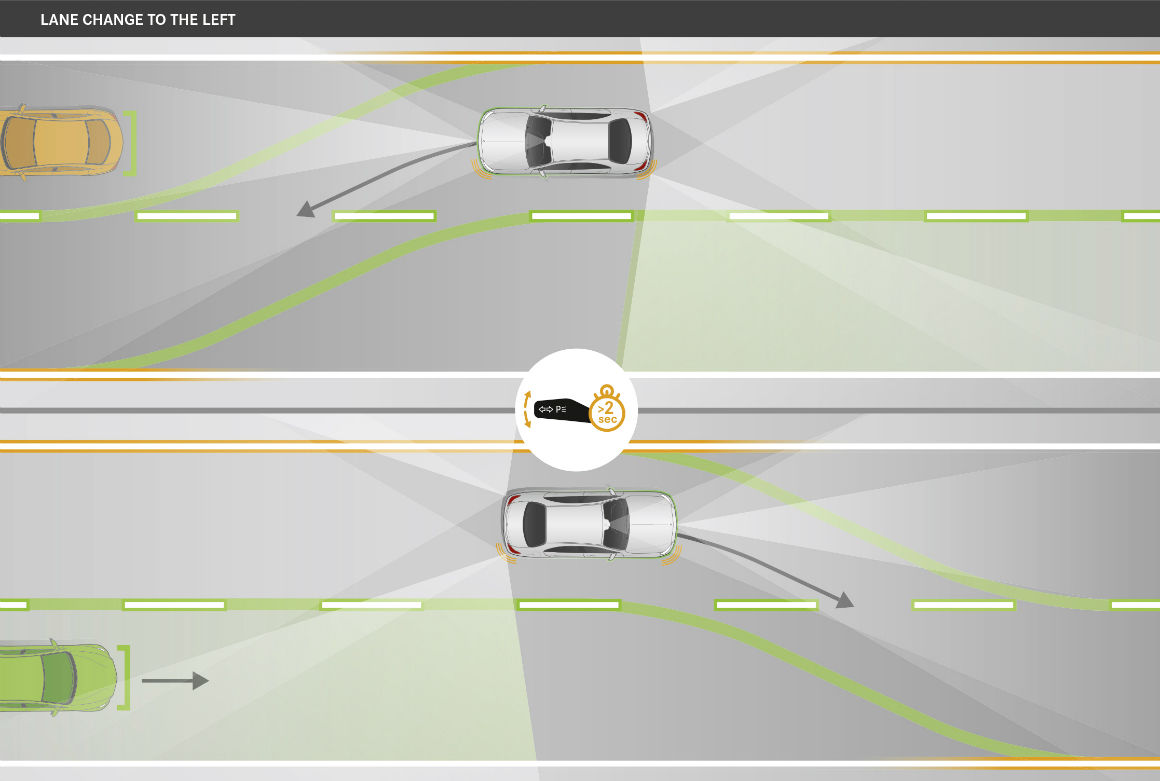
The new Drive Pilot system in the E-Class enables the car to take over steering duties at speeds of up to 200 kph. On the freeway, you simply double tap the cruise control lever and the car will assume control of the steering. You can take your hands off the wheel for a full 30 seconds before the E-Class will remind you to at least keep your hands on the steering wheel. There’s a full minute of no hands driving before the car decides that the driver is no longer able to drive, stops and puts on the hazard lights. Incredibly, the system will also steer into other lanes on its own; all the driver needs do is activate the indicator for two seconds and the car will then change lanes. The Drive Pilot is also clever enough to only change lanes when it’s safe to do so. For example: If there is a car is speeding up in the lane beside you, it will not make the turn until the speeding car has passed your car. The Drive Pilot system can even read road signs on the side of the road and adjust the car’s speed to match those of the road signs it has detected.
3. New crash safety systems
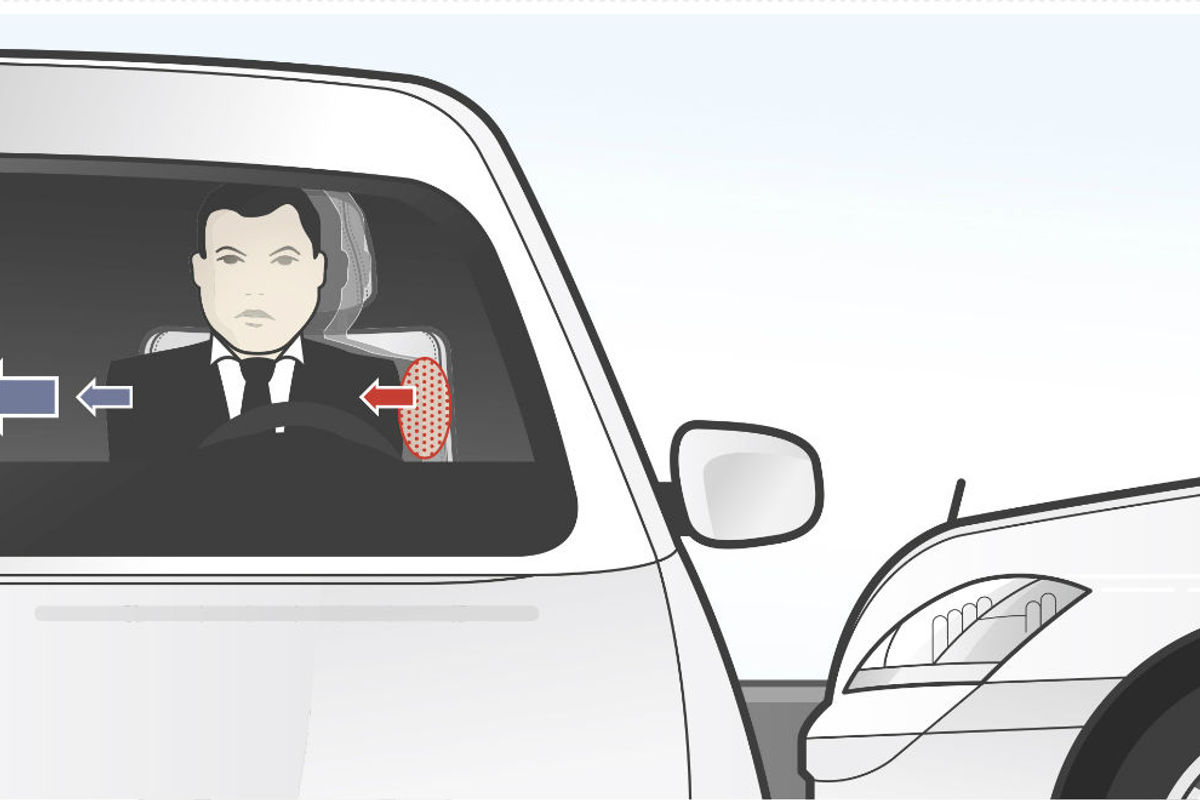
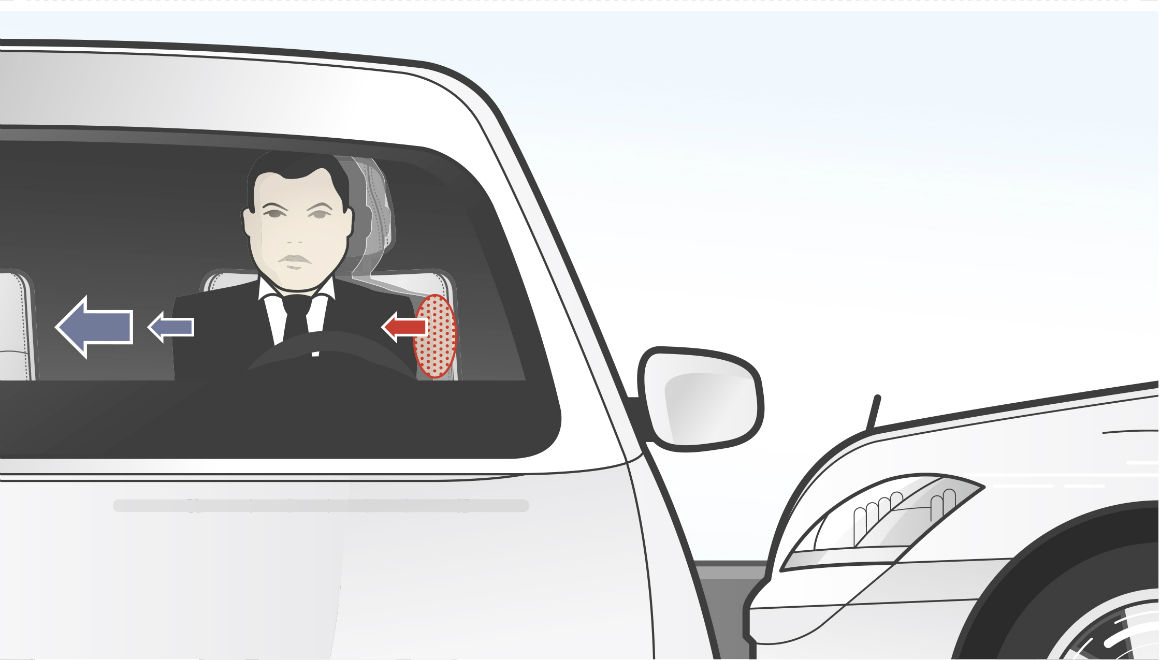
There are several improved occupant safety technologies in the new E-Class. In the event of a side impact, the E-Class will inflate the bolster of a front seat on the side of the impact to push the occupant towards the centre of the car, which reduces the intensity of the impact on the occupant. The car will also emit a loud static sound from the cars' speakers that diffuse the sound of the accident to protect the occupants ears' from possible injury. Rear passenger safety has been augmented by the introduction of airbags in the seatbelts. The integral airbag reduces the impact of rapid deceleration on the passenger’s chest.
4. It has its own cloud
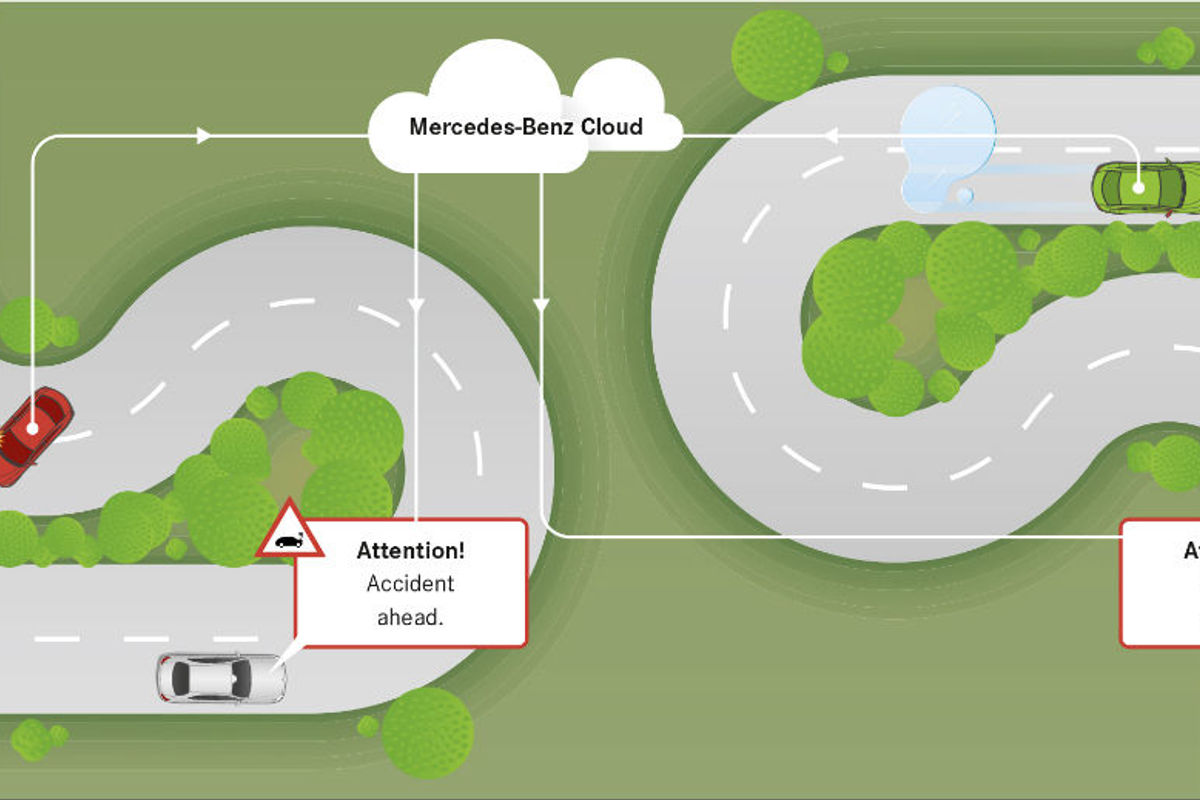
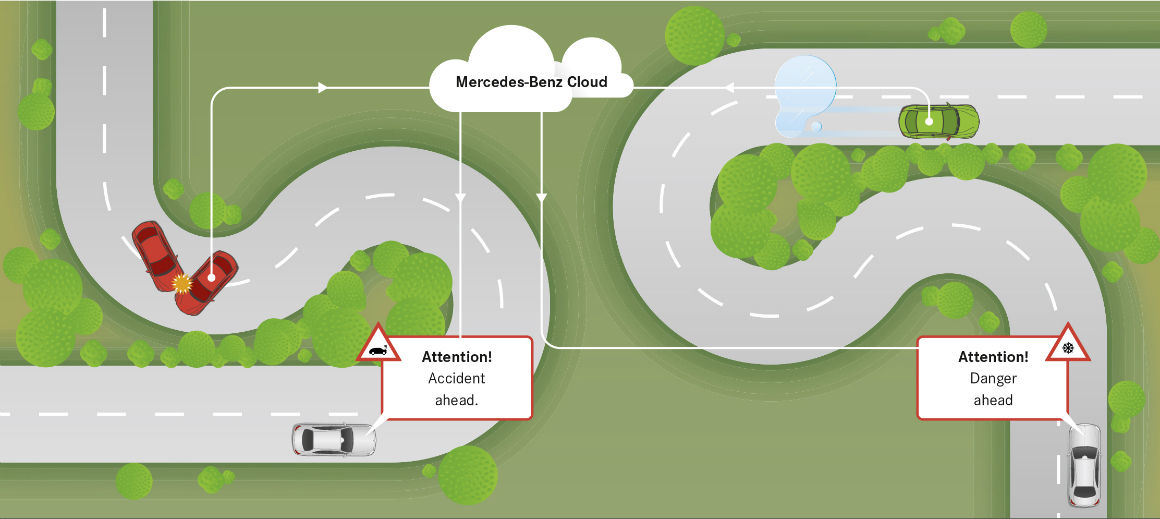
Just like the virtual cloud that contains a multitude of shareable files, Mercedes-Benz is connected to a cloud for the purpose of sharing accident locations. If you drive past an accident, the E-Class navigation system allows you to alert other E-Class drivers (and soon pilots of all Mercedes-Benz cars and, possibly, other manufacturers' vehicles) that there’s something on the road to be mindful of. The system also warns drivers in the vicinity of the E-Class by means of the navigation system. If the accident scene is clear, the driver can remove the hazard notification from the cloud and it will no longer notify other drivers.
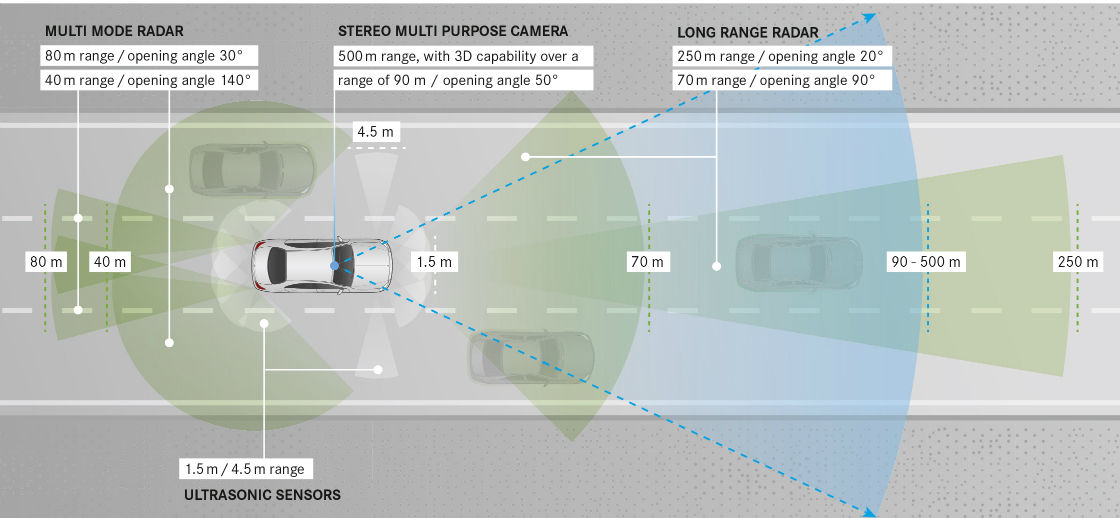
5. It can see 250 metres ahead
To put 250 metres into perspective, the E-Class scans for objects that are two football fields away. What’s it looking for? The long range radar (as it's called) is being utilised by systems such as the Drive Pilot, adaptive cruise control and brake assist systems that detect if there is anything ahead that could cause an accident. If the E-Class suspects it could hit something (pedestrians or another vehicle) it first audibly warns the driver and if nothing happens, it begins emergency braking at the last possible moment. If you begin to swerve out of the way, the vehicle detects the driver making an evasive manoeuvre and adds torque to the steering wheel. This torque controls the evasive manoeuvre and makes sure that it doesn’t get out of hand after the wheel has been turned.
E-Class pricing in South Africa
E200 R709 608
E220d R759 100
E350d R961 036
(prices include CO2-emissions tax and Mercedes-Benz's 6-year/100 000 km maintenance plan).
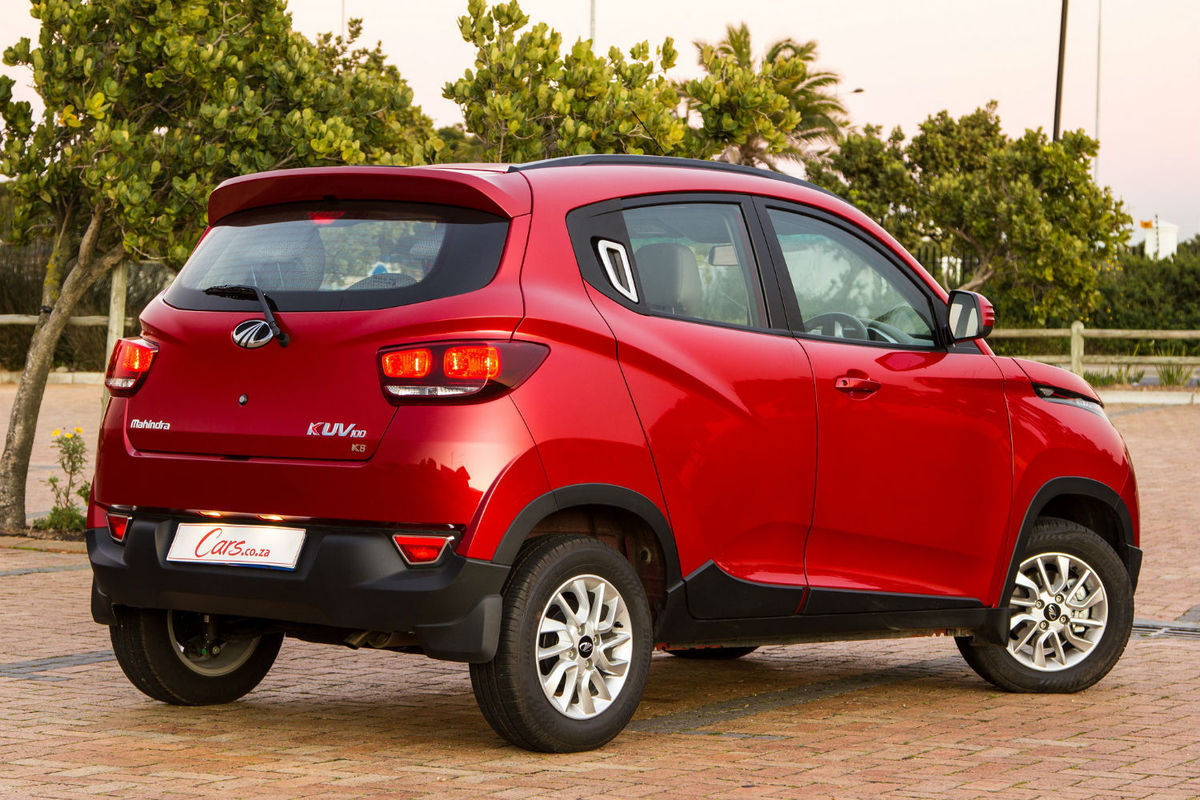
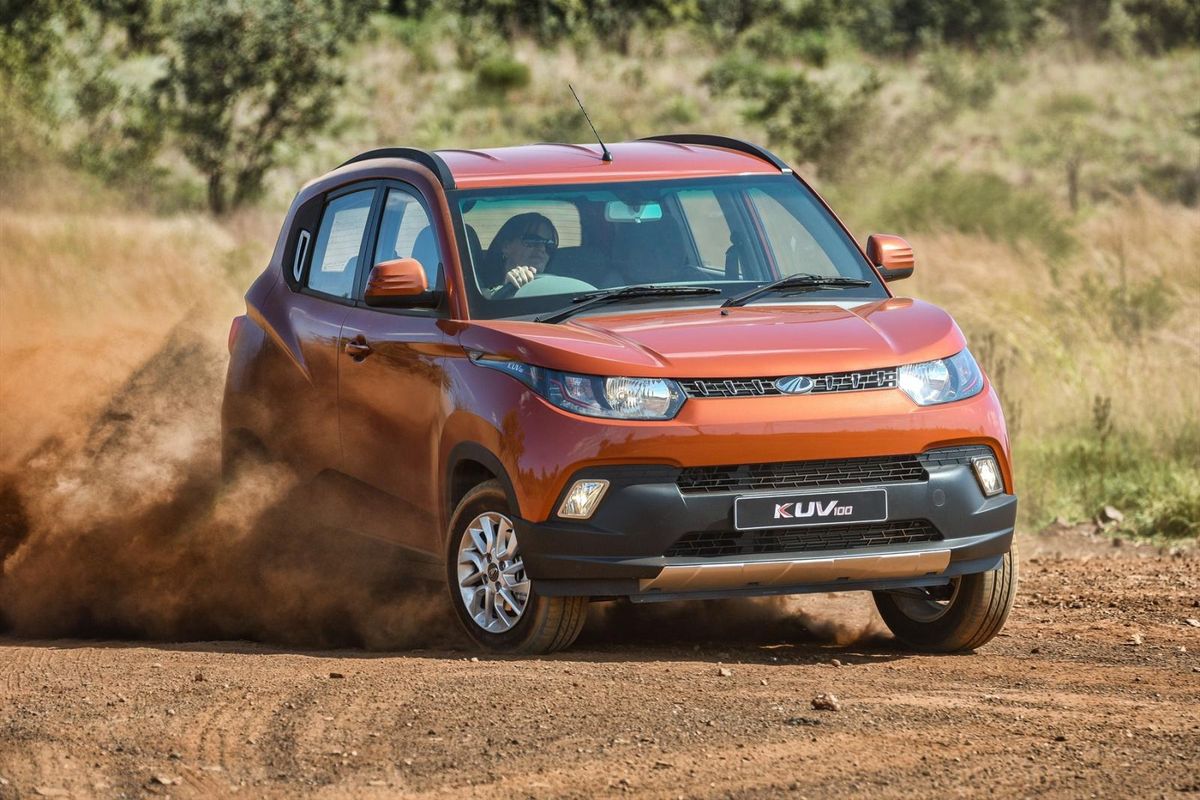
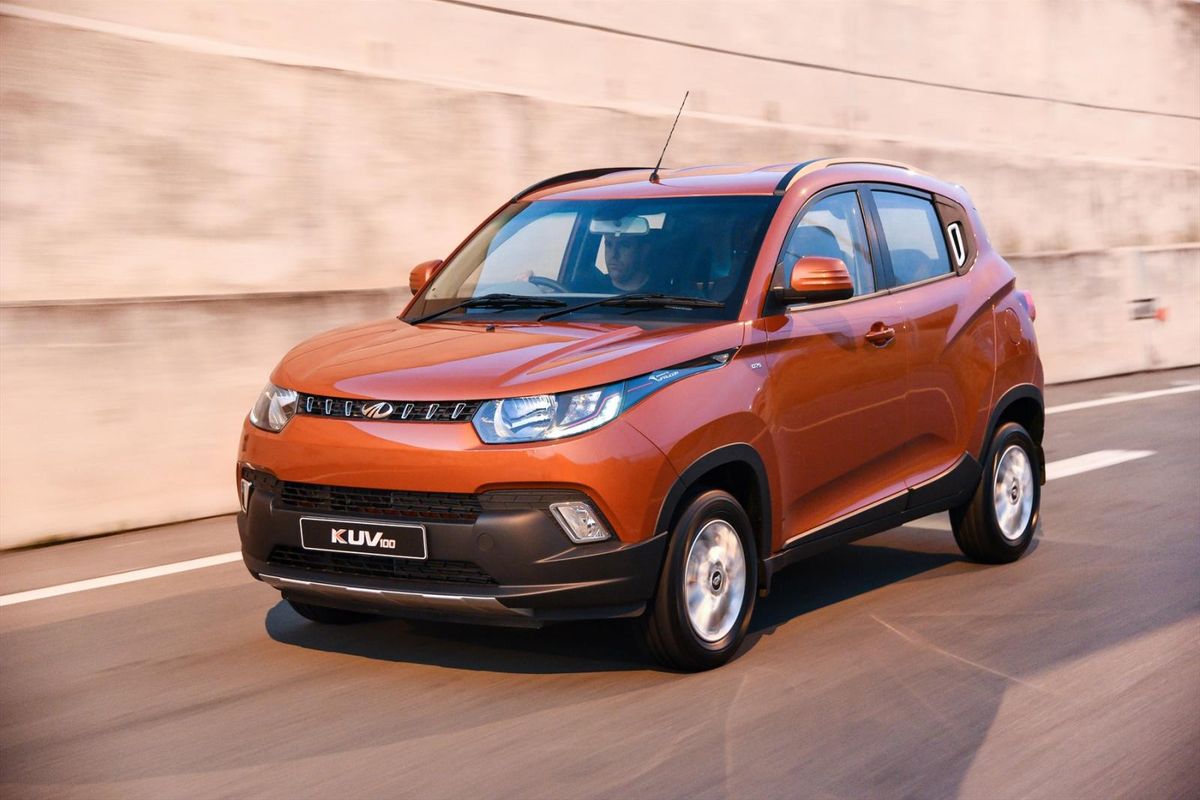
Mahindra has bolstered its local product line-up with the introduction of the new KUV100 small crossover, which becomes available this month.
The new KUV100 is targeted at buyers who would ordinarily be looking for a small hatchback, but the Mahindra offers additional ruggedness (thanks to its raised ride height), plus a modicum of versatility (characteristics typically associated with SUVs). The KUV100 is available with petrol and diesel engines driving the front wheels through a five-speed manual 'box.
"The KUV100 seeks to offer access to the benefits of SUV ownership, but linked to the affordability and lower running costs of a small hatchback. The result is a vehicle with broad appeal offering a strong value proposition," says Sanjoy Gupta, CEO of Mahindra SA.
Styling features
The KUV100 is built on an all-new monocoque platform that is both wider and taller than a hatchback of a similar length. The front end is defined by a recessed grille with a large, lower air intake. The headlights with integrated turn signals are relatively slim, with daytime running lights featuring on high-spec models. Contrasting body cladding is found on the front bumper, wheel arches and sills, while a front scuff plate adds to the KUV100’s rugged look. Roof rails and a rear spoiler are fitted to all derivatives in the KUV100 range.
The KUV100 has a ground clearance of 170 mm and comes fitted with 14-inch wheels as standard. High-spec models gain chrome inserts on the grille, alloy wheels, silver rear door handles, a roof-mounted antenna and front and rear fog lights with chrome surrounds.
Engine choice
The Mahindra KUV100 offers both petrol and turbodiesel engines.
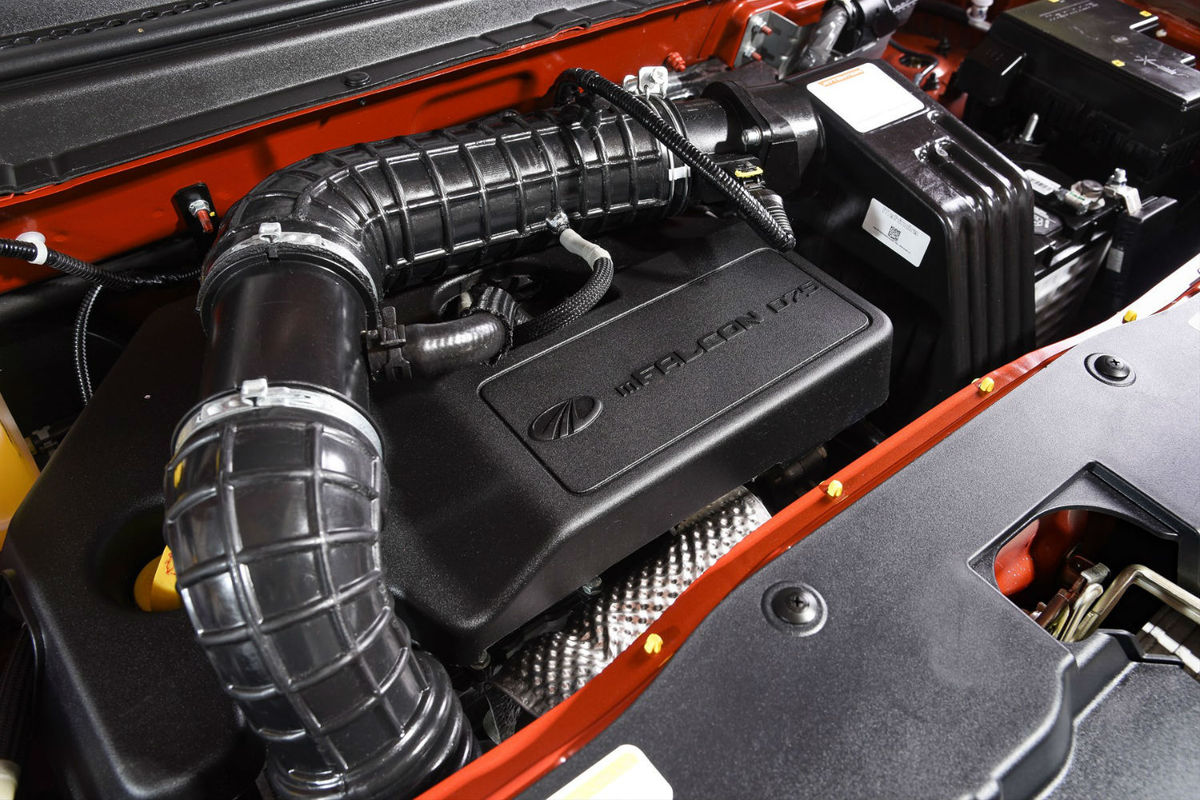
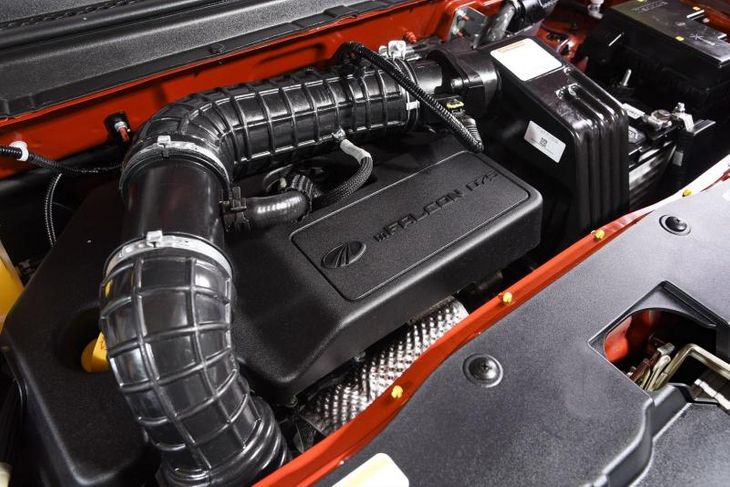
The 3-cylinder, 1.2-litre petrol engine produces 61 kW and 115 Nm of torque and is claimed to consume 5.9 L/100 km, while the 3-cylinder, 1.2-litre turbodiesel engine (57 kW/190 Nm) is said to have a combined fuel consumption of 4.4 L/100 km.
Model range
The KUV100 range consists of 5 derivatives and is available in 3 levels of trim. The range kicks off with the K4+, which is only offered with the petrol engine. This model rides on 14-inch steel wheels and features a tilt-adjustable steering wheel, electric windows, air-conditioning, manual central locking and a folding rear bench.
The next level up is the K6+, which can be had with both the petrol or turbodiesel engine. The K6+ adds features such as chrome accents for the grille, colour-coded door handles and exterior mirrors and door-side cladding. The B-pillars on this model are black and the derivative gains a roof-mounted antenna.
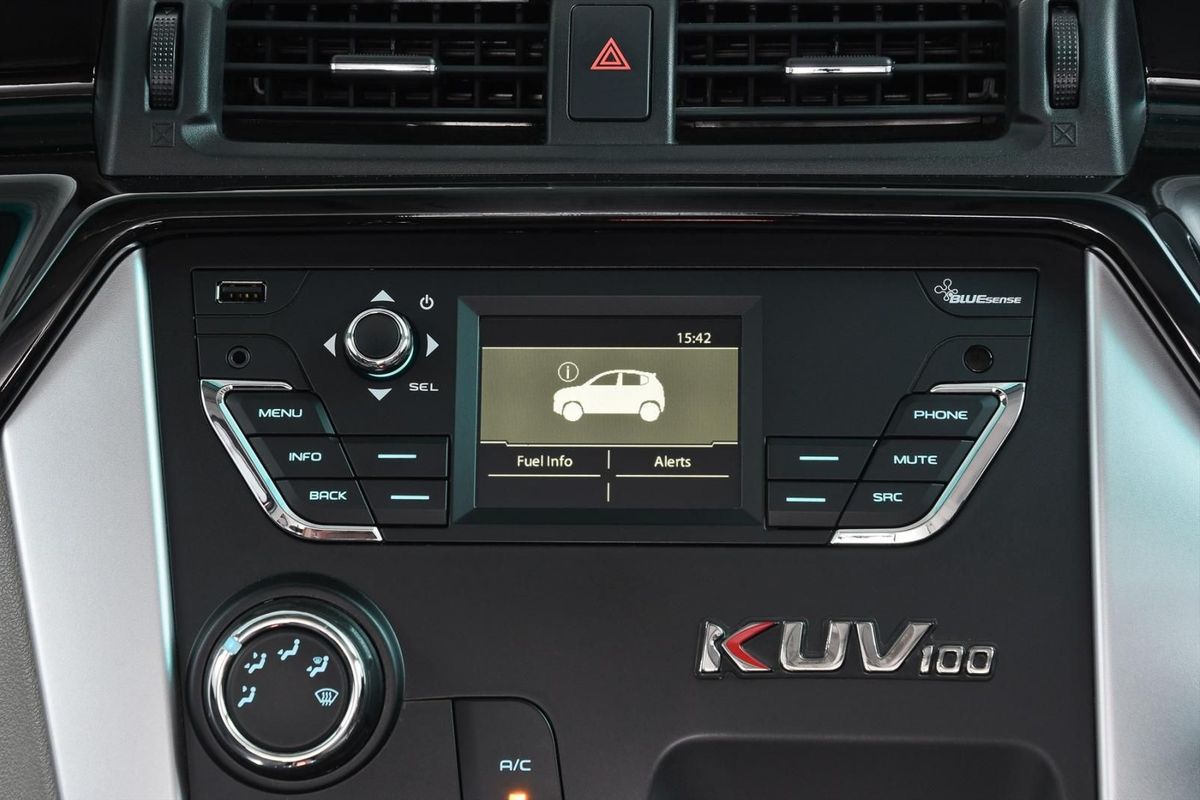
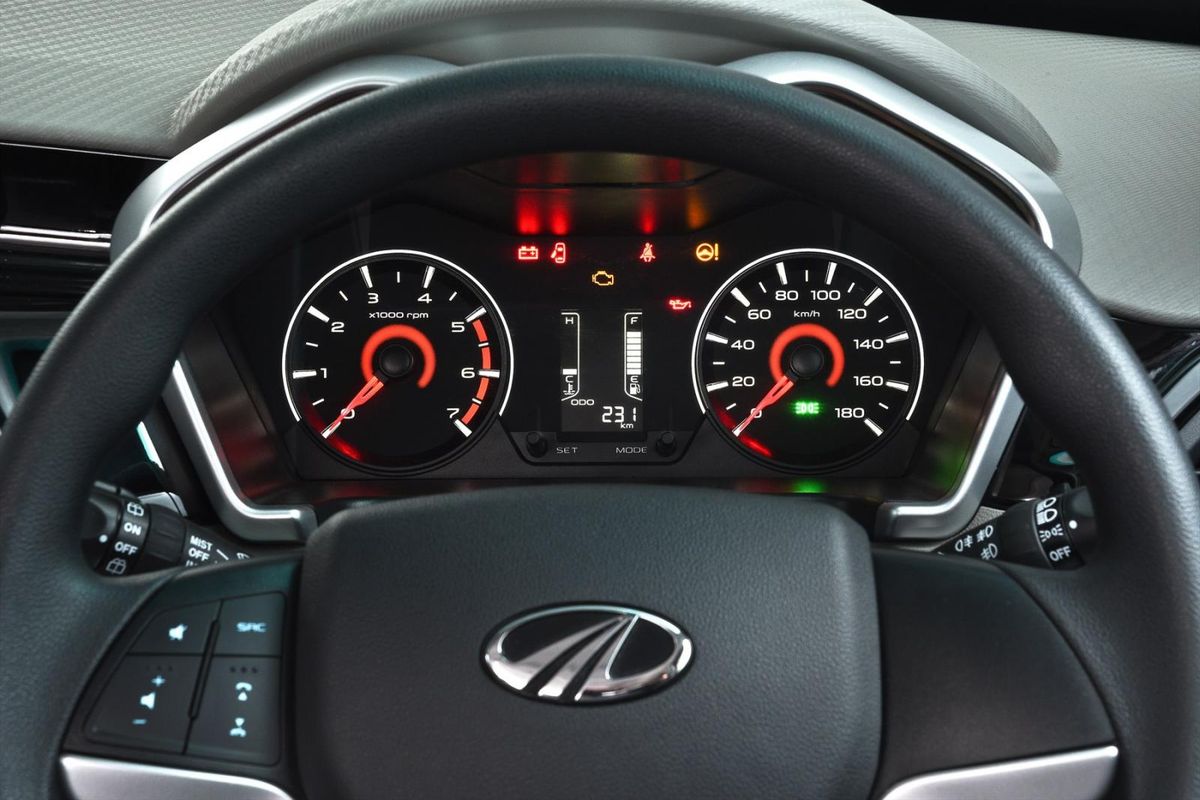
Inside, this model gains an infotainment system with a 3.5-inch display, multi-information display, Bluetooth and USB port. A multifunction steering wheel, a 6-speaker audio system and a cooled glovebox are also fitted. The K6+ also gains piano black inserts, a rear centre armrest, keyless entry and an anti-theft alarm.
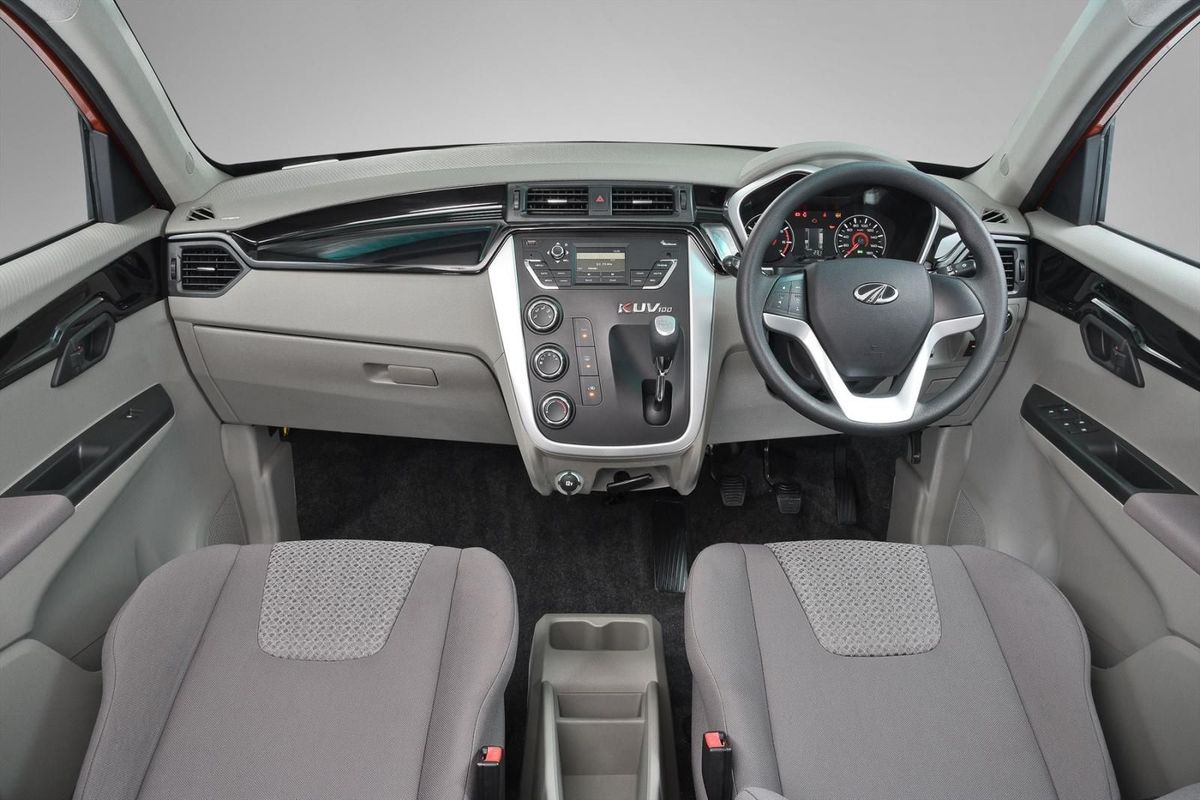
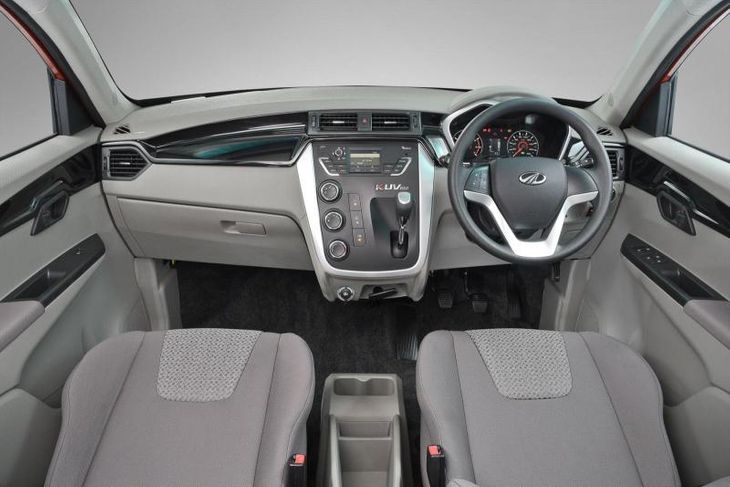
The gear lever in the Mahindra KUV100 is mounted in the dashboard to save space.
The final trim level is the K8+, offered with the petrol or turbodiesel engine. In addition to the features mentioned above, the K8+ adds daytime running lights, alloy wheels, front and rear fog lights, silver-accentuated rear doors handles and start-stop system for the turbodiesel derivative.
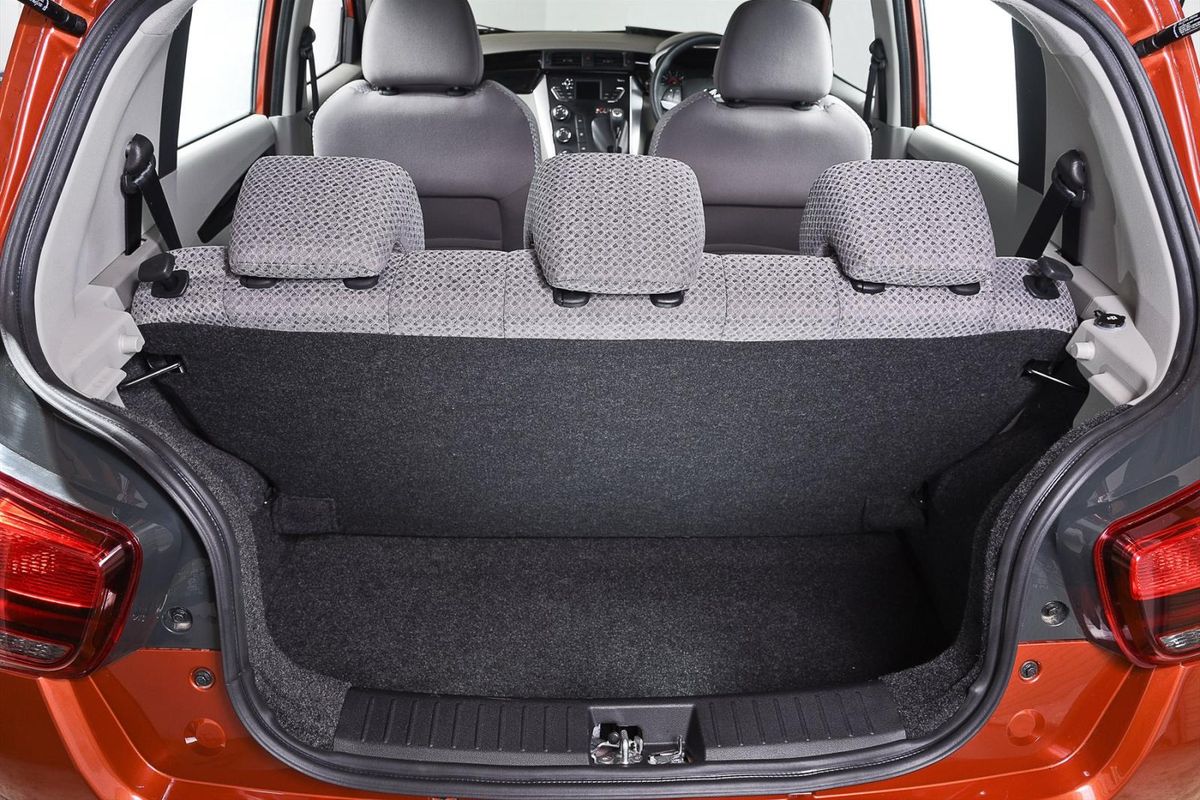
On the inside, the KUV100 features a stubby gear lever mounted in the dashboard, which affords the driver and passenger with more space. The seats are upholstered in fabric and the boot can accommodate 243 litres, increasing to 473 litres when you fold the rear seatback flat. A underfloor storage area is also included for additional stowage.
The steering wheel is tilt-adjustable and there are front and rear cup holders in the armrests as well as bottle holders in the door mouldings.
In terms of safety, the KUV100 features ABS with EBD, corner braking control and dual front airbags.
Mahindra KUV100 prices in South Africa (February 2017)
1.2 K4+ Petrol R154 995
1.2 K6+ Petrol R177 995
1.2 K6+ Turbodiesel R195 995
1.2 K8 Petrol R187 995
1.2 K8 Turbodiesel R205 995
Pricing includes a three-year/100 000 km warranty on all models, and a three-year/50 000 km service plan on the K6+ and K8 derivatives (optional for K4+).
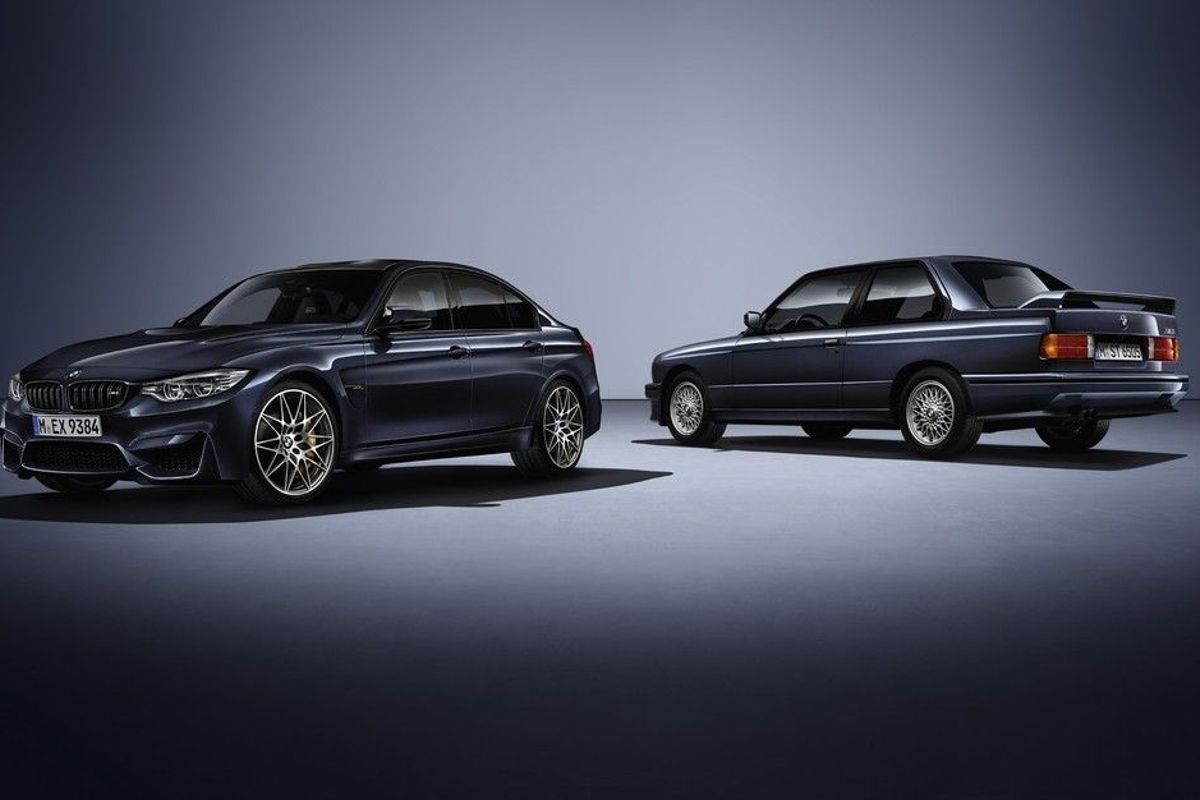
It’s been 30 years since the original M3 was introduced. BMW celebrates with a limited edition of the current generation.
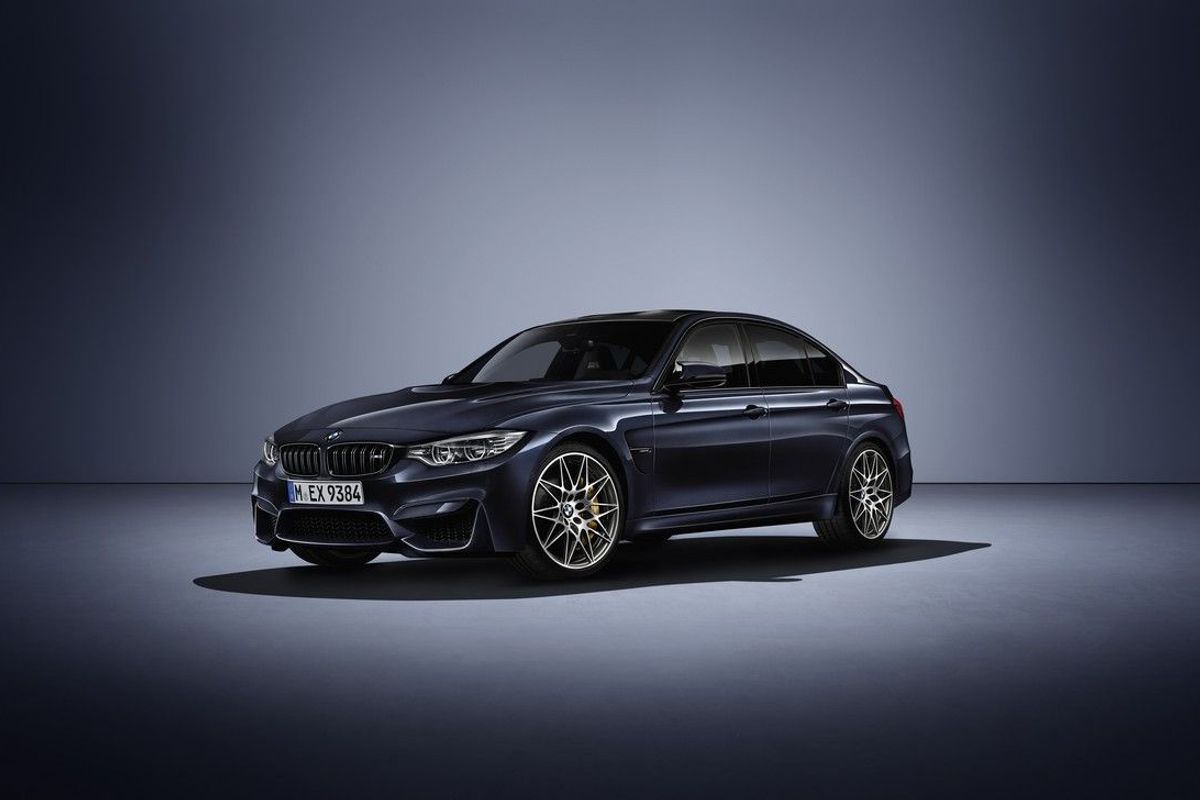
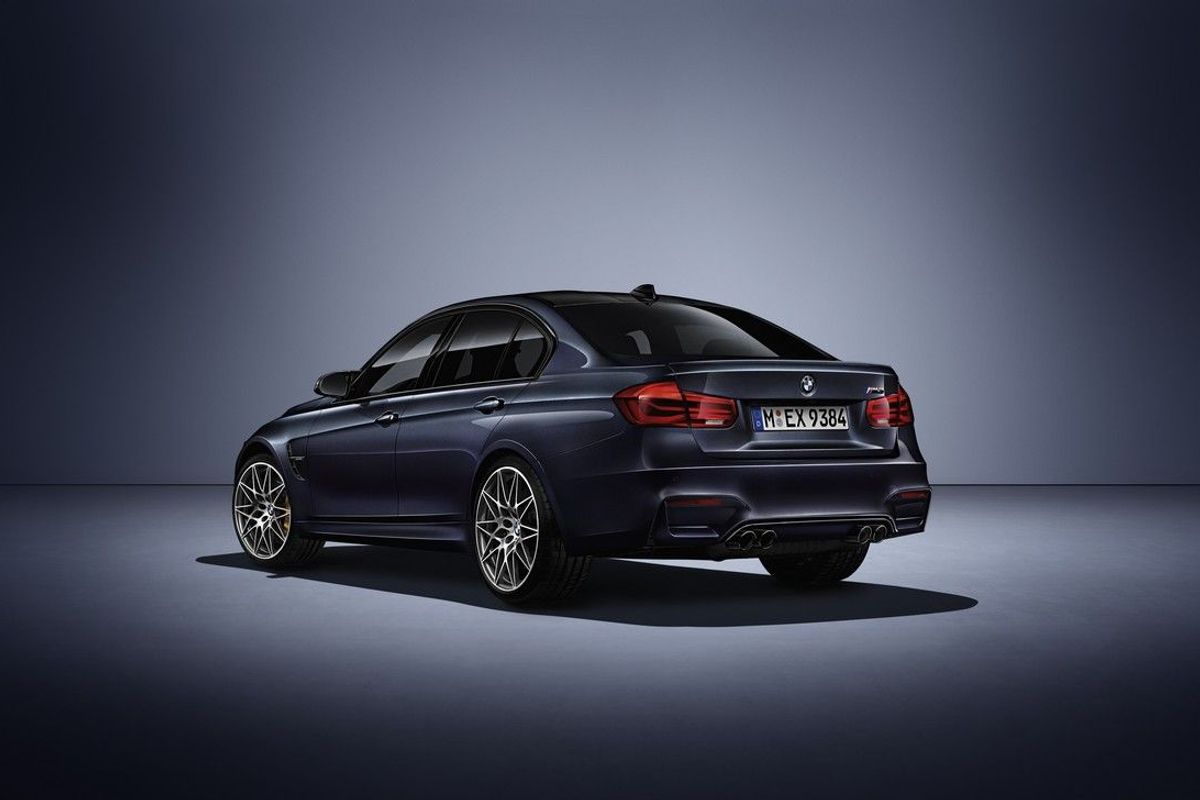
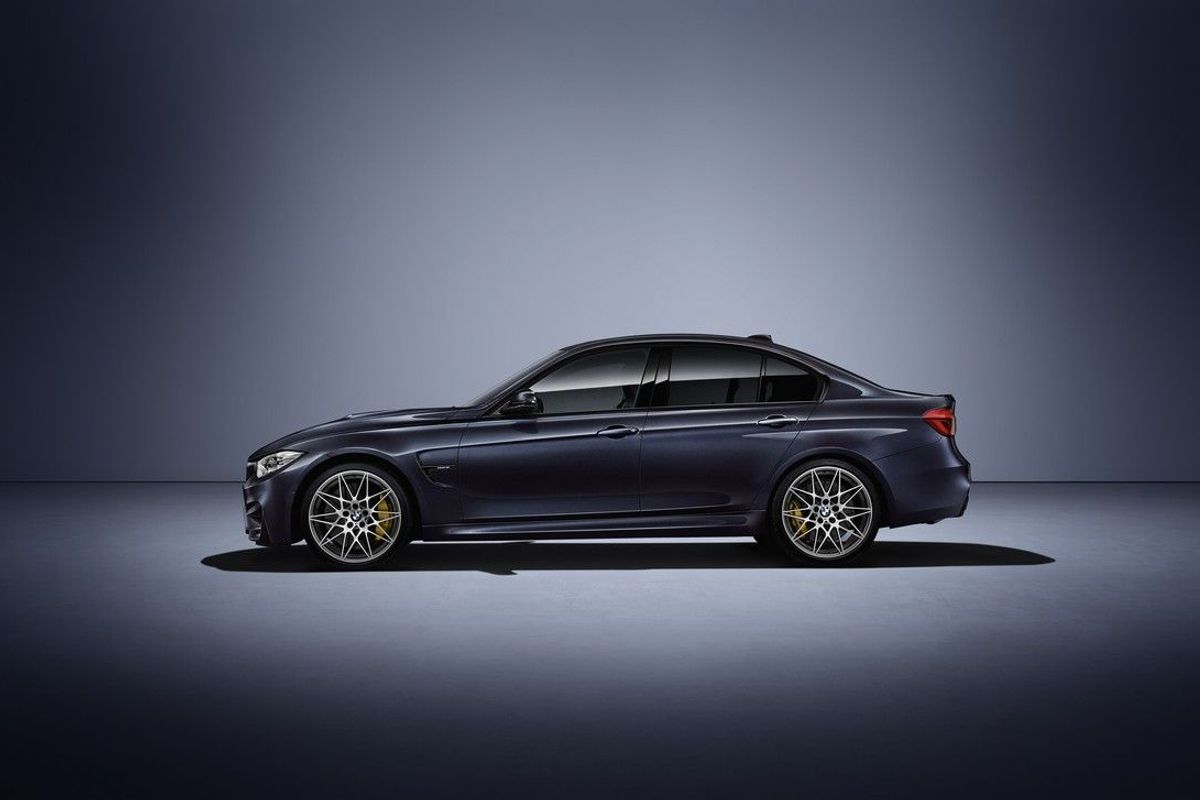
The BMW M3 “30 years of M3” is limited to just 500 units worldwide. It will also be sold in just one colour – Macao Blue Metallic. The colour is a throwback to the original M3 where the hue featured as a special option.
As for the details of the new special edition, it takes the Competition Pack M3 as its base and builds on from there. Power remains the same at 331 kW and the special edition also packs the Adaptive M Suspension as standard. Dynamically the special edition remains the same as the Competition Pack M3. Zero to 100kph remains the same at a blistering 4-seconds flat.
In addition to the Competition Pack, special 20-inch light-alloy wheels with a 666 M star spoke design are part of the deal.
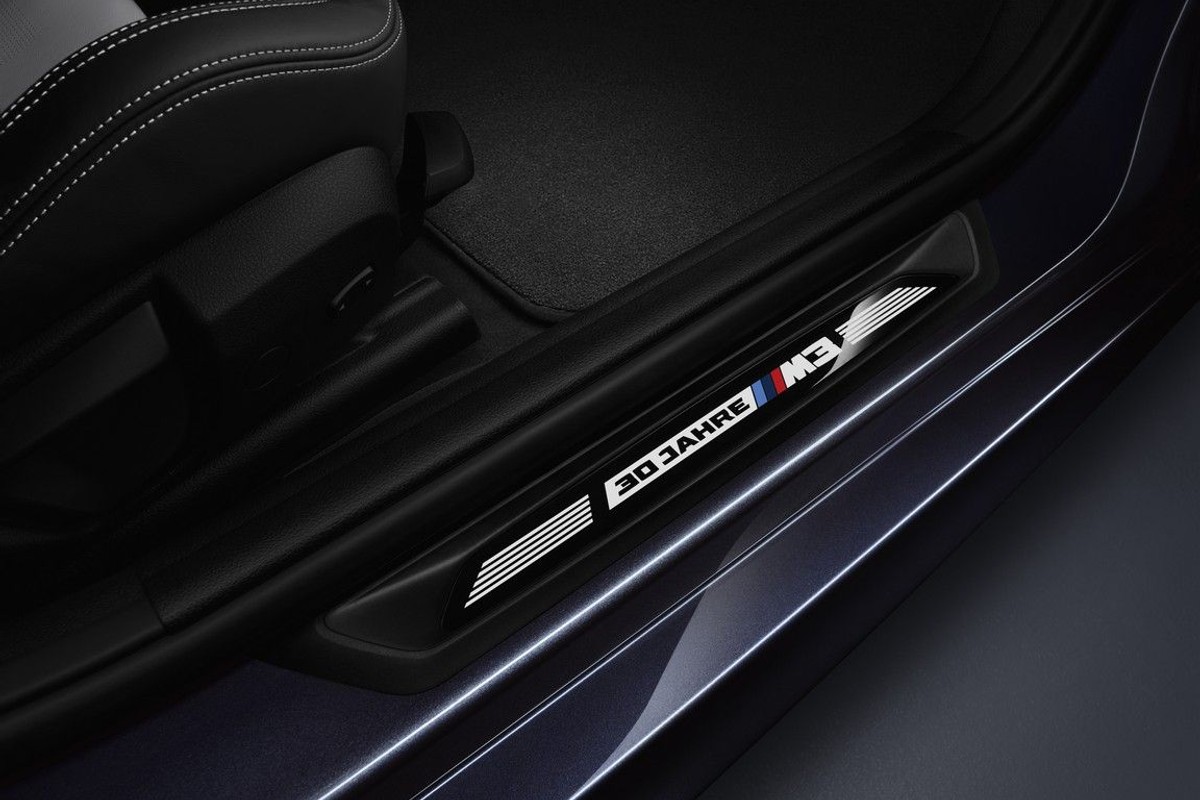
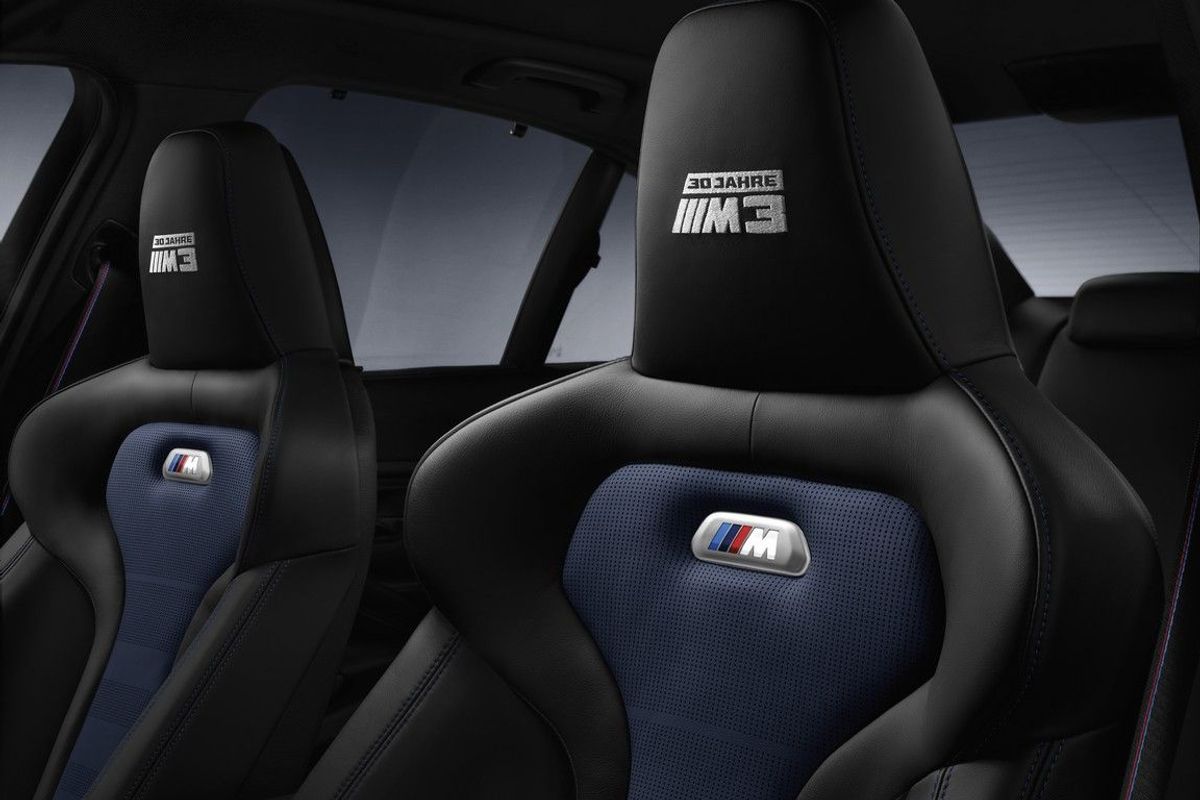
Inside this special edition, there a few other subtle changes. The logo “30 Years M3” is etched on the front doorsills. The wording “30 Years M3 1/500” on the carbon fibre interior trim strip of the instrument panel gives an indication of the exclusiveness of the BMW M3 “30 Years M3”. “30 Years M3” is again embroidered into the front headrests.
The cost of the “upgrades” for the special addition model amount to 10 000 Euros (est R170 000) on top of the Competition Package which, sells for R1 186 076 currently. South Africa has received confirmation that 30 units will be making their way here, so start saving now as the vehicles will be arriving around the third quarter of 2016.
Hyundai’s N division, the Korean marque’s performance arm, is planning to launch a sportier version of its i30 hatchback in 2017.
Last year, Hyundai introduced a sportier, N-inspired Sport version of its i20 hatchback in South Africa that offered 85 kW and 160 Nm of torque and although it offered marginally more power, racier packaging and a louder exhaust note than the standard i20 (74 kW/133 Nm), there wasn’t much for hot hatch aficionados to get excited about.
However, that may very well change if Hyundai goes ahead with the production of the i30 N, which recently took part in the Nürburgring 24-hour endurance race. According to reports, Albert Biermann, Hyundai’s Head of Vehicle Test & High Performance Development has confirmed that the i30 N will go into production in 2017.
Turbo Power for i30 N
The Hyundai i30 N is powered by a turbocharged 2.0-litre engine and even though its peak power and torque figures have not yet been confirmed, Hyundai has hinted that the engine should be capable of producing at least 194 kW and 309 Nm of torque. The powerplant will be mated with a manual transmission with a possibility of a dual-clutch automatic transmission being introduced at a later stage. The i30 N is expected to be a front-wheel driven model, but an all-wheel-drive configuration has not been ruled out.
According to Biermann, the i30 N will represent a "more affordable" alternative to other hot hatches on the market, such as the Volkswagen Golf GTI and the Ford Focus ST.
Given the fact that the i20 Sport is on sale in South Africa, there’s a strong chance that the i30 N will be offered to the local market in 2017, but this has not been confirmed… yet. We will keep you updated when more detail becomes available.