SUV Comparison: Ford Kuga vs Honda CR-V vs Subaru Forester
SHORT READ (1 minute)
LONG READ (5 minutes)
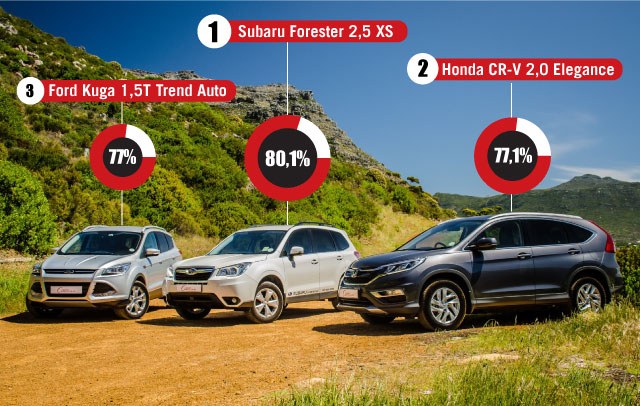
SHORT READ If you need a mid-size crossover/SUV and can't afford to wait for newcomers from Hyundai, Volkswagen and Kia coming in 2016, the Ford Kuga, Honda CR-V and Subaru Forester deserve your attention.
Exterior Design: The Ford is the winner due to its slick, upmarket looks and good detailing. By comparison the Honda is slightly too MPV-ish and the Subaru just rather bland.
Interior Design & Finish: The Honda sneaks a victory here by virtue of its combination of quality, MPV-like family friendliness and a modern, clutter-free facia.
Interior Features: The Ford takes a relatively easy win here due to the combination of its generous standard specification and low price, as well as attention to detail.
Practicality: The Honda’s family friendly design nets it an important victory here. With five seats taken, it offers the most boot space in a compartment that is also shaped to accommodate a wider range of objects.
Drivetrain & Refinement: Our testers voted the Subaru’s engine/gearbox combination as the best here. It delivers eager performance, impressive refinement along with a reputation for being very reliable.
Ride & Handling: An easy victory for the Subaru, by virtue of its impeccable road manners as well as superb dirt-road ability.
Safety Features: With similar results for crash safety by EuroNCAP, it is up to the Honda’s extra features to clinch it a victory in this section.
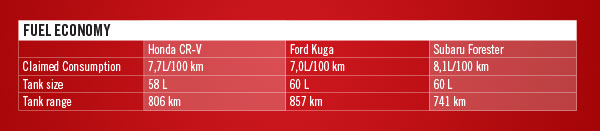
Fuel Economy: The Ford Kuga takes a narrow victory here based on claimed fuel consumption figures. Real-world figures are, however, significantly higher and brings it closer to its two rivals.
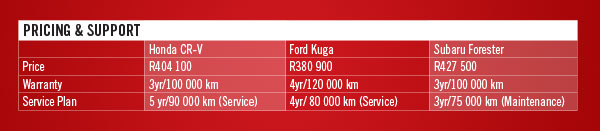
Pricing & After Sales: A narrow victory for the Ford here because it offers such outstanding value. But don’t discount the Subaru – it may look pricey on paper, but it’s actually well-priced for what it offers.
Verdict: The Forester’s engine is beautifully refined and responsive, the ride set-up strikes a great compromise between on-road comfort and off-road ruggedness and, save for the lack of leather upholstery and rear ventilation outlets, there isn’t really anything glaringly obvious missing from the specification sheet. Factor in a reputation for reliability and outstanding ownership satisfaction, and our test team voted its particular skill set as the most impressive of the three vehicles.
Introduction
The mid-size crossover/SUV segment is easily one of the busiest, and largest, in the market. Several of the best sellers in South Africa are due for imminent replacement. A new Hyundai ix35 (Tucson) is around the corner. And next year we can look forward to a new Volkswagen Tiguan as well as Kia Sportage. If you can’t wait for those, however, we suggest you take a close look at these three contenders… Lining up for an in-depth test is Ford’s popular Kuga, tested here in 1.5T Trend Automatic guise, Honda’s highly regarded CR-V 2.0 Elegance, and Subaru’s often ignored Forester, in 2.5 XS specification. We tested the threesome on a variety of roads (including gravel) and spent hours debating and measuring their cabins. The outcome may surprise you…
Exterior Design
|
Ford
|
Honda
|
Subaru
|

|

|

|

|

|

|


With design being such a subjective matter, it is often impossible to find agreement on this topic in a large test team. In this instance, however, the team was of the unanimous opinion that the Ford Kuga was the most attractive offering on test. Ford’s Trend specification is quite generous when it comes to the shiny bits, and as such the Kuga features neat 17-inch alloy wheels as standard, as well as front and rear fog lamps, silver roof rails, twin exhaust outlets and rear privacy glass.
Following its recent facelift, the Honda CR-V certainly appears more expensive and sophisticated, courtesy of a large helping of chrome and far more attractive head- and tail lamps that boast LEDs. It also rides on 17-inch wheels and gets rear privacy glass as well as roof rails. Given its emphasis on interior packaging, the exterior design makes it look bulkier than the suave and sporty Kuga.
The Subaru Forester is of course not a brand new vehicle anymore and it makes use of a fairly conservative design. Parked between its two rivals, it looks markedly narrower, a perception that is based in fact, as the tape measure shows. It is however, similarly high and long and boasts the best ground clearance here by some margin. Like the others, 17-inch alloy wheels are fitted as standard, as are roof rails and rear privacy glass.
Summary: The Ford is the winner due to its slick, upmarket looks and good detailing. By comparison the Honda is slightly too MPV-ish and the Subaru just rather bland.
Interior Design & Finish
|
Ford
No touch-screen in Kuga's otherwise smart cabin. |
Honda
High-placed controls boosts sense of space in CR-V. |
Subaru
Straightforward layout is a Forester hallmark. |


None of the vehicles here are brand new designs, so it shows in the cabins. The Ford has the most individualistic design, with a combination of sweeping curves and sharp edges. A small information screen is positioned high on top of a prominent control interface for the info-tainment system. We have clearly grown used to touch-screen systems, because the multitude of buttons on the Ford’s facia initially appears daunting. Still, with familiarity this element of intimidation (and fumbling) falls away.
By comparison the Honda and Subaru’s interiors look simpler and more modern because many of the controls have migrated to neat touch-screen systems. Interestingly, the screens in the two Japanese cars look and feel remarkably similar to use. Honda has taken an almost MPV-like approach with the design of the CR-V’s facia – it appears elevated, to create the sensation of space lower down and the gearlever is mounted high, too.
The Subaru, on the other hand, has a very straightforward design with almost no quirks. Build integrity appears good on all the vehicles, and soft-touch surfaces lift the perceived quality on all three cars, but it has to be said that it was the Subaru that felt the most solid, with not a rattle or squeak to be heard, even when traversing poor, corrugated surfaces. Also requiring some time to get used to is the Ford’s seating position, which even in its lowest position, subjectively “feels” higher than the other vehicles.
Nevertheless, it is a comfortable position once you’ve settled which also affords the driver great visibility out of the vehicle. All three vehicles boast rake/reach-adjustable, leather-wrapped steering wheels and height-adjustable driver seats, but the Subaru makes do with cloth upholstery while the Ford and Honda both feature leather.
Summary: The Honda sneaks a victory here by virtue of its combination of quality, MPV-like family friendliness and a modern, clutter-free facia.
Interior Features
|
Ford
Kuga's infotainment system is button heavy. |
Honda
Neat control interface for the CR-V. |
Subaru
Forester offers very simple ergonomics. |
|
Flip-up trays a welcome Kuga touch. |
CR-V even offers an HDMI input.? |
Simple but effective extended sun visors. |


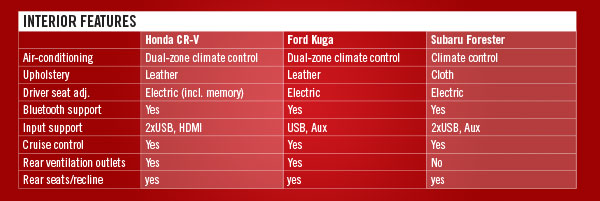
Ford has been on a real run of late in the way it offers exceptionally generously specified vehicles at good pricing. The Kuga is no different and the Trend specification, as tested here, is particularly well stocked with features. You get dual-zone climate control, cruise control, Ford’s SYNC info-tainment system with Bluetooth and USB/Aux support, electrically adjustable driver seat with lumbar support and heated front seats, among a number of other items. The front passenger seat is also adjustable for height, albeit manually, and at the rear there is a handy 230V/150W power outlet as well as flip-up airline-style trays for kiddies. Also important for those long trips are rear ventilation outlets and rear seats that offer reclining backrests.
The Subaru, by comparison, is not quite as generously specified. We’ve already mentioned that it lacks leather upholstery, but it also makes do with only single-zone climate control and there are no rear ventilation outlets, either. In fact, barring very welcome extendable sunvisors and a particularly large storage box between the front seats, it would appear as if Subaru’s designers didn’t feel the need to add surprise-and-delight touches to the Forester’s straightforward cabin. It does, however, still offer an electrically adjustable driver seat, keyless access and two USB ports as well as Aux support for the info-tainment system.
The Honda comes closer to matching the Ford’s specification, as it comes with dual-zone climate control, rear ventilation outlets and heated front seats. Both front chairs offer electrical adjustment, by the way, with the driver’s adding memory settings and height adjustment. On the info-tainment side, the Honda gains an HDMI port, but loses Aux support. A nice touch is an overhead “child view” monitor, which again illustrates the CR-V’s near MPV-levels of family friendly interior design.
Summary: The Ford takes a relatively easy win here due to the combination of its generous standard specification and low price, as well as attention to detail.
Practicality
|
Ford
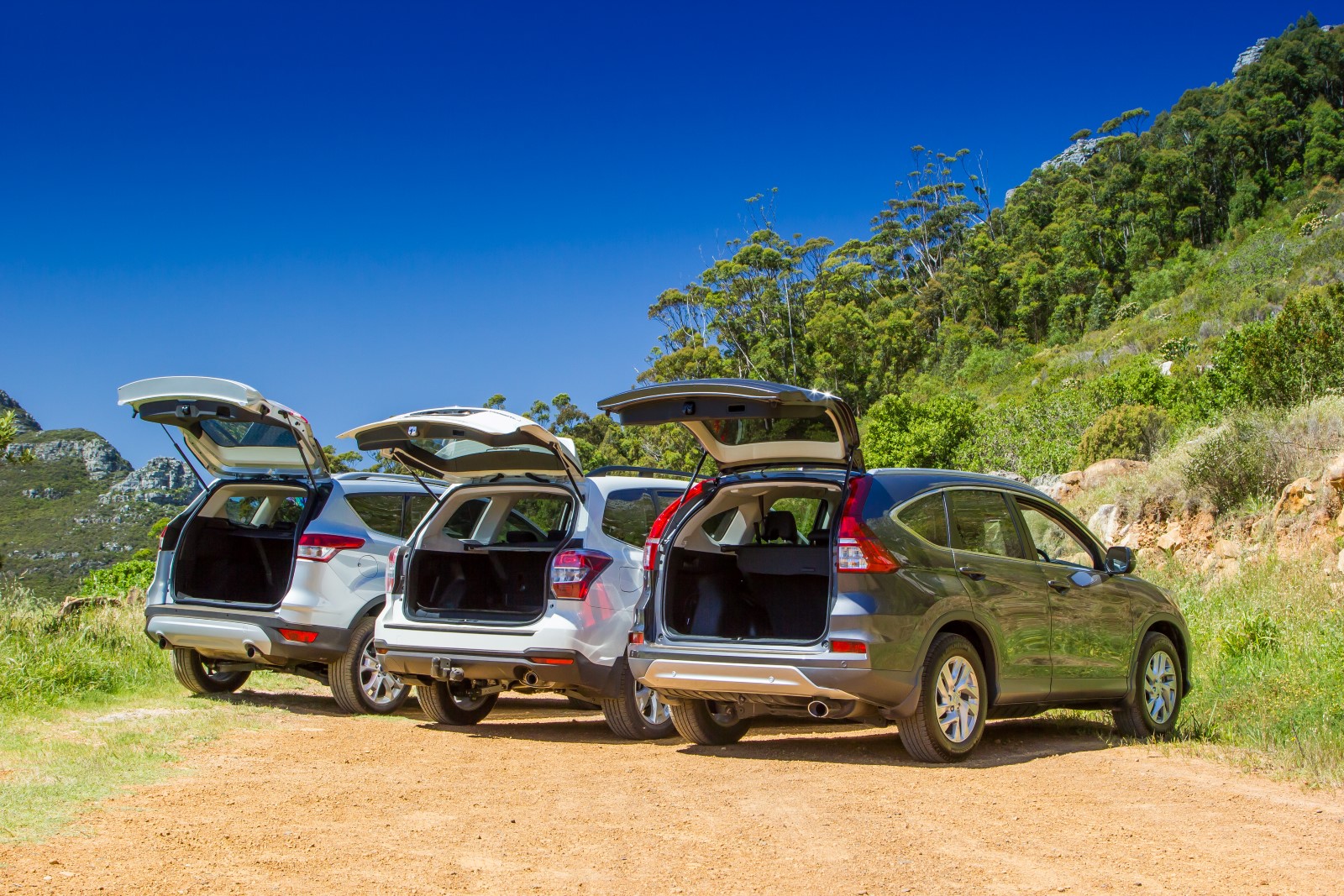
Kuga's tailgate lifts highest, but seats can't folded down from the rear. |
Honda
CR-V rear seats can be folded while standing behind the vehicle. |
Subaru
Like the Honda, Forester's rear seats can be folded from behind. |


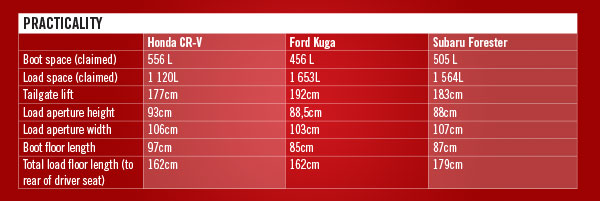
The Honda’s boot area itself is also clearly larger than the others, but it’s not only more voluminous, it is also better shaped – the boot floor is significantly longer than the others at 97cm (compared with 87cm for the Forester and 85cm for the Kuga). Fold down the rear seats, which is easily done in the Honda and Subaru via buttons or levers in the boot, and the picture changes quite dramatically.Thus far we’ve mentioned the Honda CR-V’s MPV-like design rather often. This approach certainly pays off when it comes to practicality. Honda claims a boot volume of 556L for the CR-V, with the Subaru coming in at an impressive 505L and the Ford at 456L.
The Honda feels the most spacious to passengers, mostly because of the extra height in the cabin. Rear legroom is very good on all three vehicles, and the doors open wide to almost 90 degrees on all three contenders – this provides easy access to the rear seats for the fitment of a child seat, etc. Towards the rear the differences become more pronounced. The tailgate on the Ford lifts the highest (1.92m). Tall folks will have to keep an eye out for the Honda’s tailgate on the other hand, as it lifts to a comparatively low 1.77m. With regards to the width of the loading aperture, the vehicles posted similar results, but the Honda has the highest opening, making the loading of bulky/large objects potentially an easier affair.
Interestingly, however, the roles are reversed once the seats are folded down. Honda claims only 1120L of utility space, with the Subaru at 1564L and the Ford at a surprisingly large 1653L. But because manufacturers use different ways of measuring utility space, we decided to get out the tape measure and do some measuring ourselves… with interesting results. Let’s get the similarities out of the way first.
According to our tape measure, it is the Subaru that has the longest load area, with the Ford and Honda being pretty much identical in length. The Subaru and Honda cabins are also marginally wider (around rear occupants’ shoulders) than the Ford’s.
Summary: The Honda’s family friendly design nets it an important victory here. With five seats taken, it offers the most boot space in a compartment that is also shaped to accommodate a wider range of objects.
Drivetrain & Refinement
|
Ford
Awkwardly placed manual gearshift button for Kuga. |
Honda
Simple, neat analogue/digital instruments in the CR-V. |
Subaru
X Mode indicative of Subaru's rough-road intentions. |


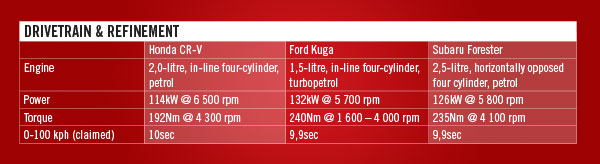
Open the Honda’s bonnet and you’ll find a surprisingly small engine in there, a 2.0-litre normally aspirated unit that delivers 114 kW and 192 Nm of torque, the lowest outputs here. Being a Honda engine, it also needs revs (4 300rpm) to achieve that maximum torque figure. Sending the engine spinning is no hardship, however, as it is a sweet-revving unit that is mated with a typically Honda-slick six-speed manual transmission. Of course, for slightly more money, you can get this engine paired with a five-speed automatic, which given the likely usage of this vehicle, makes more sense. Even so, there’s no question about the Honda’s relative lack of performance compared with the other two cars here.
The three contenders use rather different powertrains at this price level. The Ford is the most modern, with a turbocharged small-capacity engine of 1.5-litres that is claimed to offer big-engine performance without the fuel consumption penalty. It certainly delivers on the performance front, with a power output of 132 kW, the most here. It also has the most torque (240 Nm), and achieves the maximum output at lower engine speeds (from 1 600rpm to 4 000rpm). No surprise, then, that it clocks the equal fastest 0-100kph sprint time (9.9sec). In our test car, the engine was mated with Ford’s six-speed automatic transmission that offers manual shifting via awkwardly placed buttons on the side of the gearknob.
The Forester is, of course, powered by the brand’s trademark 2.5-litre “boxer” engine. This means the cylinders lie flat, to great advantage of the centre of gravity of the vehicle’s powertrain. It is a powerful unit, too, with 126 kW and 235 Nm of torque, only marginally less than the turbocharged Ford. The Subaru engine is normally aspirated, so there is no expensive turbocharger maintenance or replacement costs to worry about in the long term. The engine is mated with Subaru’s continuously variable transmission (CVT) that is easily one of the best of its type. The driver can also change gears “manually” via neat shift paddles behind the steering wheel. It is the Subaru powertrain that impressed most, with the software of the CVT being particularly quick to react to driver inputs, resulting in immediate response when the throttle is depressed. It’s a car that consequently feels eager and sporty to drive, yet is also impressively refined.
The Ford is also very good, particularly on the open road, but it’s not as refined as the Subaru and the power delivery is not as linear, either. And the Honda? It’s not as lazy as the figures make it appear and the gearbox is a good one too, if you don’t mind shifting gears yourself. And, like all Honda engines, it is a very refined unit that should be bulletproof.
Summary: Our testers voted the Subaru’s engine/gearbox combination as the best here. It delivers eager performance, impressive refinement along with a reputation for being very reliable.
Ride & Handling
|
Ford
Kuga is great on tar, slightly less so on gravel. |
Honda
Refined CR-V surprisingly at home on gravel. |
Subaru
Forester is the gravel-road specialist. |


Perhaps surprisingly, the Honda felt quite at home on gravel, managing to soak up much of what our test road served up without losing its composure and remaining largely rattle free in the process. On tar the trade-off is a somewhat less entertaining drive, however, than the Ford. That said, for the target market, its softer set-up is probably nearer the desired mark. It’s not a vehicle for the “enthusiastic” driver.All three test vehicles ride on sporty 17-inch footwear, but manage to offer decent ride comfort, but there are marked differences. The Ford puts in a sterling performance on the road, where its suspension feels supple, yet firm enough to counter excessive bodyroll in the corners.
As is the case with most Fords, there is a delicacy to the steering and a crispness to the responses that belies its family friendly packaging. Unfortunately, it’s less impressive when the road surface deteriorates or turns to gravel. In the latter instance the relative firmness that lends the Kuga such impressive on-tar ability becomes a nuisance, resulting in a comparatively skittish feel that also set off a number of rattles and squeaks in the cabin.
The Forester, on the other hand, manages to serve up a ride/handling compromise that is simply sublime, no matter what the road surface. Even if you take out of the equation its symmetrical all-wheel drive, which gives it remarkable grip and composure on poor surfaces, the ride seems better set-up than on its rivals. It irons out road surface imperfections and yet feels good in the corners too. Yes, there is still some rally DNA left in this car… It may not be entirely fair to compare this all-wheel drive version of the Forester with front-wheel drive versions of the Ford and Honda, especially seeing as an all-wheel drive version of the Kuga is available at a cheaper price than the Forester, but based on what we know of the Kuga all-wheel drive, the Subaru would still put in a more impressive performance overall.
The Subaru’s symmetrical, permanent all-wheel drive system also creates a great sense of security on poor road surfaces (or during bad weather), and the X-mode system adds even hill-descent control. It also offers the most generous ground clearance, so for buyers who intend doing regular driving on poor or gravel surfaces, it is by far the best choice here.
Summary: An easy victory for the Subaru, by virtue of its impeccable road manners as well as superb dirt-road ability.
Safety Features
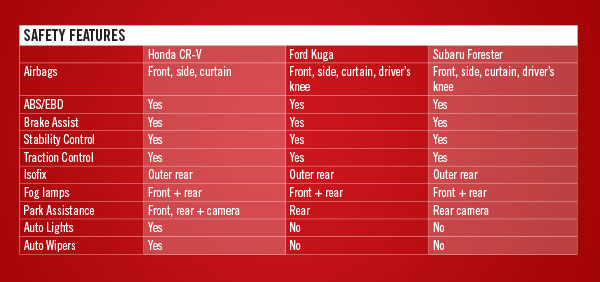
As is to be expected at this level, all the vehicles boast the essentials such as ABS/EBD, Brake Assist, traction control, stability control, Isofix child seat anchors and a raft of airbags (six for the Honda and seven each for the Subaru and Ford). The Honda is best equipped to avoid those nasty parking incidents as it offers not only front and rear park distance control, but also a camera. The Forester has only a rear-facing camera while the Ford has no camera but rear park sensors. All three cars have front and rear fog lamps, but only the Honda offers auto lights and wipers. Interestingly, while both the Honda and Subaru feature full-size spare wheels, the Kuga makes do with a temporary spare – not ideal for a family crossover vehicle.
Summary: With similar results for crash safety by EuroNCAP, it is up to the Honda’s extra features to clinch it a victory in this section.
Fuel Economy
With a claimed consumption figure of 7L/100km, the Ford Kuga should be significantly more economical than its two rivals. In reality however, it proved difficult to keep the consumption below 10L/100 km. It’s still more economical than the Honda (claimed 7.7L/100km) and Subaru (claimed 8.1L/100km) in the real world, but it’s far closer than you may think.
Summary: The Ford Kuga takes a narrow victory here based on claimed fuel consumption figures. Real-world figures are, however, significantly higher and brings it closer to its two rivals.
Pricing & After-Sales
With a price of R380 900 as tested, the Kuga offers unbeatable value in this test. If you should need all-wheel drive, such a model, equipped with an automatic transmission, is available for an outstanding R408 900. By comparison the Honda CR-V looks relatively overpriced, given the fact that it is positioned at R404 100 and offers neither all-wheel drive nor an automatic transmission, as tested. In fact, while an automatic version of the CR-V you see here is available for a reasonable R419 100, you’ll have to go for the R520 900 2.4-litre Executive if you want all-wheel drive… Then again, the CR-V specification is certainly generous.
And the Forester? Well, it is the most expensive of this trio but keep in mind that you get not only the impressive Continuously Variable Transmission (CVT) but also all-wheel drive. And… a full maintenance plan as opposed to the service plans offered by the competition. It may lack some of the nice-to-have features of the others, most notably leather upholstery and perhaps auto lights/wipers, but it hits back with mechanical hardware which the others can’t match. In terms of back-up, Ford easily has the widest service network, but Honda and Subaru owners are among the most satisfied in the market.
Summary: A narrow victory for the Ford here because it offers such outstanding value. But don’t discount the Subaru – it may look pricey on paper, but it’s actually well-priced for what it offers.
Verdict
When we initially compared specification and pricing, we were left with the expectation of a relatively easy victory for the Ford. The reality, however, turned out to be rather different. Firstly, the vehicles tested here are not direct rivals. Let’s use the Subaru Forester as the basis for comparison, as it has all the hardware – all-wheel drive and an automatic transmission. If you need this combination, then you have to spend more than R500 000 to get a Honda CR-V, but less than R410 000 to get a Ford Kuga. In that context, the Ford looks like outstanding value and we can see why it is such a strong seller. But throughout the duration of this test the Subaru Forester made an increasingly louder and convincing purchasing argument. In terms of mechanical hardware, it is the most impressive vehicle here.
The Forester’s engine is beautifully refined and responsive, the ride set-up strikes a great compromise between on-road comfort and off-road ruggedness and, save for the lack of leather upholstery and rear ventilation outlets, there isn’t really anything glaringly obvious missing from the specification sheet. Factor in a reputation for reliability and outstanding ownership satisfaction, and our test team voted its particular skill set as the most impressive of the three vehicles. Well done, Subaru! But… as ever, things are not always as simple as that. There’s no bad choice here and personal requirements will be the deciding factor in most instances.
Buy the Ford if getting the most for your money takes precedence. Opt for the Honda if cabin space and long-term reliability are key factors. If you anticipate a lot of gravel road driving and overall driving enjoyment is important, then the Forester is a must.