Volkswagen Golf SV 1.4 TSI Comfortline DSG (2015) Review

The MPV segment in South Africa is currently experiencing something of a resurgence. Motor vehicle data specialist, Lightstone Auto, reports steady increases in MPV market share in the passenger vehicle market for 2015. More so, the growth in demand for MPV’s can be attributed to the introduction of new products such as the BMW 2-Series Active Tourer and the Honda Mobilio and Suzuki Ertiga. Interestingly, Lightstone also reports very strong growth for crossovers (up 26,7% already in the first four months of 2015), but the sedan market remains under pressure.

With the arrival of Volkswagen’s new Golf SV we can expect the MPV market to grow even further, adding to the sedan segment’s suffering. Of course, Volkswagen already offers the Touran MPV, too.

The arrival of the Golf SV at the Cars.co.za office in Cape Town sparked a level of excitement as we needed a vehicle for a trip down the Garden Route. The Jaguar Simola Hillclimb in Knysna was our destination and the Golf SV was chosen to make the trip as part of this review. How would it fare on a long-distance drive?

The model on test here is the Volkswagen Golf SV 1.4 TSI Comfortline Automatic in Tornado Red.

Practical Interior

Packing a car for a long journey is the best way to test loading capacity. Throw three surfers into the mix and things get complicated very quickly. Practicality however is one of the SV’s core strengths, and thanks to an extended wheelbase, a longer, wider and taller body compared to the Golf hatchback, the SV is surprisingly spacious.

With a boot capacity of 500L and a 60:40 split rear bench that can slide forwards and backwards independently to increase space, the Golf SV can cope with just about any kind of load. The SV swallowed three surfboards with ease and there was still ample space for luggage, camera equipment and other surfing paraphernalia. With the rear bench folded completely flat, space increases to a generous 1 520L if need be.

Other cool practical additions include bottle holders in all the doors, a centre armrest with integrated storage compartment and two cup holders as well as a storage bin on the dashboard. This Comfortline model also comes fitted with tray tables for rear seat passengers and under-seat storage drawers. Interior optional extras fitted to this model include a panoramic sunroof (R9 200), leather seats (R11 500) and a 5.8-inch Composition Media Radio (R3 500).

Much like the Golf, the interior build quality in the Golf SV is of a good standard with quality fit and finish, which is difficult to fault.

On The Road

This particular Golf SV derivative packs a turbocharged 1.4-litre petrol engine with 92 kW and 200 Nm of torque at your disposable. Power reaches the front wheels via a 7-speed DSG transmission. This derivative can also be had with a 6-speed manual transmission.

The open road is where the Golf SV proved its worth. The suspension is on the firm side, but not too firm, which means that the SV soaks up bumps reasonably well. This test unit is fitted with 16-inch ‘Toronto’ alloy wheels and the ride quality in the Golf SV is to be commended, as it provides good feedback through the steering wheel and delivers a comfortable overall driving experience. Overtaking is simple, with the tiniest pause from the DSG as it quickly downshifts to an appropriate gear and into the power band. Once the power tap is turned on, there’s more than enough grunt to get the job done quickly and swiftly.

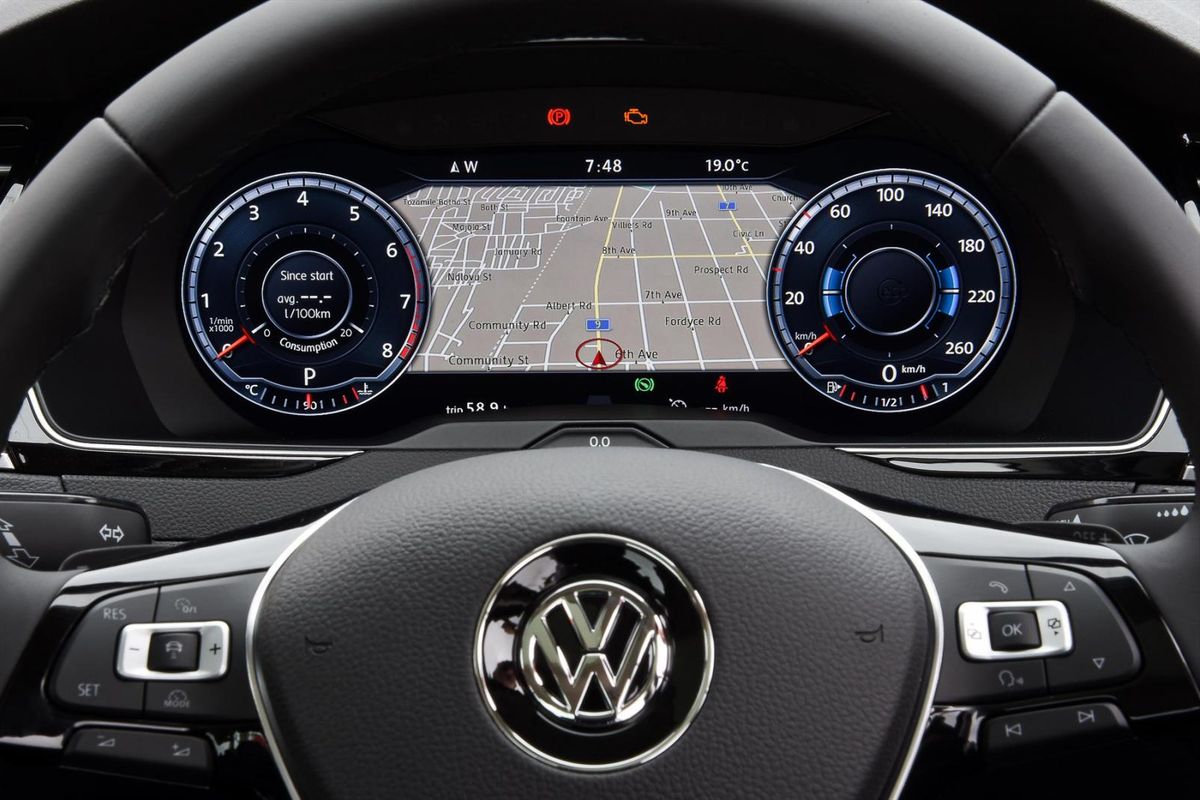
Cruise control made the drive to Knynsa that much more relaxing and is fitted as standard on this Comfortline derivative. The cruise control is activated via the multi-function steering which is also rake and reach adjustable. With BlueMotion Technology, emphasis is placed on economy. Volkswagen claims 5.2L/100km on the combined cycle. My long-distance trip on the open road returned a real world figure of 7.2L/100km, which is okay for a fully loaded MPV.

Comprehensive Features

The Golf SV is well equipped with a raft of safety features as standard. These features include a total of seven airbags, Electronic Stability Control (ESC), traction control, ABS with EBD and Brake Assist, XDS electronic differential lock, Multi Collision Brake, tyre pressure monitoring system and ISOFIX mounts on the rear bench. Our test unit was also fitted with the optional Park Distance Control (R4 500) and Light Assist (R1 100) which provides additional side lighting when turning into corners.

Verdict

If you are looking for a practical car, then the Volkswagen Golf SV is a winner with its impressive interior space and flexibility. In addition to this, the Golf SV, in my opinion, is a superb car to drive on a daily basis thanks to high comfort levels and performs exceedingly well on those longer journeys.

Although the Golf SV has lots of features, it comes up against some stiff competition in the MPV segment in the form of the Opel Meriva, Mazda5, Citroen C4 Picasso and Peugeot 3008. Optional extras are expensive too, so pick wisely. Buyers are advised to compare the Golf SV with its competitors here before making a final decision. Note, also, that in terms of overall packaging and design, the Golf SV makes an excellent (and much more affordable) alternative to premium-badged vehicles such as the Mercedes-Benz B-Class and BMW 2 Series Active Tourer.

Second Opinion

I only drove the Golf SV for a day, but was impressed by its build quality and ride comfort. It really is an impressive piece of kit and a vehicle that punches about its weight in terms of premium fit and finish. The engine is a good one and I have only positive words to say about the DSG transmission. If transporting people and practicality is your thing, then the Golf SV is a good choice. If you’re after something similar, but are budget conscious, then the Opel Meriva will do just as good a job. – David Taylor

Volkswagen Golf SV Price in South Africa

The Golf SV range starts off with the 1.2 TSI Trendline manual priced at R292 500. The 1.4 TSI Comfortline manual is priced at R325 200 with the DSG derivative priced at R340 700. The unit on test here came in at R370 500 with all the optional extras fitted. There’s also a 2.0 TDI on offer at R343 700 for the manual and R359 200 with a 6-speed DSG.

Prices include a 3-year/120 000 km warranty, 5-year/90 000km service plan with service intervas set at 15 000km as well as a 12-year anti-corrosion warranty.

We Like: Practicality, comfort, space

We Don’t Like: Expensive options

Also Consider: Opel Meriva, Peugeot 3008, Citroen C4 Picasso, Mazda5

Compare the Golf SV with its competitors here

Volkswagen Golf SV 1.4 TSI Comfortline DSG Quick Specs
VW Golf SV

Mercedes AMG C63 (2015) First Drive

The previous-gen Mercedes Benz C63 was a conundrum. Enthusiasts loved it for having the gruffest exhaust note on the planet and acceleration to roll your ear-lobes back, but purists tended to bemoan the fact that it could be a wayward beast. Also, it’s rock-hard suspension set-up rendering it somewhat schizophrenic on road surfaces anything less than smooth.

Enter the all-new Mercedes AMG C63 and note the name change. Based on the car (known internally as the W205 series) that scooped the World Car of the Year prize for 2014, much has been expected of the new Big Bad Wolf. And let us state from the start that the new car has an entirely different power-plant compared to the out-going car  and a new set of table manners to go with the new body style.

Monster Powerplant

Replacing the massive naturally-aspirated 6.2-litre V8 that pumped out between 336 and 375 kW and 600 Nm of twist (depending on the hotness ordered)  is the all new 4.0-litre twin-turbo V8 that will form the bedrock of AMG engineering for the next few years, and used in the stunning new AMG GT sports car due for launch here in mid-year. The smaller engine is lighter and extremely compact, a significant packaging factor for the C 63 being that the turbochargers are located within the cylinder banks, which means better heat exchange and less pipework.

The compact twin-turbo produces 350 kW in “normal” C 63 form and 375 kW in the S model, these being the two cars that are being launched right now. No doubt there will be even more special versions available during the car’s life-cycle, as there has been with the previous-gen Mercedes cars using the big V8.

Significantly, torque on the new car is up to 650 Nm on the standard model and 700 Nm on the S, and it is available through a broad rev-spread of 1 750 to 4 500 rpm. Happily from a Mercedes-AMG company perspective, massive fuel economy gains have been achieved with the car, Merc claims a 32% reduction in overall consumption! Overall combined consumption tests rate the car at 8.2 to 8.4L/100, but of course you will get nowhere near that if you own one, and you probably won’t care!

Gearbox and Interior

The new engine is mated again to a  seven-speed full automatic, fluid-drive  electronic lock-up gearbox (rather than a double-clutch ‘box, which is so fashionable at the moment), known as the AMG Speedshift MCT-7. The gearbox has been substantially revised to interface with the new 4.0-litre turbo engine, and plenty of attention has been paid to achieving much faster up-shifts and, importantly, quicker down-shifts, complete with racing engine sounds. The gearbox offers a choice between Comfort, Sport, Sport+ and Individual modes and “Race” for the S model only.

Similarly, the substantially up-graded suspension system has a revised Ride Control package with three settings adjustable via a console switch, or by digging into the dash-mounted display screen and setting the car up exactly the way you want it.

The interior is beautifully trimmed, with perforated leather sports seats, tastefully contrasting panel colour changes and restrained use of metal brightwork, mainly on the sports steering wheel. It is easy to achieve a perfect driving position via full electric adjustability of both seat and steering wheel. The only thing you have to watch for, before you get used to the car, is that that right stalk on the steering column is for gear-selection. The left stalk controls all the major indication and wiping functions, and initially you may just knock the car into neutral as you approach your first left-hand turn at an intersection!

Optional is an exhaust system that adjusts the sound of the tailpipes, and we would recommend going for this, because, turbocharged or not, this AMG still has a killer tail-pipe bellow. It’s just so much more noticeable with the “loud pipe” button activated on the console.

It’s All About The Numbers

Okay, so how does this car go? Figure on doing zero to 100 kph sprints all day in the lower four-second region (4.0 for the S, 4.1 for the normal C 63) and running onto the top speed limiter in just a few hundred metres, at which point you’ll be travelling at 250kph. A special AMG Driver’s Package allows the top speed to be increased to 290kph on both models.

Interestingly, the Mercedes AMG C63 achieves its standard  limited top speed of 250kph in fifth gear, and there are still two gears to go on the Speedshift ‘box! If AMG (or your friendly after-market tuning company) were to re-programme the main ECU without restraint, we have no doubt that you’d be seeing speeds in the 320-plus region on this monster machine.

Is it over-powered? The simple answer is no. A sweet drive on open roads using various suspension modes showed the car now has vastly improved manners. In fact it is quite calm on bumpy fast open roads, allowing it to track straight and true with a very relaxed natural grip on the steering wheel.

The launch programme saw us doing laps on the Zwartkops Raceway and here again the Mercedes AMG C63 telegraphed all its intentions superbly. We were restricted to “traction control on” mode during our hot laps, but earlier I noticed a very pleasing tendency for the rear end to become just loose enough to help point the car into a  fast sweep while being instantly controllable.

Overall it is an AMG that has found its niche – still ultra-muscular, more so in fact, but the suspension and gearbox now work with the driver in offering a relaxed, yet pleasantly communicative ride-handling package.

Pricing for Mercedes AMG C 63

Prices are on the expensive side, but then this is a supercar for the family man! You’ll pay R1 004 700 for the basic Mercedes AMG C 63 and R1 163 800 for the more potent, flamboyant S model. Of course there are various options you can add, including a special Edition 1  pack available at launch with glossy spoilers, radiator grille detailing, cross-spoked alloys in 19-inch sizing and various interior trim stand-outs. This costs between R175 000 for the S model and R212 000 if you add it to the more basic edition.

It’s a great car now, one that inspires loads of confidence despite its massive power. The Big Bad Wolf has been house-trained!

Interested in a Mercedes AMG C63? 
For more details such as pricing and specifications, click here.

Hot Lap Race: New VW Polo GTI vs Ford Fiesta ST

SCROLL DOWN FOR VIDEO!

Well this is exciting. The brand new Volkswagen Polo GTI against the semi-legendary current Ford Fiesta ST.

It’s exciting because VW has really upped its game in this segment. The latest GTI looks fantastic, and as Ashley Oldfield assured me, the suspension setup is very unlike a VW – it’s firmer and racier than usual. This is a good thing. VW has also shoved in a 1.8-Litre turbo motor with outputs of 141 kW and 250 Nm.

But, list price is R326 400, with our test unit coming in at around R340 000. It feels very premium inside however, the new alcantara and leather seats are just the business and of course it has two more doors than the Fiesta ST.

With a list price of R275 900, the ST is significantly cheaper, but is only available as a three-door hatch (other markets have a five-door, boo). The 1.6-Litre turbo motor in the ST offers 134 kW and 240 Nm, with an overboost function.

The Fiesta is 90kg lighter than the Polo, weighing in at 1100kg (kerb weight) which should help it around Killarney.

Making it even more interesting, the Polo we used was fitted with DSG, while the Fiesta was a manual. However, we should see a manual Volkswagen Polo GTI coming later in 2015, which will be cheaper.

With the two cars lined up, we told our very own Ashley Oldfield to race suit-up! One standing start hot lap of the Killarney Racetrack in Cape Town, by one driver, in perfect conditions, minutes after each other. It doesn’t get closer.

Interested in a new Polo GTI? 

Interested in a new Fiesta ST? 

For an ultra detailed side by side comparison, visit our Compare page here

Volkswagen Polo GTI Ford Fiesta ST
Price R326 400 R275 900
Engine 1.8-Litre 4-cyl turbo 1.6-Litre 4-cyl turbo
Power 141 kW 134 kW
Torque 250 Nm 249 Nm
Fuel economy 5.6 L/100km (claimed) 5.9 L/100km (claimed)
0 – 100km/h 6.7 seconds 6.9 seconds
Top speed 236kph 220kph
Weight (kerb) 1190kg 1100kg
Transmission DSG Manual

Huge thanks to Killarney and the team for helping make this possible. Check out their calendar of events here: www.wpmc.co.za

Hot Lap Race: New VW Polo GTI vs Ford Fiesta ST

Peugeot 308 1.2T GT Line (2015) Review

The new Peugeot 308 1.2T GT Line spent a week at our offices and we got to grips with the current European Car of the Year.

You read correctly. The European Car of the Year title went to the Peugeot 308. How it managed to beat off trendsetter BMW i3 I do not know, but there has to be merit in selecting the Peugeot hatchback over everything else. Peugeot South Africa is paired with Citroen SA and the two brands are taking on the market as a combined force. Peugeot is targeting the premium market, while Citroen has a more budget-conscious market in its crosshairs, with its DS sub-brand also targeting more upmarket consumers.

Peugeot Pushing For Premium

The Peugeot 308 is a smart-looking vehicle and you can see the brand is pushing hard into the premium segment. There’s fancy daylight running lights as well as the Audi-esque sweeping indicators at the front, while the back makes do with a typically Peugeot neat rear. Unlike compatriots Renault that offer flamboyant styling that polarises opinions, Peugeot has played it safe and opted for an unassuming design.

Interior and Specifications

It’s the interior of the Peugeot 308 where great things happen. The design is very minimalist, with a single touchscreen infotainment unit dominating proceedings. The traditional handbrake has disappeared and is replaced by an electronic parking brake button. Materials used in the cabin are either soft-touch plastics, leather or metal, and there’s a premium feel about the place. The steering wheel has been pinched from the nimble Peugeot 208 GTI and at first glance, looks strangely small in comparison to other wheels.

One of the most eye-catching features is the instrumentation, where the rev counter moves in the opposite direction to a regular car’s. Features are in abundance, especially in this top-spec GT Line. There are massage seats, USB/Aux/Bluetooth connectivity and park distance control front & back.

It’s a shame the rear legroom is a little lacking as the cabin does feel light and spacious. Upon closer inspection, its the boot which, at 420L, is taking up the most space. The boot size can be expanded to 1228L, which is handy if you’re wanting to shift something large such as a mountain bike. Compared to its rivals, the Peugeot 308 has a bigger boot.

French cars never skimp on safety and the Peugeot 308 is no exception. With six airbags (four in the entry level Active model), ESP, ABS, hill assist, tyre pressure sensors and ISOFIX mounts, the Peugeot 308 managed to score five stars in its 2013 EuroNCAP crash test.

Terrific Engine

Peugeot has taken the downsizing trend seriously and underneath that bonnet is a 1.2-litre turbocharged three-cylinder engine with 96 kW and 230 Nm, while the entry-level model makes do with 81 kW and 205 Nm. It’s an energetic little motor, delivering good pull from low revs and thanks to a solid six-speed gearbox, endows it with a bit of a sporty nature. It’s claimed to be light on fuel too, with a figure of 4.6L/100km, but in reality you should get about 7L/100km.

It’s a nice drive too, even on South Africa’s poor roads and on sporty 17-inch alloy wheels. There’s a sorted chassis under there which gives great feedback, and the lightweight EMP2 platform means the car is about 140kg lighter than the previous model.

Summary and Conclusion

Has a Peugeot product finally got it right and become a sensible purchase option in a brand-fussy market? We think so. The Peugeot 308 acquits itself well and as far as Peugeot products go, it’s one of the brand’s best. It offers near Germanic levels of build quality and a generous helping of gadgets and gizmos. If it were not for a poor Rand/Euro exchange rate, we’d see the Peugeot 308 come in a little cheaper.

At R330k, the Peugeot 308 is in pricey territory and more established brands like Volkswagen and to an extent, Audi, will offer premium brand prestige for not too dissimilar money. Still, with a European Car of the Year title under its belt, the Peugeot 308 deserves to do well.

Second Opinion

The Peugeot 308 deserves to do well, from the moment i stepped inside i was impressed with the step up in build quality and materials used. There’s also a good engine and chassis underneath that will provide entertainment for the more enthusiastic driver. The touchscreen that handles absolutely every setting and feature on the car could do with being a bit more sensitive and faster as it can be sluggish navigating through the menus at times.-Ashley Oldfield

Price in South Africa

The Peugeot 308 comes in two versions. Tested here is the 1.2T GT Line which retails for R329 900, which the lesser specced 1.2T Active costs R275 900. The vehicle comes with a three-year or 100 000km manufacturer’s warranty, a five-year or 60 000km service plan, and a three-year or 100 000km roadside assistance package. Peugeot South Africa is trying its hardest to rectify its past service (or lack thereof) efforts and this includes a guaranteed loan car as well as a guaranteed buy back option.

We Like: Improved build quality, great engine, ride is excellent, generous specification

We don’t Like: Rear legroom is a little tight, touchscreen isn’t as responsive as it should be

Also consider: Volkswagen Golf, Mazda3, Ford Focus, Audi A3

Compare the Peugeot 308 to the Volkswagen Golf 1.4 TFSI Highline and the Mazda3 here
Interested in a Peugeot 308? 

Quick Specs
Specs

Infiniti Q50 2.0T (2014) Review

The Infiniti Q50 is the brand’s attempt at taking on the premium executive sedan market. You know, the one dominated by the likes of BMW, Mercedes-Benz, Audi and to a lesser extent Lexus. I can see why Infiniti wants to play in this space as Lexus has done extraordinarily well in the United States and has had some degree of success in South Africa. We were moderately impressed with the Q50 hybrid which we reviewed back in January 2015, but at R600 000 it’s definitely a top of the range model. How does this 2,0T model fare?

2.0T Engine is Excellent

You’ve got the option of diesel and petrol lower down in the Q50 ranks, and it’s the 2.0-litre turbocharged petrol we are reviewing here. This engine is a four-cylinder unit which offers 155kW and 350Nm of torque. Rear-wheel drive and a 7-speed gearbox with paddle shifters located behind the steering wheel make this sound like a bit of a performance car, and in reality the Q50 can get a move on.

There’s a lag-free experience provided you keep the gearbox in sport mode and the engine pulls smoothly. Off the line you can expect to reach 100kph in about 7 seconds, which is pretty good.

Fuel economy is claimed at 7L/100km, but due to the weight of the car and how it drives, you’ll be lucky to get under 10L/100km, which is about on par for the segment.

Dynamically, it’s probably not as impressive as it could be, and ultimately loses out in the handling stakes. You get a sense that the car has been set up mostly for comfort and not enthusiastic driving, which isn’t necessarily a bad thing. If you’re after a sportier drive, then you’ll do no wrong in looking at the class-leading BMW 3 Series for thrills. I suspect it’s a combination of weight and the lack of steering feel that makes the Infiniti feels less sporty than some rivals.

Good Comfort and Specification

The real strength of the Infiniti Q50 is its comfort and specification, the latter of which I’ll get to shortly. This vehicle is a supremely comfortable mile-muncher and you can easily cover vast distances without feeling too drained upon arriving at your destination. Interestingly, the big alloy wheels didn’t impact the ride quality as badly as we were expecting, but like most modern cars, you can expect the ride to become a little crashy over uneven tarmac.

As mentioned in the previous paragraph, the Infiniti Q50’s strength is its specification. You’re getting a lot of car for your money here and things that are considered as pricey options in the competition are fitted as standard. For example, you get not one, but two infotainment screens, which differ in resolution and quality. The bottom one resembles a smart tablet with exceptional resolution, while the one on the top just feels like it’s there to display a dot matrix digital clock (it actually delivers more information).

These are backed up by a full house infotainment system that features six speakers, CD player, Bluetooth streaming, iPod/USB ports as well as voice command. There’s a multi-functional leather steering wheel too. The dashboard features Infiniti’s new InTouch system with its mentioned dual LCD VGA touchscreens along with a fully customisable digital environment. Sound is provided by a Bose six-speaker system.

You also get dual-zone climate control, intelligent cruise control, automatic wipers, hill start assist, rear view camera and keyless accessibility. There’s a full complement of safety features too with six airbags, traction control, tyre pressure warning system and brake assist.

And if that is not enough, then there are the spec option packs… The Multimedia pack costs R30 800 and comprises of a navigation system and a 14-speaker Bose audio system. The Visibility pack for R20 310 adds adaptive front lighting, smart beam and around view monitor. The R12 000 Steering Pack gives you Direct Adaptive Steering and Active Lane control to give a more customised and precise feel to the steering whilst maintaining a more central path within a lane without the need for minor steering adjustments. This may resolve the numb steering feel issue. Finally, you can get the Safety Shield Pack for R27 000 which adds Intelligent cruise control, lane departure warning and lane departure prevention, blind spot warning and blind spot intervention, forward emergency braking, predictive forward collision warning, distance control assist and back up collision intervention.

Summary and Conclusion

It’s not quite a segment-beating product, but as far as the Infiniti Q50 ranges goes, the 2.0T is the best offering for the money. That engine is excellent and the specification levels are generous, plus its priced lower than its immediate rivals. However a numb steering setup and tight cabin for tall passengers make it less desirable than say a Mercedes-Benz C-Class or BMW 3 Series. Nice enough car though, but the competition in this segment is super stiff.

Price in South Africa

The Infiniti Q50 2.0T starts at R450 500 for the Premium model, while there is a Sport version costing R480 700. The vehicle comes with a 3 year/100 000km warranty and a 5 year/100 000km service plan with intervals every 15 000km.

We Like: Styling, great engine, generous specification, comfort, pricing

We don’t Like: Dealer footprint (or lack thereof), steering feel

Also consider: BMW 3-Series, Audi A4, Mercedes-Benz C-Class, Lexus IS

Compare the Infiniti Q50 2.0T with the BMW 3-Series and Mercedes-Benz C-Class here .
Interested in an Infiniti Q50? 

Quick Specs
Infiniti

Subaru Legacy 3.6 R-S (2015) Review

The Subaru Legacy is a favourite with our Southern Hemisphere buddies over in Australia and New Zealand but it has never really made much headway here. The new model has sneaked its way onto the local scene with a solo offering that promises emotional and rational appeal. We got to grips with the Legacy during the course of a week long test of this middleweight sedan.

The New Bits

The design, for starters, is more appealing. It’s good looking with the raked front windscreen, strong front grille and the familiar but well suited hawkeye lights. It mixes aggressive and stylish well. The engine under the bonnet remains the same but is dialled towards better efficiency.

The interior has had an overhaul in order to meet buyers who need something easier on the eye but still durable and spacious. There’s a more rigid chassis beneath the Legacy body to improve handling and all-wheel drive remains key to the Subaru Legacy’s offering.

Boxer Engine

The familiar 3.6-Litre, six-cylinder boxer engine retains its place under the bonnet and Subaru says the fuel economy has been improved. It claims you’ll achieve around 9.9L/100km if you don’t use all of the 191 kW and 350 Nm of torque at once. You’ll want to use the throttle though as the engine is quick to respond and feels fluid as it continues through its CVT “gear ratios”. The shifts are hardly noticeable when driving normally and even when you push on, the familiar CVT drone isn’t nearly as much of a kill-joy as CVT gearboxes can be.

There’s even a set of paddles behind the steering wheel should you want to do the shifting yourself, although it doesn’t feel as enthralling as a regular auto or dual clutch that gives you a solid wallop when you flick the paddle. Continuing the sporty theme, the Legacy comes with several engine modes that increase the ferocity with which it delivers its power. The modes are accessed via buttons on the steering wheel labelled [S] and [I].

Improved Interior

Interiors in Subarus have always leaned towards functional and durable rather than eye-catching and stylish but this Legacy’s innards seem to have blended the two quite nicely. Leather is used widely throughout the interior in places such as the gear lever, steering wheel and seats. The seats are also electrically adjustable with two memory settings.

It’s got most of the modern gadgets like a USB and Aux port, Bluetooth and a great 6.2-inch infotainment system. The system is particularly responsive to touch and fast thinking, and it also harvests a high-resolution rear-view camera with parking sensors. The buttons on the centre dash for the dual zone climate control and digital readout from the instrument binnacle might not be as fancy as some of the German brands but they get the job done and deliver the same information. The cabin is spacious and occupants have plenty of room both in the front and rear whilst the boot is huge at 506-Litres. The rear seats also fold neatly flat if you need to load longer items.

Safety has been taken care of and the Legacy boasts a five-star ANCAP rating (Australian NCAP rating where right-hand drive models are tested). There are standard stability control and traction control systems that are teamed with ABS and EBD, not to mention all-wheel drive for a bit of extra grip in tricky situations. There isn’t however anything ground-breaking in terms of tech that could set it apart from the competition.

Ride and Drive

With Subaru’s strengthened underpinnings the Legacy is a pleasure to drive. It’s composed over bumps and mixes firmness with comfort impressively. In town, the length of the Legacy is noticeable as you switch lanes or try and get into tight parking spaces. The Legacy is more at home out on the open road where it can stretch its legs and cruise with effortless ease. It’s a car that eats up long distances without feeling like you’ve done half the mileage the ODO says.

When turned into a sports sedan, the Legacy does an admirable job. It’s not particularly heavy for its size (1 645 kg) so the body remains quite flat when cornering quickly. There’s plenty of grip from the 225/50 18-inch tyres and the steering is well-weighted if a little dull in feedback.

Verdict

The Subaru Legacy is a good offering, and it hits the right spots in terms of an overall package. It’s spacious, has a strong engine, is well equipped inside and rides well. It’s a bit thirsty compared to the smaller capacity turbo engines around but if you’re looking at a 3.6-Litre engine, fuel economy probably isn’t at the forefront of your buying needs. The Legacy, despite being a more spacious car, with more standard spec will have the problem of trying to coax buyers away from the likes of the BMW 3 Series, Audi A4 and Merc C-Class. Its direct competition lies more in the form of the Honda Accord and the Volkswagen CC.

Second Opinion

I enjoyed driving the Subaru Legacy. The interior is comfortable and spacious, with the leather seats having sufficient bolstering for when you decide to press on. I found the infotainment system easy to use and I never got the sense that the interior was lacking. In terms of the drive, the Legacy did well. Power is right there when you need it and navigating traffic in the Legacy is a breeze with a touch of excitement too. Overall, the Legacy is a solid offering, but will have a tough time pipping its competitors. – Gero Lilleike 

Subaru Legacy Pricing

Subaru offer just the one model in the legacy range so the 3.6 R-S comes in at R529 000. That includes a three-year/100 000km warranty and three-year/75 000km service plan with service intervals every 15 000km.

We Like: Improved styling in and out, comfortable ride, great touchscreen

We don’t Like: Thirsty, nothing ground breaking to make it stand out

Also consider: Honda Accord V6, Volkswagen CC V6

Compare the Legacy with the Accord and CC here

Subaru Legacy 3.6 R-S Quick Specs
Subaru Legacy Specs
Lamborghini SUV for Production

Throw yourself back to the 2012 Beijing Motor Show and you will in all likelihood remember the reveal of Lamborghini’s SUV concept, the Urus. At that point, it was merely a concept, a dream. After years of mulling over the viability of a Lamborghini SUV, the company has finally made the decision to action the production of a new SUV model.

Lamborghini SUV coming in 2018

The arrival of Lamborghini’s first SUV can be expected in 2018, but much needs to happen before then. The new model will be produced in Sant’Agata Bolognese, Italy, and represents an opportunity for growth and during the lifecycle of the vehicle, Lamborghini will be investing millions of Euros.

A joint commitment of several parties including Volkswagen, Audi, the Italian Ministry of Economic Development, Invitalia (Italian national agency for inward investments and economic development), Emilia Romagna Region, the Union Representatives and the Lamborghini team, will ensure that the project is realized.

Automobili Lamborghini President and CEO Stephan Winkelmann said, “This is a proud moment for everybody in Lamborghini. The introduction of a third model line endorses the stable and sustainable growth of the company and signifies for us the beginning of a new era.”

The factory at Sant’Agata Bolognese will be upgraded with the construction of new facilities such as a new production line, warehousing and expansion of the R&D department. Lamborghini will also look to employ at least 500 new employees.

With its SUV, Lamborghini will seek to exploit the fast growing luxury SUV segment while increasing its clientele. Potential customers include current Lamborghini customers, people who have driven SUV’s from other brands as well as families and people who are new to the Lamborghini brand.

About 3 000 units will be produced annually with volumes distributed to markets such as the USA, China, Middle East, United Kingdom, Germany and Russia.

Five Best Family Cars Under R300 000

There was a time when shopping for new family cars meant a choice between a sedan and a station wagon. These days, however, the car shopper looking for versatility, space and safety faces a much more difficult decision. The station wagon segment has shrunk into almost non-existence, certainly so when you apply a R300 000 price barrier. In its place are a number of MPVs, crossovers and compact SUVs that vie for attention.

In selecting the top five family cars for under R300 000, I’ve placed a high priority on comfort, spaciousness, safety and a mixture of easy-driving characteristics and practicality. A full complement of front, side and curtain airbags, ABS/EBD, electronic stability control and Isofix child seat anchors are non-negotiables.
Five Best Family Cars Under R300k

Nissan Qashqai 1.2T Visia

qashqai_8_361261

The new-generation Nissan Qashqai is already a strong seller in the local market and it is very easy to understand why. It offers a stylish package that skilfully blends upmarket design with a spacious and very cleverly specced cabin that will be hard to resist for families shopping in this segment. The boot is large and well-shaped to accommodate a variety of different-shaped objects, and those rear seats fold down at the flick of a lever. The boot measures 430L and is expandable to 1 585L.

Powered by a 85 kW/190 Nm turbocharged 1.2-litre petrol engine, this particular model may not deliver sizzling performance, but it’s certainly sufficient for most applications. The engine is nicely refined and well-matched with a slick manual transmission. Expect an average fuel consumption figure of around 7.5 L/100 km (Nissan claims 6.2 L/100 km).

Although lacking some surprise-and-delight items (such as alloy wheels and park-distance control), this Qashqai is otherwise well-equipped with cruise control, Bluetooth and aux/USB support. An industry leading 6-year/150 000 km warranty further sweetens the deal and a 5-year/90 000 km service plan is standard. It sells for R287 500.

Mazda5 2.0 Active Automatic

159113_Full_HiRes_1800x1800

The MPV offerings are also under pressure from the SUVs/crossovers, but the Mazda5 remains a solid choice and is offered at a very attractive price (R283 500 for this 2.0 Active Automatic).

I’ve selected the automatic offering because in my experience this transmission makes for smoother driving, which is particularly important when trying not to upset little ones sleeping, or to stop them from making a mess while eating/drinking in the car. You can opt for the Individual manual model and still remain under the R300 000 barrier and also get extra goodies such as leather upholstery and cruise control, should you wish.

That said, the main reason for opting for the Mazda5 remains its very spacious body and seven-seat capability. You can fold the seats in various ways to adjust the cabin’s layout according to your needs. Ultimately, up to nearly 1 500 L of packing space is available.The rear sliding doors on both sides make loading kids and things a breeze.

The Mazda5 is powered by a 106 kW/180 Nm 2.0-litre petrol engine that delivers perky performance for such a relatively big vehicle, but at some cost. The claimed fuel consumption figure of 8.3L/100 km is the highest of all the vehicles listed here. For those dads (or moms) who actually like driving, it is important to note that the Mazda5 is not your typical flat-footed, top-heavy minibus – it actually feels good on the road.

The Mazda5 2.0 Active Automatic costs R283 500 and is backed by a three-year/unlimited km warranty and service plan.

Opel Meriva 1.4T Enjoy

228964_Full_HiRes_1800x1800

One of the few compact MPVs remaining on the market is Opel’s Meriva. With its bizarre “suicide” door arrangement and dipped window line, it certainly can’t be described as boring, but underneath the quirky looks hides a very clever little people mover, albeit an ageing one.

With as many as 32 different storage places dotted around the cabin as well as multiple seating configurations, the Meriva’s cabin is well-suited to family (ab)use. Good thing, then, that the quality of the plastics and the actual fit and finish are top class, as befits a product from a near-premium brand. Interestingly, the boot appears quite small at first glance, but it is deceptively well shaped and can accommodate 400 L of “stuff”. With the rear seats folded down, utility space expands to an impressive 1 500 L.

This Enjoy variant (now the only Meriva on offer), is also generously specified with items such as Bluetooth, cruise control, auto wipers and park distance control. On the safety side you also get six airbags, ESP (electronic stability control) and Isofix child seat anchors.

I spent a few thousand kilometres behind the steering wheel of a Meriva in a Russian winter and endured some pretty poor road conditions, and can vouch for its long-distance comfort (for all passengers). It is also good to drive, with the familiar 103 kW/200 Nm turbocharged 1.4-litre petrol engine delivering a good blend of nippy performance and frugal economy. Even the ride strikes a fine balance between comfort and firm control.

Priced at R261 500 and backed with a five-year/120 000 km warranty and 5-year/90 000 km service plan, the Opel Meriva 1.4T Enjoy is an excellent choice for smaller families.

Peugeot 3008 1.6 Access

232468_Full_HiRes_1800x1800

People tend to forget or ignore Peugeot’s very practical 3008. It’s understandable. When the 3008 was launched it boasted – let’s be kind – awkward looks. And the Peugeot name is not exactly the first that comes to mind when you talk trouble-free motoring, even though the perception of poor quality or service may long be outdated.

Nowadays, however, the 3008 is far more attractive following some intensive surgery. In fact, I rate it as rather stylish. More importantly, it continues to offer a very practical cabin aimed specifically at family use. The boot is large (432 L) and can be expanded to a colossal 1 604 L with the rear seats folded down.

On the long road, the 3008 is one of the best offerings at the price. The seats must rate among the most comfortable on the market, offering a superb blend of firm support and soft cushioning. And there are so many hidey holes to store smaller items.

Even this base Access model offers a comprehensive specification level, with Bluetooth, cruise control, aux/USB support and Isofix child seat mountings being part of the deal. You do, however, only get 17-inch steel wheels…

To a large degree any ownership concerns regarding Peugeot reliability and back-up are answered convincingly by the 3008 1.6 Access. Firstly, there’s the uncomplicated 1.6-litre petrol engine that is naturally aspirated and therefore free of turbo-/supercharging complexity and potential cost. It delivers a steady 88 kW and 160 Nm, resulting in relaxed performance – but nothing to worry most families. Secondly, the 3008 is backed with a full five-year/100 000 maintenance plan as opposed to the more common service plan. It sells for R289 900.

Ford Tourneo Connect 1.0T Trend

tourneo-connect_025_1800x1800

And now for something different. There are a few other crossovers and small SUVs that could’ve reached this list, but I’ve decided to add the recently launched Ford Tourneo Connect 1,0T Trend as it brings something different to the party.

With its van-derived underpinnings, this Ford offers impressive total utility space (2 410 L) and unrivalled headroom, for example, as well as the added convenience of two sliding doors. Of course, you can move/remove the seats in a number of ways, adding further flexibility. Overall then, the Ford Tourneo Connect makes this list largely because it is a true dual-purpose vehicle – a family car and potentially a vehicle that can be used to do some heavy lifting.

What Ford has probably done better than most other brands when it comes to using utility van underpinnings, however, is to make sure it is equally impressive as a family car. You still get front and curtain airbags, ESP (electronic stability programme), cruise control, Bluetooth and USB/aux support, among other items. Ford’s SYNC info-tainment system is also standard. As is the case with some other offerings on this page, you do however have to make do with steel wheels.

Powered by the brand’s highly praised 1.0-litre turbocharged EcoBoost petrol engine, the Tourneo’s performance isn’t going to see it win any traffic light races, but it is a smooth cruiser with sufficient power for overtaking. It is also economical – claimed fuel consumption is 5.6 L/100 km.

The Tourneo Connect 1.0T Trend sells for R279 900 and is backed with a four-year/120 000 km warranty and three-year/60 000 km service plan.

New Mercedes-Benz AMG C 63 Lands in South Africa

The Mercedes-Benz AMG C63 and C 63 S are now available in South Africa. In addition, the two models will also be available as Edition 1 models which add exclusive features over and above the standard models.

Engine Power

Both the C 63 and C 63 S are powered by a thrumming 4.0-litre biturbo V8 mated to a AMG SPEEDSHIFT MCT 7-speed transmission. In the C 63, maximum power output is at 350 kW with a maximum torque figure of 650 Nm. For this model,  acceleration to 100 kph takes only 4.1 seconds before reaching a limited top speed of 250 kph.

In the C 63 S, maximum power is at 375 kW with a torque figure topping 700 Nm. This results in a 0-100 kph sprint time of 4.0 seconds before hitting the limit at 250 kph.

Top speed can be increased to 290 kph if buyers opt for the AMG Driver’s Package. For a more throaty exhaust note, you can also request a performance exhaust system as an option, which will vary the engine note depending on the AMG DYNAMIC SELECT transmission mode or the engine sound can be selected in two stages at the touch of a button. Modes include ‘Comfort’, ‘Sport’, ‘Sport+’ and ‘Individual’, with ‘Race’ being exclusive to the C 63 S.

The new models consume about 32% less fuel compared to its predecessor with a combined fuel consumption figure of 8.2L/100km. Each engine is assembled by hand in Affalterbach under the “one man, one engine” principle.

Superior Suspension

The new Mercedes-Benz C 63 and C63 S features a AMG RIDE CONTROL sports suspension with a three-stage damping adjustment allowing the driver to control suspension settings according to driving conditions.

For added traction and improved dynamics, the C 63 features a mechanical rear axle locking differential while the C 63 S features an electronic rear axle locking differential. The locking differential works in conjunction with a three-stage ESP to deliver improved driving dynamics.

The C 63 rides on 18-inch 10-spoke alloy wheels painted in titanium grey with a high sheen finish while the C 63 S comes fitted with 19-inch, 5-twin-spoke light alloy wheels in titanium grey with a high sheen finish.

Mercedes-Benz AMG C 63 Price in South Africa

Mercedes-Benz AMG C 63 S: R1 163 800

Edition 1: +R175 000

Mercedes-AMG C 63: R1 004 700

Edition 1: +R212 000

Alfa Romeo Giulietta Squadra Corse (2015) Review


Alfa Romeo remains an iconic brand and, in recent years, the Giulietta and MiTo hatches have faithfully served fans of this illustrious marque, but undoubtedly some sparkle has been lacking. Then the 4C sportscar arrived and accelerated the Alfa name back into the consciousness of petrolheads all over… but at an eye-watering cost!

So… what to do if you want your Giulietta with some 4C gusto? Enter a rather special Alfa Romeo Giulietta… Its full name is the Alfa Romeo 1750 Giulietta Quadrifoglio Verde Squadra Corse TCT. What a mouthful! You have to love the Italians for being so patriotic. Everything in Italian sounds better anyway… Squadra Corse essentially means “race team” and this gives you some idea of what this car is all about.

South Africa Only Limited Edition

It’s a South Africa-only model and will be produced in limited numbers. 100 units are planned for a staggered release which means about 10 will reach the Alfa Romeo dealer network each month. Visually, a lot has been done to separate the Squadra Corse from its siblings. There’s a bold body kit consisting of side skirts, a carbon fibre rear spoiler as well as a lovely rear diffuser with larger than usual exhaust outlets. You also get some decals and Squadra Corse stickers on the flanks. I suspect the suspension has been fractionally lowered too, which gives it a better stance and could marginally improve handling.

The Giulietta Squadra Corse certainly looks the part, but are there any improvements on performance? The answer is yes and there’s been some substantial work done on that front. With an electronic remap and a completely decatted custom sports exhaust, this car offers a bit more grunt than the normal Giulietta. Alfa Romeo SA claims an output of 210kW, which is 33kW more than the standard car. The torque figure is unknown, but I estimate there should be around 370Nm.

Do the hardware upgrades translate into a monster gain in performance? The short answer is no. For a car wielding over 200kW, I was expecting a bit more shove. Don’t get me wrong, this Giulietta is still devishly quick when the engine is in Dynamic mode, but it does not feel quite like there is 210kW under the bonnet. It sounds like there is, though… The sound from that reworked exhaust is definitely worth talking about. Alfa Romeo says its a ‘harmonically tuned’ unit and it truly sounds incredible.

Most four-cylinder engines have a distinct mechanical thrum to them, which has necessitated manufacturers to either induce a gearshift pop like the Volkswagen Audi Group S-tronic/DSG, or artificially create an in-car noise through the audio system a la Ford ST. Alfa Romeo has made this car sound demonic. It’s impossible to go anywhere quietly and cold morning start ups are particularly unsubtle. There’s a distinct induction bark, followed by the mandatory twin-clutch gearshift noise and a lovely fizz from the turbo’s wastegate.

Ride and Drive

On the road, the Squadra Corse turns heads. Actually, people hear it coming long before they see it. The six-speed TCT gearbox is a little sluggish in first and second gear, particularly in Normal mode, but engage Dynamic and use the steering wheel mounted paddles. Increase the speed and things improve. The ride is firm, as is to be expected from a vehicle of this nature but the car soaks up imperfections well. While the handling is good, it’s not as precise a driving weapon as a RenaultSport Megane, but the Alfa Romeo responds well when pressing on. Steering feedback is direct and pleasant, while Brembo brakes do a fine job of bringing the car to a halt.

The Giulietta comes with a decent amount of kit and the highlight for me has to be the Uconnect infotainment system which offers Bluetooth and USB connectivity. It’s a smart, sleek unit that works well. There’s also climate control, cruise control, steering wheel mounted controls for audio as well as park distance control at the front and rear. Worthy of a mention too are the excellent and supportive Giulietta-branded leather seats.

Squadra Corse Summary and Verdict

The Squadra Corse retails for R466 400, R40 000 more than the standard Giulietta QV. While it may not feel overtly faster than its sibling, its looks and accompanying soundtrack will win many fans. It may not offer the complete package that is a Volkswagen Golf GTI, but the Alfa Romeo Giulietta offers a lot more personality, character and charm. It also happens to look and sound a lot better too. While it’s not perfect, I applaud Alfa Romeo SA for making this car and if the demand is anything to go by, the Squadra Corse will be a success.

Second Opinion

Firstly, if you’re hoping to read here that Alfa Romeo has built a Golf GTI slayer, then you will be disappointed. This Giulietta is not nearly as refined or precise as that German champion. No… what we have here is a car for someone who is not interested in Nurburgring lap times, but who rather craves something unique and memorable. On that front this Giulietta delivers by the bucketload. Every drive results in sensory overload. Take one test drive and you’ll know whether it is for you, or not. – Hannes Oosthuizen

Compare the Alfa Romeo with its competitors here!

We Like: Looks, incredible noise, rare and exclusive

We Don’t Like: Doesn’t feel as fast as it should, sluggish gearbox at slow speeds, rear legroom is a little tight

Also consider: Volkswagen Golf GTI, Renault Megane RS